ISSN Print: 2380-4327
DOI: 10.4236/jhepgc.2019.54061 Sep. 18, 2019 1090 Journal of High Energy Physics, Gravitation and Cosmology
The 6.7 keV Line Emission from the Stellar
Flare of Algol
Ambrose C. Eze
1,2*, Sudum Esaenwi
3, Abraham I. Chima
41Department of Physics and Geosciences, Faculty of Natural and Applied Sciences, Godfrey Okoye University, Enugu, Nigeria
2Department of Physics and Astronomy, Faculty of Physical Sciences, University of Nigeria, Nsukka, Nigeria 3NASRDA-Centre for Basic Space Science, Nsukka, Nigeria
4Department of Industrial Physics, Enugu State University of Science and Technology, Enugu, Nigeria
Abstract
We present spectral analysis of Algol stellar flare data. The 2-day observation of Algol in our Galaxy was done by Suzaku Satellite. Algol binary system con-sists of two component stars that eclipse one another periodically. The stellar magnetic field activities and Roche Lobe overflow/mass transfer mechanisms during rapid rotation of the component stars generate an X-ray emission. The variation in brightness of the stellar flare from epoch to epoch provides useful information of stellar properties of the component stars. The atomic physics of the Kα line emission process in the vicinities of chromospherically active and X-ray flare stars, and binaries is well understood. The photo ioniza-tion/collisional excitation in the Algol’s corona produces 6.7 keV line emis-sion. The accumulated spectra in X-ray Imaging Spectrometer (XIS) sensors fitted combined with bremsstrahlung model and Gaussian line show a strong fixed X-ray energy of 6.7 keV.
Keywords
Flare Stars, Active Eclipsing Binary, Algol, Corona, Stellar Flare, X-Ray, Line Emission
1. Introduction
Stellar properties (temperature, mass, chemical composition, radius and lumi-nosity) of variable flare stars have been observed in the Milky Way Galaxy
[1]-[7]. Algol is among the extrinsic variable flare stars (e.g. W Uma, β-Lyrae, RS CVn, By Dra) that have been observed in our Galaxy by different satellites in the X-ray region of the electromagnetic spectrum [8][9]. Algol is a bright eclipsing
How to cite this paper: Eze, A.C., Esaenwi, S. and Chima, A.I. (2019) The 6.7 keV Line Emission from the Stellar Flare of Algol. Journal of High Energy Physics, Gravita-tion and Cosmology, 5, 1090-1097. https://doi.org/10.4236/jhepgc.2019.54061
Received: June 13, 2019 Accepted: September 15, 2019 Published: September 18, 2019
Copyright © 2019 by author(s) and Scientific Research Publishing Inc. This work is licensed under the Creative Commons Attribution International License (CC BY 4.0).
http://creativecommons.org/licenses/by/4.0/
DOI: 10.4236/jhepgc.2019.54061 1091 Journal of High Energy Physics, Gravitation and Cosmology
binary flare star, believed to be a strong Galactic X-ray energy source, and was discovered in the 1970s as mass-transferring binary system [3][10][11]. More-over, this astrophysical object exhibits stellarspot and it is about ~28.46 parsec away from the Sun. Algol consists of massive (~3.70 Mʘ) B-type star and its
companion less massive (~0.80Mʘ) K-type star [4]. The B-type star is in its
main-sequence, whereas the K-type star is a Roche Lobe sub-giant. The compo-nent stars are tidally locked and rotate rapidly around their common barycenter at an inclination of ~81˚ and with orbital periods of about 2.87 days [9][12][13] [14]. The convective envelope is one of the characteristics of chromospherically active stars. Algol exhibits strong chromospheres, coronae and stellar coronal activity. The K-star is magnetically active and evolved more than the B-star. This contradicts the theory of stellar evolution in which the more massive star should evolve more than its companion less massive star. Albeit mass transfer mechan-ism which is an active process in a close binary system resolved this chaos, this suggests that Algol is a chromospherically and coronally active mass-transfer binary system since B-star accretes material/particles from K-star; during rapid rotation [15] [16]. Therefore, the Roche Lobe overflow/Mass transfer mechan-isms and stellar magnetic activity through the inner Langrangian point of the binary system explains the coronal X-ray emission [17][18] [19] and magnetic reconnection of energetic particles in the corona led to the release of sporadic stellar flare [5][20][21][22]. The detectable charged particles in the stellar flare of Algol dissipate enormous energy with a variable X-ray luminosity in the range; 1030 - 1035 ergs−1[8][11][15][23][24]. The X-ray spectrum from Algol’s
stellar flare composed of quiescent and flare phases with a thermal temperature of about ~106 K and ~107 K respectively and thus, confirms that Algol’s X-ray
flux varies [14][16] [17]. There are enormous energies at the flare phase [25] [26], and Satellite (ROSAT, BeppoSAX, Chandra, and XMM-Newton) observa-tions of Algol’s stellar flare during the quiescent and the flare epoch in the X-ray regime have revealed the presence of chemical compositions [6][14] [15][27]. The geometry of X-ray light curve of Algol obeys the exponential decay law. The evidence of sustained heating during the decay phase of the flare has been vealed, and the corona of the binary system is concentrated onto the polar re-gions of the K-star [9][25]. Photo ionization/collisional excitation in the corona of chromospherically active stars, X-ray flare stars and binaries generate 6.7 keV line emission [28][29][30][31]. The observation of 6.7 keV line emission, with an equivalent width range (420 eV - 600 eV), from Algol during the flare phase by GINGA (Japanese for “galaxy” X-ray) satellite has been reported by author of
[3], though the X-ray light curve of this observation at different epochs was not explained. Author of [4] and [27] resolved 6.7 keV line emission in stellar flare data of Algol observed by ASCA (Advanced Satellite for Cosmology and Astro-physics) and BeppoSAX satellites, but the equivalent width of the 6.7 keV line emission was not reported.
DOI: 10.4236/jhepgc.2019.54061 1092 Journal of High Energy Physics, Gravitation and Cosmology
explain the X-ray light curve of Algol from epoch to epoch. In Section 2, data acquisition/analysis was discussed. The results are presented in Section 3 whe-reas Sections 4 & 5 is discussion and conclusion respectively.
2. Data Acquisition/Analysis
The Algol stellar flare photon count/flux data used in this paper was retrieved from the Suzaku Public Archive. The observation of this source was done, in March 8th-10th, 2007 (Obs Id: 401093010), with X-ray Imaging Spectrometer
(XIS) on board the Suzaku Satellite with a net exposure time of about 170 kilo seconds. The XIS contains three X-ray charge coupled devices (CCD) camera systems (XIS 0, XIS 1, and XIS 3), with energy resolution of 0.2 - 700 keV. XIS 0 and XIS 3 have front-illuminated (FI) chips while XIS 1 has a back-illuminated (BI) chip. A detailed description of Suzaku satellite is given by author of [32], and [33].
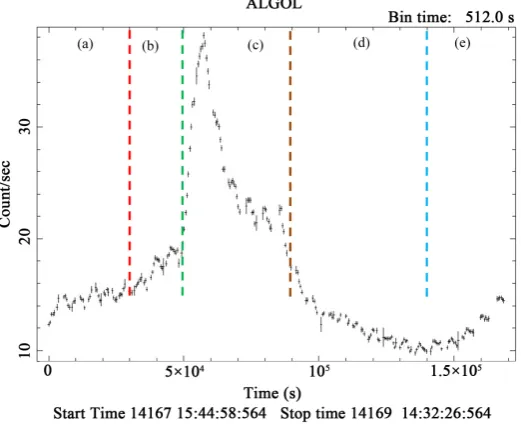
[image:3.595.245.506.495.707.2]The Suzaku off-line standard version 2.0 software and tools provided in High Energy Astrophysical Software (HEASoft; FTOOLS) version 6.10 software, which run on LINUX. XSELECT and XSPEC software packages which are part of the HEASoft were used. The work directory was prepared and the source’s flux was launched into. The XSELECT was used to extract the Algol’s spectrum and background spectrum from a circular region of 180 and 100 arc-second ra-dius respectively. A proactive measure was taken during extraction to eliminated X-ray contamination of the apparent (Perseus cluster) and other nearby sources’ effect. We also ensured that the circular region of 180 arc-second radius covers about 90% of the Algol’s flux, and the background extraction was done within the proximity of the Algol’s flux. Each extracted spectrum was saved respective-ly. The background spectrum was subtracted from the Algol’s spectrum, and thereafter, the light curve was generated (see Figure 1). The Flexible Image
DOI: 10.4236/jhepgc.2019.54061 1093 Journal of High Energy Physics, Gravitation and Cosmology
Transport System Tools (FTOOLS), X-ray imaging spectrometer response ma-trix file generator (xisrmf-gene) and X-ray imaging spectrometer Ancillary re-sponse matrix file generator (xissamrf-gene) were used to create the Redistribu-tion Matrix File (RMF), and Ancillary Response File (ARF) for the X-ray imag-ing spectrometer sensors (XIS; 0, 1, and 3) respectively. The X-ray imagimag-ing spec-trometer sensor 2 has been inactive long ago (see reference therein). We referred XIS1 spectrum as XIS back-illuminated (BI) spectrum. The spectral data of XIS 0, and XIS 3 was merged and we referred it as XIS front illuminated (FI) spec-trum. The XIS BI spectrum and XIS FI spectrum analysis were performed using XSPEC version 12.8. Each XIS BI and XIS FI spectrum was modeled using ther-mal bremsstrahlung model with a Gaussian line.
[image:4.595.260.486.341.510.2]3. Results
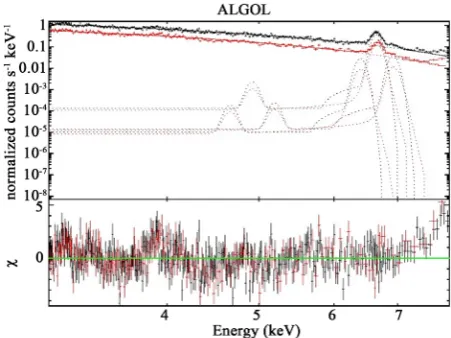
Figure 1 shows the background subtracted X-ray light-curve of the Algol stellar flare. Figure 2 shows the spectra of XIS FI and XIS BI sensors. The peak of XIS FI and XIS BI spectra corresponds to the strong fixed energy at 6.7 keV line emission. Table 1 shows the spectral parameters of the data fitted.
Figure 2. Spectrum of Algol. In the upper panel, the fitted data and the best-fit model are
[image:4.595.209.541.611.701.2]shown by crosses and solid lines respectively. The XIS BI spectrum is the red color while the XIS FI spectrum is the black color. The peak of both spectra shows a strong fixed energy at 6.7 keV line. The cross lines in the lower panel show the ratio of the data to the best-fit model.
Table 1. Algol spectral parameters.
Spectral Parameter Value Unit
E6.7 6.65 ± 0.01 keV
EW6.7 511.00 ± 0.50 eV
Fcount (0.175 ± 0.005) × 10−3 Photons s−1∙cm−2
KT 3.60 ± 0.15 keV
d.o.f 235 -
Rχ2 1.37 -
E6.7 = peak energy of the 6.7 keV, EW6.7 = equivalent width of 6.7 keV line emission, KT = continuum
tem-perature (energy), d.o.f. = degrees of freedom, (Rχ2) = Reduced Chi Squared value, F
DOI: 10.4236/jhepgc.2019.54061 1094 Journal of High Energy Physics, Gravitation and Cosmology
4. Discussion of Results
The X-ray light-curve of the Algol shows a long duration sporadic activity with the typical signature of two-ribbon stellar flare type that obeys exponential decay curve. The magnetic field structure of this stellar flare type is about 104 - 105 km
with complex loop arcades and inter-binary loops [20]. The geometry of X-ray light curve of Algol revealed the starspot evolution during activity-cycle. The X-ray light curve of Algol (Figure 1) shows that at time interval between 0 - 30 kiloseconds, uniform brightness of stellar flare was observed and this corres-ponds to the quiescent phase (region a). The stellar flares brightness rises at an interval of 31 to 49 kiloseconds (region b). The rapid rise in the brightness was observed at the interval of 50 kiloseconds, and the stellar flare attains its peak at 60 kilo seconds. These phases correspond to when X-ray emission from K-star was not eclipsed by its companion. The brightness decreases rapidly at an inter-val of 61 to 90 kiloseconds (region c). Thereafter, the brightness decays gradually between the intervals of 91 - 140 kilo seconds as B-star occults the X-ray emis-sion from its companion (region d). The stellar flares start to rise again at 141 kilo seconds for another activity-cycle as the component stars rotate rapidly (re-gion d). Therefore, the variations of stellar flare brightness at different interval (epoch) are due to variation in stellar spot during rapid rotation of the compo-nent stars. The X-ray emission from Algol is due to magnetic activities and mass transfer/Roche Lobe overflow mechanism. The 6.7 keV line emission is pro-duced in the Algol’s corona by photo ionization/collisional excitation processes. The Bremsstrahlung model with a Gaussian line for the 6.7 keV line emission gave a good statistical fits and spectral parameter as shown in Table 1. The error in each parameter is estimated at the 90% confidence ranges. The peak of the XIS FI and XIS BI spectra in Figure 2 represents the strong 6.7 keV line emis-sion. We resolved 6.7 keV line emission during the flare epoch of Algol that is similar to the results of previous spectroscopic studies on Algol [3][4][14][27], but our results show a vivid and clear resolution of 6.7 keV line emission. The 6.7 keV line emission is an indicator of chromospheric activity, and the Algol’s energy spectrum is similar to the hard energy spectra of point sources observed in the galactic plane and/or ridge [34] [35] [36] [37]. We obtained equivalent width (EW) of 511 eV of this 6.7 keV line emission which previous research work on Algol [4][14][27] was unable to obtain.
5. Conclusion
activi-DOI: 10.4236/jhepgc.2019.54061 1095 Journal of High Energy Physics, Gravitation and Cosmology
ties. The 6.7 keV line emission resolved during the flare epoch suggests that Al-gol is among the Galactic X-ray point sources with strong convective envelope, and high intense chromospheric stellar activity. We are of the view that collec-tion of binary systems like Algol, X-ray flaring stars and chromospherically tive binaries (e.g. GT Muscae, Sigma Gem, Sigma CRB, BY Dra, etc.) could ac-count for a large number of galactic fast-transient X-ray sources, and these co-ronally active binaries could be among the probable sources of 6.7 keV line emission in the galactic ridge.
Acknowledgements
The authors acknowledge the Suzaku team for providing data and any relevant files used in the analysis presented here. This research made use of data obtained from Data Archives and Transmission System (DARTS), provided by Center for Science-satellite Operation and Data Archives (C-SODA) at ISAS/JAXA.
Conflicts of Interest
The authors declare no conflicts of interest regarding the publication of this pa-per.
References
[1] Mullan, D.F. (1976) Flare Stars I, Physical Characteristics of the Stars. The Irish As-tronomical Journal, 12, 161-182.
[2] Pettersen, B.R. (1989) A Review of Stellar Flares and Their Characteristics. Solar Physics, 121, 299-312.https://doi.org/10.1007/978-94-009-1017-1_20
[3] Stern, R., Uchida, Y., Tsuneta, S. and Nagase, F. (1992) GINGA Observation of X-Ray Flares on Algol. The Astrophysical Journal, 400, 321-329.
https://doi.org/10.1086/171998
[4] Favata, F. and Schmitt, J.H.M.M. (1999) Spectroscopic Analysis of a Super-Hot Giant Flare Observed on Algol by BeppoSAX on 30 August 1997. Astronomy & As-trophysics, 350, 900-916.
[5] Drake, J.J. (2003) Chemical Fractionation and Abundances in Coronal Plasma. Ad-vances in Space Research, 32, 945-954.
https://doi.org/10.1016/S0273-1177(03)00296-5
[6] Nordon, R. and Behar, E. (2007) Six Large Coronal X-Ray Flares Observed with Chandra. Astronomy & Astrophysics, 464, 309-321.
https://doi.org/10.1051/0004-6361:20066449
[7] Pye, J.P., Rosen, S., Fyfe, D. and Schröder, A.C. (2015) A Survey of Stellar X-Ray Flares from the XMM-Newton Serendipitous Source Catalogue: Hipparcos-Tycho Cool Stars. Astronomy & Astrophysics, 581, A28.
https://doi.org/10.1051/0004-6361/201526217
[8] Singh, K.P., Drake, S.A. and White, N.E. (1996) RS CVn versus Algol-Type Binaries: A Comparative Study of Their X-Ray Emission. The Astronomical Journal, 111, 2415.https://doi.org/10.1086/117975
DOI: 10.4236/jhepgc.2019.54061 1096 Journal of High Energy Physics, Gravitation and Cosmology [10] Schnopper, H., Delvaille, J.P., Epstein, A., Helmken, H. and Murray, S. (1976)
De-tection of X-Rays from Algol (β Persei). The Astrophysical Journal, 210, 75-77.
https://doi.org/10.1086/182307
[11] Harnden, F., Fabricant, D., Topka, K., Flannery, B., Tucker, W. and Gorenstein, P. (1977) A Soft X-Ray Image of the Algol Region. The Astrophysical Journal, 214, 418-422.https://doi.org/10.1086/155266
[12] Pallavicini, R., Golub, L., Rosner, R., Vaiana, G.S., Ayres, T. and Linsky, J.L. (1981) Relations among Stellar X-Ray Emission Observed from Einstein, Stellar Rotation and Bolometric Luminosity. Astrophysical Journal, 248, 279-290.
https://doi.org/10.1086/159152
[13] Simon, T. and Drake, S.A. (1989) Element Abundances in Stellar Coronae. The As-trophysical Journal, 346, 303.
[14] Yang, X., Lu, F., Aschenbach, B. and Chen, L. (2011) XMM-Newton Observation of the Eclipsing Binary Algol. Research in Astronomy and Astrophysics, 11, 457-470.
https://doi.org/10.1088/1674-4527/11/4/008
[15] Ottmann, R. and Schmitt, J.H.M.M. (1996) ROSAT Observation of a Giant X-Ray Flare on Algol: Evidence of Abundance Variation? Astronomy & Astrophysics, 307, 813-823.
[16] Chung, S.M., Drake, J.J., Kashayap, V.L., Lin, L.W. and Ratzlaff, P.W. (2004) Dopp-ler Shifts and Broadening and the Structure of the X-Ray Emission from Algol. The Astrophysical Journal, 606, 1184.https://doi.org/10.1086/383195
[17] White, N., Holt, S., Becker, R., et al. (1980) X-Ray Observations of Algol. The As-trophysical Journal, 239, 69-71.https://doi.org/10.1086/183294
[18] Garcia, M., Baliunas, S.L., Conroy, M., Johnston, M.D., Ralph, E., Roberts, W., Schwartz, D.A. and Tonry, J. (1980) Optical Identification of H0123+075 and 4u 1137-65: Hard X-Ray Emission from Rs Canum Venaticorum Systems. The Astro-physical Journal, 240, L107-L110.https://doi.org/10.1086/183334
[19] Drake, J.J. (2003) From the Heart of the Ghoul: C and N Abundances in the Corona of Algol B. The Astrophysical Journal, 594, 496-509.https://doi.org/10.1086/375837 [20] Van den Oord, G. and Mewe, R. (1989) The X-Ray Flare and the Quiescent
Emis-sion from Algol as Detected by EXOSAT. Astronomy & Astrophysics, 213, 245-260. [21] Favata, F. and Micela, G. (2003) Stellar Coronal Astronomy. Space Science Reviews,
108, 577-708.https://doi.org/10.1023/B:SPAC.0000007491.80144.21
[22] Balona, L.A. (2013) Activity in A-Type Stars. Monthly Notices of the Royal Astro-nomical Society, 431, 2240-2252.https://doi.org/10.1093/mnras/stt322
[23] Berghofer, T.W., Schmitt, J.H.M.M., Danner, R. and Cassinelli, J.P. (1997) X-Ray Properties of Bright OB-Type Stars Detected in the ROSAT All-Sky Survey. As-tronomy & Astrophysics,322, 167-174.
[24] Schmitt, J.H.M.M. and Favata, F. (1999) Continuous Heating of Giant X-Ray Flare on Algol. Nature, 401, 44-46.https://doi.org/10.1038/43389
[25] Schmitt, J.H.M.M., Ness, J.-U. and Franco, G. (2003) A Spatially Resolved Limb Flare on Algol B Observed with XMM-Newton. Astronomy & Astrophysics, 412, 849-855.https://doi.org/10.1051/0004-6361:20034057
[26] Gudel, M. (2004) X-Ray Astronomy of Stellar Coronae. Astronomy & Astrophysics Review, 12, 71-237.https://doi.org/10.1007/s00159-004-0023-2
[27] Antunes, A., Nagase, F. and White, N.E. (1994) ASCA Observations of the Coronal X-Ray Emission of Algol. The Astrophysical Journal, 436, 83-86.
DOI: 10.4236/jhepgc.2019.54061 1097 Journal of High Energy Physics, Gravitation and Cosmology [28] Warwick, R.S. (2014) Low-Luminosity X-Ray Sources and the Galactic Ridge X-Ray
Emission. Monthly Notice of the Royal Astronomical Society, 445, 66-80.
https://doi.org/10.1093/mnras/stu1748
[29] Eze, R.N.C. (2014) Fe Kα-Line in Hard X-Ray Emitting Symbiotic Stars. Monthly Notice of the Royal Astronomy Society, 437, 857.
https://doi.org/10.1093/mnras/stt1947
[30] Esaenwi, S. and Eze, R.N.C. (2014) On the Origin of the Fe Kα Emission Line from Intermediate Polar EX Hyrae. New Astronomy, 35, 84-87.
https://doi.org/10.1016/j.newast.2014.09.009
[31] Eze, R.N.C. (2015) Suzaku Observations of Fe Kα Line in Some Magnetic Cataclys-mic Variables. New Astronomy, 37, 35-41.
https://doi.org/10.1016/j.newast.2014.11.006
[32] Koyama, K., Tsunemi, H., Dotani, T., et al. (2007) X-Ray Imaging Spectrometer (XIS) on Board Suzaku. Publication of the Astronomical Society of Japan, 59, 23-33. [33] Serlemitsos, P., Soong, Y., Chan, K., et al. (2007) The X-Ray Telescope on Board
Suzaku. Publication of the Astronomical Society of Japan, 59, 9-21.
https://doi.org/10.1093/pasj/59.sp1.S9
[34] Revnivtsev, M., Sazonov, S., Churazov, E., Forman, W., Vikhlinin, A. and Sunyaev, R. (2009) Discrete Sources as the Origin of the Galactic X-Ray Ridge Emission. Na-ture, 458, 1142-1144.https://doi.org/10.1038/nature07946
[35] Matsuoka, M., Sugizaku, M., Tsuboi, Y., et al. (2011) A Contribution of Stellar Flares to the GRXE-Based on MAXI Observation. NARIT Conference Series, 1, 246-249.https://doi.org/10.1063/1.3696210
[36] Morihana, K., Tsujimoto, M., Yoshida, T. and Ebisawa, K. (2013) X-Ray Point Source Populations Constituting the Galactic Ridge X-Ray Emission. The Astro-physical Journal, 766, 14.https://doi.org/10.1088/0004-637X/766/1/14