Architecture Design of an Integrated
Communication and Broadcasting Network
Weidong Liu, Jiang Wu, Hong Shen
Tsinghua National Laboratory for Information Science and Technology, Department of Computer Science and Technology, Tsinghua University, Beijing, China
E-mail: [email protected]
Received September 17, 2010; revised September 25, 2010; accepted September 26, 2010
Abstract
Due to the power limitation of nodes in wire-less sensor networks (WSNs), how to maximize network life-time has become a critical issue for deployment of WSNs. Although several schemes have been proposed for 2D WSNs, few for 3D WSNs are known. In this paper, we present a scheme to maximize network lifetime for 3D WSNs through balancing energy consumption, as an extension of the existing scheme for 2D WSNs proposed recently [1]. Same as [1], we formulate the energy consumption balancing problem as an problem of optimal distribution of transmitting data by combining the techniques of sphere-corona based network di-vision, mixed-routing and data aggregation. We first present a Tiled-block based routing scheme in order to balance energy consumption among nodes in each sphere-corona. Then we design an algorithm to compute the optimal distribution ratio of transmitting data between direct and hop-by-hop transmission, with the pur-pose of balancing energy consumption among nodes across different sphere-coronas. We show maximizing network lifetime through computing the optimal number of sphere-coronas. Afterwards a energy consump-tion balanced data collecting protocol (ECBDC) is designed and a soluconsump-tion to extend ECBDC to largescale WSNs is also presented. Simulaiton results show that ECBDC is superior to conventional direct and multi-hop transmission schemes in network lifetime.
Keywords:Wireless Sensor Networks, 3D, Network Lifetime, Energy Balancing
1. Introduction
Wireless sensor networks (WSNs) have been widely used in various applications, such as environmental and industrial monitoring [2]. The ability to withstand harsh environmental conditions and to run without manual in-tervention is the most attractive feature for users.
The greatest difficulty for WSNs applications proba-bly is hardware constraints: limitation in power, insuffi-cient in computational capacity, and shortage in memory [3]. The limitation of energy supply directly influences thelifetime of network which is the critical problem for WSNs. How to reduce energy consumption to prolong network lifetime remains a key issue for WNSs. There have been rich literatures discussing this issue and nu-merous schemes have been proposed. Geographical adaptive fidelity (GAF) algorithm [4] conserves energy by identifying nodes that are equivalent from a routing perspective and then turning off unnecessary nodes, keeping a constant level of routing fidelity. In [5-12],
minimum energy routing problems have been addressed, in order to prolong network lifetime. The approach in those works is to minimize the total energy consumed to reach the sink node, which minimizes the energy con-sumed by each packet or data flow.
Basically, energy consumption in sensor nodes is di-vided in three fields: sensing, communicating (transmit-ting data and receiving data) and data processing [13]. But it is necessary to notice that, in WSNs, to transmit one bit data at short range consumes much more energy than to process it [14]. Thus, most algorithms designed for WSNs aims to reduce communication cost of whole network, which can prolong network lifetime. Many oth-er ideas are also attractive to maximize network lifetime. Three common approaches are effective to achieve maxi- mization of system lifetime: mix-routing [15-18], net-work partition [1] and data aggregation [19-24].
while transmitting data to next hop node in hop-by-hop mode. Energy consumption balance may be achieved if node chooses an appropriate data allocation in these two transmission modes, and then maximization of network lifetime could be achieved accordingly.
Network partition has great influence on network life-time. A good dividing method may reduce the amount of data transmitted, save energy of sensor nodes, and then prolong the system lifetime. Slice-based partition and corona-based partition are two common methods for network partition. Slice-based partition divide circular network into slices. And Corona-based partition method divides circular network area into coronas centred with sink node with different radius.
Data aggregation is a useful technique to eliminate redundant data of network. Nodes in small area are close to each other and may generate redundant sensing data in WSNs like temperature monitoring WSNs. In data ag- gregation a node may pack its input data into a different size outputted, reduce unnecessary data transmission and save energy, which extends the lifetime of network.
For common situations, WSNs are mainly used in a two dimensional environment. Recently there are emer- ging applications deploying WSNs in a three dimension-al environment, such as marine environment monitoring and safety monitoring for coal mine that have attracted interesting attention. Compared to 2D deployment, due to the sufficient increase in the number of sensor nodes within the coverage of WSNs in a 3D deployment, the limit in power storage and supply remains even more severe for WSNs in 3D applications. In this paper, we present a method to maximize network lifetime by ba-lancing the energy consumption at all nodes for 3D WSNs deployment. The main contributions of this paper can be summarized as follows:
• Similar to the zone based routing scheme in [1], we propose a routing scheme called tiled-block routing for 3D environment. Our work is inspired and extends the solution of [1] from 2D to 3D.
• Using a method similar to corona-partition, we pro-pose a decomposing method that decompro-poses a 3D mon-itoring sphere space into sphere-coronas, and then break energy consumption balance down to two levels: intra sphere-corona and inter sphere-corona.
• We propose a scheme to achieve intra energy con-sumption balance, through partitioning each sphere co-rona into a set of sphere subcoco-ronas, such that data transmission takes place only between two sphere sub-coronas that have the same relative positions in two neighbouring sphere-coronas.
• We propose a scheme to achieve inter energy con-sumption balance, by computing a proper data distribu-tion ratio for each sphere-corona between direct and hop-by-hop transmission.
• We show that maximizing network lifetime can be achieved through setting an optimal number of sphere-coronas and that of sphere subcoronas within each corona.
This paper is organized as follows: Section 2 presents the system model and the statement of problems. Sec-tions 3 and 4 give the soluSec-tions for the intra sphere coro-na energy balance problem and inter sphere-corocoro-na energy balance problem. Section 5 solves the maximiz-ing network lifetime problem. Section 6 presents a pro-tocol called ECBDC and Section 7 give the solutions to extend ECBDC to large-scale sensor network. In Section 8, the ECBDC is evaluated through simulation and com-pared to other protocols. And the conclusion of this pa-per is given in Section 9.
2. System Models and Problem Statement
2.1. Network Model
We assume that all sensor nodes are distributed in a sphere space S of radius R, in which the node distribu-tion density is ρ. There is only one sink node that is lo-cated at the core of S. All nodes have the same maximum range of transmission Tmax that is larger than R and the
same amount of initial energy. Every node knows its geographic location.
The data operation is divided into T rounds. In one word, nodes receive data and generate data then transmit it in one round. In the gap of two adjacent rounds, nodes turn off its radio to save the energy.
2.2. Data Aggregation Model
We use a function [25] to illustrate the data aggregation model:
x mx c (1)
where φ(x) is the amount of data output, x is the
amount of data received, m is the aggregation propor-tion and c is a const that depends on specific situapropor-tion:
• If m = 0 and c > 0, the amount of data that will be transmitted in one node in one round is small so that it can be put in a single packet.
• If m = 1 and c = 0, in this case, the node does not perform any data aggregation.
• If 0 < m < 1 and c = 0, the node compresses the data output by a factor of m.
2.3. Energy Model
The energy consumption function is given below:
kelec amp
x x
where xk is the total energy consumption of transmit-ting one bit over distance x, elec is the energy
con-sumed by transmitter electronics, and amp is the
transmitting amplifier and k k
2
is the propaga-tion loss exponent.When the node is receiving data, only the receiving circuit is used, for the energy consumption for receiving one bit by one node is relec
In this paper, we ignore the energy consumed by ge-nerating data for nodes, which is small compared with energy consumption for transmission and reception.
2.4. Problem Statement
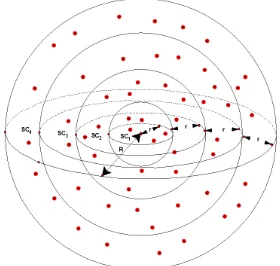
As shown in Figure 1, the monitoring 3D sphere space is
divided into n concentric sphere-coronas
SC SC1,SC2,n
SC with the same width r r
R n
. Similar to 2Dscheme, each node has two ways to transmit its data: directly to the sink and hop-by-hop to a node in the neighbor sphere-corona which is nearer to the sink. Ba-lanced energy consumption can be achieved by allocat-ing data in these two ways.
Definition 1: The data distribution ratio of node u, which is denoted by p(u), is defined as the ratio of the amount of data transmitted in direct mode to the amount of data transmitted in hop-by-hop mode:
D u
P uF u D u
(3)
Let T be the total number of rounds during the whole network lifetime, and l be the number of bits of data generated by one node in one round. D u
denotes the amount of data transmitted in direct mode in T rounds,andF u
denotes the amount of data transmitted inhop-by-hop mode. To solve this problem, we should firstly solve the following sub-problems:
• How to achieve energy consumption balance among nodes within each sphere-corona?
[image:3.595.102.242.566.699.2]• How to achieve energy consumption balance among
Figure 1. Illustration of network division (n = 4).
nodes in different sphere-coronas?
• How to get the optimal number of sphere-coronas n in order to maximizing the network lifetime?
We will address these issues in the subsequent sections respectively.
3. Intra Sphere-Corona Energy
Consumption Balancing
This section focuses on solving the sub-problem of energy consumption balancing (ECB) among nodes within each sphere-corona.
3.1. Sufficient and Necessary Condition for Intra Sphere-Corona ECB
Firstly, we give the energy consumption function based on the energy model in Subsection 2.3:
u F u
t
r D
u t
ir S u
t (4)
where
u is the total amount of energy consumed by node u in T rounds, and S u
denotes the amount of data received by node u in T rounds. Then
t
F u r is the amount of energy consumed by
node u when transmitting data in hop-by-hop mode in T rounds, D
u t
ir is the amount of energycon-sumed by node u when transmitting data in direct mode
in T rounds, and S u
is the amount of energyconsumed by node u when receiving data in T rounds.
Lemma 1: [1] u , vCi F u
F v
and
D u D v if and only if S u
S v
.Theorem 1: [1] Energy consumption is balanced
among nodes within in SCi if the amount of data
re-ceived by nodes in SCi is balanced. Lemma 2:
2 2 1
1 3 3
1 3 3
i i
s i i
f i i
1 i n
Proof: Let
i c
N and Nci1 be the number of nodes in
i
SC and SCi1, thus
3
3 3 3
2
4 4 1 4 1 3 3
4 3 3
ci
N ir i r r i i
3 3 3 3 3
2
1
4 4 4
1 1 3 3
3 3 3
ci
N i r i r r i i
1 1
i
c i ci i
N s N f
,
2 2 1
1 3 3
1 3 3
i i
s i i
f i i
3.2. Tiled-block Based Routing Scheme
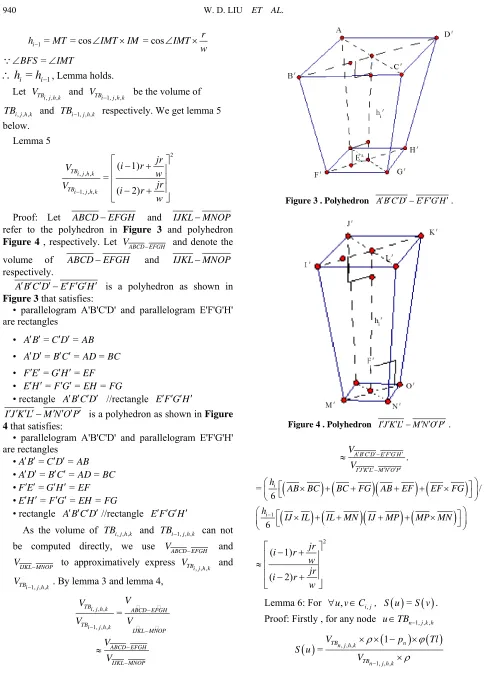
The basic idea of the Tiled-block (TB) is illustrated as follows: As shown in Figure 2, each sphere-corona is
divided into sphere subcoronas with equal width
r w, then the spherical surface of each sphere subcorona is divided with latitudes of number La and then longi- tudes of number L O , with La and L O defined by users. Moreover, the Lo longitudes divide the spherical
surface into L O same cambered surfaces with equal
radian and equal width , and La latitudes divide each longitude into La1 equilength arcs. Nodes in sphere subcorona SCi use two tuples to express their Tiled-block ID
e g h k, ,
. Index h locates nodes inlatitudinal direction and index
locates nodes in lon-gitudinal direction.For any node u,
u, u, u
denotes the threedimen-sional polar coordinates of u, and TBi j h k, , , denotes the tiled
block
h k, inSCi j, , hi and hi1 denote the distancebetween plane ABCD and plane EFGH and the distance
[image:4.595.92.262.372.701.2]between plane IJKL and plane MNOP respectively.
Figure 2. TBi1, , ,j h kandTBi j h k, , , in a sphere space.
Lemma 3:
1
2
jr i r
BC AB w
jr
IL IJ i r
w
Proof: As shown in Figure 2, let BC be the radian
of BC, RBC be the radius of spherical surface which BCbelongs to, and BCbe the length of line whose two
endpoints are nodes B and C. Obviously, ADBC,
because AD and BC belong to the same spherical
surface and the length of arc AD equals to the length
of arc BC . With the same reason, EH FG ,
JKIL, OPMN
= ,
2 sin R
2
=2 sin 1
2
BC IL AB IJ
BC BC
BC
BC
jr i r
w
2 sin R
2
=2 sin 2
2
1
2 IL
IL
IL
IL
jr
i r
w jr
i r
BC w
jr
IL i r
w
2 sin R
2
=2 sin 1
2
AB AB
AB
AB
jr
i r
w
2 sin R
2 IJ
IJ
IJ
=2 sin 2
2
IJ i r jr
w
1
2 jr
i r
AB w BC
jr
IJ i r IL
w
Lemma 4
1
= 2
i i
h h i n
Proof: As shown in Figure 2,
= = cos = cos
i
r
h FS BFS BF BFS
w
1= = cos = cos
i
r
h MT IMT IM IMT
w
=
BFS IMT
1
=
h
ih
i , Lemma holds.Let VTBi j h k, , , and TBi 1, , ,
j h k
V be the volume of
, , ,
i j h k
TB and TBi1, , ,j h k respectively. We get lemma 5 below.
Lemma 5
2
, , ,
1, , ,
( 1) =
( 2)
TBi j h k
TBi j h k
jr i r V
w jr
V i r
w
Proof: Let ABCDEFGH and IJKLMNOP
refer to the polyhedron in Figure 3 and polyhedron
Figure 4 , respectively. Let VABCD EFGH and denote the
volume of ABCDEFGH and IJKLMNOP
respectively.
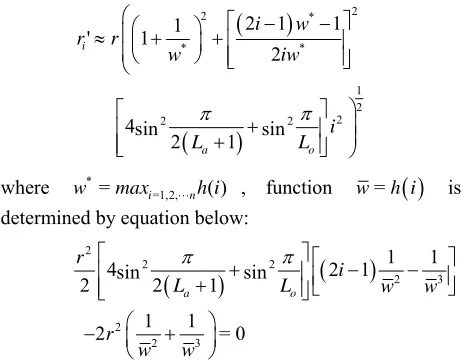
[image:5.595.54.540.52.737.2] [image:5.595.59.285.68.376.2] [image:5.595.340.508.74.233.2]A B C D E F G H is a polyhedron as shown in Figure 3 that satisfies:
• parallelogram A'B'C'D' and parallelogram E'F'G'H' are rectangles
• A B =C D = AB
• A D =B C =AD=BC
• F E =G H =EF
• E H =F G =EH=FG
• rectangle A B C D //rectangle E F G H
I J K L M N O P is a polyhedron as shown in Figure 4 that satisfies:
• parallelogram A'B'C'D' and parallelogram E'F'G'H' are rectangles
•A B =C D =AB
•A D =B C = AD=BC
•F E =G H =EF
•E H =F G =EH =FG
• rectangle A B C D //rectangle E F G H
As the volume of TBi j h k, , , and TBi1, , ,j h k can not
be computed directly, we use VABCD EFGH and
IJKL MNOP
V to approximatively express VTBi j h k, , , and
1, , ,
TBi j h k
V . By lemma 3 and lemma 4,
, , ,
1, , ,
=
TBi j h k ABCD EFGH
TBi j h k
IJKL MNOP
V V
V V
ABCD EFGH
IJKL MNOP V
V
Figure 3 . Polyhedron A B C D E F G H .
Figure 4 . Polyhedron I J K L M N O P .
A B C D E F G H .
I J K L M N O P V
V
1
= /
6
6
i
i
h
AB BC BC FG AB EF EF FG
h
IJ IL IL MN IJ MP MP MN
2
( 1)
( 2)
jr i r
w jr i r
w
Lemma 6: For u v, Ci j, , S u
=S v
. Proof: Firstly , for any node uTBn1, , ,j k h
, , ,
1, , ,
1 = TBn j h k n
TBn j h k
V p Tl
S u
V
, , ,
1, , ,
= TBn j h k 1 n
TBn j h k
V
p Tl
V
By lemma 5
( 1) ( ) = ( 2) jr n r w S u jr n r w ,
we can see that S u
is a function of variable j, pn,w, which are the same to for nodes in TBn1, , ,j h k. Besides, n, T and l are constants. Therefore, for any nodes u, v, S u( ) = ( )S v . Secondly, suppose that
the amount of data received by any node in SCi is
balanced. For any node uTBi1, , ,j h k,
, , ,
,
1, , ,1
= TBi j h k i i j
TBi j h k
V p Tl S
S u V
, , , , 1, , ,= TBi j h k 1 i i j
TBi j h k V
p Tl S
V
2 , 1 = 12 i i j
j
i r
rw p Tl S
j i r rw
So, the amount of data received by nodes in SCi1,j is balanced.
Theorem 2 The amount of data received by nodes in
i
SC is balanced in Tiled-block based on routing scheme if
3 2 2 2 33
, 2 2 3
1 3 3 3 3
= 1
1 3 i j
i i i j ij j
r r i
w
i si w w
Proof: By lemma 2,
2
1,1 1,2 1,
2
,1 ,2 ,
1 3 3
= = = =
1 3 3
Ci Ci Ci w
Ci Ci Ci w
V V V i i
V V V i i
3 3 =1 1, 3 3 3=1 , ,
4 4
3 3
=
4 4 1
3 3
j C k i k
j C
k i k i j
jr
ir ir
V w
V r i r
2 21 3 3
=
1 3 3
i i i i
3 2 2 2 33
, 2 2 3
1 3 3 3 3
= 1
1 3 i j
i i i j ij j r r i
w
i si w w
4. Inter Sphere-Corona Energy Consump-
tion Balancing
This section focus on solving the sub-problem of balancing energy consumption among nodes in different sphere-coronas.
4.1. Hop-by-Hop Transmission Distance
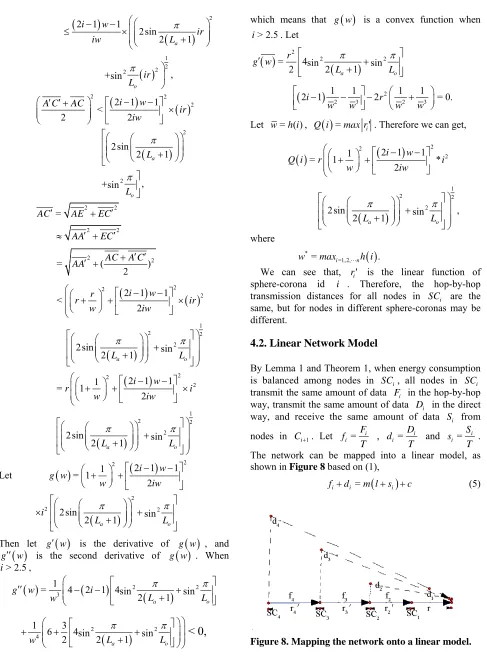
In this section, we compute the hop-by-hop transmission distance 'ri for each sphere-corona SCi.
Theorem 3: Let *
w be the optimal number of sphere
subcoronas for maximizing ri, then,
22 *
* *
2 1 1
1 ' 1 2 i i w r r w iw
1 2 2 2 2 4sin sin2 La 1 Lo i
where *
=1,2,
= i n ( )
w max h i , function w=h i
isdetermined by equation below:
2
2 2
2 3
1 1
4sin sin 2 1
2 2 a 1 o
r
i
L L w w
2 2 3 1 1
2r = 0
w w
Proof: All nodes in SCi have the same hop-by-hop
transmission distance ri. We assume that point Y and
point Z are two points located in the same sphere
subcorona and keep the same distance to sink. Obviously, these two points are located on the same spherical surface centered at the sink. Then let YZ be the radian of YZ , and
YZ
R be the radius of spherical surface to
which YZ belongs.
As shown in Figure 5, obviously the hop-by-hop
transmission distance ri= AC , now we are going to compute the length of AC.What shown in Figure6 is
the top view of tiled-block TBi j h k, , , , and the profile of
arc BC in Figure 7. Point
O
in (b) denotes the sink, which is the core of the sphere space. We can get,= 2sin 2 DC
DC
DC R
= 2sin
2 a 1
OC L
= 2sin 1
2 a 1
[image:6.595.308.539.241.421.2]= BC
R BN
= sinBMO BM
= 2sin 2
BOM
sin 1
2 BMO
i r fjrw
= 1
1 a
pi
BMO h
L
1
= 2sin 12 sin( 1
1
BC
a
h
R f f h
L
2 a 1 1
jr
L i r
w
1
1
= cos sin
2 a 1 2 a 1
h h
L L
1
jr
i r
w
[image:7.595.69.264.52.703.2]
Figure 5. Illustration of the range of ri'.
Figure 6. The cross section of TBi j h k, , , .
In the same way, we can also get AD:
= 2sin cos sin 1 .
2 1 2 1
o a a
h h jr
AD i r
L L L w
2 2
=
AC CH AH
2
= DC AD BC
2 2
= 2sin 1 sin
2 a 1 o
jr
i r
L w L
12
2 1
1 sin sin
1 1
a a
h
jr h
i r
w L L
1 2
= ,
1
j r
i r
A C OA w
jr
AC OA i r
w
1 2
1 1
j r
i r
w
A C AC AC
jr
i r
w
2 3 2 1
< 2sin
1 2 a 1
i w j
i w j L
1
2 2 2
2
1 sin 1
o
jr jr
i r i r
w L w
[image:7.595.103.527.66.709.2]
2
2 1 1
2sin
2 a 1
i w ir iw L
1 2 2 2 , sin o ir L
2 2 22 1 1
<
2 2
i w
A C AC
ir iw
2 2sin2 La 1
2 , sin o L 2 2 =
AC AE EC
2 2
AA EC
2 2
= ( )
2
AC A C
AA
2
2
2
2 1 1
< 2 i w r r ir w iw
1 2 2 2 2sin sin2 La 1 Lo
22
2
2 1 1
1 = 1 2 i w r i w iw
1 2 2 2 2sin sin2 La 1 Lo
Let
2
2 2 1 1
1 = 1 2 i w g w w iw
22 2sin sin2
2 a 1 o
i L L
Then let g w
is the derivative of g w
, and
g w is the second derivative of g w
. When> 2.5
i ,
2
23
1
= 4 2 1 4sin 2 1 sin
a o
g w i
L L w
2 2 4 1 36 4sin sin
2 2 La 1 Lo
w
<
0,
which means that g w
is a convex function when> 2.5
i . Let
= 2 4sin2
sin22 2 a 1 o
r g w L L
22 3 2 3
1 1 1 1
2 1i 2r
w w w w
= 0.
Let w= ( )h i , Q i
=max ri'. Therefore we can get,
= 1 1 2
2 1
1 2* 22
i w
Q i r i
w iw
1 2 2 22sin sin ,
2 La 1 Lo
where
* =1,2,= i n .
w max h i
We can see that, 'ri is the linear function of
sphere-corona id i . Therefore, the hop-by-hop
transmission distances for all nodes in SCi are the
same, but for nodes in different sphere-coronas may be different.
4.2. Linear Network Model
By Lemma 1 and Theorem 1, when energy consumption
is balanced among nodes in SCi, all nodes in SCi
transmit the same amount of data Fi in the hop-by-hop
way, transmit the same amount of data Di in the direct
way, and receive the same amount of data Si from
nodes in Ci1. Let =
i i
F f
T , =
i i
D d
T and =
i i
S s
T .
The network can be mapped into a linear model, as shown in Figure 8 based on (1),
=
i i i
[image:8.595.58.545.67.738.2]f d m ls c (5)
By (3),
= i = i = i
i
i i i i i i
D d d
p
F D f d m f d c (6)
Let = i
i
E e
T . By (4),
= '
i i t i i t i elec
e f r d ir s (7)
So, the Inter sphere-corona energy consumption balanc- ing problem can be formulated as the following problem of distribution of data transmission:
1 2 1
1
. . = = = = = = .
i
i n n
Compute p i n
s t e e e e e
(8)
4.3. Optimal Data Distribution Ratio Allocation
Since energy consumption balance may be achived by optimally distributing the amount of data in direct transmission and hop-by-hop transmission, we focus on computing the optimal data distrubition ratio for each sphere-corona.
Lemma 7:
1 1
220 ;
= 1 3 3
1 .
1 3 3
i
i i
i n
s i i
m s l c d i n
i i
Proof: If =i n, SCn is the outermost sphere-
corona. Since all nodes in
SC
n do not receive anydata ,
s
n= 0. If1
i
<
n
, by Lemma 2,2
1 2
1 3 3
=
1 3 3
i i
i i s f
i i
By (5), fi =m s
i l
c di. Therefore,
1 1
221 3 3
= .
1 3 3
i i i
i i
s m s l c d
i i
Lemma 8:
1
11
= ( 1 '
'
i i t t i
t t i
d d i r r
ir r
i1
t
i1' i i 1
elecm s l c r s s
i1
t
i'
m s l c r
where 2 i n.
Proof: When > 1i , all nodes have two ways to
transmit data: in hop-by-hop way and in direct way. Energy consumption balance can be achieved only when
1
=
i i
e e . Thus
1 1 1 1 1
i t i i t i elec
f r d i r s
= fit ri' di t ir si elec
1
1 1
fi t ri' fi t ri si si elec
1
=di t i1 r di t ir By (5),
1
11
= ( 1
'
i i i
t t i
d d i r r
ir r
i1
i1 i i1
elecm s l c r s s
i1
t
i'
m s l c r
Lemma 9
2 1 2 1
2
1 =
2 ' elec t
t t
d s s m s r
r r
2 t 2' t t 2'
s r ml c r r
Proof: Since all nodes in SC1 transmit their data only
in direct way, therefore,
1 = 1 t 1 elec e d r s
1
1=m s l c t r s elec By e1=e2,
1
t
1 elecm s l c r s
2 2 2 2
= f t r' d t 2r s elec
Therefore, the lemma holds.
From Lemma 7, si can be expressed by si1 and
1
i
d , from Lemma 8,
d
i can be expressed by 'ri , si,1
i
s and di1, from Lemma 9, d2 can be expressed by 2'
r , s1 and s2 . for all nodes in SCn , sn= 1.
Therefore, we can compute di and fi for nodes in
each SCi after a few iterations. The detailed algorithm is given below:
Algorithm 1: 1) For = 1i to n do
2) Compute 'ri
3) For =i n1 down to
2
do 4) Express si by dn5) Express di by dn 6) Express d2 by dn
7) Compute dn by making d2 in Lemma 8 equal to
2
d in Lemma 9
8) For
i
=
2
ton
do 9) Compute di ands
110)
= i
i i
d p
m s l c
We can see that, the complexity of this algorithm is
4.4. Numerical Results and Analysis
We have done numerical analysis , in order to understand how data compression ratio m influences the data transmission and reception. The system parameters are set as follows:
= 100
R , r= 10 , n= 10 , elec = 50nJ bit/ ,
= 100 /
amp pJ bit
[image:10.595.323.522.77.232.2] , and k= 2.
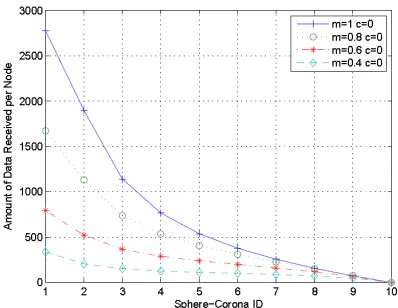
Figure 9 plots the amount of data received per node
with different sphere-coronas. We can see that, sensors near the sink node receive more data from hop-by-hop transmission than those far from the sink node. Especially, nodes in the outmost sphere-corona (id = 10) receive no data as no one transmits data to them. This showns our scheme results in a desirable data distribution to achieve energy consumption balance. And we can also see that, as the data compression ratio m sets smaller, the amount of data received per node in the network becomes also smaller. This phenomenon manifests that data aggregation can reduce data transmitted and hence save energy consumption for WSNs.
Figure 10 plots the ratios of data distribution in
different sphere-coronas. The data distribution ratio firstly decreases rapidly, then remains constant more or less in the middle sphere-coronas and finally increases in the last few sphere-coronas. This can be explained as that, energy consumption is proportional to the production of data volume and square of the transmission distance. To maintain a balanced energy consumption, nodes at the two ends have a higher distribution ratio because at the near end nodes have heavy relay burden, but at the far end it just goes to the opposite: long transmitting distance but small data volume. And in Figure 10, it is
[image:10.595.73.272.537.691.2]also easily see that data compression ratio(m) has great influence on the distribution ratios. When m decreases, data distribution ratio also decreases at a rate following lemmas 5-7.
Figure 9. Amount of data received per node for different sphere-coronas with different data aggregation ratios.
Figure 10. The data distribution ratio different sphere- coronas with different data aggregation parameters.
5. Network Lifetime Maximization
This section focused on solving the problem of maximizing network lifetime by achieving energy consumption balance among all nodes in the network. For nodes in the outmost sphere-corona SCn,
= *
n n t n n t e f r d nr
= k
n elec amp n
ml c d r
k
n elec amp
d R
When energy consumption balance is achieved, all nodes
have the same energy consumption equalength to
e
n.Thus, network lifetime maximization can be formulated as the following optimization problem:
;
. . = , 1 ,
= .
n
i j
min e
s t e e i j n
nr R
5.1. Optimal Number of Sphere Subcoronas
Given n sphere-coronas, pi and di can be
computed step by step using the algorithm above. By Theorem 3, the optimal number of sphere subcoronas w* can be obtained from:
*
=1,2, ,
= i n
w max h i
Where function w=h i
is determined by equationbelow:
2
2 2
2 3
1 1
4sin sin 2 1
2 2 a 1 o
r
i
L L w w
2
2 3
1 1
2r = 0
w w
5.2. Optimal Number of Sphere-coronas
By Lemma 8, di is a nonlinear function of ri .
Therefore, getting the optimal number of sphere-coronas is a nonlinear integer programming problem which is NP hard. We can use heuristic algorithm s to solve this problem.
6. The ECBDC Protocol
In this section, a protocol called ECBDC (energy consumption balanced data collecting protocol) is designed. The operation of this protocol is divided into two phases: network set-up phase and data gathering phase.
6.1. Network Set-up Phase
As discussed before, network parameters such as the
optimal number of sphere-coronas
n
and the optimaldata distribution ratio
p
i can be computed offline.Therefore, in the set-up phase, the sink broadcasts these parameters to all nodes and then each node establishes its sphere-corona id, source sphere subcorona id, destination sphere-corona id, tiled-block id and hop-by-hop trans- mission distance
r
i'
.Consider three consecutive sphere-coronas SCi1 ,
i
SC and SCi1. SCi acts as destination sphere-corona
when the nodes in SCi receive data from nodes in
1
i
SC , and SCi acts as source sphere-corona when
nodes in SCi forward data to nodes inSCi1. TBi j h k, , ,
is the tiled block in which nodes located.
For any node
u
, let
u, u, u
be the threedimensional polar coordinates of node
u
. Since thenetwork of monitoring sphere space S is divided into
n
sphere-coronas with equal width R n/ , we can getthe sphere-corona ID
i
as follows: *= =
/
u u
r r n
i
R n R
When node
u
in SCi forwards their data to thecorresponding nodes in SCi1, SCi acts the source sphere-corona. Since the source sphere-corona is divided into w sphere subcoronas with equal width
R n/
/w, the source sphere subcorona ID of nodeu
can be given bellow:
1 /
= /
u j
r i R n
S
R nw
1
= nwru i RW
R
When node
u
in SCi receives data from thecorresponding nodes in SCi1 , SCi acts as the
destination sphere-corona. By Theorem 2, the destination
sphere-corona is divided into w sphere subcoronas
with unequal width, so we can not simply get the destination sphere-corona ID like before. We give a simple algorithm based on Theorem 2 to compute the destination sphere-corona ID as follows:
Algorithm 2:
1) For j= 1 to
w
do 2) If ruri j, and rri j, 13) Return j 4) End for
As illustrated in Subsection 3.2, in Tiled-block based routing scheme, the spherical surface is divided with latitudes of number La and then longitudes of number
o
L . Moreover, the Lo longitudes divide spherical
surface into Lo cambered surface with equal radian , and
La latitudes divide each longitude into La1
equilength arcs. Nodes use two-tuples to express their Tiled-block ID (e.g h k, ). Tuple
h
locates nodes in the latitudinal direction and Tuplek
locates nodes in the longitudinal direction. For any node u,
u, u, u
denotes the three dimensional polar coordinates of u,
Therefore,
= 2 /
u o h
L
= 2
uLo
=
/ 1
u a k
L
1
= u La
6.2. Data Gathering Stage
As in [1], in ECBDC, all sensor nodes work between two states: active and sleep. In the former state, each node generates data, compresses data and transmits data. In the latter state, each node turns off its radio to save energy.
Let Tround be the time duration for completing one round of data gathering. Tround is divided into
w
*
n
time slots 0, , ,1w n*1. In time slot
i, nodes in,
i i n w i w
w w
SC
and
1,
i i
n w i w
w w
SC
wake up,
then nodes in
,
i i n w i w
w w
SC
in
1,
i i
n w i w
w w
SC
, and in the meantime, other nodes
in the sphere space get into sleep state. Let T us
and
d
T u be the timers to control node u enter into active
state to transmit data and to receive data respectively. Let
i
l
be the length of time slot
i which is set as follows:, 3
= ,
4 / 3
SC i i
n w i w
w w
i
V l
R
where
,
SC i i
n w i w
w w
V
is the space volume of
,
i i n w i w
w w
SC
.
The data gathering operation follows the DG algorithm proposed in [1], as shown in Appendix A.
7. Extension to Large-scale Data-gathering
Sensor Networks
In this section, we extend the ECBDC protocol to large-scale WSNs. In ECBDC, one of the preconditions is that the transmission range of each node is not less than the radius of the monitoring sphere space, so that every node can transmit data directly to the sink node when in direct mode. However, practically, most sensor nodes have a limited transmission range and may not transmit data to the sink node directly. Same as [1], we solve this problem with clustering technique [26-32].
We divide the whole network into small clusters. Each cluster is equiped with a special node called cluster head, which is located in the core of the cluster. All nodes in one cluster transmit data to its cluster head directly or hop by hop, then the head node transmit data to the sink node. The cluster head has battery energy which is much more than others. The data gathering in the extended ECBDC is implemented as follows:
• Intra-Cluster: In each cluster, all nodes transmit their data to the cluster head using ECBDC.
• Inter-Cluster: All the cluster heads form a super-clus- ter, and transmit data to the sink node using ECBDC.
8. Simulation Results and Analysis
In this section, simulations have been made to evaluate the performance of ECBDC. As so far there is no known scheme for 3D WSNs, for comparison purpose, we choose two conventional 2D schemes: multihop routing scheme and direct transmitting scheme, and apply them to the 3D model.
8.1. Simulation Setup
Sensor nodes are deployed in a sphere space, and the sink node is located in the core of the sphere. The radius of the sphere varys from 100 m to 1000 m and the data
compression ratio varys from 0.1 to 1.0. All sensor nodes have the same initial energy 1J. In every round, each node generates 100 bits data. For the radio model,
= 50 /
elec nJ bits
, = 100 / / 2
amp pJ bit m
, and = 2k .
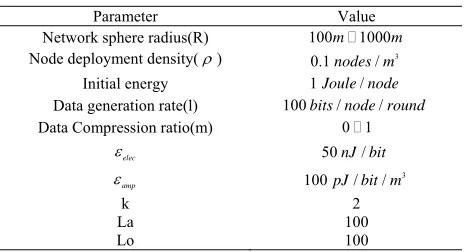
The value of all parameters are shown in Table 1 below.
8.2. Comparison with Direct Transmission and Multihop Routing Schemes
In ECBDC, our target is to balance energy consumption and maximize network lifetime. In the best case, all nodes run out their energy in the same moment. In simulations, we pick up two conventional 2D schemes for comparison purpose: direct transmssion and multihop routing. In the direct method, all nodes in monitoring space transmit their data directly to sink node rather than getting through relay nodes; in the multihop method, every node forwards all its data to the next hop node. The ECBDC protocol and this two 2D schemes all run in the 3D model proposed in this paper.
Figure 11 plots network lifetime achieved by the three
schemes with different radius of the sphere space when
the number of sphere-coronas n10 and data
compression ratio m0.8. We can see, with the growing
R, network lifetime decreases dramatically. When R
varys from 100 m to 600 m, ECBDC significantly
outperforms other two schemes. And when R varys
from 700 m to 1000 m, though still ECBDC outmatches the rivals, the differences among the three are not great.
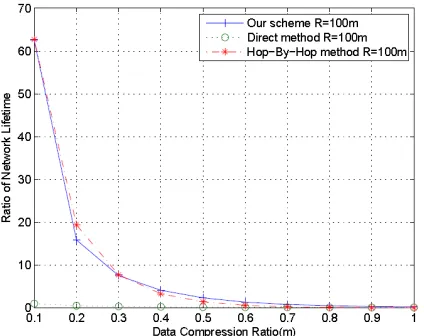
Figure 12 plots network lifetime obtained by the three
schemes with different ratios of data compression when
number of sphere-coronas n10 and sphere space
radius R100 m. Whenmvarys from 0.1 to 0.3, the
[image:12.595.308.540.589.715.2]multihop scheme is as good as ECBDC, which manifests that data compression is important, especially for multihop scheme and ECBDC. Effective data com- pression methods can bring low data compression ratio, reduce the amount of data transmitted, and hence lower energy consumption, prolonging network lifetime. In the figure, it’s worth noting that, whenmvary from
Table 1. Value of all parameters.
Parameter Value Network sphere radius(R) 100m 1000m
Node deployment density() 0.1 / 3
nodes m
Initial energy 1Joule node/ Data generation rate(l) 100bits node round/ / Data Compression ratio(m) 0 1
elec
50nJ bit/
amp
100pJ bit m/ / 3
Figure 11. Network lifetime of different routing schemes when m = 0.8 and n = 10.
Figure 12. Network lifetime with different routing schemes and data compression ratio when R = 100 and n = 10.
0.4 to 1.0, ECBDC outmatches the rivals. Especially, in
the figure, for all value of m, the multihop scheme
appears better than direct scheme when the space radius 100 m
R , which indicates that, comparing to direct
transmission to sink, hop-by-hop transmission is a better choice.
9. Conclusion
Unbalanced energy consumption is an important problem in wireless sensor networks, which can dramatically reduce network lifetime. In this paper, we proposed a solution to maximize network lifetime through balancing energy consumption among all nodes in data-gathering sensor networks. We formulated the balancing energy consumption problem as the problem of optimal allocation of transmitting data by combining the ideas of sphere-corona based network partition and mixed-routing strategy together with data aggregation. We presented the solutions for balancing energy consumption among
nodes both in the same sphere-coronas and different sphere-coronas. Based on our model, an ECBDC protocol and its extension to large-scale data-gathering sensor networks were developed. Simulation results show that ECBDC can greatly extend network lifetime compared with a multihop transmission scheme and a direct transmission scheme.
10. References
[1] H. Zhang and H. Shen, “Balancing Energy Consumption to Maximize Network Lifetime in Data-Gathering Sensor Networks,” IEEE Transactions on Parallel and Distributed Systems, Vol. 20, No. 10, 2009, pp. 1526-1539.
[2] I. F. Akyildiz, W. Su, Y. Sankarasubramaniam and E. Cayirci, “A Survey on Sensor Networks,” IEEE Commu- nications Magazine, August 2002, pp. 102-114.
[3] A. Brayner and R. Menezes, “Balancing Energy Con- sumption and Memory Usage in Sensor Data Pro- cessing,” Proceedings of the 2007 ACM Symposium on Applied Computing, Seoul, 11-15 March 2007.
[4] Y. Xu, J. Heidemann and D. Estrin, “Geography- Informed Energy Conservation for Ad Hoc Routing,”
Proceedings of the 7th Annual International Conference on Mobile Computing and Networking, Rome, July 2001,
pp. 70-84.
[5] D. J. Baker and A. Ephremides, “The Architectural Organization of a Mobile Radio Network via a Distributed Algorithm,” IEEE Transactions on Commu- nications, Vol. 29, No. 11, 1981, pp. 1694 -1701.
[6] A. Ephremides, J. E. Wieselthier and D. J. Baker, “A Design Concept for Reliable Mobile Radio Networks with Frequency Hopping Signaling,” Proceedings of the IEEE, Vol. 75, No. 1, 1987, pp. 56-73.
[7] M. Ettus, “System Capacity, Latency, and Power Consumption in Multihoprouted SS-CDMA Wireless Networks,” Proceedings of IEEE Radio and Wireless Conference, Springs, 9-12 August 1998, pp. 55-58.
[8] R. G. Gallager, P. A. Humblet and P. M. Spira, “A Distributed Algorithm for Minimum Weight Spanning Trees,” Massachusetts Institute of Technology, 1979. [9] T. H. Meng and V. Rodoplu, “Distributed Network
Protocols for Wireless Communication,” Proceedings of the 1998 IEEE International Symposium on Circuits and Systems, Monterey, Vol. 4, June 1998, pp. IV-600-IV-
603.
[10] V. Rodoplu and T. H. Meng, “Minimum Energy Mobile Wireless Networks,” IEEE Journal on Selected Areas in Communications, Vol. 17, No. 8, 1999, pp. 1333-1344.
[11] T. Shepard, “Decentralized Channel Management in Scalable Multihop Spread Spectrum Packet Radio Net- works,” Massachusetts Institute of Technology,1995. [12] S. Singh, M. Woo and C. S. Raghavendra, “Power-
[image:13.595.67.279.277.445.2]