ISSN Online: 2329-3292 ISSN Print: 2329-3284
DOI: 10.4236/ojbm.2019.72051 Apr. 11, 2019 775 Open Journal of Business and Management
The Relationship between Knowledge
Workers and Innovative Behavior
Based on Brand Identity
Zhuolin Xiao
*, Zhensong Cai
Department of Food and Pharmaceutical, Qingyuan Polytechnic, Qingyuan, China
Abstract
Aim: The relationship between brand identity and innovative behavior of knowledge workers is studied taking the researchers in 81 enterprises as an example by using statistical research method. Methods: The questionnaires are made, theoretical basis and research hypothesis was done in these col-lected data, the results of descriptive statistics and correlation analysis of the variables are explained. Results: Brand identity is positively correlated with knowledge workers’ innovative behavior. Conclusion: Brand identity has a positive impact on the innovative behavior of knowledge workers. Human resource management policies of enterprises can carry out various human resource management practices from the perspective of shaping a good em-ployment relationship, so as to obtain excess added value through brand building.
Keywords
Brand Identity, Knowledge Worker, Innovative Behavior
1. Introduction
In the 21st century, China’s economy has been developing rapidly, and the en-vironment of enterprises has become more complex. How to maintain sustaina-ble competitiveness and achieve sustainasustaina-ble development has become one of the main problems faced by enterprises. In 2018, Premier Li Keqiang emphasized in his government work report “speed up the construction of an innovative coun-try, implement the innovation-driven development strategy in depth, strengthen the construction of the national innovation system, implement and improve the innovation incentive policy, and promote mass entrepreneurship and innovation
How to cite this paper: Xiao, Z.L. and Cai, Z.S. (2019) The Relationship between Know- ledge Workers and Innovative Behavior Based on Brand Identity. Open Journal of Business and Management, 7, 775-782.
https://doi.org/10.4236/ojbm.2019.72051
Received: March 10, 2019 Accepted: April 8, 2019 Published: April 11, 2019
Copyright © 2019 by author(s) and Scientific Research Publishing Inc. This work is licensed under the Creative Commons Attribution International License (CC BY 4.0).
http://creativecommons.org/licenses/by/4.0/
DOI: 10.4236/ojbm.2019.72051 776 Open Journal of Business and Management to a higher level”. Under such economic situation and the call of the correspond-ing countries, enterprises can better cope with competition and achieve sustainable and stable development only through continuous innovation, strengthening their innovation ability and releasing productivity in an all-round way.
In the era of knowledge economy dominated by innovation, the creativity of knowledge workers is the potential resource of enterprises and the micro-foundation of enterprise innovation [1]. Therefore, how to stimulate the innovative behavior of knowledge workers is an important topic of long-term concern in the study of organizational behavior and management. The existing research on the innova-tive behavior of knowledge workers focuses more on their individual roles, lea-dership and team factors [2]. In recent years, with the rise of strategic human resource management theory, scholars believe that human resource manage-ment practice is one of the important factors affecting innovative behavior of knowledge workers, and prove the relationship between human resource prac-tice activities (such as commitment-based, support-based, high-performance work system) and employees’ innovative behavior through various ways [3]. However, due to the inertia of enterprise human resource management system and the uniqueness, continuity and consistency of human resource management practice, the impact of human resource management practice on employees’ at-titudes and behavior is often slow. Therefore, Kissel believed that human re-source practice will not directly affect employees’ behavior. It is possible to achieve through staff’s cognition and evaluation of organizational human re-source practices [4].
2. State of the Art
As a brand of human resource management service products, employer brand is essentially the perception and evaluation of employees and potential employees of a series of functional benefits, economic benefits and psychological benefits provided by employers. Therefore, it should be more obvious than the impact of human resource management activities and practices on employees’ innovative behavior. In fact, according to social exchange theory, when individuals perceive more economic and social emotional resources obtained from the organization, they usually exchange with the organization with greater enthusiasm and in-vestment, thus showing more positive organizational behaviors such as invest-ment, innovation and so on [5]. Therefore, brand identity, as a cognition beyond human resource management practice, may promote knowledge workers’ inno-vative behavior through the path of cognition to behavior.
DOI: 10.4236/ojbm.2019.72051 777 Open Journal of Business and Management workflows. From the viewpoint of scholars, it is believed that employees’ innova-tive behavior is the behavior that employees, for improving team or organiza-tional performance, initiatively put forward new ideas related to work improve-ment, strive for resources support within the organization, put them into prac-tice and actively participate in innovative activities within the organization and team [6].
The employer brand originated from the Best Employers competition held by Fortune magazine in the 1980s. In 1996, Ambler and Barrow drew lessons from the brand theory in marketing and defined employer brand as a combination of functions, economy and benefits brought about by employer relationship [7]. In recent research on innovative behavior, more attention has been paid to the in-fluence of salary, position and reward, or to the external support of innovation, while neglecting the research on the individual initiative psychological factors of employees’ innovative behavior. Lee took employee innovation behavior as de-pendent variable and brand identity as indede-pendent variable, and constructs a model to reveal the effect and mechanism of brand identity on employee inno-vation behavior. Based on a questionnaire survey of 946 employees in 81 enter-prises, a multi-level linear model was used to analyze the sample data. The re-sults showed that brand identity positively affected employees’ job well-being and innovation behavior [8]. Omri took employee’s perception and inner expe-rience of brand building as the breakthrough point, and explored the internal mechanism of employer brand’s influence on employee’s innovative behavior in technology-based enterprises. It has important theoretical value and practical significance for promoting employer brand building and employee innovation in domestic technology enterprises [9]. Helm conducted project analysis, factor analysis, independent sample T-test, variance analysis and correlation analysis with the help of SPSS statistical software through questionnaires. It was found that there was a significant positive correlation between brand identity and em-ployee innovation behavior. Each dimension of brand identity affected emem-ployee innovation at different levels, and individual variables significantly affected brand identity and employee innovation behavior. Therefore, enterprises can enhance employees’ innovative behavior through the construction of brand identity, and adopt corresponding strategies according to the characteristics of dif-ferent employees to increase the frequency of their innovative behavior [10]. Edú used employer brand theory, competitiveness theory, ecology theory, co-evolution theory and other theoretical tools to comprehensively and systematically study the impact mechanism, complex adaptability and co-evolution of employer brand in high-tech enterprises, taking employer brand in high-tech enterprises as the research object [11].
3. Methodology
3.1. Theoretical Basis and Research Hypothesis
DOI: 10.4236/ojbm.2019.72051 778 Open Journal of Business and Management Fortune magazine in the 1980s. In 1996, Ambler and Barrow drew lessons from the brand theory in marketing and defined employer brand as a combination of functions, economy and benefits brought about by employer relationship [7]. With the deepening of people’s understanding of employer’s brand, the conno-tation of employer’s brand has been continuously deepened. It is not only a good human resource image established by enterprises in the external labor market, but also an emotional relationship widely spread between enterprises and ployees. It is also a brand commitment made by enterprises to internal em-ployees and an employment experience of emem-ployees [8]. Good employment experience stimulates more organizational citizenship behavior, improve em-ployee job satisfaction, organizational commitment and work input, and ulti-mately improve personal output and organizational performance [9]. In the va-riables of job performance and organizational citizenship behavior, innovation performance and innovation behavior are usually included. Based on this, it is assumed that brand identity is positively correlated with knowledge workers’ innovative behavior.
3.2. Research Object
Research and development personnel of 10 manufacturing enterprises in Shang-hai, Hangzhou, Beijing and Chengdu are investigated. The survey started in Feb-ruary 2016 and lasted three months. By the end of April, 1084 questionnaires were collected from 92 enterprises. After strict quality inspection of the questionnaire, excluding unqualified questionnaires, 946 questionnaires from 81 enterprises were finally retained. The questionnaire is mainly composed of two measurement scales of research variables and sample basic information. The basic information of the respondents mainly includes gender, age, education and position. The purpose of the questionnaire is to grasp the sample characteristics of the research subjects. The two scales used in the study are brand identity and knowledge workers’ inno-vative behavior scale, which is in the form of Lickett 5-point scale.
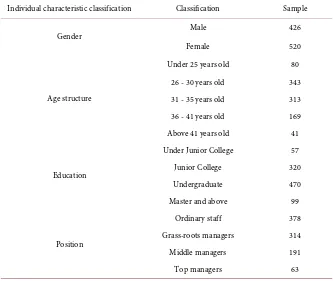
In the final valid sample questionnaires, 426 males and 520 females were se-lected according to gender. 80 males aged 25 and younger, 343 males aged 26 to 30, 313 females aged 31 to 35, 169 females aged 36 to 41 and 41 females aged 41 and above were selected according to age. 57 people below junior college, 320 junior colleges, 470 undergraduates, and 99 people with master’s degree or above were selected according to their educational background. According to the sur-vey sample positions, 378 ordinary employees, 314 grassroots managers, 191 middle-level managers and 63 senior managers were selected. 70 people under one year, 204 people in one to two years, 332 people in three to five years, 206 people in six to ten years, 134 people over 11 years were selected in terms of working hours. The specific information is shown in Table 1.
3.3. Research Scale
DOI: 10.4236/ojbm.2019.72051 779 Open Journal of Business and Management
Table 1. Descriptive statistical results of sample population characteristics.
Individual characteristic classification Classification Sample
Gender Male 426
Female 520
Age structure
Under 25 years old 80 26 - 30 years old 343 31 - 35 years old 313 36 - 41 years old 169 Above 41 years old 41
Education
Under Junior College 57 Junior College 320 Undergraduate 470 Master and above 99
Position
Ordinary staff 378 Grass-roots managers 314 Middle managers 191 Top managers 63
by Zhu Yongguo and Ding Xuefeng and the Internal Employer Brand Measure-ment Scale developed by Zhang Hong (2014). The scale includes five dimen-sions: salary and welfare, work arrangement, personal development, enterprise strength and enterprise image, including “the salary and performance of our employees are linked”, “our enterprises can arrange appropriate work content according to the actual ability of employees”, “our enterprises provide conti-nuous training opportunities for employees”, “our enterprises have a strong in-fluence”, “our enterprise is full of friendly cultural atmosphere” and other 24 topics. Reliability analysis shows that the Cronbach’s a coefficient of the scale is 0.960; confirmatory factor analysis shows that the scale X2/df = 4.935; GFI = 0.901; AGFI = 0.882; NFI = 0.923; IFI = 0.912; CFI = 0.912; and RMSEA = 0.092. All indicators reach acceptable levels, indicating that the scale has good reliabili-ty and structural validireliabili-ty.
in-DOI: 10.4236/ojbm.2019.72051 780 Open Journal of Business and Management dicating that the scale has good reliability and structural validity.
4. Results and Discussion
4.1. Descriptive Statistics and Correlation Analysis of Variables
The results of descriptive statistics and correlation analysis of the variables are shown in Table 2. It can be seen that the average value of brand identity and innovation behavior is 3.6466 and 3.5090, respectively, and the standard devia-tion is 0.67547 and 0.70183, respectively. Relevant analysis results show that the correlation between brand identity and innovation behavior of knowledge workers has reached a very significant level.
4.2. Hypothesis Test
The results of correlation coefficients of the variables in Table 2 show that there are significant positive correlations among the variables, and the hypothesis is initially supported. This part focuses on further validation of the hypothesis, and tests the direct effect model of brand identity on knowledge workers’ innovation behavior.
From Table 3, it can be seen that Chi-square degree of freedom ratio χ2/df = 1.135 < 3; RMSEA = 0.023 < 0.08; GFI, NFI, TLI and CFI all reached the critical value above 0.9. Therefore, in general, the fitting indexes of the model reach ac-ceptable level. Further comparing the path coefficients in the model, it is found that the path coefficients between organizational identity and innovation beha-vior in the model are 0.35 (P < 0.001), and the hypothesis is supported.
5. Conclusion
[image:6.595.209.537.591.641.2]Taking research and development personnel-knowledge worker as the research object, the impact of brand identity on innovation behavior of knowledge workers is explored. The results show that brand identity has a positive impact on know-ledge workers’ innovative behavior. The results of empirical research have some guidance to human resource management in enterprises. The establishment of the influence mechanism of brand identity on employees’ innovative behavior provides a new focus for human resource management in enterprises. In the
Table 2. Mean, standard deviation and correlation coefficient of variables.
Variable Mean Standard deviation Brand identity Innovative behavior Brand identity 3.6466 0.67547
Innovative behavior 3.5090 0.70183 0.323**
Note: **P < 0.01.
Table 3. Model test.
Χ2/df RMSEA GFI NFI TLI CFI
DOI: 10.4236/ojbm.2019.72051 781 Open Journal of Business and Management new economic era, the distance between organizations and employees is becom-ing smaller and smaller because of the Internet, micro-blog and micro-mes- senger. Employees are freer to express their own emotional changes, value de-mands and perceptions of enterprises than ever before. Therefore, enterprises should accurately locate their brand value, and various human resources manage-ment of enterprises should be located based on respect, concern and trust for employees. Human resources management practices should be carried out from the perspective of shaping good employment relationship, so as to obtain excess added value through brand building.
Conflicts of Interest
The authors declare no conflicts of interest regarding the publication of this pa-per.
References
[1] Goi, M.T., Goi, C.L. and Wong, D. (2014) Constructing a Brand Identity Scale for Higher Education Institutions. Journal of Marketing for Higher Education, 24, 59-74.
https://doi.org/10.1080/08841241.2014.906017
[2] Brown, J.H., Melewar, T.C. and Nguyen, B. (2016) Exploring Brand Identity, Meaning, Image, and Reputation (BIMIR) in Higher Education: A Special Section. Journal of Business Research, 69, 3019-3022.
https://doi.org/10.1016/j.jbusres.2016.01.016
[3] Lin, J.S. and Sung, Y. (2014) Nothing Can Tear Us Apart: The Effect of Brand Iden-tity Fusion in Consumer-Brand Relationships. Psychology & Marketing, 31, 54-69.
https://doi.org/10.1002/mar.20675
[4] Kissel, P. and Büttgen, M. (2015) Using Social Media to Communicate Employer Brand Identity: The Impact on Corporate Image and Employer Attractiveness. Jour-nal of Brand Management, 22, 755-777. https://doi.org/10.1057/bm.2015.42
[5] Yuan, R.Z., Liu, M.J. and Luo, J. (2016) Reciprocal Transfer of Brand Identity and Image Associations Arising from Higher Education Brand Extensions. Journal of Business Research, 69, 3069-3076. https://doi.org/10.1016/j.jbusres.2016.01.022
[6] Webb, H., Jones, B.M. and McNeill, K. (2017) Smoke Signals: The Decline of Brand Identity Predicts Reduced Smoking Behaviour Following the Introduction of Plain Packaging. Addictive Behaviors Reports, 5, 49-55.
https://doi.org/10.1016/j.abrep.2017.02.003
[7] Thurlings, M., Evers, A.T. and Vermeulen, M. (2015) Toward a Model of Explain-ing Teachers’ Innovative Behavior A Literature Review. Review of Educational Re-search, 85, 430-471. https://doi.org/10.3102/0034654314557949
[8] Lee, H.S. and Hong, S.A. (2014) Factors Affecting Hospital Employees Knowledge Sharing Intention and Behavior, and Innovation Behavior. Osong Public Health and Research Perspectives, 5, 148-155. https://doi.org/10.1016/j.phrp.2014.04.006
[9] Omri, W., Becuwe, A. and Mathe, J.C. (2014) Ownership Structure and Innovative Behavior. Journal of Accounting in Emerging Economies, 4, 220-239.
https://doi.org/10.1108/JAEE-07-2012-0033