SemEval’07 Task 19: Frame Semantic Structure Extraction
Collin Baker, Michael Ellsworth
International Computer Science Institute Berkeley, California
{collinb,infinity}
@icsi.berkeley.edu
Katrin Erk
Computer Science Dept. University of Texas
Austin
Abstract
This task consists of recognizing words and phrases that evoke semantic frames as defined in the FrameNet project (http:
//framenet.icsi.berkeley.edu),
and their semantic dependents, which are usually, but not always, their syntactic dependents (including subjects). The train-ing data was FN annotated sentences. In testing, participants automatically annotated three previously unseen texts to match gold standard (human) annotation, including pre-dicting previously unseen frames and roles. Precision and recall were measured both for matching of labels of frames and FEs and for matching of semantic dependency trees based on the annotation.
1 Introduction
The task of labeling frame-evoking words with ap-propriate frames is similar to WSD, while the task of assigning frame elements is called Semantic Role Labeling(SRL), and has been the subject of several shared tasks at ACL and CoNLL. For example, in the sentence “Matilde said, ‘I rarely eat rutabaga,”’ said evokes the Statement frame, and eat evokes the Ingestion frame. The role of SPEAKER in the Statement frame is filled by Matilda, and the role of MESSAGE, by the whole quotation. In the Inges-tion frame,Iis the INGESTORandrutabagafills the INGESTIBLESrole. Since the ingestion event is con-tained within the MESSAGE of the Statement event, we can represent the fact that the message conveyed
was about ingestion, just by annotating the sentence with respect to these two frames.
After training on FN annotations, the participants’ systems labeled three new texts automatically. The evaluation measured precision and recall for frames and frame elements, with partial credit for incorrect but closely related frames. Two types of evaluation were carried out: Label matching evaluation, in which the participant’s labeled data was compared directly with the gold standard labeled data, and Se-mantic dependency evaluation, in which both the gold standard and the submitted data were first con-verted to semantic dependency graphs in XML for-mat, and then these graphs were compared.
2 Frame semantics and FrameNet
The basic concept of Frame Semantics is that many words are best understood as part of a group of terms that are related to a particular type of event and the participants and “props” involved in it (Fill-more, 1976; Fill(Fill-more, 1982). The classes of events are the semanticframes of thelexical units (LUs) that evoke them, and the roles associated with the event are referred to asframe elements(FEs). The same type of analysis applies not only to events but also to relations and states; the frame-evoking pressions may be single words or multi-word ex-pressions, which may be of any syntactic category. Note that these FE names are quite frame-specific; generalizations over them are expressed via explicit FE-FE relations.
The Berkeley FrameNet project (hereafter FN) (Fillmore et al., 2003) is creating a computer- and human-readable lexical resource for English, based on the theory of frame semantics and supported by corpus evidence. The current release (1.3) of the FrameNet data, which has been freely available for instructional and research purposes since the fall of 2006, includes roughly 780 frames with roughly 10,000 word senses (lexical units). It also contains roughly 150,000 annotation sets, of which 139,000 are lexicographic examples, with each sentence an-notated for a single predicator. The remainder are from full-text annotation in which each sentence is annotated for all predicators; 1,700 sentences are an-notated in the full-text portion of the database, ac-counting for roughly 11,700 annotation sets, or 6.8 predicators (=annotation sets) per sentence. Nearly all of the frames are connected into a single graph by frame-to-frame relations, almost all of which have associated FE-to-FE relations (Fillmore et al., 2004a)
2.1 Frame Semantics of texts
The ultimate goal is to represent the lexical se-mantics of all the sentences in a text, based on the relations between predicators and their depen-dents, including both phrases and clauses, which may, in turn, include other predicators; although this has been a long-standing goal of FN (Fillmore and Baker, 2001), automatic means of doing this are only now becoming available.
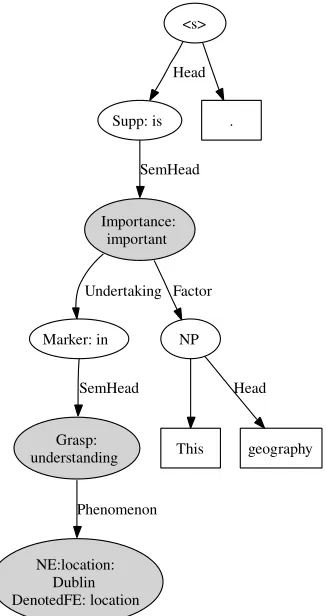
Consider a sentence from one of the testing texts: (1) This geography is important in understanding Dublin.
In the frame semantic analysis of this sentence, there are two predicators which FN has analyzed: importantand understanding, as well as one which we have not yet analyzed, geography. In addition, Dublinis recognized by the NER system as a loca-tion. In the gold standard annotation, we have the annotation shown in (2) for the Importance frame, evoked by the targetimportant, and the annotation shown in (3) for the Grasp frame, evoked by under-standing.
(2) [FACTOR This geography] [COP is] IMPOR-TANT [UNDERTAKING in understanding Dublin]. [INTERESTED PARTYINI]
(3) This geography is important in UNDER-STANDING [PHENOMENON Dublin]. [COGNIZER CNI]
The definitions of the two frames begin like this: Importance: A FACTORaffects the outcome of an UNDERTAKING, which can be a goal-oriented activ-ity or the maintenance of a desirable state, the work in a FIELD, or something portrayed as affecting an INTERESTED PARTY. . .
Grasp: A COGNIZER possesses knowledge about the workings, significance, or meaning of an idea or object, which we call PHENOMENON, and is able to make predictions about the behavior or occurrence of the PHENOMENON. . .
Using these definitions and the labels, and the fact that the target and FEs of one frame are subsumed by an FE of the other, we can compose the mean-ings of the two frames to produce a detailed para-phrase of the meaning of the sentence: Something denoted bythis geography is a factor which affects the outcome of the undertaking of understanding the location called “Dublin” by any interested party. We have not dealt with geography as a frame-evoking expression, although we would eventually like to. (The preposition inserves only as a marker of the frame element UNDERTAKING.)
thatthis geography is important for anyone in gen-eral’s understanding of Dublin. In (3), the COG-NIZER is “constructionally null instantiated”, as the gerund understanding licenses omission of its sub-ject. The marking of null instantiations is important in handling text coherence and was part of the gold standard, but as far as we know, none of the partici-pants attempted it, and it was ignored in the evalua-tion.
Note that we have collapsed the two null instan-tiated FEs, the INTERESTED PARTY of the impor-tance frame and the COGNIZERin the Grasp frame, since they are not constrained to be distinct.
2.2 Semantic dependency graphs
Since the role fillers are dependents (broadly speak-ing) of the predicators, the full FrameNet annotation of a sentence is roughly equivalent to a dependency parse, in which some of the arcs are labeled with role names; and a dependency graph can be derived algo-rithmically from FrameNet annotation; an early ver-sion of this was proposed by (Fillmore et al., 2004b) Fig. 1 shows the semantic dependency graph de-rived from sentence (1); this graphical representa-tion was derived from a semantic dependency XML file (see Sec. 5). It shows that the top frame in this sentence is evoked by the wordimportant, although the syntactic head is the copula is (here given the more general label “Support”). The labels on the arcs are either the names of frame elements or indi-cations of which of the daughter nodes are seman-tic heads, which is important in some versions of the evaluation. The labels on nodes are either frame names (also colored gray), syntactic phrases types (e.g. NP), or the names of certain other syntactic “connectors”, in this case, Marker and Support.
3 Definition of the task 3.1 Training data
The major part of the training data for the task con-sisted of the current data release from FrameNet (Release 1.3), described in Sec.2 This was supple-mented by additional training data made available through SemEval to participants in this task. In ad-dition to updated versions of some of the full-text an-notation from Release 1.3, three files from the ANC were included: from Slate.com, “Stephanopoulos
Importance: important
Marker: in Undertaking
NP Factor
Grasp: understanding
SemHead
This geography Head
NE:location: Dublin DenotedFE: location
Phenomenon <s>
Supp: is Head
.
[image:3.612.320.483.54.362.2]SemHead
Figure 1: Sample Semantic Dependency Graph
Crimes” and “Entrepreneur as Madonna”, and from the Berlitz travel guides, “History of Jerusalem”.
3.2 Testing data
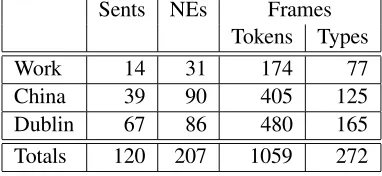
Sents NEs Frames Tokens Types
Work 14 31 174 77
China 39 90 405 125
Dublin 67 86 480 165
[image:4.612.71.262.55.143.2]Totals 120 207 1059 272 Table 1: Summary of Testing Data
Dublin”, taken from the American National Cor-pus (ANC,www.americannationalcorpus. org) Berlitz travel guides, is of quite a different genre, although the “History of Jerusalem” text in the training data was somewhat similar. Table 1 gives some statistics on the three testing files. To give a flavor of the texts, here are two sentences; frame evoking words are in boldface:
From “Work Advances”: “TheIraniansarenow willing to accept the installation of cameras only
outsidethecascade halls, which will not enable the IAEA tomonitortheentire uranium enrichment process,” thediplomat said.
From “Introduction to Dublin”: And in this
city,where literatureandtheaterhavehistorically dominated the scene, visual arts are finally com-ing into their own with thenew Museumof Modern
Artand themany galleriesthat display the work of
modern Irish artists.
4 Participants
A number of groups downloaded the training or test-ing data, but in the end, only three groups submitted results: the UTD-SRL group and the LTH group, who submitted full results, and the CLR group who submitted results for frames only. It should also be noted that the LTH group had the testing data for longer than the 10 days allowed by the rules of the exercise, which means that the results of the two teams are not exactly comparable. Also, the results from the CLR group were initially formatted slightly differently from the gold standard with regard to character spacing; a later reformatting allowed their results to be scored with the other groups’.
The LTH system used only SVM classifiers, while the UTD-SRL system used a combination of SVM and ME classifiers, determined experimentally. The CLR system did not use classifiers, but hand-written
symbolic rules. Please consult the separate system papers for details about the features used.
5 Evaluation
The labels-only matching was similar to previous shared tasks, but the dependency structure evalua-tion deserves further explanaevalua-tion: The XML seman-tic dependency structure was produced by a program called fttosem, implemented in Perl, which goes sentence by sentence through a FrameNet full-text XML file, taking LU, FE, and other labels and using them to structure a syntactically unparsed piece of a sentence into a syntactic-semantic tree. Two basic principles allow us to produce this tree: (1) LUs are the sole syntactic head of a phrase whose semantics is expressed by their frame and (2) each label span is interpreted as the boundaries of a syntactic phrase, so that when a larger label span subsumes a smaller one, the larger span can be interpreted as a the higher node in a hierarchical tree. There are a fair num-ber of complications, largely involving identifying mismatches between syntactic and semantic headed-ness. Some of these (support verbs, copulas, mod-ifiers, transparent nouns, relative clauses) are anno-tated in the data with their own labels, while oth-ers (syntactic markoth-ers, e.g. prepositions, and auxil-iary verbs) must be identified using simple syntactic heuristics and part-of-speech tags.
For this evaluation, a non-frame node counts as matching provided that it includes the head of the gold standard, whether or not non-head children of that node are included. For frame nodes, the partici-pants got full credit if the frame of the node matched the gold standard.
5.1 Partial credit for related frames
the system can’t be sure that a new use of a lemma is in one of the frames listed for that lemma, then it must consider all the 800+ frames as possibili-ties. This amounts to the automatic induction of fine-grained semantic similarity from corpus data, a notoriously difficult problem (Stevenson and Joanis, 2003; Schulte im Walde, 2003).
For LUs which clearly do not fit into any exist-ing frames, the problem is still more difficult. In the course of creating the gold standard annotation of the three testing texts, the FN team created almost 40 new frames. We cannot ask that participants hit upon the new frame name, but the new frames are not cre-ated in a vacuum; as mentioned above, they are al-most always added to the existing structure of frame-to-frame relations; this allows us to give credit for assignment to frames which are not the precise one in the gold standard, but are close in terms of frame-to-frame relations. Whenever participants’ proposed frames were wrong but connected to the right frame by frame relations, partial credit was given, decreas-ing by 20% for each link in the frame-frame relation graph between the proposed frame and the gold stan-dard. For FEs, each frame element had to match the gold standard frame element and contain at least the same head word in order to gain full credit; again, partial credit was given for frame elements related via FE-to-FE relations.
6 Results
Text Group Recall Prec. F1
[image:5.612.313.557.52.264.2]Dublin UTD-SRL 0.4188 0.7716 0.5430 China UTD-SRL 0.5498 0.8009 0.6520 Work UTD-SRL 0.5251 0.8382 0.6457 Dublin LTH 0.5184 0.7156 0.6012 China LTH 0.6261 0.7731 0.6918 Work LTH 0.6606 0.8642 0.7488 Dublin CLR 0.3984 0.6469 0.4931 China CLR 0.4621 0.6302 0.5332 Work CLR 0.5054 0.7452 0.6023
Table 2: Frame Recognition only
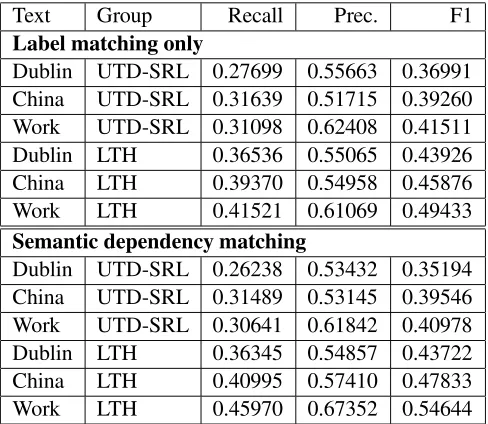
The strictness of the requirement of exact bound-ary matching (which depends on an accurate syntac-tic parse) is compounded by the cascading effect of semantic classification errors, as seen by comparing
Text Group Recall Prec. F1
Label matching only
Dublin UTD-SRL 0.27699 0.55663 0.36991 China UTD-SRL 0.31639 0.51715 0.39260 Work UTD-SRL 0.31098 0.62408 0.41511 Dublin LTH 0.36536 0.55065 0.43926 China LTH 0.39370 0.54958 0.45876 Work LTH 0.41521 0.61069 0.49433
Semantic dependency matching
Dublin UTD-SRL 0.26238 0.53432 0.35194 China UTD-SRL 0.31489 0.53145 0.39546 Work UTD-SRL 0.30641 0.61842 0.40978 Dublin LTH 0.36345 0.54857 0.43722 China LTH 0.40995 0.57410 0.47833 Work LTH 0.45970 0.67352 0.54644 Table 3: Results for combined Frame and FE recog-nition
the F-scores in Table 3 with those in Table 2. The difficulty of the task is reflected in the F-scores of around 35% for the most difficult text in the most difficult condition, but participants still managed to reach F-scores as high as 75% for the more limited task of Frame Identification (Table 2), which more closely matches traditional Senseval tasks, despite the lack of a full sense inventory. The difficulty posed by having such an unconstrained task led to understandably low recall scores in all participants (between 25 and 50%). The systems submitted by the teams differed in their sensitivity to differences in the texts: UTD-SRL’s system varied by around 10% across texts, while LTH’s varied by 15%.
There are some rather encouraging results also. The participants rather consistently performed bet-ter with our more complex, but also more useful and realistic scoring, including partial credit and grad-ing on semantic dependency rather than exact span match (compare the top and bottom halves of Table 3). The participants all performed relatively well on the frame-recognition task, with precision scores av-eraging 63% and topping 85%.
7 Discussion
40 new frames were created in the process of an-notating these three specific passages. One result of this was that the test passages had more unseen frames than a random unseen passage, which prob-ably lowered the recall on frames. It appears that this was not entirely compensated by giving partial credit for related frames.
This task is a more advanced and realistic version of the Automatic Semantic Role Labeling task of Senseval-3 (Litkowski, 2004). Unlike that task, the testing data was previously unseen, participants had to determine the correct frames as a first step, and participants also had to determine FE boundaries, which were given in the Senseval-3.
A crucial difference from similar approaches, such as SRL with PropBank roles (Pradhan et al., 2004) is that by identifying relations as part of a frame, you have identified a gestalt of relations that enables far more inference, and sentences from the same passage that use other words from the same frame will be easier to link together. Thus, the FN SRL results are translatable fairly directly into formal representations which can be used for rea-soning, question answering, etc. (Scheffczyk et al., 2006; Frank and Semecky, 2004; Sinha and Narayanan, 2005).
Despite the problems with recall, the participants have expressed a determination to work to improve these results, and the FN staff are eager to collabo-rate in this effort. A project is now underway at ICSI to speed up frame and LU definition, and another to speed up the training of SRL systems is just begin-ning, so the prospects for improvement seem good.
This material is based in part upon work sup-ported by the National Science Foundation under Grant No. IIS-0535297.
References
Charles J. Fillmore and Collin F. Baker. 2001. Frame semantics for text understanding. In Proceedings of WordNet and Other Lexical Resources Workshop, Pittsburgh, June. NAACL.
Charles J. Fillmore, Christopher R. Johnson, and Miriam R.L Petruck. 2003. Background to FrameNet.
International Journal of Lexicography, 16.3:235–250.
Charles J. Fillmore, Collin F. Baker, and Hiroaki Sato.
2004a. FrameNet as a “Net”. In Proceedings of LREC, volume 4, pages 1091–1094, Lisbon. ELRA. Charles J. Fillmore, Josef Ruppenhofer, and Collin F.
Baker. 2004b. FrameNet and representing the link between semantic and syntactic relations. In Chu-ren Huang and Winfried Lenders, editors, Frontiers in Linguistics, volume I ofLanguage and Linguisitcs Monograph Series B, pages 19–59. Inst. of Linguistics, Acadmia Sinica, Taipei.
Charles J. Fillmore. 1976. Frame semantics and the na-ture of language. Annals of the New York Academy of Sciences, 280:20–32.
Charles J. Fillmore. 1982. Frame semantics. In Lin-guistics in the Morning Calm, pages 111–137. Han-shin PubliHan-shing Co., Seoul, South Korea.
Anette Frank and Jiri Semecky. 2004. Corpus-based induction of an LFG syntax-semantics interface for frame semantic processing. InProceedings of the 5th International Workshop on Linguistically Interpreted Corpora (LINC 2004), Geneva, Switzerland.
Ken Litkowski. 2004. Senseval-3 task: Automatic label-ing of semantic roles. In Rada Mihalcea and Phil Ed-monds, editors,Senseval-3: Third International Work-shop on the Evaluation of Systems for the Semantic Analysis of Text, pages 9–12, Barcelona, Spain, July. Association for Computational Linguistics.
Sameer S. Pradhan, Wayne H. Ward, Kadri Hacioglu, James H. Martin, and Dan Jurafsky. 2004. Shallow semantic parsing using support vector machines. In Daniel Marcu Susan Dumais and Salim Roukos, ed-itors, HLT-NAACL 2004: Main Proceedings, pages 233–240, Boston, Massachusetts, USA, May 2 - May 7. Association for Computational Linguistics.
Jan Scheffczyk, Collin F. Baker, and Srini Narayanan. 2006. Ontology-based reasoning about lexical re-sources. In Alessandro Oltramari, editor,Proceedings of ONTOLEX 2006, pages 1–8, Genoa. LREC. Sabine Schulte im Walde. 2003. Experiments on the
choice of features for learning verb classes. In Pro-ceedings of the 10th Conference of the EACL (EACL-03).
Steve Sinha and Srini Narayanan. 2005. Model based answer selection. InProceedings of the Workshop on Textual Inference, 18th National Conference on Artifi-cial Intelligence, PA, Pittsburgh. AAAI.