Which Step Do I Take First? Troubleshooting with Bayesian Models
Annie Louis and Mirella LapataSchool of Informatics, University of Edinburgh 10 Crichton Street, Edinburgh EH8 9AB
{alouis,mlap}@inf.ed.ac.uk
Abstract
Online discussion forums and community question-answering websites provide one of the primary avenues for online users to share information. In this paper, we propose text mining techniques which aid users navigate troubleshooting-oriented data such as ques-tions asked on forums and their suggested so-lutions. We introduce Bayesian generative models of the troubleshooting data and apply them to two interrelated tasks: (a) predicting the complexity of the solutions (e.g., plugging a keyboard in the computer is easier compared to installing a special driver) and (b) present-ing them in a ranked order from least to most complex. Experimental results show that our models are on par with human performance on these tasks, while outperforming baselines based on solution length or readability.
1 Introduction
Online forums and discussion boards have created novel ways for discovering, sharing, and distribut-ing information. Users typically post their ques-tions or problems and obtain possible soluques-tions from other users. Through this simple mechanism of community-based question answering, it is possible to find answers to personal, open-ended, or highly specialized questions. However, navigating the in-formation available in web-archived data can be challenging given the lack of appropriate search and browsing facilities.
Table 1 shows examples typical of the problems and proposed solutions found in troubleshooting-oriented online forums. The first problem concerns a shaky monitor and has three solutions with increas-ing degrees of complexity. Solution (1) is probably easiest to implement in terms of user time, effort, and expertise; solution (3) is most complex (i.e., the user should understand what signal timing is and
The screen is shaking.
1. Move all objects that emit a magnetic field, such as a motor or transformer, away from the monitor.
2. Check if the specified voltage is applied.
3. Check if the signal timing of the computer system is within the specification of the monitor.
“Illegal Operation has Occurred” error message is displayed.
1. Software being used is not Microsoft-certified for your version of Windows. Verify that the software is certified by Microsoft for your version of Windows (see program packaging for this information).
[image:1.612.318.533.163.322.2]2. Configuration files are corrupt. If possible, save all data, close all programs, and restart the computer.
Table 1: Example problems and solutions taken from on-line troubleshooting oriented forums.
then try to establish whether it is within the specifi-cation of the monitor), whereas solution (2) is some-where in between. In most cases, the solutions are not organized in any particular fashion, neither in terms of content nor complexity.
In this paper, we present models to automatically predict the complexity of troubleshooting solutions, which we argue could improve user experience, and potentially help solve the problem faster (e.g., by prioritizing easier solutions). Automatically struc-turing solutions according to complexity could also facilitate search through large archives of solutions or serve as a summarization tool. From a linguis-tic perspective, learning how complexity is verbal-ized can be viewed as an instance of grounded lan-guage acquisition. Solutions direct users to carry out certain actions (e.g., on their computers or de-vices) and complexity is an attribute of these ac-tions. Information access systems incorporating a notion of complexity would allow to take user in-tentions into account and how these translate into natural language. Current summarization and infor-mation retrieval methods are agnostic of such types of text semantics. Moreover, the models presented here could be used for analyzing collaborative
lem solving and its social networks. Characterizing the content of discussion forums by their complexity can provide additional cues for identifying user au-thority and if there is a need for expert intervention. We begin by validating that the task is indeed meaningful and that humans perceive varying de-grees of complexity when reading troubleshooting solutions. We also show experimentally that users agree in their intuitions about the relative complex-ity of different solutions to the same problem. We define “complexity” as an aggregate notion of the time, expertise, and money required to implement a solution. We next model the complexity predic-tion task, following a Bayesian approach. Specifi-cally, we learn to assign complexity levels to solu-tions based on their linguistic makeup. We leverage weaksupervision in the form of lists of solutions (to different problems) approximately ordered from low to high complexity (see Table 1). We assume that the data is generated from a fixed number of dis-crete complexity levels. Each level has a probability distribution over the vocabulary and there is a canon-ical ordering between levels indicating their relative complexity. During inference, we recover the vo-cabularies of the complexity levels and the ordering of levels that explains the solutions and their attested sequences in the training data.
We explore two Bayesian models differing in how they learn an ordering among complexity levels. The first model is local, it assigns an expected position (in any list of solutions) to each complexity level and orders the levels based on this expected posi-tion value. The second model is global, it defines probabilities over permutations of complexity lev-els and directly uncovers a consensus ordering from the training data. We evaluate our models on a lution ordering task, where the goal is to rank so-lutions from least to most complex. We show that a supervised ranking approach using features based on the predictions of our generative models is on par with human performance on this task while outper-forming competitive baselines based on length and readability of the solution text.
2 Related work
There is a long tradition of research on decision-theoretic troubleshooting where the aim is to find a cost efficient repair strategy for a malfunction-ing device (Heckerman et al., 1995). Typically, a
diagnostic procedure (i.e., a planner) is developed that determines the next best troubleshooting step by estimating the expected cost of repair for various plans. Costs are specified by domain experts and are usually defined in terms of time and/or money in-curred by carrying out a particular repair action. Our notion of complexity is conceptually similar to the cost of an action, however we learn to predict com-plexity levels rather than calibrate them manually. Also note that our troubleshooting task is not device specific. Our models learn from troubleshooting-oriented data without any restrictions on the prob-lems being solved.
Previous work on web-based user support has mostly focused on thread analysis. The idea is to model the content structure of forum threads by an-alyzing the requests for information and suggested solutions in the thread data (Wang et al., 2011; Kim et al., 2010). Examples of such analysis include identifying which earlier post(s) a given post re-sponds to and in what manner (e.g., is it a question, an answer or a confirmation). Other related work (Lui and Baldwin, 2009) identifies user characteris-tics in such data, i.e., whether users express them-selves clearly, whether they are technically knowl-edgeable, and so on. Although our work does not address threaded discourse, we analyze the content of troubleshooting data and show that it is possible to predict the complexity levels for suggested solu-tions from surface lexical cues.
Our work bears some relation to language ground-ing, the problem of extracting representations of the meaning of natural language tied to the physical world. Mapping instructions to executable actions is an instance of language grounding with applica-tions to automated troubleshooting (Branavan et al., 2009; Eisenstein et al., 2009), navigation (Vogel and Jurafsky, 2010), and game-playing (Branavan et al., 2011). In our work, there is no direct attempt to model the environment or the troubleshooting steps. Rather, we study the language of instructions and how it correlates with the complexity of the implied actions. Our results show that it possible to predict complexity, while being agnostic about the seman-tics of the domain or the effect of the instructions in the corresponding environment.
and learn to predict an ordering for new sets of so-lutions. This setup is related to previous studies on information ordering where the aim is to learn statistical patterns of document structure which can be then used to order new sentences or paragraphs in a coherent manner. Some approaches approxi-mate the structure of a document via topic and entity sequences using local dependencies such as condi-tional probabilities (Lapata, 2003; Barzilay and La-pata, 2008) or Hidden Markov Models (Barzilay and Lee, 2004). More recently, global approaches which directly model the permutations of topics in the doc-ument have been proposed (Chen et al., 2009b). Fol-lowing this line of work, one of our models uses the Generalized Mallows Model (Fligner and Ver-ducci, 1986) in its generative process which allows to model permutations of complexity levels in the training data.
3 Problem formulation
Our aim in this work is to learn models which can automatically reorder solutions to a problem from low to high complexity. LetG= (c1, c2, .. cN) be
a collection of solutions to a specific problem. We wish to output a listG0 = (c01,c02, .. c0N), such that
D(c0j)≤ D(c0j+1), where D(x) refers to the com-plexity of solutionx.
3.1 Corpus Collection
As training data we are given problem-solution sets similar to the examples in Table 1 where the solu-tions are approximately ordered from low to high complexity. A solution set Si is specific to
prob-lem Pi, and contains an ordered list of NPi
solu-tions Si = (x1, x2, . . ., xNPi) such that D(xj) <
D(xj+1). We refer to the number of solutions
re-lated to a problem,NPi, as itssolution set size.
For our experiments, we collected 300 problems1
and their solutions from multiple web sites includ-ing the computinclud-ing support pages of Microsoft, Ap-ple, HP, as well as amateur computer help websites
such as www.computerhope.com. The
prob-lems were mostly frequently asked questions (FAQs) referring to malfunctioning personal computers and smart phones. The solutions were provided by com-puter experts or experienced users in the absence
1The corpus can be downloaded from http: //www.homepages.inf.ed.ac.uk/alouis/ solutionComplexity.html.
2 3 4 5 6 7 8 9 10 11 12 13 14 15 16
Solution set size
0 5 10 15 20 25 30 35 40 45 50 55 60 65 70
[image:3.612.327.527.53.191.2]Frequency
Figure 1: Histogram of solution set sizes
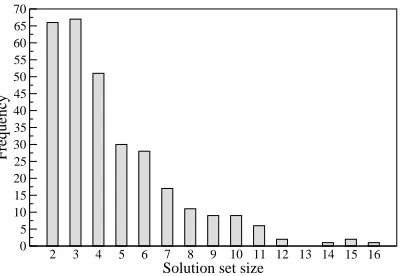
of any interaction with other users or their devices and thus constitute a generic list of steps to try out. We assume that in such a situation, the solution providers are likely to suggest simpler solutions be-fore other complex ones, leading to the solution lists being approximately ordered from low to high com-plexity. In the next section, we verify this assump-tion experimentally. In this dataset, the soluassump-tion set size varies between 2 and 16 and the average number is 4.61. Figure 1 illustrates the histogram of solution set sizes found in our corpus. We only considered problems which have no less than two solutions. All words in the corpus were lemmatized and html links and numbers were replaced with placeholders. The resulting vocabulary was approximately 2,400 word types (62,152 tokens).
Note that our dataset provides only weak super-vision for learning. The relative complexity of so-lutions for the same problem is observed, however, the relative complexity of solutions across different problems is unknown. For example, a hardware is-sue may generally receive highly complex solutions whereas a microphone issue mostly simple ones.
3.2 Task Validation
hy-B C D FAQ A 0.421 0.525 0.625 0.465
B 0.436 0.434 0.252
C 0.584 0.303
[image:4.612.103.266.53.115.2]D 0.402
Table 2: Correlation matrix for annotators (A–D) and original FAQ order using Kendall’s τ (values are
aver-ages over 100 problem-solution sets).
pothesis that the solutions in our FAQ corpus are fre-quently presented according to complexity and that this ordering is reasonable supervision for our mod-els.
Method We randomly sampled 100 solution sets (their sizes vary between 2 and 16) from the FAQ corpus described in the previous section and randomly permuted the contents of each set. Four annotators, one an author of this paper, and three graduate and undergraduate students in Computer Science were asked to order the solutions in each set from easy to most complex. An easier solution was defined as one “which takes less time or effort to carry out by a user”. The annotators saw a list of solutions for the same problem on a web interface and assigned a rank to each solution to create an or-der. No ties were allowed and a complete ordering was required to keep the annotation simple. The an-notators were fluent English speakers and had some knowledge of computer hardware and software. We refrained from including novice users in our study as they are likely to have very different personal pref-erences resulting in more divergent rankings.
Results We measured inter-annotator agreement using Kendall’sτ, a metric of rank correlation which
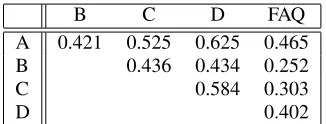
has been reliably used in information ordering eval-uations (Lapata, 2006; Bollegala et al., 2006; Mad-nani et al., 2007). τ ranges between −1 and +1, where +1 indicates equivalent rankings, −1 com-pletely reverse rankings, and 0 independent rank-ings. Table 2 shows the pairwise inter-annotator agreement as well as the agreement between each annotator and the original FAQ order. The table shows fair agreement between the annotators con-firming that this is a reasonable task for humans to do. As can be seen, there are some individual dif-ferences, with the inter-annotator agreement varying from 0.421 (for A,B) to 0.625 (for A,D).
The last column in Table 2 reports the agreement
between our annotator rankings and the original or-dering of solutions in the FAQ data. Although there is fair agreement with the FAQ providing support for its use as a gold-standard, the overallτ values are
lower compared to inter-annotator agreement. This implies that the ordering may not be strictly increas-ing in complexity in our dataset and that our models should allow for some flexibility during learning.
Several reasons contributed to disagreements be-tween annotators and with the FAQ ordering, such as the users’ expertise, personal preferences, or the nature of the solutions. For instance, annotators dis-agreed when multiple solutions were of similar com-plexity. For the first example in Table 1, all anno-tators agreed perfectly and also matched the FAQ order. For the second example, the annotators dis-agreed with each other and the FAQ.
4 Generative Models
In the following we introduce two Bayesian topic models for the complexity prediction (and rank-ing) task. In these models, complexity is captured through a discrete setDofL levels and a total
or-dering between the levels reflects their relative com-plexity. In other words,D = (d1, d2, ...dL), where d1 is easiest level andD(dm) < D(dm+1) . Each
complexity level is parametrized by a unigram lan-guage model which captures words likely to occur in solutions with that level.
Our two models are broadly similar. Their gen-erative process assigns a complexity level from D
to each solution such that it explains the words in the solution and also the ordering of solu-tions within each solution set. Words are gener-ated for each solution by mixing problem-specific words with solution-specific (and hence complexity-related) ones. Also, each problem has its own distri-bution over complexity levels which allows for some problems to have more complex solutions on aver-age, some a mix of high and low complexity solu-tions, or otherwise predominantly easier solutions.
Corpus level
For each complexity leveldm,1≤m≤L,
- Draw a complexity vocabulary distribution
φm∼Dirichlet(α)
- Draw a distribution over positions
γm∼Dirichlet(ρ)
- Draw a distributionψfor the proportion of complexity-versus problem-specific vocabulary∼Beta(δ0,δ1) Solution set level
For each solution setQiin the corpus,1≤i≤N,
- Draw a distribution over the complexity levels
θi∼Dirichlet(β)
- Draw a problem-specific vocabulary distribution
λi∼Dirichlet(ω)
Individual solution level
For each solutionxijinQi,1≤j≤NPi, - Draw a complexity level assignment,
zij∼Multinomial(θi)
- Draw a position depending on the level assigned,
rij∼Multinomial(γzij)
Word level
For each wordwijkin solutionxij,
- Draw a switch value to indicate if the word is problem- or complexity-specific,sijk∼Binomial(ψ)
[image:5.612.70.299.52.405.2]- Ifsijk= 0, drawwijk∼Multinomial(φzij) - Ifsijk= 1, drawwijk∼Multinomial(λi)
Figure 2: Generative process for the Position Model
generative process itself. The inference process of this model allows to directly uncover a canonical or-dering of the levels which explains the training data.
4.1 Expected Position model
This model infers the vocabulary associated with a complexity level and a distribution over the numer-ical positions in a solution set where such a com-plexity level is likely to occur. After inference, the model uses the position distribution to compute the expected position of each complexity level. The lev-els are ordered from low to high expected position and taken as the order of increasing complexity.
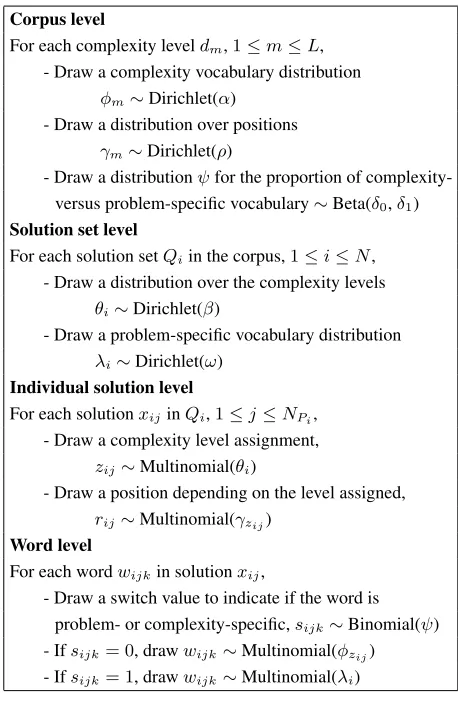
The generative process for our model is described in Figure 2. A first phase generates the latent vari-ables which are drawn once for the entire corpus. Then, variables are drawn for a solution set, next for each solution in the set, and finally for the words in the solutions. The number of complexity levels L
is a parameter in the model, while the vocabulary
size V is fixed. For each complexity level dm, we
draw one multinomial distributionφover the
vocab-ulary V, and another multinomial γ over the
pos-sible positions. These two distributions are drawn from symmetric Dirichlet priors with hyperparame-tersαandρ. Solutions will not only contain words
relating to their complexity but also to the prob-lem or malfunctioning component at hand. We as-sume these words play a minor role in determining complexity and thus draw a binomial distributionψ
that balances the amount of problem-specific ver-sus complexity-specific vocabulary. This distribu-tion has a Beta prior with hyperparametersδ0andδ1.
For each solution set, we draw a distribution over the complexity levelsθfrom another Dirichlet prior
with concentrationβ. This distribution allows each
problem to take a different preference and mix of complexity levels for its solutions. Another multino-mialλover the vocabulary is drawn for the problem-specific content of each solution set. λ is given a
symmetric Dirichlet prior with concentrationω.
For each individual solution in a set, we draw a complexity levelzfromθ, i.e., the complexity level
proportions for that problem. A position for the so-lution is then drawn from the position distribution for that level, i.e.,γz. The words in the solution are
generated by first drawing a switch value for each word indicating if the word came from the problem’s technical or complexity vocabulary. Accordingly, the word is drawn fromλorφz.
During inference, we are interested in the poste-rior of the model given the FAQ training data. Based on the conditional independencies of the model, the posterior is proportional to:
P(ψ|δ0, δ1)× L Q m=1
[P(φm|α)]× L Q m=1
[P(γm|ρ)]
×QN
i=1
[P(θi|β)]× N Q i=1
[P(λi|ω)]
×QN
i=1 NQPi
j=1
[P(zij|θi)P(rij|γzij)]
×QN
i=1 NQPi
j=1
|xQij|
k=1
[P(sijk|ψ)P(wijk|sijk, φzij, λi)]
whereLis the number of complexity levels,N the
number of problems in the training corpus,NPi the
size of solution set for problem Pi, and |xij| the
number of words in solutionxij.
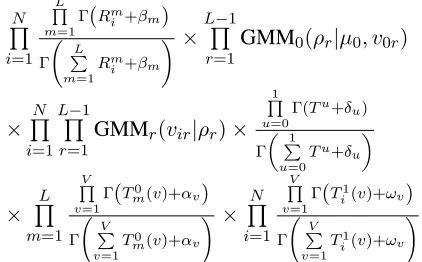
and binomial distributions allows us to integrate out the ψ, φ, γ, λand θ distributions. The simplified
posterior is proportional to:
N Q i=1 L Q m=1 Γ(Rm
i +βm)
Γ PL
m=1 Rm
i +βm
! × L Q m=1 G Q r=1 Γ(Qr
m+ρr)
Γ PG
r=1 Qr
m+ρr
!
×
1
Q
u=0 Γ(Tu+δ
u)
Γ
1
P
u=0 Tu+δu
× L Q m=1 V Q v=1 Γ(T0
m(v)+αv)
Γ PV
v=1 T0
m(v)+αv
!
× QN
i=1
V
Q
v=1 Γ(T1
i(v)+ωv)
Γ
V
P
v=1 T1
i(v)+ωv
!
where Rmi is the number of times levelm is
as-signed to a solution in problemi. Qrm is the
num-ber of times a solution with positionris given
com-plexitymover the full corpus. Positions are integer
values between 1 andG. T0andT1count the
num-ber of switch assignments of value 0 (complexity-related word) and 1 (technical word) respectively in the corpus. Tm0(v)is a refined count of the number of times word typevis assigned switch value0in a solution of complexitym.Ti1(v)counts the number of times switch value 1 is given to word typev in a
solution set for problemi.
We sample from this posterior using a collapsed Gibbs sampling algorithm. The sampling sequence starts with a random initialization to the hidden vari-ables. During each iteration, the sampler chooses a complexity level for each solution based on the current assignments to all other variables. Then the switch values for the words in each solution are sam-pled one by one. The hyperparameters are tuned us-ing grid search on development data. The language model concentrationsα, ρ and ω are given values less than 1 to obtain sparse distributions. The prior on θ, the topic proportions, is chosen to be greater
than 1 to encourage different complexity levels to be used within the same problem rather than assigning all solutions to the same one or two levels. Similarly,
δ0andδ1are>1. We run 5,000 sampling iterations
and use the last sample as a draw from the posterior. Using these assignments, we also compute an esti-mate for the parametersφm,λi andγm. For
exam-ple, the probability of a wordv inφm is computed
as T0
m(v)+αv
P
v(Tm0(v)+αv).
After inference, we obtain probability
distribu-tions for each complexity leveldmover the
vocabu-laryφmand positionsγm. We compute the expected
positionEpofdmas:
Ep(dm) = G X
pos=1
pos∗γm(pos) (1)
where pos indicates position values. Then, we rank the levels in increasing order ofEp.
4.2 Permutations-based model
In our second model we incorporate the ordering of complexity levels in the generative process itself. This is achieved by using the Generalized Mallows Model (GMM; Fligner and Verducci (1986)) within our hierarchical generative process. The GMM is a probabilistic model over permutations of items and is frequently used to learn a consensus ordering given a set of different rankings. It assumes there is an underlying canonical order of items and concen-trates probability mass on those permutations that differ from the canonical order by a small amount, while assigning lesser probability to very divergent permutations. Probabilistic inference in this model uncovers the canonical ordering.
The standard Mallows model (Mallows, 1957) has two parameters, a canonical ordering σ and a
dispersion penaltyρ > 0. The probability of an ob-served orderingπis defined as:
P(π|ρ,σ) = e−
ρd(π,σ)
ξ(ρ) ,
where d(π, σ) is a distance measure such as Kendall’sτ, between the canonical orderingσ and
an observed ordering π. The GMM decomposes
d(π, σ) in a way that captures item-specific dis-tance. This is done by computing an inversion vec-tor representation ofd(π, σ). A permutationπofn
items can be equivalently represented by a vector of inversion countsvof lengthn−1, where each com-ponentviequals the number of itemsj > ithat
oc-cur before itemiinπ. The dimension ofvisn−1 since there can be no items greater than the high-est value element. A unique inversion vector can be computed for any permutation and vice versa, and the sum of the inversion vector elements is equal tod(π, σ). Eachvi is also given a separate
disper-sion penaltyρi. Then, the GMM is defined as:
GMM(v|ρ)∝Y
i
Corpus level
For each complexity leveldm,1≤m≤L,
- Draw a complexity vocabulary distribution
φm∼Dirichlet(α)
- Draw theL−1dispersion parameters
ρr∼GMM0(µ0,v0r)
- Draw a distributionψfor the proportion of complexity-versus problem-specific vocabulary∼Beta(δ0,δ1) Solution set level
For each solution setQiin the corpus,1≤i≤N,
- Draw a distribution over the complexity levels
θi∼Dirichlet(β)
- Draw a problem-specific vocabulary distribution
λi∼Dirichlet(ω)
- Draw a bag ofNPilevels for the solution set bi∼Multinomial(θi)
- Draw an inversion vectorvi
vi∼GMM(ρ)
- Compute permutationπiof levels usingvi - Compute level assignmentsziusingπiandbi.
Assign levelzijtoxijfor1≤j≤NPi.
Word level
For each wordwijkin solutionxij,
- Draw a switch value to indicate if the word is problem- or complexity-specific,sijk∼Binomial(ψ)
[image:7.612.320.531.510.641.2]- Ifsijk= 0, drawwijk∼Multinomial(φzij) - Ifsijk= 1, drawwijk∼Multinomial(λi)
Figure 3: Generative process for Permutation Model.
And can be further factorized into item-specific components:
GMMi(vi|ρi)∝e−ρivi (3)
Since the GMM is a member of the exponential fam-ily, a conjugate prior can be defined for each disper-sion parameter ρi which allows for efficient
infer-ence. We refer the interested reader to Chen et al. (2009a) for details on the prior distribution and nor-malization factor for the GMM distribution.
Figure 3 formalizes the generative story of our own model which uses the GMM as a component. We assume the canonical order is the strictly increas-ing(1,2, .., L)order. For each complexity leveldm,
we draw a distributionφ over the vocabulary. We
also drawL−1dispersion parameters from the con-jugate prior GMM0 density. Hyperparameters for
this prior are set in a similar fashion to Chen et al. (2009a). As in the position model, we draw
a binomial distribution, ψ (with a beta prior) over complexity- versus problem-specific vocabulary. At the solution set level, we draw a multinomial dis-tribution λ over the vocabulary and a multinomial
distributionθfor the proportion ofLlevels for this
problem. Both these distributions have Dirichlet pri-ors. Next, we generate an ordering for the complex-ity levels. We drawNPi complexity levels from θ,
one for each solution in the set. Letb denote this bag of levels (e.g.,b = (1,1,2,3,4,4,4)assuming 4 complexity levels and 7 solutions for a particular problem). We also draw an inversion vectorvfrom the GMM distribution which advantageously allows for small differences from the canonical order. The
zassignments are deterministically computed by
or-dering the elements ofb according to the permuta-tion defined byv.
Given the conditional independencies of our model, the posterior is proportional to:
L Q m=1
[P(φm|α)]× LQ−1
r=1
[P(ρr|µ0, v0r)]×P(ψ|δ0, δ1)
×QN
i=1
[P(θi|β)×P(λi|ω)×P(vi|ρ)×P(bi|θi)]
×QN
i=1 NQPi
j=1
|xQij|
k=1
[P(sijk|ψ)P(wijk|sijk, φzij, λi)]
whereLis the number of complexity levels,N the total problems in the training corpus, NPi the size
of solution set for problemPi, and|xij|the number
of words in solutionxij. A simplified posterior can
be obtained by integrating out the ψ, φ, λ, and θ
distributions which is proportional to:
N Q i=1 L Q m=1 Γ(Rm
i +βm)
Γ PL
m=1 Rm
i +βm
!×LQ−1
r=1
GMM0(ρr|µ0, v0r)
×QN
i=1 LQ−1
r=1GMMr
(vir|ρr)× 1
Q
u=0
Γ(Tu+δu)
Γ
1
P
u=0 Tu+δu
× QL
m=1
V
Q
v=1 Γ(T0
m(v)+αv)
Γ PV
v=1 T0
m(v)+αv
!× N Q i=1 V Q v=1 Γ(T1
i(v)+ωv)
Γ PV
v=1 T1
i(v)+ωv
!
where theRandTcounts are defined similarly as in
the Expected Position model.
Level 1
free, space, hard, drive, sure, range, make, least, more, op-erate, than, point, less, cause, slowly, access, may, problem
Level 2
use, can, media, try, center, signal, network, make, file, sure, when, case, with, change, this, setting, type, remove
Level 19
system, file, this, restore, do, can, then, use, hard, issue, NUM, will, disk, start, step, above, run, cleanup, drive, xp
Level 20
[image:8.612.312.540.46.405.2]registry, restore, may, virus, use, bio, setting, scanreg, first, ensure, can, page, about, find, install, additional, we, utility
Table 3: Most likely words assigned to varying complex-ity levels by the permutations-based model.
randomly initializes the hidden variables. For a cho-sen solution set Si, the sampler draws NPi levels
(bi), one at a time conditioned on the assignments
to all other hidden variables of the model. Then the inversion vectorviis created by sampling each
vij in turn. At this point, the complexity level
as-signmentszican be done deterministically givenbi
and vi. Then the words in each solution set are
sampled one at a time. For the dispersion parame-ters,ρ, the normalization constant of the conjugate prior is not known. We sample from the unnormal-ized GMM0distribution using slice sampling.
Other hyperparameters of the model are tuned us-ing development data. The language model Dirichlet concentrations (α,ω) are chosen to encourage spar-sity and β > 1 as in the position model. We run the Gibbs sampler for 5,000 iterations; the disper-sion parameters are resampled every 10 iterations. The last sample is used as a draw from the posterior.
4.3 Model Output
In this section we present examples of the complex-ity assignments created by our models. Table 3 shows the output of the permutations-based model with 20 levels. Each row contains the highest prob-ability words in a single level (from the distribu-tionφm). For the sake of brevity, we only show the
two least and most complex levels. In general, we observe more specialized, technical terms in higher levels (e.g., restore, scanreg, registry) which one would expect to correlate with complex solutions. Also note that higher levels contain uncertainty de-noting words (e.g.,can, find, may) which again are indicative of increasing complexity.
Using these complexity vocabularies, our models
Low complexity
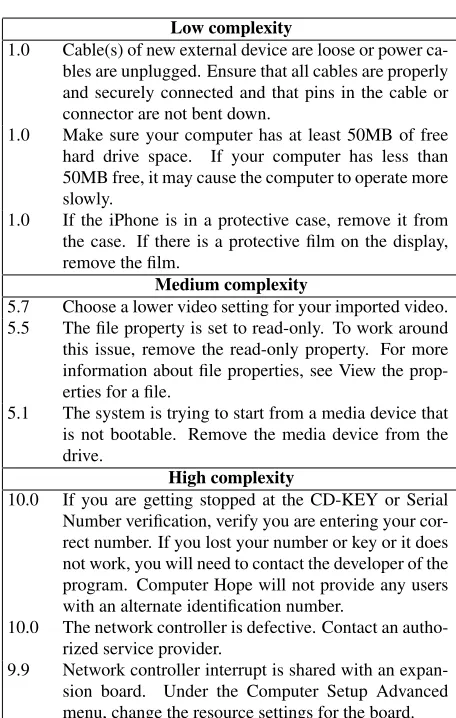
1.0 Cable(s) of new external device are loose or power ca-bles are unplugged. Ensure that all caca-bles are properly and securely connected and that pins in the cable or connector are not bent down.
1.0 Make sure your computer has at least 50MB of free hard drive space. If your computer has less than 50MB free, it may cause the computer to operate more slowly.
1.0 If the iPhone is in a protective case, remove it from the case. If there is a protective film on the display, remove the film.
Medium complexity
5.7 Choose a lower video setting for your imported video. 5.5 The file property is set to read-only. To work around this issue, remove the read-only property. For more information about file properties, see View the prop-erties for a file.
5.1 The system is trying to start from a media device that is not bootable. Remove the media device from the drive.
High complexity
10.0 If you are getting stopped at the CD-KEY or Serial Number verification, verify you are entering your cor-rect number. If you lost your number or key or it does not work, you will need to contact the developer of the program. Computer Hope will not provide any users with an alternate identification number.
10.0 The network controller is defective. Contact an autho-rized service provider.
9.9 Network controller interrupt is shared with an expan-sion board. Under the Computer Setup Advanced menu, change the resource settings for the board.
Table 4: Example solutions with low, medium and high expected complexity values (position-based model with 10 complexity levels). The solutions come from various problem-solution sets in the training corpus. Expected complexity values are shown in the first column.
can compute the expected complexity for any so-lution text,x. This value is given by [PLm=1m∗ p(m|x)]. We estimate the second term, p(m|x), using a) the complexity level language modelsφm
Low Complexity Problems
- Computer appears locked up and will not turn off when the power button is pressed.
- A USB device, headphone, or microphone is not recognized by the computer.
- Computer will not respond to USB keyboard or mouse. High Complexity Problems
- Game software and driver issues.
- Incorrect, missing or stale visible networks.
- I get an error message that says that there is not enough disk space to publish the movie. What can I do?
[image:9.612.71.296.56.215.2]- Power LED flashes Red four times, once every second, fol-lowed by two second pause, and computer beeps four times.
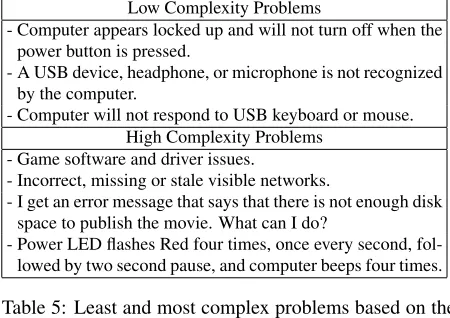
Table 5: Least and most complex problems based on the expected complexity of their solution set. Problems are shown with complexity 1–3 (top) and 8–9 (bottom) using the position-based model.
As mentioned earlier, our models only observe the relative ordering of solutions to individual problems; the relative complexity of two solutions from differ-ent problems is not known. Nevertheless, the models are able to rate solutions on a global scale while ac-commodating problem-specific ordering sequences. Specifically, we can compute the expected complex-ity of the solution set for problem i, using the
in-ferred distribution over levelsθi: PLm=1m×θim.
Table 5 shows the complexity of different problems as predicted by the position model (with 10 levels). As can be seen, easy problems are associated with accessory components (e.g., mouse or keyboard), whereas complex problems are related to core hard-ware and operating system errors.
5 Evaluation Experiments
In the previous section, we showed how our mod-els can assign an expected complexity value to a so-lution text or an entire problem. Now, we present evaluations based on model ability to order solutions according to relative complexity.
5.1 Solution Ordering Task
We evaluated our models by presenting them with a randomly permuted set of solutions to a problem and examining the accuracy with which they reorder them from least to most complex. At first instance, it would be relatively straightforward to search for the sequence of solutions which has high likelihood under the models. Unfortunately, there are two prob-lems with this approach. Firstly, the likelihood un-der our models is intractable to compute, so we
would need to adopt a simpler and less precise ap-proximation (such as the Hidden Markov Model dis-cussed below). Secondly, when the solution set size is large, we cannot enumerate all permutations and need to adopt an approximate search procedure.
We opted for a discriminative ranking approach instead which uses the generative models to compute a rich set of features. This choice allows us to simul-taneously obtain features tapping on to different as-pects learned by the models and to use well-defined objective functions. Below, we briefly describe the features based on our generative models. We also present additional features used to create baselines for system comparison.
Likelihood We created a Hidden Markov Model based on the sample from the posterior of our mod-els (for a similar HMM approximation of a Bayesian model see Elsner et al. (2007)). For our model, the HMM hasL states, and each statesm corresponds
to a complexity level dm. We used the
complex-ity language models φm estimated from the
poste-rior as the emission probability distribution for the corresponding states. The transition probabilities of the HMM were computed based on the complexity level assignments for the training solution sequences in our posterior sample. The probability of transi-tioning to statesj from statesi,p(sj|si), is the
con-ditional probability p(dj|di) computed as c(cd(id,di)j),
wherec(di, dj)is the number of times the
complex-ity leveldjis assigned to a solution immediately
fol-lowing a solution which was given complexitydi. c(di) is the number of times complexity leveldi is
assigned overall in the training corpus. We perform Laplace smoothing to avoid zero probability transi-tions between states:
p(sj|si) =
c(di, dj) + 1
c(di) +L (4)
This HMM formulation allows us to use efficient dy-namic programming to compute the likelihood of a sequence of solutions.
values were set using minimal tuning on the devel-opment data. After estimating the most likely se-quence for a solution set, we used the predicted rank of each solution as a feature in our discriminative model.
Expected Complexity As mentioned earlier, we computed the expected complexity of a solution x
as[PLm=1m∗p(m|x)], where the second term was estimated using a complexity level specific language model φm and a uniform prior over levels on the
test set. As additional features, we used the solu-tion’s perplexity under eachφm, and under each of
the technical topicsλi, and also the most likely level
for the textarg maxmp(m|x). Finally, we included
features for each word in the training data. The fea-ture value is the word’s expected level multiplied by the probability of the word in the solution text.
Length We also investigated whether solution length is a predictor of complexity (e.g., simple so-lutions may vary in length and amount of detail from complex ones). We devised three features based on the number of sentences (within a solution), words, and average sentence length.
Syntax/Semantics Another related class of fea-tures estimates solution complexity based on sen-tence structure and meaning. We obtained eight syntactic features based on the number of nouns, verbs, adjectives and adverbs, prepositions, pro-nouns, wh-adverbs, modals, and punctuation. Other features compute the average and maximum depth of constituent parse trees. The part-of-speech tags and parse trees were obtained using the Stanford CoreNLP toolkit (Manning et al., 2014). In addi-tion, we computed 10 semantic features using Word-Net (Miller, 1995). They are the average num-ber of senses for each category (noun, verb, adjec-tive/adverb), and the maximum number of senses for the same three classes. We also include the aver-age and maximum lengths of the path to the root of the hypernym tree for nouns and verbs. This class of features roughly approximates the indicators typ-ically used in predicting text readability (Schwarm and Ostendorf, 2005; McNamara et al., 2014).
5.2 Experimental Setup
We performed 10-fold cross-validation. We trained the ranking model on 240 problem-solution sets; 30 sets were reserved for development and 30 for
testing (in each fold). The most frequent 20 words in each training set were filtered as stopwords. The de-velopment data was used to tune the parameters and hyperparameters of the models and the number of complexity levels. We experimented with ranges[5– 20]and found that the best number of levels was 10 for the position model and 20 for the permutation-based model, respectively. For the expected posi-tion model, posiposi-tions were normalized before train-ing. Let solutionxir denote therth solution in the
solution set for problemPi, where1 ≤ r ≤ NPi.
We normalize r to a value between 0 and 1 using a min-max method: r0 = Nr−1
Pi−1. Then the [0–1]
range is divided intokbins. The identity of the bin containingr0 is taken as the normalized position,r.
We tunedkexperimentally during development and
found thatk= 3performed best.
For our ordering experiments we used Joachims’ (2006) SVMRank package for training and testing. During training, the classifier learns to minimize the number of swapped pairs of solutions over the train-ing data. We used a linear kernel and the regulariza-tion parameter was tuned using grid search on the development data of each fold. We evaluate how well the model’s output agrees with gold-standard ordering using Kendall’sτ.
5.3 Results
Table 6 summarizes our results (average Kendall’sτ
across folds). We present the results of the dis-criminative ranker when using a single feature class based on likelihood and expected complexity (Posi-tion, Permutation), length, and syntactico-semantic features (SynSem), and their combinations (denoted via+). We also report the performance of a base-line which computes a random permutation for each solution set (Random; results are averaged over five runs). We show results for all solution sets (All) and broken down into different set sizes (e.g., 2–3, 4–5). As can be seen, the expected position model ob-tains an overallτ of 0.30 and the permutation model
Solution set sizes
Model 2–3 4–5 >5 All
(133) (81) (86) (300) Random -0.002 0.027 -0.006 0.004 Length -0.052 -0.066 -0.028 -0.002 SynSem 0.167 0.109 0.149 0.146 Length+SynSem 0.122 0.109 0.158 0.129
Position 0.288 0.242 0.381 0.302
+Length 0.283 0.251 0.363 0.297
+SynSem 0.343 0.263 0.367 0.328 +SynSem+Length 0.348 0.263 0.368 0.331
Permutation 0.253 0.206 0.341 0.265
+Length 0.213 0.229 0.356 0.258
[image:11.612.329.522.53.208.2]+SynSem 0.268 0.263 0.353 0.291 +SynSem+Length 0.253 0.254 0.354 0.282
Table 6: Kendall’s τ values on the solution reorder-ing task usreorder-ing 10-fold cross-validation and SVM rankreorder-ing models with different features. The results are broken down by solution set size (the number of sets per size is shown within parentheses). Boldface indicates the best performing model for each set size.
SynSem features which measure the complexity of writing in the text are somewhat better but still in-ferior compared to Position and Permutation. Us-ing a paired Wilcoxon signed-rank test, we com-pared the τ values obtained by the different
mod-els. The Position and Permutation performed sig-nificantly better (p <0.05) compared to Random, Length and SynSem baselines. However, τ
differ-ences between Position and Permutation are not sta-tistically significant. With regard to feature com-binations, we observe that both models yield bet-ter performance when combined with Length or SynSem. The Position model improves with the addition of both Length and SynSem, whereas the Permutation model combines best with SynSem features. The Position+SynSem+Length model is significantly better than Permutation (p <0.05) but not Permutation+SynSem+Length or Position alone (again under the Wilcoxon test).
These results suggest that the solution ordering task is challenging with several factors influencing how a solution is perceived: the words used and their meaning, the writing style of the solution, and the amount of detail present in it. Our data comes from the FAQs produced by computer and operat-ing system manufacturers and other well-managed websites. As a result, the text in the FAQ solutions is of high quality. However, the same is not true
Model Rank 1 Rankn Both
Random 15.3 14.6 3.4
Length 18.1 16.3 6.8
SynSem 19.8 19.8 4.3
SynSem+Length 20.6 25.0 5.1
Position 31.0 37.0 13.7
+Length 36.2 36.2 18.9
+SynSem 34.4 35.3 16.3
+SynSem+Length 36.2 35.3 17.2 Permutation 28.4 37.0 12.0
+Length 30.1 37.0 15.5
+synsem 32.7 37.0 13.7
+SynSem+Length 32.7 37.9 13.7
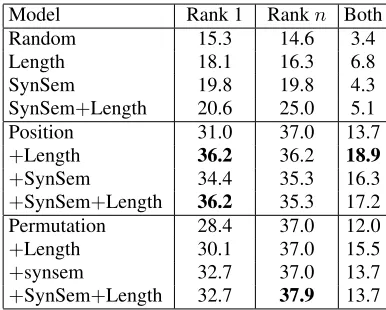
Table 7: Model accuracy at predicting the easiest solution correctly (Rank 1), the most difficult one (Rank n), or
both. Bold face indicates the best performing model for each rank.
for community-generated solution texts on discus-sion forums. In the latter case, we conjecture that the style of writing is likely to play a bigger role in how users perceive complexity. We thus expect that the benefit of adding Length and SynSem features will become stronger when we apply our models to texts from online forums.
We also computed how accurately the models identify the least and most complex solutions. For solution sets of size 5 and above (so that the task is non-trivial) we computed the number of times the rank one solution given by the models was also the easiest according to the FAQ gold-standard. Like-wise, we also computed how often the models cor-rectly predict the most complex solution. With Ran-dom rankings, the easiest and most difficult solu-tions are predicted correctly 15% of the time. Get-ting both correct for a single problem happens only 3% of the time. The Position+Length model overall performs best, identifying the easiest and most diffi-cult solution 36% of the time. Both types of solution are identified correctly 18% of the time. Interest-ingly, the generative models are better at predicting the most difficult solution (35–37%) compared to the easiest one (28–36%). One reason for this could be that there are multiple easy solutions to try out but the most difficult one is probably more unique and so easier to identify.
[image:11.612.82.291.53.229.2]be-tween the models is that during training Permutation observes the full ordering of solutions while Posi-tion observes soluPosi-tions coming from a few normal-ized position bins. Also note that in the Permuta-tion model, multiple soluPermuta-tions with the same com-plexity level are grouped together in a solution set. This property of the model is advantageous for or-dering as solutions with similar complexity should be placed adjacent to each other. At the same time, if levels 1 and 2 are flipped in the permutation sampled from the GMM, then any solution with complexity level 1 will be ordered after the solution with com-plexity 2. The Position model on the other hand, contains no special facility for grouping solutions with the same complexity. In sum, Position can more flexibly assign complexity levels to individual solutions.
6 Conclusion
This work contains a first proposal to organize and navigate crowd-generated troubleshooting data cording to the complexity of the troubleshooting ac-tion. We showed that users perceive and agree on the complexity of alternative suggestions, and presented Bayesian generative models of the troubleshooting data which can sort solutions by complexity with a performance close to human agreement on the task.
Our results suggest that search and summariza-tion tools for troubleshooting forum archives can be greatly improved by automatically predicting and using the complexity of the posted solutions. It should also be possible to build broad coverage au-tomated troubleshooting systems by bootstrapping from conversations in discussion forums. In the fu-ture, we plan to deploy our models in several tasks such as user authority prediction, expert interven-tion, and thread analysis. Furthermore, we aim to specialize our models to include category-specific complexity levels and also explore options for per-sonalizing rankings for individual users based on their knowledge of a topic and the history of their troubleshooting actions.
Acknowledgements
We would like to thank the editor and the anony-mous reviewers for their valuable feedback on an earlier draft of this paper. We are also thankful to members of the Probabilistic Models of Language reading group at the University of Edinburgh for
their many suggestions and helpful discussions. The first author was supported by a Newton International Fellowship (NF120479) from the Royal Society and the British Academy.
References
R. Barzilay and M. Lapata. 2008. Modeling local coher-ence: An entity-based approach. Computational Lin-guistics, 34(1):1–34.
R. Barzilay and L. Lee. 2004. Catching the drift: Proba-bilistic content models, with applications to generation and summarization. In Proceedings of NAACL-HLT, pages 113–120.
D. Bollegala, N. Okazaki, and M. Ishizuka. 2006. A bottom-up approach to sentence ordering for multi-document summarization. In Proceedings of
COLING-ACL, pages 385–392.
S. R. K. Branavan, H. Chen, L. S. Zettlemoyer, and R. Barzilay. 2009. Reinforcement learning for map-ping instructions to actions. InProceedings of
ACL-IJCNLP, pages 82–90.
S. R. K. Branavan, D. Silver, and R. Barzilay. 2011. Learning to win by reading manuals in a Monte-Carlo framework. InProceedings of ACL-HLT, pages 268– 277.
H. Chen, S. R. K. Branavan, R. Barzilay, and D. R. Karger. 2009a. Content modeling using latent per-mutations. Journal of Artificial Intelligence Research, 36(1):129–163.
H. Chen, S.R.K. Branavan, R. Barzilay, and D.R. Karger. 2009b. Global models of document structure using latent permutations. InProceedings of NAACL-HLT, pages 371–379.
J. Eisenstein, J. Clarke, D. Goldwasser, and D. Roth. 2009. Reading to learn: Constructing features from semantic abstracts. InProceedings of EMNLP, pages 958–967.
M. Elsner, J. Austerweil, and E. Charniak. 2007. A uni-fied local and global model for discourse coherence.
InProceedings of NAACL-HLT, pages 436–443.
M. A. Fligner and J. S. Verducci. 1986. Distance-based ranking models. Journal of the Royal Statistical Soci-ety, Series B, pages 359–369.
D. Heckerman, J. S. Breese, and K. Rommelse. 1995. Decision-theoretic troubleshooting. Communications of the ACM, 38(3):49–57.
T. Joachims. 2006. Training linear SVMs in linear time.
InProceedings of KDD, pages 217–226.
S. Kim, L. Cavedon, and T. Baldwin. 2010. Classifying dialogue acts in one-on-one live chats. InProceedings
M. Lapata. 2003. Probabilistic text structuring: Experi-ments with sentence ordering. InProceedings of ACL, pages 545–552.
M. Lapata. 2006. Automatic evaluation of information ordering. Computational Linguistics, 32(4):471–484. M. Lui and T. Baldwin. 2009. Classifying user forum
participants: Separating the gurus from the hacks, and other tales of the internet. InProceedings of the 2010
Australasian Language Technology Workshop, pages
49–57.
N. Madnani, R. Passonneau, N. Ayan, J. Conroy, B. Dorr, J. Klavans, D. O’Leary, and J. Schlesinger. 2007. Measuring variability in sentence ordering for news summarization. In Proceedings of the Eleventh
Eu-ropean Workshop on Natural Language Generation.
C. L. Mallows. 1957. Non-null ranking models. i.
Biometrika, 44(1/2):pp. 114–130.
C. D. Manning, M. Surdeanu, J. Bauer, J. Finkel, S. J. Bethard, and D. McClosky. 2014. The Stanford CoreNLP natural language processing toolkit. In
Pro-ceedings of ACL: System Demonstrations, pages 55–
60.
D. S. McNamara, A. C. Graesser, P. M. McCarthy, and Z. Cai. 2014. Automated evaluation of text and
dis-course with Coh-Metrix. Cambridge University Press.
G. A. Miller. 1995. WordNet: a lexical database for English. Communication of the ACM, 38(11):39–41. S. Schwarm and M. Ostendorf. 2005. Reading level
as-sessment using support vector machines and statistical language models. InProceedings of ACL, pages 523– 530.
A. Vogel and D. Jurafsky. 2010. Learning to follow navigational directions. InProceedings of ACL, pages 806–814.