The Effect of Corpus Size on Case Frame Acquisition
for Discourse Analysis
Ryohei Sasano Graduate School of Informatics,
Kyoto University [email protected]
Daisuke Kawahara National Institute of Information and Communications Technology
Sadao Kurohashi Graduate School of Informatics,
Kyoto University [email protected]
Abstract
This paper reports the effect of corpus size on case frame acquisition for discourse analysis in Japanese. For this study, we collected a Japanese corpus consisting of up to 100 bil-lion words, and constructed case frames from corpora of six different sizes. Then, we ap-plied these case frames to syntactic and case structure analysis, and zero anaphora resolu-tion. We obtained better results by using case frames constructed from larger corpora; the performance was not saturated even with a corpus size of 100 billion words.
1 Introduction
Very large corpora obtained from the Web have been successfully utilized for many natural lan-guage processing (NLP) applications, such as prepo-sitional phrase (PP) attachment, other-anaphora res-olution, spelling correction, confusable word set dis-ambiguation and machine translation (Volk, 2001; Modjeska et al., 2003; Lapata and Keller, 2005; At-terer and Sch¨utze, 2006; Brants et al., 2007).
Most of the previous work utilized only the sur-face information of the corpora, such as n-grams, co-occurrence counts, and simple surface syntax. This may be because these studies did not require structured knowledge, and for such studies, the size of currently available corpora is considered to have been almost enough. For instance, while Brants et al. (2007) reported that translation quality continued to improve with increasing corpus size for training language models at even size of 2 trillion tokens, the
increase became small at the corpus size of larger than 30 billion tokens.
However, for more complex NLP tasks, such as case structure analysis and zero anaphora resolution, it is necessary to obtain more structured knowledge, such as semantic case frames, which describe the cases each predicate has and the types of nouns that can fill a case slot. Note that case frames offer not only the knowledge of the relationships between a predicate and its particular case slot, but also the knowledge of the relationships among a predicate and its multiple case slots. To obtain such knowl-edge, very large corpora seem to be necessary; how-ever it is still unknown how much corpora would be required to obtain good coverage.
For examples, Kawahara and Kurohashi pro-posed a method for constructing wide-coverage case frames from large corpora (Kawahara and Kuro-hashi, 2006b), and a model for syntactic and case structure analysis of Japanese that based upon case frames (Kawahara and Kurohashi, 2006a). How-ever, they did not demonstrate whether the coverage of case frames was wide enough for these tasks and how dependent the performance of the model was on the corpus size for case frame construction.
This paper aims to address these questions. We collect a very large Japanese corpus consisting of about 100 billion words, or 1.6 billion unique sen-tences from the Web. Subsets of the corpus are ran-domly selected to obtain corpora of different sizes ranging from 1.6 million to 1.6 billion sentences. We construct case frames from each corpus and ap-ply them to syntactic and case structure analysis, and zero anaphora resolution, in order to investigate the
relationships between the corpus size and the perfor-mance of these analyses.
2 Related Work
Many NLP tasks have successfully utilized very large corpora, most of which were acquired from the Web (Kilgarriff and Grefenstette, 2003). Volk (2001) proposed a method for resolving PP attach-ment ambiguities based upon Web data. Modjeska et al. (2003) used the Web for resolving nominal anaphora. Lapata and Keller (2005) investigated the performance of web-based models for a wide range of NLP tasks, such as MT candidate selection, ar-ticle generation, and countability detection. Nakov and Hearst (2008) solved relational similarity prob-lems using the Web as a corpus.
With respect to the effect of corpus size on NLP tasks, Banko and Brill (2001a) showed that for content sensitive spelling correction, increasing the training data size improved the accuracy. Atterer and Sch¨utze (2006) investigated the effect of cor-pus size in combining supervised and unsupervised learning for two types of attachment decision; they found that the combined system only improved the performance of the parser for small training sets. Brants et al. (2007) varied the amount of language model training data from 13 million to 2 trillion to-kens and applied these models to machine transla-tion systems. They reported that translatransla-tion qual-ity continued to improve with increasing corpus size for training language models at even size of 2 tril-lion tokens. Suzuki and Isozaki (2008) provided ev-idence that the use of more unlabeled data in semi-supervised learning could improve the performance of NLP tasks, such as POS tagging, syntactic chunk-ing, and named entities recognition.
There are several methods to extract useful infor-mation from very large corpora. Search engines, such as Google and Altavista, are often used to ob-tain Web counts (e.g. (Nakov and Hearst, 2005; Gledson and Keane, 2008)). However, search en-gines are not designed for NLP research and the re-ported hit counts are subject to uncontrolled vari-ations and approximvari-ations. Therefore, several re-searchers have collected corpora from the Web by themselves. For English, Banko and Brill (2001b) collected a corpus with 1 billion words from
vari-ety of English texts. Liu and Curran (2006) created a Web corpus for English that contained 10 billion words and showed that for content-sensitive spelling correction the Web corpus results were better than using a search engine. Halacsy et al. (2004) created a corpus with 1 billion words for Hungarian from the Web by downloading 18 million pages. Others utilize publicly available corpus such as the North American News Corpus (NANC) and the Gigaword Corpus (Graff, 2003). For instance, McClosky et al. (2006) proposed a simple method of self-training a two phase parser-reranker system using NANC.
As for Japanese, Kawahara and Kurohashi (2006b) collected 23 million pages and created a corpus with approximately 20 billion words. Google released Japanese n-gram constructed from 20 bil-lion Japanese sentences (Kudo and Kazawa, 2007). Several news wires are publicly available consisting of tens of million sentences. Kotonoha project is now constructing a balanced corpus of the present-day written Japanese consisting of 50 million words (Maekawa, 2006).
3 Construction of Case Frames
Case frames describe the cases each predicate has and what nouns can fill the case slots. In this study, case frames we construct case frames from raw cor-pora by using the method described in (Kawahara and Kurohashi, 2006b). This section illustrates the methodology for constructing case frames.
3.1 Basic Method
After parsing a large corpus by a Japanese parser KNP1, we construct case frames from modifier-head
examples in the resulting parses. The problems for case frame construction are syntactic and semantic ambiguities. In other words, the resulting parses evitably contain errors and predicate senses are in-trinsically ambiguous. To cope with these problems, we construct case frames from reliable modifier-head examples.
First, we extract modifier-head examples that had no syntactic ambiguity, and assemble them by cou-pling a predicate and its closest case component. That is, we assemble the examples not by predi-cates, such astsumu(load/accumulate), but by
Table 1: Examples of Constructed Case Frames. Case slot Examples Generalized examples with rate
ga(nominative) he, driver, friend,· · · [CT:PERSON]:0.45, [NE:PERSON]:0.08,· · · tsumu(1) wo(accusative) baggage, luggage, hay,· · · [CT:ARTIFACT]:0.31,· · ·
(load) ni(dative) car, truck, vessel, seat,· · · [CT:VEHICLE]:0.32,· · ·
tsumu(2) ga(nominative) player, children, party,· · · [CT:PERSON]:0.40, [NE:PERSON]:0.12,· · ·
(accumulate) wo(accusative) experience, knowledge,· · · [CT:ABSTRACT]:0.47,· · ·
... ... ...
ga(nominative) company, Microsoft, firm,· · · [NE:ORGANIZATION]:0.16, [CT:ORGANIZATION]:0.13,· · · hanbai(1) wo(accusative) goods, product, ticket,· · · [CT:ARTIFACT]:0.40, [CT:FOOD]:0.07,· · ·
(sell) ni(dative) customer, company, user,· · · [CT:PERSON]:0.28,· · ·
de(locative) shop, bookstore, site· · · [CT:FACILITY]:0.40, [CT:LOCATION]:0.39,· · ·
... ... ...
ples, such asnimotsu-wo tsumu(load baggage) and keiken-wo tsumu (accumulate experience). Such couples are considered to play an important role for constituting sentence meanings. We call the as-sembled examples as basic case frames. In order to remove inappropriate examples, we introduce a thresholdαand use only examples that appeared no less thanαtimes in the corpora.
Then, we cluster the basic case frames to merge similar case frames. For example, since nimotsu-wo tsumu(load baggage) andbusshi-wo tsumu(load supplies) are similar, they are merged. The similar-ity is measured by using a Japanese thesaurus (The National Language Institute for Japanese Language, 2004). Table 1 shows examples of constructed case frames.
3.2 Generalization of Examples
When we use hand-crafted case frames, the data sparseness problem is serious; by using case frames automatically constructed from a large corpus, it was alleviated to some extent but not eliminated. For in-stance, there are thousands of named entities (NEs) that cannot be covered intrinsically. To deal with this problem, we generalize the examples of the case slots. Kawahara and Kurohashi also generalized ex-amples but only for a few types. In this study, we generalize case slot examples based upon common noun categories and NE classes.
First, we generalize the examples based upon the categories that tagged by the Japanese morpholog-ical analyzer JUMAN2. In JUMAN, about 20
cat-egories are defined and tagged to common nouns. For example, ringo (apple), inu (dog) and byoin
2http://nlp.kuee.kyoto-u.ac.jp/nl-resource/juman-e.html
Table 2: Definition of NE in IREX.
NE class Examples
ORGANIZATION NHK Symphony Orchestra
PERSON Kawasaki Kenjiro
LOCATION Rome, Sinuiju
ARTIFACT Nobel Prize
DATE July 17, April this year
TIME twelve o’clock noon
MONEY sixty thousand dollars
PERCENT 20%, thirty percents
(hospital) are tagged as FOOD, ANIMAL and FA-CILITY, respectively. For each category, we calcu-late the ratio of the categorized example among all case slot examples, and add it to the case slot (e.g. [CT:FOOD]:0.07).
We also generalize the examples based upon NE classes. We use a common standard NE defini-tion for Japanese provided by the IREX (1999). We first recognize NEs in the source corpus by using an NE recognizer (Sasano and Kurohashi, 2008); and then construct case frames from the NE-recognized corpus. Similar to the categories, for each NE class, we calculate the NE ratio among all the case slot examples, and add it to the case slot (e.g. [NE:PERSON]:0.12). The generalized exam-ples are also included in Table 1.
4.1 Model for Syntactic and Case Structure Analysis
Kawahara and Kurohashi (2006a) proposed an in-tegrated probabilistic model for Japanese syntactic and case structure analysis based upon case frames. Case structure analysis recognizes predicate argu-ment structures. Their model gives a probability to each possible syntactic structure T and case struc-tureLof the input sentenceS, and outputs the syn-tactic and case structure that have the highest proba-bility. That is to say, the system selects the syntactic structureTbestand the case structureLbestthat
max-imize the probabilityP(T, L|S):
(Tbest, Lbest) = argmax
(T,L)
P(T, L|S)
= argmax
(T,L)
P(T, L, S) (1) The last equation is derived becauseP(S) is con-stant.P(T, L, S)is defined as the product of a prob-ability for generating a clauseCias follows:
P(T, L, S) = ∏
i=1..n
P(Ci|bhi) (2)
where nis the number of clauses in S, and bhi is
Ci’s modifying bunsetsu3. P(Ci|bhi) is
approxi-mately decomposed into the product of several gen-erative probabilities such asP(A(sj) = 1|CFl, sj)
andP(nj|CFl, sj, A(sj) = 1), where the function
A(sj)returns 1 if a case slotsjis filled with an input
case component; otherwise 0.P(A(sj)=1|CFl, sj)
denotes the probability that the case slotsj is filled
with an input case component, and is estimated from resultant case structure analysis of a large raw
cor-pus. P(nj|CFl, sj, A(sj) = 1) denotes the
proba-bility of generating a content partnj from a filled
case slotsj in a case frameCFl, and is calculated
by using case frames. For details see (Kawahara and Kurohashi, 2006a).
4.2 Model for Zero Anaphora Resolution Anaphora resolution is one of the most important techniques for discourse analysis. In English, overt pronouns such assheand definite noun phrases such as the company are anaphors that refer to preced-ing entities (antecedents). On the other hand, in
3In Japanese,bunsetsuis a basic unit of dependency,
con-sisting of one or more content words and the following zero or more function words. It corresponds to a base phrase in English.
Japanese, anaphors are often omitted; these omis-sions are called zero pronouns. Zero anaphora res-olution is the integrated task of zero pronoun detec-tion and zero pronoun resoludetec-tion.
We proposed a probabilistic model for Japanese zero anaphora resolution based upon case frames (Sasano et al., 2008). This model first resolves coreference and identifies discourse entities; then gives a probability to each possible case frameCF and case assignment CA when target predicate v, input case componentsICC and existing discourse entitiesEN T are given, and outputs the case frame and case assignment that have the highest probabil-ity. That is to say, this model selects the case frame CFbest and the case assignmentCAbest that
maxi-mize the probabilityP(CF, CA|v, ICC, EN T):
(CFbest, CAbest)
= argmax
(CF,CA)
P(CF, CA|v, ICC, EN T) (3)
P(CF, CA|v, ICC, EN T)is approximately de-composed into the product of several probabilities. Case frames are used for calculating P(nj|CFl,
sj, A(sj) = 1), the probability of generating a
con-tent part nj from a case slot sj in a case frame
CFl, andP(nj|CFl, sj, A0(sj) = 1), the probability
of generating a content part nj of a zero pronoun,
where the functionA0(sj)returns 1 if a case slotsj
is filled with an antecedent of a zero pronoun; other-wise 0.
P(nj|CFl, sj, A0(sj)=1)is similar toP(nj|CFl,
sj, A(sj)=1)and estimated from the frequencies of
case slot examples in case frames. However, while
A0(sj) = 1meanssj is not filled with an overt
argu-ment but filled with an antecedent of zero pronoun, case frames are constructed from overt predicate ar-gument pairs. Therefore, the content partnjis often
not included in the case slot examples. To cope with this problem, this model also utilizes generalized ex-amples to estimate P(nj|CFl, sj, A(sj) = 1). For
details see (Sasano et al., 2008).
5 Experiments
5.1 Construction of Case Frames
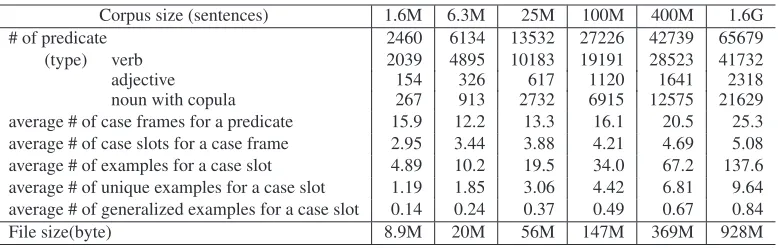
Table 4: Statistics of the Constructed Case Frames.
Corpus size (sentences) 1.6M 6.3M 25M 100M 400M 1.6G
# of predicate 2460 6134 13532 27226 42739 65679
(type) verb 2039 4895 10183 19191 28523 41732
adjective 154 326 617 1120 1641 2318
noun with copula 267 913 2732 6915 12575 21629
average # of case frames for a predicate 15.9 12.2 13.3 16.1 20.5 25.3 average # of case slots for a case frame 2.95 3.44 3.88 4.21 4.69 5.08
average # of examples for a case slot 4.89 10.2 19.5 34.0 67.2 137.6
average # of unique examples for a case slot 1.19 1.85 3.06 4.42 6.81 9.64 average # of generalized examples for a case slot 0.14 0.24 0.37 0.49 0.67 0.84
File size(byte) 8.9M 20M 56M 147M 369M 928M
Table 3: Corpus Sizes and Thresholds. Corpus size for case
frame construction 1.6M 6.3M 25M 100M 400M 1.6G (sentences)
Thresholdα
introduced in Sec. 3.1 2 3 4 5 7 10
Corpus size to
estimate generative 1.6M 3.2M 6.3M 13M 25M 50M probability (sentences)
from the Web using the method proposed by Kawa-hara and Kurohashi (2006b). We acquired approx-imately 6 billion Japanese sentences consisting of approximately 100 billion words from 100 million Japanese web pages. After discarding duplicate sen-tences, which may have been extracted from mirror sites, we acquired a corpus comprising of 1.6 bil-lion (1.6G) unique Japanese sentences consisting of approximately 25 billion words. The average num-ber of characters and words in each sentence was 28.3, 15.6, respectively. Then we randomly selected subsets of the corpus for five different sizes; 1.6M, 6.3M, 25M, 100M, and 400M sentences to obtain corpora of different sizes.
We constructed case frames from each corpus. We employed JUMAN and KNP to parse each corpus. We changed the threshold α introduced in Section 3.1 depending upon the size of the corpus as shown in Table 3. Completing the case frame construc-tion took about two weeks using 600 CPUs. Ta-ble 4 shows the statistics for the constructed case frames. The number of predicates, the average num-ber of examples and unique examples for a case slot, and whole file size were confirmed to be heavily de-pendent upon the corpus size. However, the average number of case frames for a predicate and case slots for a case frame did not.
5.2 Coverage of Constructed Case Frames 5.2.1 Setting
In order to investigate the coverage of the resul-tant case frames, we used a syntactic relation, case structure, and anaphoric relation annotated corpus consisting of 186 web documents (979 sentences). This corpus was manually annotated using the same criteria as Kawahara et al. (2004). There were 2,390 annotated relationships between predicates and their direct (not omitted) case components and 837 zero anaphoric relations in the corpus.
We used two evaluation metrics depending upon whether the target case component was omitted or not. For the overt case component of a predicate, we judged the target component was covered by case frames if the target component itself was included in the examples for one of the corresponding case slots of the case frame. For the omitted case component, we checked not only the target component itself but also all mentions that refer to the same entity as the target component.
5.2.2 Coverage of Case Frames
Figure 1 shows the coverage of case frames for the overt argument, which would have tight relations with case structure analysis. The lower line shows the coverage without considering generalized exam-ples, the middle line shows the coverage considering generalized NE examples, and the upper line shows the coverage considering all generalized examples.
sys-0.0 0.2 0.4 0.6 0.8 1.0
1M 10M 100M 1000M
Coverage
Corpus Size (Number of Sentences) 0.897
0.683
0.649 +NE,CT match
+ NE match exact match
Figure 1: Coverage of CF (overt argument).
0.0 0.2 0.4 0.6 0.8 1.0
1M 10M 100M 1000M
Coverage
Corpus Size (Number of Sentences) 0.892
0.608
0.472 +NE,CT match
+ NE match exact match
Figure 2: Coverage of CF (omitted argument).
tem described in Section 4.2. Comparing with Fig-ure 1, we found two characteristics. First, the lower and middle lines of Figure 2 were located lower than the corresponding lines in Figure 1. This would re-flect that some frequently omitted case components are not described in the case frames because the case frames were constructed from only overt predicate argument pairs. Secondly, the effect of generalized NE examples was more evident for the omitted ar-gument reflecting the important role of NEs in zero anaphora resolution.
[image:6.612.80.276.56.378.2]Both figures show that the coverage was improved by using larger corpora and there was no saturation even when the largest corpus of 1.6 billion sentences was used. When the largest corpus and all general-ized examples were used, the case frames achieved a coverage of almost 90% for both the overt and omit-ted argument.
Figure 3 shows the coverage of case frames for each predicate type, which was calculated for both overt and omitted argument considering all general-ized examples. The case frames for verbs achieved a coverage of 93.0%. There were 189 predicate-argument pairs that were not included case frames;
0.0 0.2 0.4 0.6 0.8 1.0
1M 10M 100M 1000M
Coverage
Corpus Size (Number of Sentences) verb
adjective
noun with copula 0.930
0.788
0.545
Figure 3: Coverage of CF for Each Predicate Type.
11 pairs of them were due to lack of the case frame of target predicate itself, and the others were due to lack of the corresponding example. For adjec-tive, the coverage was 78.8%. The main cause of the lower coverage would be that the predicate argu-ment relations concerning adjectives that were used in restrictive manner, such as “oishii sushi” (deli-cious sushi), were not used for case frame construc-tion, although such relations were also the target of the coverage evaluation. For noun with copula, the coverage was only 54.5%. However, most predicate argument relations concerning nouns with copula were easily recognized from syntactic preference, and thus the low coverage would not quite affect the performance of discourse analysis.
5.3 Syntactic and Case Structure Analysis 5.3.1 Accuracy of Syntactic Analysis
[image:6.612.319.519.58.201.2]We investigated the effect of corpus size for syn-tactic analysis described in Section 4.1. We used hand-annotated 759 web sentences, which was used by Kawahara and Kurohashi (2007). We evaluated the resultant syntactic structures with regard to de-pendency accuracy, the proportion of correct depen-dencies out of all dependepen-dencies4.
Figure 4 shows the accuracy of syntactic struc-tures. We conducted these experiments with case frames constructed from corpora of different sizes. We also changed the corpus size to estimate gen-erative probability of a case slot in Section 4.1 de-pending upon the size of the corpus for case frame construction as shown in Table 3. Figure 4 also
in-4Note that Kawahara and Kurohashi (2007) exclude the
0.886 0.888 0.890 0.892 0.894 0.896
1M 10M 100M 1000M
Accuracy
Corpus Size (Number of Sentences) 0.894
1.6G p < 0.1
100M 25M p < 0.01
6.3M 1.6M 400M
p < 0.1 25M p < 0.01
6.3M 1.6M 100M
p < 0.1 6.3M 1.6M 25M
p < 0.1 6.3M 1.6M 6.3M 1.6M
[image:7.612.321.520.63.212.2]with case frames w/o case frames
Figure 4: Accuracy of Syntactic Analysis. (McNemar’s test results are also shown under each data point.)
cludes McNemar’s test results. For instance, the dif-ference between the corpus size of 1.6G and 100M sentences is significant at the 90% level (p = 0.1), but not significant at the 99% level (p= 0.01).
In Figure 4, ‘w/o case frames’ shows the accu-racy of the rule-based syntactic parser KNP that does not use case frames. Since the model described in Section 4.1 assumes the existence of reasonable case frames, when we used case frames constructed from very small corpus, such as 1.6M and 6.3M sen-tences, the accuracy was lower than that of the rule-based syntactic parser. Moreover, when we tested the model described in Section 4.1 without any case frames, the accuracy was 0.885.
We confirmed that better performance was ob-tained by using case frames constructed from larger corpora, and the accuracy of 0.8945 was achieved
by using the case frames constructed from 1.6G sen-tences. However the effect of the corpus size was limited. This is because there are various causes of dependency error and the case frame sparseness problem is not serious for syntactic analysis.
We considered that generalized examples can benefit for the accuracy of syntactic analysis, and tried several models that utilize these examples. However, we cannot confirm any improvement.
5.3.2 Accuracy of Case Structure Analysis We conducted case structure analysis on 215 web sentences in order to investigate the effect of cor-pus size for case structure analysis. The case mark-ers of topic marking phrases and clausal modifimark-ers
5It corresponds to 0.877 in Kawahara and Kurohashi’s
(2007) evaluation metrics.
0.400 0.500 0.600 0.700 0.800 0.900
1M 10M 100M 1000M
Accuracy
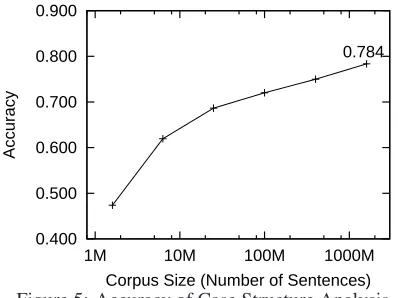
Corpus Size (Number of Sentences) 0.784
[image:7.612.78.285.66.204.2]Figure 5: Accuracy of Case Structure Analysis.
Table 5: Corpus Sizes for Case Frame Construction and Time for Syntactic and Case Structure Analysis.
Corpus size 1.6M 6.3M 25M 100M 400M 1.6G Time (sec.) 850 1244 1833 2696 3783 5553
were evaluated by comparing them with the gold standard in the corpus. Figure 5 shows the experi-mental results. We confirmed that the accuracy of case structure analysis strongly depends on corpus size for case frame construction.
5.3.3 Analysis Speed
Table 5 shows the time for analyzing syntactic and case structure of 759 web sentences. Although the time for analysis became longer by using case frames constructed from a larger corpus, the growth rate was smaller than the growth rate of the size for case frames described in Table 4.
Since there is enough increase in accuracy of case structure analysis, we can say that case frames con-structed larger corpora are desirable for case struc-ture analysis.
5.4 Zero Anaphora Resolution
5.4.1 Accuracy of Zero Anaphora Resolution We used an anaphoric relation annotated corpus consisting of 186 web documents (979 sentences) to evaluate zero anaphora resolution. We used first 51 documents for test and used the other 135 doc-uments for calculating several probabilities. In the 51 test documents, 233 zero anaphora relations were annotated between one of the mentions of the an-tecedent and corresponding predicate that had zero pronoun.
mor-0.00 0.10 0.20 0.30 0.40 0.50
1M 10M 100M 1000M
F-measure
Corpus Size (Number of Sentences) 0.417
0.330
0.313 +NE,CT match
+ NE match exact match
Figure 6: F-measure of Zero Anaphora Resolution.
phemes, named entities, syntactic structures and coreference relations that were manually annotated. Since correct coreference relations were given, the number of created entities was the same between the gold standard and the system output because zero anaphora resolution did not create new entities.
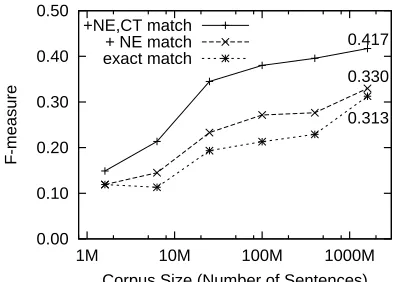
The experimental results are shown in Figure 6, in which F-measure was calculated by:
R= # of correctly recognized zero anaphora # of zero anaphora annotated in corpus, P = # of correctly recognized zero anaphora
# of system outputted zero anaphora ,
F = 2
1/R+ 1/P.
The upper line shows the performance using all generalized examples, the middle line shows the performance using only generalized NEs, and the lower line shows the performance without using any generalized examples. While generalized cat-egories much improved the F-measure, generalized NEs contributed little. This tendency is similar to that of coverage of case frames for omitted argument shown in Figure 2. Unlike syntactic and case struc-ture analysis, the performance for the zero anaphora resolution is quite low when using case frames con-structed from small corpora, and we can say case frames constructed from larger corpora are essential for zero anaphora resolution.
5.4.2 Analysis Speed
[image:8.612.79.278.63.204.2]Table 6 shows the time for resolving zero anaphora in 51 web documents consisting of 278 sentences. The time for analysis became longer by using case frames constructed from larger corpora,
Table 6: Corpus Sizes for Case Frame Construction and Time for Zero Anaphora Resolution.
Corpus size 1.6M 6.3M 25M 100M 400M 1.6G Time (sec.) 538 545 835 1040 1646 2219
which tendency is similar to the growth of the time for analyzing syntactic and case structure.
5.5 Discussion
Experimental results of both case structure analy-sis and zero anaphora resolution show the effective-ness of a larger corpus in case frame acquisition for Japanese discourse analysis. Up to the corpus size of 1.6 billion sentences, or 100 billion words, these experimental results still show a steady increase in performance. That is, we can say that the corpus size of 1.6 billion sentences is not enough to obtain case frames of sufficient coverage.
These results suggest that increasing corpus size is more essential for acquiring structured knowledge than for acquiring unstructured statistics of a corpus, such asn-grams, and co-occurrence counts; and for complex NLP tasks such as case structure analysis and zero anaphora resolution, the currently available corpus size is not sufficient.
Therefore, to construct more wide-coverage case frames by using a larger corpus and reveal how much corpora would be required to obtain sufficient cov-erage is considered as future work.
6 Conclusion
This paper has reported the effect of corpus size on case frame acquisition for syntactic and case structure analysis, and zero anaphora resolution in Japanese. We constructed case frames from cor-pora of six different sizes ranging from 1.6 million to 1.6 billion sentences; and then applied these case frames to Japanese syntactic and case structure anal-ysis, and zero anaphora resolution. Experimental re-sults showed better rere-sults were obtained using case frames constructed from larger corpora, and the per-formance showed no saturation even when the cor-pus size was 1.6 billion sentences.
References
Michaela Atterer and Hinrich Sch¨utze. 2006. The ef-fect of corpus size in combining supervised and un-supervised training for disambiguation. In Proc. of COLING-ACL’06, pages 25–32.
Michele Banko and Eric Brill. 2001a. Mitigating the paucity-of-data problem: Exploring the effect of train-ing corpus size on classifier performance for natural language processing. InProc. of HLT’01.
Michele Banko and Eric Brill. 2001b. Scaling to very very large corpora for natural language disambigua-tion. InProc. of ACL’01, pages 26–33.
Thorsten Brants, Ashok C. Popat, Peng Xu, Franz J. Och, and Jeffrey Dean. 2007. Large language models in machine translation. InProc. of EMNLP-CoNLL’07, pages 858–867.
Ann Gledson and John Keane. 2008. Using web-search results to measure word-group similarity. InProc. of COLING’08, pages 281–288.
David Graff. 2003. English Gigaword. Technical Report LDC2003T05, Linguistic Data Consortium, Philadel-phia, PA USA.
Peter Halacsy, Andras Kornai, Laszlo Nemeth, Andras Rung, Istvan Szakadat, and Vikto Tron. 2004. Creat-ing open language resources for Hungarian. InProc. of LREC’04, pages 203–210.
IREX Committee, editor. 1999.Proc. of the IREX Work-shop.
Daisuke Kawahara and Sadao Kurohashi. 2006a. A fully-lexicalized probabilistic model for Japanese syn-tactic and case structure analysis. InProc. of HLT-NAACL’06, pages 176–183.
Daisuke Kawahara and Sadao Kurohashi. 2006b. Case frame compilation from the web using high-performance computing. InProc. of LREC’06, pages 1344–1347.
Daisuke Kawahara and Sadao Kurohashi. 2007. Probabilistic coordination disambiguation in a fully-lexicalized Japanese parser. In Proc. of EMNLP-CoNLL’07, pages 306–314.
Daisuke Kawahara, Ryohei Sasano, and Sadao Kuro-hashi. 2004. Toward text understanding: Integrat-ing relevance-tagged corpora and automatically con-structed case frames. In Proc. of LREC’04, pages 1833–1836.
Adam Kilgarriff and Gregory Grefenstette. 2003. In-troduction to the special issue on the web as corpus. Computational Linguistic, 29(3):333–347.
Taku Kudo and Hideto Kazawa. 2007. Web Japanese N-gram version 1, published by Gengo Shigen Kyokai. Mirella Lapata and Frank Keller. 2005. Web-based
mod-els for natural language processing. ACM Transac-tions on Speech and Language Processing, 2:1:1–31.
Vinci Liu and James R. Curran. 2006. Web text corpus for natural language processing. InProc. of EACL’06, pages 233–240.
Kikuo Maekawa. 2006. Kotonoha, the corpus develop-ment project of the National Institute for Japanese lan-guage. InProc. of the 13th NIJL International Sympo-sium, pages 55–62.
David McClosky, Eugene Charniak, and Mark Johnson. 2006. Effective self-training for parsing. InProc. of HLT-NAACL’06, pages 152–159.
Natalia N. Modjeska, Katja Markert, and Malvina Nis-sim. 2003. Using the web in machine learning for other-anaphora resolution. InProc. of EMNLP-2003, pages 176–183.
Preslav Nakov and Marti Hearst. 2005. A study of using search engine page hits as a proxy for n-gram frequen-cies. InProc. of RANLP’05.
Preslav Nakov and Marti A. Hearst. 2008. Solving rela-tional similarity problems using the web as a corpus. InProc. of ACL-HLT’08, pages 452–460.
Ryohei Sasano and Sadao Kurohashi. 2008. Japanese named entity recognition using structural natural lan-guage processing. InProc. of IJCNLP’08, pages 607– 612.
Ryohei Sasano, Daisuke Kawahara, and Sadao Kuro-hashi. 2008. A fully-lexicalized probabilistic model for japanese zero anaphora resolution. In Proc. of COLING’08, pages 769–776.
Jun Suzuki and Hideki Isozaki. 2008. Semi-supervised sequential labeling and segmentation using giga-word scale unlabeled data. InProceedings of ACL-HLT’08, pages 665–673.