Human Language Technologies: The 2009 Annual Conference of the North American Chapter of the ACL, pages 371–379,
Global Models of Document Structure Using Latent Permutations
Harr Chen, S.R.K. Branavan, Regina Barzilay, David R. Karger Computer Science and Artificial Intelligence Laboratory
Massachusetts Institute of Technology
{harr, branavan, regina, karger}@csail.mit.edu
Abstract
We present a novel Bayesian topic model for learning discourse-level document structure. Our model leverages insights from discourse theory to constrain latent topic assignments in a way that reflects the underlying organiza-tion of document topics. We propose aglobal
model in which both topic selection and order-ing are biased to be similar across a collection of related documents. We show that this space of orderings can be elegantly represented us-ing a distribution over permutations called the
generalized Mallows model. Our structure-aware approach substantially outperforms al-ternative approaches for cross-document com-parison and single-document segmentation.1
1 Introduction
In this paper, we introduce a novel latent topic model for the unsupervised learning of document structure. Traditional topic models assume that topics are ran-domly spread throughout a document, or that the succession of topics in a document is Markovian. In contrast, our approach takes advantage of two important discourse-level properties of text in de-termining topic assignments: first, that each docu-ment follows a progression of nonrecurring coher-ent topics (Halliday and Hasan, 1976); and sec-ond, that documents from the same domain tend to present similar topics, in similar orders (Wray, 2002). We show that a topic model incorporat-ing these long-range dependencies outperforms
al-1Code, data, and annotations used in this work are available
at http://groups.csail.mit.edu/rbg/code/mallows/
ternative approaches for segmentation and cross-document comparison.
For example, consider a collection of encyclope-dia articles about cities. The first constraint captures the notion that a single topic, such as Architecture, is expressed in a contiguous block within the docu-ment, rather than spread over disconnected sections. The second constraint reflects our intuition that all of these related articles will generally mention some major topics associated with cities, such as History and Culture, and will often exhibit similar topic or-derings, such as placing History before Culture.
We present a Bayesian latent topic model over re-lated documents that encodes these discourse con-straints by positing a single distribution over a doc-ument’sentiretopic structure. This global view on ordering is able to elegantly encode discourse-level properties that would be difficult to represent using local dependencies, such as those induced by hid-den Markov models. Our model enforces that the same topic does not appear in disconnected portions of the topic sequence. Furthermore, our approach biases toward selecting sequences with similar topic ordering, by modeling a distribution over the space of topic permutations.
Learning this ordering distribution is a key tech-nical challenge in our proposed approach. For this purpose, we employ thegeneralized Mallows model, a permutation distribution that concentrates proba-bility mass on a small set of similar permutations. It directly captures the intuition of the second con-straint, and uses a small parameter set to control how likely individual topics are to be reordered.
We evaluate our model on two challenging
document-level tasks. In thealignmenttask, we aim to discover paragraphs across different documents that share the same topic. We also consider the seg-mentation task, where the goal is to partition each document into a sequence of topically coherent seg-ments. We find that our structure modeling approach substantially outperforms state-of-the-art baselines for both tasks. Furthermore, we demonstrate the im-portance of explicitly modeling a distribution over topic permutations; our model yields significantly better results than variants that either use a fixed or-dering, or are order-agnostic.
2 Related Work
Topic and Content Models Our work is grounded in topic modeling approaches, which posit that la-tent state variables control the generation of words. In earlier topic modeling work such aslatent Dirich-let allocation(LDA) (Blei et al., 2003; Griffiths and Steyvers, 2004), documents are treated as bags of words, where each word receives a separate topic assignment; the topic assignments are auxiliary vari-ables to the main task of language modeling.
More recent work has attempted to adapt the con-cepts of topic modeling to more sophisticated repre-sentations than a bag of words; they use these rep-resentations to impose stronger constraints on topic assignments (Griffiths et al., 2005; Wallach, 2006; Purver et al., 2006; Gruber et al., 2007). These approaches, however, generally model Markovian topic or state transitions, which only capture lo-cal dependencies between adjacent words or blocks within a document. For instance, content mod-els (Barzilay and Lee, 2004; Elsner et al., 2007) are implemented as HMMs, where the states cor-respond to topics of domain-specific information, and transitions reflect pairwise ordering prefer-ences. Even approaches that break text into con-tiguous chunks (Titov and McDonald, 2008) as-sign topics based on local context. While these locally constrained models can implicitly reflect some discourse-level constraints, they cannot cap-ture long-range dependencies without an explosion of the parameter space. In contrast, our model cap-tures the entire sequence of topics using a compact representation. As a result, we can explicitly and tractably model global discourse-level constraints.
Modeling Ordering Constraints Sentence order-ing has been extensively studied in the context of probabilistic text modeling for summarization and generation (Barzilay et al., 2002; Lapata, 2003; Karamanis et al., 2004). The emphasis of that body of work is on learning ordering constraints from data, with the goal of reordering new text from the same domain. Our emphasis, however, is on ap-plications where ordering is already observed, and how that ordering can improve text analysis. From the methodological side, that body of prior work is largely driven by local pairwise constraints, while we aim to encode global constraints.
3 Problem Formulation
Our document structure learning problem can be for-malized as follows. We are given a corpus of D
related documents. Each document expresses some subset of a common set ofK topics. We assign a
single topic to each paragraph,2 incorporating the
notion that paragraphs are internally topically con-sistent (Halliday and Hasan, 1976). To capture the discourse constraint on topic progression described in Section 1, we require that topic assignments be contiguous within each document.3 Furthermore,
we assume that the underlying topic sequences ex-hibit similarity across documents. Our goal is to re-cover atopic assignmentfor each paragraph in the corpus, subject to these constraints.
Our formulation shares some similarity with the standard LDA setup, in that a common set of topics is assigned across a collection of documents. How-ever, in LDA each word’s topic assignment is con-ditionally independent, following the bag of words view of documents. In contrast, our constraints on how topics are assigned let us connect word distri-butional patterns to document-level topic structure.
4 Model
We propose a generative Bayesian model that ex-plains how a corpus of Ddocuments, given as
se-quences of paragraphs, can be produced from a set of hidden topic variables. Topic assignments to each
2Note that our analysis applies equally to other levels of
tex-tual granularity, such as sentences.
3That is, if paragraphsiandjare assigned the same topic,
paragraph, ranging from 1 to K, are the model’s
final output, implicitly grouping topically similar paragraphs. At a high level, the process first selects the bag of topics to be expressed in the document, and how they are ordered; these topics then deter-mine the selection of words for each paragraph.
For each documentdwithNdparagraphs, we
sep-arately generate abag of topicstdand atopic
order-ingπd. The unordered bag of topics, which contains
Ndelements, expresses how many paragraphs of the
document are assigned to each of theKtopics. Note
that some topics may not appear at all. Variabletd
is constructed by takingNd samples from a
distri-bution over topicsτ, a multinomial representing the
probability of each topic being expressed. Sharing
τ between documents captures the intuition that
cer-tain topics are more likely across the entire corpus. The topic ordering variable πd is a permutation
over the numbers 1 throughKthat defines the order
in which topics appear in the document. We drawπd
from thegeneralized Mallows model, a distribution over permutations that we explain in Section 4.1. As we will see, this particular distribution biases the permutation selection to be close to a single cen-troid, reflecting the discourse constraint of prefer-ring similar topic structures across documents.
Together, a document’s bag of topics td and
or-dering πd determine the topic assignment zd,p for
each of its paragraphs. For example, in a corpus with K = 4, a seven-paragraph document d with
td = {1,1,1,1,2,4,4} andπd = (2 4 3 1)would
induce the topic sequencezd= (2 4 4 1 1 1 1). The
induced topic sequencezdcan never assign the same
topic to two unconnected portions of a document, thus satisfying the constraint of topic contiguity.
As with LDA, we assume that each topickis
as-sociated with a language modelθk. The words of a
paragraph assigned to topic kare then drawn from
that topic’s language modelθk.
Before turning to a more formal discussion of the generative process, we first provide background on the permutation model for topic ordering.
4.1 The Generalized Mallows Model
A central challenge of the approach we take is mod-eling the distribution over possible topic permuta-tions. For this purpose we use the generalized Mal-lows model (GMM) (Fligner and Verducci, 1986;
Lebanon and Lafferty, 2002; Meil˘a et al., 2007), which exhibits two appealing properties in the con-text of this task. First, the model concentrates proba-bility mass on some “canonical” ordering and small perturbations of that ordering. This characteris-tic matches our constraint that documents from the same domain exhibit structural similarity. Second, its parameter set scales linearly with the permuta-tion length, making it sufficiently constrained and tractable for inference. In general, this distribution could potentially be applied to other NLP applica-tions where ordering is important.
Permutation Representation Typically, permuta-tions are represented directly as an ordered sequence of elements. The GMM utilizes an alternative rep-resentation defined as a vector(v1, . . . , vK−1)of
in-version countswith respect to the identity permuta-tion(1, . . . , K). Termvjcounts the number of times
a value greater thanjappears beforejin the permu-tation.4 For instance, given the standard-form
per-mutation(3 1 5 2 4),v2= 2because 3 and 5 appear before 2; the entire inversion count vector would be (1 2 0 1). Every vector of inversion counts uniquely identifies a single permutation.
The Distribution The GMM assigns proba-bility mass according to the distance of a given permutation from the identity permutation
{1, . . . , K}, based onK−1real-valued parameters (ρ1, . . . ρK−1).5 Using the inversion count represen-tation of a permurepresen-tation, the GMM’s probability mass function is expressed as an independent product of probabilities for eachvj:
GMM(v|ρ) = e
−Pjρjvj
ψ(ρ)
=
nY−1
j=1
e−ρjvj ψj(ρj)
, (1)
whereψj(ρj)is a normalization factor with value:
ψj(ρj) =
1−e−(K−j+1)ρj
1−e−ρj .
4The sum of a vector of inversion counts is simply that
per-mutation’s Kendall’sτdistance to the identity permutation.
5In our work we take the identity permutation to be the fixed
Due to the exponential form of the distribution, re-quiring that ρj > 0 constrains the GMM to assign
highest probability mass to eachvj being zero,
cor-responding to the identity permutation. A higher value forρj assigns more probability mass tovj
be-ing close to zero, biasbe-ingjto have fewer inversions.
The GMM elegantly captures our earlier require-ment for a probability distribution that concentrates mass around a global ordering, and uses few param-eters to do so. Because the topic numbers in our task are completely symmetric and not linked to any extrinsic observations, fixing the identity permuta-tion to be that global ordering does not sacrifice any representational power. Another major benefit of the GMM is its membership in the exponential fam-ily of distributions; this means that it is particularly amenable to a Bayesian representation, as it admits a natural conjugate prior:
GMM0(ρj |vj,0, ν0)∝e(−ρjvj,0−logψj(ρj))ν0. (2)
Intuitively, this prior states that overν0 prior trials, the total number of inversions wasν0vj,0. This dis-tribution can be easily updated with the observedvj
to derive a posterior distribution.6 4.2 Formal Generative Process
We now fully specify the details of our model. We observe a corpus ofDdocuments, each an ordered
sequence of paragraphs, and a specification of a number of topicsK. Each paragraph is represented
as a bag of words. The model induces a set of hid-den variables that probabilistically explain how the words of the corpus were produced. Our final de-sired output is the distributions over the paragraphs’ hidden topic assignment variables. In the following, variables subscripted with 0 are fixed prior hyperpa-rameters.
1. For each topick, draw a language modelθk∼
Dirichlet(θ0). As with LDA, these are topic-specific word distributions.
2. Draw a topic distribution τ ∼ Dirichlet(τ0), which expresses how likely each topic is to ap-pear regardless of position.
6Because each v
j has a different range, it is inconvenient
to set the prior hyperparametersvj,0 directly. In our work, we instead fix the mode of the prior distribution to a valueρ0, which works out to settingvj,0= exp(ρ01)−1 −exp((KK−−jj+1)+1ρ0)−1.
3. Draw the topic ordering distribution parame-tersρj ∼ GMM0(ρ0, ν0)forj = 1toK −1. These parameters control how rapidly probabil-ity mass decays for having more inversions for each topic. A separateρjfor every topic allows
us to learn that some topics are more likely to be reordered than others.
4. For each documentdwithNdparagraphs:
(a) Draw a bag of topicstdby sampling Nd
times from Multinomial(τ).
(b) Draw a topic ordering πd by sampling a
vector of inversion countsvd∼GMM(ρ).
(c) Compute the vector of topic assignments
zdfor documentd’s paragraphs, by sorting
tdaccording toπd.7
(d) For each paragraphpin documentd:
i. Sample each wordwd,p,j according to
the language model of p: wd,p,j ∼
Multinomial(θzd,p).
5 Inference
The variables that we aim to infer are the topic as-signments z of each paragraph, which are
deter-mined by the bag of topicstand orderingπfor each document. Thus, our goal is to estimate the marginal distributions oftandπgiven the document text.
We accomplish this inference task through Gibbs sampling (Bishop, 2006). A Gibbs sampler builds a Markov chain over the hidden variable state space whose stationary distribution is the actual posterior of the joint distribution. Each new sample is drawn from the distribution of a single variable conditioned on previous samples of the other variables. We can “collapse” the sampler by integrating over some of the hidden variables in the model, in effect reducing the state space of the Markov chain. Collapsed sam-pling has been previously demonstrated to be effec-tive for LDA and its variants (Griffiths and Steyvers, 2004; Porteous et al., 2008; Titov and McDonald, 2008). Our sampler integrates over all but three sets
7Multiple permutations can contribute to the probability of a
single document’s topic assignmentszd, if there are topics that
do not appear intd. As a result, our current formulation is
of hidden variables: bags of topics t, orderings π,
and permutation inversion parameters ρ. After a burn-in period, we treat the last samples of t and
πas a draw from the true posterior.
Document Probability As a preliminary step, consider how to calculate the probability of a single document’s words wd given the document’s
para-graph topic assignments zd, and other documents
and their topic assignments. Note that this proba-bility is decomposable into a product of probabil-ities over individual paragraphs, where paragraphs with different topics have conditionally independent word probabilities. Let w−d and z−d indicate the
words and topic assignments to documents other than d, and W be the vocabulary size. The
proba-bility of the words indis then:
P(wd|z,w−d, θ0)
=
K
Y
k=1
Z
θk
P(wd|zd, θk)P(θk|z,w−d, θ0)dθk
=
K
Y
k=1
DCM({wd,i :zd,i=k}
| {w−d,i :z−d,i =k}, θ0), (3) where DCM(·) refers to the Dirichlet compound
multinomial distribution, the result of integrat-ing over multinomial parameters with a Dirichlet prior (Bernardo and Smith, 2000). For a Dirichlet prior with parametersα= (α1, . . . , αW), the DCM
assigns the following probability to a series of ob-servationsx={x1, . . . , xn}:
DCM(x|α) = Γ(
P
jαj)
Q
jΓ(αj) W
Y
i=1
Γ(N(x, i) +αi)
Γ(|x|+Pjαj)
,
where N(x, i) refers to the number of times word iappears in x. Here, Γ(·) is the Gamma function,
a generalization of the factorial for real numbers. Some algebra shows that the DCM’s posterior prob-ability density function conditioned on a series of observationsy={y1, . . . , yn}can be computed by updating each αi with counts of how often word i
appears iny: DCM(x|y, α)
=DCM(x|α1+N(y,1), . . . , αW +N(y, W)).
(4)
Equation 3 and 4 will be used again to compute the conditional distributions of the hidden variables.
We now turn to a discussion of how each individ-ual random variable is resampled.
Bag of Topics First we consider how to resample
td,i, theith topic draw for document dconditioned
on all other parameters being fixed (note this isnot the topic of theith paragraph, as we reorder topics
usingπd):
P(td,i =t|. . .)
∝P(td,i=t|t−(d,i), τ0)P(wd|td, πd,w−d,z−d, θ0)
∝ N(t−(d,i), t) +τ0 |t−(d,i)|+Kτ0
P(wd|z,w−d, θ0),
wheretdis updated to reflecttd,i =t, andzdis
de-terministically computed by mappingtd andπd to
actual paragraph topic assignments. The first step reflects an application of Bayes rule to factor out the term forwd. In the second step, the first term arises
out of the DCM, by updating the parametersτ0with observations t−(d,i) as in equation 4 and dropping constants. The document probability term is com-puted using equation 3. The new td,i is selected
by sampling from this probability computed over all possible topic assignments.
Ordering The parameterization of a permutation
πas a series of inversion valuesvj reveals a natural
way to decompose the search space for Gibbs sam-pling. For a single ordering, eachvjcan be sampled
independently, according to:
P(vj =v|. . .)
∝P(vj =v|ρj)P(wd|td, πd,w−d,z−d, θ0)
=GMMj(v |ρj)P(wd|zd,w−d,z−d, θ0),
whereπdis updated to reflectvj =v, andzdis
com-puted according totd andπd. The first term refers
to thejth multiplicand of equation 1; the second is
computed using equation 3. Termvj is sampled
ac-cording to the resulting probabilities.
GMM Parameters For eachj = 1toK−1, we resampleρj from its posterior distribution:
P(ρj |. . .)
=GMM0
ρj
P
ivj,i+vj,0ν0
N+ν0
, N +ν0
where GMM0 is evaluated according to equation 2. The normalization constant of this distribution is un-known, meaning that we cannot directly compute and invert the cumulative distribution function to sample from this distribution. However, the distri-bution itself is univariate and unimodal, so we can expect that an MCMC technique such asslice sam-pling(Neal, 2003) should perform well. In practice, the MATLAB black-box slice sampler provides a ro-bust draw from this distribution.
6 Experimental Setup
Data Sets We evaluate our model on two data sets drawn from the English Wikipedia. The first set is 100 articles about large cities, with topics such as History, Culture, and Demographics. The sec-ond is 118 articles about chemical elements in the periodic table, including topics such as Biological Role, Occurrence, and Isotopes. Within each cor-pus, articles often exhibit similar section orderings, but many have idiosyncratic inversions. This struc-tural variability arises out of the collaborative nature of Wikipedia, which allows articles to evolve inde-pendently. Corpus statistics are summarized below.
Corpus Docs Paragraphs Vocab Words Cities 100 6,670 41,978 492,402 Elements 118 2,810 18,008 191,762
In each data set, the articles’noisy section head-ingsinduce a reference structure to compare against. This reference structure assumes that two para-graphs are aligned if and only if their section head-ings are identical, and that section boundaries pro-vide the correct segmentation of each document. These headings are only used for evaluation, and are not provided to any of the systems.
Using the section headings to build the reference structure can be problematic, as the same topic may be referred to using different titles across different documents, and sections may be divided at differing levels of granularity. Thus, for the Cities data set, we manually annotated each article’s paragraphs with a consistent set of section headings, providing us an additional reference structure to evaluate against. In thisclean section headings set, we found approxi-mately 18 topics that were expressed in more than one document.
Tasks and Metrics We study performance on the tasks of alignment and segmentation. In the former task, we measure whether paragraphs identified to be the same topic by our model have the same sec-tion headings, and vice versa. First, we identify the “closest” topic to each section heading, by finding the topic that is most commonly assigned to para-graphs under that section heading. We compute the proportion of paragraphs where the model’s topic as-signment matches the section heading’s topic, giv-ing us a recall score. High recall indicates that paragraphs of the same section headings are always being assigned to the same topic. Conversely, we can find the closest section heading to each topic, by finding the section heading that is most com-mon for the paragraphs assigned to a single topic. We then compute the proportion of paragraphs from that topic whose section heading is the same as the reference heading for that topic, yielding a preci-sion score. High precision means that paragraphs assigned to a single topic usually correspond to the same section heading. The harmonic mean of recall and precision is the summaryF-score.
Statistical significance in this setup is measured withapproximate randomization (Noreen, 1989), a nonparametric test that can be directly applied to nonlinear metrics such as F-score. This test has been used in prior evaluations for information extraction and machine translation (Chinchor, 1995; Riezler and Maxwell, 2005).
For the second task, we take the boundaries at which topics change within a document to be a segmentation of that document. We evaluate us-ing the standard penalty metricsPkand
WindowD-iff (Beeferman et al., 1999; Pevzner and Hearst, 2002). Both pass a sliding window over the doc-uments and compute the probability of the words at the ends of the windows being improperly seg-mented with respect to each other. WindowDiff re-quires that the number of segmentation boundaries between the endpoints be correct as well.8
Our model takes a parameter K which controls
the upper bound on the number of latent topics. Note that our algorithm can select fewer thanKtopics for each document, soKdoes not determine the number
8Statistical significance testing is not standardized and
of segments in each document. We report results using bothK = 10and 20 (recall that the cleanly annotated Cities data set had 18 topics).
Baselines and Model Variants We consider base-lines from the literature that perform either align-ment or segalign-mentation. For the first task, we compare against the hidden topic Markov model (HTMM) (Gruber et al., 2007), which represents topic transitions between adjacent paragraphs in a Markovian fashion, similar to the approach taken in content modeling work. Note that HTMM can only capture local constraints, so it would allow topics to recur noncontiguously throughout a document.
We also compare against the structure-agnostic approach of clustering the paragraphs using the CLUTO toolkit,9 which uses repeated bisection to
maximize a cosine similarity-based objective. For the segmentation task, we compare to BayesSeg (Eisenstein and Barzilay, 2008),10
a Bayesian topic-based segmentation model that outperforms previous segmentation ap-proaches (Utiyama and Isahara, 2001; Galley et al., 2003; Purver et al., 2006; Malioutov and Barzilay, 2006). BayesSeg enforces the topic contiguity constraint that motivated our model. We provide this baseline with the benefit of knowing the correct number of segments for each document, which is not provided to our system. Note that BayesSeg processes each document individually, so it cannot capture structural relatedness across documents.
To investigate the importance of our ordering model, we consider two variants of our model that alternately relax and tighten ordering constraints. In theconstrainedmodel, we require all documents to follow the same canonical ordering of topics. This is equivalent to forcing the topic permutation distri-bution to give all its probability to one ordering, and can be implemented by fixing all inversion countsv to zero during inference. At the other extreme, we consider the uniformmodel, which assumes a uni-form distribution over all topic permutations instead of biasing toward a small related set. In our im-plementation, this can be simulated by forcing the
9http://glaros.dtc.umn.edu/gkhome/views/cluto/
10We do not evaluate on the corpora used in their work, since
our model relies on content similarity across documents in the corpus.
GMM parametersρto always be zero. Both variants
still enforce topic contiguity, and allow segments across documents to be aligned by topic assignment.
Evaluation Procedures For each evaluation of our model and its variants, we run the Gibbs sampler from five random seed states, and take the 10,000th iteration of each chain as a sample. Results shown are the average over these five samples. All Dirich-let prior hyperparameters are set to 0.1, encouraging sparse distributions. For the GMM, we set the prior decay parameterρ0 to 1, and the sample size prior
ν0to be 0.1 times the number of documents. For the baselines, we use implementations pub-licly released by their authors. We set HTMM’s pri-ors according to values recommended in the authpri-ors’ original work. For BayesSeg, we use its built-in hy-perparameter re-estimation mechanism.
7 Results
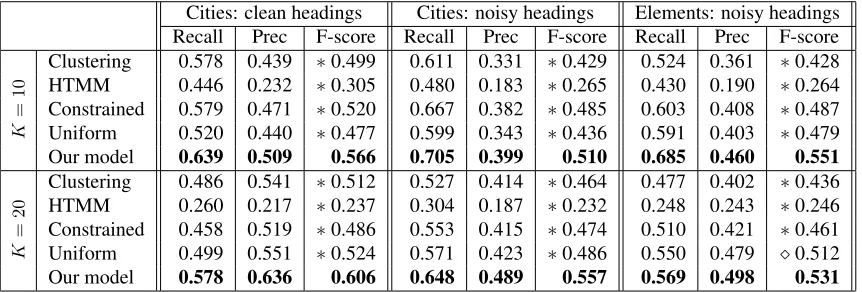
Alignment Table 1 presents the results of the alignment evaluation. In every case, the best per-formance is achieved using our full model, by a sta-tistically significant and usually substantial margin.
In both domains, the baseline clustering method performs competitively, indicating that word cues alone are a good indicator of topic. While the sim-pler variations of our model achieve reasonable per-formance, adding the richer GMM distribution con-sistently yields superior results.
Across each of our evaluations, HTMM greatly underperforms the other approaches. Manual ex-amination of the actual topic assignments reveals that HTMM often selects the same topic for discon-nected paragraphs of the same document, violating the topic contiguity constraint, and demonstrating the importance of modeling global constraints for document structure tasks.
We also compare performance measured on the manually annotated section headings against the ac-tual noisy headings. The ranking of methods by per-formance remains mostly unchanged between these two evaluations, indicating that the noisy headings are sufficient for gaining insight into the compara-tive performance of the different approaches.
Cities: clean headings Cities: noisy headings Elements: noisy headings Recall Prec F-score Recall Prec F-score Recall Prec F-score
K
=
10
Clustering 0.578 0.439 ∗0.499 0.611 0.331 ∗0.429 0.524 0.361 ∗0.428 HTMM 0.446 0.232 ∗0.305 0.480 0.183 ∗0.265 0.430 0.190 ∗0.264 Constrained 0.579 0.471 ∗0.520 0.667 0.382 ∗0.485 0.603 0.408 ∗0.487 Uniform 0.520 0.440 ∗0.477 0.599 0.343 ∗0.436 0.591 0.403 ∗0.479 Our model 0.639 0.509 0.566 0.705 0.399 0.510 0.685 0.460 0.551
K
=
20
Clustering 0.486 0.541 ∗0.512 0.527 0.414 ∗0.464 0.477 0.402 ∗0.436 HTMM 0.260 0.217 ∗0.237 0.304 0.187 ∗0.232 0.248 0.243 ∗0.246 Constrained 0.458 0.519 ∗0.486 0.553 0.415 ∗0.474 0.510 0.421 ∗0.461 Uniform 0.499 0.551 ∗0.524 0.571 0.423 ∗0.486 0.550 0.479 0.512 Our model 0.578 0.636 0.606 0.648 0.489 0.557 0.569 0.498 0.531
Table 1: Comparison of the alignments produced by our model and a series of baselines and model variations, for both 10 and 20 topics, evaluated against clean and noisy sets of section headings. Higher scores are better. Within the same
K, the methods which our model significantly outperforms are indicated with∗forp <0.001andforp <0.01.
Cities: clean headings Cities: noisy headings Elements: noisy headings
Pk WD # Segs Pk WD # Segs Pk WD # Segs
BayesSeg 0.321 0.376 †12.3 0.317 0.376 †13.2 0.279 0.316 †7.7
K
=
10 Constrained 0.260 0.281 7.7 0.267 0.288 7.7 0.227 0.244 5.4
Uniform 0.268 0.300 8.8 0.273 0.304 8.8 0.226 0.250 6.6 Our model 0.253 0.283 9.0 0.257 0.286 9.0 0.201 0.226 6.7
K
=
20 Constrained 0.274 0.314 10.9 0.274 0.313 10.9 0.231 0.257 6.6
[image:8.612.92.523.60.206.2]Uniform 0.234 0.294 14.0 0.234 0.290 14.0 0.209 0.248 8.7 Our model 0.221 0.278 14.2 0.222 0.278 14.2 0.203 0.243 8.6
Table 2: Comparison of the segmentations produced by our model and a series of baselines and model variations, for both 10 and 20 topics, evaluated against clean and noisy sets of section headings. Lower scores are better.†BayesSeg is given the true number of segments, so its segments count reflects the reference structure’s segmentation.
outperforms the BayesSeg baseline by a substantial margin regardless ofK. This result provides strong
evidence that learning connected topic models over related documents leads to improved segmentation performance. In effect, our model can take advan-tage of shared structure across related documents.
In all but one case, the best performance is ob-tained by the full version of our model. This result indicates that enforcing discourse-motivated struc-tural constraints allows for better segmentation in-duction. Encoding global discourse-level constraints leads to better language models, resulting in more accurate predictions of segment boundaries.
8 Conclusions
In this paper, we have shown how an unsupervised topic-based approach can capture document struc-ture. Our resulting model constrains topic assign-ments in a way that requires global modeling of en-tire topic sequences. We showed that the generalized
Mallows model is a theoretically and empirically ap-pealing way of capturing the ordering component of this topic sequence. Our results demonstrate the importance of augmenting statistical models of text analysis with structural constraints motivated by dis-course theory.
Acknowledgments
References
Regina Barzilay and Lillian Lee. 2004. Catching the drift: Probabilistic content models, with applications to generation and summarization. InProceedings of NAACL/HLT.
Regina Barzilay, Noemie Elhadad, and Kathleen McKe-own. 2002. Inferring strategies for sentence ordering in multidocument news summarization.Journal of Ar-tificial Intelligence Research, 17:35–55.
Doug Beeferman, Adam Berger, and John D. Lafferty. 1999. Statistical models for text segmentation. Ma-chine Learning, 34:177–210.
Jos´e M. Bernardo and Adrian F.M. Smith. 2000.
Bayesian Theory. Wiley Series in Probability and Statistics.
Christopher M. Bishop. 2006. Pattern Recognition and Machine Learning. Springer.
David M. Blei, Andrew Ng, and Michael Jordan. 2003. Latent dirichlet allocation.Journal of Machine Learn-ing Research, 3:993–1022.
Nancy Chinchor. 1995. Statistical significance of MUC-6 results. In Proceedings of the 6th Conference on Message Understanding.
Jacob Eisenstein and Regina Barzilay. 2008. Bayesian unsupervised topic segmentation. In Proceedings of EMNLP.
Micha Elsner, Joseph Austerweil, and Eugene Charniak. 2007. A unified local and global model for discourse coherence. InProceedings of NAACL/HLT.
M.A. Fligner and J.S. Verducci. 1986. Distance based ranking models. Journal of the Royal Statistical Soci-ety, Series B, 48(3):359–369.
Michel Galley, Kathleen R. McKeown, Eric Fosler-Lussier, and Hongyan Jing. 2003. Discourse segmen-tation of multi-party conversation. InProceedings of ACL.
Thomas L. Griffiths and Mark Steyvers. 2004. Find-ing scientific topics. Proceedings of the National Academy of Sciences, 101:5228–5235.
Thomas L. Griffiths, Mark Steyvers, David M. Blei, and Joshua B. Tenenbaum. 2005. Integrating topics and syntax. InAdvances in NIPS.
Amit Gruber, Michal Rosen-Zvi, and Yair Weiss. 2007. Hidden topic markov models. InProceedings of AIS-TATS.
M. A. K. Halliday and Ruqaiya Hasan. 1976. Cohesion in English. Longman.
Nikiforos Karamanis, Massimo Poesio, Chris Mellish, and Jon Oberlander. 2004. Evaluating centering-based metrics of coherence for text structuring using a reliably annotated corpus. InProceedings of ACL.
Mirella Lapata. 2003. Probabilistic text structuring: Ex-periments with sentence ordering. InProceedings of ACL.
Guy Lebanon and John Lafferty. 2002. Cranking: com-bining rankings using conditional probability models on permutations. InProceedings of ICML.
Igor Malioutov and Regina Barzilay. 2006. Minimum cut model for spoken lecture segmentation. In Pro-ceedings of ACL.
Marina Meil˘a, Kapil Phadnis, Arthur Patterson, and Jeff Bilmes. 2007. Consensus ranking under the exponen-tial model. InProceedings of UAI.
Radford M. Neal. 2003. Slice sampling. Annals of Statistics, 31:705–767.
Eric W. Noreen. 1989. Computer Intensive Methods for Testing Hypotheses. An Introduction. Wiley.
Lev Pevzner and Marti A. Hearst. 2002. A critique and improvement of an evaluation metric for text segmen-tation.Computational Linguistics, 28:19–36.
Ian Porteous, David Newman, Alexander Ihler, Arthur Asuncion, Padhraic Smyth, and Max Welling. 2008. Fast collapsed gibbs sampling for latent dirichlet allo-cation. InProceedings of SIGKDD.
Matthew Purver, Konrad K¨ording, Thomas L. Griffiths, and Joshua B. Tenenbaum. 2006. Unsupervised topic modelling for multi-party spoken discourse. In Pro-ceedings of ACL/COLING.
Stefan Riezler and John T. Maxwell. 2005. On some pitfalls in automatic evaluation and significance test-ing for MT. InProceedings of the ACL Workshop on Intrinsic and Extrinsic Evaluation Measures for Ma-chine Translation and/or Summarization.
Ivan Titov and Ryan McDonald. 2008. Modeling online reviews with multi-grain topic models. InProceedings of WWW.
Masao Utiyama and Hitoshi Isahara. 2001. A statistical model for domain-independent text segmentation. In
Proceedings of ACL.
Hanna M. Wallach. 2006. Topic modeling: beyond bag of words. InProceedings of ICML.