Reference Scope Identification in Citing Sentences
Amjad Abu-Jbara
EECS Department University of Michigan
Ann Arbor, MI, USA [email protected]
Dragomir Radev
EECS Department University of Michigan
Ann Arbor, MI, USA [email protected]
Abstract
A citing sentence is one that appears in a sci-entific article and cites previous work. Cit-ing sentences have been studied and used in many applications. For example, they have been used in scientific paper summarization, automatic survey generation, paraphrase iden-tification, and citation function classification. Citing sentences that cite multiple papers are common in scientific writing. This observa-tion should be taken into consideraobserva-tion when using citing sentences in applications. For in-stance, when a citing sentence is used in a summary of a scientific paper, only the frag-ments of the sentence that are relevant to the summarized paper should be included in the summary. In this paper, we present and com-pare three different approaches for identifying the fragments of a citing sentence that are re-lated to a given target reference. Our methods are: word classification, sequence labeling, and segment classification. Our experiments show that segment classification achieves the best results.
1 Introduction
Citation plays an important role in science. It makes the accumulation of knowledge possible. When a reference appears in a scientific article, it is usually accompanied by a span of text that highlights the important contributions of the cited article. We call a sentence that contains an explicit reference
to previous work acitation sentence. For example, sentence (1) below is a citing sentence that cites a paper by Philip Resnik and describes the problem Resnik addressed in his paper.
(1) Resnik (1999) addressed the issue of language identification
for finding Web pages in the languages of interest.
Previous work has studied and used citation sen-tences in various applications such as: scientific pa-per summarization (Elkiss et al., 2008; Qazvinian and Radev, 2008; Mei and Zhai, 2008; Qazvinian et al., 2010; Qazvinian and Radev, 2010; Abu-Jbara and Radev, 2011), automatic survey genera-tion (Nanba et al., 2000; Mohammad et al., 2009), citation function classification (Nanba et al., 2000; Teufel et al., 2006; Siddharthan and Teufel, 2007; Teufel, 2007), and paraphrase recognition (Nakov et al., 2004; Schwartz et al., 2007).
Sentence (1) above contains one reference, and the whole sentence is talking about that reference. This is not always the case in scientific writing. Sentences that contain references to multiple papers are very common. For example, sentence (2) below contains three references.
(2) Grefenstette and Nioche (2000) and Jones and Ghani (2000)
use the web to generate corpora for languages where electronic
resources are scarce, while Resnik (1999)describes a method
for mining the web for bilingual texts.
The first fragment describes the contribution of Grefenstette and Nioche (2000) and Jones and Ghani (2000). The second fragment describes the contribu-tion of Resnik (1999).
This observation should be taken into considera-tion when using citing sentences in the aforemen-tioned applications. For example, in citation-based summarization of scientific papers, a subset of cit-ing sentences that cite a given target paper is se-lected and used to form a summary of that paper. It is very likely that one or more of the selected sen-tences cite multiple papers besides the target. This means that some of the text included in the sum-mary might be irrelevant to the summarized paper. Including irrelevant text in the summary introduces several problems. First, the summarization task aims at summarizing the contributions of the target paper using minimal text. Extraneous text takes space in the summary while being irrelevant and less impor-tant. Second, including irrelevant text in the sum-mary breaks the context and confuses the reader. Therefore, if sentence (2) above is to be added to a citation-based summary of Resnik´s (1999) paper, only the underlined fragment should be added to the summary and the rest of the sentence should be ex-cluded.
For another example, consider the task of citation function classification. The goal of this task is to determine the reason for citing paperB by paperA based on linguistic and structural features extracted from citing sentences that appear inAand citeB. If a citing sentence inAcites multiple papers besides B, classification features should be extracted only from the fragments of the sentence that are relevant toB. Sentence (3) below shows an examples of this case.
(3) Cohn and Lapata (2008) used the GHKM extraction method (Galley
et al., 2004), which is limited to constituent phrases and thus produces
a reasonably small set of syntactic rules.
If the target reference is Cohn and Lapata (2008), only the underlined segment should be used for
fea-ture extraction. The limitation stated in the sec-ond segment of sentence is referring to Galley et al., (2004).
In this paper, we address the problem of identi-fying the fragments of a citing sentence that are re-lated to a given target reference. Henceforth, we use the termReference Scopeto refer to those fragments. We present and compare three different approaches to this problem.
In the first approach, we define the problem as a word classification task. We classify each word in the sentence asinsideoroutsidethe scope of the tar-get reference.
In the second approach, we define the problem as a sequence labeling problem. This is different from the first approach in that the label assigned to each word is dependent on the labels of nearby words. In the third approach, instead of classifying individual words, we split the sentence into segments and clas-sify each segment asinsideoroutside the scope of the target reference.
Applying any of the three approaches is pre-ceded by a preprocessing stage. In this stage, cit-ing sentences are analyzed to tag references, iden-tify groups of references, and distinguish between syntactic and non-syntactic references.
The rest of this paper is organized as follows. Sec-tion 2 examines the related work. We define the problem in Section3. Section 4 presents our ap-proaches. Experiments, results and analysis are pre-sented in Section 5. We conclude and provide direc-tions to future work in Section 6
2 Related Work
and show how our work is different.
One line of research that is related to our work has to do with identifying what Nanba and Oku-mura (1999) call theciting areaThey define the cit-ing area as the succession of sentences that appear around the location of a given reference in a sci-entific paper and have connection to it. Their al-gorithm starts by adding the sentence that contains the target reference as the first member sentence in the citing area. Then, they use a set of cue words and hand-crafted rules to determine whether the sur-rounding sentences should be added to the citing area or not. In (Nanba et al., 2000) they use their cit-ing area identification algorithm to improve citation type classification and automatic survey generation.
Qazvinian and Radev (2010) addressed a simi-lar problem. They proposed a method based on probabilistic inference to extract non-explicit cit-ing sentences; i.e., sentences that appear around the sentence that contains the target reference and are related to it. They showed experimentally that citation-based survey generation produces better re-sults when using both explicit and non-explicit cit-ing sentences rather than uscit-ing the explicit ones alone.
Although this work shares the same general goal with ours (i.e identifying the pieces of text that are relevant to a given target reference), our work is dif-ferent in two ways. First, previous work mostly ig-nored the fact that the citing sentence itself might be citing multiple references. Second, it defined the
citing area (Nanba and Okumura, 1999) or the ci-tation context(Qazvinian and Radev, 2010) as a set of whole contiguous sentences. In our work, we ad-dress the case where one citing sentence cites mul-tiple papers, and define what we call the reference scopeto be the fragments (not necessarily contigu-ous) of the citing sentence that are related to the tar-get reference.
In a recent work on citation-based summarization by Abu-Jbara and Radev (2011), the authors noticed the issue of having multiple references in one sen-tence. They raised this issue when they discussed
the factors that impede the coherence and the read-ability of citation-based summaries. They suggested that removing the fragments of a citing sentence that are not relevant to the summarized paper will sig-nificantly improve the quality of the produced sum-maries. In their work, they defined the scope of a given reference as the shortest fragment of the citing sentence that contains the reference and could form a grammatical sentence if the rest of the sentence was removed. They identify the scope by generating the syntactic parse tree of the sentence and then find-ing the text that corresponds to the smallest subtree rooted at anSnode and contains the target reference node as one of its leaf nodes. They admitted that their method was very basic and works only when the scope forms one grammatical fragment, which is not true in many cases.
Athar (2011) noticed the same issue with cit-ing sentences that cite multiple references, but this time in the context of sentiment analysis in ci-tations. He showed experimentally that identify-ing what he termed the scope of citation influ-enceimproves sentiment classification accuracy. He adapted the same basic method proposed by Abu-Jbara and Radev (2011). We use this method as a baseline in our evaluation below.
We believe that all the these applications will ben-efit from the output of our work.
3 Problem Definition
The problem that we are trying to solve is to iden-tify which fragments of a given citing sentence that cites multiple references are semantically related to a given target reference. As stated above, we call these fragments thereference scope. Formally, given a citing sentenceS ={w1, w2, ..., wn}where w1, w2, ..., wn are the tokens of the sentence and given thatScontains a set of two or more references R, we want to assign the label1to the wordwi if it falls in the scope of a given target referencer ∈ R, and 0 otherwise.
For example, sentences (4) and (5) below are labeled for the target references Tetreault and Chodorow (2008), and Cutting et al.(1992) respec-tively. The underlined words are labeled 1 (i.e., inside the target reference scope), while all others are labeled 0.
(4) For example, Tetreault and Chodorow (2008)use a maximum
entropy classifier to build a model of correct preposition usage, with 7
million instances in their training set, and Lee and Knutsson (2008)
use memory-based learning, with 10 million sentences in their training
set.
(5) There are many POS taggers developed using different techniques
for many major languages such as transformation-based error-driven
learning (Brill, 1995), decision trees (Black et al., 1992), Markov
model (Cutting et al., 1992), maximum entropy methods (Ratnaparkhi,
1996) etc for English.
4 Approach
In this section, we present our approach for address-ing the problem defined in the previous section. Our approach involves two stages: 1) preprocessing and 2) reference scope identification. We present three alternative methods for the second stage. The fol-lowing two subsections describe the two stages.
4.1 Stage 1: Preprocessing
The goal of the preprocessing stage is to clean and prepare the citing sentence for the next processing steps. The second stage involves higher level text processing such as part-of-speech tagging, syntac-tic parsing, and dependency parsing. The available tools for these tasks are not trained on citing sen-tences which contain references written in a special format. For example, it is very common in scien-tific writing to have references (usually written be-tween parentheses) that are not a syntactic part of the sentence. It is also common to cite a group of ref-erences who share the same contribution by listing them between parentheses separated by a comma or a semi-colon. We address these issues to improve the accuracy of the processing done in the second stage. The preprocessing stage involves three tasks:
4.1.1 Reference Tagging
The first preprocessing task is to find and tag all the references that appear in the citing sentence. Authors of scientific articles use standard patterns to include references in text. We apply a regular expression to find all the references that appear in a sentence. We replace each reference with a placeholder. The target reference is replaced by TREF. Each other reference is replaced by REF. We keep track of the original text of each replaced reference. Sentence (6) below shows an example of a citing sentence with the references replaced.
(6) These constraints can be lexicalized (REF.1; REF.2),
un-lexicalized (REF.3; TREF.4) or automatically learned (REF.5;
REF.6).
4.1.2 Reference Grouping
Sentence (7) below is the same as sentence (6) but with the three groups of references replaced.
(7) These constraints can be lexicalized (GREF.1), unlexicalized
(GTREF.2) or automatically learned (GREF.3).
4.1.3 Non-syntactic Reference Removal
A reference (REF or TREF) or a group of refer-ences (GREF or GTREF) could either be a syntactic constituent and has a semantic role in the sentence (e.g. GTREF.1 in sentence (8) below) or not (e.g. REF.2 in sentence (8)).
(8) (GTREF.1) apply fuzzy techniques for integrating source
syntax into hierarchical phrase-based systems (REF.2).
The task in this step is to determine whether a ref-erence is a syntactic component in the sentence or not. If yes, we keep it as is. If not, we remove it from the sentence and keep track of its position. Ac-cordingly, after this step, REF.2 in sentence (8) will be removed. We use a rule-based algorithm to deter-mine whether a reference should be removed from the sentence or kept. Our algorithm (Algorithm 1) uses stylistic and linguistic features such as the style of the reference, the position of the reference, and the surrounding words to make the decision.
When a reference is removed, we pick a word from the sentence to represent it. This is needed for feature extraction in the next stage. We use as a rep-resentative the head of the closest noun phrase (NP) that comes before the position of the removed refer-ence. For example, in sentence (8) above, the closest NP before REF.2 ishierarchical phrase-based sys-temsand the head is the nounsystems.
4.2 Stage 2: Reference Scope Identification
In this section we present three different methods for identifying the scope of a given reference within a citing sentence. We compare the performance of these methods in Section 5. The following three sub-sections describe the methods.
Algorithm 1Remove Non-syntactic References Require: A citing sentence S
1: for allReference R (REF, TREF, GREF, or GTREF) in Sdo
2: ifR style matches “Authors (year)”then
3: Keep R // syntactic
4: else ifR is the first word in the sentence or in a clausethen
5: Keep R // syntactic
6: else ifR is preceded by a preposition (in, of, by, etc.)then
7: Keep R // syntactic
8: else
9: Remove R // non-syntactic
10: end if
11: end for
4.2.1 Word Classification
In this method we define reference scope identifi-cation as a classifiidentifi-cation task of the individual words of the citing sentence. Each word is classified as
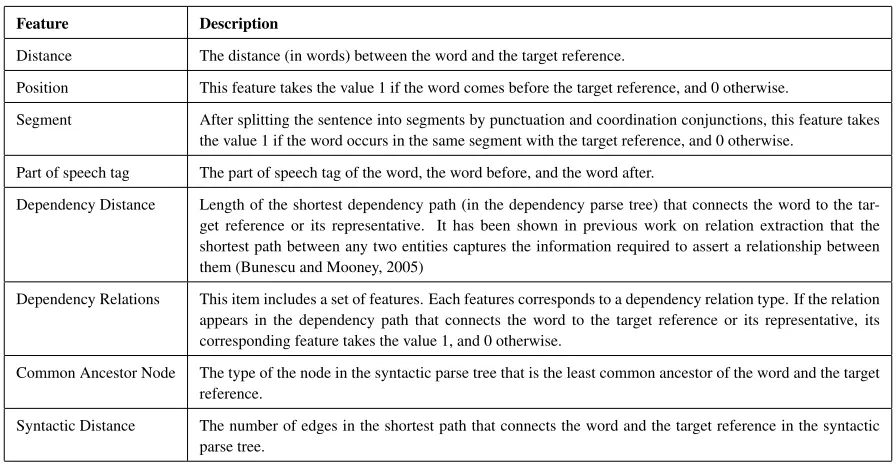
inside oroutside the scope of a given target refer-ence. We use a number of linguistic and structural features to train a classification model on a set of labeled sentences. The trained model is then used to label new sentences. The features that we use to train the model are listed in Table 1. We use the Stanford parser (Klein and Manning, 2003) for syn-tactic and dependency parsing. We experiment with two classification algorithms: Support Vector Ma-chines (SVM) and logistic regression.
4.2.2 Sequence Labeling
Feature Description
Distance The distance (in words) between the word and the target reference.
Position This feature takes the value 1 if the word comes before the target reference, and 0 otherwise.
Segment After splitting the sentence into segments by punctuation and coordination conjunctions, this feature takes the value 1 if the word occurs in the same segment with the target reference, and 0 otherwise.
Part of speech tag The part of speech tag of the word, the word before, and the word after.
Dependency Distance Length of the shortest dependency path (in the dependency parse tree) that connects the word to the tar-get reference or its representative. It has been shown in previous work on relation extraction that the shortest path between any two entities captures the information required to assert a relationship between them (Bunescu and Mooney, 2005)
Dependency Relations This item includes a set of features. Each features corresponds to a dependency relation type. If the relation appears in the dependency path that connects the word to the target reference or its representative, its corresponding feature takes the value 1, and 0 otherwise.
Common Ancestor Node The type of the node in the syntactic parse tree that is the least common ancestor of the word and the target reference.
[image:6.612.81.529.52.288.2]Syntactic Distance The number of edges in the shortest path that connects the word and the target reference in the syntactic parse tree.
Table 1: The features used for word classification and sequence labeling
of labels for all the words in the sentence at once. We use Conditional Random Fields (CRF) as our sequence labeling algorithm. In particular, we use first-order chain-structured CRF. The chain consists of two sets of nodes: a set of hidden nodesYwhich represent the scope labels (0 or 1) in our case, and a set of observed nodesX which represent the ob-served features. The task is to estimate the probabil-ity of a sequence of labels Y given the sequence of observed features X:P(Y|X)
Lafferty et al. (2001) define this probability to be a normalized product of potential functionsψ:
P(y|x) =Y t
ψk(yt, yt−1,x) (1)
Whereψk(yt, yt−1,x)is defined as
ψk(yt, yt−1,x) =exp(
X
k
λkf(yt, yt−1,x)) (2)
where f(yt, yt−1,x) is a transition feature
func-tion of the label at posifunc-tions i −1 and i and the observation sequence x; andλj is parameter to be estimated from training data. We use, as the obser-vations at each position, the same features that we used in Section 4.2.1 above (Table 1).
4.2.3 Segment Classification
We noticed that the scope of a given reference often consists of units of higher granularity than words. Therefore, in this method, we split the sentence into segments of contiguous words and, instead of labeling individual words, we label the whole segment as inside or outside the scope of the target reference. We experimented with two different segmentation methods. In the first method (method-1), we segment the sentence at punctuation marks, coordination conjunctions, and a set of special expressions such as “for example”, “for instance”, “including”, “includes”, “such as”, “like”, etc. Sentence (8) below shows an example of this segmentation method (Segments are enclosed in square brackets).
(8) [Rerankers have been successfully applied to numerous NLP
tasks such as] [parse selection (GTREF)], [parse reranking (GREF)],
[question-answering (REF)].
groups, and adverb groups. Each such group (or chunk) forms a segment. If a word does not belong to any chunk, it forms a singleton segment by itself. Sentence (9) below shows an example of this segmentation method (Segments are enclosed in square brackets).
(9) [To] [score] [the output] [of] [the coreference models],
[we] [employ] [the commonly-used MUC scoring program (REF)]
[and] [the recently-developed CEAF scoring program (TREF)].
We assign a label to each segment in two steps. In the first step, we use the sequence labeling method described in Section 4.2.2 to assign labels to all the individual words in the sentence. In the second step, we aggregate the labels of all the words contained in a segment to assign a label to the whole segment. We experimented with three different label aggregation rules: 1) rule-1: assign to the segment the majority label of the words it contains, and 2) rule-2: assign to the segment the label 1 (i.e.,inside) if at least one of the words contained in the segment is labeled 1, and assign the label 0 to the segment otherwise, and 3) rule-3: assign the label 0 to the segment if at least of the words it contains is labeled 0, and assign 1 otherwise.
5 Evaluation
5.1 Data
We use the ACL Anthology Network corpus (AAN) (Radev et al., 2009) in our evaluation. AAN is a publicly available collection of more than 19,000 NLP papers. AAN provides a manually curated cita-tion network of its papers and the citing sentence(s) associated with each edge. The current release of AAN contains about 76,000 unique citing sentences 56% of which contain 2 or more references and 44% contain 1 reference only. From this set, we ran-domly selected 3500 citing sentences, each contain-ing at least two references (3.75 references on aver-age with a standard deviation of 2.5). The total num-ber of references in this set of sentences is 19,591.
We split the data set into two random subsets:
a development set (200 sentences) and a train-ing/testing set (3300 sentences). We used the devel-opment set to study the data and develop our strate-gies of addressing the problem. The second set was used to train and test the system in a cross-validation mode.
5.2 Annotation
We asked graduate students with good background in NLP (the area of the annotated sentences) to pro-vide three annotations for each sentence in the data set described above. First, we asked them to de-termine whether each of the references in the sen-tence was correctly tagged or not. Second, we asked them to determine for each reference whether it is a syntactic constituent in the sentence or not. Third, we asked them to determine and label the scope of one reference in each sentence which was marked as a target reference (TREF). We designed a user-friendly tool to collect the annotations from the stu-dents.
To estimate the inter-annotator agreement, we picked 500 random sentences from our data set and assigned them to two different annotators. The inter-annotator agreement was perfect on both the refer-ence tagging annotation and the referrefer-ence syntacti-cality annotation. This is expected since both are ob-jective, clear, and easy tasks. To measure the inter-annotator agreement on the scope annotation task, we deal with it as a word classification task. This allows us to use the popular classification agreement measure, the Kappa coefficient (Cohen, 1968). The Kappa coefficient is defined as follows:
K= P(A)−P(E)
1−P(E) (3)
5.3 Experimental Setup
We use the Edinburgh Language Technology Text Tokenization Toolkit (LT-TTT) (Grover et al., 2000) for text tokenization, part-of-speech tagging, chunk-ing, and noun phrase head identification. We use the Stanford parser (Klein and Manning, 2003) for syntactic and dependency parsing. We use Lib-SVM (Chang and Lin, 2011) for Support Vector Ma-chines (SVM) classification. Our SVM model uses a linear kernel. We use Weka (Hall et al., 2009) for lo-gistic regression classification. We use the Machine Learning for Language Toolkit (MALLET) (McCal-lum, 2002) for CRF-based sequence labeling. In all the scope identification experiments and results below, we use 10-fold cross validation for train-ing/testing.
5.4 Preprocessing Component Evaluation
We ran our three rule-based preprocessing modules on the testing data set and compared the output to the human annotations. The test set was not used in the tuning of the system but was done using the development data set as described above. We report the results for each of the preprocessing modules. Our reference tagging module achieved 98.3% pre-cision and 93.1% recall. Most of the errors were due to issues with text extraction from PDF or due to bad references practices by some authors (i.e., not following scientific referencing standards). Our ref-erence grouping module achieved perfect accuracy for all the correctly tagged references. This was expected since this is a straightforward task. The non-syntactic reference removal module achieved 90.08% precision and 90.1% recall. Again, most of the errors were the result of bad referencing prac-tices by the authors.
5.5 Reference Scope Identification Experiments
We conducted several experiments to compare the methods proposed in Section 4 and their variants. We ran all the experiments on the training/testing set (the 3300 sentences) described in Section 5.1.
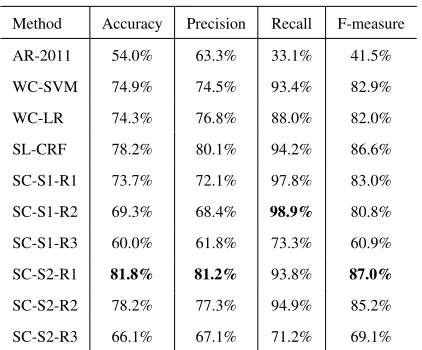
Method Accuracy Precision Recall F-measure
AR-2011 54.0% 63.3% 33.1% 41.5%
WC-SVM 74.9% 74.5% 93.4% 82.9%
WC-LR 74.3% 76.8% 88.0% 82.0%
SL-CRF 78.2% 80.1% 94.2% 86.6%
SC-S1-R1 73.7% 72.1% 97.8% 83.0%
SC-S1-R2 69.3% 68.4% 98.9% 80.8%
SC-S1-R3 60.0% 61.8% 73.3% 60.9%
SC-S2-R1 81.8% 81.2% 93.8% 87.0%
SC-S2-R2 78.2% 77.3% 94.9% 85.2%
[image:8.612.313.524.52.227.2]SC-S2-R3 66.1% 67.1% 71.2% 69.1%
Table 3: Results of scope identification using the different algorithms described in the paper
The experiments that we ran are as follows: 1) word classification using a SVM classifier (WC-SVM); 2) word classification using a logistic regression classifier(WC-LR); 3) CRF-based sequence labeling (SL-CRF); 4) segment classification using segmen-tation method-1 and label aggregation rule-1 (SC-S1-R1); 5,6,7,8,9) same as (4) but using different combinations of segmentation methods 1 and 2, and label aggregation rules 1,2 and 3: S1-R2, SC-S1-R3, SC-S2-R1, SC-S2-R2, SC-S2-R3 (where Sx refers to segmentation method x and Ry refers to label aggregation rule y all as explained in Sec-tion 4.2.3). Finally, 10) we compare our meth-ods to the baseline method proposed by Abu-Jbara and Radev (2011) which was described in Section 4 (AR-2011).
To better understand which of the features listed in Table 1 are more important for the task, we use Guyon et al.’s (2002) method for feature selection using SVM to rank the features based on their im-portance. The results of the experiments and the feature analysis are presented and discussed in the following subsection.
5.6 Results and Discussion
5.6.1 Experimental Results
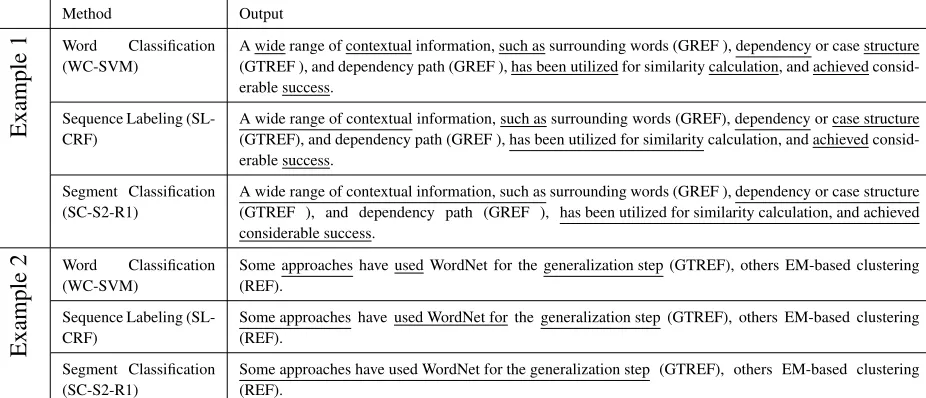
Sec-Method Output
Example
1 Word Classification (WC-SVM)
A wide range of contextual information, such as surrounding words (GREF ), dependency or case structure (GTREF ), and dependency path (GREF ), has been utilized for similarity calculation, and achieved consid-erable success.
Sequence Labeling (SL-CRF)
A wide range of contextual information, such as surrounding words (GREF), dependency or case structure (GTREF), and dependency path (GREF ), has been utilized for similarity calculation, and achieved consid-erable success.
Segment Classification (SC-S2-R1)
A wide range of contextual information, such as surrounding words (GREF ), dependency or case structure (GTREF ), and dependency path (GREF ), has been utilized for similarity calculation, and achieved considerable success.
Example
2 Word Classification (WC-SVM)
Some approaches have used WordNet for the generalization step (GTREF), others EM-based clustering (REF).
Sequence Labeling (SL-CRF)
Some approaches have used WordNet for the generalization step (GTREF), others EM-based clustering (REF).
Segment Classification (SC-S2-R1)
[image:9.612.73.536.57.256.2]Some approaches have used WordNet for the generalization step (GTREF), others EM-based clustering (REF).
Table 2: Two example outputs produced by the three methods
tion 5.1. Table 3 compares the precision, recall, F1, and accuracy for the three methods described in Sec-tion 4 and their variaSec-tions. All the metrics were com-puted at the word level. The results show that all our methods outperform the baseline method AR-2011 that was proposed by Abu-Jbara and Radev (2011). In the word classification method, we notice no sig-nificant difference between the performance of the SVM vs Logistic Regression classifier. We also no-tice that the CRF-based sequence labeling method performs significantly better than the word classi-fication method. This result corroborates our intu-ition that the labels of neighboring words are de-pendent. The results also show that segment la-beling generally performs better than word label-ing. More specifically, the results indicate that seg-mentation based on chunking and the label aggre-gation based on plurality when used together (i.e., SC-S2-R1) achieve higher precision, accuracy, and F-measure than the punctuation-based segmentation and the other label aggregation rules.
Table 2 shows the output of the three methods on two example sentences. The underlined words are labeled by the system as scope words.
5.6.2 Feature Analysis
We performed an analysis of our classification features using Guyon et al. (2002) method. The analysis revealed that both structural and syntactic features are important. Among the syntactic fea-tures, the dependency path is the most important. Among the structural features, the segment feature (as described in Table 1) is the most important.
6 Conclusions
We presented and compared three different meth-ods for reference scope identification: word classi-fication, sequence labeling, and segment classifica-tion. Our results indicate that segment classification achieves the best performance. The next direction in this research is to extract the scope of a given refer-ence as a standalone grammatical sentrefer-ence. In many cases, the scope identified by our method can form a grammatical sentence with no or minimal postpro-cessing. In other cases, more advancedtext regener-ationtechniques are needed for scope extraction.
References
Amjad Abu-Jbara and Dragomir Radev. 2011. Coherent citation-based summarization of scientific papers. In
Lan-guage Technologies, pages 500–509, Portland, Ore-gon, USA, June. Association for Computational Lin-guistics.
Awais Athar. 2011. Sentiment analysis of citations us-ing sentence structure-based features. InProceedings of the ACL 2011 Student Session, pages 81–87, Port-land, OR, USA, June. Association for Computational Linguistics.
Christine L. Borgman and Jonathan Furner. 2002. Schol-arly communication and bibliometrics. ANNUAL RE-VIEW OF INFORMATION SCIENCE AND TECH-NOLOGY, 36(1):2–72.
Razvan Bunescu and Raymond Mooney. 2005. A short-est path dependency kernel for relation extraction. In
Proceedings of Human Language Technology Confer-ence and ConferConfer-ence on Empirical Methods in Nat-ural Language Processing, pages 724–731, Vancou-ver, British Columbia, Canada, October. Association for Computational Linguistics.
Chih-Chung Chang and Chih-Jen Lin. 2011. LIBSVM: A library for support vector machines. ACM Transac-tions on Intelligent Systems and Technology, 2:27:1– 27:27.
J. Cohen. 1968. Weighted kappa: Nominal scale agree-ment with provision for scaled disagreeagree-ment or partial credit. Psychological Bulletin, 70:213–220.
Aaron Elkiss, Siwei Shen, Anthony Fader, G¨unes¸ Erkan, David States, and Dragomir Radev. 2008. Blind men and elephants: What do citation summaries tell us about a research article? J. Am. Soc. Inf. Sci. Tech-nol., 59(1):51–62.
E. Garfield, Irving H. Sher, and R. J. Torpie. 1984. The Use of Citation Data in Writing the History of Science. Institute for Scientific Information Inc., Philadelphia, Pennsylvania, USA.
Claire Grover, Colin Matheson, Andrei Mikheev, and Marc Moens. 2000. Lt ttt - a flexible tokenisation tool. InIn Proceedings of Second International Con-ference on Language Resources and Evaluation, pages 1147–1154.
Isabelle Guyon, Jason Weston, Stephen Barnhill, and Vladimir Vapnik. 2002. Gene selection for cancer classification using support vector machines. Mach. Learn., 46:389–422, March.
Mark Hall, Eibe Frank, Geoffrey Holmes, Bernhard Pfahringer, Peter Reutemann, and Ian H. Witten. 2009. The weka data mining software: an update.
SIGKDD Explor. Newsl., 11(1):10–18.
T. L. Hodges. 1972. Citation indexing-its theory and application in science, technology, and humani-ties. Ph.D. thesis, University of California at Berke-ley.Ph.D. thesis, University of California at Berkeley.
Dan Klein and Christopher D. Manning. 2003. Accu-rate unlexicalized parsing. InIN PROCEEDINGS OF
THE 41ST ANNUAL MEETING OF THE ASSOCIA-TION FOR COMPUTAASSOCIA-TIONAL LINGUISTICS, pages 423–430.
John D. Lafferty, Andrew McCallum, and Fernando C. N. Pereira. 2001. Conditional random fields: Proba-bilistic models for segmenting and labeling sequence data. InProceedings of the Eighteenth International Conference on Machine Learning, ICML ’01, pages 282–289, San Francisco, CA, USA. Morgan Kauf-mann Publishers Inc.
J. Richard Landis and Gary G. Koch. 1977. The Mea-surement of Observer Agreement for Categorical Data.
Biometrics, 33(1):159–174, March.
Terttu Luukkonen. 1992. Is scientists’ publishing be-haviour rewardseeking? Scientometrics, 24:297–319. 10.1007/BF02017913.
Andrew Kachites McCallum. 2002. Mal-let: A machine learning for language toolkit. http://mallet.cs.umass.edu.
Qiaozhu Mei and ChengXiang Zhai. 2008. Generating impact-based summaries for scientific literature. In
Proceedings of ACL-08: HLT, pages 816–824, Colum-bus, Ohio, June. Association for Computational Lin-guistics.
Saif Mohammad, Bonnie Dorr, Melissa Egan, Ahmed Hassan, Pradeep Muthukrishan, Vahed Qazvinian, Dragomir Radev, and David Zajic. 2009. Using ci-tations to generate surveys of scientific paradigms. In
Proceedings of Human Language Technologies: The 2009 Annual Conference of the North American Chap-ter of the Association for Computational Linguistics, pages 584–592, Boulder, Colorado, June. Association for Computational Linguistics.
Preslav I. Nakov, Ariel S. Schwartz, and Marti A. Hearst. 2004. Citances: Citation sentences for semantic anal-ysis of bioscience text. InIn Proceedings of the SI-GIR04 workshop on Search and Discovery in Bioin-formatics.
Hidetsugu Nanba and Manabu Okumura. 1999. To-wards multi-paper summarization using reference in-formation. In IJCAI ’99: Proceedings of the Six-teenth International Joint Conference on Artificial In-telligence, pages 926–931, San Francisco, CA, USA. Morgan Kaufmann Publishers Inc.
Hidetsugu Nanba, Noriko Kando, Manabu Okumura, and Of Information Science. 2000. Classification of re-search papers using citation links and citation types: Towards automatic review article generation.
Vahed Qazvinian and Dragomir R. Radev. 2010. Identi-fying non-explicit citing sentences for citation-based summarization. In Proceedings of the 48th Annual Meeting of the Association for Computational Linguis-tics, pages 555–564, Uppsala, Sweden, July. Associa-tion for ComputaAssocia-tional Linguistics.
Vahed Qazvinian, Dragomir R. Radev, and Arzucan Ozgur. 2010. Citation summarization through keyphrase extraction. InProceedings of the 23rd In-ternational Conference on Computational Linguistics (Coling 2010), pages 895–903, Beijing, China, Au-gust. Coling 2010 Organizing Committee.
Dragomir R. Radev, Pradeep Muthukrishnan, and Vahed Qazvinian. 2009. The acl anthology network corpus. InNLPIR4DL ’09: Proceedings of the 2009 Workshop on Text and Citation Analysis for Scholarly Digital Li-braries, pages 54–61, Morristown, NJ, USA. Associa-tion for ComputaAssocia-tional Linguistics.
Ariel Schwartz, Anna Divoli, and Marti Hearst. 2007. Multiple alignment of citation sentences with con-ditional random fields and posterior decoding. In
Proceedings of the 2007 Joint Conference on Empir-ical Methods in Natural Language Processing and Computational Natural Language Learning (EMNLP-CoNLL), pages 847–857.
Advaith Siddharthan and Simone Teufel. 2007. Whose idea was this, and why does it matter? attributing scientific work to citations. In In Proceedings of NAACL/HLT-07.
Simone Teufel, Advaith Siddharthan, and Dan Tidhar. 2006. Automatic classification of citation function. In
In Proc. of EMNLP-06.
Simone Teufel. 2007. Argumentative zoning for im-proved citation indexing. computing attitude and affect in text. InTheory and Applications, pages 159170. Howard D. White. 2004. Citation analysis and discourse