Online Continuing Professional Development: Discourse
Analysis of Primary Teachers’ perspectives on Visual Arts
Appreciation at Primary Level.
Michael Flannery
PhD in Education
Faculty of Education,
The National College of Art and Design,
A Recognised College of the National University of Ireland
Professor Gary Granville
i
Declarations
I hereby declare that this dissertation is entirely my own
work and that it has not been submitted as an exercise for a
diploma or degree in any other college or university. I
agree that the Library may lend or copy the thesis upon
request from the date of deposit of the thesis
Word Count 103,556 words
June 2010
ii
Abstract
Online continuing professional development courses have been a highly popular choice in recent years with Irish primary teachers. For the researcher, computer-mediated communications from a virtual learning community can provide a rich pool of data. This thesis documents some of the opportunities and obstacles encountered in using primary teachers’ online discourse hosted within the learning management system Moodle to generate theory in order to explain current implementation of visual arts awareness, appreciation and appraisal at primary level.
This study investigates why, according to recent national research, visual art appreciation and appraisal (looking and responding) has not translated well from the curriculum documents into classroom practice. It examines why looking and responding has not been embraced as readily as other components since the curriculum’s introduction in 1999. It explores why teachers tend to address a narrow spectrum of visual art despite their current mindfulness of diversity in the classroom and inclusive practice.
This research has adopted a discourse analysis method of enquiry and a grounded theory approach, as theory evolved from data. Data consisted of online reflective learning logs and forum discussion postings volunteered by 2,100 Irish primary teachers over four consecutive summers from 2006 to 2009. Both quantitative and qualitative methods have been applied. The study has an autoethnographic component also, in the format of self-interview, as throughout this inquiry, the researcher fulfilled another role of online course developer.
The study suggests Irish primary teachers’ expressionistic epistemological leanings and perceived levels of connoisseurship negatively impacts upon the frequency and quality of visual arts appreciation. It proposes that the integrationist and thematic approaches advocated by the primary curriculum steer primary teachers towards addressing certain kinds of artwork to the neglect of others. Primary teachers’ selection criteria is based more on a work’s perceived potential for integration or general language development, rather than selecting art for art’s sake. This inquiry also suggests that teachers’ personal comfort zones, preferences and lack of confidence limit the resultant art appreciation menu to familiar and narrative works predominantly. There is little challenge provided in terms of semiotics or critical dialogue. An understandable conservatism regarding artwork selection also stems from their position of loco parentis andtheir mindfulness of the different values held by the various religious or cultural groups they teach.
iii
Table of Contents
Chapter one: Primary teachers and visual arts appreciation: Gate keepers or window openers?
Introduction 1
1.1Personal and national concerns regarding looking and responding 9
1.2International concerns 17
1.3Dearth of research into LAR and oTCD 21
1.4 Added Value 23
Chapter two: Fours contexts of this inquiry
Introduction 27
2.1 Primary Teaching 32
2.2 Visual Arts Education 45
2.3 Looking and Responding 53
2.4 Professional Development 57
Chapter three: The merits of looking and responding to artwork of other professional artists
Introduction: 64
3.1Debating probable objections to Looking and responding (LAR) 67 3.2 LAR considered not a priority and or useful to a minority 73
3.3 LAR cannot be measured, is too costly to teach 76
3.4 LAR cannot be taught by a generalist teacher 83
3.5 Merits from Looking and responding 88
Chapter four: Shared roles of Art Critic and Primary Teacher
Introduction 100
4.1 Art criticism: roles, requirements, genres and evolution 101
4.2 Critical studies in visual arts education at primary level: What’s feasible? 106
4.3 Power and influence 108
4.4 Art Criticism as interpretation only or implying judgement 113
4.5 The Role of LAR-Teacher 118
Chapter five: Online Continuing Professional Development
Introduction 126
5.1 Open learning, online learning and virtual learning communities 131
5.2 Continuing Professional and Development 135
5.3 CPD, oCPD and consequential debates (An Irish context) 137
5.4 Online learning 149
5.5 Applying Freeland’s concepts to oCPD 155
Chapter six: Methodology
Introduction: Our eyes are far too good for us 162
iv
6.2 Using interactive and reflective online discourse as raw data 166
6.3 Informed consent, volunteerism and anonymity 171
6.4 Challenges of using electronic discourse for analysis 174
6.5 Autoethnography 180
Chapter seven: Open coded discourses analysis
Introduction: Analysing ‘warp’ threads of online discourse 186
7.1 Shared perspectives regarding perceived knowledge acquisition 187 7.2 Open coding with respect to ‘good intentioned’ application 194
7.3 Emerging questions and shifting perspectives 200
7.4 Sample group representation and summary of findings 205
Chapter eight: Axial coding
Introduction: Axial coded discourse analysis 210
8.1 LAR-Teaching 212
8.2 LAR-Resourcing 224
8.3 Further developing LAR with respect to Teaching and Resourcing 233
Chapter nine:
Introduction: Triadic LAR dynamic between child, teacher and artwork 238
9.1 Phenomena relating to LAR-Teacher 241
9.2 Art Teacher types 249
9.3 Revealing secondary ignorance 253
Chapter ten: Investigating issues pertaining to LAR-Content
Introduction 257
10.1 Equilibrium in LAR 259
10.2 Emerging patterns regarding primary teachers’ art preferences 264 10.3 Investigating teachers’ preferences and comfort levels in art 268
10.4 Least favourite 287
Chapter eleven: Autoethnography: Self Interview
Introduction: Rationale 292
11.1 Questions concerning oCPD 297
11.2 Questions concerning his epistemological positions 308
11.3 Questions regarding online learning 314
11.4 Questions regarding his parallel research 317
Chapter twelve: Emerging storylines – conclusions and recommendations of the study
Introduction: Delimiting and integrating storylines 326
12.1 LAR storyline development – sewing patterns 328
12.2 Conclusions: Theory generation and implications 335
12.3 Limitations of this inquiry 337
v
Bibliography 345
vi
Table of Figures
1.1 Six strand structure of the visual arts primary curriculum 3
1.2 Student teachers’ perceived confidence level regarding LAR 10
1.3 Fried egg metaphor (Hardy, 2006) 18
1.4 Interpretation and impediments shaping implemented curriculum 22 1.5 Added value for researchers, art educators and online course developers 24
2.1 Four contexts of this inquiry 27
2.2 Broad objectives concerning LAR 28
2.3 Fifteen considerations 35
2.4 Digital snapshot from Teacher Guidelines which outlines thematic planning including visual arts (DES, 1999b, p. 30)
38
2.5 List of primary curriculum subjects and allocated hours 44
2.6 Curriculum summary part I 45
2.7 Curriculum synopsis part II 47
2.8 Digital snapshot of lesson exemplar from the Draft Visual Arts Education Guidelines for Teachers of Children with Mild General Learning Disabilities p.56
48
2.9 Curaclam na Bunscoile, 1999, p. 82, 83 50
2.10 Curriculum synopsis part III 50
2.11 Digital snap shot of the eight aims of the visual arts primary curriculum (DES, 1999b, p.15)
52
2.12 LAR Exemplars (DES, 1999b, pp. 123- 127) 56
3.1 Merit of LAR from four levels 65
3.2 Different arts education paradigms 73
3.3 Digital snapshot of Parson’s art appreciation development 76
3.4 Savvy Teacher of Art 86
4.1 American public’s most and least wanted paintings 111
5.1 Digital snapshot from Rembrant project website 127
5.2 Digital snapshot from Artemis website 128
5.3 Digital snapshot from oCPD 2009 Visual arts: Fun and learning through looking and responding
130
5.4 One completed reflective learning log from oCPD 2008, p.9 146 5.5 Digital snapshot of ‘Not for use’ usage to indicate refrain from research 146
6.1 Triadic methodological approach 165
6.2 One sample online discussion forum posting from Module five of OCPD 2008
167
6.3 Reflective learning log 09 RLL B13, p. 67 168
vii
6.5 Digital snapshot of discussion forum posting 174
6.6 Open coded discourse analysis on Reflective Learning Logs 176 6.7 Open coded discourse analysis on Reflective Learning Logs 176
6.8 A third methodology: Autoethnography 183
7.1 Weave constructed from warp (vertical) and weft (horizontal) threads 186 7.2 Examining online postings for common codes through
open coded discourse analysis
187
7.3 Open coded discourse analysis on systematic sample group from oCPD 2009 188. 7.4 Open coded discourse analysis on systematic sample groups from oCPD
2008
188
7.5 Some of the artwork addressed in oCPD 2008 as a means of celebrating feasts and festivals which are considered integral to the primary school calendar
193
7.6 Emerging questions and realisations relating to LAR classroom practice from SSG 2009 obtained from open coded discourse analysis
200
7.7 Emerging questions and realisations relating to LAR classroom practice from SSG 2008 obtained from open coded discourse analysis
201
7.8 Screen print of Microsoft Word’s word search for FISH 205
7.9 Four emergent open code categories 207
8.1 Weaving metaphor continuing 210
8.2 Focussing on LAR-Teaching and LAR-Resourcing 211
8.3 Starting point definitions as outlined in oCPD 2007 213
8.4 Most used starting points for art production in classroom practice 214 8.5 Least used practical starting point for children’s art production 216
8.6 Components of oCPD 20008 and 2009 218
8.7 Reasons for most used and least starting points 221
8.8 Implications of practical starting point pattern 223
8.9 Perceptions regarding school’s LAR resources 227
8.10 Factors affecting quality of LAR teaching 229
8.11 Perceptions regarding links between schools and local galleries 232
9.1 Looking and responding in a gallery setting 236
9.2 Looking and responding to children’s own artwork in the classroom 236 9.3 Looking and responding to visual arts by other artists in a classroom setting 237 9.4 Four LAR code categories as extracted from open coded discourse analysis 240 9.5 Relationship between teacher knowledge and classroom practice 240
9.6 Traits of an excellent LAR teacher 242
9.7 Teacher as researcher: Research and preparation fuelling confidence and openness
243
9.8 LAR-Teacher types 247
9.9 Most common LAR-Teacher types 249
viii
10.1 Digital snapshot from oCPD 2009 which addresses monochrome painting 257
10.2 Open codes pertaining to LAR-Content 259
10.3 Some of the artwork addressed in oCPD 2009 262
10.4 Butterfly wall installations by Paul Villinski 264
10.5 Temporary land installations by artists Christo and Jeanne Claude 266
10.6 Artwork by Henri Matisse and Felix González-Torres 267
10.7 Some of the artworks presented in Module one of oCPD 2006 269 10.8 Sample group’s impressions of artwork addressed in module two of oCPD
2006
271
10.9 Sample group’s impressions of artwork addressed in module one of oCPD 2006
271
10.10 Some of the artworks addressed in oCPD 2009 273
10.11 Preference patterns removing Tropical storm with Tiger 276
10.12 The painting continuum from the photorealistic to the pure abstract 276
10.13 Preference patterns removing Starry Night 277
10.14 Alison Lapper Pregnant by Marc Quinn 278
10.15 Suggested starting points for these canonical works of art 280
10.16 Most comfortable survey findings 281
10.17 Reasons for looking at and talking about Starry Night 281
10.18 Reasons for appraising Tropical storm with tiger 283
10.29 Least favourite work of art from oCPD 2006 module one 287
10.20 Reasons for least favourite 287
10.21 Least favourite from oCPD 2006 Module two 289
11.1 Flannery Researcher and Course Developer as participant observers of primary teachers’ oCPD in LAR
292
11.2 Triadic methodological approach adopted for this research 294 11.3 Discrete projects of FR and FCD while oCPD course content and teacher
discourse were symbiotic
295
11.4 A question of compromise 299
11.5 Digital snapshot of side panel glossary and bullet pointed signposting 299 11.6 Digital snapshot of icons used to denote recommended breaks from computer
screen , hyperlinks to other websites, self-reflection, suggested practical tasks
302
11.7 Digital snapshot displaying a Google search result for ‘Starry Night’ images 307
11.8 Key components of any arts education curriculum 309
11.9 The Open Learning Continuum (Forsyth et al, 1995, p. 12) 315
11.10 No time weighting sought from student teachers 322
11.11 Perceived roles of the primary teacher for visual arts 323
12.1 Emergent LAR storylines 327
12.2 Teachers’ perceived knowledge acquisition from oCPD 330
12.3 Digital art addressed in OCPD 2009 335
ix
12.5 Intended classroom application as communicated in teachers’ Reflective learning logs
338
12.6 Re-presenting the strand units of Visual Arts Curriculum 341
12.7 Re-presenting the lesson structure 342
x
Index of Tables
3,1 Three levels of reflective judgement 79
4.1 International colour preferences (Komar & Melamid, 1997) 113
5.1 Comparison of virtual and physical organisation of learning communities (Lewis & Allen, 2005, p. 45)
132
5.2 Teachers’ perceptions following oCPD in LAR 153
6.1 Percentages of Not for use postings in relation to a selection of different searches obtained from 2006 to 2009
173
6.2 Referencing system used to code postings in SSG 2009 taken from oCPD 2009
177
6.3 Referencing system used to code postings in SSG 2008 taken from oCPD 2008
177
6.4 Listing topics and an allocated alphabet letter as its code 178 6.5 Outlining connections concerning the least used starting point for art
production
179
7.1 Most frequent codes relating to perceived knowledge acquisition 190 7.2 Shared codes from combined groupings – ( SSG 2009 U SSG 2008) 191 7.3 Most frequent emerged codes in relation to future classroom practice 196
7.4 Other intended actions identified by both SSG groups 198
7.5 Shared critical questions and topics of self-appraisal between both groupings 202 7.6 Microsoft Word’s word searches for codes extracted from discourse analysis 206
8.1 Exploring axial relationships within emerging LAR phenomena 212
8.2 Demonstrating referencing system 214
8.3 Shared future actions 220
8.4 Listing anchor words of some of the reasons communicated from teachers who most use Experience and imagination
222
8.5 Implications of their starting points 224
8.6 Results from Microsoft Word’s word searches for anchor words 227
9.1 Teachers’ intentions with respect to future LAR classroom practice 238 9.2 Respondents who identified themselves as being responsible for LAR 241 9.3 Word searches for organisational considerations pertaining to LAR 244
10.1 Gmail group responses 272
10.2 Teachers’ favourite work of art from oCPD 2007 284
xi
Acknowledgements
I would like to acknowledge and express my gratitude to the thousands of primary teachers for their generosity of spirit in terms of sharing their personal and professional perspectives concerning the world of visual arts and the inclusion of visual arts appreciation at primary level. Without their contributions, it would have been impossible to ascertain patterns of similar thinking or classroom practice to generate ‘grounded theory’ concerning the current implementation of the strand units ‘looking and responding’ at primary at primary.
I would like to convey special thanks to Allison Gilliland from the Professional Development Unit of the Irish National Teacher’s Organisation and to Gene Mehigan, Coordinator of Continuing Professional Development at Marino Institute of Education,for affording me the opportunity and the challenge of developing online CPD summer courses for primary teachers. Each resultant virtual learning community of teachers provided me with a rich source of online teacher discourse from which ‘grounded’ theory generation was possible.
I would like to communicate my heartfelt appreciation to my tutors Professor Gary Granville and Dervil Jordan of the Faculty of Education at the National College of Art and Design, for their continuing interest, motivation and guidance in relation to my studies. They were both extremely helpful in assisting my research. Each tutor meeting was of tremendous importance in terms of consolidating progress, identifying emerging issues and resolving challenges. I left each meeting with renewed enthusiasm, a sense of accomplishment and a focus to further progress this research. I would also like to thank the librarian staff at the National College of Art and Design for their help and assistance.
1
Chapter One: Primary Teachers and Visual Arts
Appreciation: Gate keepers or window openers?
Introduction:
In 1999, no one really knows what art is anymore, or what it ought to look like. Or what it is for. This causes anxiety for some, while others see it as a kind of freedom…the definition, re-definition and de-definition of what it can and cannot achieve has been a major subject of the art of this century…
(Searle, 1999, p. 46)
So wrote Adrian Searle in The Guardian newspaper about the different responses felt and expressed in reaction to the ever expanding universe of visual arts and the inclusion of other forms of visuality under the increasingly familiar term ‘visual culture’. Freeland (2001, p. xviii) remarks that ‘the practices and roles of artists are amazingly multiple and elusive’ and that many modern artworks challenge viewers and critics to figure out why, using any theory of art, they would count as art. Holland (2006, p. 60) comments that school art education has struggled to keep up and accommodate or contribute to these redefinitions of what constitutes as art. Hickman (2006, p. 169) remarks, however, that the key to the future of art education lies with new teachers and teacher in training with respect to their perceptions of art and aims of art education. A key focus of this inquiry is to ascertain Irish primary teacher’s perspectives of art and art education at primary level with a particular focus on visual arts appreciation. It seeks to discover patterns of shared thinking and opinion in relation to preferences, perceptions and practices regarding visual arts appreciation. It aims using a grounded theoretical approach to generate theory which may explain why visual arts appreciation is not being fully implemented as intended, as evidenced in findings from various national studies (Crafts Council, 2009; INTO, 2009; DES, 2005; NCCA, 2005).
2
informs and enhances production. Taylor (1986, p. 178) agrees explaining ‘the teaching of art has two aspects - Janus like – looking out the visual language evolved by culture we share and looking inwards towards the individual’s student’s expressive needs’. However, Holland (2006, p. 66) laments that ‘there is little mention of schools providing an experience of art education based on challenge, risk or the unorthodox and so ‘children are disempowered when they need to make judgements about much of what now counts as art’ echoing Searle’s concern in the opening quotation. The real world of art and visual culture, Holland (2006, p. 66) remarks, ‘is often about challenge and question; play and transgression; it will often run against the grain’. He questions ‘why there has been little debate around the meanings inherent in the way we select and use resources’ for art appreciation in schools and why the same artists appear with monotonous regularity (Holland, 2006, p. 67). He complains that despite the arrival of the Internet and information and communication technologies (ICT) in UK schools, the bulk of art education multimedia concerning visual arts appreciation for example promotes rather than challenges a prescribed narrow canon of selected artwork and artists. Green and Mitchell (1997, p. 11) ascertain, however, that one of the purposes of art education is to start with popular opinion and develop from that a raft of understandings about art, through considering the nature of art and lives of artists.
3
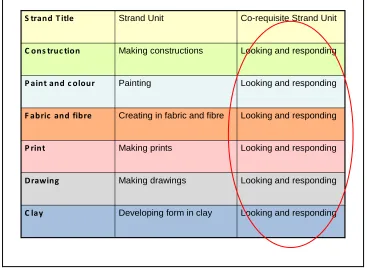
emphases and structure across all of its six media orientated ‘strands’ entitled Drawing, Paint and colour, Print, Clay, Fabric and fibre and Construction (DES, 1999, p. 7).Each strand is composed of two ‘strand units’. One strand unit concerns production and its co-requisite concerns looking and responding (see figure 1.1).
The strand unit Looking and responding affords children opportunities to see, feel, think and talk about their own artwork as well as that of other professional artists, crafts people or designers (DES, 1999b & DES, 1999c). It concerns three of the four ways Eisner (1989, p. 17) contends we come to understand art – looking, understanding its place in culture over time and making judgments about quality (Tallack, 2006, p. 111). The fourth way is through production. Chapter two examines the visual arts curriculum’s strand units Looking and responding in greater detail while chapter three investigates the merits of looking and responding for children’s development and for education itself.
Looking and responding Developing form in clay
C lay
Looking and responding Making drawings
Drawing
Looking and responding Making prints
P rint
Looking and responding Creating in fabric and fibre
F abric and fibre
Looking and responding Painting
P aint and c olour
Looking and responding Making constructions
C ons truc tion
Co-requisite Strand Unit Strand Unit
[image:15.612.123.491.363.632.2]S trand T itle
Figure 1.1. Six strand structure of the visual arts primary curriculum
4
2003, p. 4). The word ‘artist’ will imply artist, craftsperson, designer, photographer, industrial designer, architect or any other art professional. The phrase looking and responding (LAR) in this study will refer to children’s looking at and talking about artwork created by other professional artists only. However, any references to the curriculum’s looking and responding ‘strand units’ implies looking at and talking about children’s own artwork and the work of other children as well (DES, 1999c). While different perceptions of art appreciation and art criticism will be examined more closely in chapter three, the term ‘visual arts appreciation’ for this study will infer awareness, appreciation as well as appraisal. It will imply having or developing some sense of connoisseurship in children about the different worlds of art and artists and ways of addressing artwork in order to make informed, reasoned and fair appraisals. It will be perceived as entailing children’s elemental learning of aesthetics, art history and critical theory.
5
342 teachers in 2009]. The resultant online teacher discourse generated and volunteered by course participants became the data for this research.
Grigg (2004) comments that ‘the canon of art is [still] formulated and disseminated by a variety of agencies’ such as galleries, art museums, mass media, publishers but also by schools and universities (2004, p. 45). Many institutions would like to be perceived as both window openers to diversity, but also gate keepers in term of maintaining quality. As window opener they may adopt ‘Danto’s open door theory of art’ (Freeland, 2003, p. 39) welcoming the avant-garde and experimental art forms. Newer galleries around the world for example differ from more traditional gallery institutions by ‘showcasing minority artists, women, and ordinary people’ (Freeland, 2001, p. 90). As window opener to further understanding, they often provide a contextual LAR experience for the public combining art with anthropology, sociology and revisionist art history. Others galleries may perceive their role as gate keeper in terms of protecting and nurturing a particular minority grouping’s artists, tastes and values which have become vulnerable (Freeland, 2001, p.92). Burgess& Addison (2006) and Hollands (2006) perceive that schools behave as gate keepers of a particularly conservative and monotonous canon. Institutional Theory accepts that an object or concept becomes art when it is considered to be so by the artists and those ‘in the know’ who work in the world of visual arts (Pooke & Whitham, 2003, p. 77). Gallery institutions might be perceived as gate keepers of the ever evolving definitions, re-definitions and de-re-definitions of what constitutes art. Their function is ‘to make art worthless again. They take the work out of the market and put it in place where it becomes part of the common wealth’ (Thornton, 2008, p. xiv).
6
primary teachers are professionally trained to make informed judgements about the quality and potential of all lesson content from an educational and child-centred perspective. Yet, they have the responsibility of providing access for children to a variety of art styles from different times and cultures (DES, 1999b, p. 14). It may be impossible for primary teachers to represent the increasingly diversity of art in a fair, non-hierarchical and objective manner. Taylor (1989, p. 102) notes ‘that there may be no way of presenting images value free, without an implicit imprimatur from the adult world’. Unless a disclaimer is made, works of art addressed will be perceived ‘as meeting teacher’s approval and indicative of adult taste in general’ (Taylor, 1989, p. 102). Grigg comments that
despite the talk of modern eclecticism, Victorian mentalities still inform cultural institutions and art education. The education system is constrained, both in maintaining nineteenth-century rigid subject divisions an in the narrow, school-based way many art teachers construe cultural education.
(Grigg, 2004, p. 56)
Yet, the constraints of subject divides do apply to primary education which embraces an integrationist education paradigm. The integration of learning and the transfer of learning are considered core principles of learning in the curriculum (DES, 1999a, p. 16). Cross-curricular teaching, thematic planning and integrated learning are integral to the primary teaching day. This inquiry seeks insight into the kind of artwork that is addressed in Irish primary schools. It questions ‘whether their [LAR-Content] contain a useful balance of [artwork] representing the work of craftspeople as well as “fine” artists, and of women as well as men; whether they are culturally wide-ranging and not Euro-centric or parochial; and include both the established and the avant-garde or experiential examples of art and design’(Mortimer, 1989, p. 60)?
7
in terms of disposition, approach, level of involvement and commitment to LAR. Hickman (2004, p.170) comments with particular reference to second level art education, that ‘we ideally need appropriately trained teachers of visual culture as well as teachers who are experts in studio skills’. This desire for two qualified types of art teacher reflects a key emphasis of the 1999 visual arts primary curriculum (1999b, p.11). It emphasises that ‘balancing opportunities to make art with opportunities to make a personal response to art’. But it doesn’t propose a specialist teacher for each area at this level of children’s education. But the question remains regarding what level of aptitude is required of a generalist primary teacher to implement this duality and most especially LAR as intended in the 1999 curriculum. What ‘specific subject knowledge is axiomatic if a teacher is to act as an effective subject mentor’ (Swift & Steers, 2006, p.23)? Chapter four explores the roles, responsibilities and level of connoisseurship (Eisner, 2002, p. 57) suggested of the primary teacher in relation to LAR and compares them with that of another perceived window opener or gate keeper within the art world – the art critic.
8
Children are growing up in many different kinds of family units. There is greater inclusion of children with special needs and general learning disabilities in primary classrooms and the 1999 curriculum was accompanied by parallel curricula for children with mild, moderate and severe general learning disabilities (NCCA, 1999b). Newcomer children, many with English as a second language have enriched class composition. There is also greater diversity with respect to children’s cultural and religious backgrounds. The Intercultural Education Guidelines highlight the potential of LAR in terms of cross-cultural understanding and inclusion on one hand but its propensity for perpetuating racial and cultural stereotyping on the other (NCCA, 2005, p.84; Comhlámh, 2009, p. 2). Chapter four explores how ignoring the context of art can lead to cultural appropriation as opposed to understanding (Freeland, 2003, p. 45) and investigates different perspectives on what art appreciation entails. Does it imply judgement or interpretation only?
The third principle of Swift and Steers (1999) manifesto entitled ‘independent thought’ (Hardy, 2006, p. 17) is also enshrined as a general learning principle in the primary school curriculum (1999a, p. 16). Children are active agents in their own learning. Learner autonomy is promoted as well as the development of children’s higher-order thinking and problem-solving skills (1999a, p. 14-18).
In the curriculum the child is encouraged to observe, collate and evaluate evidence, to ask questions, to identify essential information, to recognise the essence of a problem, to suggest solutions, and to make informed judgements. These activities help to foster the higher-order thinking skills such as summarising, analysing, making inferences and deductions, and interpreting figurative language and imagery.
(DES, 1999a, p. 16)
9
evidences the significant effect primary school engagement with art has on children in terms of their understanding, enjoyment and consumption of visual arts as adults (Gibson, 2008, p.178). This inquiry investigates how aware, if at all, primary teachers are of what effect their chosen LAR menu has on children with respect to their impressions, perceptions and dispositions towards visual arts as adults.
The 1999 Irish primary school curriculum might be considered post-modern from a third perspective. It doesn’t prescribe a syllabus of artwork to be addressed. It doesn’t outline a compulsory or approved list of canonical artwork. Nor does it align certain art forms, media or genres with particular age groups. It does not have a nationalist agenda for example in terms of promoting Irish artists only. Rather It asks teachers to expose children to a diverse range of visual arts ‘from different times and cultures and explore their role in those cultures and how it differs with art of our times (DES, 1999b, p. 14). It embraces relativism. ‘The school should highlight the fact that each individual is an artist when art activity is entered into. The student’s work can share the same space as the prints of paintings by Van Gogh or daVinci (NCCA, 2002, p. 9). It advocates that teachers inculcate a sense of ‘openness’ in children to the ever increasing diversity of visual arts and help them to look at work attentively so they can evaluate work in a critical and personally meaningful way (DES, 1999b, p. 14). It invites primary teachers to be ‘window openers’ to the world(s) of visual arts rather than gate keepers of an approved list. This study explores whether primary teachers fulfil their role as window openers or gatekeepers in their LAR classroom practice. It investigates primary teachers’ preferences and comfort levels regarding art and if these or other variables affect their choice of LAR content. It also considers the null LAR curriculum as ‘what is not taught can be as important as what is taught’ (Eisner, 2002, p.159) in determining whether teachers are gate keepers of a school canon.
1.1
Personal and national concerns regarding LAR
10
analyses of incoming student teachers indicated that their perceived confidence levels in their ability to talk about visual arts was lower than their perceived capacity to be creative with art media. This was further noted through informal conversations with and observing the student teachers on teaching practice‘plurality’ and ‘difference’.
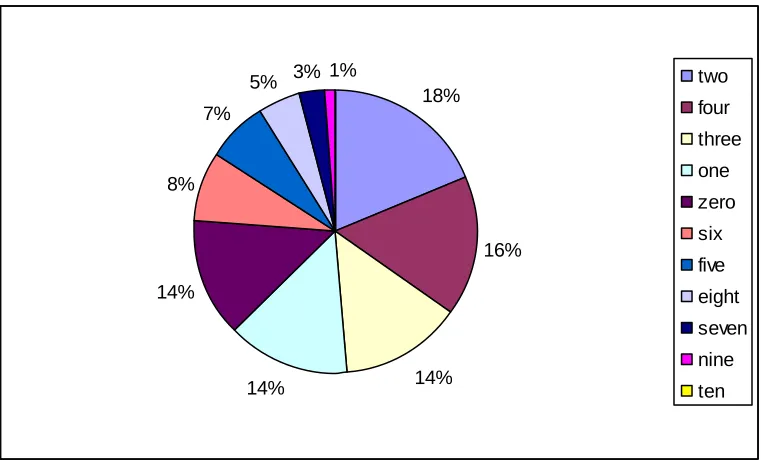
[image:22.612.116.501.466.696.2]Feedback from a questionnaire administered to one typical incoming year group for example revealed that sixty-four of the hundred students didn’t take visual arts as subject beyond primary level. Eighty-four per cent of that year group rarely or never visited a gallery. Just over one third admitted they never visited an art gallery while forty nine student teachers responded that they rarely went. The Arts Council’s survey (2006) on 1,210 members of the general public indicated that just eleven percent had gone to an art gallery in the previous twelve months. Fifteen percent attended an art exhibition which was eight percent fewer when compared with figures obtained in 1994. Incoming student teachers seemed to be no more familiar or interested in the world of visual arts and artists than the general population. The student teachers were asked to gauge their perceived confidence level with respect to talking about art in terms of giving their first impressions, describing its content, form, how it was made and sharing their interpretations with others. Over two thirds rated their confidence level as being four or less out of ten (see figure 1.2).
Figure 1.2. Student teachers’ perceived confidence level regarding LAR
18%
16%
14% 14%
14% 8%
7%
5% 3% 1% two
11
Rossi’s (2007) study on two groups of student teachers attending two different Irish primary teacher educator providers [Hibernia and St Patrick’s College] indicated that one fifth of student teachers had confidence and competence concerns with respect to their capacity to fully deliver the visual arts curriculum. Fifty-seven percent, however, felt they their college prepared them well to deliver the programme. There was no specific finding in relation to LAR or critical studies. A preliminary survey for this research conducted on one group of thirty practising primary teachers who were attending a face to face continuing professional development (CPD) seminar concerning visual arts education evidenced a shared lack of confidence in facilitating looking and responding to works of art by other professional artists (LAR). Nineteen teachers wrote that they least use LAR as a practical starting point for art production as opposed to the other three starting points presented in the visual arts curriculum. These are Experience and imagination, Materials and tools and Observation and curiosity which will be outlined in more detail in chapter two. One third stated that this was due to a lack of LAR knowledge and experience and one third indicated that sourcing LAR resources was the impediment. Interestingly, both LAR-Teacher and LAR-Resourcing emerge as two key categories from the initial open coded discourse analysis of teachers’ online computer mediated communications (CMCs).
12
p92). Twenty-seven percent report that their most frequent use of ICT was for LAR [in this case looking at pictures and online galleries]. These teachers explained that they used the Internet to research visual artists, their life and works (NCCA, 2005, p99). The Visual Arts Teacher Guidelines recommends a balance of both integrated and single-subject teaching (DES, 1999b, p. 35). Their findings report that less than ten percent of teachers surveyed hardly ever or never taught the visual arts through theme-based activities. Theme based art production and curriculum integration is reduced somewhat as children move up the school which is consistent with curriculum guidance.
As a curriculum, it was warmly received by teachers who highlighted many of its successes. One of the perceived successes was the integration [my emphasis] of visual arts with other subject areas. Almost fifty per cent of teachers surveyed reported that they afforded opportunities for children to experience the visual arts through theme–based activities which facilitated integration at least a few times a week. Almost another fifty percent of teachers reported that they facilitated integration incorporating visual arts once or twice a month (DES, 2005, p. 30). Almost twenty percent of teachers identified children’s growing appreciation of visual arts as another success of the 1999 curriculum while a third of teachers communicated that children had opportunities to see how artists, craftspeople and designers work with(in), and in response to, their environments. Another perceived success of the visual arts curriculum was its natural inclusiveness, whereby children with general learning disabilities or special needs could participate to their current potentiality (DES, 2009, p. 30 & 31).
13
world and that opportunities be provided for pupils to perceive and enjoy (DES, 2005, p. 38). The inspectors found that while aspects of the strand units Looking and responding were explored in slightly more than two-thirds of classrooms evaluated, there was little or no emphasis placed on looking and responding to the work of artists [craftspeople and designers] in all six strands (DES, 2005, p. 41). The review outlined how the curriculum advocates ‘access to different art, styles, times and cultures’ as motivating agents to stimulate children’s art production and to make connections between other artists’ observations and interpretations and children’s own work. They emphasise how exposure to a variety of visual arts enhances children’s perceptual and aesthetic sensibilities and ‘promotes opportunities for questioning, discussion, reflection and evaluation’ (DES, 2005, p. 40). They noted that ‘the potential for ICT to broaden pupil’s experience and understanding of art was not exploited in most primary schools’ (DES, 2005, p. 44).
The INTO’s survey titled Creativity and the Arts in the primary School (2009) found that primary teachers appear to spending far more time on art production than on LAR. Almost all of the respondents [209] devoted more than half of their time to Making art with three quarters of them devoting all of their time to it. Almost all teachers allocate less than half their time to LAR with eighty percent admitting to spending a quarter or less of the time on LAR (INTO, 2009, p. 47). Most respondents do not use information technology (IT) in their teaching of visual arts. These teachers commented that they had limited IT facilities, no Internet access or very slow computers (INTO, 2009, p. 49). Any respondent, who indicated they used ICT, did so in terms of advanced research or presenting other artwork as a stimulus for follow through art making. Just over one quarter of these primary teachers engaged the services of art specialists in relation to working with clay followed by fabric and fibre. These were mostly funded externally by their local County Council or school’s parents association.
14
was conducted in 2008, highlighted that while there approximately three to four articles each year addressing children’s art production, there were only two articles during that time period which addressed visual arts appreciation. One article concerned looking at and talking about the canonical painting entitled Starry Night by Van Gogh in terms of its content, form, mood and process and proposed how it could be used as a catalyst for follow-through painting. Part of this inquiry examines how often primary teachers use and their perceptions of using artworks as a ‘practical starting point’ for children’s art production (DES, 1999b, p. 29). A second article entitled Art Critic outlined how looking at and talking about artwork by other artists can be integrated with either the English or Gaeilge curricula – as part of a discrete oral language programme. The focus was on the integrative potential of artworks in terms of language development as opposed to appreciating art for art’s sake (InTouch, 2004). LAR ‘has proved an effective precursor to literacy (Danko-McGhee, 2003) as well as oral language development (Higgins 2005)’ (Higgins (2010, p.43). Eisner (2002, p.156) comments that while integration is an aspiration on the one hand, it can be a problem on the other, most especially when one tries to maintain the ‘integrity’ of a discipline, in this case being visual arts appreciation. Integration has been identified by primary teacher as one of the perceived successes of the visual arts curriculum (INTO, 2009, p. 30). While chapter two explores the general perceived merits of integration at primary level, the issue of subject boundary strength does emerge later as interesting point for debate.
15
period of perceived economic boom, these are a flavour of some of the subject areas addressed in the magazine
- Differentiation in the classroom - English as an additional language - Special needs education
- Information communication technology - Integration and holism
- Assessment
- Class size and other challenges
- Managing multi grade teaching contexts - Early literacy and numeracy intervention - Relationships and sexuality education
- Sexual identity and dealing with homophobia - Children with challenging behaviour
- Bullying in the schools
- Class diversity and inclusion and intercultural education - Conditions of employment and legal issue
16
or art exhibits in local galleries, museums and art centres (O Reilly, 2010d, p. 51). He highlights the potential use of Internet and information communication technologies (ICT) for LAR. While online teacher discourse indicates that online continuing professional development (oCPD) enabled them acquire greater knowledge and understanding concerning LAR resourcing, this inquiry ascertains there whether there other shared perceived needs or critical questions among Irish primary teachers concerning LAR.
The IMMA (1999 & 2002) has undertaken research with respect to the impact of their school links initiatives with children and primary teachers. Seventy eight percent of teacher participants in its Breaking The Cycle project indicated how it triggered them to critically reflect upon their current visual arts classroom practice while eighty-seven percent commented it caused actual change in classroom practice. Fifty-nine per cent noted it increased their capacity to deliver the 1999 visual arts curriculum (IMMA, 2002, p. 57). With respect to LAR specifically, the museum visits afforded opportunities ‘for exploration of the physical space and engagement with contemporary artwork’ and ‘teachers were surprised at the complexity and quality of children’s responses’ (IMMA, 2002, p. 75). Teachers also reported increased freedom and confidence in responding to art. IMMA (1999) has also documented the benefits derived from projects which used artwork by contemporary artists and LAR as stimuli for art production projects with primary school children. IMMA (2002, p. 111) advocates in its recommendations that children ought to experience a nonverbal response to artworks as well. They facilitate this either in a workshop setting or in their response room.
17
where a child and adult [teacher] can dream, in order to speculate and grow’ (O Donoghue cited in IMMA, 1999, p. 14). IMMA’s grounded research obtained through semi structured interviews, survey, focus group discussion and participant observation evidence that CPD of and support for class teacher is central but identifies that because of a dynamic and full school day, there is little opportunity and time to engage ‘in personal and collective reflection and evaluation’ (IMMA, 2002, p. 91).
1.2 International concerns
Grigg (2004) writes that the findings from the national survey undertaken by the UK Qualifications and Curriculum Authority (1998) found the most popular artists addressed in primary and secondary schools were Van Gogh, Picasso, Monet and Lowry. He penned concern that four of those artists are associated with Parisian modernism, that the selection in no way reflects art of the last fifty years and that it equally showed little commitment to art prior to 1850 (Hickman, R. 2004, p.51). Grigg’s appraisal of their findings is quite critical concluding that ‘despite talk of modern eclecticism, Victorian mentalities still inform cultural institutions and art education. The education system is constrained, both in maintaining nineteen century rigid subject divisions and in the narrow school based way many art teachers construe cultural education’ (Hickman, R. 2004, p.56). The survey found that the Impressionists were a main focus in schools. The other artists identified were Mondrian, David Hockney and Paul Klee. In the seven to fourteen age range, the national survey revealed how other artists, such as Henry Moore, Andy Goldsworthy, Escher and Gustave Klimt, make an appearance as well as certain art movements include Surrealism, Pop art, Cubism, Op art, Fauvism, Expressionism and Futurism. American artists only account for only four per cent with Andy Warhol, Georgia O Keefe and Roy Lichenstein the most used (Hickman, R. 2004, p.52).
18
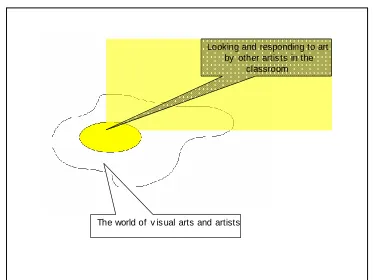
more representative spectrum of visual arts including emerging art of children’s time (see figure 1.3).
Looking and responding to art by other artis ts in the
classroom
The world of v is ual arts and artists
Figure 1.3. Fried egg metaphor (Hardy, 2006)
[image:30.612.119.492.106.386.2]19
Haanstra et al’s (2008) research in the Netherlands shows that many Dutch teachers [second level] ignore contemporary art and are reluctant to incorporate popular visual culture. They recommended that teachers build bridges between school art with ‘real’ art worlds outside school. [Their use of the term ‘real’ is somewhat unfortunate. It devalues school art. Children are legitimate makers of art and even staged theories of artistic development don’t equate one stage as being superior to another.] They write that
Very few teachers considered it possible or desirable to introduce contemporary art into lessons, For the majority the task of relating contemporary art to their student’s experience of the world was too challenging. They explained that the gap between the two worlds is too wide; that contemporary art is too complex and shocking and the subject matters may be unacceptable for some cultural groups; and that introducing it runs the risk of confirming student’s prejudices (for example, the idea that ‘anyone can do art’)
(Haanstra et al, 2008, p. 51) Their studies revealed how Dutch art teachers felt they did try and keep abreast of youth visual culture, but in truth they mostly ‘domesticated’ (Wilson, 2003, p. 224) a few aspects of youth culture ‘as a source for teaching the same things they had taught for many years and still wanted to teach’. Their research findings concerning school teachers is echoed by research undertaken by Wilson (2003) in the United States and Downing & Watson (2004) in the UK.
20
the learning potential and relevance of contemporary art forms through research or project initiatives (Addisson and Burgess, 2007; Atkinson, 2002; Efland et al, 1996; Hughes, 1998; IMMA, 1999).
The Tate primary and secondary schools project (Adams et al, 2006) is of particular relevance to this inquiry as there are many parallels. Participant teachers engaged in a Tate and Goldsmith CPD concerning LAR in relation to contemporary artwork (Adams et al, 2006, p. 15). They learnt about contemporary art and educational theory. They explored diverse methods of interpretation in relation to LAR. They also completed independent research and engaged in online discourse as part of a virtual learning community. Their project evidenced how CPD proved central in ensuring a shift in pedagogic practices (Adams et al. 2006, p. 7). One key shift in teacher’s thinking was towards a conception of art as text with meanings to be deciphered rather than a practice in a particular medium. Teachers felt in many ways it was easier to address contemporary art forms with children knowing that ‘children would not necessarily understand the work in the way that adults might read and interpret it’ (Adams et al, 2006, p. 24). The impact of contemporary art practices on teaching and learning evidenced that the teacher as active researcher was established as having a crucial role and responsibility. The LAR teaching and learning approaches adopted ‘paralleled with traditions of child-centred and experiential learning’ (Adams et al, 2006, p. 27).
21
balance between what teachers perceived they wanted and what research indicated they needed. Like Sharp’s research, this inquiry explores analysis of teacher discourse in this case comprising asynchronous online computer mediated communications (CMCs) to ascertain what perhaps is the focus of LAR discussions in primary classrooms.
1.3 Dearth of research into LAR and online teacher professional development
(oTPD)
Literature search identified no studies which focused specifically on LAR [looking at and responding to works of art by other professional artists] in Irish primary classrooms. There is a dearth of research regarding the current repertoire of art addressed with primary children. Although there have been a number of reviews and inquiries regarding the visual arts curriculum’s implementation since its introduction, no detailed feedback has been reported regarding the quality of LAR with respect to content or teaching. DES and NCCA findings evidence that aspect of the curriculum is poorly planned for in comparison to other areas of the curriculum. This inquiry seeks to ascertain why certain parts of the visual arts primary curriculum are embraced more so than others. For example, two dimensional art production is explored with children more so than creating three dimensional forms. Open ended art production is embraced in the main but there is little evidence of assessment in terms of concepts or skills development. Craft and design are not addressed in same manner as art. ICT is used only for planning and resourcing purposes.
22
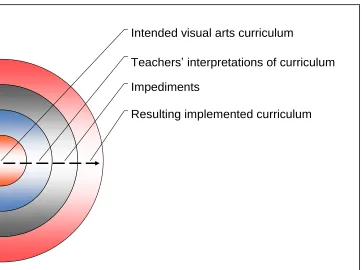
involving a relationship between curriculum intention, in this case being the ‘formal [visual arts] curriculum’, primary teachers’ shared interpretations of that curriculum - the perceived visual arts curriculum, and the enacted ‘actual’ visual arts curriculum (McKernan, 2008, p.35). It also explores what other variables emerge as real impediments to its full realisation or implementation (See figure 1.4)?
Resulting implemented curriculum Impediments
[image:34.612.127.489.192.462.2]Teachers’ interpretations of curriculum Intended visual arts curriculum
Figure 1.4. Interpretation and impediments shaping implemented curriculum
23
discourse, experiential, and resource tools for learning’. It can facilitate real time participant interaction while ‘providing immediate peer support and feedback’. It thirdly, ‘shows the presence of the audience and thus encourages participants to collaborate with one another and to engage in meaningful conversations about art’ (Lilly-Lu, 2008, p. 52).
This research indirectly provides insight from three different perspectives in relation to the potential benefits that oCPD can afford professionals in terms of their continuing professional development. Through discourse analysis of different sample groups of fifty teachers from over two thousand one hundred teacher participants from four different oCPD LAR summer courses it aims to identify shared opinions of the learner professional. This study has autoethnographic component in the form of a ‘considered’ self-interview, whereby Flannery as Course Developer (CFD), crafts considered written responses to a series of questions posed by Flannery Researcher (FR). While many questions concern LAR specifically, others concern his impressions of oCPD and VLEs in relation to continuing professional development and his ‘lived’ experiences as online course developer from 2006 to 2009. The other perspective is that of researcher, who chose to use computer mediated communications (CMCs) as generated within a virtual learning environment (VLE) as data for grounded theoretical research. He outlines his ‘lived’ experience in terms of the opportunities such electronic discourse presents and the challenges faced concerning data containment and protection.
1.4 Added value
24
grounded it is in terms of the available data, how exacting it is in terms of making sense of particular phenomena and how applicable it can be in terms of predicting or controlling outcomes in other similar situational contexts (Cohen et al, 2007, p. 493). In this case, is theory of use in explaining the current status of LAR?
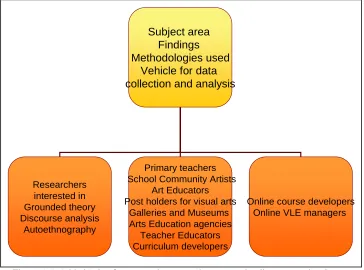
Subject area Findings Methodologies used
Vehicle for data collection and analysis
Researchers interested in Grounded theory Discourse analysis
Autoethnography
Primary teachers School Community Artists
Art Educators Post holders for visual arts
Galleries and Museums Arts Education agencies
Teacher Educators Curriculum developers
[image:36.612.125.489.176.446.2]Online course developers Online VLE managers
Figure 1.5. Added value for researchers, art educators and online course developers
25
can do in demystifying their artwork and making it more accessible and approachable for the general public including children.
The data source for this research was mostly comprised of virtual online discourse generated and hosted within a Management Learning Environment (MLE) managed by and belonging to the INTO and not MIE (Researcher’s place of work). The online course was designed using freely available software New View [NVU] from the Internet. Once the course content was devised it was then emailed to IT support who housed it in the INTO’s management learning environment [Moodle]. Flannery Course Developer had no further involvement in the summer course. Flannery Researcher had access to course sometimes as an administrator and at other times just as another participant. The electronic participant discourse was kept for the duration of the course and some months later until it was time for the Professional Development Units of the INTO to organise and install summer courses for the following year by which time Flannery Researcher had to ensure relevant raw data was downloaded and saved for repeated analysis and to substantiate any ‘grounded’ theory.
26
27
Chapter two: Four contexts of this inquiry
Introduction:
Continued Professional Development
Primary Teaching
Visual Arts Education
Looking and responding
Figure 2.1. Four contexts of this inquiry
28
as a central source of human activity’ (1995, p.20). It is also perceived to be influenced by the Education Act of 1998 which specifically refers to ‘promoting the development of the arts and other cultural matters as a particular function for schools’ [Education Act, 1998, Section 9 (f)] (Arts Council, 2007, p. 19). The Arts Education curriculum [which includes Music, Drama and Visual Arts Education as distinct subject areas] ‘aspires to provide for a balance between expression and the child’s need to experience and respond to visual arts, to Music and Drama’ (DES, 1999a, p. 2).
When due account is taken of intrinsic abilities and varying circumstances, the visual arts curriculum should enable the child to
- Look at curiosity and openness at the work of a wide range of artists and craftspeople [awareness]
- Explore atmosphere, content and impact in the work of artists [appreciation]
- Identify a variety of visual arts media and describe some of the creative processes involved [awareness]
- Develop the ability to identify and discuss what he/ she considers the most important design elements of individual pieces [appraisal]
- Discuss the preferred design elements in the work of others [appraisal] - Begin to appreciate the context in which great art and artefacts are
created and the culture form which they grow [awareness]
- Use appropriate language in responding to visual arts experiences [articulation]
(DES, 1999c, p. 10 & 11) Figure 2.2. Broad objectives concerning LAR
29
Critical studies, Art history and Aesthetics (Bloomsfield & Childs, 2000, p. 91; Clement, 1993, p.5; Eisner, 2009; Green & Mitchell, 1997, p. 31; Hickman, 2004, Hurwitz & Day, 2007, p. 202; p. 4; Larkin, 1981, p. 11; Stevens, 1994; Tickle, 1996, p. 23;) This research interprets this aspect of LAR as involving awareness, appreciation and appraisal. Part of this study examines how these three aspects of LAR are articulated and supported in the curriculum. The broad objectives concerning LAR address all three with elements of LAR with one broad objective addressing the development of children’s LAR lexicon to enable them articulate their awareness, appreciation and appraisal (see figure 2.2). Part of this study analyses teacher’s perspectives regarding their perceived roles and responsibilities in attaining those broad objectives. This chapter aims to appreciate the context in which LAR is situated within the visual arts curriculum, the broader realm and culture of primary teaching and in terms of teachers’ continuing professional development.
30
of teacher preparation should be retained. It comments that in some subject areas such as Arts Education, ‘there may be a need to increase the non-practical element’. It advises that colleges should provide dedicated spaces and appropriate materials for Arts Education (Teaching Council, 2009) pp. 279-286.
As with any other subject area, some primary teachers will have a greater interest in visual arts more than others. Often there is very tangible evidence of a teacher’s interest in the visual arts in terms of their classroom and adjacent corridor displays. Barnes (2002, p. 18) comments, that ‘within minutes of walking inside a school premises, it is often possible to absorb and sense the way in which art is valued’. He cautions however, that there can be the danger ‘that art for display in the school becomes “window dressing” for parents and important visitors’. An artist’s corner, a post-holder with special responsibility for visual arts, an ‘artist of the month’ display, a rich selection of art appreciation library books, prints and posters of canonical work, established links with local galleries, an aesthetically pleasing school environment, planned excursions to local galleries – all these are all possible indicators of a school’s interest in and commitment to looking and responding. Some primary schools have also assigned part of a post holder’s duties for the development of visual arts in terms of whole school planning and evaluation, staff development, display, events and resource organisation as means of ensuring visual arts is alive and vibrant both in the implicit, explicit and hidden curriculum (Eisner, 2009, p.158).
31
have been trained in the 1999 curriculum at pre-service level. Teacher preparation courses in visual arts vary slightly in different Colleges of Education in terms of course duration, class size and delivery format, as with other many other curriculum, areas but they all share core components comprising of the practical as well as the theoretical, classroom experience and knowledge of the curriculum. Interestingly, the Kellaghan Report (2002) recommends a possible increase in the non-practical components of Arts Education (Teaching Council, 2009, p. 283). This may imply that greater time be spent on the conceptual, contextual and critical domains of visual arts (LAR). Thirdly, an emerging number of newly qualified teachers have received their training in the 1999 visual arts curriculum but have also experienced the curriculum first hand as learners in the twilight years of their primary schooling.
Since the introduction of the ‘consecutive route’ for degree graduates to become a primary teacher by completing a Higher Diploma in Primary Education, a small number of primary teachers have entered the school system with a prior third level specialist background in an arts area such as textiles, graphic design or art history. This diversity in qualification is welcomed by the Colleges of Education Research Consortium (CERC) in terms of sharing expertise and collegial support. Over the years, other primary teachers have completed postgraduate studies including a research component concerning visual arts provided by some of the Colleges of Education. This year (2010), the National College of Art and Design (NCAD) launched a Masters course in Visual Arts Education (MAVA) which is comprised of a number of primary teachers alongside secondary school art teachers and artists. The INTO’s research (2009) found that twenty-eight per cent of their teacher respondents engaged the services of specialist art teachers for aspects of curriculum delivery. They were mostly sought for the three dimensional stands Clay, Construction and fabric and fibre. These were mostly funded by County Councils, schools or parent associations (INTO, 2009, p. 51). There was no reference of teacher obtaining specialist help in relation to art appreciation.
32
country. These are usually organised by Education Centres, Colleges of Education, galleries, museums and other arts related agencies. Evidence is anecdotal only, but many teachers who select a visual arts orientated CPD summer course; do so because it is perceived as being less intense than other course topics. The visual arts in-service courses usually feature lots of practical ‘hands on’ experimentation. A more detailed description about primary teachers’ general CPD patterns over the past decade is provided later in this chapter [section 2.4]. In 2006, the first of four consecutive online continuing professional development (oCPD) summer courses addressing looking and responding (LAR) was launched by the INTO in conjunction with Coláiste Mhuire, Marino Institute of Education. Coláiste Mhuire is long established College of Education, which is affiliated with Trinity College, Dublin. The online course used a Course Management System (CMS), also known as a Learning Management System (LMS) or a Virtual Learning Environment (VLE) entitled Moodle, which is freely available from the Internet. Its online discussion forum facility was subsequently used as the vehicle in obtaining primary teachers’ perspectives regarding LAR for this research.
2.1 Primary Teaching
McCarr (2008) explains to potential interested teachers in her Teaching Careers article entitled Encouraging Creativity and Learning that the role of a teacher is not confined to imparting academic information. She explains that it is ‘legally defined in Ireland as promoting the educational, personal and social development of young people and teachers must adhere to a professional code of conduct defined in legislation’. She notes that as well as contact teaching hours, teachers are obliged to plan lessons, prepare class reports and tests and mark papers as well as prepare students academically and emotionally for state exams. They organise extracurricular activities, meet with parents of students and work as part of a team in the school staff (2008, p. 2). This description, however, resonates more of second level teaching than primary teaching. Her description doesn’t quite capture the essence of primary teaching as many primary teachers perceive it. The general aims of primary education are threefold
33
- To enable the child to develop as a social being through living and cooperating with others and so contribute to the good of society
- To prepare the child for further education and lifelong learning
(DES, 1999a, p. 7)
Hayes (2006, p.19) comments that while the teacher’s role has many facets, the profession is now dominated by functional aspects including curriculum implementation, planning lessons, assessing pupils progress and compiling reports. ‘Motivating factors such as altruism, compassion, a love of children and the fulfilment of a working environment sometimes have to be subordinated to these pragmatic aims. But recent research from the Colleges of Education Research Consortium (CERC), find, however that altruism is ever present. ‘Making a difference’ is still the reason consistently given by newly qualified teachers regarding their choice of career. They note that virtually all of those who qualify as teachers continue with teaching in contrast with the UK whereby fifty percent of newly qualifies teachers have left teaching within five years (INTO, 2008, p.37). A cross-cultural inquiry into the values held by teachers in the USA, Costa Rica, Palestine and the Republic of Ireland described in Mc Kernan (2008 p. 177- 195), found teachers to be honest, loving and respectable people who seek family security and self-respect as means and end respectively.
34
Arthur et al (2006, p164) presents Tabberer’s composite list (1997) of stated aims from primary education systems from around the world. They included excellence, social development, equal opportunity, preparation for work, foundation for further education, citizenship, community and democracy, creativity, health, physical and leisure, parental participation, individual development, personal qualities, national economy, basic skills, knowledge, skills and understating, cultural heritage and literacy, environment and lifelong learning. The Irish Primary School Curriculum (PSC) is no different, listing fifteen similar key considerations in the revision of the curriculum (1999a, 1999, p. 26-31). All fifteen issues impact on the quality of LAR as with any other curriculum component and chapter three will outline how looking and responding to diverse artwork of other artists can contribute significantly, uniquely in attaining these considerations (see squared brackets).
1. Quality in Education [Deep as opposed to shallow forms LAR dialogue] 2. Literacy and numeracy [Visual literacy development ]
3. A sense of Irish identity [Irish cultural literacy development] 4. The Irish language [Mediating LAR through Irish language]
5. The spiritual dimension [LAR engagement and spirituality (Hall, 2004)] 6. The European and global dimension [Diversity in LAR menu]
7. Pluralism [A key characteristic of post-modern visual arts education] 8. Equality and fairness of access [Inclusion and balance in LAR content] 9. Partnership [Galleries, Museums, world of artists]
10.Science Education [Designing and making, (DES, 1999a, p.29)]
11.Information and communication technologies [Digital media, virtual galleries] 12.Children with special needs [Artist with special needs, portrayal of disability] 13.Early childhood education [Language development, perceptual skills]
14.Transition from primary to post primary [Shared research concerns re. LAR] 15.The curriculum for lifelong learning [Consumers of art]