Proceedings of the 2011 Conference on Empirical Methods in Natural Language Processing, pages 486–496,
A Word Reordering Model for Improved Machine Translation
Karthik VisweswariahIBM Research India Bangalore, India [email protected]
Rajakrishnan Rajkumar Dept. of Linguistics Ohio State University [email protected]
Ankur Gandhe IBM Research India
Bangalore, India [email protected]
Ananthakrishnan Ramanathan IBM Research India
Bangalore, India [email protected]
Jiri Navratil
IBM T.J. Watson Research Center Yorktown Heights, New York
Abstract
Preordering of source side sentences has proved to be useful in improving statistical machine translation. Most work has used a parser in the source language along with rules to map the source language word order into the target language word order. The require-ment to have a source language parser is a ma-jor drawback, which we seek to overcome in this paper. Instead of using a parser and then using rules to order the source side sentence we learn a model that can directly reorder source side sentences to match target word or-der using a small parallel corpus with high-quality word alignments. Our model learns pairwise costs of a word immediately preced-ing another word. We use the Lin-Kernighan heuristic to find the best source reordering ef-ficiently during training and testing and show that it suffices to provide good quality reorder-ing.
We show gains in translation performance based on our reordering model for translating from Hindi to English, Urdu to English (with a public dataset), and English to Hindi. For English to Hindi we show that our technique achieves better performance than a method that uses rules applied to the source side En-glish parse.
1 Introduction
Languages differ in the way they order words to pro-duce sentences representing the same meaning. Ma-chine translation systems need to reorder words in the source sentence to produce fluent output in the
target language that preserves the meaning of the source sentence.
Current phrase based machine translation systems can capture short range reorderings via the phrase table. Even the capturing of these local reordering phenomena is constrained by the amount of training data available. For example, if adjectives precede nouns in the source language and follow nouns in the target language we still need to see a particular ad-jective noun pair in the parallel corpus to handle the reordering via the phrase table. Phrase based sys-tems also rely on the target side language model to produce the right target side order. This is known to be inadequate (Al-Onaizan and Papineni, 2006), and this inadequacy has spurred various attempts to overcome the problem of handling differing word order in languages.
One approach is through distortion models, that try to model which reorderings are more likely than others. The simplest models just penalize long jumps in the source sentence when producing the target sentence. These models have also been generalized (Al-Onaizan and Papineni, 2006; Till-man, 2004) to allow for lexical dependencies on the source. While these models are simple, and can be integrated with the decoder they are insufficient to capture long-range reordering phenomena espe-cially for language pairs that differ significantly.
mance they generally involve joint parsing of the source and target language which is significantly more computationally expensive when compared to phrase based translation systems. Another approach that overcomes this weakness, is to to reorder the source sentence based on rules applied on the source parse (either hand written or learned from data) both when training and testing (Collins et al., 2005; Gen-zel, 2010; Visweswariah et al., 2010).
In this paper we propose a novel method for deal-ing with the word order problem that is efficient and does not rely on a source or target side parse being available. We cast the word ordering problem as a Traveling Salesman Problem (TSP) based on previ-ous work on word-based and phrased-based statis-tical machine translation (Tillmann and Ney, 2003; Zaslavskiy et al., 2009). Words are the cities in the TSP and the objective is to learn the distance be-tween words so that the shortest tour corresponds to the ordering of the words in the source sentence in the target language. We show that the TSP distances for reordering can be learned from a small amount of high-quality word alignment data by means of pairwise word comparisons and an informative fea-ture set involving words and part-of-speech (POS) tags adapted and extended from prior work on de-pendency parsing (McDonald et al., 2005b). Ob-taining high-quality word alignments that we require for training is fairly easy compared with obtaining a treebank required to obtain parses for use in syntax based methods.
We show experimentally that our reordering model, even when used to reorder sentences for training and testing (rather than being used as an additional score in the decoder) improves machine translation performance for: Hindi→ English, En-glish→Hindi, and Urdu→English. Although Urdu
is similar to Hindi from the point of reordering phe-nomena we include it in our experiments since there are publicly available datasets for Urdu-English. For English→Hindi we obtained better machine
trans-lation performance with our reordering model as compared to a method that uses reordering rules ap-plied to the source side parse.
The rest of the paper is organized as follows. Sec-tion 2 reviews related work and places our work in context. Section 3 outlines reordering issues due to syntactic differences between Hindi and English.
Section 4 presents our reordering model, Section 5 presents experimental results and Section 6 presents our conclusions and possible future work.
2 Related work
There have been several studies demonstrating im-proved machine translation performance by reorder-ing source side sentences based on rules applied to the source side parse during training and decoding. Much of this work has used hand written rules and several language pairs have been studied e.g German to English (Collins et al., 2005), Chinese to English (Wang et al., 2007), English to Hindi (Ramanathan et al., 2009), English to Arabic (Badr et al., 2009) and Japanese to English (Lee et al., 2010). There have also been some studies where the rules are learned from the data (Genzel, 2010; Visweswariah et al., 2010; Xia and McCord, 2004). In addition there has been work (Yamada and Knight, 2002; Zollmann and Venugopal, 2006; Galley et al., 2006; Liu et al., 2006) which uses source and/or target side syntax in a Context Free Grammar framework which results in machine translation decoding being considered as a parsing problem. In this paper we propose a model that does not require either source or target side syntax while also preserving the effi-ciency of reordering techniques based on rules ap-plied to the source side parse.
In work that is closely related to ours, (Tromble and Eisner, 2009) formulated word reordering as a Linear Ordering Problem (LOP), an NP-hard permu-tation problem. They learned LOP model weights capable of assigning a score to every possible per-mutation of the source language sentence from an aligned corpus by using a averaged perceptron learn-ing model. The key difference between our model and the model in (Tromble and Eisner, 2009) is that while they learn costs of a wordwi appearing
any-wherebeforewj, we learn costs ofwi immediately
precedingwj. This results in more compact models and (as we show in Section 5) better models.
decoding as a TSP and they show favorable speed performance trade-offs compared with Moses, an existing state-of-the-art decoder. In (Tillmann and Ney, 2003), a beam-search algorithm used for TSP is adapted to work with an IBM-4 word-based model and phrase-based model respectively. As opposed to calculating TSP distances from existing machine translation components ( viz. the translation, dis-tortion and language model probabilities) we learn model weightsto reorder source sentences to match target word order using an informative feature set adapted from graph-based dependency parsing (Mc-Donald et al., 2005a).
3 Hindi-English reordering issues
This section provides a brief survey of constructions that the two languages in question differ as well as have in common. (Ramanathan et al., 2009) notes the following divergences:
• English follows SVO order while Hindi follows
SOV order
• English uses prepositions while Hindi uses
post-positions
• Hindi allows greater word order freedom
• Hindi has a relatively richer case-marking sys-tem
In addition to these differences, (Visweswariah et al., 2010) mention the similarity in word order in the case of adjective noun sequences (some books
vs.kuch kitab).
4 Reordering model
Consider a source sentence w consisting of a
se-quence of n words w1, w2, ... wn that we would like to reorder into the target language order. Given a permutation π of the indices 1..n, let the
candi-date reordering bewπ1,wπ2, ...,wπn. Thus,πi de-notes the index of the word in the source sentence that maps to position iin the candidate reordering.
Clearly there aren!such permutations. Our
reorder-ing model assigns costs to candidate permutations as:
C(π|w) =X
i
c(πi−1, πi).
The costc(m, n)can be thought of as the cost of the
word at index m immediately preceding the word with indexnin the candidate reordering. In this
pa-per, we parametrize the costs as:
c(m, n) =θTΦ(w, m, n),
where θ is a learned vector of weights and Φ is a vector of feature functions.
Given a source sentencewwe reorder it
accord-ing to the permutation π that minimizes the cost C(π|w). Thus, we would like our cost function
C(π|w)to be such that the correct reorderingπ∗has
the lowest cost of all possible reorderingsπ. In
Sec-tion 4.1 we describe the featuresΦthat we use, and
in Section 4.2 we describe how we train the weights
θto obtain a good reordering model.
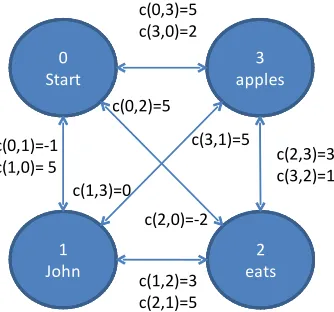
Given our model structure, the minimization problem that we need to solve is identical to solving a Asymmetric Traveling Salesman Problem (ATSP) with each word corresponding to a city, and the costs
c(m, n)representing the pairwise distances between
the cities. Consider the following example: English input: John eats apples
Hindi: John seba(apples) khaataa hai(eats) Desired reordered English: John apples eats The ATSP that we need to solve is represented pictorially in Figure 1 with sample costs. Note that we have one extra node numbered 0. We start and end the tour at node 0, and this determines the first word in the reordered sentence. In this example the minimum cost tour is:
Start→John→apple→eats
recovering the right reordering for translation into Hindi.
Solving the ATSP (which is a well known NP hard problem) efficiently is crucial for the efficiency of our reordering model. To solve the ATSP, we first convert the ATSP to a symmetric TSP and then use the Lin-Kernighan heuristic as implemented in Con-corde, a state-of-the-art TSP solver (Applegate et al., 2005). We also experimented with using the exact TSP solver inConcordebut since it was slower and did not improve performance we preferred using the Lin-Kernighan heuristic. To convert the ATSP to a symmetric TSP we double the size of the orig-inal problem creating a node N0 for every node
3 apples
2 eats 1
John 0 Start
c(2,3)=3 c(3,2)=1 c(0,3)=5
c(3,0)=2
c(0,1)=-1 c(1,0)= 5
c(1,3)=0 c(0,2)=5
c(1,2)=3 c(2,1)=5
c(3,1)=5
[image:4.612.381.471.68.254.2]c(2,0)=-2
Figure 1: Example of an ATSP for reordering the sen-tence:John eats apples.
Hahsler, 2009), we then set new costs as follows:
c0(A, B) = ∞, c0(A, B0) = c0(B0, A) = c(A, B)
andC(A, A0) = −∞. Even with this doubling of the number of nodes, we observed that solving the TSPs with the Lin-Kernighan heuristic is very fast, taking roughly 10 milliseconds per sentence on av-erage. Overall, this means that our reordering model is as fast as parsing and hence our model is compara-ble in performance to techniques based on applying rules to the parse tree.
4.1 Features
Since we would like to model reordering phenomena which are largely related to analyzing the syntax of the source sentence, we chose to use features based on those that have in the past been used for parsing (McDonald et al., 2005a). A subset of the features we use was also used for reordering in (Tromble and Eisner, 2009).
To be able to generalize from relatively small amounts of data, we use features that in addition to depending on the words in the input sentencew
de-pend on the part-of-speech (POS) tags of the words in the input sentence. All featuresΦ(w, i, j)we use
are binary features, that fire based on the identities of the words and POS tags at or surrounding posi-tionsiandjin the source sentence. The first set of
feature templates we use are given in Table 1. These features depend only on the identities of the word and POS tag of the two positionsiandjand we call
wi pi wj pj
× × × ×
× ×
× ×
× ×
× ×
× ×
× ×
× ×
× ×
× × ×
Table 1: Bigram feature templates used to calculate the cost that word at positioniimmediately precedes word at positionj in the target word order. wi (pi) denotes the
word (POS tag) at positioniin the source sentence. Each of the templates is also conjoined withi-jthe signed dis-tance between the two words in the source sentence.
these Bigram features.
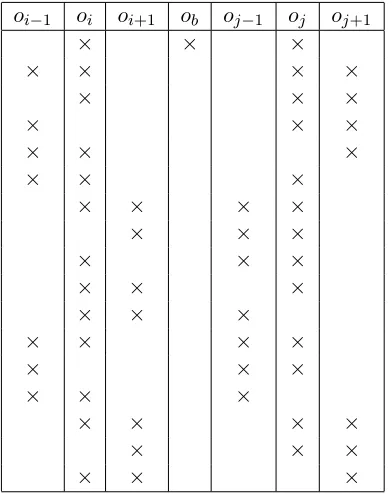
The second set of feature templates we use are given in Table 2. These features, in addition to ex-amining positions i and j examine the surround-ing positions. We instantiate these feature templates separately for the POS tag sequence and for the word sequence. We call these two feature sets Con-textPOS and ContextWord respectively. When in-stantiated with POS tags, the first row of Table 2 looks at all POS tags between positions i and j.
(Tromble and Eisner, 2009) use Bigram and Con-textPOS features, while we extend their feature set with the use of ContextWord features. Since Hindi is verb final, in Hindi sentences with multiple verb groups it is rare for words with a verb in between to be placed together in the reordering to match En-glish. Looking at the POS tags of words between positionsiandjallows us to penalize such
reorder-ings.
Each of the templates described in Table 1 and Table 2 is also conjoined with i-j the signed
dis-tance between the two words in the source sentence. The values ofi-jbetween 5 and 10, and greater than
10 are quantized (negative values are similarly quan-tized).
[image:4.612.106.273.81.237.2]oi−1 oi oi+1 ob oj−1 oj oj+1
× × ×
× × × ×
× × ×
× × ×
× × ×
× × ×
× × × ×
× × ×
× × ×
× × ×
× × ×
× × × ×
× × ×
× × ×
× × × ×
× × ×
[image:5.612.89.285.71.318.2]× × ×
Table 2: Context feature templates used to calculate the cost that word at positioniimmediately precedes word at positionjin the target word order. oi denotes the
ob-servation at positioniin the source sentence andob
de-notes an observation at a position between i andj (i.e i+ 1 ≤ b ≤ j−1). Each of the templates is instan-tiated with the observation sequence otaken to be the word sequencewand the POS tag sequencep. Each of the templates is also conjoined withi-j the signed dis-tance between the two positions in the source sentence.
types for the task of reordering Hindi sentences to be in English word order.
4.2 Training
To train the weights θ in our model, we need a
collection of sentences, where we have the desired reference reordering π∗(x) for each input sentence
x. To obtain these reference reorderings we use word aligned source-target sentence pairs. The qual-ity and consistency of these reference reorderings will depend on the quality of the word alignments that we use. Given word aligned source and tar-get sentences, we drop the source words that are not aligned. Letmi be the mean of the target word po-sitions that the source word at indexiis aligned to.
We then sort the source indices in increasing order ofmi. Ifmi =mj (for example, becausewiandwj are aligned to the same set of words) we keep them
in the same order that they occurred in the source sentence. Obtaining the target ordering in this man-ner, is certainly not the only possible way and we would like to explore better treatment of this in fu-ture work.
We used the single best Margin Infused Re-laxed Algorithm (MIRA) ((McDonald et al., 2005b), (Crammer and Singer, 2003)) with the online up-dates to our parameters being given by
θi+1= arg min
θ ||
θ−θi||
s.t. C(π∗|w)< C(ˆπ|w)−L(π∗,πˆ).
In the equation above,
ˆ
π = arg min
π C(π|x)
is the best reordering based on the current parameter value andLis a loss function. We take the loss of
a reordering to be the number of words for which the preceding word is wrong relative to the reference target order.
We also experimented with the averaged percep-tron algorithm (Collins, 2002), but found single best MIRA to work slightly better and hence used MIRA for all our experiments.
5 Experiments
In this section we report on experiments to evalu-ate our reordering model. The first method we use for evaluation (monolingual BLEU) is by generat-ing the desired reordergenerat-ing of the source sentence (as described in Section 4.2) and compare the reordered output to this desired reordered sentence using the BLEU metric. In addition, to these monolingual BLEU results, we also evaluate (in Section 5.5) the reordering by its effect on eventual machine transla-tion performance.
5.1 Reordering model training data and alignment quality
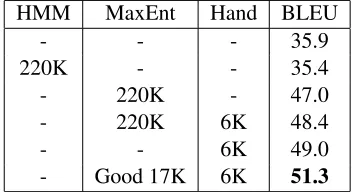
To train our reordering models we need training data where we have the input source language sentence and the desired reordering in the target language. As described in Section 4.2 we derive the refer-ence reordered sentrefer-ence using word alignments. Ta-ble 3 presents our monolingual BLEU results for Hindi to English reordering as the source of the word alignments is varied. All results in Table 3 are with Bigram and ContextPOS features. We have word alignments from three sources: A small set of hand aligned sentences, HMM alignments (Vo-gel et al., 1996) and alignments obtained using a su-pervised Maximum Entropy aligner (Ittycheriah and Roukos, 2005) trained on the hand alignments. The F-measure for the HMM alignments were65%and 78% for the Maximum Entropy model alignments.
We see that the quality of the alignments is an im-portant determiner of reordering performance. Row 1 shows the BLEU for unreordered (baseline) Hindi compared with the Hindi sentences reordered in En-glish Order. Using just HMM alignments to train our model we do worse than unreordered Hindi. Al-though using the Maximum Entropy alignments is better than using HMM alignments, we do not im-prove upon a small number of hand alignments by using all the Maximum Entropy alignments.
To improve upon the model trained with only hand alignments we selected a small number of snip-pets of sentences from our Maximum Entropy align-ments. The goal was to pick parts of sentences where the alignment is reliable enough to use for training. The heuristic we used in the selection of snippets was to pick maximal snippets of at least 7 consecutive Hindi words with all Hindi words aligned to a consecutive span of English words, with no unaligned English words in the span and no English words aligned to Hindi words outside the span. Adding snippets selected with this heuristic improves the reordering performance of our model as seen in the last row of Table 3.
5.2 Feature set comparison
In this section we report on experiments to deter-mine the performance of the different classes of fea-tures (Bigram, ContextPos and ContextWord)
dis-HMM MaxEnt Hand BLEU
- - - 35.9
220K - - 35.4
- 220K - 47.0
- 220K 6K 48.4
- - 6K 49.0
[image:6.612.338.515.72.168.2]- Good 17K 6K 51.3
Table 3: Monolingual BLEU scores for Hindi to English reordering using models trained on different alignment types and tested on a development set of 280 Hindi sen-tences (5590 tokens).
Feature template
Bigram ContextPOS ContextWord BLEU
- - - 35.9
× - - 43.8
× × - 49.0
[image:6.612.313.539.236.320.2]× × × 51.3
Table 4: Monolingual BLEU scores for Hindi to En-glish reordering using models trained with different fea-ture sets and tested on a development set of 280 Hindi sentences (5590 tokens).
cussed in Section 4.1. Table 4 shows monolingual BLEU results for training with different features sets for Hindi to English reordering. In all cases, we use a set of 6000 sentence pairs which were hand aligned to generate the training data. It is clear that all three sets of features contribute to performance of the reordering model, however the number of Con-textWord features is larger than the number of Bi-gram and ContextPOS features put together, and it may be desirable to select from this set of features especially when training on large amounts of data.
Language pair Monolingual BLEU Source Target Unreordered LOP TSP
Hindi English 35.9 36.6 49.0
English Hindi 34.4 48.4 56.7
Urdu English 35.6 39.5 49.9
[image:7.612.78.298.70.155.2]English French 64.4 78.2 81.2
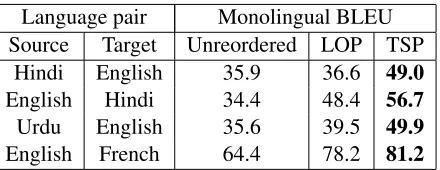
Table 5: Monolingual BLEU scores comparing the orig-inal source order with desired target reorder without re-ordering, and reordering using our model (TSP) and the model proposed in (Tromble and Eisner, 2009) (LOP).
test data consisted of 280 sentences for Hindi to En-glish and 400 sentences for all other language pairs generated from hand aligned sentences. We include English-French here to compare on a fairly similar language pair with local reordering phenomena (the main difference being that in French adjectives gen-erally follow nouns). We note that our model outper-forms the model proposed in (Tromble and Eisner, 2009) in all cases.
5.4 Analysis of reordering performance
To get a feel for the qualitative performance of our reordering algorithm and the kind of phenomena it is able to capture, we analyze the reordering per-formance in terms of (i) whether the clause restruc-turing is done correctly – these can be thought of as medium-to-long range reorderings, (ii) whether clause boundaries are respected, and (iii) whether lo-cal (short range) reordering is performed correctly. The following analysis is for Hindi to English re-ordering with the best model (this is also the model used for Machine Translation experiments reported on in Section 5.5).
• Clause structure: As discussed in Section 3,
the canonical clause order in Hindi is SOV, while in English it is SVO. However, variations on this structure are possible and quite frequent (e.g., clauses with two objects). To evaluate clause restructuring, we compared sequences of subjects, objects and verbs in the output and reference reorderings.
We had a set of 70 sentences annotated with subject, direct object, indirect object and verb information – these annotations were made on the head word of each phrase, and the
compar-isons were on sequences of these words alone and not the entire constituent phrase. 52 sen-tences were reordered by the model to match the order of the corresponding reference. Eight sentences were ordered correctly but differently from the reference, because the reference was expressed in non-canonical fashion (e.g., in the passive) – note that these cases negatively im-pact the monolingual BLEU score. The follow-ing example shows a sentence befollow-ing reordered correctly, where, however, the reference is ex-pressed differently (note the position of the subject “policy” (niiti) in the reference and the reordered output)1:
Input: aba1(now) taka2(till) aisii3(this)niiti4 (policy) kabhii5(ever) nahii6 (not) rahii7(has) hai8(been)
Reordered: taka2 (till) aba1 (now) aisii3(this)
niiti4 (policy) hai8(been) kabhii5(ever) nahii6 (not) rahii7 (has)
Reference: taka2 (till) aba1 (now) aisii3 (this) kabhii5 (ever) nahii6 (not) rahii7 (has) hai8 (been)niiti4(policy)
English: Till now this never has been thepolicy
The remaining ten sentences were reordered in-correctly. These errors are largely in clauses which deviate from the SVO order in some way – clauses with multiple subjects or objects, clauses with no object, etc.. For example, the following sentence with two subjects and ob-jects corresponding to the verbwearinghas not been reordered correctly.
Input: sabhii1 (all) purusha2 (men) safeda3 (white) evama4 (and) mahilaaen5 (women) kesariyaa6(saffron) vastra7(clothes) dhaarana8 (wear) kiye9 hue10(-ing) thiin11(were) Reordered: sabhii1 (all) purusha2 (men) safeda3 (white) evama4 (and) mahilaaen5 (women) kesariyaa6 (saffron) vastra7 (clothes) dhaarana8 (wear) thiin11(were) kiye9 hue10 (-ing)
ing) safeda3 (white) evama4 (and) mahilaaen5 (women) kesariyaa6 (saffron)
English: All men were wearing white and the women saffron
The model possibly needs more data with pat-terns that deviate from the standard SOV order to learn to reorder them correctly. We could also add to the model, features pertaining to subject, object, etc.
• Clause boundaries: Measured on a set of
844 sentences which were marked with clause boundaries, 37 sentences (4.4 %) had reorder-ings that violated these boundaries. An exam-ple of such a clause-boundary violation is be-low:
Input: main1(I) sarakaara2(government) kaa3 (of) dhyaana4 (attention) maananiiya5
(hon-ourable) pradhaana6 (prime) mantri7
(min-ister) dvaaraa8 (by) isa9 (this) sabhaa10
(house) me11 (in) kiye12 gaye13 (made) isa14
(this) vaade15 (promise) ki16 ora17 (towards) dilaanaa18 (to bring) chaahuungaa19 (would like)
Reordered: main1 (I) chahuungaa19 (would like) dilaanaa18 (to bring) kii16 ora17 (to-wards) isa9 (this) vaade15 (promise) kiye12
gaye13 (made) dvaaraa8 (by) maananiiya5
(honourable) mantri7 (minister) pradhaana6
(prime) dhyaana4 (attention) kaa3 (of) sarakaara2(government)men11(in) isa14(this)
sabhaa10(house)
Reference: main1 (I) chahuungaa19 (would like) dilaanaa18(to bring) dhyaana4(attention) kaa3 (of) sarakaara2 (government)kii16 ora17
(towards) isa9 (this) vaade15 (promise) kiye12
gaye13 (made) dvaaraa8 (by) maananiiya5
(honourable) mantri7 (minister) pradhaana6
(prime) men11(in) isa9(this) sabhaa10(house) EnglishI would like to bring the attention of the government towards this promisemade by the honourable prime minister in this house. Note how the italicized clause, which is kept together in the reference, is split up incorrectly in the reordered output. The proportion of such
boundary violations is, however, quite low, be-cause Hindi being a verb-final language, most clauses end with a verb and it is probably quite straightforward for the model to keep clauses separate. A clause boundary detection program should make it possible to eliminate the re-maining errors.
• Local reordering: To estimate the short range
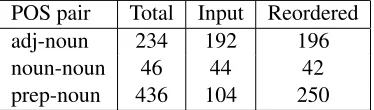
reordering performance, we consider how of-ten different POS bigrams in the input are re-ordered correctly. Here, we expect the model to reorder prepositions correctly, and to avoid any reordering that moves apart nouns and their adjectival pre-modifiers or components of com-pound nouns (see Section 3). Table 6 sum-marizes the reordering performance for these categories for a set of 280 sentences (same as the test set used in Section 5.1). Each row in Table 6 indicates the total number of cor-rect instances for the pair, i.e., the number of instances of the pair in the reference (column titled Total), the number of instances that al-ready appear in the correct order in the input (column Input), and the number that are or-dered correctly by the reordering model (col-umnReordered). The first two rows show that adjective-noun and noun-noun (compounds) are in most cases correctly retained in the orig-inal order by the model. The forig-inal row shows that while many prepositions have been moved into their correct positions, there are still quite a few mismatches with the reference. An impor-tant reason why this happens is that nouns mod-ified by prepositional phrases can often also be expressed as noun compounds. For example,
POS pair Total Input Reordered
adj-noun 234 192 196
noun-noun 46 44 42
[image:9.612.319.536.69.141.2]prep-noun 436 104 250
Table 6: An analyis of reordering for a few POS bigrams
5.5 Machine translation results
We now present experiments in incorporating the re-ordering model in machine translation systems. For all results presented here, we reorder the training and test data using the single best reordering based on our reordering model for each sentence. For each of the language pairs we evaluated, we trained Direct Translation Model 2 (DTM) systems (Ittycheriah and Roukos, 2007) with and without reordering and compared performance on test data. We note that the DTM system includes features that allow it to model lexicalized reordering phenomena. The reordering window size was set to +/-8 words for both the base-line and our reordered input. In our experiments, we left the word alignments fixed, i.e we reordered the existing word alignments rather than realigning the sentences after reordering. Redoing the word align-ments with the reordered data could potentially give further small improvements. We note that we ob-tained better baseline performance using DTM sys-tems than the standard Moses/Giza++ pipeline (e.g we obtained a BLEU of 14.9 for English to Hindi with a standard Moses/Giza++ pipeline). For all of our systems we used a combination of HMM (Vo-gel et al., 1996) and MaxEnt alignments (Ittycheriah and Roukos, 2005).
For our Hindi-English experiments we use a train-ing set of roughly 250k sentences (5.5M words) con-sisting of the Darpa-TIDES dataset (Bojar et al., 2010) and an internal dataset from several domains but dominated by news. Our test set was roughly 1.2K sentences from the news domain with a sin-gle reference. To train our reordering model, we used roughly 6K alignments plus 17K snippets se-lected from MaxEnt alignments as described in Sec-tion 5.1 with bigram, ContextPOS and ContextWord features. The monolingual reordering BLEU (on the same data reported on in Section 5.3) was 54.0 for Hindi to English and 60.8 for English to Hindi.
For our Urdu-English experiments we used 70k
Language pair BLEU
Source Target Unreordered Reordered
Hindi English 14.7 16.7
Urdu English 23.3 24.8
English Hindi 20.7 22.5
Table 7: Translation performance without reordering (baseline) compared with performance after preordering with our reordering model.
sentences from the NIST MT-08 training corpus and used the MT-08 eval set for testing. We note that the MT-08 eval set has four references as com-pared to one reference for our Hindi-English test set. This largely explains the improved baseline per-formance for Urdu-English as compared to Hindi-English. We present averaged results for the Web and News part of the test sets. To train the reorder-ing model we used 9K hand alignments and 11K snippets extracted from MaxEnt alignments as de-scribed in Section 5.1 with bigram, ContextPOS and ContextWord context feature. The monolingual re-ordering BLEU for the rere-ordering model thus ob-tained (on the same data reported on in Section 5.3) was 52.7.
Table 7 shows that for Hindi to English, English to Hindi and for Urdu to English we see a gain of 1.5 - 2 BLEU points. For English → Hindi
we also experimented with a system that uses rules (learned from the data using the methods described in (Visweswariah et al., 2010)) applied to a parse to reorder source side English sentences. This system had a BLEU score of21.2, which is an improvement
over the baseline, but our reordering model is better by1.3BLEU points.
[image:9.612.93.280.72.127.2]skip Unreordered Reordered
2 12.2 16.7
4 13.4 16.7
[image:10.612.107.265.71.127.2]8 14.7 16.4
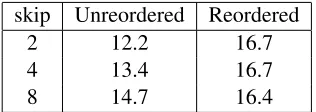
Table 8: Translation performance with/without reorder-ing with varyreorder-ing decoder search space.
6 Conclusion and future work
In this paper we presented a reordering model to reorder source language data to make it resemble the target language word order without using either a source or target parser. We showed consistent gains of up to 2 BLEU points in machine transla-tion performance using this model to preorder train-ing and test data. We show better performance com-pared to syntax based reordering rules for English to Hindi translation. Our model used only a part of speech tagger (sometimes trained with fairly small amounts of data) and a small corpus of word align-ments. Considering the fact that treebanks required to build high quality parsers are costly to obtain, we think that our reordering model is a viable alterna-tive to using syntax for reordering. We also note, that with the preordering based on our reordering model we can achieve the best BLEU scores with a much tighter search space in the decoder. Even ac-counting for the cost of finding the best reordering according to our model, this usually results in faster processing than if we did not have the reordering in place.
In future work we plan to explore using more data from automatic alignments, perhaps by considering a joint model for aligning and reordering. We would also like to explore doing away with the requirement of having a POS tagger, using completely unsuper-vised methods to class words. We currently only look at word pairs in calculating the loss function used in MIRA updates. We would like to investigate the use of other loss functions and their effect on re-ordering performance. We also would like to explore whether the use of scores from our reordering model directly in machine translation systems can improve performance relative to using just the single best re-ordering.
References
Yaser Al-Onaizan and Kishore Papineni. 2006. Dis-tortion models for statistical machine translation. In Proceedings of ACL, ACL-44, pages 529–536, Mor-ristown, NJ, USA. Association for Computational Lin-guistics.
David L. Applegate, Robert E. Bixby, Vasek Chvatal, and William J. Cook. 2005. Concorde tsp solver. In http://www.tsp.gatech.edu/.
Ibrahim Badr, Rabih Zbib, and James Glass. 2009. Syn-tactic phrase reordering for English-to-Arabic statisti-cal machine translation. InProceedings of EACL. Ondrej Bojar, Pavel Stranak, and Daniel Zeman. 2010.
Data issues in English-to-Hindi machine translation. InLREC.
Michael Collins, Philipp Koehn, and Ivona Kuˇcerov´a. 2005. Clause restructuring for statistical machine translation. In Proceedings of ACL, pages 531–540, Morristown, NJ, USA. Association for Computational Linguistics.
Michael Collins. 2002. Discriminative training meth-ods for hidden Markov models: theory and experi-ments with perceptron algorithms. InProceedings of EMNLP.
K. Crammer and Y. Singer. 2003. Ultraconservative on-line algorithms for multiclass problems. Journal of Machine Learning Research.
Aniket Dalal, Kumar Nagaraj, Uma Sawant, Sandeep Shelke, and Pushpak Bhattacharyya. 2007. Building feature rich pos tagger for morphologically rich lan-guages: Experiences in Hindi. InProceedings of In-ternational Conference on Natural Language Process-ing.
M. Galley, J. Graehl, K. Knight, D. Marcu, S. DeNeefe, W. Wang, and I. Thayer. 2006. Scalable inference and training of context-rich syntactic translation models. InProceedings of ACL.
D. Genzel. 2010. Automatically learning source-side re-ordering rules for large scale machine translation. In Proceedings of the 23rd International Conference on Computational Linguistics.
Kurt Hornik and Michael Hahsler. 2009. TSP– infrastructure for the traveling salesperson problem. Journal of Statistical Software, 23(i02).
Sarmad Hussain. 2008. Resources for Urdu language processing. In Proceedings of the 6th Workshop on Asian Language Resources, IJCNLP’08.
Abraham Ittycheriah and Salim Roukos. 2007. Direct translation model 2. InProceedings of HLT-NAACL, pages 57–64.
Kevin Knight. 1999. Decoding complexity in word-replacement translation models. Comput. Linguist., 25:607–615, December.
Young-Suk Lee, Bing Zhao, and Xiaoqian Luo. 2010. Constituent reordering and syntax models for English-to-Japanese statistical machine translation. In COL-ING.
Y. Liu, Q. Liu, and S. Lin. 2006. Tree-to-String align-ment template for statistical machine translation. In Proceedings of ACL.
R. McDonald, K. Crammer, and F. Pereira. 2005a. On-line large-margin training of dependency parsers. In Proceedings of ACL.
Ryan McDonald, Fernando Pereira, Kiril Ribarov, and Jan Hajiˇc. 2005b. Non-projective dependency pars-ing uspars-ing spannpars-ing tree algorithms. InProceedings of HLT.
Ananthakrishnan Ramanathan, Hansraj Choudhary, Avishek Ghosh, and Pushpak Bhattacharyya. 2009. Case markers and morphology: addressing the crux of the fluency problem in English-Hindi smt. In Proceedings of ACL-IJCNLP.
Christoph Tillman. 2004. A unigram orientation model for statistical machine translation. In Proceedings of HLT-NAACL.
Christoph Tillmann and Hermann Ney. 2003. Word re-ordering and a dynamic programming beam search al-gorithm for statistical machine translation. Computa-tional Linguistics, 29(1):97–133.
Roy Tromble and Jason Eisner. 2009. Learning linear or-dering problems for better translation. InProceedings of EMNLP.
Karthik Visweswariah, Jiri Navratil, Jeffrey Sorensen, Vijil Chenthamarakshan, and Nandakishore Kamb-hatla. 2010. Syntax based reordering with automat-ically derived rules for improved statistical machine translation. InProceedings of the 23rd International Conference on Computational Linguistics.
Stephan Vogel, Hermann Ney, and Christoph Tillmann. 1996. HMM-based word alignment in statistical trans-lation. InProceedings of the 16th conference on Com-putational Linguistics.
Chao Wang, Michael Collins, and Philipp Koehn. 2007. Chinese syntactic reordering for statistical machine translation. InProceedings of EMNLP-CoNLL. Fei Xia and Michael McCord. 2004. Improving a
sta-tistical MT system with automatically learned rewrite patterns. InCOLING.
Kenji Yamada and Kevin Knight. 2002. A decoder for syntax-based statistical mt. InProceedings of ACL.
Mikhail Zaslavskiy, Marc Dymetman, and Nicola Can-cedda. 2009. Phrase-based statistical machine transla-tion as a traveling salesman problem. InProceedings of ACL-IJCNLP.