Partially Supervised Coreference Resolution for Opinion Summarization
through Structured Rule Learning
Veselin Stoyanov and Claire Cardie
Department of Computer Science Cornell University
Ithaca, NY 14850, USA
{ves,cardie}@cs.cornell.edu
Abstract
Combining fine-grained opinion informa-tion to produce opinion summaries is im-portant for sentiment analysis applica-tions. Toward that end, we tackle the problem of source coreference resolution – linking together source mentions that re-fer to the same entity. The partially super-vised nature of the problem leads us to de-fine and approach it as the novel problem of partially supervised clustering. We pro-pose and evaluate a new algorithm for the task of source coreference resolution that outperforms competitive baselines.
1 Introduction
Sentiment analysis is concerned with extracting attitudes, opinions, evaluations, and sentiment from text. Work in this area has been motivated by the desire to provide information analysis ap-plications in the arenas of government, business, and politics (e.g. Coglianese (2004)). Addition-ally, sentiment analysis can augment existing NLP applications such as question answering, informa-tion retrieval, summarizainforma-tion, and clustering by providing information about sentiment (e.g. Stoy-anov et al. (2005), Riloff et al. (2005)). To date, research in the area (see Related Work section) has focused on the problem of extracting senti-ment both at the docusenti-ment level (coarse-grained
sentiment information), and at the level of
sen-tences, clauses, or individual expressions
(fine-grained sentiment information).
In contrast, our work concerns the
summa-rization of fine-grained information about opin-ions. In particular, while recent research ef-forts have shown that fine-grained opinions (e.g.
Riloff and Wiebe (2003), Bethard et al. (2004), Wiebe and Riloff (2005)) as well as their sources (e.g. Bethard et al. (2004), Choi et al. (2005), Kim and Hovy (2005)) can be extracted auto-matically, little has been done to create
opin-ion summaries, where opinopin-ions from the same
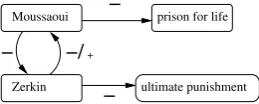
source/target are combined, statistics are com-puted for each source/target and multiple opinions from the same source to the same target are ag-gregated. A simple opinion summary is shown in figure 1.1 We expect that this type of opinion sum-mary, based on fine-grained opinion information, will be important for information analysis applica-tions in any domain where the analysis of opinions is critical.
This paper addresses the problem of opinion summarization by considering the creation of sim-ple opinion summaries like those of figure 1. We propose source coreference resolution — the task of determining which mentions of opinion sources refer to the same entity — as the primary mecha-nism for identifying the set of opinions attributed to each real-world source. For this type of sum-mary, source coreference resolution constitutes an integral step in the process of generating full opin-ion summaries. For example, given the opinopin-ion expressions of figure 1, their polarity, and the asso-ciated opinion sources and targets, the bulk of the resulting summary can be produced by recogniz-ing that source mentions “Zacarias Moussaoui”, “he”, “my”, and “Mr. Moussaoui” all refer to the same person; and that source mentions “Mr. Zerkin” and “Zerkin” refer to the same person.2
1For simplicity, the example summary does not contain
any source/target statistics.
2In addition, the summary would require the closely
re-lated task of target coreference resolution and a means for ag-gregating the conflicting opinions from Zerkin toward
Mous-saoui.
At first glance, source coreference resolution appears equivalent to the task of noun phrase coreference resolution and therefore amenable to traditional coreference resolution techniques (e.g. Ng and Cardie (2002), Morton (2000)). We hy-pothesize in Section 3, however, that the task is likely to succumb to a better solution by treating it in the context of a new machine learning set-ting that we refer to as partially supervised
clus-tering. In particular, due to high coreference
an-notation costs, data sets that are annotated with opinion information (like ours) do not typically in-clude supervisory coreference information for all noun phrases in a document (as would be required for the application of traditional coreference reso-lution techniques), but only for noun phrases that act as opinion sources (or targets).
As a result, we define the task of partially
su-pervised clustering, the goal of which is to learn
a clustering function from a set of partially spec-ified clustering examples (Section 4). We are not aware of prior work on the problem of partially supervised clustering and argue that it differs sub-stantially from that of semi-supervised clustering. We propose an algorithm for partially supervised clustering that extends a rule learner with structure information and is generally applicable to prob-lems that fit the partially supervised clustering def-inition (Section 5). We apply the algorithm to the source coreference resolution task and evalu-ate its performance on a standard sentiment analy-sis data set that includes source coreference chains (Section 6). We find that our algorithm outper-forms highly competitive baselines by a consid-erable margin – B3 score of 83.2 vs. 81.8 and 67.1 vs. 60.9 F1 score for the identification of positive source coreference links.
2 Related Work
Work relevant to our problem can be split into three main areas – sentiment analysis, traditional noun phrase coreference resolution, and super-vised and weakly supersuper-vised clustering. Related work in the former two areas is summarized briefly below. Supervised and weakly supervised cluster-ing approaches are discussed in Section 4.
Sentiment analysis. Much of the relevant re-search in sentiment analysis addresses sentiment classification, a text categorization task of extract-ing opinion at the coarse-grained document level. The goal in sentiment classification is to assign to
[SourceZacarias Moussaoui] [−complained]at length today
about[Targethis own lawyer], telling a federal court jury that
[Targethe]was[−more interested in achieving fame than
sav-ing Moussaoui’s life].
Mr. Moussaoui said he was appearing on the witness stand to tell the truth. And one part of the truth,[Sourcehe]said, is that
[Targetsending him to prison for life]would be “[−a greater
punishment]than being sentenced to death.”
“[−[Target You]have put your interest ahead of[Sourcemy] life],”[SourceMr. Moussaoui]told his court-appointed lawyer
Gerald T. Zerkin. ...
But,[SourceMr. Zerkin]pressed[TargetMr. Moussaoui], was
it[−not true]that he told his lawyers earlier not to involve
any Muslims in the defense, not to present any evidence that might persuade the jurors to spare his life?
...
[Source Zerkin] seemed to be trying to show the jurors
that while [Target the defendant]is generally[+ an honest individual], his conduct shows [Target he]is [−not stable
mentally], and thus[−undeserving]of [Target the ultimate
punishment].
Moussaoui
Zerkin
prison for life
ultimate punishment −
− −
[image:2.595.351.481.314.366.2]−/+
Figure 1: Example text containing opinions (above) and a summary of the opinions (be-low). Sources and targets of opinions are brack-eted; opinion expressions are shown in italics and bracketed with associated polarity, either positive (+) or negative (-). The underlined phrase will be explained later in the paper.
characterize the relations between opinions and their sources.
Coreference resolution. Coreference resolution is a relatively well studied NLP problem (e.g. Morton (2000), Ng and Cardie (2002), Iida et al. (2003), McCallum and Wellner (2003)). Corefer-ence resolution is defined as the problem of decid-ing which noun phrases in the text (mentions) re-fer to the same real world entities (are corere-ferent). Generally, successful approaches to coreference resolution have relied on supervised classification followed by clustering. For supervised classifica-tion these approaches learn a pairwise funcclassifica-tion to predict whether a pair of noun phrases is corefer-ent. Subsequently, when making coreference res-olution decisions on unseen documents, the learnt pairwise NP coreference classifier is run, followed by a clustering step to produce the final clusters (coreference chains) of coreferent NPs. For both training and testing, coreference resolution algo-rithms rely on feature vectors for pairs of noun phrases that encode linguistic information about the NPs and their local context. Our general ap-proach to source coreference resolution is inspired by the state-of-the-art performance of one such ap-proach to coreference resolution, which relies on a rule learner and single-link clustering as described in Ng and Cardie (2002).
3 Source Coreference Resolution
In this section we introduce the problem of source coreference resolution in the context of opinion summarization and argue for the need for novel methods for the task.
The task of source coreference resolution is to decide which mentions of opinion sources refer to the same entity. Much like traditional coreference resolution, we employ a learning approach; how-ever, our approach differs from traditional coref-erence resolution in its definition of the learn-ing task. Motivated by the desire to utilize unla-beled examples (discussed later), we define train-ing as an integrated task in which pairwise NP coreference decisions are learned together with the clustering function as opposed to treating each NP pair as a training example. Thus, our train-ing phase takes as input a set of documents with manually annotated opinion sources together with coreference annotations for the sources; it outputs a classifier that can produce source coreference chains for previously unseen documents
contain-ing marked (manually or automatically) opinion sources. More specifically, the source coreference resolution training phase proceeds through the fol-lowing steps:
1. Source-to-NP mapping: We preprocess each document by running a tokenizer, sen-tence splitter, POS tagger, parser, and an NP finder. Subsequently, we augment the set of NPs found by the NP finder with the help of a system for named entity detection. We then map the sources to the NPs. Since there is no one-to-one correspondence, we use a set of heuristics to create the mapping. More de-tails about why heuristics are needed and the process used to map sources to NPs can be found in Stoyanov and Cardie (2006).
2. Feature vector creation: We extract a fea-ture vector for every pair of NPs from the pre-processed corpus. We use the features intro-duced by Ng and Cardie (2002) for the task of coreference resolution.
3. Classifier construction: Using the feature vectors from step 2, we construct a training set containing one training example per doc-ument. Each training example consists of the feature vectors for all pairs of NPs in the doc-ument, including those that do not map to sources, together with the available corefer-ence information for the source noun phrases (i.e. the noun phrases to which sources are mapped). The training instances are pro-vided as input to a learning algorithm (see Section 5), which constructs a classifier that can take the instances associated with a new (previously unseen) document and produce a clustering over all NPs in the document.
The testing phase employs steps 1 and 2 as de-scribed above, but replaces step 3 by a straightfor-ward application of the learnt classifier. Since we are interested in coreference information only for the source NPs, we simply discard the non-source NPs from the resulting clustering.
step 1 above, our approach can rely on the avail-able coreference information for the source NPs. Due to the high cost of coreference annotation, we desire methods that can work in the presence of only this limited amount of coreference informa-tion.
A possible workaround the absence of full NP coreference information is to train a traditional coreference system only on the labeled part of the data (indeed that is one of the baselines against which we compare). However, we believe that an effective approach to source coreference res-olution has to utilize the unlabeled noun phrases because links between sources might be realized through non-source mentions. This problem is il-lustrated in figure 1. The underlined Moussaoui is coreferent with all of the Moussaoui references marked as sources, but, because it is used in an objective sentence rather than as the source of an opinion, the reference would be omitted from the Moussaoui source chain. Unfortunately, this proper noun phrase might be critical in establish-ing the coreference of the final source reference he with the other mentions of the source Moussaoui.
As mentioned previously, in order to utilize the unlabeled data, our approach differs from tra-ditional coreference resolution, which uses NP pairs as training instances. We instead follow the framework of supervised clustering (Finley and Joachims, 2005; Li and Roth, 2005) and consider each document as a training example. As in super-vised clustering, this framework has the additional advantage that the learning algorithm can consider the clustering algorithm when making decisions about pairwise classification, which could lead to improvements in the classifier. In the next section we describe our approach to classifier construction for step 3 and compare our problem to traditional weakly supervised clustering, characterizing it as an instance of the novel problem of partially su-pervised clustering.
4 Partially Supervised Clustering
In our desire to perform effective source corefer-ence resolution we arrive at the following learning problem – the learning algorithm is presented with a set of partially specified examples of clusterings and acquires a function that can cluster accurately an unseen set of items, while taking advantage of the unlabeled information in the examples.
This setting is to be contrasted with
semi-supervised clustering (or clustering with con-straints), which has received much research at-tention (e.g. Demiriz et al. (1999), Wagstaff and Cardie (2000), Basu (2005), Davidson and Ravi (2005)). Semi-supervised clustering can be de-fined as the problem of clustering a set of items in the presence of limited supervisory informa-tion such as pairwise constraints (e.g. two items must/cannot be in the same cluster) or labeled points. In contrast to our setting, in the semi-supervised case there is no training phase – the algorithm receives all examples (labeled and un-labeled) at the same time together with some dis-tance or cost function and attempts to find a clus-tering that optimizes a given measure (usually based on the distance or cost function).
Source coreference resolution might alterna-tively be approached as a supervised clustering problem. Traditionally, approaches to supervised clustering have treated the pairwise link decisions as a classification problem. These approaches first learn a distance metric that optimizes the pairwise decisions; and then follow the pairwise classifica-tion with a clustering step. However, these tradi-tional approaches have no obvious way of utilizing the available unlabeled information.
In contrast, we follow recent approaches to su-pervised clustering that propose ways to learn the distance measure in the context of the clus-tering decisions (Li and Roth, 2005; Finley and Joachims, 2005; McCallum and Wellner, 2003). This provides two advantages for the problem of source coreference resolution. First, it allows the algorithm to take advantage of the complexity of the rich structural dependencies introduced by the clustering problem. Viewed traditionally as a hur-dle, the structural complexity of clustering may be beneficial in the partially supervised case. We be-lieve that provided with a few partially specified clustering examples, an algorithm might be able to generalize from the structural dependencies to infer correctly the whole clustering of the items. In addition, considering pairwise decisions in the context of the clustering can arguably lead to more accurate classifiers.
un-labeled portions of the data.
Formal definition. For partially supervised clustering we extend the formal definition of su-pervised clustering given by Finley and Joachims (2005). In the fully supervised setting, an al-gorithm is given a set S of n training examples
(x1, y1), ...,(xn, yn) ∈ X ×Y, whereX is the set of all possible sets of items andY is the set of all possible clusterings of these sets. For a train-ing example(x, y), x = {x1, x2, ..., xk}is a set ofkitems andy = {y1, y2, ..., yr}is a clustering of the items in x with each yi ⊆ x. Addition-ally, each item can be in no more than one cluster (∀i, j.yi∩yj =∅) and in the fully supervised case each item is in at least one cluster (x = S
yi). The goal of the learning algorithm is to acquire a functionh :X → Y that can accurately cluster a (previously unseen) set of items.
In the context of source coreference resolution the training set contains one example for each doc-ument. The items in each training example are the NPs and the clustering over the items is the equiv-alence relation defined by the coreference infor-mation. For source coreference resolution, how-ever, clustering information is unavailable for the non-source NPs. Thus, to be able to deal with this unlabeled component of the data we arrive to the setting of partially supervised clustering, in which we relax the condition that each item is in at least one cluster (x=S
yi) and replace it with the con-ditionx ⊇S
yi. The items with no linking infor-mation (items inx\Sy
i) constitute the unlabeled (unsupervised) component of the partially super-vised clustering.
5 Structured Rule Learner
We develop a novel method for partially super-vised clustering, which is motivated by the success of a rule learner (RIPPER) for coreference resolu-tion (Ng and Cardie, 2002). We extend RIPPER so that it can learn rules in the context of single-link clustering, which both suits our task (i.e. pro-nouns link to their single antecedent) and has ex-hibited good performance for coreference resolu-tion (Ng and Cardie, 2002). We begin with a brief overview of RIPPER followed by a description of the modifications that we implemented. For ease of presentation, we assume that we are in the fully supervised case. We end this section by describing the changes for the partially supervised case.
procedure StRip(TrainData){
GrowData, PruneData = Split(TrainData); //Keep instances from the same document together while(there are positive uncovered instances){
r = growRule(GrowData); r = pruneRule(r, PruneData); DL = relativeDL(Ruleset); if(DL≤minDL + d bits)
Ruleset.add(r);
Mark examples covered by r as +;
else
exit loop with Ruleset }
}
procedure growRule(growData){ r = empty rule;
for(every unused feature f){ if (f is nominal feature){
for(every possible value v of f){
mark all instances that have values of v for f with +; compute the transitive closure of the positive instances //(including instances marked + from previous rules);
compute the infoGain for the future/value combination; }
}else{//Numeric feature
create one bag for each feature value and split the instances into bags; do a forward and a backward pass over the bags keeping a running clustering and compute the information gain for each value; }
}
add the future/value pair with the best infoGain to r;
growData = growData - all negative instances;
return r; }
procedure pruneRule(r, pruneData){ for(all antecedents a in the rule){
apply all antecedents in r up to a to pruneData;
compute the transitive closure of the positive instances;
compute A(a) – the accuracy of the rule up to antecedent a; }
[image:5.595.304.516.57.397.2]Remove all antecedents after the antecedent for which A(a) is maximum. }
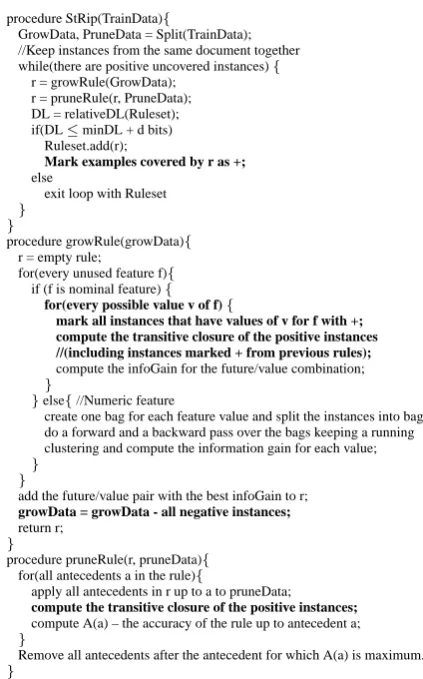
Figure 2: The StRip algorithm. Additions to RIP-PER are shown in bold.
5.1 The RIPPER Algorithm
RIPPER (for Repeated Incremental Pruning to Produce Error Reduction) was introduced by Co-hen (1995) as an extension of an existing rule induction algorithm. Cohen (1995) showed that RIPPER produces error rates competitive with C4.5, while exhibiting better running times. RIP-PER consists of two phases – a ruleset is grown and then optimized.
The ruleset creation phase begins by
ran-domly splitting the training data into a rule-growing set (2/3 of the training data) and a pruning set (the remaining 1/3). A rule is then grown on the former set by repeatedly adding the antecedent (the feature value test) with the largest information gain until the accuracy of the rule becomes 1.0 or there are no remaining potential antecedents. Next the rule is applied to the pruning data and any rule-final sequence that reduces the accuracy of the rule is removed.
set to first grow a replacement rule and a revised rule for each rule in the ruleset. For each rule, the algorithm then considers the original rule, the replacement rule, and the revised rule, and keeps the rule with the smallest description length in the context of the ruleset. After all rules are con-sidered, RIPPER attempts to grow residual rules that cover data not already covered by the rule-set. Finally, RIPPER deletes any rules from the ruleset that reduce the overall minimum descrip-tion length of the data plus the ruleset. RIPPER performs two rounds of this optimization phase.
5.2 The StRip Algorithm
The property of partially supervised clustering that we want to explore is the structured nature of the decisions. That is, each decision of whether two items (sayaandb) belong to the same cluster has an implication for all items a0 that belong to a’s cluster and all itemsb0 that belong tob’s cluster.
We target modifications to RIPPER that will al-low StRip (for Structured RIPPER) to learn rules that produce good clusterings in the context of single-link clustering. We extend RIPPER so that every time it makes a decision about a rule, it con-siders the effect of the rule on the overall clus-tering of items (as opposed to considering the in-stances that the rule classifies as positive/negative in isolation). More precisely, we precede every computation of rule performance (e.g. informa-tion gain or descripinforma-tion length) by a transitive clo-sure (i.e. single link clustering) of the data w.r.t. to the pairwise classifications. Following the transi-tive closure, all pairs of items that are in the same cluster are considered covered by the rule for per-formance computation.
The StRip algorithm is given in figure 2, with modifications to the original RIPPER algorithm shown in bold. Due to space limitations the op-timization stage of the algorithm is omitted. Our modifications to the optimization stage of RIPPER are in the spirit of the rest of the StRip algorithm.
Partially supervised case. So far we described StRip only for the fully supervised case. We use a very simple modification to handle the par-tially supervised setting: we exclude the unla-beled pairs when computing the performance of the rules. Thus, the unlabeled items do not count as correct or incorrect classifications when acquir-ing or prunacquir-ing a rule, although they do participate in the transitive closure. Links in the unlabeled
data are inferred entirely through the indirect links between items in the labeled component that they introduce. In the example of figure 1, the two problematic unlabeled links are the link between the source mention “he” and the underlined non-source NP “Mr. Moussaoui” and the link between the underlined “Mr. Moussaoui” to any source mention of Moussaoui. While StRip will not re-ward any rule (or rule set) that covers these two links directly, such rules will be rewarded indi-rectly since they put the source he in the chain for the source Moussaoui.
StRip running time. StRip’s running time is generally comparable to that of RIPPER. We com-pute transitive closure by using a Union-Find structure, which runs in timeO(log∗n), which for practical purposes can be considered linear (O(n))
3. However, when computing the best information
gain for a nominal feature, StRip has to make a pass over the data for each value that the feature takes, while RIPPER can split the data into bags and perform the computation in one pass.
6 Evaluation and Results
This section describes the source coreference data set, the baselines, our implementation of StRip, and the results of our experiments.
6.1 Data set
For evaluation we use the MPQA corpus (Wiebe et al., 2005).4 The corpus consists of 535 doc-uments from the world press. All docdoc-uments in the collection are manually annotated with phrase-level opinion information following the annota-tion scheme of Wiebe et al. (2005). Discussion of the annotation scheme is beyond the scope of this paper; for our purposes it suffices to say that the annotations include the source of each opin-ion and coreference informatopin-ion for the sources (e.g. source coreference chains). The corpus con-tains no additional noun phrase coreference infor-mation.
For our experiments, we randomly split the data set into a training set consisting of 400 documents and a test set consisting of the remaining 135 doc-uments. We use the same test set for all
experi-3For the transitive closure,nis the number of items in a
document, which isO(√k), wherek is the number of NP pairs. Thus, transitive closure is sublinear in the number of training instances.
4The MPQA corpus is available at
ments, although some learning runs were trained on 200 training documents (see next Subsection). The test set contains a total of 4736 source NPs (average of 35.34 source NPs per document) split into 1710 total source NP chains (average of 12.76 chains per document) for an average of 2.77 source NPs per chain.
6.2 Implementation
We implemented the StRip algorithm by modify-ing JRip – the java implementation of RIPPER in-cluded in the WEKA toolkit (Witten and Frank, 2000). The WEKA implementation follows the original RIPPER specification. We changed the implementation to incorporate the modifications suggested by the StRip algorithm; we also mod-ified the underlying data representations and data handling techniques for efficiency. Also due to ef-ficiency considerations, we train StRip only on the 200-document training set.
6.3 Competitive baselines
We compare the results of the new method to three fully supervised baseline systems, each of which employs the same traditional coreference resolu-tion approach. In particular, we use the afore-mentioned algorithm proposed by Ng and Cardie (2002), which combines a pairwise NP corefer-ence classifier with single-link clustering.
For one baseline, we train the coreference reso-lution algorithm on the MPQA src corpus — the labeled portion of the MPQA corpus (i.e. NPs from the source coreference chains) with unla-beled instances removed.
The second and third baselines investigate whether the source coreference resolution task can benefit from NP coreference resolution training data from a different domain. Thus, we train the traditional coreference resolution algorithm on the
MUC6 and MUC7 coreference-annotated corpora5
that contain documents similar in style to those in the MPQA corpus (e.g. newspaper articles), but emanate from different domains.
For all baselines we targeted the best possi-ble systems by trying two pairwise NP classifiers (RIPPER and an SVM in the SV Mlight imple-mentation (Joachims, 1998)), many different pa-rameter settings for the classifiers, two different feature sets, two different training set sizes (the
5We train each baseline using both the development set
and the test set from the corresponding MUC corpus.
full training set and a smaller training set consist-ing of half of the documents selected at random), and three different instance selection algorithms6. This variety of classifier and training data settings was motivated by reported differences in perfor-mance of coreference resolution approaches w.r.t. these variations (Ng and Cardie, 2002). More de-tails on the different parameter settings and in-stance selection algorithms as well as trends in the performance of different settings can be found in Stoyanov and Cardie (2006). In the experiments below we report the best performance of each of the two learning algorithms on the MPQA test data.
6.4 Evaluation
In addition to the baselines described above, we evaluate StRip both with and without unlabeled data. That is, we train on the MPQA corpus StRip using either all NPs or just opinion source NPs.
We use theB3(Bagga and Baldwin, 1998) eval-uation measure as well as precision, recall, and F1 measured on the (positive) pairwise decisions.
B3 is a measure widely used for evaluating coref-erence resolution algorithms. The measure com-putes the precision and recall for each NP mention in a document, and then averages them to produce combined results for the entire output. More pre-cisely, given a mention i that has been assigned to chainci, the precision for mention iis defined as the number of correctly identified mentions in
ci divided by the total number of mentions in ci. Recall foriis defined as the number of correctly identified mentions incidivided by the number of mentions in the gold standard chain fori.
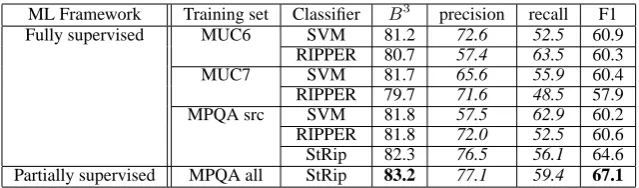
Results are shown in Table 1. The first six rows of results correspond to the fully supervised baseline systems trained on different corpora —
MUC6, MUC7, and MPQA src. The seventh row
of results shows the performance of StRip using only labeled data. The final row of the table shows the results for partially supervised learning with unlabeled data. The table lists results from the best performing run for each algorithm.
Performance among the baselines trained on the
MUC data is comparable. However, the two
base-line runs trained on the MPQA src corpus (i.e. re-sults rows five and six) show slightly better perfor-mance on theB3 metric than the baselines trained
6The goal of the instance selection algorithms is to
ML Framework Training set Classifier B3 precision recall F1
Fully supervised MUC6 SVM 81.2 72.6 52.5 60.9
RIPPER 80.7 57.4 63.5 60.3
MUC7 SVM 81.7 65.6 55.9 60.4
RIPPER 79.7 71.6 48.5 57.9
MPQA src SVM 81.8 57.5 62.9 60.2
RIPPER 81.8 72.0 52.5 60.6
StRip 82.3 76.5 56.1 64.6
[image:8.595.138.458.61.155.2]Partially supervised MPQA all StRip 83.2 77.1 59.4 67.1
Table 1: Results for Source Coreference. MPQA src stands for the MPQA corpus limited to only source NPs, while MPQA full contains the unlabeled NPs.
on the MUC data, which indicates that for our task the similarity of the documents in the train-ing and test sets appears to be more important than the presence of complete supervisory infor-mation. (Improvements over the RIPPER runs trained on the MUC corpora are statistically sig-nificant7, while improvements over the SVM runs are not.)
Table 1 also shows that StRip outperforms the baselines on both performance metrics. StRip’s performance is better than the baselines when trained on MPQA src (improvement not statisti-cally significant,p > 0.20) and even better when trained on the full MPQA corpus, which includes the unlabeled NPs (improvement over the base-lines and the former StRip run statistically signif-icant). These results confirm our hypothesis that StRip improves due to two factors: first, consider-ing pairwise decisions in the context of the clus-tering function leads to improvements in the clas-sifier; and, second, StRip can take advantage of the unlabeled portion of the data.
StRip’s performance is all the more impressive considering the strength of the SVM and RIPPER baselines, which which represent the best runs across the 336 different parameter settings tested forSV Mlightand 144 different settings tested for RIPPER. In contrast, all four of the StRip runs us-ing the full MPQA corpus (we vary the loss ratio for false positive/false negative cost) outperform those baselines.
7 Future Work
Source coreference resolution is only one aspect of opinion summarization. Additionally, an opin-ion summarizatopin-ion system will need to handle
7Statistical significance is measured using both a 2-tailed
paired t-test and the Wilcoxon matched-pairs signed-ranks test (p < 0.05). The two tests agreed on all significance judgements, so we will not report them separately.
the closely related task of target coreference res-olution in order to cluster targets of opinions8 and combine multiple conflicting opinions from a source to the same targets. Furthermore, a fully automatic opinion summarizer requires automatic source and opinion extractors. While we antici-pate that target coreference resolution will be sub-ject to error rates similar to those of source coref-erence resolution, incorporating these imperfect opinions and sources will further impair the per-formance of the opinion summarizer. We are not aware of any measure that can be directly used to assess the goodness of opinion summaries, but plan to develop such in future work in conjunc-tion with the development of methods for creating opinion summaries completely automatically. The evaluation metrics will likely have to depend on the task for which the summaries are used.
A limitation of our approach to partially super-vised clustering is that we do not directly optimize for the performance measure (e.g. B3). Other ef-forts in the area of supervised clustering (Finley and Joachims, 2005; Li and Roth, 2005) have sug-gested ways to learn distance measures that can optimize directly for a desired performance mea-sure. We plan to investigate algorithms that can di-rectly optimize for complex measures (such asB3) for the problem of partially supervised clustering. Unfortunately, a measure as complex asB3makes extending existing approaches far from trivial due to the difficulty of establishing the connection be-tween individual pairwise decisions (the distance metric) and the score of the clustering algorithm.
Acknowledgements
The authors would like to thank Vincent Ng and Art Munson for providing coreference resolution
8We did not tackle the task of target coreference
code, members of the Cornell NLP group (es-pecially Yejin Choi and Art Munson) for many helpful discussions, and the anonymous review-ers for their insightful comments. This work was supported by the Advanced Research and Devel-opment Activity (ARDA), by NSF Grants IIS-0535099 and IIS-0208028, by gifts from Google and the Xerox Foundation, and by an NSF Gradu-ate Research Fellowship to the first author.
References
A. Bagga and B. Baldwin. 1998. Entity-based cross-document coreferencing using the vector space model. In
In Proceedings of COLING/ACL.
S. Basu. 2005. Semi-supervised Clustering: Probabilistic
Models, Algorithms and Experiments. Ph.D. thesis,
De-partment of Computer Sciences, UT at Austin.
S. Bethard, H. Yu, A. Thornton, V. Hativassiloglou, and D. Jurafsky. 2004. Automatic extraction of opinion propositions and their holders. In 2004 AAAI Spring
Sym-posium on Exploring Attitude and Affect in Text.
Y. Choi, C. Cardie, E. Riloff, and S. Patwardhan. 2005. Iden-tifying sources of opinions with conditional random fields and extraction patterns. In Proceedings of EMNLP. C. Coglianese. 2004. E-rulemaking: Information technology
and regulatory policy: New directions in digital govern-ment research. Technical report, Harvard University, J. F. Kennedy School of Government.
W. Cohen. 1995. Fast effective rule induction. In
Proceed-ings of ICML.
S. Das and M. Chen. 2001. Yahoo for amazon: Extracting market sentiment from stock message boards. In
Proceed-ings of APFAAC.
K. Dave, S. Lawrence, and D. Pennock. 2003. Mining the peanut gallery: Opinion extraction and semantic classifi-cation of product reviews. In Proceedings of IWWWC. I. Davidson and S. Ravi. 2005. Clustering with constraints:
Feasibility issues and the k-means algorithm. In
Proceed-ings of SDM.
A. Demiriz, K. P. Bennett, and M. J. Embrechts. 1999. Semi-supervised clustering using genetic algorithms. In
Pro-ceeding of ANNIE.
T. Finley and T. Joachims. 2005. Supervised clustering with support vector machines. In Proceedings of ICML. R. Iida, K. Inui, H. Takamura, and Y. Matsumoto. 2003.
In-corporating contextual cues in trainable models for coref-erence resolution. In Proceedings of the EACL Workshop
on The Computational Treatment of Anaphora.
T. Joachims. 1998. Making large-scale support vector machine learning practical. In A. Smola B. Sch¨olkopf, C. Burges, editor, Advances in Kernel Methods: Support
Vector Machines. MIT Press, Cambridge, MA.
S. Kim and E. Hovy. 2005. Identifying opinion holders for question answering in opinion texts. In Proceedings of
AAAI Workshop on Question Answering in Restricted Do-mains.
X. Li and D. Roth. 2005. Discriminative training of cluster-ing functions: Theory and experiments with entity identi-fication. In Proceedings of CoNLL.
A. McCallum and B. Wellner. 2003. Toward conditional models of identity uncertainty with application to proper noun coreference. In Proceedings of the IJCAI Workshop
on Information Integration on the Web.
T. Morton. 2000. Coreference for NLP applications. In
Pro-ceedings of ACL.
V. Ng and C. Cardie. 2002. Improving machine learning approaches to coreference resolution. In In Proceedings
of ACL.
B. Pang and L. Lee. 2004. A sentimental education: Senti-ment analysis using subjectivity summarization based on minimum cuts. In Proceedings of ACL.
B. Pang, L. Lee, and S. Vaithyanathan. 2002. Thumbs up? Sentiment classification using machine learning tech-niques. In Proceedings of EMNLP.
E. Riloff and J. Wiebe. 2003. Learning extraction patterns for subjective expressions. In Proceesings of EMNLP. E. Riloff, J. Wiebe, and W. Phillips. 2005. Exploiting
sub-jectivity classification to improve information extraction. In Proceedings of AAAI.
V. Stoyanov and C. Cardie. 2006. Toward opinion summa-rization: Linking the sources. In Proceedings of the ACL
Workshop on Sentiment and Subjectivity in Text.
V. Stoyanov, C. Cardie, and J. Wiebe. 2005. Multi-Perspective question answering using the OpQA corpus. In Proceedings of EMNLP.
P. Turney. 2002. Thumbs up or thumbs down? Semantic ori-entation applied to unsupervised classification of reviews. In Proceedings of ACL.
K. Wagstaff and C. Cardie. 2000. Clustering with instance-level constraints. In Proceedings of the 17-th National
Conference on Artificial Intelligence and 12-th Confer-ence on Innovative Applications of Artificial IntelligConfer-ence.
J. Wiebe and E. Riloff. 2005. Creating subjective and objec-tive sentence classifiers from unannotated texts. In
Pro-ceedings of CICLing.
J. Wiebe, T. Wilson, and C. Cardie. 2005. Annotating ex-pressions of opinions and emotions in language. Lan-guage Resources and Evaluation, 1(2).
T. Wilson, J. Wiebe, and R. Hwa. 2004. Just how mad are you? Finding strong and weak opinion clauses. In
Pro-ceedings of AAAI.
I.H. Witten and E. Frank. 2000. Data Mining: Practical
ma-chine learning tools with Java implementations. Morgan
Kaufmann, San Francisco.
H. Yu and V. Hatzivassiloglou. 2003. Towards answer-ing opinion questions: Separatanswer-ing facts from opinions and identifying the polarity of opinion sentences. In