SHELLFBK
: An Information Retrieval-based System For Multi-Domain
Sentiment Analysis
Mauro Dragoni Fondazione Bruno Kessler
Via Sommarive 18 Povo, Trento [email protected]
Abstract
This paper describes theSHELLFBKsystem that participated in SemEval 2015 Tasks 9, 10, and 11. Our system takes a supervised approach that builds on techniques from in-formation retrieval. The algorithm populates an inverted index with pseudo-documents that encode dependency parse relationships ex-tracted from the sentences in the training set. Each record stored in the index is annotated with the polarity and domain of the sentence it represents. When the polarity or domain of a new sentence has to be computed, the new sentence is converted to a query that is used to retrieve the most similar sentences from the training set. The retrieved instances are scored for relevance to the query. The most rele-vant training instant is used to assign a polarity and domain label to the new sentence. While the results on well-formed sentences are en-couraging, the performance obtained on short texts like tweets demonstrate that more work is needed in this area.
1 Introduction
Sentiment analysis is a natural language processing task whose aim is to classify documents according to the opinion (polarity) they express on a given sub-ject (Pang et al., 2002). Generally speaking, sen-timent analysis aims at determining the attitude of a speaker or a writer with respect to a topic or the overall tonality of a document. This task has created a considerable interest due to its wide applications. In recent years, the exponential increase of the Web for exchanging public opinions about events, facts,
products, etc., has led to an extensive usage of senti-ment analysis approaches, especially for marketing purposes.
By formalizing the sentiment analysis problem, a “sentiment” or “opinion” has been defined by (Liu and Zhang, 2012) as a quintuple:
hoj, fjk, soijkl, hi, tli, (1)
where oj is a target object, fjk is a feature of the
objectoj,soijklis the sentiment value of the opinion
of the opinion holderhi on featurefjk of objectoj
at timetl. The value ofsoijkl can be positive (by
denoting a state of happiness, bliss, or satisfaction), negative (by denoting a state of sorrow, dejection, or disappointment), or neutral (it is not possible to denote any particular sentiment), or a more granular rating. The termhi encodes the opinion holder, and tlis the time when the opinion is expressed.
Such an analysis, may bedocument-based, where the positive, negative, or neutral sentiment is as-signed to the entire document content; or it may be
sentence-basedwhere individual sentences are ana-lyzed separately and classified according to the dif-ferent polarity values. In the latter case, it is often desirable to find with a high precision the entity at-tributes towards which the detected sentiment is di-rected.
In the classic sentiment analysis problem, the po-larity of each term within the document is com-puted independently of the domain which the doc-ument’s domain. However, conditioning term po-larity by domain has been found to improve perfor-mance (Blitzer et al., 2007). We illustrate the intu-ition behind domain specific term polarity. Let us
consider the following example concerning the ad-jective “small”:
1. The sideboard issmalland it is not able to con-tain a lot of stuff.
2. Thesmalldimensions of this decoder allow to move it easily.
In the first sentence, we considered the Furnishings domain and, within it, the polarity of the adjective “small” is, for sure, “negative” because it highlights an issue of the described item. On the other hand, in the second sentence, where we considered the Elec-tronics domain, the polarity of such an adjective may be considered “positive”.
Unlike the approaches already discussed in the lit-erature (and presented in Section 2), we address the multi-domain sentiment analysis problem by apply-ing Information Retrieval (IR) techniques for repre-senting information about the linguistic structure of sentences and by taking into account both their po-larity and the domain.
The rest of the work is structured as follows. Sec-tion 2 presents a survey on works about sentiment analysis. Section 3 provides a description of the
SHELLFBKsystem by described how information are stored during the training phase and exploited during the test one. Section 4 reports the system evaluation performed on the Tasks 9, 10, and 11 pro-posed at SemEval 2015 and, finally, Section 5 con-cludes the paper.
2 Related Work
The topic of sentiment analysis has been studied ex-tensively in the literature (Pang and Lee, 2008; Liu and Zhang, 2012), where several techniques have been proposed and validated.
Machine learning techniques are the most com-mon approaches used for addressing this problem, given that any existing supervised methods can be applied to sentiment classification. For instance, in (Pang et al., 2002) and (Pang and Lee, 2004), the authors compared the performance of Naive-Bayes, Maximum Entropy, and Support Vector Machines in sentiment analysis on different features like consid-ering only unigrams, bigrams, combination of both, incorporating parts of speech and position informa-tion or by taking only adjectives. Moreover, beside
the use of standard machine learning method, re-searchers have also proposed several custom tech-niques specifically for sentiment classification, like the use of adapted score function based on the eval-uation of positive or negative words in product re-views (Dave et al., 2003), as well as by defining weighting schemata for enhancing classification ac-curacy (Paltoglou and Thelwall, 2010).
An obstacle to research in this direction is the need of labeled training data, whose preparation is a time-consuming activity. Therefore, in order to re-duce the labeling effort, opinion words have been used for training procedures. In (Tan et al., 2008) and (Qiu et al., 2009b), the authors used opinion words to label portions of informative examples for training the classifiers. Opinion words have been ex-ploited also for improving the accuracy of sentiment classification, as presented in (Melville et al., 2009), where a framework incorporating lexical knowledge in supervised learning to enhance accuracy has been proposed. Opinion words have been used also for unsupervised learning approaches like the ones pre-sented in (Taboada et al., 2011) and (Turney, 2002). Another research direction concerns the exploita-tion of discourse-analysis techniques. (Somasun-daran, 2010) and (Asher et al., 2008) discuss some discourse-based supervised and unsupervised ap-proaches for opinion analysis; while in (Wang and Zhou, 2010), the authors present an approach to identify discourse relations.
methods as for sentiment classification may be ap-plied. For example, in (Hatzivassiloglou and Wiebe, 2000) the authors consider gradable adjectives for sentiment spotting; while in (Kim and Hovy, 2007) and (Kim et al., 2006) the authors built models to identify some specific types of opinions.
The growth of product reviews was the perfect floor for using sentiment analysis techniques in mar-keting activities. However, the issue of improving the ability of detecting the different opinions con-cerning the same product expressed in the same re-view became a challenging problem. Such a task has been faced by introducing “aspect” extraction approaches that were able to extract, from each sentence, which is the aspect the opinion refers to. In the literature, many approaches have been proposed: conditional random fields (CRF) (Jakob and Gurevych, 2010; Lafferty et al., 2001), hid-den Markov models (HMM) (Freitag and McCal-lum, 2000; Jin and Ho, 2009; Jin et al., 2009), se-quential rule mining (Liu et al., 2005), dependency tree kernels (Wu et al., 2009), and clustering (Su et al., 2008). In (Qiu et al., 2009a; Qiu et al., 2011), a method was proposed to extract both opinion words and aspects simultaneously by exploiting some syn-tactic relations of opinion words and aspects.
A particular attention should be given also to the application of sentiment analysis in social networks. More and more often, people use social networks for expressing their moods concerning their last pur-chase or, in general, about new products. Such a social network environment opened up new chal-lenges due to the different ways people express their opinions, as described by (Barbosa and Feng, 2010) and (Bermingham and Smeaton, 2010), who men-tion “noisy data” as one of the biggest hurdles in analyzing social network texts.
One of the first studies on sentiment analysis on micro-blogging websites has been discussed in (Go et al., 2009), where the authors present a distant supervision-based approach for sentiment classifica-tion.
At the same time, the social dimension of the Web opens up the opportunity to combine com-puter science and social sciences to better recognize, interpret, and process opinions and sentiments ex-pressed over it. Such multi-disciplinary approach has been calledsentic computing(Cambria and
Hus-sain, 2012b). Application domains where sentic computing has already shown its potential are the cognitive-inspired classification of images (Cambria and Hussain, 2012a), of texts in natural language, and of handwritten text (Wang et al., 2013).
Finally, an interesting recent research direction is domain adaptation, as it has been shown that senti-ment classification is highly sensitive to the domain from which the training data is extracted. A classi-fier trained using opinionated documents from one domain often performs poorly when it is applied or tested on opinionated documents from another do-main, as we demonstrated through the example pre-sented in Section 1. The reason is that words and even language constructs used in different domains for expressing opinions can be quite different. To make matters worse, the same word in one domain may have positive connotations, but in another main may have negative connotations; therefore, do-main adaptation is needed. In the literature, dif-ferent approaches related to the Multi-Domain sen-timent analysis have been proposed. Briefly, two main categories may be identified: (i) the transfer of learned classifiers across different domains (Yang et al., 2006; Blitzer et al., 2007; Pan et al., 2010; Bollegala et al., 2013; Xia et al., 2013; Yoshida et al., 2011), and (ii) the use of propagation of labels through graph structures (Ponomareva and Thelwall, 2013; Tsai et al., 2013; Tai and Kao, 2013; Huang et al., 2014). Independently of the kind of approach, works using concepts rather than terms for repre-senting different sentiments have been proposed.
3 TheSHELLFBKSystem
3.1 Indexes Construction
The proposed approach, with respect to a classic IR system, does not use a single index for containing all information, but a set of indexes are created in order to facilitate the identification of the correct po-larity and domain, of a sentence during the valida-tion phase. In particular, we built the following set of indexes:
• Polarity Indexes: from the training set, the positive, negative, and neutral sentences have been indexed separately.
• Domain Indexes:: a different index has been built for each domain identified in the training set. This way, it is possible to store information about which terms, or expression, are relevant for each domain.
• Mixed Indexes: by considering the multi-domain nature of the system, this further set of indexes allows to have, for each domain, infor-mation about the correlation between the do-main and the polarities. This way, we are able to know if the same term, or expression, has the same polarity in different domains or not. For each sentence of the training set, we exploited the Stanford NLP Library for extracting the depen-dencies between the terms. Such dependepen-dencies are then used as input for the indexing procedure.
As example, let’s consider the following sentence extracted from the training set of the Task 9:
“I came here to reflect my happiness by fishing.” This sentence has a positive polarity and belongs to the “outdoor activity” domain. By applying the Stanford parser, the dependencies that are extracted are the following ones:
nsubj(came-2, I-1) nsubj(reflect-5, I-1) root(ROOT-0, came-2) advmod(came-2, here-3) aux(reflect-5, to-4) xcomp(came-2, reflect-5) poss(happiness-7, my-6) dobj(reflect-5, happiness-7) prep_by(reflect-5, fishing-9)
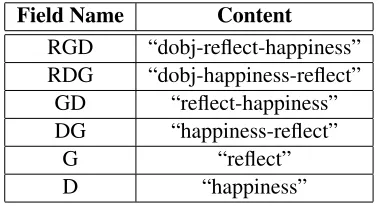
Each dependency is composed by three elements: the name of the “relation” (R), the “governor” (G) that is the first term of the dependency, and the “de-pendent” (D) that is the second one. We extract,
from each dependency, the structure “field - content” shown in Table 1 by using as example the depen-dency “dobj(reflect-5, happiness-7)”. Such a struc-ture is then given as input to the index.
Field Name Content
RGD “dobj-reflect-happiness” RDG “dobj-happiness-reflect”
GD “reflect-happiness” DG “happiness-reflect”
G “reflect”
[image:4.612.332.522.125.228.2]D “happiness”
Table 1: Field structure and corresponding content stored in the index.
The structure shown in Table 1 is created for each dependency extracted from the sentence and the ag-gregation of all structures are stored as final record in the index.
3.2 Polarity and Domain Computation
Once the indexes are built, both the polarity and the domain of each sentence that need to be evaluated, are computed by performing a set of queries on the indexes. In our approach, we implemented a varia-tion of classic IR scoring formula for our purposes. In the classical TF-IDF IR model (van Rijsbergen, 1979), theinverse document frequencyvalue is used for identifying which are the most significant docu-ments with respect to a particular query. This value is useful when we want to identify the uniqueness of a document with respect to a term contained in a query, with respect to the other documents stored into the index. In our case, the scenario is different because if a term, or expression, occurs often in the index, this aspect has to be emphasized instead of being discriminated. Therefore, in our scoring for-mula we consider, as final score of a term or an ex-pression, the document frequency (DF) value (i.e., the inverse of the IDF). This way, we are able to in-fer if a particular term or expression is significant or not for a given polarity value or domain.
aggre-gated for inferring both the polarity and domain of the sentence.
As example of how the system works, let’s con-sider the following sentence:
“I feel good and I feel healthy.”
For simplicity, we only consider the following two extracted dependencies:
acomp(feel-2, good-3) acomp(feel-6, healthy-7)
From these two dependencies, we generate the following two queries:
Q1: "RGD:"acomp-feel-good" OR RDG:"acomp-good-feel"
OR GD:"feel-good" OR DG:"good-feel" OR G:"feel" OR D:"good"
Q2: "RGD:"acomp-feel-healthy" OR RDG:"acomp-healthy-feel"
OR GD:"feel-healthy" OR DG:"healthy-feel" OR G:"feel" OR D:"healthy"
For computing the polarity of the sentence, the queries are performed on the three indexes con-taining polarized records: positive (P OS), negative (NEG), and neutral (NEU). From the computed ranks, we extract only the DF associated to each fieldF contained in the query:
DF(F) = 1/IDF(F) (2)
whereDF is the value extracted.
As a direct consequence, for each index I, the value representing theRSV of a sentence is:
RSV(I) =DF(RGDQ1) +DF(RDGQ1)+ DF(GDQ1) +DF(DGQ1) +DF(GQ1)+ DF(DQ1) +DF(RGDQ2) +DF(RDGQ2)+ DF(GDQ2) +DF(DGQ2) +DF(GQ2)+ DF(DQ2)
(3)
Finally, the polarity of the sentenceS is inferred by considering the maximumRSV computed over the three indexes:
Polarity(S) =
argmaxP∈POS,NEU,NEGRSV(S, P) (4)
In case of domain assignment, given a setDofk
domains, the domain is computed by:
Domain(S) =argmaxi∈1...kRSV(S, Di) (5)
4 Results
The SHELLFBK system participated in three Se-mEval 2015 tasks: 9, 10, and 11. All three tasks were about the sentiment analysis topic with the fol-lowing differences:
• Task 9 (Russo et al., 2015): this task is based on a dataset of events annotated as instantiations of pleasant and unpleasant events previously col-lected in psychological researches as the ones on which human judgments converge (Lewin-sohn and Amenson, 1978),(MacPhillamy. and Lewinsohn, 1982). Task 9 concerns classifica-tion of the events that are pleasant or unpleas-ant for a person writing in first person. This task was organized around two subtasks: (A) identification of the polarity value associated to an event instance, and (B) identification of both the event instantiations and the associated polarity values. The SHELLFBK system has been tested on both tasks.
• Task 10 (Rosenthal et al., 2015): this task aims to identify sentiment polarities in short text messages contained in the Twitter micro-blog. This task contains five subtasks: (A) expression-level, (B) message-level, (C) topic-related, (D) trend, and (E) a task on prior polar-ity of terms. TheSHELLFBKhas been tested only on the subtask (B).
• Task 11 (Ghosh et al., 2015): this task consists in the classification of tweets containing irony and metaphors. Given a set of tweets that are rich in metaphor and irony, the goal is to deter-mine whether the user has expressed a positive, negative, or neutral sentiment in each, and the degree to which this sentiment has been com-municated. With respect to the other tasks, here the polarity is expressed through a fine-grained scale in the interval [-5, 5].
In the following subsections, we will briefly re-port the performance obtained on each task.
4.1 Task 9
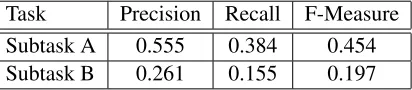
Task Precision Recall F-Measure Subtask A 0.555 0.384 0.454 Subtask B 0.261 0.155 0.197
Table 2: Results obtained by theSHELLFBKsystem on Task 9.
the identification of both the polarity and the do-main of the sentence (subtask B). Precision, recall and F-Measure have been computed. As expected, the accuracy obtained on the sole prediction of the sentence polarity is higher with respect to the one obtained on the subtask combining the inference of both the domain and the polarity itself. Unfortu-nately, the recall values obtained on both subtasks are quite low, especially for the subtask B.
4.2 Task 10
Performance obtained by the SHELLFBK system on Task 10 have been reported in Table 3. For this task, theSHELLFBK system has been tested only on the message-level polarity subtask (B). By serving either the overall f-measure and the ones ob-tained on the different portions of the dataset, the performance of the system are too low for consider-ing it a reliable solution for beconsider-ing used in contexts where short texts are taken into account.
4.3 Task 11
Results of the proposed system concerning Task 11 are shown in Table 4. In this task, due to the fine-grained nature of the polarity predictions, the cosine similarity and the mean square error with respect to the gold standard have been computed. In the first result-line, the values obtained on the four figura-tive categories are reported, while in the second one, the overall results. By observing the results, for the “Sarcasm” and “Irony” topics the obtained results are acceptable; while, for the “Metaphor” and for the “Other” category, both the cosine similarity and the MSE are significantly worse with respect to the first two. These results, either with the ones obtained on Task 10, confirm that the analysis of short texts is the first issue to address for improving the general quality of the system.
5 Conclusion
In this paper, we described theSHELLFBKsystem presented at SemEval 2015 that participated in Se-mEval 2015 Tasks 9, 10, and 11. Our system makes use of IR techniques to classify sentences by polar-ity, domain and the joint prediction of polarity and domain, effectively providing domain specific senti-ment analysis. The results demonstrated that, while on well-formed sentences the system obtained good performance, the method performs less well on short texts like tweets. Therefore, future work will focus on the improvement of the system in this direction. In future work, we intend to explore the integration of sentiment knowledge bases (Dragoni et al., 2014) in order to move toward a more cognitive approach.
Acknowledgments
We would like to thank the anonymous reviewers for their helpful suggestions and comments.
References
Nicholas Asher, Farah Benamara, and Yvette Yannick Mathieu. 2008. Distilling opinion in discourse: A preliminary study. InCOLING (Posters), pages 7–10. Luciano Barbosa and Junlan Feng. 2010. Robust
senti-ment detection on twitter from biased and noisy data. InCOLING (Posters), pages 36–44.
Adam Bermingham and Alan F. Smeaton. 2010. Clas-sifying sentiment in microblogs: is brevity an advan-tage? InCIKM, pages 1833–1836.
John Blitzer, Mark Dredze, and Fernando Pereira. 2007. Biographies, bollywood, boom-boxes and blenders: Domain adaptation for sentiment classification. In ACL, pages 187–205.
Danushka Bollegala, David J. Weir, and John A. Carroll. 2013. Cross-domain sentiment classification using a sentiment sensitive thesaurus. IEEE Trans. Knowl. Data Eng., 25(8):1719–1731.
Erik Cambria and Amir Hussain. 2012a. Sentic album: Content-, concept-, and context-based online personal photo management system. Cognitive Computation, 4(4):477–496.
Erik Cambria and Amir Hussain. 2012b. Sentic Com-puting: Techniques, Tools, and Applications, volume 2 ofSpringerBriefs in Cognitive Computation. Springer, Dordrecht, Netherlands.
Task Live Journal 2014 SMS 2013 Twitter 2013 Twitter 2014 Twitter 2014 Sarcasm Progress Test 0.3406 0.2614 0.3214 0.3220 0.3558
Task F-Measure - - -
-Overall 0.3245 - - -
-Table 3: Results obtained by theSHELLFBKon Task 10.
Mean Square Error Cosine Similarity
Sarcasm Irony Metaphor Other Sarcasm Irony Metaphor Other Detailed Results 4.375 4.516 9.219 12.16 0.669 0.625 0.35 0.167
MSE Cosine - - -
-General Result 7.701 0.431 - - -
-Table 4: Results obtained by theSHELLFBKon Task 11.
and semantic classification of product reviews. In WWW, pages 519–528.
Mauro Dragoni, Andrea G.B.Tettamanzi, and C´elia da Costa Pereira. 2014. Propagating and aggregating fuzzy polarities for concept-level sentiment analysis. Cognitive Computation, pages 1–12.
Dayne Freitag and Andrew McCallum. 2000. In-formation extraction with hmm structures learned by stochastic optimization. In AAAI/IAAI, pages 584– 589.
Aniruddha Ghosh, Guofu Li, Tony Veale, Paolo Rosso, Ekaterina Shutova, Antonio Reyes, and John Barnden. 2015. SemEval-2015 task 11: Sentiment analysis of figurative language in twitter. InProceedings of the 9th International Workshop on Semantic Evaluation, SemEval ’2015, Denver, Colorado, June.
Alec Go, Richa Bhayani, and Lei Huang. 2009. Twit-ter sentiment classification using distant supervision. CS224N Project Report, Standford University. Vasileios Hatzivassiloglou and Janyce Wiebe. 2000.
Ef-fects of adjective orientation and gradability on sen-tence subjectivity. InCOLING, pages 299–305. Sheng Huang, Zhendong Niu, and Chongyang Shi.
2014. Automatic construction of domain-specific sen-timent lexicon based on constrained label propagation. Knowl.-Based Syst., 56:191–200.
Niklas Jakob and Iryna Gurevych. 2010. Extracting opinion targets in a single and cross-domain setting with conditional random fields. In EMNLP, pages 1035–1045.
Wei Jin and Hung Hay Ho. 2009. A novel lexicalized HMM-based learning framework for web opinion min-ing. InProceedings of the 26th Annual International Conference on Machine Learning, ICML ’09, pages 465–472, New York, NY, USA. ACM.
Wei Jin, Hung Hay Ho, and Rohini K. Srihari. 2009. Opinionminer: a novel machine learning system for
web opinion mining and extraction. In KDD, pages 1195–1204.
Soo-Min Kim and Eduard H. Hovy. 2007. Crystal: An-alyzing predictive opinions on the web. In EMNLP-CoNLL, pages 1056–1064.
Soo-Min Kim, Patrick Pantel, Timothy Chklovski, and Marco Pennacchiotti. 2006. Automatically assessing review helpfulness. InEMNLP, pages 423–430. John D. Lafferty, Andrew McCallum, and Fernando C. N.
Pereira. 2001. Conditional random fields: Probabilis-tic models for segmenting and labeling sequence data. InICML, pages 282–289.
Peter M. Lewinsohn and Christopher S. Amenson. 1978. Some relations between pleasant and unpleas-ant events and depression. Journal of Abnormal Psy-chology, 87:644–654.
Bing Liu and Lei Zhang. 2012. A survey of opinion mining and sentiment analysis. In C. C. Aggarwal and C. X. Zhai, editors,Mining Text Data, pages 415–463. Springer.
Bing Liu, Minqing Hu, and Junsheng Cheng. 2005. Opinion observer: analyzing and comparing opinions on the web. InWWW, pages 342–351.
Douglas MacPhillamy, and Peter M. Lewinsohn. 1982. The pleasant event schedule: Studies on reliability, va-lidity, and scale intercorrelation. Journal of Counsel-ing and Clinical Psychology, 50:363–380.
Prem Melville, Wojciech Gryc, and Richard D. Lawrence. 2009. Sentiment analysis of blogs by com-bining lexical knowledge with text classification. In KDD, pages 1275–1284.
Georgios Paltoglou and Mike Thelwall. 2010. A study of information retrieval weighting schemes for sentiment analysis. InACL, pages 1386–1395.
[image:7.612.72.537.57.118.2]senti-ment classification via spectral feature alignsenti-ment. In WWW, pages 751–760.
Bo Pang and Lillian Lee. 2004. A sentimental education: Sentiment analysis using subjectivity summarization based on minimum cuts. InACL, pages 271–278. Bo Pang and Lillian Lee. 2008. Opinion mining and
sentiment analysis. Foundations and Trends in Infor-mation Retrieval, 2(1-2):1–135.
Bo Pang, Lillian Lee, and Shivakumar Vaithyanathan. 2002. Thumbs up? sentiment classification using ma-chine learning techniques. InProceedings of EMNLP 2002, pages 79–86, Philadelphia, July.
Natalia Ponomareva and Mike Thelwall. 2013. Semi-supervised vs. cross-domain graphs for sentiment anal-ysis. InRANLP, pages 571–578.
Guang Qiu, Bing Liu, Jiajun Bu, and Chun Chen. 2009a. Expanding domain sentiment lexicon through double propagation. InIJCAI, pages 1199–1204.
Likun Qiu, Weishi Zhang, Changjian Hu, and Kai Zhao. 2009b. Selc: a self-supervised model for sentiment classification. InCIKM, pages 929–936.
Guang Qiu, Bing Liu, Jiajun Bu, and Chun Chen. 2011. Opinion word expansion and target extraction through double propagation. Computational Linguis-tics, 37(1):9–27.
Ellen Riloff, Siddharth Patwardhan, and Janyce Wiebe. 2006. Feature subsumption for opinion analysis. In EMNLP, pages 440–448.
Sara Rosenthal, Preslav Nakov, Svetlana Kiritchenko, Saif M Mohammad, Alan Ritter, and Veselin Stoy-anov. 2015. SemEval-2015 task 10: Sentiment analy-sis in twitter. InProceedings of the 9th International Workshop on Semantic Evaluation, SemEval ’2015, Denver, Colorado, June.
Irene Russo, Tommaso Caselli, and Carlo Strapparava. 2015. SemEval-2015 Task 9: CLIPEval Implicit Po-larity of Events. In Proceedings of the 9th Inter-national Workshop on Semantic Evaluation, SemEval ’2015, Denver, Colorado, June.
Swapna Somasundaran. 2010. Discourse-level relations for Opinion Analysis. Ph.D. thesis, University of Pitts-burgh.
Qi Su, Xinying Xu, Honglei Guo, Zhili Guo, Xian Wu, Xiaoxun Zhang, Bin Swen, and Zhong Su. 2008. Hid-den sentiment association in chinese web opinion min-ing. InWWW, pages 959–968.
Maite Taboada, Julian Brooke, Milan Tofiloski, Kim-berly D. Voll, and Manfred Stede. 2011. Lexicon-based methods for sentiment analysis. Computational Linguistics, 37(2):267–307.
Yen-Jen Tai and Hung-Yu Kao. 2013. Automatic domain-specific sentiment lexicon generation with la-bel propagation. IniiWAS, pages 53:53–53:62. ACM.
Songbo Tan, Yuefen Wang, and Xueqi Cheng. 2008. Combining learn-based and lexicon-based techniques for sentiment detection without using labeled exam-ples. InSIGIR, pages 743–744.
Angela Charng-Rurng Tsai, Chi-En Wu, Richard Tzong-Han Tsai, and Jane Yung jen Hsu. 2013. Building a concept-level sentiment dictionary based on common-sense knowledge.IEEE Int. Systems, 28(2):22–30. C´elia da Costa Pereira, Mauro Dragoni, and Gabriella
Pasi 2012. Multidimensional relevance: Prioritized aggregation in a personalized Information Retrieval setting.Inf. Process. Manage., 48(2):340–357. Peter D. Turney. 2002. Thumbs up or thumbs down?
semantic orientation applied to unsupervised classifi-cation of reviews. InACL, pages 417–424.
Cornelis Joost van Rijsbergen. 1979. Information Re-trieval. Butterworth.
Hongling Wang and Guodong Zhou. 2010. Topic-driven multi-document summarization. InIALP, pages 195– 198.
Qiu Feng Wang, Erik Cambria, Cheng Lin Liu, and Amir Hussain. 2013. Common sense knowledge for hand-written chinese recognition. Cognitive Computation, 5(2):234–242.
Janyce Wiebe, Theresa Wilson, Rebecca F. Bruce, Matthew Bell, and Melanie Martin. 2004. Learn-ing subjective language. Computational Linguistics, 30(3):277–308.
Theresa Wilson, Janyce Wiebe, and Rebecca Hwa. 2004. Just how mad are you? finding strong and weak opin-ion clauses. InAAAI, pages 761–769.
Theresa Wilson, Janyce Wiebe, and Rebecca Hwa. 2006. Recognizing strong and weak opinion clauses. Com-putational Intelligence, 22(2):73–99.
Yuanbin Wu, Qi Zhang, Xuanjing Huang, and Lide Wu. 2009. Phrase dependency parsing for opinion mining. InEMNLP, pages 1533–1541.
Rui Xia, Chengqing Zong, Xuelei Hu, and Erik Cambria. 2013. Feature ensemble plus sample selection: Do-main adaptation for sentiment classification. IEEE Int. Systems, 28(3):10–18.
Hui Yang, Jamie Callan, and Luo Si. 2006. Knowledge transfer and opinion detection in the TREC 2006 blog track. InTREC.
Yasuhisa Yoshida, Tsutomu Hirao, Tomoharu Iwata, Masaaki Nagata, and Yuji Matsumoto. 2011. Trans-fer learning for multiple-domain sentiment analysis— identifying domain dependent/independent word po-larity. InAAAI, pages 1286–1291.