USNA: A Dual-Classifier Approach to Contextual Sentiment Analysis
Ganesh Harihara and Eugene Yang and Nathanael Chambers United States Naval Academy
Annapolis, MD 21401, USA
Abstract
This paper describes a dual-classifier ap-proach to contextual sentiment analysis at the SemEval-2013 Task 2. Contextual analysis of polarity focuses on a word or phrase, rather than the broader task of identifying the senti-ment of an entire text. The Task 2 definition includes target word spans that range in size from a single word to entire sentences. How-ever, the context of a single word is depen-dent on the word’s surrounding syntax, while a phrase contains most of the polarity within it-self. We thus describe separate treatment with two independent classifiers, outperforming the accuracy of a single classifier. Our system ranked 6th out of 19 teams on SMS message classification, and 8th of 23 on twitter data. We also show a surprising result that a very small amount of word context is needed for high-performance polarity extraction.
1 Introduction
A variety of approaches to sentiment analysis have been proposed in the literature. Early work sought to identify the general sentiment of entire documents, but a recent shift to social media has provided a large quantity of publicly available data, and private orga-nizations are increasingly interested in how a pop-ulation “feels” toward its products. Identifying the polarity of language toward a particular topic, how-ever, no longer requires identifying the sentiment of an entire text, but rather the contextual sentiment
surrounding a target phrase.
Identifying the polarity of text toward a phrase is significantly different from a sentence’s overall
po-larity, as seen in this example from the SemEval-2013 Task 2 (Wilson et al., SemEval-2013) training set:
I had a severe nosebleed last night. I think my iPad caused it as I was browsing for a few hours on it. Anyhow, its stopped, which is good.
An ideal sentiment classifier would classify this text as overall positive (the nosebleed stopped!), but this short snippet actually contains three types of po-larity (positive, negative, and neutral). The middle sentence about the iPad is not positive, but neutral. The word ‘nosebleed’ has a very negative polarity in this context, and the phrase ‘its stopped’ is posi-tive. Someone interested in specific health concerns, such as nosebleeds, needs a contextual classifier to identify the desired polarity in this context.
This example also illustrates how phrases of dif-ferent sizes require unique handling. Single token phrases, such as ‘nosebleed’, are highly dependent on the surrounding context for its polarity. How-ever, the polarity of the middle iPad sentence is tained within the phrase itself. The surrounding con-text is not as important. This paper thus proposes a dual-classifier that trains two separate classifiers, one for single words, and another for phrases. We empirically show that unique features apply to both, and both benefit from independent training. In fact, we show a surprising result that a very small win-dow size is needed for the context of single word phrases. Our system performs well on the SemEval task, placing 8th of 23 systems on twitter text. It also shows strong generalization to SMS text messages, placing 6th of 19.
2 Previous Work
Sentiment analysis is a large field applicable to many genres. This paper focuses on social media (microblogs) and contextual polarity, so we only address the closest work in those areas. For a broader perspective, several survey papers are avail-able (Pang and Lee, 2008; Tang et al., 2009; Liu and Zhang, 2012; Tsytsarau and Palpanas, 2012).
Microblogs serve as a quick way to measure a large population’s mood and opinion. Many differ-ent sources have been used. O’Connor et al. (2010) used Twitter data to compute a ratio of positive and negative words to measure consumer confidence and presidential approval. Kramer (2010) counted lex-icon words on Facebook for a general ’happiness’ measure, and Thelwall (2011) built a general senti-ment model on MySpace user comsenti-ments. These are general sentiment algorithms.
Specific work on microblogs has focused on find-ing noisy trainfind-ing data with distant supervision. Many of these algorithms use emoticons as seman-tic indicators of polarity. For instance, a tweet that contains a sad face likely contains a negative polar-ity (Read, 2005; Go et al., 2009; Bifet and Frank, 2010; Pak and Paroubek, 2010; Davidov et al., 2010; Kouloumpis et al., 2011). In a similar vein, hash-tags can also serve as noisy labels (Davidov et al., 2010; Kouloumpis et al., 2011). Most work on dis-tant supervisionrelies on a variety of syntactic and word-based features (Marchetti-Bowick and Cham-bers, 2012). We adopt many of these features.
Supervised learning for contextual sentiment analysis has not been thoroughly investigated. La-beled data for specific words or queries is expensive to generate, so Jiang et al. (2011) is one of the few approaches with labeled training data. Earlier work on product reviews sought the sentiment toward par-ticular product features. These systems used rule based approaches based on parts of speech and other surface features (Nasukawa and Yi, 2003; Hu and Liu, 2004; Ding and Liu, 2007).
Finally, topic identification in microblogs is also related. The first approaches are somewhat simple, selecting single keywords (e.g., “Obama”) to rep-resent the topic (e.g., “US President”), and retrieve tweets that contain the word (O’Connor et al., 2010; Tumasjan et al., 2010; Tan et al., 2011). These
sys-tems then classify the polarity of the entire tweet, and ignore the question of polarity toward the partic-ular topic. This paper focuses on the particpartic-ular key-word or phrase, and identifies the sentiment toward that phrase, not the overall sentiment of the text.
3 Dataset
This paper uses three polarity classes: positive, neg-ative, and neutral. We developed all algorithms on the ‘Task A’ corpora provided by SemEval-2013 Task 2 (Wilson et al., 2013). Both training and de-velopment sets were provided, and an unseen test set was ultimately used to evaluate the final systems. The number of tweets in each set are shown here:
positive negative neutral
training 5348 2817 422
development 648 430 57
test (tweet) 2734 1541 160
test (sms) 1071 1104 159
4 Contextual Sentiment Analysis
Contextual sentiment analysis focuses on the dispo-sition of a certain word or groups of words. Most data-driven approaches rely on a labeled corpus to drive the learning process, and this paper is no dif-ferent. However, we propose a novel approach to contextual analysis that differentiates between sin-gle wordsandphrases.
The semantics of a single word in context from that of a phrase are fundamentally different. Since one word will have multiple contexts and is heavily influenced by the surrounding words, more consid-eration is given to adjacent words. A phrase often carries its own semantics, so has less variability in its meaning based on its context. Context is still im-portant, but we propose separate classifiers in order to learn weights unique to tokens and phrases. The following describes the two unique feature sets. We trained a Maximum Entropy classifier for each set.
4.1 Text Pre-Processing
be-comes “not-happy”). We also found that removing prefix and affix punctuation from each token, and storing the punctuation for later use in punctuation features boosts performance. These cleaned tokens are the input to the features described below.
4.2 Single Word Sentiment Analysis
Assigning polarity to a single word mainly requires features that accurately capture the surrounding con-text. In fact, many single words do no carry any po-larity in isolation, but solely require context. Take the following two examples:
JustinLOVE YA so excited for the concert in october MEXICO LOVES YOU
Im not getting on twitter tomorrow because all my TL will consist of is a bunch of girls talking aboutJustinBeiber
In these examples, Justin is the name of a singer who does not carry an initial polarity. The first tweet is clearly positive toward him, while the second is not. Our single-token classifier used the following set of features to capture these different contexts:
Target Token: The first features are the unigram and bigram ending with the target token. We attach a unique string to each to distinguish it from the text’s other n-grams. We also include a feature for any punctuation that was attached to the end of the token (e.g., ’Justin!’ generates ’!’ as a feature).
Target Patterns: This feature generalizes the n-grams that include the target word. It replaces the target word with a variable in an effort to capture general patterns that indicate sentiment. For in-stance, using the first tweet above, we add the tri-gram ‘<s> LOVE’ and two bigrams, ‘<s> ’ and ‘ LOVE’.
Unigrams, Bigrams, Trigrams: We include all other n-grams in the text within a window of size
nfrom the target token.
Dictionary Matching: We have two binary fea-tures,postivemoodandnegativemood, that indicate if any word in the text appears in a sentiment lex-icon’s positive or negative list. We use Bing Liu’s Opinion Lexicon1.
1
http://www.cs.uic.edu/˜liub/FBS/ sentiment-analysis.html\#lexicon
Punctuation Features: We included a binary fea-ture for the presence or absence of exclamation marks anywhere in the text. Further, we generate a feature for punctuation at the end of the text.
Emoticons: We included two binary features for the presence or absence of a smiley face and sad face emoticon.
4.3 Phrasal Sentiment Analysis
We adopted several single word features for use in phrases, including punctuation, dictionary match-ing, and emoticons. However, since phrasal analy-sis is often less dependent on context and more de-pendent on the phrase itself, we altered the n-gram features to be unique to the phrase. The following features are solely used for target phrases, not single words:
Unigrams, Bigrams, Trigrams: We include all n-gramsin the target phrase only. This differs from the single token features that included n-grams from a surrounding window.
Phrasal Punctuation: If thetarget phraseends with any type of punctuation, we include it as a feature.
5 Experiments
Initial model design and feature tuning was con-ducted on the SemEval-2013 Task 2 training set for training, and its dev set for evaluation. We split the data into two parts: tweets with single word targets, and tweets with target phrases. We trained two Max-Ent classifiers using the Stanford JavaNLP toolkit2. Each datum in the test set is labeled using the appro-priate classifier based on the target phrase’s length.
The first experiments are ablation over the fea-tures described in Section 4, separately improving the single token and phrasal classifiers. Results are reported in Table 1 using simple accuracy on the de-velopment set. We initially do not split off punc-tuation, and use only unigram features for phrases. The window size is initally infinite (i.e., the entire text is used for n-grams). Bigrams and trigrams hurt performance and are not shown. Reducing the win-dow size to a single token (ignore the entire tweet) increased performance by 1.2%, and stripping punc-tuation off tokens by another 1.9%. The
Single Token Features
Just Unigrams 70.5
+ Target Token Patterns 70.4 + Sentiment Lexicon 71.5 + Target Token N-Grams 73.3
+ EOS punctuation 73.2
+ Emoticons 73.3
Set Window Size = 1 74.5 Strip punctuation off tokens 76.4
Phrasal Features
Just Unigrams 76.4
+ Emoticons 76.3
[image:4.612.336.513.53.218.2]+ EOS punctuation 76.6 + Exclamation Marks 76.5 + Sentiment Lexicon 77.7
Table 1: Feature ablation in order. Single token features begin with unigrams only, holding phrasal features con-stant at unigrams only. The phrasal table picks up where the single token table finishes. Each row uses all features added in previous rows.
Dual-Classifier Comparison
Single Classifier 76.6% Dual-Classifier 77.7%
Table 2: Performance increase from splitting into two classifiers. Accuracy reported on the development set.
mance increase with phrasal features is 1.3% abso-lute, whereas token features contributed 5.9%.
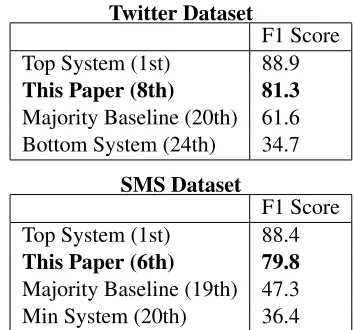
After choosing the optimum set of features based on ablation, we then retrained the classifiers on both the training and development sets as one large train-ing corpus. The SemEval-2013 Task 2 competition included two datasets for testing: tweets and SMS messages. Official results for both are given in Ta-ble 3 using the F1 measure.
Finally, we compare our dual-classifier to a single standard classifier. We use the same features used in Table 1, train on the training set, and report accu-racy on the development set. See Table 2. Our dual classifier improves relative accuracy by 1.4%.
6 Discussion
One of the main surprises from our experiments was that a large portion of text could be ignored with-out hurting classification performance. We reduced
Twitter Dataset
F1 Score Top System (1st) 88.9
This Paper (8th) 81.3
Majority Baseline (20th) 61.6 Bottom System (24th) 34.7
SMS Dataset
F1 Score Top System (1st) 88.4
This Paper (6th) 79.8
Majority Baseline (19th) 47.3 Min System (20th) 36.4
Table 3: Performance on Twitter and SMS Data.
the window size in which n-grams are extracted to size one, and performance actually increases 1.2%. At least for single word target phrases, including n-grams of the entire tweet/sms is not helpful. We only used n-gram patterns that included the token and its two immediate neighbors. A nice side ben-efit is that the classifier contains fewer features, and trains faster as a result.
The decision to use two separate classifiers helped performance, improving by 1.4% relative accuracy on the development set. The decision was moti-vated by the observation that the polarity of a token is dependent on its surrounding context, but a longer phrase is dependent more on its internal syntax. This allowed us to make finer-grained feature decisions, and the feature ablation experiments suggest our ob-servation to be true. Better feature weights are ulti-mately learned for the unique tasks.
Finally, the feature ablation experiments revealed a few key takeaways for feature engineering: bi-grams and tribi-grams hurt classification, using a win-dow size is better than the entire text, and punctu-ation should always be split off tokens. Further, a sentiment lexicon reliably improves both token and phrasal classification.
[image:4.612.103.268.60.268.2]References
Albert Bifet and Eibe Frank. 2010. Sentiment knowl-edge discovery in twitter streaming data. In Lecture Notes in Computer Science, volume 6332, pages 1–15. Dmitry Davidov, Oren Tsur, and Ari Rappoport. 2010. Enhanced sentiment learning using twitter hashtags and smileys. InProceedings of the 23rd International Conference on Computational Linguistics (COLING 2010).
Xiaowen Ding and Bing Liu. 2007. The utility of lin-guistic rules in opinion mining. In Proceedings of SIGIR-2007, pages 23–27.
Alec Go, Richa Bhayani, and Lei Huang. 2009. Twit-ter sentiment classification using distant supervision. Technical report.
Minqing Hu and Bing Liu. 2004. Mining and sum-marizing customer reviews. In Proceedings of the ACM SIGKDD International Conference on Knowl-edge Discovery and Data Mining.
Long Jiang, Mo Yu, Ming Zhou, Xiaohua Liu, and Tiejun Zhao. 2011. Target-dependent twitter sentiment clas-sification. InProceedings of the Association for Com-putational Linguistics (ACL-2011).
Efthymios Kouloumpis, Theresa Wilson, and Johanna Moore. 2011. Twitter sentiment analysis: The good the bad and the omg! InProceedings of the Fifth In-ternational AAAI Conference on Weblogs and Social Media.
Adam D. I. Kramer. 2010. An unobtrusive behavioral model of ‘gross national happiness’. InProceedings of the 28th International Conference on Human Factors in Computing Systems (CHI 2010).
Bing Liu and Lei Zhang. 2012. A survey of opinion min-ing and sentiment analysis. Mining Text Data, pages 415–463.
Micol Marchetti-Bowick and Nathanael Chambers. 2012. Learning for microblogs with distant supervi-sion: Political forecasting with twitter. InProceedings of the 13th Conference of the European Chapter of the Association for Computational Linguistics.
Tetsuya Nasukawa and Jeonghee Yi. 2003. Sentiment analysis: capturing favorability using natural language processing. InProceedings of K-CAP.
Brendan O’Connor, Ramnath Balasubramanyan, Bryan R. Routledge, and Noah A. Smith. 2010. From tweets to polls: Linking text sentiment to public opinion time series. In Proceedings of the AAAI Conference on Weblogs and Social Media.
Alexander Pak and Patrick Paroubek. 2010. Twitter as a corpus for sentiment analysis and opinion mining. In Proceedings of the Seventh International Conference On Language Resources and Evaluation (LREC).
B. Pang and L. Lee. 2008. Opinion mining and senti-ment analysis. Foundations and Trends in Information Retrieval.
Jonathon Read. 2005. Using emoticons to reduce depen-dency in machine learning techniques for sentiment classification. InProceedings of the ACL Student Re-search Workshop (ACL-2005).
Chenhao Tan, Lillian Lee, Jie Tang, Long Jiang, Ming Zhou, and Ping Li. 2011. User-level sentiment anal-ysis incorporating social networks. In Proceedings of the 17th ACM SIGKDD Conference on Knowledge Discovery and Data Mining.
H. Tang, S. Tan, and X. Cheng. 2009. A survey on senti-ment detection of reviews. Expert Systems with Appli-cations.
Mike Thelwall, Kevan Buckley, and Georgios Paltoglou. 2011. Sentiment in twitter events. Journal of the American Society for Information Science and Tech-nology, 62(2):406–418.
M. Tsytsarau and T. Palpanas. 2012. Survey on mining subjective data on the web. Data Mining and Knowl-edge Discovery Journal, 24(3):478–514.
Andranik Tumasjan, Timm O. Sprenger, Philipp G. Sand-ner, and Isabell M. Welpe. 2010. Election forecasts with twitter: How 140 characters reflect the political landscape.Social Science Computer Review.