Fast and highly parallelizable phrase table for statistical machine
translation
Nikolay Bogoychev The University of Edinburgh 11 Crichton St, Edinburgh EH8 9LE
United Kingdom [email protected]
Hieu Hoang
Moses Machine Translation CIC [email protected]
Abstract
Speed of access is a very important prop-erty for phrase tables in phrase based sta-tistical machine translation as they are queried many times per sentence. In this paper we present a new standalone phrase table, optimized for query speed and mem-ory locality. The phrase table is cache free and can optionally incorporate a reorder-ing table within. We are able to achieve two times faster decoding by using our phrase table in the Moses decoder in place of the current state-of-the-art phrase ta-ble solution without sacrificing translation quality. Using a new, experimental version of Moses we are able to achieve 10 times faster decoding using our novel phrase ta-ble.
1 Introduction
Phrase tables are the most basic component of a statistical machine translation decoder, containing the parallel phrases necessary to perform phrase-based machine translation. Due to the noisy na-ture of phrase extraction and the large phrase vo-cabulary, phrase tables’ size can reach hundreds of gigabytes in size. Lopez (2008) describes phrase tables of size of half of terabyte. A decade ago it was prohibitively expensive for a phrase table of this size to reside in memory, even if hardware supported it: a gigabyte of RAM back in 2006 costed about a 100 USD, compared to 5 USD in 2016. Because of that for a long time Machine Translation was considered a big data problem and the engineering efforts were focused on reducing the model size. This lead to the creation of sev-eral binary phrase table implementations that tack-led the memory usage problem: Zens and Ney (2007) and Junczys-Dowmunt (2012b) developed
memory mapped phrase tables which also reduce memory usage using specific datastructures. The former uses a trie (Fredkin, 1960) and the latter uses specific for the purpose phrasal rank encod-ing. Lopez (2007) and Germann (2015) developed suffix array based phrase tables, which work di-rectly with the parallel corpora in order to enable easier addition of new data, avoid long binariza-tion times and keep memory usage low, but tradi-tional precomputed phrase tables offer better per-formance. RAM prices have dropped 20 times over the past 10 years and high performance server machines have hundreds of gigabytes of memory. For those machines it is no longer needed to sac-rifice query performance in favour of compression techniques such as the one in Junczys-Dowmunt (2012a). Furthermore the machines nowadays are highly parallel and locking caches which didn’t hurt performance in the past now prevent imple-mentations from scaling. We have designed a new phrase table calledProbingPTbased on lin-ear probing hash (Heafield, 2011) for storage and lock-free querying, in order to deliver the best possible performance in modern use cases where memory is not an issue.
2 Implementation
First, we will give a brief overview of Junczys-Dowmunt’s (2012b) CompactPT which is cur-rently the state of the art phrase table in terms of both speed and space usage. It uses phrasal rank compression (Junczys-Dowmunt, 2012a) which can be viewed as a form of byte pair encoding (Gage, 1994). The method recursively encodes bigger strings as a composition of several smaller ones until only small units remain. Minimum perfect hashing (Nick Cercone, 1983) is used to hash phrases to their expansions and on top of that bit aligned Huffman encoding is used to
ther compress the phrases. This approach achieves the smallest model size but it has several draw-backs when it comes to lookup. First, minimum perfect hashing requires a secondary hash func-tion called fingerprinting in order to avoid false positives which results in increased CPU usage. Second, while phrasal rank encoding is extremely space efficient, it is quite slow to compute, because of the multitude of random memory accesses nec-essary to reconstruct a single phrase. The reason is that when a request to read a portion of memory is submitted what is actually fetched is not only the bytes that were requested but also the surrounding bytes. This is because usually when one byte of memory is accessed, the surrounding bytes would also be necessary so memory has been designed to fetch things in small burst, called DRAM bursts. As such peak memory performance can only be achieved by accessing consecutive memory and random memory accesses reduce the total mem-ory bandwidth, because some of fetched bytes are not used.
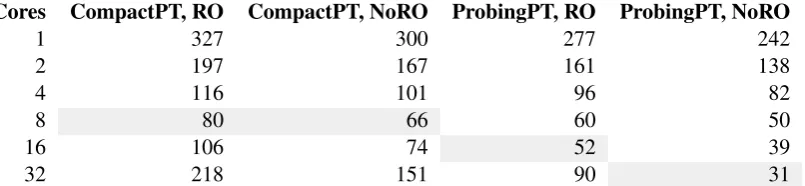
In order to speed up querying in CompactPT, extensive caching is used but it is not thread lo-cal and causes a lot of locking for higher thread count. In our experiments we found that more than 8 threads actually hurt CompactPT’s performance. The phrase table also has a mode which disables phrasal rank encoding and caching. In this mode performance at higher thread count doesn’t de-crease but instead flattens out, however it is un-able to achieve better performance than the phrase rank encoding version no matter the thread count.1
Even if caches don’t cause lock contention at higher thread count, they carry additional over-head during runtime. Our goal in design was to eliminate the necessity for cache by using high performance datastructures and eliminate random memory accesses to maximize the memory band-width.
2.1 ProbingPT
Our phrase table is based on an existing lin-ear probing hash table implementation (Heafield, 2011). Linear probing hash providesO(1)search
time, has a very small overhead per entry stored and is shown to be very fast in practice (Heafield, 2011). The phrase table consists of two byte ar-rays: The first contains the probing hash table and the second one contains the payloads (phrase
prob-1https://github.com/moses-smt/mosesdecoder/issues/39
abilities, word alignments and optionally lexically reordering scores) associated with each entry in the hash table. Hashes of the source phrases are used as keys. When the phrase table is queried, the source phrase is hashed and we try to find it in the probing hash table. If it is found inside the hash ta-ble we are given a start and end index correspond-ing to the location of the target phrases associated with the source phrase queried inside the payloads byte array. The payloads byte array stores con-secutively in binary format each target phrase to-gether with its scores and word alignment infor-mation. We have also provided the option to store lexical reordering information and sparse features. Unlike previous phrase tables implementations, this phrase table doesn’t employ any compression method which allows for all target phrases asso-ciated with a single source phrase to be fetched in a single memory operation. In contrast, both Junczys-Dowmunt’s (2012b) and Zens and Ney (2007) employ pointer chasing during querying in order to extract and reassemble the results. Their approaches are more space-efficient but in-cur higher memory cost due to increased number of random memory accesses. Furthermore our im-plementation doesn’t require any scratch memory to decompress queries: they can be read directly from the payloads byte array which contributes to its speed and avoids extra memory operations (al-locations/deallocations) or the need for caching. Storing lexical reordering information inside the phrase table reduces the memory usage, because we no longer need to store a key for every lexical reordering score, as we reuse the phrase table key. Extracting lexical reordering scores no longer car-ries an extra performance penalty as querying is tied to the phrase table query and all related scores would be fetched with the same DRAM burst, be-cause they are stored consecutively in memory. To our knowledge, this is the first phrase table im-plementation that incorporates lexical reordering table.
The phrase table is part of upstream Moses2but
it can also be used standalone.3
3 Experimental setup
For our performance evaluation we used French-English model trained on 2 million EUROPARL sentences. We used a KenLM (Heafield, 2011)
language model and cube pruning algorithm (Chi-ang, 2007) with a pop-limit of 400. We time the end to end translation of 200,000 sentences from the training set. All experiments were performed on a machine with two Xeon E5-2680 processors clocked at 2.7 Ghz with total of 16 cores and 16 hyperthreads and 290 GB of RAM. In all of our figures “32 cores” means 16 cores and 16 hyper-threads. Note that hyperthread do not provide ad-ditional computational power but merely permit better resource utilization by allowing more work to be scheduled for the CPU by the OS. This al-lows the CPU to already have scheduled work to do while a scheduled process is waiting for IO. Us-ing hyperthreads will not necessarily increase per-formance and in cases with high lock contention it can be detrimental for performance.
3.1 Decoders
We use two different decoders for our experi-ments: The widely used moses machine transla-tion decoder, available publically andMoses2, an experimental faster version of Moses.4 We
per-form some benchmarks using Moses to show the speedup our implementation offers as a drop-in re-placement to existing phrase tables in the widely used decoder. Unfortunately Moses has known multi-threading issues that come from the usage of several functions which callstd::localeas part of their initiations, which carries a global lock.1 As
such it is not entirely adequate to use it to measure the performance of the phrase tables because it serves as a bottleneck that might hide performance issues. Thus we used the highly optimizedMoses2
to show the speed our phrase table can achieve when it is running on a fast decoder, optimized for multi-threading. Furthermore because of their in-trusive nature, integrated lexical reordering tables are only implemented in Moses2. It is expected that whenMoses2matures it will be merged back into Moses master.
3.2 PhraseTables
In our experiments we focus on comparing Prob-ingPT against CompactPT. There are currently two other phrase tables: PhraseDictionaryOnDisk, a multithreading enabled implementation of the Zens and Ney (2007) phrase table and Phrase-DictionaryMemory, an in-memory phrase table which reads in the raw phrase table and puts it
4Anonymous for submission
inside a hash map. Junczys-Dowmunt (2012b) has shown that CompactPT is faster than Phrase-DictionaryOnDisk under any condition, so we do not run experiments against it. PhraseDic-tionaryMemory comes with the downside that it needs to parse in the phrase table first, before de-coding can commence, which leads to long load-ing times and huge memory usage. In our experi-mental setup, the in-memory phrase table took 20 minutes to load and consumed 86 GBs of mem-ory, more than ten times more memory than any other phrase table. Even when disregarding load-ing time, we found out that it is consistently 1-5% slower than ProbingPT in various thread configu-rations. We decided not to include those results, as they do not show anything interesting and because of the aforementioned shortcomings, PhraseDic-tionaryMemory is seldom used in practice, unless the dataset involved is really tiny.
ProbingPT and CompactPT produced identi-cal translations under the same decoder. In our tests 3 out of 200,000 sentences slightly differ in their translation. This is expected according to Junczys-Dowmunt (2012b) because CompactPT’s fingerprinting leads to collisions and extracting the wrong phrase in few rare cases. We conclude that our implementation is correct and can be used as drop-in replacement for CompactPT. We have pro-vided the complete set of conducted experiments on Figure 5 in the appendix. Those are useful if the reader wishes to compare system/user time us-age between different configurations.
3.3 Model sizes
Phrase table Size
ProbingPT 5.8 GB
ProbingPT + Reordering (RO) 8.2 GB
CompactPT 1.3 GB
CompactPT RO 0.6 GB
Table 1: Phrase table sizes
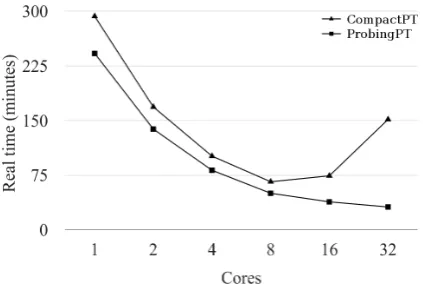
Figure 1: Real time comparison of Moses be-tween ProbingPT and CompactPT together with reordering models based on CompactPT.
[image:4.595.312.523.261.397.2]Figure 2: Real time comparison of Moses be-tween ProbingPT and CompactPT
Figure 3: System time comparison of the sys-tems on Figure 2. The comparison is in log scale.
Figure 4: Moses2 comparison between Prob-ingPT integrated reordering and CompactPT based reordering. Both systems use ProbingPT as a phrase table.
4 Evaluation
Figure 1 shows performance comparison of two systems with CompactPT based reordering tables that differ in the phrase table used. The best performing ProbingPT system here delivers about 30% better performance compared to the corre-sponding CompactPT system. We see that the CompactPT system doesn’t improve its perfor-mance when using more than 8 threads, but the ProbingPT one continues to scale further until it starts using hyperthreads.
We find it likely that the performance of the ProbingPT system on Figure 1 is hampered by the inclusion of CompactPT based reordering. Moses doesn’t support ProbingPT based reordering and in order to measure the head-to-head performance of the two phrase tables we conducted the same test using two systems that do not use reorder-ing tables and only differ by the phrase table, as shown on Figure 2. We can see that ProbingPT
[image:4.595.76.284.267.405.2]conclude that Moses can achieve faster translation times on highly parallel systems by using Prob-ingPT.
4.1 Why is CompactPT slower?
In the single-threaded case it likely that Com-pactPT’s many random memory accesses cause it to be slower than ProbingPT, because consec-utive memory accesses are much faster due to the DRAM burst effect. When the thread count grows, the performance gap between CompactPT and ProbingPT widens, because of the locking that goes on in the former’s cache. This can be seen from Figure 3 which shows the system time used during the execution of the phrase table only test. System time shows how much time a process has spent inside kernel routines, which includes but is not limited to locking and memory allocation. The ProbingPT system uses orders of magnitude less system time compared to the CompactPT one. The system time used in the CompactPT system grows linearly until 8 threads and then the growth rate starts increasing at a faster rate widening the gap with ProbingPT. This is also the reason why Com-pactPT’s performance severely degrades when us-ing hyperthreads. The Probus-ingPT system on the other hand (Figure 3) increases its usage of sys-tem time at a linear rate even when using hyper-threads. We can conclude that the simpler design of ProbingPT scales very well with the increase of number of threads and is suitable for use in mod-ern translation systems running on contemporary hardware.
4.2 Integrated reordering table
As integrated lexical reordering is only available inMoses2we conducted an experiment where we compare systems using CompactPT based reorder-ing and Probreorder-ingPT integrated reorderreorder-ing (Figure 4). The best ProbingPT based system is able to translate all sentences in our test set in only 4 min-utes, whereas the best CompactPT reordering sys-tem took 39 minutes (Table 3). We also observed limited scaling when using CompactPT based re-ordering: the best performance was achieved at 8 threads. For contrast with Moses (Table 2) we can see that lexicalized reordering has neglige-ble impact on performance if it is used within ProbingPT (We believe the reason we are getting slightly worse results when not using a reordering table are due to a bug in our implementation). We are not entirely certain which factor contributed
more to the increased performance: having a re-ordering table based on the faster ProbingPT or the reduced IO and computational resources that the integrated reordering table requires. As we do not currently have a standalone ProbingPT based reordering table we can not say for sure. Never-theless we achieve 10x speedup by using our novel reordering table withinMoses2.
4.3 Profiling the code
We were very surprised of the speedup our phrase table offered, particularly in Moses2, because in phrase based decoding, the number of phrase ta-ble queries increases linearly with the length of the sentence. They constitute a tiny fraction of the number of language model queries, which are about 1 million per sentence (Heafield, 2013). We decided to investigate our results using Google’s profiler.5 We profiled the pair of systems,
dis-played on Figure 4, because they showed the high-est relative difference between each other. In the system which has ProbingPT based reordering, the language model is responsible for about 40% of the decoding runtime, compared with only 1% in theMoses2system with CompactPT based re-ordering. In the latter system the runtime is domi-nated by CompactPT search andstd::locale lock-ing due to the phrase table uslock-ing strlock-ing operations during its search.
In Moses the difference between using Prob-ingPT and CompactPT is not so apparent, before we go to higher thread count, because the decoder itself is very slow and hides the phrase table inef-ficiencies. It is clear that even though the phrase table queries are a small part of the full decod-ing process, they are enough to slow it down 10 times if no other bottlenecks exist. Using Prob-ingPT for both the phrase table and the reordering model makes for a compelling combination.
5 Future work
In the future we will add support for cal phrase tables inside ProbingPT. In hierarchi-cal machine translation the burden on the phrase table is a lot higher so the improved performance would be even more noticeable. Given the differ-ence between the systems with and without Prob-ingPT based reordering in Table 3 we believe that adding that feature to Moses will allow us to get performance similar to that in the final column of
Cores CompactPT, RO CompactPT, NoRO ProbingPT, RO ProbingPT, NoRO
1 327 300 277 242
2 197 167 161 138
4 116 101 96 82
8 80 66 60 50
16 106 74 52 39
[image:6.595.103.506.63.156.2]32 218 151 90 31
Table 2: Time (in minutes) it took to translate our test set with Moses with different number of cores used. The systems differ by the type of phrase table used (ProbingPT or CompactPT) and whether they use a reordering table (based on CompactPT). The fastest translation time for each system is highligthed.
Cores CompactRO ProbingRO NoRO
1 116 66 72
2 64 30 35
4 40 15 18
8 39 9 10
16 46 5 6
[image:6.595.78.288.225.322.2]32 67 4 5
Table 3: Time (in minutes) it took to translate our test set withMoses2with different number of cores used. Since the only phrase table that is used is ProbingPT, the systems differ by the reordering table used. The fastest translation time for each system is highligthed.
Table 2, while maintaining the quality of the more complex model described in the first column of the same table.
6 Conclusion
As hardware evolves extremely fast, it may prove useful to revisit old problems which are consid-ered solved. The new available technology com-pels us to reconsider our priorities and decisions we took in the past.
We designed a faster phrase table that is able to take full advantage of the modern highly parallel CPUs. It shows better performance than related work and also scales better with higher thread count and it helped us expose performance issues in Moses. We believe ProbingPT is useful to in-dustry and researchers who use modern server ma-chines with many cores and a lot of main memory. Enthusiast machine translation users would proba-bly prefer to use CompactPT as it is most suitable when memory is limited and the thread count is low.
Acknowledgements
This work was conducted within the scope of the Horizon 2020 Innovation Ac-tionModern MT, which has received funding from the European Unions Horizon 2020 research and innovation programme under grant agreement No 645487.
This work is sponsored by the Air Force Re-search Laboratory, prime contract FA8650-11-C-6160. The views and conclusions contained in this document are those of the authors and should not be interpreted as representative of the official poli-cies, either expressed or implied, of the Air Force Research Laboratory or the U.S. Government.
We thank Adam Lopez, Kenneth Heafield, Ul-rich Germann, Rico SennUl-rich, Marcin Junczys-Dowmunt, Nathan Schneider, Sorcha Gilroy, Clara Vania and the anonymous reviewers for pro-ductive discussion of this work and helpful com-ments on previous drafts of the paper. Any errors are our own.
References
David Chiang. 2007. Hierarchical phrase-based trans-lation.Comput. Linguist., 33(2):201–228, June.
Edward Fredkin. 1960. Trie memory.Commun. ACM, 3(9):490–499, sep.
Philip Gage. 1994. A new algorithm for data compres-sion.C Users J., 12(2):23–38, February.
Ulrich Germann. 2015. Sampling phrase tables for the moses statistical machine translation system.
Prague Bull. Math. Linguistics, 104:39–50.
Kenneth Heafield. 2013.Efficient Language Modeling Algorithms with Applications to Statistical Machine Translation. Ph.D. thesis, Carnegie Mellon Univer-sity, September.
Marcin Junczys-Dowmunt. 2012a. Phrasal rank-encoding: Exploiting phrase redundancy and trans-lational relations for phrase table compression.
Prague Bull. Math. Linguistics, 98:63–74.
Marcin Junczys-Dowmunt. 2012b. A space-efficient phrase table implementation using minimal perfect hash functions. InText, Speech and Dialogue - 15th International Conference, TSD 2012, Brno, Czech Republic, September 3-7, 2012. Proceedings, pages 320–327.
Adam Lopez. 2007. Hierarchical phrase-based trans-lation with suffix arrays. InProceedings of the 2007 Joint Conference on Empirical Methods in Natural Language Processing and Computational Natural Language Learning (EMNLP-CoNLL), pages 976– 985, Prague, Czech Republic, June. Association for Computational Linguistics.
Adam Lopez, 2008.Tera-Scale Translation Models via Pattern Matching, pages 505–512. Coling 2008 Or-ganizing Committee, 8.
John Boates Nick Cercone, Max Krause. 1983. Mini-mal and almost miniMini-mal perfect hash function search with application to natural language lexicon design.
CAMWA, 9(1):215–231.
A Experiments Matrix