PAPERS FROM PR
ACTICE
: PLANNING SUBURBIA
Planning Suburbi
a: Density Dilemmas
Bob Biddlecombe
Senior Executive Planner, Planning Department, Fingal Co. Council
(The fol/owing are my personal views and do nol represem any views of my past or present employing allliwrilies.)
TraditionaUy, town planners have disliked suburban 20-25 to the hectare (8-10 to the acre) housing for aesthetic reasons, particularly the 'dog-tooth' nature of semi-detached and detached houses, me difficulty of creating closure and the too open character of estates resulting from separation distances being too wide for the height ~f the buildings. On the other hand, given the ever-increasing space demands of house buyers and the relatively mean II m. minimum rcar gardens found in many estates. housing was seen to be increasingly 'too big' for the sitc. Ever-increasing house depths to create floorspace was eating up rear garden areas and increasing ridge heights.
The typical planning response tothis problem is to reduce the front garden and roads, terrace the housing into wide-frontaged terraces, possibly with shared mezzanine returns to reduce ridge hcights, pUi the parking behind the building line or into parking bays and at the same time to increase rear garden areas and maintain rear separation. This essentially Victorian solution generally creates a 30 to the hectare (12 to the acre) density. While it is not popular with house buyers, it is generally acceptable.
Double Standards
The 'Residential Density Guideline!;' (Dept of the Environment, 1999) argued for even higher suburban densities (35 to 50 per hectare) on the grounds of saving land and for sustainability. For suburban housing development both arguments are probably specious. With regard to saving land. when ancillary uses for education, amenity and recreational open space, residential service provision and distributor roads and public transport are taken into account the land saving between 24 and 35 dwellings per hectare (10 and 15 per acre) is minimal.
Significant land savings could be made by eliminating the development of new isolated housing in the countryside and very low density housing on small sites. However. the Guidelinesdid not target this fonn of housing. This was because it was politically unpopUlar and the policy was in any case a response to pressure from city developers and the lack of serviced urban land. This enonnous loop-hole in the Guidelines was not lost on the middle-income groups who rejected high-priced. high-density urban living for small rural sites and car commuting. This resulted in over half the current build being detached.
majority of families are living in 120m2 semi-detached houses.
Twin Track
With regard to sustainability, if properly laid out, residential development even at 24 dwellings to the hectare (10 dwellings per acre) is easily serviced by buses. Indeed, 24-29 per hectare (10-12 per acre) density must use buses as they have such flexibility within the suburbs. However the introduction of significant bus priority and car demand management was found to be politically difficult but essential if buses were to take over from cars for journey to work. As aconsequence, the strategy set out in 'Platform/or Change' (Dublin Transportation Office, 2(00) increasingly advocated completely segregated rail systems which would not threaten the use of private cars. Thus the transport strategy mirrors the density strategy in advocating unrealistic high-order transport systems but in reality depending on congestion to ration roadspace.
The loopholes that have been built into policy mean that the essential trade-off between a reasonable housing density providing acceptable standards and the need to control the car has never been clearly laid out and the car restraint issue has been confused with unacceptable densities or the issue has been put off by suggesting there is some utopian public transport solution. In fact, the choice of high-order rail transport will make it impossible 10 provide acceptable housing densities.
Finding Flat Dwellers
The Guidelines require minimum densities somewhat higher than curren! middle-income housing standards. To increase the density to over 35 per hectare (15 per acre) requires an clement of apartment development. The problem is to find a market for this fonn of development.
The Declining Dinky
The higher incomes and the postponing of child rearing have created a window of opportunity for apartment developers for the 20-30 year-old middle-income students and workers between homes. This group traditionally located in rooming houses in the inner-suburbs but ,with the increase in income and car ownership. this market decentralised to better quality rented housing in the 1970s.
This window is however rapidly closing as the children of the last economic upturn in the late 1960s and early 1 970s, and of the late 1970s (the so-called Popc's children) are replaced by the far scarcer children of the depressed 1980s. In Dublin, until about 2005, there will be a significant market created by students and young workers inside the canal ring which might even be attracted to a district centre, university, major hospital, or even a DART station. However, attracting them to a standard suburb has proved more difficult, particularly for existing city dwellers. This difficulty may increase further as tax-subsidised student accommodation is developed at locations close to third-level colleges and hospitals.
The Elusive Elderly
Planning Suburbia: Density Dilemmas 89
well-heeled, crimeless parts of the old suburbs, any demand in the new suburbs is unlikely to
materialise for 30 years. While the correct .~sponse is to reserve land for this use, this is unlikely to occur in the current climate of developing all serviced land as rapidly as possible. Consequently, it will be important to ensure that suburban apartments arc of a quality and design (particularly in lenns of size and accessibility) 10 satisfy this long-tenn demand.
The Dublin and Mid-East regional policy in the 'Strategic Planning Guidelines/or the Greater Dublin Area' (Brady Shipman Martin et aI, 1999) to increase occupancy rates in existing residential areas having an ageing population suggests tax relief for sale or rental of housing owned by the elderly, and the building of purpose-built accommodation]. It is unlikely,
however, that the returns from this form of development would justify large-scalc
redevelopment of 25 units per hectare (10 units per acre) suburbs.
The elderly own existing houses and probably have children who are also locally resident. Falling fertility and relatively large houses create the possibility of 'granny flats' being a significant clement in supplying this demand. The perception of this function by many families and the need to expand houses for this demand will significantly limit increasing housing densities.
This retirement apartment market is currently in competition with retirement accommodation
outside of cities, as many older people are themselves rural emigrants and retain their family
links with rural areas.
In Transit
Advocates for higher densities often cite an increase in housing choice as a justification for apartment development. However, historically, the largest client group for apartments have
been people who have little or no housing choice. Local authority family apartments lost their popularity by the 1960s when housing became more easily available and very few
tenants were subsequently capable of paying economic rents. The wave of inner-city speculative apartment development in the 1980s and 1990s was not only carried on the back
of tax breaks, but Supplementary Welfare Allowances were estimated to subsidise a third of all rented accommodation in 19982.
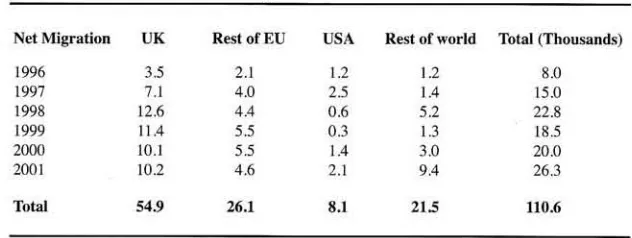
The rural migrants of the 1980s and early 1990s have been supplemented by the inflow of international migrant workers and asylum seekers. Net migration into the country has risen
from 8,000 in 1996 to 26,300 in 2000. A significant proportion of this group, who arc concentrated in the Dublin area), probably lack the capital resources to buy housing and are
largely dependent on rented accommodation. This has reinvigorated the apartment market
all over the city.
The possible transient nature of this demand in the face of lower economic or increasing
local unemployment may make suburban areas vulnerable to a down-tum and the apartment
market may again be seen as a last resort for the poorest groups.
Despite the in-migration and considerable capital subsidies, there is not a significant market demand for family apartments in either the inner or outer city. Inner-city apartment
Table 1 . Net Migration (immigrants-emigrants) by Country ofOrigin!Destination
Net Migration UK Rest ofEU USA Rest or world Total (Thousands)
19% 35 2.1 1.2 1.2 '0
1997 7.1 4.0 2' 1.4 15.0
1998 12.6 4.4 0.6 5.2 22.8
1999 11.4 55 0.3 L3 18.5
2000 to.1 55 1.4 3.0 20.0
2001 10.2 46 2.1 9.4 26.3
Total 54> 26.1 8.1 215 110.6
(Based on: Ccntral Statistics Office (2001) Popu/arion and MigrariQn ESlimates
Penniless Developers
The overall lack of demand for suburban apartments means that if the Density Guidelines are to be met, targets must be largely achieved by housing. Developing housing much above 30 to the heetare (12.5 per acre) can only be achieved by reducing amenity or increasing cost.
Amenity is reduced by providing less private or public space, covering the roads and hard areas with car parking, increasing overshadowing and reducing daylight with higher buildings.
The costs are increased by thc need to provide underground parking, hard open spaces above parking, balconies, roof spaces, more stairs and internal space in buildings, together with significantly improved finishes as the building and spaces are in more intimate contact with the general public. (This latter element is inherent in some 30 unitlhectare (12.5 per acre) schemes as front gardens disappear and roadspace is shared).
The outcome of this conllict is still playing itself out. Despite market prices of even the cheapest new suburban houses in Dublin being almost twice the construction price, developers claim that the cost of land limits their ability to invest in quality. There is no doubt that very fine high-density housing with adequate space and amenity standards could be provided if the £160,CKX.l went into the construction of the house and services and not into high land prices. Standards of space and finish have already declined in a number of suburban estates.
Suburban Networks
The young people who have resisted apartment development and have located up to 90 km. from Dublin in order to get a house probably recognise the importance of the social stability that a house provides. Its flexibility means that it is probably a lifetime purchase and may be
in a family for generations. The links with community that this stability implies mean that the future family is anchored in a suburban social network of family and friends thai reinforces this security.
[image:4.482.96.412.95.214.2]Planning Suburbia: Density Dilemmas 91
No such thing as Society
The current policy is undermining communi.ty in four ways. First, the subsidised apartment policy is facilitating transience. particularly the movement of young and old people away from their home area. For example if 20 to 30 year olds move away to the bright lights. a significant segment of the community disappears. Who are the local role models for the young? Who trains the local football team? Who organises youth activities and brings some life into the community?
Secondly. by reducing the amenity of family-housing areas below a reasonable minimum, the density policy is making family-housing areas transient; a rung on the trading-up ladder and increasing socia! segregation with each rung.
Thirdly, the reduction in amenity space is undermining traditional culture which has been based on low density, gardening, field sports, hobbies and pets. The lack of strength of this culture in some areas of the city permitted social breakdown in the late 1970s and its re-emergence in the late 1980s has significantly contributed to social stability in the poorer parts of Dublin where it has occurred.
Fourthly, by facilitating increased in-migration, the policy significantly reduces the homes available to the local community, not only where the transient groups concentrate, but in a period of housing shortage and high house prices, throughout the city. In addition, the increased labour supply depresses wage levels in the poorer areas. The lack of wage inflalion means there is no brake on the economic growth of Dublin and no incentive for significant decentralisation.
The right of speculative developers and government officials to significantly modify the culture of its poorest and weakest citizens in order to amortise the land banks and squeeze an already overdeveloped city into its inadequate infrastructure, demonstrates a breathtaking arrogance. It may however demonstrate stupidity if, as in the 1980s, the long-term social cost of the strategy makes the economic growth of the previous decade meaningless. Unfortunately the people who will have to pay will not be those who profited from the boom.
Notes
I. Brady Shipman Martin el al (1999) Strategic Planning Guidelines for the Greater Dublin Area.
Dublin Corporation el ai, Dublin, p. 88
2. Quoted in Peter Bacon and Associates (1998) An Economic Assessment of Recent House Price De~·elopments. Government of Ireland, Dublin.
3. Regional Population Projections, 2001·2031. Central Statistics Office (1S'h June 2(01). Dublin,
assume approximately 50% of nCI migration to Dublin.
References
Department of the Environment (1999) Residential Density Guidelilles, Department of the Environment, Dublin.