29
Handling Noisy Labels for Robustly Learning from Self-Training Data for
Low-Resource Sequence Labeling
Debjit Paul∗§, Mittul Singh†§, Michael A. Hedderich‡, Dietrich Klakow‡ ∗Research Training Group AIPHES, Institute for Computational Linguistics,
Heidelberg University, Germany
†Department of Signal Processing and Acoustics, Aalto University, Finland ‡Spoken Language Systems (LSV), Saarland Informatics Campus,
Saarland University, Germany
[email protected], [email protected],
{mhedderich, dietrich.klakow}@lsv.uni-saarland.de
Abstract
In this paper, we address the problem of effec-tively self-training neural networks in a low-resource setting. Self-training is frequently used to automatically increase the amount of training data. However, in a low-resource sce-nario, it is less effective due to unreliable anno-tations created using self-labeling of unlabeled data. We propose to combine self-training with noise handling on the self-labeled data. Directly estimating noise on the combined clean training set and self-labeled data can lead to corruption of the clean data and hence, per-forms worse. Thus, we propose the Clean and Noisy Label Neural Network which trains on clean and noisy self-labeled data simul-taneously by explicitly modelling clean and noisy labels separately. In our experiments on Chunking and NER, this approach performs more robustly than the baselines. Complemen-tary to this explicit approach, noise can also be handled implicitly with the help of an auxil-iary learning task. To such a complementary approach, our method is more beneficial than other baseline methods and together provides the best performance overall.
1 Introduction
For many low-resource languages or domains, only small amounts of labeled data exist. Raw or unlabeled data, on the other hand, is usually avail-able even in these scenarios. Automatic annota-tion or distant supervision techniques are an opannota-tion to obtain labels for this raw data, but they often require additional external resources like human-generated lexica which might not be available in a low-resource context. Self-training is a popu-lar technique to automatically label additional text. There, a classifier is trained on a small amount of labeled data and then used to obtain labels for
§
This work was started while the authors were at Saarland University.
unlabeled instances. However, this can lead to unreliable or noisy labels on the additional data which impede the learning process (Pechenizkiy et al., 2006; Nettleton et al., 2010). In this pa-per, we focus on overcoming this slowdown of self-training. Hence, we propose to apply noise-reduction techniques during self-training to clean the self-labeled data and learn effectively in a low-resource scenario.
Inspired by the improvements shown by the Noisy Label Neural Network (NLNN,Bekker and Goldberger(2016)), we can directly applyNLNN
to the combined set of the existing clean data and the noisy self-labeled data. However, such an ap-plication can be detrimental to the learning pro-cess (Section6). Thus, we introduce the Clean and Noisy Label Neural Network (CNLNN) that treats the clean and noisy data separately while training on them simultaneously (Section3).
This approach leads to two advantages over
NLNN (Section6and7) when evaluating on two sequence-labeling tasks, Chunking and Named Entity Recognition. Firstly, when adding noisy data, CNLNN is robust showing consistent im-provements over the regular neural network, whereas NLNN can lead to degradation in per-formance. Secondly, when combining with an indirect-noise handling technique, i.e. with an auxiliary target in a multi-task fashion, CNLNN
complements better thanNLNN in the multi-task setup and overall leads to the best performance.
2 Related Work
Self-training has been applied to various NLP tasks, e.g. Steedman et al.(2003) and Sagae and Tsujii (2007). WhileMcClosky et al.(2006) are able to leverage self-training for parsing,Charniak
respectively. In some cases, the results even dete-riorate. Other successful approaches of automati-cally labeling data include using a different classi-fier trained on out-of-domain data (Petrov et al.,
2010) or leveraging external knowledge ( Dem-bowski et al.,2017).
A detailed review of learning in the presence of noisy labels is given in (Fr´enay and Verleysen,
2014). Recently, several approaches have been proposed for modeling the noise using a confu-sion matrix in a neural network context. Many works assume that all the data is noisy-labeled (Bekker and Goldberger, 2016; Goldberger and Ben-Reuven,2017;Sukhbaatar et al.,2015). Hed-derich and Klakow (2018) and Hendrycks et al.
(2018) propose a setting where a mix of clean and unlabeled data is used. However, they require external knowledge sources for labeling the data or evaluate on synthetic noise. Alternatively, in-stances with incorrect labels might be filtered out, e.g. in the work byGuan et al.(2011) orHan et al.
(2018), but this involves the risk of also filtering out difficult but correct instances. Another orthog-onal approach is the use of noise-robust loss func-tions (Zhang and Sabuncu,2018).
3 Clean and Noisy Label Neural Network
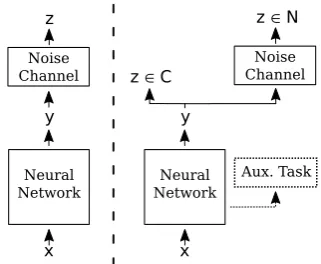
The Noisy Label Neural Network (NLNN,Bekker and Goldberger(2016)) assumes that all observed labels in the training set pass through a noise channel flipping some of them from a correct to an incorrect label (see left part of Figure 1). In our scenario, this means that both the human-annotated and the additional automatically-labeled (self-training) corpora are assumed to be noisy. In our experiments (Section 6 and 7), treating both corpora in this fashion degrades the overall per-formance. To remedy this effect, we propose to treat the human-annotated data as clean data and the self-training data as noisy.
We assume a similar setup asBekker and Gold-berger (2016), training a multi-class neural net-work soft-max classifier
p(y=i|x;w) = exp(u
T ih)
Pk
j=1exp(u T jh)
wherexis the feature vector,yis the label,w de-notes the network weights,kis the number of pos-sible labels,uare soft-max weights andh=h(x)
denotes the multi-layer neural network applied to
[image:2.595.335.496.66.198.2]x. In contrast to Bekker and Goldberger (2016), we assume that not all of the training data passes
Figure 1: A representation ofNLNN (left) compared to our proposedCNLNN model. The complementary multi-task component (aux. task) is dashed.
through a noisy channel changing the correct la-belsyto noisy ones (z∈N). A part of the training set remains clean (z∈C) such that|C|+|N| n
wherenis the total number of training examples. The clean labels are a copy of the corresponding correct labels. A schematic representation of this model is shown on the right side of Figure1. The correct labels y and the noise distribution θ are hidden for the noisy labels.
We define the probability of observing a label
z, which can either be noisy or clean and is, thus, dependent on the label’s membership toCorN:
p(z j|x, w, θ)
Pk
i 1p(z j|y i;θ)p(y i|x;w)
ifz∈N p(y j|x;w) ifz∈Ci.e.z y
Using this probability function and t to index training instances, the log-likelihood of the model parameters is defined as
L(w, θ) = X
zt∈C
logp(zt|xt, w)
+ X
zt∈N
log(
k X
i 1
(p(zt|yt i;θ)·p(yt i|xt;w))
As inBekker and Goldberger(2016) the model parameters are computed using Expectation Max-imization. In the E-step,θandware fixed and an estimatecof the true labels y is obtained for the noisy labelsz:
cti p(yt i|xt, zt;w, θ)
p(zt|yt i, θ)p(yt i|xt;w) P
jp(zt|yt j;θ)p(yt j|xt, w)
forzt∈N
0 10K 40K 90K 190K Self-trained Automatically-Labeled Data 90.5
91.0 91.5 92.0 92.5 93.0
F1
-s
co
re
91.1
90.8
91.3 91.3 91.3 91.1 91.1
91.4 91.5
91.2
91.1
91.3
91.5 91.7
92.0
91.2
91.5 91.5
91.8 91.9
91.2 91.1 91.2 91.3
92.1
91.2
91.9 91.8
92.1
92.5
Chunking NN
NLNN CNLNN MTL MTL+NLNN MTL+CNLNN
0 10K 40K 90K 190K
Self-trained Automatically-Labeled Data 44
50 55 60 64
F1
-s
co
re
45.9 47.1
53.0
54.7 54.9
45.9
48.1
53.1 54.2 54.5
45.9
49.1
57.0 57.1 57.4
51.5
57.3 58.9 58.8 58.4
51.5
58.3 58.5 59.9 58.1
51.5
59.1 60.0
61.5 62.0
[image:3.595.81.508.65.198.2]NER
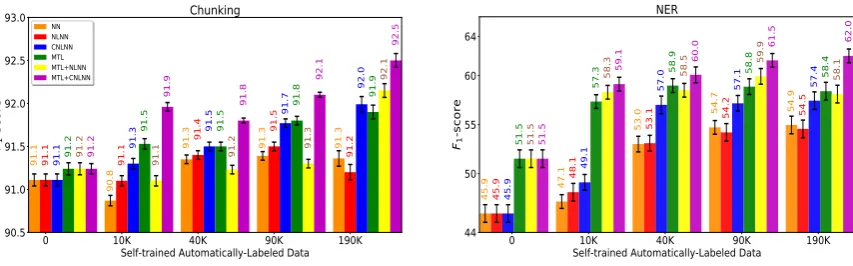
Figure 2: Micro-averaged F1-scores (averaged over five runs) on English Penn Treebank’s Chunking and
En-glish CoNLL 2003’s NER tasks of models from Section 5 are plotted (with error bars) against the amount of automatically-labeled data. 0 on thex-axis represents models trained with only the clean training set (10k tokens).
shown below.
θ(i, j) =
P
tcti1{zt=j}
P tcti
i, j∈ {1, ..., k}, zt∈N
During the M-step, the neural network weights
ware estimated as well. The loss function, how-ever, changes compared to the original approach (Bekker and Goldberger, 2016) to (1) and thus, changing the calculation of the gradient to (2):
S(w) = X
zt∈C
logp(zt|xt, w)+ X
zt∈N k X
i 1
ctilogp(yt i|xt;w)
(1) ∂S
∂ui X
zt∈C
(1{zt i}−p(zt|xt, w))h(xt)
+ X
zt∈N
(cti−p(yt|xt, w))h(xt) (2)
Interestingly, the gradient calculation (2) is a summation of two parts: one to learn from the clean labels and another to learn from the noisy labels. We refer to this model as the Clean and Noisy Label Neural Network (CNLNN).
4 Training with Noisy Labels in a Multi-Task Setup
NLNNandCNLNNform explicit ways of handling noise as the noise distribution is calculated dur-ing traindur-ing. In contrast, we can apply a Deep Multi-Task Learning (MTL) approach (Søgaard and Goldberg, 2016), which, unlike NLNN and
CNLNN, does not estimate the noise directly and thus, is an implicit noise-cleaning approach. The MTL method leverages an auxiliary task that aug-ments the data providing other reliable labels and hence, ignoring noisy labels (Ruder,2017). In our experiments, we combine the implicit noise dling of Deep MTL with the explicit noise
han-dling of NLNN andCNLNN to complement each other and obtain a more powerful noise handling model than the individual models. Schematic de-piction of combining MTL andCNLNNis shown in Figure1. MTL andNLNNcan also be combined in a similar way.
5 Experimental Setup
We evaluate CNLNN and other methods on a Chunking and a Named Entity Recognition (NER) task withF1-score as the metric in each case. For
Chunking, we use the same data splits as (Søgaard and Goldberg, 2016) based on the English Penn Treebank dataset (Marcus et al.,1993). For NER, the data splits of the English CoNLL 2003 task are used (Sang and Buchholz,2000). Note that in our NER setup, we evaluate usingBIO-2labels, soF1
-scores reported below might not be comparable to prior work.
To mimic a low resource setting, we limit each training set to the first 10k tokens. The devel-opment sets are randomly chosen sentences from the original training set restricted to 1k tokens. The test sets remain unchanged. For the rest of the training data, the original labels are removed and the words are automatically labeled using the baseline model (NN described below). We add variable amounts of this automatically-annotated data for self-training in our experiments.
5.1 Models
trained on the clean data, is used for automatically labeling the raw data (obtaining the noisy data).
NLNN combines the NN with the original noise channel (Bekker and Goldberger, 2016), training it both on clean and noisy instances. CNLNN
is our new approach of modeling noise, treating clean and noisy labels separately (section3).
In contrast to the explicit noise handling of
NLNN andCNLNN, we also apply MTLfor im-plicit noise handling. Here, we useNNas the base architecture and POS-tagging as an auxiliary task. We hypothesise that this low-level task helps the model to generalise its representation and that the POS-tags are helpful because e.g. many named entities are proper nouns. The auxiliary task is trained jointly with the first LSTM layer of NN
for Chunking and with the second LSTM layer for NER. In our low-resource setting, we use the first 10k tokens of section 0 of Penn Treebank for the auxiliary POS-tagging task for the MTL (Søgaard and Goldberg, 2016). This data is disjunct from the other datasets.
Additionally, we combine both the explicit and implicit noise handling. In the low-resource set-ting, in general, such a combination addresses the data scarcity better than the individual models.
NLNN andCNLNN combinations with MTL are labeled as MTL+NLNNandMTL+CNLNN re-spectively.
5.2 Implementation Details
During training, we minimize the cross entropy loss which sums over the entire sentence. The networks are trained with Stochastic Gradient De-scent (SGD). To determine the number of itera-tions for both the NN model and the EM algo-rithm we use the development data. All models are trained with word embeddings of dimension-ality 64 that are initialized with pre-trained Poly-got embeddings (Al-Rfou et al., 2013). We add Dropout (Srivastava et al.,2014) with p=0.1 in be-tween the word embedding layer and the LSTM.
6 Results
In Figure2, we present theF1 scores of the
mod-els introduced in the previous section. We per-form experiments on Chunking and NER with various amounts of added, automatically-labeled data. In general, adding additional, noisy data tends to improve the performance for all
mod-I-LOC I-PERI-MISCI-ORGOTHER I-LOC
I-PER I-MISC I-ORG OTHER
575 4 2 7 5
83 766 0 6 3 10 1 211 28 5 49 7 43 265 27 4 0 6 12 7153
1. Iteration
I-LOC I-PERI-MISCI-ORGOTHER I-LOC
I-PER I-MISC I-ORG OTHER
540 28 5 6 14
87 745 0 6 20 61 8 151 16 19 110 91 47 71 72 9 4 7 6 7149
3. Iteration
Predicted Label
[image:4.595.310.526.61.171.2]True Label
Figure 3: NLNN confusion matrices on Chunking’s clean training set for 1. and 3. EM iteration. The colors correspond to row-normalized values.
-2.5 -2 -1.5 -1 -0.5 0 0.5
i-advpb-prti-adjpb-adjpb-sbarb-advpi-vp b-vp b-pp b-np i-np
Δ
Pr
ecision
Chunking
MTL+CNLNN MTL+NLNN MTL
0 0.5 1 1.5 2 2.5 3
i-misc i-loc i-or g
i-per
Classes
NER
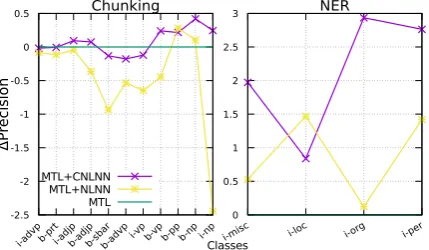
Figure 4: MTL+CNLNN vs MTL+NLNN: Difference in precision between the combined models and MTL for NER and Chunking test sets with 190K noisy data.
els. This includes the plainNN, showing that this model is somewhat robust to noise. Especially for the Chunking task, the possibility for improve-ment seems limited for NN as the performance converges after adding 40k noisy instances. In the Chunking 10k case, the negative effect of the noisy instances results in a score lower than if no data is added.
The originalNLNNmodel performs similarly to the NN model without a noise-handling compo-nent. In some cases, the score is even lower. In contrast, CNLNN is able to consistently improve over these scores. This demonstrates the impor-tance of our proposedCNLNN which treats clean and noisy data separately.
MTL is able to improve somewhat over NN
even without adding automatically-annotated data thanks to the auxiliary task. Additionally, MTL
[image:4.595.310.525.233.358.2]perfor-mance, especially on Chunking. The best results are achieved with our combined MTL+CNLNN
model as it outperforms all other models. Even when adding 19 times the amount of self-labeled data, the model is still able to cope with the noise and improve the performance.
7 Analysis
NLNN vs. CNLNN:InNLNN, we observed that clean training tokens were subverted to become noisy in subsequent EM iterations mostly due to the influence of noisy labels from self-labeled data and this effect leads to NLNN’s worse perfor-mance. Figure 3 presents one such case where the corruption of the confusion matrix from 1. iteration to 3. iteration is displayed. CNLNN
treats clean and noise data separately and there-fore avoids the corruption of clean labels.
MTL+CNLNN vs. MTL+NLNN:We noted that
MTL+CNLNNconsistently outperformsMTLand
MTL+NLNN, whereas the MTL+NLNN combi-nation can degrade MTL’s performance. For nearly all predicted labels the improvements in precision overMTLare higher forMTL+CNLNN
when compared toMTL+NLNN (Figure4). This shows thatCNLNNcomplementsMTLbetter than
NLNN.
8 Concluding Remarks
In this paper, we apply self-training to neural net-works for Chunking and NER in a low-resource setup. Adding automatically-labeled data, the per-formance of the classifier can wane or can even decline. We propose to mitigate this effect by ap-plying noisy label handling techniques.
However, we found that directly applying an off-the-shelf noise-handling technique as NLNN leads to corruption of the clean training set and worse performance. Thus, we propose the Clean and Noisy Label Neural Network to work sep-arately on the automatically-labeled data. Our model improves the performance faster for a lesser amount of additional data. Moreover, combing the training with auxiliary information can further help handle noise in a complementary fashion.
Meanwhile, more complex neural network ar-chitectures (Goldberger and Ben-Reuven, 2017;
Luo et al.,2017;Veit et al.,2017) are available for handling noise and we look forward to working with these to upgrade our approach in the future.
9 Acknowledgements
This work has been supported by the German Re-search Foundation as part of the ReRe-search Training Group Adaptive Preparation of Information from Heterogeneous Sources (AIPHES) under grant No. GRK 1994/1. We also thank the anonymous reviewers whose comments helped improve this paper.
References
Rami Al-Rfou, Bryan Perozzi, and Steven Skiena. 2013. Polyglot: Distributed word representations for multilingual NLP. InProceedings of the Seven-teenth Conference on Computational Natural Lan-guage Learning, CoNLL 2013, Sofia, Bulgaria,
Au-gust 8-9, 2013, pages 183–192.
Alan Joseph Bekker and Jacob Goldberger. 2016. Training deep neural-networks based on unreliable
labels. In Proceedings of the 2016 IEEE
Interna-tional Conference on Acoustics, Speech and Signal
Processing, pages 2682–2686.
Eugene Charniak. 1997. Statistical parsing with a
context-free grammar and word statistics. In
Pro-ceedings of the Fourteenth National Conference on Artificial Intelligence and Ninth Conference on
Innovative Applications of Artificial Intelligence,
AAAI’97/IAAI’97, pages 598–603.
Stephen Clark, James R. Curran, and Miles Osborne. 2003. Bootstrapping pos taggers using unlabelled data. InProceedings of the Seventh Conference on Natural Language Learning at HLTNAACL 2003
-Volume 4, CONLL ’03, pages 49–55.
Julia Dembowski, Michael Wiegand, and Dietrich Klakow. 2017. Language independent named en-tity recognition using distant supervision. In Pro-ceedings of Language and Technology Conference
(LTC).
Benoˆıt Fr´enay and Michel Verleysen. 2014.
Classifica-tion in the presence of label noise: A survey. IEEE
Transactions on Neural Networks and Learning Sys-tems, 25(5):845–869.
Jacob Goldberger and Ehud Ben-Reuven. 2017. Train-ing deep neural-networks usTrain-ing a noise adaptation layer. InInternational Conference on Learning
Rep-resentations (ICLR).
Donghai Guan, Weiwei Yuan, Young-Koo Lee, and Sungyoung Lee. 2011. Identifying mislabeled
train-ing data with the aid of unlabeled data. Applied
In-telligence, 35(3):345–358.
Bo Han, Quanming Yao, Xingrui Yu, Gang Niu, Miao Xu, Weihua Hu, Ivor W. Tsang, and Masashi Sugiyama. 2018. Co-teaching: Robust training of
InAdvances in Neural Information Processing Sys-tems 31: Annual Conference on Neural Informa-tion Processing Systems 2018, NeurIPS 2018, 3-8
December 2018, Montr´eal, Canada., pages 8536–
8546.
Michael A. Hedderich and Dietrich Klakow. 2018. Training a neural network in a low-resource setting
on automatically annotated noisy data. In
Proceed-ings of the Workshop on Deep Learning Approaches
for Low-Resource NLP, pages 12–18. Association
for Computational Linguistics.
Dan Hendrycks, Mantas Mazeika, Duncan Wilson, and Kevin Gimpel. 2018. Using trusted data to train
deep networks on labels corrupted by severe noise.
InAdvances in Neural Information Processing
Sys-tems 31: Annual Conference on Neural Informa-tion Processing Systems 2018, NeurIPS 2018, 3-8
December 2018, Montr´eal, Canada., pages 10477–
10486. Curran Associates, Inc.
Sepp Hochreiter and J¨urgen Schmidhuber. 1997. Long short-term memory. Neural computation, 9(8):1735–1780.
Bingfeng Luo, Yansong Feng, Zheng Wang, Zhanxing Zhu, Songfang Huang, Rui Yan, and Dongyan Zhao. 2017. Learning with noise: Enhance distantly su-pervised relation extraction with dynamic transition matrix. In Proceedings of the 55th Annual Meet-ing of the Association for Computational LMeet-inguistics
(Volume 1: Long Papers).
Mitchell P. Marcus, Mary Ann Marcinkiewicz, and Beatrice Santorini. 1993. Building a large annotated
corpus of english: The penn treebank.
Computa-tional Linguistics, 19(2):313–330.
David McClosky, Eugene Charniak, and Mark John-son. 2006. Effective self-training for parsing. In
Proceedings of the main conference on human lan-guage technology conference of the North American Chapter of the Association of Computational
Lin-guistics, pages 152–159. Association for
Computa-tional Linguistics.
David F. Nettleton, Albert Orriols-Puig, and Albert Fornells. 2010. A study of the effect of differ-ent types of noise on the precision of supervised
learning techniques. Artificial Intelligence Review,
33(4):275–306.
Mykola Pechenizkiy, Alexey Tsymbal, Seppo Puuro-nen, and Oleksandr Pechenizkiy. 2006. Class noise and supervised learning in medical domains: The
ef-fect of feature extraction. In19th IEEE Symposium
on Computer-Based Medical Systems, pages 708–
713.
Slav Petrov, Pi-Chuan Chang, Michael Ringgaard, and Hiyan Alshawi. 2010. Uptraining for accurate
de-terministic question parsing. InProceedings of the
2010 Conference on Empirical Methods in Natural
Language Processing, EMNLP ’10, pages 705–713.
Sebastian Ruder. 2017. An overview of multi-task
learning in deep neural networks. arXiv e-prints,
page arXiv:1706.05098.
Kenji Sagae and Jun’ichi Tsujii. 2007. Dependency parsing and domain adaptation with lr models and parser ensembles. InProceedings of the 2007 Joint Conference on Empirical Methods in Natural guage Processing and Computational Natural
Lan-guage Learning.
Erik F. Tjong Kim Sang and Sabine Buchholz. 2000. Introduction to the conll-2000 shared task: Chunk-ing. InProceedings of the 2nd workshop on Learn-ing language in logic and the 4th conference on
Computational natural language learning-Volume 7,
pages 127–132. Association for Computational Lin-guistics.
Anders Søgaard and Yoav Goldberg. 2016. Deep multi-task learning with low level tasks supervised at lower layers. InProceedings of the 54th Annual Meeting of the Association for Computational
Lin-guistics (Volume 2: Short Papers).
Nitish Srivastava, Geoffrey Hinton, Alex Krizhevsky, Ilya Sutskever, and Ruslan Salakhutdinov. 2014. Dropout: A simple way to prevent neural networks
from overfitting. Journal of Machine Learning
Re-search, 15:1929–1958.
Mark Steedman, Miles Osborne, Anoop Sarkar, Stephen Clark, Rebecca Hwa, Julia Hockenmaier, Paul Ruhlen, Steven Baker, and Jeremiah Crim. 2003. Bootstrapping statistical parsers from small datasets. In Proceedings of the Tenth Conference on European Chapter of the Association for
Com-putational Linguistics - Volume 1, EACL ’03, pages
331–338.
Sainbayar Sukhbaatar, Joan Bruna, Manohar Paluri, Lubomir Bourdev, and Rob Fergus. 2015. Learn-ing from noisy labels with deep neural networks. In
ICLR Workshop track.
Andreas Veit, Neil Alldrin, Gal Chechik, Ivan Krasin, Abhinav Gupta, and Serge Belongie. 2017. Learn-ing from noisy large-scale datasets with minimal
su-pervision. InProceedings of the IEEE Conference
on Computer Vision and Pattern Recognition, pages
839–847.
Zhilu Zhang and Mert R. Sabuncu. 2018. General-ized cross entropy loss for training deep neural
net-works with noisy labels. In Advances in Neural
Information Processing Systems 31: Annual Con-ference on Neural Information Processing Systems 2018, NeurIPS 2018, 3-8 December 2018, Montr´eal,