Aspect-Based Sentiment Analysis Using BERT
Mickel Hoang
Chalmers University of Technology Sweden
Oskar Alija Bihorac
Chalmers University of Technology Sweden
Jacobo Rouces
Spr˚akbanken, University of Gothenburg Sweden
Abstract
Sentiment analysis has become very popu-lar in both research and business due to the vast amount of opinionated text currently produced by Internet users. Standard sen-timent analysis deals with classifying the overall sentiment of a text, but this doesn’t include other important information such as towards which entity, topic or aspect within the text the sentiment is directed. Aspect-based sentiment analysis (ABSA) is a more complex task that consists in identifying both sentiments and aspects. This paper shows the potential of using the contextual word representations from the pre-trained language model BERT, to-gether with a fine-tuning method with ad-ditional generated text, in order to solve out-of-domain ABSA and outperform pre-vious state-of-the-art results on 2015 (task 12, subtask 2) and SemEval-2016 (task 5). To the best of our knowl-edge, no other existing work has been done on out-of-domain ABSA for aspect classification.
1 Introduction
Sentiment analysis, also known as opinion mining, is a field within natural language processing (NLP) that consists in automatically identifying the sen-timent of a text, often in categories like negative, neutral and positive. It has become a very popu-lar field in both research and industry due to the large and increasing amount of opinionated user-generated text in the Internet, for instance social media and product reviews. Knowing how users
feel or think about a certain brand, product, idea or topic is a valuable source of information for companies, organizations and researchers, but it can be a challenging task. Natural language of-ten contains ambiguity and figurative expressions that make the automated extraction of information in general very complex.
Traditional sentiment analysis focuses on clas-sifying the overall sentiment expressed in a text without specifying what the sentiment is about. This may not be enough if the text is simultane-ously referring to different topics or entities (also known as aspects), possibly expressing different sentiments towards different aspects. Identifying sentiments associated to specific aspects in a text is a more complex task known as aspect-based senti-ment analysis (ABSA).
ABSA as a research topic gained special trac-tion during SemEval-2014 (Pontiki et al., 2014) workshop, where it was first introduced as Task 4 and reappeared in the SemEval-2015 (Pontiki et al., 2015) and SemEval-2016 (Pontiki et al., 2016) workshops.
exter-nal training data, due to the pre-training of the base language model. More precisely, the contributions of this paper are as follows:
• It proposes the new ABSA task for out-of-domain classification at both sentence and text levels.
• To solve this task, a general classifier model is proposed, which uses the pre-trained lan-guage model BERT as the base for the con-textual word representations. It makes use of the sentence pair classification model (Devlin et al., 2019) to find semantic similarities be-tween a text and an aspect. This method out-performs all of the previous submissions, ex-cept for one in SemEval-2016.
• It proposes a combined model, which uses only one sentence pair classifier model from BERT to solve both aspect classification and sentiment classification simultaneously.
2 State-of-the-art
This chapter provides an overview of the tech-niques and models used throughout the rest of the paper, as well as existing state-of-the-art results.
Section 2.1 will cover the pre-trained model used in this paper, which has achieved state-of-the-art results in several NLP tasks, together with the architecture of the model and its key features. Thereafter, Section 2.2 will explain the ABSA task from SemEval-2016. Previous work with and without a pre-trained model will be briefly de-scribed in Section 2.3 and Section 2.4.
2.1 BERT
Pre-trained language models are providing a con-text to words, that have previously been learning the occurrence and representations of words from unannotated training data.
Bidirectional encoder representations from transformers (BERT) is a pre-trained language model that is designed to consider the context of a word from both left and right side simultane-ously (Devlin et al., 2019). While the concept is simple, it improves results at several NLP tasks such as sentiment analysis and question and an-swering systems. BERT can extract more con-text features from a sequence compared to train-ing left and right separately, as other models such as ELMo do (Peters et al., 2018).
The left and right pre-training of BERT is achieved using modified language model masks, called masked language model (MLM). The pur-pose of MLM is to mask a random word in a sen-tence with a small probability. When the model masks a word it replaces the word with a to-ken [MASK]. The model later tries to predict the masked word by using the context from both left and right of the masked word with the help of transformers. In addition to left and right context extraction using MLM, BERT has an additional key objective which differs from previous works, namely next-sentence prediction.
Previous work
BERT is the first deeply bidirectional and un-supervised language representation model devel-oped. There have been several other pre-trained language models before BERT that also use bidi-rectional unsupervised learning. One of them is ELMo (Peters et al., 2018), which also focuses on contextualized word representations. The word embeddings ELMo generates are produced by us-ing a Recurrent Neural Network (RNN) named Long Short-Term Memory (LSTM) (Sak et al., 2014) to train left-to-right and right-to-left inde-pendently and later concatenate both word repre-sentations (Peters et al., 2018). BERT does not utilize LSTM to get the word context features, but instead uses transformers (Vaswani et al., 2017), which are attention-based mechanisms that are not based on recurrence.
Input Representaion
Transformers
Previous work in sequence modeling used the common framework sequence-to-sequence (seq2seq) (Sutskever et al., 2014), with tech-niques such as recurrent neural networks (RNNs) (Graves, 2013) and long short-term memory (LSTM) (Hochreiter and Schmidhuber, 1997).
The architecture of transformers is not based on RNNs but on attention mechanics (Vaswani et al., 2017), which decides what sequences are impor-tant in each computational step. The encoder does not only map the input to a higher dimensional space vector, but also uses the important keywords as additional input to the decoder. This in turn im-proves the decoder because it has additional infor-mation such which sequences are important and which keywords give context to the sentence.
Sentence Pair Classifier Task
Originally, BERT pre-trained the model to obtain word embeddings to make it easier to fine-tune the model for a specific task without having to make a major change in the model and parameters. Usu-ally, only one additional output layer on top of the model was required to make the model more task-specific.
The Sentence Pair Classifier task deals with de-termining the semantic relations between two sen-tences. The model takes two texts as input, as de-scribed in Section 2.1, and outputs a label repre-senting the type of relation between the sentences. This kind of task evaluates how good a model is on comprehensive understanding of natural language and the ability to do further inference on full sen-tences (Conneau et al., 2017). There is a bench-mark that evaluates natural language understand-ing on models named general language under-standing evaluation (GLUE) (Wang et al., 2018), which consists of several tasks such as multi-genre natural language inference (MNLI) (Williams et al., 2018), the semantic textual similarity bench-mark (STS-B) (Cer et al., 2017) and Microsoft research paraphrase corpus (MRPC) (Dolan and Brockett, 2005).
Pre-training tasks
Supervised machine learning tasks are solved training a model from scratch with training data. NLP is a diversified field that contains many dis-tinct tasks for which only small sets of human-labeled training data may be available. It has been
proven that a large amount of training data in-creases the performance of deep learning models, for instance in the computer vision field with Im-ageNet (Deng et al., 2009). The same concept can be applied to deep language models. The devel-opment of a general purpose language model uses large amount of unannotated text, which is called pre-training, and the general purpose for the lan-guage model is to learn the contextual representa-tion of words.
Language Modelsare key components in solv-ing NLP problems and learn word occurrence and word prediction patterns based on unannotated text data. A language model learns the context by using techniques such as word embeddings which use vectors to represent the words in a vector space (Mikolov et al., 2013). With the large amount of training data, the language model learns that rep-resentations of words, depending on the context, allows similar words to have a similar representa-tion.
Masked Language Model BERT uses a mask token [MASK] to pre-train deep bidirectional rep-resentations for the language model. But as op-posed to conditional language models that train left-to-right or right-to-left to predict words, where the predicted word is positioned at the end or at the start of the text sequence, BERT masks a random word in the sequence. The other reason for using a mask token to pre-train is that the standard condi-tional language models are only able to explicitly train left-to-right or right-to-left because the words can indirectly “see itself” in a multi-layered con-text.
Next Sentence Prediction is used to under-stand the relationship between two text sentences. BERT has been pre-trained to predict whether or not there exists a relation between two sentences. Each of these sentences, sentence A and sentence B, has its own embedding dimensions.
Sentence A :[CLS] The man went to the store . [SEP]
Sentence B :He bought a gallon of milk . [SEP]
Label :IsNextSentence
2.2 Aspect-Based Sentiment Analysis
ABSA is a more complex task than traditional text-level sentiment analysis. It focuses on iden-tifying the attributes or aspects of an entity men-tioned in a text, together with the sentiment ex-pressed towards each aspect.
ABSA was first introduced in SemEval-2014 (Pontiki et al., 2014), which provided a dataset with annotated reviews about restaurants and lap-tops. The ABSA task in SemEval-2014 did not contain full reviews until SemEval-2015 (Pontiki et al., 2015) and the dataset for SemEval-2016 did not change from 2015 except for additional test data.
The goal of the SemEval-2016 ABSA task is to identify opinions expressed towards specific as-pect for a topic within customer reviews. Specif-ically, given a text review about a certain topic, from the dataset (e.g. laptop, restaurant), the ob-jective for SemEval-2016, the goal is to address the following tasks:
Aspect category classificationaims to identify the topic and aspect pair, which an opinion is ex-pressed in the text. The topic and aspect should be chosen from an already defined set of topic types (e.g. LAPTOP, RESTAURANT, FOOD) and as-pects (e.g. PRICE, QUALITY) per domain.
Opinion target expression(OTE) is the task of extracting the linguistic expression used in the text input that refers to the reviewed entity, for each entity-aspect pair. The OTE is defined with one starting and ending offsets in the sequence. If no entity is explicitly mentioned, the value returned is ”NULL”.
Sentiment polarity classification has the ob-jective of predicting the sentiment polarity for each identified topic and aspect pair. The senti-ment polarity is a value within the set {positive, negative, neutral, conflict}.
Subtask 1: Sentence Level. The input consists of one sentence, usually obtained from the fully text level text.
Subtask 2: Text Level. The input is a full re-view, where several aspects can be mentioned si-multaneously and also different opinions on the same aspect can be given.
2.3 ABSA without BERT
The submissions that performed best at the SemEval-2016 ABSA challenges used mostly ma-chine learning techniques such as support
vec-tor machines (SVM) (Joachims, 1998; Hsu et al., 2003) or conditional random field classifiers (Laf-ferty et al., 2001). Even though deep learning models have shown to perform well in sentiment analysis (Kim, 2014), the submissions employing deep learning techniques performed poorly that year.
The features used with the SVM were usually contextualized word representations extracted us-ing GloVe (Pennus-ington et al., 2014) or word lists, which were generated by extracting the nouns and adjectives from the datasets.
2.4 ABSA with BERT
BERT has shown to produce good results on NLP tasks (Wang et al., 2018) due to the large amounts of text it has been trained on. For tasks such as ABSA, performance has shown to improve with the help of an additional training on Review text, called Post-Training (Xu et al., 2019). To solve an ABSA task, the Post-Training paper constructed ABSA as a question answering problem, together with a machine reading comprehension technique for reviews called “review reading comprehen-sion”.
Solving ABSA as a sentence-pair classifica-tion task using BERT by constructing auxiliary sentence has been seen to improve the results, compared to the previous state-of-the-art models that used single-sentence classification (Sun et al., 2019).
3 Experiments
Sentence Level Text Level
Restaurant Laptop Both Restaurant Laptop Both
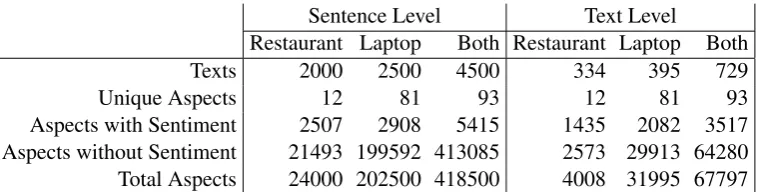
Texts 2000 2500 4500 334 395 729
Unique Aspects 12 81 93 12 81 93
[image:5.595.111.491.61.157.2]Aspects with Sentiment 2507 2908 5415 1435 2082 3517 Aspects without Sentiment 21493 199592 413085 2573 29913 64280 Total Aspects 24000 202500 418500 4008 31995 67797
Table 1: Distribution of data in each training dataset.
3.1 Pre-processing entity and aspect pairs for BERT
The format of the pairs in the SemEval-2016 dataset is originally structured in the form of ”EN-TITY#ASPECT”. In order to fit better the BERT model when training and to be able have the pre-trained data in BERT to be applicable, we for-matted it to have a sentence-like structure, so the pair ”FOOD#STYLE OPTIONS” gets parsed into ”food, style options”. This text is what we use as aspect.
3.2 Data generation
The dataset used in our experiments is reused from SemEval-2016 - Task 5 (Pontiki et al., 2016). Each sample in the dataset contains text that has been annotated with a list of aspects and sentiment po-larity which consists of ’positive’, ’neutral’, ’neg-ative’ or ’conflict’. The annotations to be gener-ated are those which have an aspect that are not related to the subject, for example, the text “The food tasted great!” and the aspect ’restaurant, am-bience’ do not have any relations.
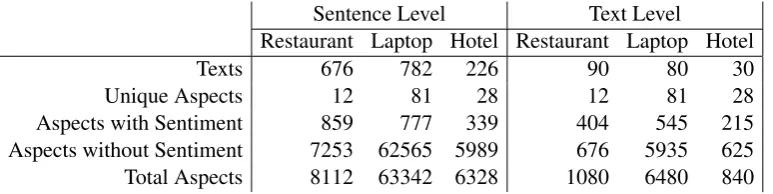
As the dataset has a fixed amount of aspects (e.g. the Restaurant dataset has 12 different unique aspects), we can assume that each aspect that has not been annotated for a specific text is unrelated to said text. The aspects, which are not related to the text will be added to the list of aspects for the text with an ’unrelated’ label instead of a senti-ment label. Table 1 and Table 6 show the distribu-tion of the original data and our generated data in the training and test dataset respectively.
Unbalanced data
The dataset from SemEval-2016 is originally very unbalanced, it becomes even more so when the un-related data is generated, as seen in aspects with-out sentiment compared to aspects with sentiment in Table 1.
To compensate for the imbalance, we weight
each label depending on how frequently they show up in the training set. The higher the frequency of a label, the lower the weight of the given label.
3.3 Sentiment Classifier
This is a model for predicting sentiment on a text, given a specific aspect. It is implemented using the architecture of the Sentence Pair classification model explained in Section 2.1, where the first put is the text to be evaluated, and the second in-put is the aspect that the text will be evaluated on. The output of this model will be one of the la-bels ‘positive’, ‘negative’, ‘neutral’ and ‘conflict’, where ‘conflict’ means that there are parts of the text where the aspect is judged positively and other parts where the aspect judged negatively.
3.4 Aspect Category Classifier
This is a model for aspect classification, with the structure of a Sentence Pair classifier described in Section 2.1, with the text and the aspect as input. This model is used to predict whether or not the aspect is related to the text or not, using labels ’re-lated’ and ’unre’re-lated’. With the aspect as input, it is possible to handle out-of-domain aspects, i.e. outside the set of aspects the model was trained on.
3.5 Combined model
This model is structured as a multi-class classifier for predicting both the aspect and the sentiment using the structure of a Sentence Pair classifica-tion, described in Section 2.1. The model also takes the text and the aspect as input and returns a sentiment label if the aspect is related to the text, and the unrelated label otherwise.
4 Evaluation
[image:6.595.311.506.61.134.2]The evaluation is based on the SemEval-2016 Task 5, more specifically the subtasks: aspect catego-rization in subtask 1 & 2, slot 1 and sentiment po-larity in subtask 1 & 2, slot 3. The results for each model implemented are presented in the tables in Table 2a to Table 5c, with the previous state-of-the-art models as baseline.
The Aspect Category Classifier, the Sentiment Classifier, and the Combined Classifier, have all been trained on each dataset described in Ta-ble 1. This results in 18 models, where each of these models have been tested on every dataset de-scribed in Table 6. However, the text-level Ho-tel dataset was generated by concatenating all the sentence-level input to a full text and labelling the text with all the aspects corresponding to the sen-tences, because the Hotel dataset only consisted of the sentence level.
For the results in the tables of this section, we only show the best performing model for model type, in-domain, out-of-domain, text-level and sentence-level model. The dataset in which these models has been tested on can be found in the de-scription of the tables.
4.1 Aspect Category Models
In this section, we evaluate how well the aspect categorization works with our models, which are described in Section 3.4 and Section 3.5. Each is trained in all the different domains and levels described in Table 1. As the performance of as-pect category classifiers is only measured with F1-score in SemEval-2016, all the result tables in this section are ordered by F1 score in descending or-der.
In the tables within this section, the ’Model’ column represents which model type it is. The combined model is defined as ’COM’ and ’ASP’ is the Aspect Category Classifier. The other two columns, Domain and Level, denote which do-main and text type it was trained on.
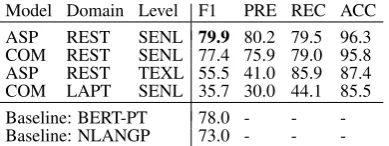
For aspect classification, the text-level datasets in Table 3 produce better results than the sentence-level datasets in Table 2. In both of these ta-bles, the aspect classifiers always outperform the combined classifiers. In out-of-scope evaluations, aspect classification performs better with classi-fiers that have been trained on datasets with more unique aspects.
Model Domain Level F1 PRE REC ACC ASP REST SENL 79.9 80.2 79.5 96.3 COM REST SENL 77.4 75.9 79.0 95.8 ASP REST TEXL 55.5 41.0 85.9 87.4 COM LAPT SENL 35.7 30.0 44.1 85.5 Baseline: BERT-PT 78.0 - -
-Baseline: NLANGP 73.0 - -
-(a) Results of Aspect models on dataset: Restau-rant, Sentence-Level. BERT-PT (Xu et al., 2019) and NLANGP (Toh and Su, 2016) as baselines
Model Domain Level F1 PRE REC ACC ASP BOTH SENL 51.7 40.7 70.6 98.4 ASP BOTH TEXL 39.0 27.5 66.7 97.5 COM BOTH SENL 38.7 25.5 80.7 96.9 ASP REST SENL 5.7 3.0 67.3 73.5
Baseline: NLANGP 51.9 - -
-(b) Results of Aspect models on dataset: Laptop, Sentence Level. With NLANGP (Toh and Su, 2016) as baseline.
Model Domain Level F1 PRE REC ACC ASP BOTH SENL 34.4 23.3 65.9 89.1 COM REST SENL 34.1 22.9 67.5 88.7 ASP LAPT TEXL 33.8 28.2 42.1 92.8
[image:6.595.311.504.279.323.2](c) Performance of Aspect models on the dataset: Hotel, Sentence-Level.
Table 2: Best performance of aspect category clas-sifiers in sentence-level datasets
Model Domain Level F1 PRE REC ACC ASP REST TEXL 85.0 84.2 85.9 88.7 COM BOTH TEXL 82.4 78.2 87.1 86.1 ASP BOTH SENL 78.8 81.9 76.0 84.7 COM LAPT TEXL 68.0 66.4 69.6 75.5
Baseline: GTI 84.0 - -
-(a) Results of Aspect models on dataset: Restaurant, Text-Level. Baseline: GTI ( ´Alvarez-L´opez et al., 2016).
Model Domain Level F1 PRE REC ACC ASP BOTH TEXL 64.3 60.9 68.1 92.3 COM BOTH TEXL 63.9 57.4 72.1 91.7 ASP LAPT SENL 61.0 58.7 64.6 91.6 COM REST SENL 21.6 12.3 87.4 37.0
Baseline: UWB 60.5 - -
-(b) Performance of Aspect models on the dataset: Laptop, Text-Level. UWB (Hercig et al., 2016) as baseline.
Model Domain Level F1 PRE REC ACC
ASP BOTH TEXL 60.8 48.3 82.0 62.8 COM LAPT TEXL 59.4 53.7 66.4 68.0 COM BOTH SENL 58.8 45.2 84.0 58.5 ASP REST SENL 56.7 45.0 76.7 58.8
(c) Results of aspect category classifiers on the dataset: Ho-tel, Text-Level
[image:6.595.311.509.449.514.2]4.2 Sentiment Models
In this section, we evaluate how well the sentiment classification performs with our models, which are described in Section 3.3 and Section 3.5. Each model trained on all the different domains and lev-els are described in Table 1. The F1 score mea-sured on the tables in this section is a weighted average of the F1 on each label. As the perfor-mance of sentiment classifiers are only measured with accuracy in SemEval-2016, all the tables in this section is ordered by accuracy in descending order.
In the tables within this section, the ’Model’ column represents which model type it is, ’COM’ is the combined model, ’SEN’ is the Sentiment Classifier. The other two columns, Domain and Level, is which domain and text type it was trained on.
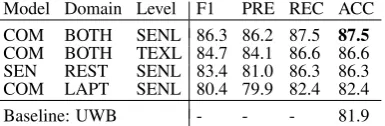
[image:7.595.312.505.62.125.2]For sentiment classification, in both Table 4 and Table 5, the combined classifiers always outper-formed the sentiment classifiers. In out-of-scope scenarios, the classifiers which have been trained on sentence-level datasets outperform the classi-fiers which have been trained on the text-level datasets.
Model Domain Level F1 PRE REC ACC COM BOTH SENL 89.5 89.5 89.8 89.8
SEN BOTH SENL 89.2 89.6 89.5 89.5 COM BOTH TEXL 83.3 84.0 84.0 84.0 SEN LAPT SENL 81.6 84.0 81.2 81.2
Baseline: XRCE - - - 88.1
(a) Performance of Sentiment models on the dataset: Restaurant, Sentence-Level. XRCE (Brun et al., 2016) as baseline.
Model Domain Level F1 PRE REC ACC COM BOTH SENL 83.2 83.6 82.8 82.8
SEN LAPT SENL 82.7 83.0 82.6 82.6 COM REST SENL 77.0 75.7 79.0 79.0 COM BOTH TEXL 76.2 76.1 76.7 76.7
Baseline: IIT-T - - - 82.8
(b) Performance of Sentiment models on the dataset: Lap-top, Sentence-Level. IIT-T (Kumar et al., 2016) as baseline.
Model Domain Level F1 PRE REC ACC COM BOTH SENL 90.0 91.0 89.5 89.5
SEN BOTH SENL 89.0 89.4 88.9 88.9 SEN REST SENL 87.0 86.9 87.3 87.3 COM LAPT SENL 86.2 86.0 87.0 87.0 COM BOTH TEXL 84.2 84.2 84.2 84.2
Baseline: lsislif - - - 85.8
[image:7.595.74.268.419.482.2](c) Performance of Sentiment models on the dataset: Hotel, Sentence-Level. Lsislif (Hamdan et al., 2015) as baseline.
Table 4: Best performance of sentiment classifiers in sentence-level datasets
Model Domain Level F1 PRE REC ACC COM BOTH SENL 86.3 86.2 87.5 87.5
COM BOTH TEXL 84.7 84.1 86.6 86.6 SEN REST SENL 83.4 81.0 86.3 86.3 COM LAPT SENL 80.4 79.9 82.4 82.4
Baseline: UWB - - - 81.9
(a) Results of aspect category classifiers on dataset: Restau-rant, Text-Level. Baseline: GTI ( ´Alvarez-L´opez et al., 2016).
Model Domain Level F1 PRE REC ACC COM BOTH SENL 79.4 80.8 78.7 78.7
COM REST SENL 75.6 73.4 78.2 78.2 SEN BOTH SENL 77.1 76.7 77.8 77.8 COM LAPT TEXL 75.1 74.4 76.7 76.7
Baseline: ECNU - - - 75.0
(b) Performance of Sentiment models on the dataset: Lap-top, Text-Level. ECNU (Jiang et al., 2016) as baseline.
Model Domain Level F1 PRE REC ACC COM BOTH SENL 86.9 86.5 87.3 87.3
COM REST SENL 85.5 84.1 87.3 87.3 COM BOTH TEXL 85.4 84.9 86.4 86.4 SEN BOTH SENL 82.5 81.6 83.8 83.8 COM LAPT SENL 82.3 81.1 83.5 83.5
(c) Performance of Sentiment models on the dataset: Hotel, Text-Level
Table 5: Best performance of sentiment classifiers in text-level datasets
5 Discussion
Our proposed out-of-domain implementation per-formed well in the out-of-domain evaluation. In aspect category for hotels in Table 3c, which our aspect models have not been introduced to before, the model achieved a higher F1 score than the in-domain baseline for laptop F1 score in Table 3b. This shows the potential of using semantic simi-larities to find features for relations between aspect and a text input. However, to compare these mod-els more in depth, a better measurement would be to look at both precision and recall, as the laptop domain has much more unique aspects, which in turn makes it more likely to predict more false pos-itives which causes a lower precision.
[image:7.595.74.267.626.701.2]Sentence Level Text Level
Restaurant Laptop Hotel Restaurant Laptop Hotel
Texts 676 782 226 90 80 30
Unique Aspects 12 81 28 12 81 28
Aspects with Sentiment 859 777 339 404 545 215
[image:8.595.108.495.62.159.2]Aspects without Sentiment 7253 62565 5989 676 5935 625 Total Aspects 8112 63342 6328 1080 6480 840
Table 6: Data distribution in test datasets.
do with the difference between the amount of unique aspects in the domains. The aspect clas-sifiers seem not to work well on the sentence-level test dataset. We suspect that the reason for this is that each sentence does not necessar-ily have enough information to validate whether an aspect is relevant for a text. A sentence-level text input example is “It wakes up super fast and is always ready to go”, which is categorized as “LAPTOP#OPERATION PERFORMANCE”. In the out-of-domain and generalized model, this sentence does not provide the necessary informa-tion to make clear that the aspect is related to the sentence and instead can be applied to a lot of other aspects from other domains.
The combined model performs consistently bet-ter than the sentiment model in all domains. We believe that the reason for this is that the combined model is trained on a vast volume of “unrelated” data compared to the sentiment model, which al-lows it to learn to ignore redundant features when predicting the sentiment. However, the combined model performs worse than the aspect model in classifying relevant aspects. We conclude that the reason for this is that the combined model has to find what is relevant, which for this model is defined by the 4 sentiment polarity labels. This increases the complexity compared to the aspect model that was trained specifically on whether or not the aspect is relevant to the text.
A possible reason for why our model improves upon previous state-of-the-art models may be that it uses BERT for the word representation and can then employ the semantic similarities in the dif-ferent word embeddings for the word, which cap-tures the context, to find sentiments for an aspect in a text. Compared to the previous best models that generate one vector for each word, BERT uses positional word embeddings to generate different word embeddings for each word, depending on its position in the text. Another possible reason is the
use of sentence-pair classification to compare the similarities of an aspect to a text instead of the pre-vious best models that used single-sentence classi-fication to determine what aspect is found in a text.
6 Conclusion
In this paper, we proposed an ABSA model that can predict the aspect related to a text for in-domain and out-of-in-domain. We achieve this by using the pre-trained language model BERT and fine-tuning it to a sentence pair classification model for the ABSA task. Moreover, we train the aspect classifier model with data that we generate, which consist of ’related’ and ’unrelated’ labels.
We further experimented with this approach for the sentiment classifier, by fine-tuning the model to find a relation between an aspect and a text and to make the model learn when the contextual rep-resentation showed a sentiment context. Further-more, we proposed a combined model that can classify both aspect and sentiment using only one sentence pair classification model. Experimental results show that the combined model outperforms previous state-of-the-art results for aspect based sentiment classification.
References
Tamara Alvarez-L´opez, Jonathan Juncal-Mart´ınez,´ Milagros Fern´andez Gavilanes, Enrique Costa-Montenegro, and Francisco Javier Gonz´alez-Casta˜no. 2016. Gti at semeval-2016 task 5: Svm and crf for aspect detection and unsu-pervised aspect-based sentiment analysis. In SemEval@NAACL-HLT.
Daniel Cer, Mona Diab, Eneko Agirre, I˜nigo Lopez-Gazpio, and Lucia Specia. 2017. SemEval-2017 task 1: Semantic textual similarity multilingual and crosslingual focused evaluation. In Proceedings of the 11th International Workshop on Semantic Evaluation (SemEval-2017), pages 1–14, Vancou-ver, Canada. Association for Computational Lin-guistics.
Alexis Conneau, Douwe Kiela, Holger Schwenk, Lo¨ıc Barrault, and Antoine Bordes. 2017. Supervised learning of universal sentence representations from natural language inference data. InProceedings of the 2017 Conference on Empirical Methods in Nat-ural Language Processing, pages 670–680, Copen-hagen, Denmark. Association for Computational Linguistics.
J. Deng, W. Dong, R. Socher, L. Li, Kai Li, and Li Fei-Fei. 2009. Imagenet: A large-scale hierarchical image database. In2009 IEEE Conference on Com-puter Vision and Pattern Recognition, pages 248– 255.
Jacob Devlin, Ming-Wei Chang, Kenton Lee, and Kristina Toutanova. 2019. BERT: Pre-training of deep bidirectional transformers for language under-standing. In Proceedings of the 2019 Conference of the North American Chapter of the Association for Computational Linguistics: Human Language Technologies, Volume 1 (Long and Short Papers), pages 4171–4186, Minneapolis, Minnesota. Associ-ation for ComputAssoci-ational Linguistics.
William B. Dolan and Chris Brockett. 2005. Automati-cally constructing a corpus of sentential paraphrases. InProceedings of the Third International Workshop on Paraphrasing (IWP2005).
Alex Graves. 2013. Generating sequences with recur-rent neural networks. CoRR, abs/1308.0850.
Hussam Hamdan, Patrice Bellot, and Frederic Bechet. 2015. Lsislif: CRF and logistic regression for opin-ion target extractopin-ion and sentiment polarity analysis. InProceedings of the 9th International Workshop on Semantic Evaluation (SemEval 2015), pages 753– 758, Denver, Colorado. Association for Computa-tional Linguistics.
Tom´aˇs Hercig, Tom´aˇs Brychc´ın, Luk´aˇs Svoboda, and Michal Konkol. 2016. UWB at SemEval-2016 task 5: Aspect based sentiment analysis. In Proceed-ings of the 10th International Workshop on Seman-tic Evaluation (SemEval-2016), pages 342–349, San Diego, California. Association for Computational Linguistics.
Sepp Hochreiter and J¨urgen Schmidhuber. 1997. Long short-term memory. Neural Comput., 9(8):1735– 1780.
Chih-Wei Hsu, Chih-Chung Chang, and Chih-Jen Lin. 2003. A practical guide to support vector classifi-cation. Technical report, Department of Computer Science, National Taiwan University.
Mengxiao Jiang, Zhihua Zhang, and Man Lan. 2016. ECNU at SemEval-2016 task 5: Extracting effec-tive features from relevant fragments in sentence for aspect-based sentiment analysis in reviews. In Pro-ceedings of the 10th International Workshop on Se-mantic Evaluation (SemEval-2016), pages 361–366, San Diego, California. Association for Computa-tional Linguistics.
Thorsten Joachims. 1998. Text categorization with support vector machines: Learning with many rel-evant features. InProceedings of the 10th European Conference on Machine Learning, ECML’98, pages 137–142, Berlin, Heidelberg. Springer-Verlag.
Yoon Kim. 2014. Convolutional neural networks for sentence classification. In Proceedings of the 2014 Conference on Empirical Methods in Natural Language Processing (EMNLP), pages 1746–1751, Doha, Qatar. Association for Computational Lin-guistics.
Ayush Kumar, Sarah Kohail, Amit Kumar, Asif Ekbal, and Chris Biemann. 2016. IIT-TUDA at SemEval-2016 task 5: Beyond sentiment lexicon: Combin-ing domain dependency and distributional seman-tics features for aspect based sentiment analysis. In Proceedings of the 10th International Workshop on Semantic Evaluation (SemEval-2016), pages 1129– 1135, San Diego, California. Association for Com-putational Linguistics.
John D. Lafferty, Andrew McCallum, and Fernando C. N. Pereira. 2001. Conditional random fields: Probabilistic models for segmenting and labeling se-quence data. InProceedings of the Eighteenth Inter-national Conference on Machine Learning, ICML ’01, pages 282–289, San Francisco, CA, USA. Mor-gan Kaufmann Publishers Inc.
Tomas Mikolov, Kai Chen, Greg Corrado, and Jeffrey Dean. 2013. Efficient estimation of word represen-tations in vector space.
Jeffrey Pennington, Richard Socher, and Christopher Manning. 2014. Glove: Global vectors for word representation. In Proceedings of the 2014 Con-ference on Empirical Methods in Natural Language Processing (EMNLP), pages 1532–1543, Doha, Qatar. Association for Computational Linguistics.
Matthew Peters, Mark Neumann, Mohit Iyyer, Matt Gardner, Christopher Clark, Kenton Lee, and Luke Zettlemoyer. 2018. Deep contextualized word rep-resentations. In Proceedings of the 2018 Confer-ence of the North American Chapter of the Associ-ation for ComputAssoci-ational Linguistics: Human Lan-guage Technologies, Volume 1 (Long Papers), pages 2227–2237, New Orleans, Louisiana. Association for Computational Linguistics.
8th international workshop on semantic evaluation (SemEval 2014), pages 27–35.
Maria Pontiki, Dimitris Galanis, Haris Papageor-giou, Ion Androutsopoulos, Suresh Manandhar, Mo-hammed AL-Smadi, Mahmoud Al-Ayyoub, Yanyan Zhao, Bing Qin, Orph´ee De Clercq, Veronique Hoste, Marianna Apidianaki, Xavier Tannier, Na-talia Loukachevitch, Evgeniy Kotelnikov, N´uria Bel, Salud Maria Jim´enez-Zafra, and G¨uls¸en Eryi˘git. 2016. Semeval-2016 task 5 : aspect based senti-ment analysis. InProceedings of the 10th Interna-tional Workshop on Semantic Evaluation (SemEval-2016), pages 19–30. Association for Computational Linguistics.
Maria Pontiki, Dimitris Galanis, Haris Papageorgiou, Suresh Manandhar, and Ion Androutsopoulos. 2015. SemEval-2015 task 12: Aspect based sentiment analysis. In Proceedings of the 9th International Workshop on Semantic Evaluation (SemEval 2015), pages 486–495, Denver, Colorado. Association for Computational Linguistics.
Hasim Sak, Andrew W. Senior, and Franoise Beaufays. 2014. Long short-term memory recurrent neural network architectures for large scale acoustic mod-eling. InINTERSPEECH, pages 338–342.
Chi Sun, Luyao Huang, and Xipeng Qiu. 2019. Uti-lizing BERT for aspect-based sentiment analysis via constructing auxiliary sentence. In Proceedings of the 2019 Conference of the North American Chap-ter of the Association for Computational Linguistics: Human Language Technologies, Volume 1 (Long and Short Papers), pages 380–385, Minneapolis, Minnesota. Association for Computational Linguis-tics.
Ilya Sutskever, Oriol Vinyals, and Quoc V. Le. 2014. Sequence to sequence learning with neural net-works. In Proceedings of the 27th International Conference on Neural Information Processing Sys-tems - Volume 2, NIPS’14, pages 3104–3112, Cam-bridge, MA, USA. MIT Press.
Zhiqiang Toh and Jian Su. 2016. NLANGP at SemEval-2016 task 5: Improving aspect based sen-timent analysis using neural network features. In Proceedings of the 10th International Workshop on Semantic Evaluation (SemEval-2016), pages 282– 288, San Diego, California. Association for Com-putational Linguistics.
Ashish Vaswani, Noam Shazeer, Niki Parmar, Jakob Uszkoreit, Llion Jones, Aidan N. Gomez, Lukasz Kaiser, and Illia Polosukhin. 2017. Attention is all you need.
Alex Wang, Amanpreet Singh, Julian Michael, Fe-lix Hill, Omer Levy, and Samuel Bowman. 2018. GLUE: A multi-task benchmark and analysis plat-form for natural language understanding. In Pro-ceedings of the 2018 EMNLP Workshop Black-boxNLP: Analyzing and Interpreting Neural
Net-works for NLP, pages 353–355, Brussels, Belgium. Association for Computational Linguistics.
Adina Williams, Nikita Nangia, and Samuel Bowman. 2018. A broad-coverage challenge corpus for sen-tence understanding through inference. In Proceed-ings of the 2018 Conference of the North American Chapter of the Association for Computational Lin-guistics: Human Language Technologies, Volume 1 (Long Papers), pages 1112–1122, New Orleans, Louisiana. Association for Computational Linguis-tics.
Yonghui Wu, Mike Schuster, Zhifeng Chen, Quoc V. Le, Mohammad Norouzi, Wolfgang Macherey, Maxim Krikun, Yuan Cao, Qin Gao, Klaus Macherey, Jeff Klingner, Apurva Shah, Melvin Johnson, Xiaobing Liu, ukasz Kaiser, Stephan Gouws, Yoshikiyo Kato, Taku Kudo, Hideto Kazawa, Keith Stevens, George Kurian, Nishant Patil, Wei Wang, Cliff Young, Jason Smith, Jason Riesa, Alex Rudnick, Oriol Vinyals, Greg Corrado, Macduff Hughes, and Jeffrey Dean. 2016. Google’s neural machine translation system: Bridging the gap between human and machine translation.