Joint Modeling of Opinion Expression Extraction
and Attribute Classification
Bishan Yang
Department of Computer Science Cornell University
Claire Cardie
Department of Computer Science Cornell University
Abstract
In this paper, we study the problems of opin-ion expressopin-ion extractopin-ion and expressopin-ion-level polarity and intensity classification. Tradi-tional fine-grained opinion analysis systems address these problems in isolation and thus cannot capture interactions among the tex-tual spans of opinion expressions and their opinion-related properties. We present two types of joint approaches that can account for such interactions during 1) both learning and inference or 2) only during inference. Exten-sive experiments on a standard dataset demon-strate that our approaches provide substantial improvements over previously published re-sults. By analyzing the results, we gain some insight into the advantages of different joint models.
1 Introduction
Automatic extraction of opinions from text has at-tracted considerable attention in recent years. In particular, significant research has focused on ex-tracting detailed information for opinions at the fine-grained level, e.g. identifying opinion expressions within a sentence and predicting phrase-level po-larity and intensity. The ability to extract fine-grained opinion information is crucial in supporting many opinion-mining applications such as opinion summarization, opinion-oriented question answer-ing and opinion retrieval.
In this paper, we focus on the problem of identi-fying opinion expressions and classiidenti-fying their at-tributes. We consider as an opinion expression
any subjective expression that explicitly or implic-itly conveys emotions, sentiment, beliefs, opinions (i.e. private states) (Wiebe et al., 2005), and con-sider two key attributes — polarity and intensity — for characterizing the opinions. Consider the sen-tence in Figure 1, for example. The phrases “a bias in favor of” and “being severely criticized” are opin-ion expressopin-ions containing positive sentiment with medium intensity and negative sentiment with high intensity, respectively.
Most existing approaches tackle the tasks of opin-ion expressopin-ion extractopin-ion and attribute classificatopin-ion in isolation. The first task is typically formulated as a sequence labeling problem, where the goal is to la-bel the boundaries of text spans that correspond to opinion expressions (Breck et al., 2007; Yang and Cardie, 2012). The second task is usually treated as a binary or multi-class classification problem (Wil-son et al., 2005; Choi and Cardie, 2008; Yessenalina and Cardie, 2011), where the goal is to assign a class label to a text fragment (e.g. a phrase or a sen-tence). Solutions to the two tasks can be applied in a pipeline architecture to extract opinion expressions and their attributes. However, pipeline systems suf-fer from error propagation: opinion expression er-rors propagate and lead to unrecoverable erer-rors in attribute classification.
Limited work has been done on the joint modeling of opinion expression extraction and attribute clas-sification. Choi and Cardie (2010) first proposed a joint sequence labeling approach to extract opion expressopions and label them with polarity and in-tensity. Their approach treats both expression ex-traction and attribute classification as token-level
He demonstrated a bias in favor ofmediumthe rebels despite being severely criticizedhigh.
Figure 1: An example sentence annotated with opinion expressions and their polarity and intensity. We use colored boxes to mark the textual spans of opinion expressions where green (red) denotes positive (negative) polarity, and use subscripts to denote intensity.
quence labeling tasks, and thus cannot model the label distribution over expressions even though the annotations are given at the expression level. Jo-hansson and Moschitti (2011) considered a pipeline of opinion extraction followed by polarity
classifica-tion and propose re-ranking itsk-best outputs using
global features. One key issue, however, is that the
approach enumerates thek-best output in a pipeline
manner and thus they do not necessarily correspond
to the k-best global decisions. Moreover, as the
number of opinion attributes grows, it is not clear
how to identify the bestkfor each attribute.
In contrast to existing approaches, we formu-late opinion expression extraction as a segmenta-tion problem and attribute classificasegmenta-tion as segment-level attribute labeling. To capture their interac-tions, we present two types of joint approaches: (1) joint learningapproaches, which combine opinion segment detection and attribute labeling into a sin-gle probabilistic model, and estimate parameters for
this joint model; and (2)joint inferenceapproaches,
which build separate models for opinion segment detection and attribute labeling at training time, and jointly apply these (via a single objective function) only at test time to identify the best “combined” de-cision of the two models.
To investigate the effectiveness of our approaches, we conducted extensive experiments on a standard corpus for fine-grained opinion analysis (the MPQA
corpus (Wiebe et al., 2005)). We found that
all of our proposed approaches provide substan-tial improvements over the previously published re-sults. We also compared our approaches to a strong pipeline baseline and observed that joint learning re-sults in a significant boost in precision while joint inference, with an appropriate objective, can signifi-cantly boost both precision and recall and obtain the best overall performance. Error analysis provides additional understanding of the differences between the joint learning and joint inference approaches, and suggests that joint inference can be more effec-tive and more efficient for the task in practice.
2 Related Work
Significant research effort has been invested in the task of fine-grained opinion analysis in recent years (Wiebe et al., 2005; Wilson et al., 2009). Wil-son et al. (2005) first motivated and studied phrase-level polarity classification on an open-domain cor-pus. Choi and Cardie (2008) developed inference rules to capture compositional effects at the lexical level on phrase-level polarity classification. Yesse-nalina and Cardie (2011) and Socher et al. (2013) learn continuous-valued phrase representations by combining the representations of words within an opinion expression and using them as features for classifying polarity and intensity. All of these ap-proaches assume the opinion expressions are avail-able before training the classifiers. However, in real-world settings, the spans of opinion expres-sions within the sentence are not available. In fact, Choi and Cardie (2008) demonstrated that the per-formance of expression-level polarity classification degrades as more surrounding (but irrelevant) con-text is considered. This motivates the additional task of identifying the spans of opinion expressions.
Opinion expression extraction has been success-fully tackled via sequence tagging methods. Breck et al. (2007) applied conditional random fields to as-sign each token a label indicating whether it belongs to an opinion expression or not. Yang and Cardie (2012) employed a segment-level sequence labeler based on semi-CRFs with rich phrase-level syntac-tic features. In this work, we also utilize semi-CRFs to model opinion expression extraction.
inter-actions at the expression-level. Johansson and Mos-chitti (2011) and Johansson and MosMos-chitti (2013) propose a joint approach to opinion expression ex-traction and polarity classification by re-ranking its
k-best output using global features. One major
is-sue with their approach is that thek-best candidates
were obtained without global reasoning about the relative uncertainty in the individual stages. As the number of considered attributes grows, it also be-comes harder to decide how many predictions to se-lect from each attribute classifier.
Compared to the existing approaches, our joint models have the advantage of modeling opinion ex-pression extraction and attribute classification at the segment-level, and more importantly, they provide a principled way of combining the segmentation and classification components.
Our work follows a long line of joint modeling re-search that has demonstrated great success for vari-ous NLP tasks (Roth and Yih, 2004; Punyakanok et al., 2004; Finkel and Manning, 2010; Rush et al., 2010; Choi et al., 2006; Yang and Cardie, 2013). Methods tend to fall into one of two joint mod-eling frameworks: the first learns a joint model that captures global dependencies; the other uses independently-learned models and considers global dependencies only during inference. In this work, we study both types of joint approaches for opinion expression extraction and opinion attribute classifi-cation.
3 Approach
In this section, we present our approaches for the joint modeling of opinion expression extraction and attribute classification. Specifically, given a sen-tence, our goal is to identify the spans of opinion expressions, and simultaneously assign their polar-ity and intenspolar-ity. Training data consists of a col-lection of sentences with manually annotated opin-ion expressopin-ion spans, each associated with a
polar-ity label that takes values from {positive, negative,
neutral}, and an intensity label, taking values from {high, medium, low}.
In the following, we first describe how we model opinion expression extraction as a segment-level se-quence labeling problem and model attribute predic-tion as a classificapredic-tion problem. Then we propose
our joint models for combining opinion segmenta-tion and attribute classificasegmenta-tion.
3.1 Opinion Expression Extraction
The problem of opinion expression extraction as-sumes tokenized sentences as input and outputs the spans of the opinion expressions in each sen-tence. Previous work has tackled this problem us-ing token-based sequence labelus-ing methods such as CRFs (e.g. Breck et al. (2007), Yang and Cardie (2012)). However, semi-Markov CRFs (Sarawagi
and Cohen, 2004) (henceforthsemi-CRF) have been
shown more appropriate for the task than CRFs since they allow contiguous spans in the input sequence (e.g. a noun phrase) to be treated as a group rather than as distinct tokens. Thus, they can easily capture segment-level information like syntactic constituent structure (Yang and Cardie, 2012). Therefore we adopt the semi-CRF model for opinion expression extraction here.
Given a sentence x, denote an opinion
seg-mentation as ys = h(s0, b0), ...,(sk, bk)i, where
the s0:k are consecutive segments that form a
segmentation of x; each segment si = (ti, ui)
consists of the positions of the start token ti and
an end token ui; and each si is associated with
a binary variable bi ∈ {I, O}, which indicates
whether it is an opinion expression (I) or not
(O). Take the sentence in Figure 1, for
exam-ple. The corresponding opinion segmentation is
ys=h((0,0), O),((1,1), O),((2,6), I),((7,8), O)
,((9,9), O),((10,12), I),((13,13), O)i, where
each segment corresponds to an opinion expression or to a phrase unit that does not express any opinion. Using a semi-Markov CRF, we model the condi-tional distribution over all possible opinion
segmen-tations given the inputx:
P(ys|x) =
exp{P|ys|
i=1θ·f(ysi, ysi−1,x)}
P
y0s∈Yexp{P|y 0
s|
i=1θ·f(y0si, ys0i−1,x)}
(1)
whereθdenotes the model parameters,ysi = (si, bi)
andfdenotes a feature function that encodes the
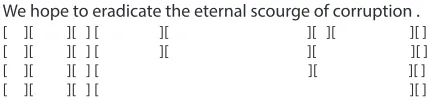
Note that the probability is normalized over all possible opinion segmentations. To reduce the train-ing complexity, we adopted the method described in Yang and Cardie (2012), which only normalizes over segment candidates that are plausible accord-ing to the parsaccord-ing structure of the sentence. Figure 2 shows some candidate segmentations generated for an example sentence. Such a technique results in a large reduction in training time and was shown to be effective for identifying opinion expressions.
The standard training objective of a semi-CRF, is to minimize the log loss
L(θ) = arg min
θ − N
X
i=1
logP(y(si)|x(i)) (2)
It penalizes any predicted opinion expression whose boundaries do not exactly align with the boundaries of the correct opinion expressions using 0-1 loss. Unfortunately, exact boundary matching is often not used as an evaluation metric for opinion expres-sion extraction since it is hard for human annota-tors to agree on the exact boundaries of opinion
ex-pressions.1 Most previous work used proportional
matching(Johansson and Moschitti, 2013) as it takes into account the overlapping proportion of the pre-dicted and the correct opinion expressions to com-pute precision and recall. To incorporate this eval-uation metric into training, we use softmax-margin
(Gimpel and Smith, 2010) that replaceP(ys(i)|x(i))
in (2) withPcost(y(si)|x(i)), which equals
exp{P|ys|
i=1θ·f(ysi, ysi−1,x)}
P
y0s∈Yexp{P|y 0
s|
i=1θ·f(ys0i, ys0i−1,x) +l(y0s,ys)}
and we define the loss functionl(y0s,ys)as
|y0
s|
X
i=1
|ys|
X
j=1
(1{b0i 6=bj∧b0i 6=O}| sj∩s0i|
|s0 i|
+1{b0i 6=bj∧bj 6=O}| sj ∩s0i|
|sj| )
which is the sum of the precision and recall errors of segment labeling using proportional matching. The loss-augmented probability is only computed during
1The inter-annotator agreement on boundaries of opinion
expressions is not stressed in MPQA (Wiebe et al., 2005).
We hope to eradicate the eternal scourge of corruption .
[image:4.612.319.533.54.104.2][ ][ ][ ] [ ][ ][ ][ ][ ] [ ][ ][ ] [ ][ ][ ][ ] [ ][ ][ ] [ ][ ][ ] [ ][ ][ ] [ ][ ]
Figure 2: Examples of Segmentation Candidates
training. The more the proposed labeled segmenta-tion overlaps with the true labeled segmentasegmenta-tion for
x, the less it will be penalized.
During inference, we can obtain the best labeled segmentation by solving
argmax
ys
P(ys|x) = argmax ys
|ys|
X
i=1
θ·f(ysi, ysi−1,x)
This can be done efficiently via dynamic program-ming:
V(t) = argmax
s=(u,t)∈s:t,y=(s,b),y0
G(y, y0)+V(u−1) (3)
wheres:t denotes all candidate segments ending at
positiontandG(y, y0) =θ·f(y, y0,x). The optimal
ys∗can be obtained by computingV(n), wherenis
the length of the sentence.
3.2 Opinion Attribute Classification
We consider two types of opinion attributes:
polar-ityand intensity. For each attribute, we model the multinomial distribution of an attribute class given a text segment Denoting the class variable for each
attribute asaj, we have
P(aj|xs) = exp{φj ·gj(a
j,xs)}
P
a0∈Ajexp{φj·gj(a0,xs)} (4)
where xs denotes a text segment, φj is a
pa-rameter vector and gj denotes feature functions
for attribute aj. The label space for polarity
classification is {positive, negative, neutral,∅}
and the label space for intensity classification is {high, medium, low,∅}. We include an empty
value ∅ to denote assigning no attribute value to
3.3 The Joint Models
We propose two types of joint models for opinion
segmentation and attribute classification: (1) joint
learning models, which train a single sequence la-beling model that maximizes a joint probability dis-tribution over segmentation and attribute labeling, and infers the most probable labeled segmentations
according to the joint probability; and (2)joint
infer-encemodels, which train a sequence labeling model
for opinion segmentation and separately train classi-fication models for attribute labeling, and combine the segmentation and classification models during inference to make global decisions. In the follow-ing, we first present the joint learning models and then introduce the joint inference models.
3.3.1 Joint Sequence Labeling
We can formulate joint opinion segmentation and classification as a sequence labeling problem on the
label space Y = {y|y = h(s0,˜b0), ...,(sk,˜bk)i}
where ˜bi = (bi, ai) ∈ {I, O} × A, where bi is
a binary variable as described before and ai is an
attribute class variable associated with segmentsi.
Since only opinion expressions should be assigned opinion attributes, we consider the following
label-ing constraints:ai =∅if and only ifbi =O.
We can apply the same training and inference pro-cedure described in Section 3.1 by replacing the
la-bel spaceyswith the joint label spacey. Note that
the feature functions are shared over the joint label space. For the loss function in the loss-augmented
objective, the opinion segment label b is also
re-placed with the augmented label˜b.
3.3.2 Hierarchical Joint Sequence Labeling
The above joint sequence labeling model does not explicitly model the dependencies between opinion segmentation and attribute labeling. The two sub-tasks share the same set of features and parameters. In the following, we introduce an alternative ap-proach that explicitly models the conditional depen-dency between opinion segmentation and attribute labeling, and allows segmentation- and attribute-specific parameters to be jointly learned in one sin-gle model.
Note that the joint label space naturally forms a hierarchical structure: the probability of
choos-ing a sequence label y can be interpreted as the
probability of first choosing an opinion segmenta-tion ys = h(s0, b0), ...,(sk, bk)i given the inputx,
and then choose a sequence of attribute labelsya=
ha0, ..., akigiven the chosen segment sequence.
Fol-lowing this intuition, the joint probability can be de-composed as
P(y|x) =P(ys|x)P(ya|ys,x)
whereP(ys|x)is modeled as Equation (1) and
P(ya|ys,x) = |ys|
Y
i=1
P(ai|ysi,x)
∝exp{
|ys|
X
i=1
φ·g(ai, ysi,x)}
where g denotes a feature function that encodes
attribute-specific information for discriminating dif-ferent attribute classes for each segment.
For training, we can also apply a softmax-margin
by adding a loss functionl(y0,y)to the denominator
ofP(y|x) (as in the basic joint sequence labeling
model described in Section 3.3.1).
With the estimated parameters, we can infer the optimal opinion segmentation and attribute labeling by solving
argmax
ys,ya
P(ys|x)P(ya|ys,x)
We can apply a similar dynamic programming
pro-cedure by replaceing y in Equation (3) with y =
(s, b, a)andG(y, y0)withθ·f(y, y0,x)+φ·g(y,x). Our decomposition of labels and features is sim-ilar to the hierarchical construction of CRF features in Choi and Cardie (2010). The difference is that our model is based on semi-CRFs and the decompo-sition is based on a joint probability. We will show that this results in better performance than the meth-ods in Choi and Cardie (2010) in our experiments.
3.3.3 Joint Inference
each segment. Thus, we also investigate joint in-ference approaches which combine the separately-trained models during inference without computing the normalization term.
For opinion segmentation, we train a semi-CRF-based model using the approach described in Sec-tion 1. For attribute classificaSec-tion, we train a
Max-Ent model by maximizingP(aj|x
s)in Equation (4).
As we only need to estimate the probability of an attribute label given individual text segments, the training data can be constructed by collecting a list of text segments labeled with correct attribute labels. The text segments do not need to form all possible sentence segmentations. To construct such training examples, we collected from each sentence all opin-ion expressopin-ions labeled with their corresponding at-tributes and use the remaining text segments as ex-amples for the empty attribute value. The training of the MaxEnt model is much more efficient than the training of the segmentation model.
Joint Inference with Probability-based Esti-matesTo combine the separately-trained models at inference time, a natural inference objective is to jointly maximize the probability of opinion segmen-tation and the probability of attribute labeling given the chosen segmentation
argmax
ys,ya
P(ys|x)P0(ya|ys,x) (5)
We approximate the conditional probability as
P0(ya|ys,x) = |ys|
Y
i=1
P(ai|xsi)
α (6)
where α ∈ (0,1]. We found thatα < 1 provides
better performance thanα = 1empirically. This is
an approximation since the distribution of attribute labeling is estimated independently from the opinion segmentation during training.
Joint Inference with Loss-based Estimates In-stead of directly using the output probabilities of the attribute classifiers, we explore an alternative that
es-timatesP0(ya|ys,x)based on the prediction
uncer-tainty:
P0(ya|ys,x)∝exp(−α |ys|
X
i=1
U(ai|xsi)) (7)
whereU(ai|xsi)is a uncertainty function that
mea-sures the classification model’s uncertainty in its
as-signment of attribute class ai to segment xsi.
In-tuitively, we want to penalize attribute assignments that are uncertain or favor attribute assignments with low uncertainty. The prediction uncertainty is mea-sured using the expected loss. The expected loss for
a predicted labela0can be written as
Ea|xsi[l(a, a0)] =X
a
P(a|xsi)l(a, a0)
where l(a, a0) is a loss function over a0 and the
true label a. We used the standard 0-1 loss
func-tion in our experiments2 and set U(a
i|xsi) = log(Ea|x
si[l(a, ai)]).
Both joint inference objectives can be solved effi-ciently via dynamic programming.
4 Features
We consider a set of basic features as well as task-specific features for opinion segmentation and at-tribute labeling, respectively.
4.1 Basic Features
Unigrams: word unigrams and POS tag unigrams for all tokens in the segment candidate.
Bigrams: word bigrams and POS bigrams within the segment candidate.
Phrase embeddings: for each segment candidate,
we associate with it a300-dimensional phrase
em-bedding as a dense feature representation for the seg-ment. We make use of the recently published word embeddings trained on Google News (Mikolov et al., 2013). For each segment, we compute the av-erage of the word embedding vectors that comprise the phrase. We omit words that are not found in the vocabulary. If no words are found in the text seg-ment, we assign a feature vector of zeros.
Opinion lexicon: For each word in the segment can-didate, we include its polarity and intensity as indi-cated in an existing Subjectivity Lexicon (Wilson et al., 2005).
2The loss function can be tuned to better tradeoff precision
4.2 Segmentation-specific Features
Boundary words and POS tags: word-level fea-tures (words, POS, lexicon) before and after the seg-ment candidate.
Phrase structure: the syntactic categories of the deepest constituents that cover the segment in the parse tree, e.g. NP, VP, TO VB.
VP patterns: VP-related syntactic patterns de-scribed in Yang and Cardie (2012), e.g. VPsubj, VParg, which have been shown useful for opinion expression extraction.
4.3 Polarity-specific Features
Polarity count: counts of positive, negative and neutral words within the segment candidate accord-ing to the opinion lexicon.
Negation: indicator for negators within the segment candidate.
4.4 Intensity-specific Features
Intensity count: counts of words with strong and weak intensity within the segment candidate accord-ing to the opinion lexicon.
Intensity dictionary: As suggested in Choi and Cardie (2010), we include features indicat-ing whether the segment contains an intensifier (e.g. highly, really), a diminisher (e.g. little, less), a strong modal verb (e.g. must, will), and a weak modal verb (e.g. may, could).
5 Experiments
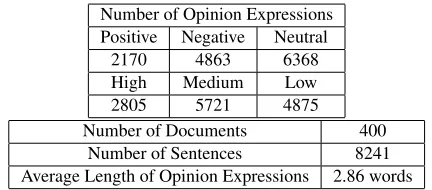
All our experiments were conducted on the MPQA corpus (Wiebe et al., 2005), a widely used corpus for fine-grained opinion analysis. We used the same evaluation setting as in Choi and Cardie (2010), where 135 documents were used for development and 10-fold cross-validation was performed on a dif-ferent set of 400 documents. Each training fold con-sists of sentences labeled with opinion expression boundaries and each expression is labeled with po-larity and intensity. Table 1 shows some statistics of the evaluation data.
We used precision, recall and F1 as evaluation metrics for opinion extraction and computed them
using bothproportional matchingandbinary
match-ing criteria. Proportional matchingconsiders the
overlapping proportion of a predicted expression s
and a gold standard expression s∗, and computes
precision asPs∈SPs∗∈S∗ |s∩s
∗|
|s| /|S| and recall as
P
s∈S
P
s∗∈S∗ |s∩s ∗|
|s∗| /|S∗|, where S andS∗ denote the set of predicted opinion expressions and the set
of correct opinion expressions, respectively. Binary
matchingis a more relaxed metric that considers a predicted opinion expression to be correct if it over-laps with a correct opinion expression.
We experimented with the following models:
(1) PIPELINE: first extracts the spans of opinion
expressions using the semi-CRF model in Section 3.1, and then assigns polarity and intensity to the ex-tracted opinion expressions using MaxEnt models in Section 3.2. Note that the label space of the MaxEnt
models does not include ∅since they assume that
all the opinion expressions extracted by the previous stage are correct.
(2) JSL: the joint sequence labeling method de-scribed in Section 3.3.1.
(3) HJSL: the hierarchical joint sequence labeling method described in Section 3.3.2.
(4) JI-PROB: the joint inference method using
probability-based estimates (Equation 6).
(5) JI-LOSS: the joint inference method using
loss-based estimates (Equation 7).
We also compare our results with previously pub-lished results from Choi and Cardie (2010) on the same task.
All our models are log linear models. We use L-BFGS with L2 regularization for training and set the
regularization parameter to 1.0. We set the scaling
parameterαin JI-PROBand JI-LOSSvia grid search
over values between 0.1 and1 with increments of
0.1using the development set.
We consider the same set of features described in Section 4 in all the models. For the pipeline and joint inference models where the opinion segmen-tator and attribute classifiers are separately trained, we employ basic features plus segmentation-specific features in the opinion segmentator; and employ ba-sic features plus attribute-specific features in the at-tribute classifiers.
5.1 Results
Loss-Number of Opinion Expressions
Positive Negative Neutral
2170 4863 6368
High Medium Low
2805 5721 4875
Number of Documents 400
Number of Sentences 8241
[image:8.612.77.293.53.148.2]Average Length of Opinion Expressions 2.86 words
Table 1: Statistics of the evaluation corpus
augmented training can be applied to the training of the opinion segmentation model used in the pipeline method and the joint inference methods, or be ap-plied to the training of the joint sequence labeling approaches, JSL and HJSL (the loss function takes into account both the span overlap and the match-ing of attribute values). We evaluate two versions of each method: one uses loss-augmented training and one uses standard log-loss training. Table 2 shows the results of opinion expression detection without evaluating their attributes. Similar trends can be ob-served in the results of opinion expression detection with respect to each attribute. We can see that in-corporating the evaluation-metric-based loss func-tion during training consistently improves the per-formance for all models in terms of F1 measure. This confirms the effectiveness of loss-augmented training of our sequence models for opinion extrac-tion. As a result, all following results are based on the loss-augmented version of our models.
Comparing the results of different models in
Ta-ble 2, we can see that PIPELINE provides a strong
baseline. In comparison, JSL and HJSL signifi-cantly improve precision but fail in recall, which indicates that joint sequence labeling is more con-servative and precision-biased for extracting opinion expressions. HJSL significantly outperforms JSL, and this confirms the benefit of modeling the con-ditional dependency between opinion segmentation and attribute classification. In addition, we see that combining opinion segmentation and attribute
clas-sification without joint training (JI-PROB and
JI-LOSS) hurt precision but improves recall (vs. JSL
and HJSL). JI-LOSS presents the best F1
perfor-mance and significantly outperforms the PIPELINE
baseline in all evaluation metrics. This suggests that
JI-LOSSprovides an effective joint inference
objec-tive and is able to provide more balanced precision and recall than other joint approaches.
Table 3 shows the performance on opinion extrac-tion with respect to polarity and intensity attributes.
Similarly, we can see that JI-LOSS outperforms all
other baselines in F1; HJSL outperforms JSL but
is slightly worse than PIPELINE in F1; JI-PROB is
recall-oriented and less effective than JI-LOSS.
We hypothesize that the worse performance of joint sequence labeling is due to its strong assump-tion on the dependencies between opinion segmen-tation and attribute labeling in the training data. For example, the expression “fundamentally unfair and unjust” as a whole is labeled as an opinion ex-pression with negative polarity. However, the sub-expression “unjust” can be also viewed as a nega-tive expression but it is not annotated as an opinion expression in this example (as MPQA does not con-sider nested opinion expressions). As a result, the model would wrongly prefer an empty attribute to the expression “unjust”. However, in our joint in-ference approaches, the attribute classification mod-els are trained independently from the segmentation model, and the training examples for the classifiers only consist of correctly labeled expressions (“un-just” as a nested opinion expression in this example would not be considered in the training data for the attribute classifier). Therefore, the joint inference approaches do not suffer from this issue. Although joint inference does not account for task dependen-cies during training, the promising performance of
JI-LOSS demonstrates that modeling label
depen-dencies during inference can be more effective than
thePIPELINEbaseline.
In Table 3, we can see that the improvement of
JI-LOSS is less significant in thepositiveclass and the
highclass. This is due to the lack of training data in
these classes. The improvement in themediumclass
is also less significant. This may be because it is
in-herently harder to disambiguate mediumfromlow.
eval-Loss-augmented Training Standard Training
P R F1 P R F1
PIPELINE 60.96 63.29 62.10 60.05 60.59 60.32
JSL 64.98† 54.60 59.29 67.09† 50.56 57.62
HJSL 66.16∗ 56.77 61.05 67.98† 50.81 58.11
JI-PROB 50.95 77.44∗ 61.32 50.06 76.98∗ 60.54
[image:9.612.171.442.53.137.2]JI-LOSS 63.77† 64.51† 64.04∗ 64.97† 61.55† 63.12∗
Table 2: Opinion Expression Extraction (Proportional Matching). In all tables, we useboldto indicate the
highest score among all the methods; use∗to indicate statistically significant improvements (p<0.05) over
all the other methods under the paired-t test; use†to denote statistically significance (p<0.05) over the
pipeline baseline.
Positive Negative Neutral
P R F1 P R F1 P R F1
PIPELINE 45.26 43.07 44.04 50.59 47.91 49.11 40.98 49.30 44.57
JSL 50.58† 32.34 39.37 50.22 44.01 46.81 46.83† 39.81 42.85
HJSL 50.34† 37.06 42.59 53.29† 43.98 48.07 47.29† 43.27 45.03
JI-PROB 36.47 47.81∗ 41.24 40.83 54.40∗ 46.51 33.59 59.22∗ 42.66
JI-LOSS 46.44† 44.58† 45.40∗ 54.88∗ 48.50 51.40∗ 43.42† 52.02† 47.09∗
High Medium Low
P R F1 P R F1 P R F1
PIPELINE 40.98 28.10 33.25 35.44 44.72 39.36 31.19 34.46 32.63
JSL 37.91 30.83† 33.88 39.07† 37.31 38.05 40.95† 26.71 32.24
HJSL 41.05 28.80 33.63 39.06† 39.71 39.17 40.01† 29.88 34.12
JI-PROB 34.82 30.94† 32.54 29.16 50.89∗ 36.89 25.06 42.99∗ 31.53
JI-LOSS 46.11∗ 26.36 33.39 37.58† 43.58 40.15∗ 33.85† 40.92† 36.93∗
Table 3: Opinion Extraction with Correct Attributes (Proportional Matching)
uation metric. CRF-JSL and CRF-HJSL are both joint sequence labeling methods based on CRFs. Different from JSL and HJSL, they perform se-quence labeling at the token level instead of the seg-ment level, and in HJSL, the decomposition of la-bels are not based on the decomposition of the joint probability of opinion segmentation and attribute la-beling. We can see that both the pipeline and joint methods clearly outperform previous results in all
evaluation criteria.3 We can also see that JI-LOSS
provides the best performance among all baselines.
5.1.1 Error Analysis
Joint vs. Pipeline We found that many errors made by the pipeline system are due to error prop-agation. Table 5 lists three examples, representing three types of the propagated errors:(1) the attribute classifiers miss the prediction since the opinion
ex-3Significance test was not conducted over the results in Choi
and Cardie (2010) as we do not have their 10 fold results.
pression extractor fails to identify the opinion ex-pression; (2) the attribute classifiers assign attributes to a non-opinionated expression since it was mistak-enly extracted; (3) the attribute classifiers misclas-sify the attributes since the boundaries of opinion ex-pressions are not correctly determined by the opin-ion expressopin-ion extractor. Our joint models are able to correct many of these errors, such as the examples in Table 5, due to the modeling of the dependency between opinion expression extraction and attribute classification.
Joint Learning vs. Joint Inference Note that JSL and HJSL both employ joint learning while
JI-PROB and JI-LOSS employ joint inference. To
in-vestigate the difference between these two types of joint models, we look into the errors made by HJSL
and JI-LOSS. In general, we observed that HJSL
ex-tracts many fewer opinion expressions compared to
JI-LOSS, and as a result, it presents high precision
[image:9.612.118.493.215.378.2]Extraction Positive Negative Neutral High Medium Low
PIPELINE 73.30 51.50 58.45 52.45 39.34 47.08 39.05
JSL 69.76 45.24 57.11 50.25 41.48† 45.88 36.49
HJSL 71.43 49.08 58.38 52.25 41.06† 46.82 38.45
JI-PROB 74.37† 50.93 58.20 54.03† 39.80 46.65 40.73†
JI-LOSS 75.11∗ 53.02∗ 62.01∗ 54.33† 41.79† 47.38 42.53∗
Previous work (Choi and Cardie (2010))
CRF-JSL 60.5 41.9 50.3 41.2 38.4 37.6 28.0
[image:10.612.132.481.53.159.2]CRF-HJSL 62.0 43.1 52.8 43.1 36.3 40.9 30.7
Table 4: Opinion Extraction Results (Binary Matching)
Example Sentences Pipeline Joint Models
It is the victim of an explosive situationhighat the
eco-nomic, ... No opinions× X
A white farmer who was shot dead Monday was the
10th to be killed. the 10th to be killedmedium × X
They would “ fall below minimum standardsmedium for
humanemediumtreatment”.
minimum standards for humane
[image:10.612.99.510.197.280.2]treatmentmedium× X
Table 5: Examples of mistakes made by the pipeline baseline that are corrected by the joint models
are cases where HJSL gains in precision and loses in recall, respectively. The last example in Table 6 shows an error made by HJSL but corrected by
JI-LOSS. Theoretically, joint learning is more powerful
than joint inference as it models the task dependen-cies during training. However, we only observe im-provements on precision and see drops in recall. As discussed before, we hypothesize that this is due to the mismatch of dependency assumptions between the model and the jointly annotated data. We found that joint inference can be superior to both pipeline and joint learning, and it is also much more efficient in training. In our experiments on an Amazon EC2 instance with 64-bit processor, 4 CPUs and 15GB memory, training for the joint learning approaches took one hour for each training fold, but only 5 min-utes for the joint inference approaches.
5.2 Additional Experiments 5.2.1 Evaluation with Reranking
Previous work (Johansson and Moschitti, 2011) showed that reranking is effective in improving the pipeline of opinion expression extraction and polar-ity classification. We extended their approach to handle both polarity and intensity and investigated the effect of reranking on both the pipeline and joint
models. For the pipeline model, we generated64
-best (distinct) output with 4-best labeling at each
pipeline stage; for the joint models, we generated
50-best (distinct) output using Viterbi-like dynamic
programming. We trained the reranker using the on-line PassiveAggressive algorithm (Crammer et al., 2006) as in Johansson and Moschitti (2013) with
100 iterations and a regularization constant C =
0.01. For features, we included the probability
out-put by the base models, the polarity and intensity of each pair of extracted opinion expressions, and the word sequence and the POS sequence between the adjacent pairs of extracted opinion expressions.
Table 7 shows the reranking performance (F1) for all subtasks. We can see that after reranking,
JI-LOSSstill provides the best performance and HJSL
achieves comparable performance to PIPELINE. We
also found that reranking leads to less performance gain for the joint inference approaches than for the
joint learning approaches. This is because thek-best
output of JI-PROB and JI-LOSS present less
diver-sity than JSL and HJSL. A similar issue for rerank-ing has also been discussed in Finkel et al. (2006).
5.2.2 Evaluation on Sentence-level Tasks
stan-Example Sentences JointLearn JointInfer
The expression is undoubtedly strong and well
thought outhigh. X well thought outmedium×
But the Sadc Ministerial Task Force said the election
was free and fairmedium. No opinions× X
The president brandedhighas the “axis of evil”highin
his statement ... of evilhigh× X
Table 6: Examples of mistakes that are made by the joint learning model but are corrected by the joint inference model and vice versa. We use the same colored box notation as before, and use yellow color to denote neutral sentiment.
Extraction Positive Negative Neutral High Medium Low
PIPELINE+ reranking 73.72 51.45 60.51 53.24 40.07 47.65 40.47
JSL + reranking 72.02 47.52 59.81 52.84 41.04† 46.58 39.40
HJSL + reranking 72.60 50.78 60.85 53.45 41.04† 47.75 40.08
JI-PROB+ reranking 74.81† 51.45 59.59 53.98 40.66 46.87 40.80
[image:11.612.92.518.53.139.2]JI-LOSS+ reranking 75.59† 53.29∗ 62.50∗ 54.94∗ 41.79∗ 47.67 42.66∗
Table 7: Opinion Extraction with Reranking (Binary Matching)
Features Acc Positive Negative Neutral
BOW 65.26 51.90 77.47 36.41
PIPELINE-OP 67.41 55.49 79.42 39.48
JSL-OP 65.86 55.97 77.68 36.46
HJSL-OP 66.79 55.12 79.29 37.56
JI-PROB-OP 67.13 56.49 79.30 38.49
JI-LOSS-OP 68.23∗ 57.32∗ 80.12∗ 40.45∗
Table 8: Sentence-level Sentiment Classification
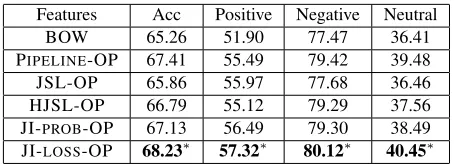
dard baseline, we train a MaxEnt classifier using unigrams, bigrams and opinion lexicon features ex-tracted from the sentence. Using the prediction out-put of an opinion extraction model, we construct fea-tures by using only words from the extracted opinion expressions, and include the predicted opinion at-tributes as additional features. We hypothesize that the more informative the extracted opinion expres-sions are, the more they can contribute to sentence-level sentiment classification as features. Table 8 shows the results in terms of classification accuracy and F1 score in each sentiment category. BOW is the standard MaxEnt baseline. We can see that us-ing features constructed from the opinion
expres-sionsalwaysimproved the performance. This
con-firms the informativeness of the extracted opinion expressions. In particular, using the opinion
expres-sions extracted by JI-LOSS gives the best
perfor-mance among all the baselines in all evaluation crite-ria. This is consistent with its superior performance in our previous experiments.
6 Conclusion
We address the problem of opinion expression ex-traction and opinion attribute classification by pre-senting two types of joint models: joint learning, which optimizes the parameters of different sub-tasks in a joint probabilistic framework; joint infer-ence, which optimizes the separately-trained mod-els jointly during inference time. We show that our models achieve substantially better performance than the previously published results, and demon-strate that joint inference with an appropriate objec-tive can be more effecobjec-tive and efficient than joint learning for the task. We also demonstrate the use-fulness of output of our systems for sentence-level sentiment analysis tasks. For future work, we plan to improve joint modeling for the task by capturing semantic relations among different opinion expres-sions.
Acknowledgement
[image:11.612.115.496.205.276.2] [image:11.612.71.298.321.404.2]References
E. Breck, Y. Choi, and C. Cardie. 2007. Identifying ex-pressions of opinion in context. InProceedings of the international joint conference on Artifical intelligence. Yejin Choi and Claire Cardie. 2008. Learning with com-positional semantics as structural inference for subsen-tential sentiment analysis. InProceedings of the Con-ference on Empirical Methods in Natural Language Processing.
Yejin Choi and Claire Cardie. 2010. Hierarchical se-quential learning for extracting opinions and their at-tributes. InProceedings of the Annual Meeting of the Association for Computational Linguistics - Short Pa-pers.
Yejin Choi, Eric Breck, and Claire Cardie. 2006. Joint extraction of entities and relations for opinion recog-nition. InProceedings of the Conference on Empirical Methods in Natural Language Processing.
Koby Crammer, Ofer Dekel, Joseph Keshet, Shai Shalev-Shwartz, and Yoram Singer. 2006. Online passive-aggressive algorithms. The Journal of Machine Learn-ing Research, 7:551–585.
Jenny Rose Finkel and Christopher D Manning. 2010. Hierarchical joint learning: Improving joint parsing and named entity recognition with non-jointly labeled data. InProceedings of the Annual Meeting of the As-sociation for Computational Linguistics.
Jenny Rose Finkel, Christopher D Manning, and An-drew Y Ng. 2006. Solving the problem of cascading errors: Approximate bayesian inference for linguistic annotation pipelines. In Proceedings of the Confer-ence on Empirical Methods in Natural Language Pro-cessing.
Kevin Gimpel and Noah A Smith. 2010. Softmax-margin crfs: Training log-linear models with cost functions. InHuman Language Technologies: Confer-ence of the North American Chapter of the Association for Computational Linguistics.
Richard Johansson and Alessandro Moschitti. 2011. Ex-tracting opinion expressions and their polarities: ex-ploration of pipelines and joint models. In Proceed-ings of the Association for Computational Linguistics: Human Language Technologies: short papers. Richard Johansson and Alessandro Moschitti. 2013.
Relational features in fine-grained opinion analysis. Computational Linguistics, 39(3):473–509.
Tomas Mikolov, Ilya Sutskever, Kai Chen, Greg S Cor-rado, and Jeff Dean. 2013. Distributed representations of words and phrases and their compositionality. In Advances in Neural Information Processing Systems. V. Punyakanok, D. Roth, W. Yih, and D. Zimak. 2004.
Semantic role labeling via integer linear programming
inference. InProceedings of the international confer-ence on Computational Linguistics.
D. Roth and W. Yih. 2004.A linear programming formu-lation for global inference in natural language tasks. Alexander M Rush, David Sontag, Michael Collins, and
Tommi Jaakkola. 2010. On dual decomposition and linear programming relaxations for natural language processing. InProceedings of the Conference on Em-pirical Methods in Natural Language Processing. Sunita Sarawagi and William W Cohen. 2004.
Semi-markov conditional random fields for information ex-traction. InAdvances in Neural Information Process-ing Systems.
Richard Socher, Alex Perelygin, Jean Y Wu, Jason Chuang, Christopher D Manning, Andrew Y Ng, and Christopher Potts. 2013. Recursive deep models for semantic compositionality over a sentiment treebank. InProceedings of the Conference on Empirical Meth-ods in Natural Language Processing.
J. Wiebe, T. Wilson, and C. Cardie. 2005. Annotating ex-pressions of opinions and emotions in language. Lan-guage Resources and Evaluation, 39(2):165–210. Theresa Wilson, Janyce Wiebe, and Paul Hoffmann.
2005. Recognizing contextual polarity in phrase-level sentiment analysis. InProceedings of the conference on human language technology and empirical methods in natural language processing.
Theresa Wilson, Janyce Wiebe, and Paul Hoffmann. 2009. Recognizing contextual polarity: An explo-ration of features for phrase-level sentiment analysis. Computational linguistics, 35(3):399–433.
Bishan Yang and Claire Cardie. 2012. Extracting opin-ion expressopin-ions with semi-markov conditopin-ional random fields. InProceedings of the Joint Conference on Em-pirical Methods in Natural Language Processing and Computational Natural Language Learning.
Bishan Yang and Claire Cardie. 2013. Joint inference for fine-grained opinion extraction. InProceedings of the Annual Meeting of the Association for Computational Linguistics.
Ainur Yessenalina and Claire Cardie. 2011. Composi-tional matrix-space models for sentiment analysis. In Proceedings of the Conference on Empirical Methods in Natural Language Processing.