1155
DUTH at SemEval-2019 Task 8:
Part-Of-Speech Features for Question Classification
Anastasios Bairaktaris Symeon Symeonidis Avi Arampatzis
Database and Information Retrieval research unit, Department of Electrical and Computer Engineering, Democritus University of Thrace, Xanthi 67100, Greece
{anasbair1,ssymeoni,avi}@ee.duth.gr
Abstract
This report describes the methods employed by the Democritus University of Thrace (DUTH) team for participating in SemEval-2019 Task 8: Fact Checking in Commu-nity Question Answering Forums. Our team dealt only with Subtask A: Question Classi-fication. Our approach was based on shal-low natural language processing (NLP) pre-processing techniques to reduce noise in data, feature selection methods, and supervised ma-chine learning algorithms such as NearestCen-troid, Perceptron, and LinearSVC. To deter-mine the essential features, we were aided by exploratory data analysis and visualizations. In order to improve classification accuracy, we developed a customized list of stopwords, re-taining some opinion- and fact-denoting com-mon function words which would have been removed by standard stoplisting. Furthermore, we examined the usefulness of part-of-speech (POS) categories for the task; by trying to re-move nouns and adjectives, we found some ev-idence that verbs are a valuable POS category for the opinion-oriented question class.
1 Introduction
The significance of Community Question Answer-ing (CQA) forums has risen in the past years. Such forums represent a modern need for infor-mation that comes with the abundance of online sources and the needs of millions of people for answers. Popular forums like StackOverflow, Ya-hoo! Answers, and Answers.com provide plat-forms for general or specific questions in a wide range of topics by users’ and also a community-based model for user interaction.
The large numbers of questions and answers lo-cated in these forums generate many opportuni-ties for information retrieval and data mining ap-plications, such as query-intent detection, opinion mining, fake news classification, etc. (Tsur et al.,
2016; Jo et al., 2018; Sethi, 2017). More ad-vanced applications do not only aim at analyzing opinions but—by categorizing the feelings of the Q&As—they may be able to detect inappropriate content such as hate speech and act accordingly (Karadzhov et al.,2017;Baly et al.,2018).
The SemEval Task 8, Fact Checking in Com-munity Forums, aims to determine whether the answers that are provided for a question in a fo-rum are true or false. While answers to fact-oriented questions can be deemed true or false, opinion-oriented and socializing questions evoke answers for which a true/false categorization does not make much sense. As a result, determining the question type is a necessary first step. Conse-quently, the subtask A of SemEval Task 8 has the goal of classifying questions in three categories: opinion, factual, or socializing.
The rest of this report is structured as follows. Section2reviews some previous studies for CQA classification. Section 3 describes our system, while Section4 presents experiments and results. Conclusions are summarized in Section5.
2 Related Work
In recent years, plenty of research work examined the problem of classifying texts of CQA forums. Some related work which we found useful or in-spiring are mentioned below.
Mihaylova et al. (2018) proposed a novel ap-proach based on multi-faceted modeling of facts, which integrates knowledge from several comple-mentary sources, such as the answer content (what is said and how), the author profile (who says it), the remainder of the community forum (where it is said), and external authoritative sources of in-formation (external support).
se-lection on the development of a question classi-fier was by Huang et al. (2008). They demon-strated the importance of using the wh-word (what, which, when) in question classification. Such words are commonly disregarded and used in stopwords lists. Our approach is also trying to use features such as imperative verbs that indicate an opinion.
The SemEval-2015 Task 3, Answer Selection in Community Question Answering, targeted to classify comments in a thread as relevant, poten-tially useful, or bad, concerning the thread ques-tion (Nakov et al.,2015). This task encouraged so-lutions for the question classification problem that involved semantic or complex linguistic informa-tion.
Finally, (Mihaylova et al.,2016;Baldwin et al., 2016;Franco-Salvador et al.,2016) participated in subtasks A, B, and C at SemEval-2016 Task 3 that involved tasks for Question-Comment Similar-ity, Question SimilarSimilar-ity, and Question-External Comment Similarity. They proposed classification models and provided results that highlighted the importance of lexical and semantic features.
The aforementioned studies help to identify ‘gaps’ in this research topic and ways to attempt new and different approaches for question classifi-cation.
3 System Description
In this section, we give the details of our ques-tion classificaques-tion model, applied pre-processing techniques, as well as some statistics and visual-izations for the dataset of the task.
3.1 Dataset
The organizers provided the dataset in an XML format. The given training set consisted of 1,118 questions for Subtask A that were selected from the Qatar Living forum.
We used Python’s Element Tree library to parse and isolate specific content from the XML. The in-teresting tags to select were RelQBody (the ques-tion) and RELQ FACT LABEL (labeled question by organizers).
Before pre-processing, an exploratory data analysis gives us the opportunity to better under-stand the dataset. Because we will develop a mul-tipurpose model that classifies not only the opinion but fact and socializing questions, it is helpful to
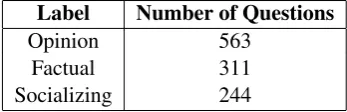
understand in depth the character of the questions. A way to understand the contents of the forum is to examine Table1where almost 50% of the ques-tions are opinion oriented. Also, Figure1presents the most common words in opinion questions.
Label Number of Questions
Opinion 563
Factual 311
[image:2.595.329.503.143.199.2]Socializing 244
[image:2.595.308.534.273.351.2]Table 1: Question types in the dataset
Figure 1: Most common words in opinion questions
3.2 Pre-processing
To reduce the noise of the text, based on the re-sults ofSymeonidis et al. (2018), we applied the following pre-processing:
• Remove Numbers
• Remove Punctuation
• Remove Symbols
• Lowercase
• Replace all URL addresses, normalizing them to ‘URL’
Figure 2 shows the most frequent words on the dataset as a wordcloud.
The final steps of pre-processing are tokeniza-tion and stemming. A basic process in NLP is to identify tokens or those basic units which need not be decomposed in subsequent processing.
Figure 2: Wordcloud of frequent words
We used Python’s SpaCy1 library to tokenize the text and convert it to lemmas. This function also removes symbols (or punctuation) such as ‘[’,‘...’,‘-’.
Stopwords are frequent words that appear in the text, but they can have an impact on retrieval ef-ficacy. The removal of stopwords also modifies the document length and subsequently affects the weighting process and efficiency during process-ing of the collection (Kwok,1998).
For our task, we found out that the most commonly-used stopword lists contain words that can be helpful. For example, the word ‘believe’ is included in most stopword lists. While it is a ubiquitous word, it may also indicate an opin-ion; therefore, it can be useful for our purpose. In order to tackle this problem, we made a custom stopword list that only removes pronouns such as ‘i’,‘he’,‘she’, etc. NLTK’s2 list of English stop-words used as guideline and contained 127 stop-words. Although there is an abundance of stopwords lists that contain even more words we used a small one on purpose. We wanted to eliminate words from our dataset that would not bear any signif-icance in our task. The next step, based on the vocabulary of the dataset, was to manually find words that could help us identify whether the ques-tion is opinion oriented, factual, or socializing. We excluded, from the NLTK’s stopword list, words such as ‘believe’, ‘think’, ‘mean’, ‘consider’, and others. Our final revised stopword list consists of 50 words.
4 Experiments
This section summarizes our experiments in the context of SemEval 2019 Task 8 Subtask A. Be-yond our officially submitted runs, we present
1
https://spacy.io 2https://www.nltk.org/
some additional experiments that although they did not perform very well, there seems to be a promising room for improvement in the future.
4.1 Machine Learning Methods
For the training of our classifiers, we used Python’s Scikit-Learn library (Pedregosa et al., 2011). We split the dataset into 749 training ques-tions and 369 testing quesques-tions, i.e. a typical 2/3– 1/3 split (ratio 2:1). After the split, the questions in the training set were shuffled for training. With the classsklearn.pipeline, we performed a sequence of different transformations and param-eters.
Vectorizer: We compared three common vec-torizers such as CountVectorizer, HashingVector-izer, and TfidfVectorizer. Finally, our selection was the TfidfVectorizer since it yielded the best results when it comes to accuracy. The TfidfVec-torizer converts a collection of raw documents to a matrix of tf-idf weighted features.
Classifiers: We experimented with various classifiers, and decided to use the following three since they yielded the best accuracy results.
• NearestCentroid: Each class is represented by its centroid, with test samples classified to the class with the nearest centroid.
• Perceptron: It is a simple and efficient al-gorithm to fit linear models, and suitable for very large numbers of features.
• LinearSVC: An SVM algorithm which tries to find a set of hyperplanes that separate space into areas representing the classes. The hyperplanes are chosen in a way to maximize the distance from the nearest data point of each class.
4.2 Results
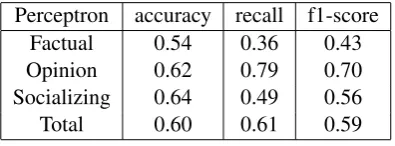
The official run that we submitted for the compe-tition proved to be the most successful. In the fol-lowing tables, we present the produced test results by using the three different classifiers, the Tfid-fVectorizer, and the custom stopword list. The re-sults are shown in Tables2,3, and4. We can ob-serve that the most accurate classifier overall is the NearestCentroid.
LinearSVC accuracy recall f1-score
Factual 0.60 0.40 0.48
Opinion 0.62 0.82 0.70
Socializing 0.75 0.53 0.62
[image:4.595.83.286.61.133.2]Total 0.64 0.64 0.62
Table 2: Test results with LinearSVC
NearestCentroid accuracy recall f1-score
Factual 0.63 0.49 0.55
Opinion 0.71 0.76 0.73
Socializing 0.70 0.77 0.73
Total 0.68 0.69 0.68
Table 3: Test results with NearestCentroid
classification techniques have considered adjec-tives, adverbs, and nouns as features. The use-fulness of part-of-speech categories in text clas-sification was investigated as early as in (Aram-patzis et al., 2000), where it was found that a traditional keyword-based indexing set can be re-duced to retain only its nouns and adjectives with-out hurting effectiveness, even slightly improving it. Nevertheless, the aforementioned work was on topic classification; later, Karamibekr and Ghor-bani(2012) showed that verbs are vital in classify-ing opinion terms, particularly in social domains.
We conducted two experiments by removing ei-ther nouns or adjectives from our dataset to help our classifiers adjust mostly on verbs. We can ob-serve, in Tables 5and6, that classifiers achieved a better accuracy score when it comes to opin-ion as opposed to fact and socializing questopin-ions. Nevertheless, by removing either nouns or adjec-tives, there is an overall drop in effectiveness in all classes. Thus, there is evidence that verbs are a useful part-of-speech category for opinion classi-fication, but they are not sufficient by themselves.
Our official submission to the competition ranked our team to the 16th place from 22 teams.
Perceptron accuracy recall f1-score
Factual 0.54 0.36 0.43
Opinion 0.62 0.79 0.70
Socializing 0.64 0.49 0.56
[image:4.595.304.527.62.132.2]Total 0.60 0.61 0.59
Table 4: Test results with Perceptron
NearestCentroid accuracy recall f1-score
Factual 0.52 0.42 0.46
Opinion 0.68 0.66 0.67
Socializing 0.56 0.72 0.63
Total 0.61 0.61 0.60
Table 5: Test results without Nouns
NearestCentroid accuracy recall f1-score
Factual 0.51 0.40 0.45
Opinion 0.66 0.65 0.66
Socializing 0.53 0.69 0.60
Total 0.59 0.59 0.59
Table 6: Test results without Adjectives
The results of our model are shown in Table7.
Accuracy F1 AverageRecall
0.71 0.56 0.60
Table 7: Official Results - Use of NearestCentroid
5 Conclusions
We presented a supervised learning model for classifying questions from online Q&A forums in three categories: factual, opinion, and socializing. We used standard pre-processing techniques, and made a custom stopword list to tackle the specific task at hand. Using standard classification meth-ods, we achieved satisfactory and promising re-sults. We also tried to use verb-oriented feature sets for classification which although they pro-vided mixed results it seems that they can be im-proved.
References
Avi Arampatzis, Th.P. van der Weide, C.H.A. Koster, and P. van Bommel. 2000. An evaluation of linguistically-motivated indexing schemes. In Pro-ceedings of the 22nd BCS-IRSG Colloquium on IR Research, pages 34–45.
Timothy Baldwin, Huizhi Liang, Bahar Salehi, Doris Hoogeveen, Yitong Li, and Long Duong. 2016.
Unimelb at semeval-2016 task 3: Identifying similar questions by combining a CNN with string similar-ity measures. In (Bethard et al.,2016), pages 851– 856.
[image:4.595.83.281.666.739.2]2018.Integrating stance detection and fact checking in a unified corpus.CoRR, abs/1804.08012.
Steven Bethard, Daniel M. Cer, Marine Carpuat, David Jurgens, Preslav Nakov, and Torsten Zesch, editors. 2016. Proceedings of the 10th International Work-shop on Semantic Evaluation,
SemEval@NAACL-HLT 2016, San Diego, CA, USA, June 16-17, 2016.
The Association for Computer Linguistics.
Marc Franco-Salvador, Sudipta Kar, Thamar Solorio, and Paolo Rosso. 2016. UH-PRHLT at semeval-2016 task 3: Combining lexical and semantic-based features for community question answering. In (Bethard et al.,2016), pages 814–821.
Zhiheng Huang, Marcus Thint, and Zengchang Qin. 2008. Question classification using head words and their hypernyms. In2008 Conference on Empirical Methods in Natural Language Processing, EMNLP 2008, Proceedings of the Conference, 25-27 October 2008, Honolulu, Hawaii, USA, A meeting of SIG-DAT, a Special Interest Group of the ACL, pages 927–936. ACL.
Saehan Jo, Immanuel Trummer, Weicheng Yu, Daniel Liu, and Niyati Mehta. 2018. The factchecker: Ver-ifying text summaries of relational data sets. CoRR, abs/1804.07686.
Georgi Karadzhov, Preslav Nakov, Llu´ıs M`arquez, Alberto Barr´on-Cede˜no, and Ivan Koychev. 2017.
Fully automated fact checking using external sources.CoRR, abs/1710.00341.
Mostafa Karamibekr and Ali A. Ghorbani. 2012.
Verb oriented sentiment classification. In 2012 IEEE/WIC/ACM International Conferences on Web Intelligence, WI 2012, Macau, China, December 4-7, 2012, pages 327–331. IEEE Computer Society.
K. L. Kwok. 1998. Book review: Information storage and retrieval by r. r. korfhage. Inf. Process. Manage., 34(4):490–492.
Chenghua Lin and Yulan He. 2009. Joint senti-ment/topic model for sentiment analysis. In Pro-ceedings of the 18th ACM Conference on Infor-mation and Knowledge Management, CIKM 2009, Hong Kong, China, November 2-6, 2009, pages 375–384. ACM.
Tsvetomila Mihaylova, Pepa Gencheva, Martin Boy-anov, Ivana Yovcheva, Todor Mihaylov, Momchil Hardalov, Yasen Kiprov, Daniel Balchev, Ivan Koy-chev, Preslav Nakov, Ivelina Nikolova, and Galia Angelova. 2016. Super team at semeval-2016 task 3: Building a feature-rich system for community ques-tion answering. In (Bethard et al.,2016), pages 836– 843.
Tsvetomila Mihaylova, Preslav Nakov, Llu´ıs M`arquez, Alberto Barr´on-Cede˜no, Mitra Mohtarami, Georgi Karadzhov, and James R. Glass. 2018. Fact check-ing in community forums. In Proceedings of the
Thirty-Second AAAI Conference on Artificial Intelli-gence, (AAAI-18), the 30th innovative Applications of Artificial Intelligence (IAAI-18), and the 8th AAAI Symposium on Educational Advances in Artificial Intelligence (EAAI-18), New Orleans, Louisiana, USA, February 2-7, 2018, pages 5309–5316. AAAI Press.
Preslav Nakov, Llu´ıs M`arquez, Walid Magdy, Alessan-dro Moschitti, Jim Glass, and Bilal Randeree. 2015.
Semeval-2015 task 3: Answer selection in com-munity question answering. In Proceedings of the 9th International Workshop on Semantic Evalua-tion, SemEval@NAACL-HLT 2015, Denver, Col-orado, USA, June 4-5, 2015, pages 269–281. The Association for Computer Linguistics.
Fabian Pedregosa, Ga¨el Varoquaux, Alexandre Gram-fort, Vincent Michel, Bertrand Thirion, Olivier Grisel, Mathieu Blondel, Peter Prettenhofer, Ron Weiss, Vincent Dubourg, Jake VanderPlas, Alexan-dre Passos, David Cournapeau, Matthieu Brucher, Matthieu Perrot, and Edouard Duchesnay. 2011.
Scikit-learn: Machine learning in python. Journal of Machine Learning Research, 12:2825–2830.
Ricky J. Sethi. 2017. Crowdsourcing the verification of fake news and alternative facts. InProceedings of the 28th ACM Conference on Hypertext and Social Media, HT 2017, Prague, Czech Republic, July 4-7, 2017, pages 315–316. ACM.
Symeon Symeonidis, Dimitrios Effrosynidis, and Avi Arampatzis. 2018.A comparative evaluation of pre-processing techniques and their interactions for twit-ter sentiment analysis. Expert Syst. Appl., 110:298– 310.
Gilad Tsur, Yuval Pinter, Idan Szpektor, and David Carmel. 2016. Identifying web queries with ques-tion intent. InProceedings of the 25th International Conference on World Wide Web, WWW 2016, Mon-treal, Canada, April 11 - 15, 2016, pages 783–793. ACM.