840
Team Bertha von Suttner at SemEval-2019 Task 4: Hyperpartisan News
Detection using ELMo Sentence Representation Convolutional Network
Ye Jiang, Johann Petrak, Xingyi Song, Kalina Bontcheva, Diana Maynard Department of Computer Science
University of Sheffield Sheffield , UK
{yjiang18,johann.petrak,x.song, k.bontcheva,d.maynard}@sheffield.ac.uk
Abstract
This paper describes the participation of team “bertha-von-suttner” in the SemEval2019 task 4 Hyperpartisan News Detection task. Our system1 uses sentence representations from averaged word embeddings generated from the pre-trained ELMo model with Convolutional Neural Networks and Batch Normalization for predicting hyperpartisan news. The final dictions were generated from the averaged pre-dictions of an ensemble of models. With this architecture, our system ranked in first place, based on accuracy, the official scoring metric.
1 Introduction
Hyperpartisan news is typically defined as news which exhibits an extremely biased opinion in favour of one side, or unreasoning allegiance to one party (Potthast et al., 2017). SemEval-2019 Task 4 on “Hyperpartisan News Detection” (Kiesel et al.,2019) is a document-level classifica-tion task which requires building a precise and re-liable algorithm to automatically discriminate hy-perpartisan news from more balanced stories.
One of the major challenges of this task is that the model must have the ability to adapt to a large range of article sizes. In one of the training data sets, the by-publisher corpus, the average article length is 796 tokens, but the longest document has 93,714 tokens. Most state-of-the-art neural net-work approaches for document classification use a token sequence as network input (Kim,2014;Yin and Sch¨utze, 2016; Conneau et al., 2016). This implies either a high computational cost when a very large maximum sequence length is used to fully represent the longest articles, or alternatively potentially a significant loss of information if the
1The code is available at
https://github.com/GateNLP/semeval2019-hyperpartisan-bertha-von-suttner
sequence length is restricted to a manageable num-ber of initial tokens from the document.
In this paper, we introduce theELMoSentence
Representation Convolutional (ESRC) Network. We first pre-calculate sentence level embeddings as the average of ELMo (Peters et al.,2018) word embeddings for each sentence, and represent the document as a sequence of such sentence embed-dings. We then apply a lightweight convolutional Neural Network (CNN), along with Batch Nor-malization (BN), to learn the document represen-tations and predict the hyperpartisan classification. Two types of data set have been made avail-able for the task. The by-publisher corpus con-tains 750K articles which were automatically clas-sified based on a categorization of the political bias of the news source. This dataset was split into a training set of 600K articles and a validation set of 150K articles, where all the articles in the valida-tion set originated from sources not in the training set. The second set, by-article, contains just 645 articles which were labelled manually. The final evaluation (Potthast et al., 2019) was carried out on a dataset of 628 articles which were also la-belled manually.
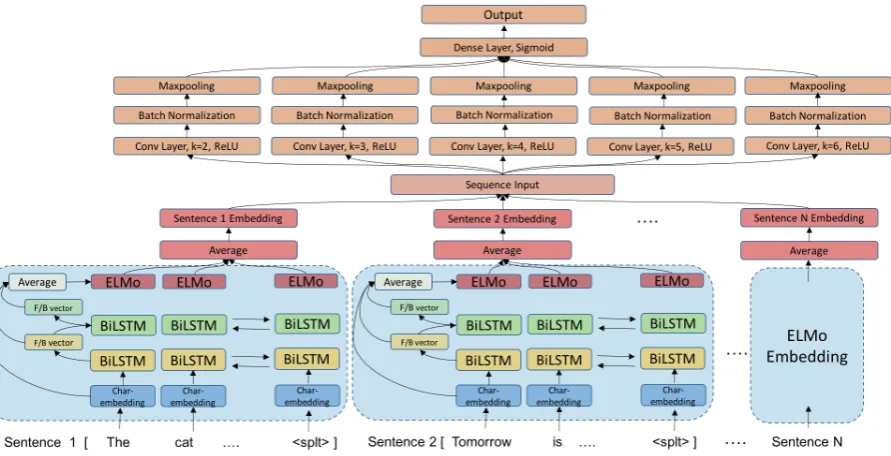
Figure 1: System architecture,F/B vectordenotes Forward/Backward hidden state from BiLSTM layers.
turned out to outperform all other attempts.
2 System Description
In our model, we represent each article as a sequence of sentence embeddings, where each sentence embedding is calculated as the aver-aged word embeddings generated from a pre-trained ELMO model. The network consists of 5 parallel convolutional layers with kernel sizes 2,3,4,5,6 and 512 output features, each followed by a ReLU non-linearity, batch normalization, and max-pooling. All the results of the max-pooling layers are combined and go through a final fully connected layer with a sigmoid activation function for the final binary classification. Our model ar-chitecture is shown in Figure1.
2.1 Data
The maximum, mean, and minimum numbers of tokens in theby-articlecorpus are: 6470, 666, 19 respectively, and in the by-publisher are: 93714, 796, 10 respectively. This makes it impractical to directly use word level representations as the in-put for our models. As a simple and easy to cal-culate compromise between representing the de-tails of the article and as much of a longer article as possible, we represent the article as a sequence of sentence embeddings which are calculated as the average of the word embeddings of a sentence. This can be done using any pre-trained word em-beddings and does not require a large training set
for training or pre-training, so can be easily ap-plied to even the smallby-articlecorpus. To form the input sequence for our network, a maximum of the 200 initial tokens per sentence was used for each sentence embedding and a maximum of 200 sentences was used per article. The title of the ar-ticle was used as the first arar-ticle sentence for each document.
2.2 Preprocessing
Our model is character-based, which enabled us to only perform minimal pre-processing. We extract the title and article text from the original XML representation. All the original HTML paragraphs in the text cause a sentence break; the remain-ing text paragraphs have been split into sentences using Spacy. The original case of the text was maintained.
Whitespace is normalized to a single space be-tween tokens; numbers are replaced by a special number token; and all punctuation and other spe-cial characters are preserved as input to the pre-trained ELMo model.
2.3 Deep Contextualized Word Representation
embeddings, in which the word representation is learned from character-based units as well as con-textual information from the news articles. These character-based word representations allow our model to pick up on morphological features that word-level embeddings could miss, and a valid word representation can be formed even for out-of-vocabulary words. Furthermore, ELMo uses two bi-directional LSTM (Gers et al., 1999) lay-ers to learn the contextual information from the text, which makes it capable of disambiguating the same word into different representations based on its context.
We use the original2 pre-trained ELMo model to output three vectors for each word. Each vec-tor corresponds to a layer output from the ELMo pre-trained model. Then, we take the average of all three vectors to form the final word vector, and compute the sentence vector by averaging the word vectors in the sentence.
2.4 Convolutional Layers
We combine 5 convolutional layers for different kernel sizes. Each layer is then followed by a non-linear activation function ReLU.
2.5 Batch Normalization
Batch Normalization (BN) is a method for re-ducing internal covariate shift in neural networks (Ioffe and Szegedy, 2015). BN normalizes the input distribution by subtracting the batch mean and dividing by the batch standard deviation, so that the ranges of input distribution between each layer stay the same. This allows the model to have a higher learning rate, so that the training speed is accelerated. It also reduces overfitting by de-creasing the dependence of weight initialization between each layer. The original paper suggested that BN should be applied before the activation layer, but we apply it after the activation layer, af-ter observing betaf-ter performance in our model this way round. We also applied weighted moving-mean and moving-variance to avoid updating the mean and variance so aggressively in the mini-batch during training time.
2.6 Fully Connected Layer
We perform max-pooling on the output of the batch-normalization layers. Then the outputs of the max-pooling for all convolution layers are
2elmo_2x4096_512_2048cnn_2xhighway
combined to form the input to a fully connected layer, which maps to a single output, followed by the Sigmoid function for the binary classification task.
3 Experiments and Results
The generated ELMo embedding contains three vectors for each word, where each vector corre-sponds to one of the output layers from the pre-trained model. We average the three vectors to generate word representations which contain mor-phological and contextual information, and com-pute the sentence vectors by averaging all the word vectors in each sentence. We take a maximum of 200 words for each sentence and a maximum of 200 sentences for each article. If a document has fewer than 200 sentences, we pad the number of sentences out to 200.
Our models are built by using the Keras library with a Tensorflow backend. All the results are shown in Table1. The table shows for each model the accuracy obtained on the by-article training set, and for the submitted models, theby-publisher test set, and the hidden by-articletest set (which unlike the other two, was not available to partici-pants).
In order to investigate the correlation be-tween the two datasets, we first built the
ESRC-publishermodel which is trained on a
randomly selected 100K out of the 750K articles from theby-publisher corpus, as it is impractical to generate ELMo embeddings for the entire cor-pus. We also fine-tuned theESRC-publisher
model based on the by-article set to obtain the
ESRC-publisher-articlemodel by
freez-ing the weights of all but the last layer of the model. Finally we trained theESRC-article
model only on theby-articleset, one version with-out and one version (ESRC-article-BN) with the additional batch normalization (BN) layer. The accuracy for the ERC-publisher model is from evaluating on the whole by-article
training set, while all other evaluations on the
by-articletraining set were carried out using
a 10-fold cross validation. However, because of the very limited size of that corpus, the evaluation part of each fold was also used for early stopping and model selection within each fold.
each fold to form an averaged ensemble model,
ESRC-article-BN-Ens.
For comparison, the table also shows the results for an earlier version of the model,
GloVe-article, which used GloVe word
em-beddings (6 billion words, 300 dimensional) to represent up to the first 400 words of the article and did not use batch normalization.
Models By-Article Training
GloVe-article 0.7963
ESRC-publisher 0.5643
ESRC-publisher-article 0.8189
ESRC-article 0.8182
ESRC-article-BN 0.8387
ESRC-article-BN-Ens 0.8404
Submitted Models By-Article Test
GloVe-article 0.7659
ESRC-article-BN-Ens 0.8216
Submitted Models By-Publisher Test
GloVe-article 0.6435
ESRC-article-BN-Ens 0.5947
Table 1: System comparison (accuracy).
The parameters in our models are as follows: we used 5 convolutional layers with kernel sizes (k = 2,3,4,5,6) and 512 output features. The momentum in the batch normalization is set to 0.7.3 We used the default Adam algorithm as the optimizer, and Binary Cross-Entropy as the loss function. The batch size was set to 32 and the fixed number of epochs used was 30. The final best model after 30 epochs was used.
4 Discussion and Conclusion
The ESRC-publisher model performs
ex-tremely badly on the by-article evaluation data. Even fine-tuning the ESRC-publisher model on the by-article corpus produces models which perform worse than a model that is trained only on theby-articledata. This confirms results from ear-lier experiments with simpler models that any use of theby-publisherdata only hurts the model. We assume that the algorithm used for assigning the labels to this dataset just does not reflect any infor-mation about hyperpartisan articles sufficiently to be helpful. For this reason, theGloVe-article
3This was determined by exploring values from 0.1 to 0.9 at an earlier stage of the experiments and kept, so it may not be the optimal value.
model also outperforms the ESRC-article-BN-Ens model on the by-publisher dataset.
A quick manual inspection of the data showed that the source of an article is insufficient by far to identify articles as hyperpartisan or not. It would be interesting to know how the algorithm used for creating theby-publishercorpus actually performs on theby-articlecorpus. To get maximum perfor-mance on theby-articledataset, we therefore de-cided to completely ignore theby-publisher data for our final model. The use of BN also showed significant improvement.
Since we use a CNN with a comparatively large number of parameters in relation to the size of the training set which is rather small, we expect significant variance in the generated models and therefore use the average of an ensemble of sev-eral models for the final predictions.
5 Acknowledgements
Research partially supported by a Grantham Cen-tre for Sustainable Future Scholarship, a Google Faculty Research Award 2017, and projects funded by the European Commissions Horizon 2020 research and innovation programme under grant agreements No. 654024 SoBigData and No. 825297 WeVerify.
References
Piotr Bojanowski, Edouard Grave, Armand Joulin, and Tomas Mikolov. 2017. Enriching word vectors with subword information. Transactions of the Associa-tion for ComputaAssocia-tional Linguistics, 5:135–146.
Alexis Conneau, Holger Schwenk, Lo¨ıc Barrault, and Yann Lecun. 2016. Very deep convolutional networks for text classification. arXiv preprint arXiv:1606.01781.
Felix A Gers, J¨urgen Schmidhuber, and Fred Cummins. 1999. Learning to forget: Continual prediction with lstm.
Sergey Ioffe and Christian Szegedy. 2015. Batch nor-malization: Accelerating deep network training by reducing internal covariate shift. arXiv preprint arXiv:1502.03167.
Johannes Kiesel, Maria Mestre, Rishabh Shukla, Em-manuel Vincent, Payam Adineh, David Corney, Benno Stein, and Martin Potthast. 2019. SemEval-2019 Task 4: Hyperpartisan News Detection. In
Yoon Kim. 2014. Convolutional neural net-works for sentence classification. arXiv preprint arXiv:1408.5882.
Tomas Mikolov, Ilya Sutskever, Kai Chen, Greg S Cor-rado, and Jeff Dean. 2013. Distributed representa-tions of words and phrases and their compositional-ity. InAdvances in neural information processing systems, pages 3111–3119.
Jeffrey Pennington, Richard Socher, and Christopher Manning. 2014. Glove: Global vectors for word representation. InProceedings of the 2014 confer-ence on empirical methods in natural language pro-cessing (EMNLP), pages 1532–1543.
Matthew E Peters, Mark Neumann, Mohit Iyyer, Matt Gardner, Christopher Clark, Kenton Lee, and Luke Zettlemoyer. 2018. Deep contextualized word rep-resentations. arXiv preprint arXiv:1802.05365.
Martin Potthast, Tim Gollub, Matti Wiegmann, and Benno Stein. 2019. TIRA Integrated Research Ar-chitecture. In Nicola Ferro and Carol Peters, edi-tors, Information Retrieval Evaluation in a Chang-ing World - Lessons Learned from 20 Years of CLEF. Springer.
Martin Potthast, Johannes Kiesel, Kevin Reinartz, Janek Bevendorff, and Benno Stein. 2017. A sty-lometric inquiry into hyperpartisan and fake news.
arXiv preprint arXiv:1702.05638.