Temnikova, I, Or˘asan, C., Corpas Pastor, G., and Mitkov, R. (eds.) (2019)Proceedings of the 2nd Workshop on Human-Informed Translation and Interpreting Technology (HiT-IT 2019), Varna, Bulgaria, September 5 - 6, pages 75–81.
75
Differences between SMT and NMT Output - a Translators’ Point of View
Jonathan Mutal1,Lise Volkart1,Pierrette Bouillon1,Sabrina Girletti1, andPaula Estrella2
1FTI/TIM, University of Geneva, Switzerland 2FaMaF y FL, University of C´ordoba, Argentina
{Jonathan.Mutal,Lise.Volkart}@unige.ch
{Pierrette.Bouillon,Sabrina.Girletti}@unige.ch
Abstract
In this study, we compare the output qual-ity of two MT systems, a statistical (SMT) and a neural (NMT) engine, customised for Swiss Post’s Language Service using the same training data. We focus on the point of view of professional translators and investigate how they perceive the dif-ferences between the MT output and a hu-man reference (namely deletions, substi-tutions, insertions and word order). Our findings show that translators more fre-quently consider these differences to be er-rors in SMT than NMT, and that deletions are the most serious errors in both archi-tectures. We also observe there to be less agreement on differences to be corrected in NMT than SMT, suggesting that errors are easier to identify in SMT. These find-ings confirm the ability of NMT to pro-duce correct paraphrases, which could also explain why BLEU is often considered to be an inadequate metric to evaluate the performance of NMT systems.
1 Introduction
Some recent studies have investigated the dif-ferences between statistical machine translation (SMT) and neural machine translation (NMT) in terms of the quality of the output (Daems and Macken, 2019; Toral and Cartagena, 2017; Ben-tivogli et al.,2016). In this paper, we focus on the point of view of professional translators and in-vestigate how they perceive the differences in the translations produced by a SMT and a NMT sys-tem, both trained on the same data for comparison purposes.
Since we cannot evaluate all the differences, we will only look at divergent cases, that is, where one type of system (SMT or NMT) produces a sentence which is identical or very close to a hu-man reference translation, while the other pro-duces a different translation. We want to answer the following research questions: 1) What are the differences between SMT and NMT in terms ofedits needed to reach the Post’s official refer-ence (namely deletions, substitutions, insertions and word order)?, 2) Would translators post-edit these differences? and, finally, 3) Do the transla-tors agree on this task? Our hypothesis is that the type of edits differs between NMT and SMT and that with NMT, edits will be less often considered as real errors by translators.
In the following sections, we will describe the context of this study, the test data and how we built the SMT and NMT engines. We will then describe the methodology used for the evaluation and the results obtained.
2 Context, MT Engine Training and Test Data
This study is part of a collaboration between the University of Geneva and Swiss Post’s in-house Language Service (Bouillon et al., 2018). The Language Service translates a broad range of texts from and into German, French, Italian and En-glish. In the context of testing two MT architec-tures (SMT and NMT), we are interested in dis-covering which differences between the MT out-put and the reference translation are considered by the translators to be errors worth editing.
train-ing data consisted of 2,558,148 translation units from the main translation memory of Swiss Post’s Language Service. In order to avoid dealing with different variables that interfere with the real ob-jective of this evaluation, such as pre-processing, post-processing and tune hyper-parameters, we kept the training as simple as possible for both ar-chitectures.
SMT engine. We followed the training pro-cess (corpus tokenization, language and transla-tion model training, tuning and testing on a dis-joint set from training) using the tools provided by Moses1. Language models were trained using KenLM (Heafield,2011) on 4-grams.
NMT engine. We segmented infrequent words into their corresponding sub-word units by ap-plying the byte pair encoding (BPE) approach (Sennrich et al.,2015); an encoder-decoder NMT model, transformer (Vaswani et al., 2017), was then trained using OpenNMT-tf (Klein et al., 2017). For this model, we used default hyper-parameters2.
Subset #sentences #tokens #vocabulary
Train 2M 36M 618k
Dev 100k 1.6M 112k
Test 1k 23k 4k
Table 1: Number of sentences, tokens and vocab-ulary for German (source language).
Subset #sentences #tokens #vocabulary
Train 2M 40M 252k
Dev 100k 2.1M 56k
Test 1k 32k 3k
Table 2: Number of sentences, tokens and vocab-ulary for French (target language).
Test data. In order to evaluate both models, we built a development data set by extracting 5% of the sentence pairs from the training data. The test data consist of 1,736 translation units retrieved from process manuals. Tables1and2summarise the number of sentences, tokens and vocabulary for each subset in each language.
1
For training processes, see:
http://www.statmt.org/moses/?n=Moses.Baseline
2http://opennmt.net/OpenNMT-tf/model.html#catalog
3 Methodology
In order to compare the two architectures and an-swer our research questions, we performed both an automatic and human evaluation with professional translators from Swiss Post’s Language Service. In the literature, many error taxonomies have been used to carry out MT evaluations (Daems et al.,
2017; Lommel et al., 2014; Stymne and Ahren-berg,2012). In this study, we focus instead on type of edits, namely (i) word insertions, (ii) word dele-tions, (iii) word substitudele-tions, and (iv) word order.
3.1 Automatic Evaluation
Two standard MT metrics were used to measure the performance of both architectures on the com-plete test set: TER (Snover et al.,2006) and BLEU (Papineni et al.,2002). The different types of ed-its (substitutions, deletions, word order and in-sertions) were also automatically calculated using TER.
3.2 Human Evaluation
In order to compare the two types of systems (SMT and NMT), we decided to focus on trans-lations that are different in the two architectures and are close to the reference from the translation memory (see Section 2) in one architecture, but more distant in the other. These sentences are in-teresting since at least one of the systems was able to produce a good translation.
We selected the two sets of data using BLEU. The first (SMT-div) contains all sentences for which NMT obtains a high BLEU score (> 85) and SMT a lower score (< 85) (353 sentences). The second (NMT-div) includes sentences with a high BLEU score in SMT (>85) and a lower one in NMT (<85) (77 sentences).
TER MT output Human annotation Type
Substitution ev´enements dus aux ´el´ements ev´enements dus aux´el´ements
naturels(tremblements de naturels(tremblements de Substitution Deletion (forces de) de terre, inondations, etc.) de terre, inondations, etc.)
Reference: ´ev´enements dus aux forces de la nature (tremblement de terre, inondation, etc.) les filialessont autoris´ees`a
Insertion v´erifier certains groupes de
marchandises plus souvent. les filialessont autoris´ees `a
v´erifier certains groupes de Substitution les filiales sont autoris´ees`a marchandises plus souvent.
Substitution v´erifier certains groupes de marchandises plus souvent.
[image:3.595.77.524.62.230.2]Reference:les filiales peuvent v´erifier certains groupes de marchandises plus souvent.
Table 3:Examples of grouping multiple edits into a single edit.
Source MT Output Edits
der Abholer ist pers¨onlich bekannt: la personnequi vient retirer l’envoi Insertion est connue personnellement:
Reference:cette personne est connue personnellement:
immer die Adresse der Filiale auff¨uhren, toujoursindiquerl’adresse de la filiale, Substitution nicht diejenige des Hauptsitzes. et non celle du si`ege principal.
Reference:toujours mentionner l’adresse de la filiale, et non celle du si`ege principal.
mit einer Zustellliste XXX werden plusieurs envois sont regroup´es sur Word order mehrere Sendungen auf einer une listeavec une feuille de distribution
Liste zusammengef¨uhrt. XXX.
Reference:avec une feuille de distribution XXX, plusieurs envois sont regroup´es sur une liste.
Table 4:Examples of sentences with edits in colour
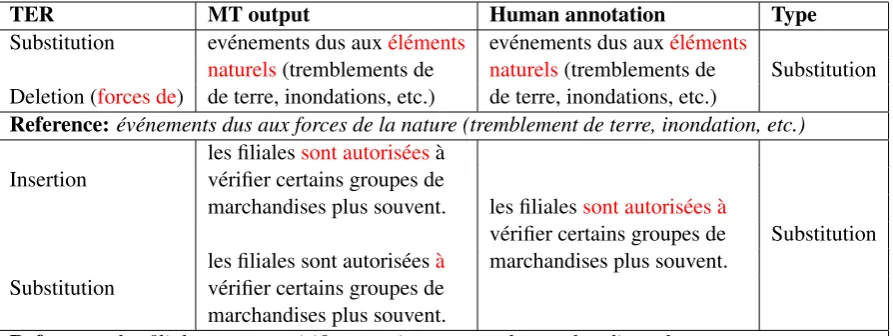
highlighted in red. In order to evaluate the edits in-dividually, we duplicated the sentences containing more than one edit, and we marked only one edit at a time. Three translators from Swiss Post’s Lan-guage Service received these target sentences in a spreadsheet along with the source sentences. For each edit, they had to state if they would modify the red part during a full post-editing task. They were not asked to post-edit the sentences, but only to indicate if they would change the highlighted part or not. Table 4 shows three different sen-tences with edits marked in red (as presented to the evaluators), as well as the corresponding reference translations. During the evaluation task, the eval-uators did not have access to the reference trans-lation and had no information about the type of system used to produced the output.
Results were collected. We calculated 1) how many differences post-editors would change in both systems, 2) the corresponding type of edit and 3) the inter-rater agreement.
4 Results
4.1 Automatic Evaluation
The two systems obtained high BLEU scores on the test set (1,736 sentences), 0.68 for NMT and 0.59 for SMT, and low TER scores of 19.96 and 30.05, showing that both systems produce good quality translations according to automatic evalu-ation.
Table 5shows the number of substitutions, in-sertions, deletions and word order differences in both architectures. The total number of edits is higher for SMT than NMT, with a total of 10,399 and 7,327 edits respectively.
For both systems, the most frequent type of ed-its are substitutions, followed by deletions, inser-tions and word order. However, the proportion of deletions is higher for SMT than NMT (36% vs 27%), whereas the proportion of substitutions is higher for NMT (47% vs 37%).
Edit SMT NMT
Insertions 1,869 (18%) 1,305 (18%)
Deletions 3,754 (36%) 1,995 (27%)
Substitutions 3,881 (37%) 3,470 (47%)
Word order 895 (9%) 557 (8%)
[image:4.595.72.291.62.147.2]Total 10,399 (100%) 7,327 (100%)
Table 5:Number of edits and percentage per edit in SMT vs NMT for language pair German-to-French.
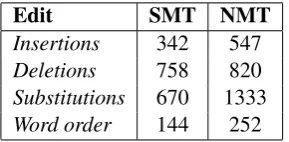
sentences for items where SMT obtained a higher BLEU score than NMT (396 sentences). Table
7 shows the number of edits in the reverse situa-tion (1,003 sentences). For the 424 remaining sen-tences, the translations by both systems obtained identical BLEU scores (100 BLEU point).
Edit SMT NMT
Insertions 342 547
Deletions 758 820
Substitutions 670 1333
[image:4.595.110.255.310.381.2]Word order 144 252
Table 6:Number of edits in sentences where SMT has a higher BLEU score than NMT (396 sen-tences).
Edit SMT NMT
Insertions 1461 690
Deletions 2911 1092
Substitutions 3044 1837
[image:4.595.111.254.454.526.2]Word order 1467 289
Table 7: Number of edits in sentence output where NMT has a higher BLEU score than SMT (1003 sentences).
It can be observed that when SMT has a higher BLEU, NMT almost doubles the number of sub-stitutions (by 1.95) and word order (by 1.75) com-pared to SMT, whereas when NMT is better, all types of edits double, with word order edits being multiplied by 5.07. This means that when NMT is good, SMT produces more word order difference, as shown in example (Table8).
Overall, the most common edit is substitution for both systems. However, if we compare the per-centage of edits in both architectures, the number of substitutions is much higher in NMT (47.34%), which can be explained by the well-known ability
of NMT to paraphrase (Mallinson et al.,2017). We can see a clear example in Table9. On the other hand, SMT had more deletions (36.09%). For the other types of edits, there is not much difference between the two systems.
4.2 Human Evaluation
The aim of the human evaluation is to shed light on how translators perceive edits in the output of each system, namely whether they would edit them or not. We also wanted to determine which types of edits would be post-edited more often by transla-tors.
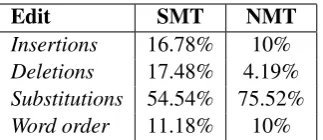
For each sentence, we considered the majority judgement (at least 2 judges agree) and we com-puted the results for both test subsets (143 edits per system). Figure 1 shows the percentages of edits that a majority of judges would change, per system and per type of edit.
If we consider all edits together, the evaluators would have post-edited the SMT output more than the NMT output: 68.53% of the edits would have been modified by a majority of judges in SMT ver-sus 14.69% in NMT. This confirms our hypothesis that the edits in NMT are more often considered to be non-significant in the post-editing task.
For both systems, the edit type most frequently marked by the translators as something they would modify was deletions, which is not surprising since an omission in the output will very likely affect the quality of the translation. As for sub-stitutions, which was the most frequent edit in both systems (see Tables 5and 10), the majority of judges would modify more than half of them (62.82%) in SMT output vs only 14.81% in NMT. This illustrates the ability of neural systems to paraphrase and use correct synonyms. Finally, we can see that word order differences, which in-crease in SMT when NMT is better (Table7), were mostly considered to be mistakes in SMT, which reflects the well-known fact that SMT has prob-lems dealing with word order differences.
Source SMT output
suchen Sie die R¨aumlichkeiten und die Umgebung fouillez les locaux et les environs de la der Filiale bis zum Eintreffen der Polizei filiale jusqu’`a l’arriv´ee de la police nach verd¨achtigen Gegenst¨anden ab. apr`es d’objets suspects.
[image:5.595.85.519.49.502.2]Reference: fouillez les locaux et les environs de la filiale `a la recherche d’objets suspects jusqu’`a l’arriv´ee de la police.
Table 8:An example of word order error for SMT.
Source NMT output
der zust¨andige Gesch¨aftsbereich ¨ubernimmt die l’unit´e d’affaires comp´etenteprend en charge interne Information und leitet bei Bedarf l’information interne et prend des mesures si
Massnahmen ein. n´ecessaire.
[image:5.595.132.458.311.487.2]Reference:l’unit´e d’affaires comp´etente assure l’information interne et met en œuvre des mesures en cas de besoin.
[image:5.595.100.464.542.719.2]Table 9:An example of substitution for NMT.
Figure 1:% of edits the translators would modify for SMT and NMT (by at least two judges).
Edit SMT NMT
Insertions 16.78% 10%
Deletions 17.48% 4.19%
Substitutions 54.54% 75.52%
[image:6.595.102.264.61.131.2]Word order 11.18% 10%
Table 10: %edit type in 143 edits extracted from each model.
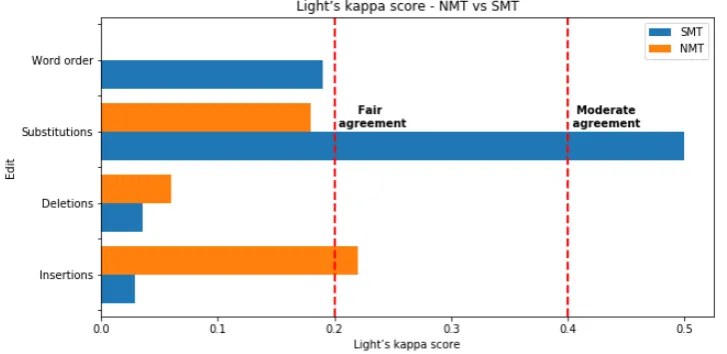
significance (p-value 34%).
Figure 2 illustrates individual Light’s kappa scores computed for each edit type. These scores show that judges do not strongly agree on the di-vergences that would need post-editing, particu-larly with NMT output. In particular, evaluators disagree on the word order category for NMT out-put, where the Light’s kappa score obtained is neg-ative. Translators moderately agreed (K=0.50) on substitutions in SMT (p-value<0.0011) and fairly on insertions (K=0.22) in NMT (p-value>0.62) (see Figure1). This suggests that in NMT, transla-tors have more difficulties clearly stating whether a sentence has to be modified or not.
5 Conclusion and Future Work
In this paper, we presented an innovative method-ology to compare SMT and NMT based on dif-ferences with an official reference. We showed that (i) the most common edits are substitutions, with respectively 37.32% and 47.34% for NMT and SMT, and deletions with 27% and 36.09%; (ii) the most significant difference from a translator’s point of view is deletions, in particular in SMT, with 80% of changes in SMT but only 33.33% in NMT; (iii) NMT edits are more often con-sidered to be non-significant from a post-editing point of view (14.68%), as opposed to SMT ed-its (68.53%); (iv) translators have more difficulties stating whether a sentence has to be modified with NMT than with SMT.
This study has several limitations: three judges were not enough to obtain a good inter-agreement score. It will be interesting to test the same methodology with the different languages of the Post (Italian and English) in order to see if there are cross-lingual differences, as well as with trans-lators trained for post-editing. We also would like to see if differences considered to be wrong by translators are related to specific types of errors.
However, despite its limitations, the paper pro-vides interesting perspectives. Firstly, the fact that
NMT produces correct paraphrases of the refer-ence confirms a common hypothesis that BLEU is not an adequate metric for evaluating the per-formance of NMT (Shterionov et al.,2017,2018;
Volkart et al., 2018). From a broader perspec-tive, the collected data, which focus on different types of individual edits, could also be used to train translators on how to distinguish between es-sential vs non eses-sential changes.
Acknowledgement
We would like to thank the translators who kindly accepted to participate in this study, as well as Martina Bellodi and the whole Swiss Post’s Lan-guage Service.
References
Luisa Bentivogli, Arianna Bisazza, Mauro Cettolo, and Marcello Federico. 2016. Neural versus phrase-based machine translation quality: a case study. In
Proceedings of the 2016 Conference on Empirical
Methods in Natural Language Processing.
Associa-tion for ComputaAssocia-tional Linguistics, Austin, Texas, pages 257–267. https://doi.org/10.18653/v1/D16-1025.
Pierrette Bouillon, Paula Estrella, Sabrina Girletti, Jonathan Mutal, Martina Bellodi, and Beatrice Bircher. 2018. Integrating MT at Swiss Post’s
Language Service: preliminary results, pages 281–
286. Proceedings of the 21st Annual Confer-ence of the European Association for Machine Translation. ID: unige:105252. https://archive-ouverte.unige.ch/unige:105252.
Joke Daems and Lieve Macken. 2019. Interactive adaptive smt versus interactive adaptive nmt: a user experience evaluation. Machine Translation
33(1):117–134. https://doi.org/10.1007/s10590-019-09230-z.
Joke Daems, Sonia Vandepitte, Robert Hartsuiker, and Lieve Macken. 2017.Identifying the machine trans-lation error types with the greatest impact on post-editing effort. Frontiers in Psychology 8:1282.
https://doi.org/10.3389/fpsyg.2017.01282.
Kenneth Heafield. 2011. KenLM: Faster and smaller language model queries. In Proceed-ings of the Sixth Workshop on Statistical
Ma-chine Translation. Association for Computational
Linguistics, Edinburgh, Scotland, pages 187–197.
https://www.aclweb.org/anthology/W11-2123.
J. Richard Landis and Gary G. Koch. 1977. The mea-surement of observer agreement for categorical data.
Richard Light. 1971. Measures of response agreement for qualitative data: Some generalizations and alter-natives. Psychological Bulletin76:365–377.
Arle Lommel, Aljoscha Burchardt, Maja Popovic, Kim Harris, Eleftherios Avramidis, and Hans Uszkoreit. 2014. Using a new analytic measure for the anno-tation and analysis of mt errors on real data. pages 165–172.
Jonathan Mallinson, Rico Sennrich, and Mirella La-pata. 2017. Paraphrasing revisited with neu-ral machine translation. In Proceedings of the 15th Conference of the European Chapter of the
Association for Computational Linguistics:
Vol-ume 1, Long Papers. Association for
Computa-tional Linguistics, Valencia, Spain, pages 881–893.
https://www.aclweb.org/anthology/E17-1083.
Kishore Papineni, Salim Roukos, Todd Ward, and Wei-Jing Zhu. 2002. Bleu: A method for au-tomatic evaluation of machine translation. In
Proceedings of the 40th Annual Meeting on
As-sociation for Computational Linguistics.
Asso-ciation for Computational Linguistics, Strouds-burg, PA, USA, ACL ’02, pages 311–318.
https://doi.org/10.3115/1073083.1073135.
Rico Sennrich, Barry Haddow, and Alexandra Birch. 2015. Neural machine translation of rare words with subword units. CoRR abs/1508.07909.
http://arxiv.org/abs/1508.07909.
Dimitar Shterionov, Pat Nagle, Laura Casanellas, Ric-cardo Superbo, and Tony O’Dowd. 2017. Empirical evaluation of nmt and pbsmt quality for large-scale translation production.
Dimitar Shterionov, Riccardo Superbo, Pat Nagle, Laura Casanellas, Tony O’dowd, and Andy Way. 2018. Human versus automatic quality evaluation of nmt and pbsmt. Machine Translation32(3):217– 235. https://doi.org/10.1007/s10590-018-9220-z.
Matthew Snover, Bonnie Dorr, Richard Schwartz, Lin-nea Micciulla, and John Makhoul. 2006. A study of translation edit rate with targeted human annota-tion. InIn Proceedings of Association for Machine Translation in the Americas. pages 223–231.
Sara Stymne and Lars Ahrenberg. 2012. On the practice of error analysis for machine transla-tion evaluatransla-tion. In Proceedings of the Eighth International Conference on Language Resources
and Evaluation (LREC-2012). European
Lan-guages Resources Association (ELRA), Istan-bul, Turkey, pages 1785–1790. http://www.lrec-conf.org/proceedings/lrec2012/pdf/717Paper.pdf.
Antonio Toral and V´ıctor Cartagena. 2017. A multi-faceted evaluation of neural versus phrase-based ma-chine translation for 9 language directions. pages 1063–1073. https://doi.org/10.18653/v1/E17-1100.
Ashish Vaswani, Noam Shazeer, Niki Parmar, Jakob Uszkoreit, Llion Jones, Aidan N. Gomez, Lukasz Kaiser, and Illia Polosukhin. 2017. Atten-tion is all you need. CoRR abs/1706.03762.
http://arxiv.org/abs/1706.03762.
Lise Volkart, Pierrette Bouillon, and Sabrina Girletti. 2018. Statistical vs. Neural Machine Transla-tion: A Comparison of MTH and DeepL at Swiss
Post’s Language Service, pages 145–150.