Using Context to Predict the Purpose of Argumentative Writing Revisions
Fan Zhang
Department of Computer Science University of Pittsburgh
Pittsburgh, PA, 15260 [email protected]
Diane Litman
Department of Computer Science and LRDC University of Pittsburgh
Pittsburgh, PA, 15260 [email protected]
Abstract
While there is increasing interest in automat-ically recognizing the argumentative structure of a text, recognizing the argumentative pur-pose of revisions to such texts has been less explored. Furthermore, existing revision clas-sification approaches typically ignore contex-tual information. We propose two approaches for utilizing contextual information when pre-dicting argumentative revision purposes: de-veloping contextual features for use in the classification paradigm of prior work, and transforming the classification problem to a sequence labeling task. Experimental results using two corpora of student essays demon-strate the utility of contextual information for predicting argumentative revision purposes.
1 Introduction
Incorporating natural language processing into sys-tems that provide writing assistance beyond gram-mar is an area of increasing research and commer-cial interest (e.g., (Writelab, 2015; Roscoe et al., 2015)). As one example, the automatic recognition of the purpose of each of an author’s revisions allows writing assistance systems to provide better rewrit-ing suggestions. In this paper, we propose context-based methods to improve the automatic identifica-tion of revision purposes in student argumentative writing. Argumentation plays an important role in analyzing many types of writing such as persuasive essays (Stab et al., 2014), scientific papers (Teufel, 2000) and law documents (Palau and Moens, 2009). In student papers, identifying revision purposes with
respect to argument structure has been used to pre-dict the grade improvement in the paper after revi-sion (Zhang and Litman, 2015).
Existing works on the analysis of writing revi-sions (Adler et al., 2011; Bronner and Monz, 2012; Daxenberger and Gurevych, 2013; Zhang and Lit-man, 2015) typically compare two versions of a text to extract revisions, then classify the purpose of each revision in isolation. That is, while limited con-textual features such as revision location have been utilized in prior work, such features are computed from the revision being classified but typically not its neighbors. In addition, ordinary classifiers rather than structured prediction models are typically used. To increase the role of context during prediction, in this paper we 1) introduce new contextual features (e.g., the impact of a revision on local text cohesion), and 2) transform revision purpose classification to a sequential labeling task to capture dependencies among revisions (as in Table 1). An experimental evaluation demonstrates the utility of our approach.
2 Related Work
There are multiple works on the classification of revisions (Adler et al., 2011; Javanmardi et al., 2011; Bronner and Monz, 2012; Daxenberger and Gurevych, 2013; Zhang and Litman, 2015). While different classification tasks were explored, similar approaches were taken by extracting features (lo-cation, text, meta-data, language) from the revised text to train a classification model (SVM, Random Forest, etc.) on the annotated data. One problem with prior works is that the contextual features used were typically shallow (location), while we
Draft 1 Draft 2
[1]Writer Richard Louv tells us to focus more on nature through hisrhetorical questions, par-allelism, and pathos.[2]Louvs rhetorical ques-tions as us whether we value technology or na-ture over the other.
[1] Writer Richard Louv emphasises this ex-panding chasm between people and nature and tries to convince people to go back to nature through his parallelism and pathos.
[First Revision: 1->1,Type: Claim, Modify],[Second Revision: 2->null,Type: Warrant, Delete] Table 1:Example dependency betweenClaimandWarrantrevisions. Sentence 1 acts as theClaim(argument structure) of Draft 1 and sentence 2 acts as theWarrantfor theClaim. Sentence 1 in Draft 1 is modified to sentence 1 (also acts as theClaim) of Draft 2. Sentence 2 in Draft 1 is deleted in Draft 2. The first revision is aClaimrevision as it modifies theClaimof the paper by removing “rhetorical questions.” This leads to the secondWarrantrevision, which deletes theWarrantfor “rhetorical questions.”
ture additional contextual information as text cohe-sion/coherence changes and revision dependencies.
As our task focuses on identifying the argumen-tative purpose of writing revisions, work in argu-ment mining is also relevant. In fact, many fea-tures for predicting argument structure (e.g., loca-tion, discourse connectives, punctuation) (Burstein and Marcu, 2003; Moens et al., 2007; Palau and Moens, 2009; Feng and Hirst, 2011) are also used in revision classification. In addition, Lawrence et al. (2014) use changes in topic to detect argumen-tation, which leads us to hypothesize that different types of argumentative revisions will have different impacts on text cohesion and coherence. Guo et al. (2011) and Park et al. (2015) both utilize Condi-tional Random Fields (CRFs) for identifying argu-mentative structures. While we focus on the differ-ent task of iddiffer-entifying revisions to argumdiffer-entation, we similarly hypothesize that dependencies exist be-tween revisions and thus utilize CRFs in our task. While our task is similar to argument mining, a key difference is that the revisions do not always appear near each other. For example, a 5-paragraph long essay might have only two or three revisions located at different paragraphs. Thus, the types of previous revisions cannot always be used as the contextual information. Moreover, the type of the revision is not necessarily the argument type of its revised sen-tence. For example, a revision on the evidence argu-ment can be just a correction of spelling mistakes.
3 Data Description
Revision purposes. To label our data, we adapt the schema defined in (Zhang and Litman, 2015) as it can be reliably annotated and is
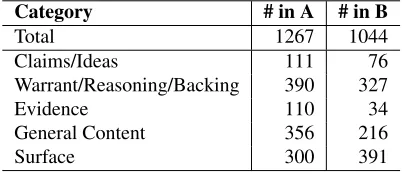
argument-Category # in A # in B
Total 1267 1044
Claims/Ideas 111 76
Warrant/Reasoning/Backing 390 327
Evidence 110 34
General Content 356 216
[image:2.612.326.527.223.310.2]Surface 300 391
Table 2:Distribution of revisions in Corpus A, B.
oriented. Sentences across paper drafts are aligned manually based on semantic similarity and re-vision purpose categories are labeled on aligned sentences. The schema includes four categories (Claims/Ideas, Warrant/Reasoning/Backing, Rebut-tal/Reservation and Evidence) based on Toulmin’s argumentation model (Toulmin, 2003), a General Content category for revisions that do not directly change the support/rebuttal of the claim (e.g. ad-dition of introductory materials, conclusions, etc.), and three categories (Conventions, Clarity and Or-ganization) based on theSurfacecategorizations in (Faigley and Witte, 1981). As we focus on argu-mentative changes, we merge all the Surface sub-categories into oneSurfacecategory. As Zhang and Litman (2015) reported that bothRebuttalsand mul-tiple labels for a single revision were rare, we merge Rebuttal and Warrant into one Warrant category1
and allow only a single (primary) label per revision.
Corpora. Our experiments use two corpora con-sisting of Drafts 1 and 2 of papers written by high school students taking AP-English courses; papers were revised after receiving and generating peer feedback. Corpus A was collected in our earlier
pa-1We also believe that differentiatingWarrantandRebuttal
per (Zhang and Litman, 2015), although the origi-nal annotations were modified as described above. It contains 47 paper draft pairs about placing contem-poraries in Dante’s Inferno. Corpus B was collected in the same manor as A with agreement Kappa 0.69. It contains 63 paper draft pairs explaining the rhetor-ical strategies used by the speaker/author of a previ-ously read lecture/essay. Both corpora were double coded and gold standard labels were created upon agreement of two annotators. Two example anno-tated revisions from Corpus B are shown in Table 1, while the distribution of annotated revision purposes for both corpora are shown in Table 2.
4 Utilizing Context
4.1 Adding contextual features
Our previous work (Zhang and Litman, 2015) used three types of features primarily from prior work (Adler et al., 2011; Bronner and Monz, 2012; Dax-enberger and Gurevych, 2013) for argumentative re-vision classification. Locationfeatures encode the location of the sentence in the paragraph and the lo-cation of the sentence’s paragraph in the essay. Tex-tual features encode revision operation, sentence length, edit distance between aligned sentences and the difference in sentence length and punctuation numbers. Languagefeatures encode part of speech (POS) unigrams and difference in POS tag counts.
We implement this feature set as the baseline as our tasks are similar, then propose two new types of contextual features. The first type (Ext) extends prior work by extracting the baseline features from not only the aligned sentence pair representing the revision in question, but also for the sentence pairs before and after the revision. The second type (Coh) measures the cohesion and coherence changes in a 2-sentence block around the revision2.
Utilizing the cohesion and coherence difference.
Inspired by (Lee et al., 2015; Vaughan and McDon-ald, 1986), we hypothesize that different revisions can have different impacts on the cohesion and co-herence of the essay. We propose to extract fea-tures for both impact on cohesion (lexical) and im-pact on coherence (semantic). Inspired by (Hearst, 1997), sequences of blocks are created for sentences
[image:3.612.351.509.61.158.2]2In this paper we consider the most adjacent sentence only.
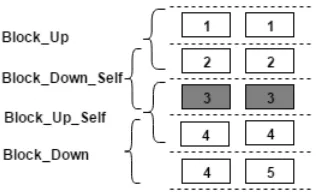
Figure 1:Example of cohesion blocks. A window of size 2 is created for both Draft 1 and Draft 2. Sequence of blocks were created by moving the window at the step of 1 (sentence).
Figure 2:Example of revision sequence transformation. Each square corresponds to a sentence in the essay, the number of the square represents the index of the sentence in the essay. Dark squares are sentences that are changed. In the example, the 2nd sentence of Draft 1 is modified, the 3rd sentence is deleted and a new sentence is added in Draft 2.
in both Draft 1 and Draft 2 as demonstrated in Fig-ure 1. Two types of featFig-ures are extracted. The first type describes the cohesion and coherence be-tween the revised sentence and its adjacent sen-tences. The similarity (lexical/semantic) between the revised sentence block and the sentence block before (Sim(Block Up, Block Up Self))and af-ter (Sim(Block Down, Block Down Self)) are calculated as the cohesion/coherence scores Coh Up and Coh Down. The features are extracted sep-arately for Draft 1 and Draft 2 sentences3. The
second type describes the impact of sentence mod-ification on cohesion and coherence4. Features
Change Up and Change Down are extracted as the division of the cohesion/coherence scores of two drafts (Coh UpCoh Up((DraftDraft2)1), Coh DownCoh Down((DraftDraft2)1)).
A bag-of-word representation is generated for
3For the added and deleted sentences, features of the empty
sentence in the other draft are set to 0.
[image:3.612.347.496.222.327.2]SVM CRFs
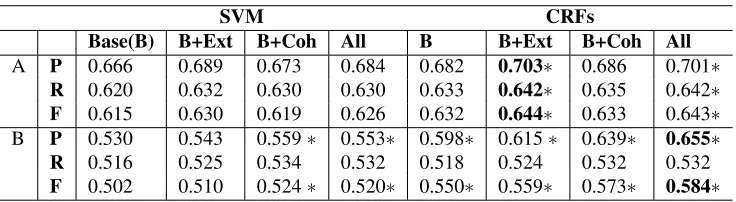
Base(B) B+Ext B+Coh All B B+Ext B+Coh All
A P 0.666 0.689 0.673 0.684 0.682 0.703∗ 0.686 0.701∗ R 0.620 0.632 0.630 0.630 0.633 0.642∗ 0.635 0.642∗ F 0.615 0.630 0.619 0.626 0.632 0.644∗ 0.633 0.643∗
B P 0.530 0.543 0.559∗ 0.553∗ 0.598∗ 0.615∗ 0.639∗ 0.655∗ R 0.516 0.525 0.534 0.532 0.518 0.524 0.532 0.532
[image:4.612.123.491.58.159.2]F 0.502 0.510 0.524∗ 0.520∗ 0.550∗ 0.559∗ 0.573∗ 0.584∗
Table 3: The average of 10-fold (student) cross-validation results on Corpora A and B. Unweighted precision (P), Unweighted recall (R) and Unweighted F-measure (F) are reported. Results of CRFs on paragraph-level segments are reported (there is no significant difference between essay level and paragraph level). ∗indicates significantly better than the baseline,Boldindicates significantly better than all other results (Paired T-test, p<0.05).
each sentence block after stop-word filtering and stemming. Jaccard similarity is used for the calcu-lation of lexical similarity between sentence blocks. Word embedding vectors (Mikolov et al., 2013) are used for the calculation of semantic similarity. A vector is calculated for each sentence block by sum-ming up the embedding vectors of words that are not stop-words5. Afterwards the similarity is
cal-culated as the cosine similarity between the block vectors. This approach has been taken by multiple groups in the SemEval-2015 semantic similarity task (SemEval-2015 Task 1)(Xu et al., 2015).
4.2 Transforming to sequence labeling
To capture dependencies among predicted revisions, we transform the revisions to a consecutive sequence and label it with Conditional Random Fields (CRFs) as demonstrated in Figure 2. For both drafts, sen-tences are sorted according to their order of occur-rence in the essay. Aligned sentences are put into the same row and each aligned pair of sentences is treated as a unit of revision. The “cross-aligned” pairs of sentences6 (which does not often occur)
are broken into deleted and added sentences (i.e, the cross-aligned sentences in Draft 1 are treated as deleted and the sentences in Draft 2 are treated as added.). After generating the sequence, each re-vision unit in the sequence is assigned the rere-vision purpose label according to the annotations, with un-changed sentence pairs labeled asNochange.
5We also tried the average of embedding vectors but
ob-served no significant difference between the two approaches.
6Sentences in Draft 1 switched their positions in Draft 2,
the cross-aligned sentences cannot be both in the same row and following their order of occurrence at the same time.
We conducted labeling on both essay-level and paragraph-level sequences. The essay-level treats the whole essay as a sequence segment while the paragraph-level treats each paragraph as a segment. After labeling, the label of each changed sentence pair is marked as the purpose of the revision7.
5 Experiments and Results
Our prior work (Zhang and Litman, 2014) proposed an approach for the alignment of sentences. The ap-proach achieves 92% accuracy on both corpora. In this paper we focus on the prediction task and as-sume we have gold-standard sentence alignments8.
The first four columns of Table 3 show the perfor-mance of baseline features with and without our new contextual features using an SVM prediction model9. The last four columns show the
perfor-mance of CRFs10. All experiments are conducted
using 10-fold (student) cross-validation with 300 features selected using learning gain ratio11.
For the SVM approach, we observe that the
Coh features yield a significant improvement over the baseline features in Corpus B, and a non-significant improvement in Corpus A. This indicates that changes in text cohesion and coherence can
in-7Revisions on cross-aligned pairs are marked asSurface. 8Similar to settings in (Daxenberger and Gurevych, 2013) 9We compared three models used in discourse analysis and
revision classification (C4.5 Decision Tree, SVM and Random Forests) (Burstein et al., 2003; Bronner and Monz, 2012; Stab and Gurevych, 2014) and SVM yielded the best performance.
10SVM model implemented with Weka (Hall et al., 2009) and
CRF model implemented with CRFSuite (Okazaki, 2007)
11We tested with parameters 100, 200, 300, 500 on a
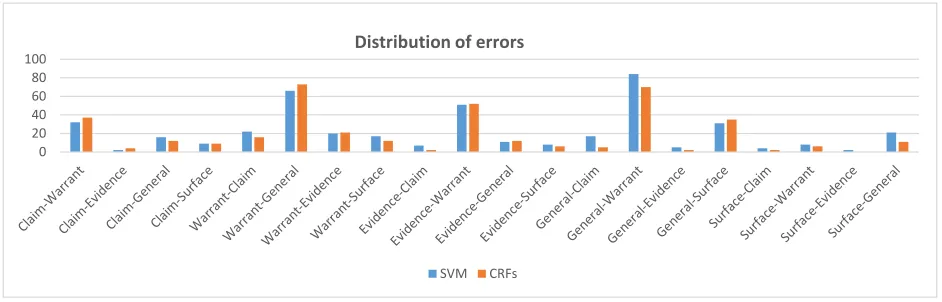
0 20 40 60 80
100 Distribution of errors
[image:5.612.71.542.60.211.2]SVM CRFs
Figure 3:The number of classification errors on Corpus A, “Warrant-General” represents classifyingWarrantasGeneral.
deed improve the prediction of argumentative revi-sion types. The Ext feature set - which computes features for not only the revision but also its im-mediately adjacent sentences - also yields a slight (although not significant) improvement. However, adding the two feature sets together does not fur-ther improve the performance using the SVM model. The CRF approach almost always yields the best results for both corpora, with all such CRF results better than all other results. This indicates that de-pendencies exist among argumentative revisions that cannot be identified with traditional classification approaches.
6 Error Analysis
To have a better understanding of how the sequence labeling approach improves the classification perfor-mance, we counted the errors of the cross-validation results on Corpus A (where the revisions are more evenly distributed). Figure 3 demonstrates the com-parison of errors made by SVM and CRFs12.
We notice that the CRF approach makes less er-rors than the SVM approach in recognizing Claim changes (General-Claim, Evidence-Claim, Warrant-Claim, Surface-Claim). This matches our intuition that there exists dependency between revisions on supporting materials and revisions on Claim. We also observe that same problems exist in both ap-proaches. The biggest difficulty is the differentia-tion betweenGeneralandWarrantrevisions, which counts 37.6% of the SVM errors and 40.1% of CRFs errors. It is also common thatClaimandEvidence
12Both use models with all the features.
revisions are classified as Warrant revisions. Ap-proaches need to be designed for such cases to fur-ther improve the classification performance.
7 Conclusion
In this paper we proposed different methods for uti-lizing contextual information when predicting the argumentative purpose of revisions in student writ-ing. Adding features that captured changes in text cohesion and coherence, as well as using sequence modeling to capture revision dependencies, both sig-nificantly improved predictive performance in an ex-perimental evaluation.
In the future, we plan to investigate whether per-formance can be further improved when more sen-tences in the context are included. Also, we plan to investigate whether revision dependencies exist in other types of corpora such as Wikipedia revisions. While the corpora used in this study cannot be pub-lished because of the lack of required IRB, we are starting a user study project (Zhang et al., 2016) on the application of our proposed techniques and will publish the data collected from this project.
Acknowledgments
References
B. Thomas Adler, Luca De Alfaro, Santiago M. Mola-Velasco, Paolo Rosso, and Andrew G. West. 2011. Wikipedia vandalism detection: Combining natural language, metadata, and reputation features. In Pro-ceedings of the 12th International Conference on Computational Linguistics and Intelligent Text Pro-cessing - Volume Part II, CICLing’11, pages 277–288, Berlin, Heidelberg. Springer-Verlag.
Amit Bronner and Christof Monz. 2012. User edits classification using document revision histories. In
Proceedings of the 13th Conference of the European Chapter of the Association for Computational Linguis-tics, pages 356–366. Association for Computational Linguistics.
Jill Burstein and Daniel Marcu. 2003. A machine learn-ing approach for identification thesis and conclusion statements in student essays. Computers and the Hu-manities, 37(4):455–467.
Jill Burstein, Daniel Marcu, and Kevin Knight. 2003. Finding the write stuff: Automatic identification of discourse structure in student essays. Intelligent Sys-tems, IEEE, 18(1):32–39.
Johannes Daxenberger and Iryna Gurevych. 2013. Auto-matically classifying edit categories in Wikipedia re-visions. In Proceedings of the 2013 Conference on Empirical Methods in Natural Language Processing, pages 578–589, Seattle, Washington, USA, October. Association for Computational Linguistics.
Lester Faigley and Stephen Witte. 1981. Analyzing revi-sion. College composition and communication, pages 400–414.
Vanessa Wei Feng and Graeme Hirst. 2011. Classify-ing arguments by scheme. InProceedings of the 49th Annual Meeting of the Association for Computational Linguistics: Human Language Technologies-Volume 1, pages 987–996. Association for Computational Lin-guistics.
Yufan Guo, Anna Korhonen, and Thierry Poibeau. 2011. A weakly-supervised approach to argumentative zon-ing of scientific documents. In Proceedings of the Conference on Empirical Methods in Natural Lan-guage Processing, pages 273–283. Association for Computational Linguistics.
Mark Hall, Eibe Frank, Geoffrey Holmes, Bernhard Pfahringer, Peter Reutemann, and Ian H Witten. 2009. The weka data mining software: an update. ACM SIGKDD explorations newsletter, 11(1):10–18. Marti A Hearst. 1997. Texttiling: Segmenting text into
multi-paragraph subtopic passages. Computational linguistics, 23(1):33–64.
Sara Javanmardi, David W McDonald, and Cristina V Lopes. 2011. Vandalism detection in wikipedia: a
high-performing, feature-rich model and its reduction through lasso. InProceedings of the 7th International Symposium on Wikis and Open Collaboration, pages 82–90. ACM.
John Lawrence, Chris Reed, Colin Allen, Simon McAl-ister, and Andrew Ravenscroft. 2014. Mining ar-guments from 19th century philosophical texts using topic based modelling. In Proceedings of the First Workshop on Argumentation Mining, pages 79–87, Baltimore, Maryland, June. Association for Compu-tational Linguistics.
John Lee, Chak Yan Yeung, Amir Zeldes, Marc Reznicek, Anke L¨udeling, and Jonathan Webster. 2015. Cityu corpus of essay drafts of english language learners: a corpus of textual revision in second lan-guage writing. Language Resources and Evaluation, pages 1–25.
Tomas Mikolov, Ilya Sutskever, Kai Chen, Greg S Cor-rado, and Jeff Dean. 2013. Distributed representa-tions of words and phrases and their compositionality. InAdvances in neural information processing systems, pages 3111–3119.
Marie-Francine Moens, Erik Boiy, Raquel Mochales Palau, and Chris Reed. 2007. Automatic detection of arguments in legal texts. InProceedings of the 11th international conference on Artificial intelligence and law, pages 225–230. ACM.
Naoaki Okazaki. 2007. Crfsuite: a fast implementation of conditional random fields (crfs).
Raquel Mochales Palau and Marie-Francine Moens. 2009. Argumentation mining: the detection, classifi-cation and structure of arguments in text. In Proceed-ings of the 12th international conference on artificial intelligence and law, pages 98–107. ACM.
Joonsuk Park, Arzoo Katiyar, and Bishan Yang. 2015. Conditional random fields for identifying appropriate types of support for propositions in online user com-ments. In Proceedings of the 2nd Workshop on Ar-gumentation Mining, pages 39–44, Denver, CO, June. Association for Computational Linguistics.
Rod D Roscoe, Erica L Snow, Laura K Allen, and Danielle S McNamara. 2015. Automated detection of essay revising patterns: applications for intelligent feedback in a writing tutor. Technology, Instruction, Cognition, and Learning.
Christian Stab and Iryna Gurevych. 2014. Identifying ar-gumentative discourse structures in persuasive essays. InEMNLP, pages 46–56.
Simone Teufel. 2000. Argumentative zoning: Informa-tion extracInforma-tion from scientific text. Ph.D. thesis, Cite-seer.
Stephen E Toulmin. 2003. The uses of argument. Cam-bridge University Press.
Marie M Vaughan and David D McDonald. 1986. A model of revision in natural language generation. In
Proceedings of the 24th annual meeting on Associa-tion for ComputaAssocia-tional Linguistics, pages 90–96. As-sociation for Computational Linguistics.
Writelab. 2015. WriteLab. http://home.writelab.com. [Online; accessed 10-03-2015].
Wei Xu, Chris Callison-Burch, and William B Dolan. 2015. Semeval-2015 task 1: Paraphrase and seman-tic similarity in twitter (pit). InProceedings of the 9th International Workshop on Semantic Evaluation (Se-mEval).
Fan Zhang and Diane Litman. 2014. Sentence-level rewriting detection. InProceedings of the Ninth Work-shop on Innovative Use of NLP for Building Educa-tional Applications, pages 149–154, Baltimore, Mary-land, June. Association for Computational Linguistics. Fan Zhang and Diane Litman. 2015. Annotation and classification of argumentative writing revisions. In
Proceedings of the Tenth Workshop on Innovative Use of NLP for Building Educational Applications, pages 133–143, Denver, Colorado, June. Association for Computational Linguistics.