Towards Unsupervised and Language-independent Compound Splitting
using Inflectional Morphological Transformations
Patrick Ziering
Institute for Natural Language Processing University of Stuttgart, Germany
Patrick.Ziering@ ims.uni-stuttgart.de
Lonneke van der Plas Institute of Linguistics University of Malta, Malta
Abstract
In this paper, we address the task of language-independent, knowledge-lean and unsuper-vised compound splitting, which is an essen-tial component for many natural language pro-cessing tasks such as machine translation. Pre-vious methods on statistical compound split-ting either include language-specific knowl-edge (e.g., linking elements) or rely on parallel data, which results in limited applicability. We aim to overcome these limitations by learning compounding morphology from inflectional information derived from lemmatized mono-lingual corpora. In experiments for Germanic languages, we show that our approach signifi-cantly outperforms language-dependent state-of-the-art methods in finding the correct split point and that word inflection is a good ap-proximation for compounding morphology.
1 Introduction
Compounding represents one of the most productive word formation types in many languages. In partic-ular, Germanic languages (e.g., German or Dutch) show high productivity in closed compounding, i.e., in creating one-word compounds such as the Ger-man Armutsbek¨ampfungsprogramm‘poverty elimi-nation program’. Previous studies on German cor-pora reveal that almost half of the corpus types are compounds, whereas individual compounds are very infrequent (Baroni et al., 2002). Therefore, an automatic compound analysis is indispensable and represents an essential component in many natural language processing (NLP) tasks such as machine translation (MT) or information retrieval (IR).
Besides determining the concatenated constituent forms, i.e., the correct split points (e.g., Armuts
| bek¨ampfungs | programm), a compound split-ter needs to normalize each part (e.g., Armut +
Bek¨ampfung + Programm), because down-stream applications such as MT systems expect lemma-tized words as input. However, normalization of constituent forms is non-trivial and usually re-quires language-specific knowledge (e.g., linking el-ements). State-of-the-art lemmatizers, designed for regular word inflection, would fail, because con-stituent forms often contain linking elements lead-ing to a non-paradigmatic word form of the corre-sponding lexeme (e.g., Armuts ‘poverty + s’ never occurs as an isolated token in German corpora, since thes-suffix, often used for genitive or pluralization, is not used with Armut). Moreover, morphologi-cal operations during compounding vary a lot across languages and lexemes: we find cases that start from the lemma and have additions (e.g., linking elements), truncations (e.g., reductions to a verbal stem), word-internal operations (e.g., Umlautung) and combinations thereof (e.g., the first constituent of the German Weihnachts|baum ‘Christmas tree’,
Weihnachten, undergoes both theen-truncation and thes-suffixation).
In this paper, we present a language-independent, unsupervised compound splitter that normalizes constituent forms by tolerantly retrieving candi-date lemmas using anNgram index and weighting string differences with inflectional information de-rived from lemmatized corpora.
Most previous work on compound splitting in-cludes language-specific knowledge such as large
lexicons and morphological analyzers (Fritzinger and Fraser, 2010) or hand-crafted lists of link-ing elements and rules for modellink-ing morphologi-cal transitions (Koehn and Knight, 2003; Stymne, 2008; Weller and Heid, 2012), which makes the approaches language-dependent. Macherey et al., (2011) were the first to overcome this limitation by learning morphological compounding operations automatically by retrieving compounds and their constituents from parallel corpora including English as support language.
We would like to take this one step further by avoiding the usage of parallel data, which are known to be sparse and frequently domain-specific, while Bretschneider and Zillner (2015) showed that com-pounding morphology varies between different do-mains. Instead, we exploit lemmatized corpora and use word inflection as an approximation to com-pounding morphology. This way, we are able to pro-cess compounds of any type of domain.
Our contributions are as follows. Firstly, we develop a language-independent and unsupervised compound splitter that does not rely on parallel data. As we will show, our system significantly outper-forms language-dependent, knowledge-rich state-of-the-art methods in predicting the best split point. Secondly, in a controlled experiment, we show that compound splitting based on inflectional morphol-ogy performs similarly to splitting based on an ex-tensive hand-crafted set of rules for compounding morphology. Thirdly, we perform a comprehensive, intrinsic evaluation of compound splitting, which is often missing in previous work that focuses on task-based evaluation (e.g., MT), and thus evaluates formance only indirectly. We compare splitting per-formance for several languages for two disciplines: (1) prediction of the correct split points and (2) nor-malization of the constituent forms. To the best of our knowledge, we are the first to evaluate these dis-ciplines separately.
The paper is structured as follows. Section 2 out-lines previous work on compound splitting. Sec-tion 3 discusses some theoretical assumpSec-tions on which we base our splitting method. Section 4 shows two efficient and flexible data structures used for our statistical compound splitter, which is de-scribed in Section 5. Section 6 presents some split-ting experiments performed on German, Dutch and
Afrikaans. Finally, Section 7 concludes and points to future work.
2 Related work
In the following discussion, we focus on splitting approaches that address morphological transforma-tions, as these are most relevant for our work. Previ-ous work on compound splitting can be roughly di-vided into two groups: (1)statisticalapproaches that are mainly based on large corpora and (2) linguisti-cally basedsplitters, usually relying on knowledge-rich morphological analyzers or rules.
mor-phology with word inflection learned from monolin-gual preprocessed data.
Linguistically based splitters are usually rely-ing on a lexical database or a set of lrely-inguistic rules. While these splitters outperform statisti-cal approaches (Escart´ın, 2014), they are designed for a specific language and thus less applicable to other languages. Nießen and Ney (2000) used the morpho-syntactic analyzerGERTWOL(Mariikka
Haapalainen and Ari Majorin, 1995) for splitting compounds. Schmid (2004) developed the mor-phological analyzerSMOR, that enumerates
linguis-tically motivated compound splits. Fritzinger and Fraser (2010) combined SMOR with Koehn and
Knight’s (2003) statistical approach and outper-formed both individual methods. Weller and Heid (2012) extended the splitter of Koehn and Knight (2003) with a list of PoS-tagged lemmas and a hand-crafted set of morphological transition rules. While our approach similarly exploits lemma and PoS in-formation, we avoid the manual input of transition rules.
3 Theoretical preliminaries
The splitting architecture, data structure, features and evaluation we propose in this paper are based on a number of assumptions and considerations that we would like to discuss first.
3.1 Morphological transformation
Closed (or concatenative) compounding is the main spelling form in many languages around the world, e.g., Germanic languages such as German, Dutch,
Swedish, Afrikaans or Danish, Uralic languages such as Estonian or Finnish, Hellenic languages such as Modern Greek, Slavic languages such as
Russianand many more. Most closed-compounding languages use morphological transformations. Ger-man or Dutch often insert a linking element between the constituents while Greek reduces the first con-stituent to its morphological stem and adds a com-pound marker. In contrast to conjugations of ir-regular verbs (such as to be), there is only a mi-nor string difference (e.g., in terms of edit distance (ED)) between constituent form and corresponding
lemma (usually they differ in at most two charac-ters). This minimal difference makes it possible to interpret constituent normalization as a kind of
tol-erant string retrieval (which is presented for the case of spelling correction within IR by Manning et al., (2008)). This is why we are using anNgram index for retrieving the candidate lemmas with the highest string similarity to the constituent form.
3.2 Inflectional morphology
Relying exclusively on the highest string similarity for the normalization, would lead to candidate lem-mas that result from linguistically unmotivated op-erations, e.g., the GermanH¨uhner‘chickens’ would be normalized to the most string-similar lemma
H¨une‘giant’ (ED=2) and not to the correct but less
string-similar lemmaHuhn‘chicken’ (ED=3). Thus,
a linguistic restrictor is indispensable for finding the underlying lemma for a given constituent.
In many languages, inflectional morphology shares operations with compounding morphology, e.g., the GermanH¨uhnerinH¨uhner|suppe‘chicken soup’ is equivalent to the plural form ofHuhn. But even for non-paradigmatic constituent forms (e.g.,
Armuts ‘poverty’), we can find cases of inflection that use the transformation at hand (e.g., the geni-tive form of window:Fensters).
We thus decided to approximate compounding morphology by using inflectional morphology as de-rived from lemmatized corpus tokens. We realize that the inflectional approximation does not work for all closed-compounding languages but it does for a large subset that is known to have a large variety of linking elements and is therefore most in need of unsupervised morphology induction, the Germanic languages. Moreover, our flexible system can be easily supported with morphological information, which is suitable for languages like Greek, that use a special compound marker.
3.3 Compound headedness
3.4 Splitting depth
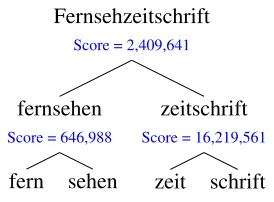
The granularity of the morphological analysis needed differs with the type of application. For MT, a compound should not be split deeper than into parts for which a translation is known, whereas for linguistic research, a deeper morphological analysis is desirable.
Fernsehzeitschrift
Score = 2,409,641
fernsehen
Score = 646,988
fern sehen
zeitschrift
Score = 16,219,561
zeit schrift
Figure 1:Linguistically motivated split
For example, while an MT system needs a binary split for the German Fernsehzeitschrift ‘television journal’, for a linguistic analysis, a split into four parts as given in Figure 1 is also valid and introduces etymological clues (e.g., how far is Zeit ‘time’ re-lated toZeitschrift‘journal’). Our flexible approach caters for all tasks1.
3.5 Constituent length balance
While compounds can be build up from almost any semantic concept pair, we observed a bias towards constituent pairs having a similar word length.
For the German, Dutch and Afrikaans compound splitting gold standards (described in Section 6.2) comprising m split compounds, we randomly re-combine all modifiers with all heads to a set ofm combinations. For both original compounds and re-combined compounds, we measure the character dif-ference in length between modifier and head form.
Compound set German Dutch Afrikaans
Original 2.62 2.26 2.87
[image:4.612.117.254.162.263.2]Recombination 3.43 2.74 2.92
Table 1:Average constituent length difference in characters
As shown in Table 1, all original compounds have a smaller difference than the recombinations.
There-1As the splitting depth is very dependent on the task at hand
and the gold standard we used is not created with a specific task in mind, we do not evaluate our system with respect to splitting depth but treat it as given. Our system cuts off subtrees with the lowest splitting score until the desired splitting depth is achieved.
fore, we decided to promote compound splits with more balanced constituent lengths.
4 Data preparation
4.1 Ngram index
As described in Section 3.1, we tolerantly retrieve candidate lemmas using an Ngram index, in order to limit the search space and allow for a quick can-didate lookup during splitting.
Ngram Lemma length (LL) Lemmas
ˆhund 4 hund#13162
ˆhund 11 hundef¨uhrer#251,
hundehalter#81, hundesteuer#64
ˆh*hn 4 hahn#2078,
huhn#1839, hohn#506
Table 2:Examples from the GermanNgram index
As search key, we useNgrams of variable length (N ≤ 15). Word-initialNgrams are indicated by ˆ and word-finalNgrams end on $. By usingNgrams, we are able to capture any kind of transformation a lemma can undergo when involved in compounding. Sometimes, a transformation includes a charac-ter replacement within the word (e.g., Umlautung). This leads to a very small set of Ngrams a con-stituent has in common with its underlying lemma. For example H¨uhner and Huhn only have the bi-gramsˆhandhnin common, which is also true for many irrelevant words such as ˆHaarschnitt ‘hair-cut’. In order to reduce noise and increase efficiency, we include the wildcard∗ for a single character in Ngrams2. This way, H¨uhner and Huhn have the common 5gramˆH*hn. As a further cue, we con-sider the lemma length (assuming that there is only a minor difference to the constituent’s length).
For a given lemmatized and PoS-tagged corpus, we index all content words (i.e., nouns, adjectives and verbs) by generating allNgrams and mapping them to a list of frequency-ranked lemma-freq pairs. Table 2 shows some examples for German3.
2For efficiency reasons, we add wildcardNgrams only for 3≤N≤7.
3Note that the lemmas include compounds, because these
[image:4.612.315.547.201.317.2]Language MOP Corpus frequency Examples
[image:5.612.69.553.62.135.2]German u/¨u:$/er$um$/en$ 117K264K <Studium, Studien<Huhn, H¨uhner>>‘study’,‘chicken’,<Medium, Medien<Buch, B¨ucher>>‘book’‘medium’ Dutch $/en$ 1.6M <arts, artsen>‘doctor’,<band, banden>‘tyre’ Afrikaans $/se$ 34K <proses, prosesse>‘process’
Table 3:Examples of MOPs for German, Dutch and Afrikaans
4.2 Morphological operation patterns
Macherey et al., (2011) describe a representation of compounding morphology using a single character replacement at either the beginning, the middle or the end of a word. For our experiments, we adopt this format. Since it is possible that a morpholog-ical operation takes place at several positions of a word, we combine all atomic replacements into a pattern describing a series of operations. This trans-formation from a word Σ to a word Ω is referred to as morphological operation pattern (MOP). For compiling an MOP, we use the Levenshtein edit dis-tance algorithm including the four operations IN -SERT (adding a character), DELETE (removing a
character), REPLACE(exchanging a characterσi by ωi) and COPY (retaining a character). In a back-trace step, we determine the first set of operations that lead to a minimum edit distance. Except for
COPY, we interpret all operations as replacements
(insertion and deletion are replacements of or by an empty element respectively). We merge all adja-cent replacements by concatenating the source and target characters. Word-initial source and target se-quences start with ˆ and word-final sese-quences end on $. Sequences of adjacentCOPYoperations are
repre-sented by ‘:’ and separate the merged replacements. For example, inH¨uhner|suppe, the modifier lemma
Huhn is transformed to H¨uhner by replacing u by
¨u(i.e., Umlautung) and adding the suffix er. The corresponding MOP is ‘u/¨u:$/er$’. The second column in Table 3 shows some additional German, Dutch and Afrikaans examples of MOPs.
As discussed in Section 3.2, we try to approxi-mate compounding MOPs using inflectional MOPs. In a lemmatized corpus, for each lemmatized word token, we determine the MOP that represents the transformation from lemma to word form. We col-lect all infcol-lectional MOPs with their token-based corpus frequency. The third column in Table 3
shows the corpus frequencies for the corresponding MOPs.
5 Compound splitting method
Our compound splitter can process compounds composed of any content word type (i.e., nouns, verbs and adjectives) and of any number of con-stituents, and provides both the split points (e.g.,
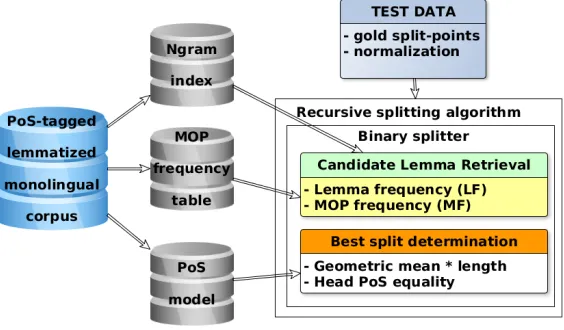
H¨uhner|suppe) and the normalized constituents (e.g.,Huhn+Suppe). The splitter is designed recur-sively, which allows us to represent the compound split both hierarchical (i.e., as a tree structure) and as a linear sequence. Figure 2 shows the architecture of our splitting algorithm. The recursive main method starts with the target word as a single constituent and recursively splits the constituents produced by the binary splitter (Section 5.1) until an atomic result is returned. The binary splitter has two subtasks: (1) for each potential constituent form, a set of candi-date lemmas is retrieved (Section 5.2) and (2) all candidate lemma combinations are ranked and the best split is returned (Section 5.3).
5.1 Binary splitter
We first generate all possible binary splits with a minimum constituent length of 2 (e.g., for ¨Olpreis ‘oil price’, we generate ¨Ol|preis, . . . , ¨Olpre|is) and add a non-split option. For each potential constituent among the generated splits, we retrieve theM most probable lemmas as described in Section 5.2. We consider allM2lemma combinations of all possible splits and rank them as described in Section 5.3. The highest-ranked split is returned.
5.2 Candidate lemma retrieval
in-Figure 2:Architecture of our splitting algorithm
dex first, thereby following the assumption that there is only a minor string difference between lemma and constituent form (cf. Section 3.1). In a second step, the inflectional MOPs are used to rank the candi-date lemmas. While following this order, we put less weight on our approximation and thereby avoid false lemmas due to irrelevant inflectional MOPs. The pseudocode for the candidate lemma retrieval is given in Algorithm 1.
Algorithm 1Candidate lemma retrieval
1: Constituentc
2: LLs←lemma lengths,±∆around len(c) 3: CLs←[ ] .the candidate lemmas 4: forL←len(c)to1do
5: LGs←generate allLgrams ofc 6: forLg inLGsdo
7: CLs←CLs+ topλ(IDX[Lg][LLs]) 8: iflen(CLs)>1then
9: break .otherwise, L is decremented
10: score(CLs) .according to a lemma model 11: rank(CLs) .according to the scores
12: returntopM(CLs)
For a given constituent c, we search for lemmas with a minimum lemma length (LL) of 2 which ranges between ±∆ around the length of c (lines 1-2). All retrieved candidate lemmas are stored in the listCLs (line 3). Starting with the L = len(c), we inspect allLgrams ofc(lines 4-5). For a given Lgram, we retrieve the topλmost frequent lemmas that have a length±∆around the length ofc(lines
6-7). If there are no lemmas retrieved, we decre-mentL(lines 8-9)4. All retrieved candidate lemmas are scored (line 10) according to our lemma model, for which we present two lemma features.
LP(li) =cf(li)·count(li,CLs) (1) The first feature is based on the lemma promi-nence (LP) as given in (1), i.e., we multiply the cor-pus frequency (cf) of a lemma li (as given in the Ngram index) with the token number ofli in CLs (i.e., with the prominence ofli among all inspected Lgrams).
The second feature estimates the suitability of the MOP (MS) transforming the candidate lemma li to the constituent form at hand, c, (represented as ‘MOP[li, c]’), as given in (2). As the first com-ponent, we use the corpus frequency extracted with the inflectional MOPs as described in Section 4.2. We rescale the MOP frequency with the resulting edit distance between the candidate lemma li and the constituent form at hand, c, (represented as ED(li, c))5. As motivated in Section 3.1, we ex-pect MOPs having a small edit distance to be more prominent in compounding. Such MOPs are not necessarily most frequent in inflection, e.g., the fre-quent irregular Afrikaans verbwees(to be) leads to MOPs like MOP[wees,is] = ˆwee/ˆi, which has anEDof 3.
MS(li) = cfED(MOP(l [li, c])
i, c) + 1 (2)
4For noise reduction due to lemmatizer errors, we can
pre-define a minimum number ofLdecrements.
[image:6.612.158.440.61.226.2]All candidate lemmas are finally scored as prod-uct of lemma prominence and MOP suitability, as given in (3).
score(li) =LP(li)·MS(li) (3) We rank all candidate lemmas and return the top M candidates (lines 11-12).
5.3 Best split determination
In the final step, we determine the best split among all split combinations (i.e., pairs of retrieved can-didate lemmas for modifier (lm) and head (lh), and corresponding split point) and the non-split option. For this task, we use a combination model, which considers the interaction between lm and lh. In-spired by Koehn and Knight (2003), as a first fea-ture, we take the geometric mean of the products of lemma score multiplied by the length of the cor-responding constituent form, as given in (4). The length factor promotes splits with more balanced lengths (as motivated in Section 3.5), which miti-gates the impact of short and high-frequent words on the overall score. For binary splits, we use the constituent setcon= {lm, lh}and for the non-split option, we usecon={lh}.
geoLen(con) = |con|
s Y
li∈con
score(li)·len(cli) (4)
The second feature is based on the assumption that the PoS of a compound wordΨusually equals the PoS of its headlh, as discussed in Section 3.3. Since our splitter works out of context, we try to subsume all possible PoS tags by representing them as a distribution over the PoS probabilities p(PoS|word) = freq(P oSfreq(word)∩word) acquired from the monolingual PoS-tagged corpus. The value of the head-PoS-equality (hEQ) feature is defined as the the cosine similarity between the PoS probability distributions of compound word Ψ and head lh, hEQ(Ψ, lh). If the PoS tag of the compound is un-known, we take 1.0 as default value.
split(con) =geoLen(con)·hEQ(Ψ, lh) (5)
Finally, all candidate lemma combinations (in-cluding the non-split option) are ranked according to the splitting score given in (5). The highest-scored split is returned as output of the binary splitter, being
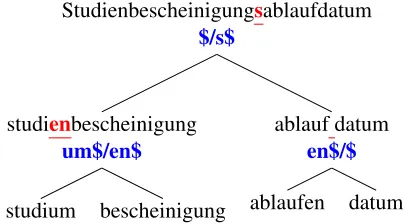
subject to the recursive process. Figure 3 shows an example of the recursive splitter output for the Ger-man compoundStudienbescheinigungsablaufdatum
‘enrollment certification expiration date’ with the re-lated MOPs.
Studienbescheinigungsablaufdatum $/s$
studienbescheinigung um$/en$
studium bescheinigung
ablauf datum en$/$
[image:7.612.329.531.139.251.2]ablaufen datum
Figure 3:Example of a split tree structure with related MOPs
6 Experiments
In our experiments, we focus on German, Dutch and Afrikaans, but expect to see similar performance for other Germanic languages.
6.1 Data
We use the German and Dutch version of Wikipedia6 and the Afrikaans Taalkommissie cor-pus7. For tokenizing, PoS-tagging and lemmatizing Wikipedia, we use Treetagger (Schmid, 1995).
Corpus # tokens # types
language words words lemmas MOPs
German 665M 9.0M 8.8M 1201
Dutch 114M 2.0M 1.9M 920
[image:7.612.314.543.436.522.2]Afrikaans 57M 748K 696K 459
Table 4:Corpus statistics
We tokenize the Taalkommissie corpus using the approach of Augustinus and Dirix (2013). We PoS-tag the corpus using the tool described in Eiselen and Puttkammer (2014) and use the lemmatizer of Peter Dirix, the second author of the previous paper.
Table 4 shows some statistics of the three prepro-cessed corpora. Since the Afrikaans corpus is one order of magnitude smaller than the German corpus, we expect a lower performance for the Afrikaans splitter.
6{de,nl}.wikipedia.org
7Taalkommissie van die Suid-Afrikaanse Akademie vir
System @1 SPAcc@2 @3 @1 NormAcc@2 @3
(A) LP.MSinfl 95.2%B,C 98.9%B,C 99.4%B,C 86.6% 94.6%B,C 96.5%B,C
(B) WH2012 93.3% 95.6% 95.7% 81.0% 85.9% 86.4%
(C) FF2010 91.4% 92.3% 93.0% 88.4%A,B 89.7% 90.2%
(D) LP.∅ 54.1% 70.5% 78.4% 28.4% 42.6% 50.8%
(E) LP.MSLanger 94.5% 98.7% 99.1% 87.1% 94.2% 95.4%
[image:8.612.92.522.59.180.2](F) LP.MSGS 95.4% 99.0% 99.4% 87.8% 95.6% 97.2%
Table 5:German results for binary compound splitting, scoresδΦoutperform the systemΦsignificantly
6.2 Gold standard
For evaluating our splitting method on German, we use the binary split compound set developed for GermaNet8 by Henrich and Hinrichs (2011). After removing hyphenated compounds9, it com-prises 51,230binary split samples. ForDutch and
Afrikaans, we use the split point gold standards de-veloped by Verhoeven et al., (2014), which comprise
21,941samples for Dutch and17,369for Afrikaans.
6.3 Evaluation measures
We evaluate the splitting quality with respect to two disciplines: (1) determination of the correct split points and (2) normalization of the resulting mod-ifier constituents10. For both disciplines, we use the accuracy measure as described in Koehn and Knight (2003). The split point accuracy (SPAcc) refers to the correctness of the split points (on word level) and the normalization accuracy (NormAcc) mea-sures the amount of both correct split points and modifier lemmas. All systems presented in this pa-per provide a ranked list of splits. This allows for a more fine-grained ranking evaluation of the binary splitting decisions with respect to the first n posi-tions. Accuracy@nrefers to the amount of correct splits among the topnsplits. We stop atn= 3, be-cause we do not expect to see a crucial difference in the performance gap for higher values ofn.
8sfs.uni-tuebingen.de/GermaNet
9We consider hyphenated compounds as trivial cases of
splitting that can be disregarded for our purpose.
10Since for Germanic languages compounding morphology
is exclusively found on the modifier, we disregard the head.
6.4 Parameter setting and models in comparison
There are three parameters presented in the candi-date lemma retrieval. For efficiency reasons, we set the number of lemmas retrieved perLgram and lemma length (λ) to 20 and the final number of re-trieved candidate lemmas (M) to 3. For the maxi-mum difference in length between lemma and con-stituent form, we observed that ∆ = 2 covers all compounding operations for Germanic languages.
For German, we compare our system based on in-flectional MOPs (LP.MSinfl) against the LP baseline
(LP.∅), which lacks a linguistic restrictor after can-didate lemma lookup from theNgram index, against an upper bound (LP.MSGS), which uses the MOPs
and frequencies derived from the normalizations in the gold standard and against a version that uses a hand-crafted set of MOPs and frequencies derived from Langer’s (1998) set of fillers (LP.MSLanger). In
addition, we compare our system against previous work: the splitting methods of Fritzinger and Fraser (2010) and of Weller and Heid (2012)11. For Dutch and Afrikaans, we compare with the SPAcc numbers of Verhoeven et al., (2014).
6.5 Results and discussion
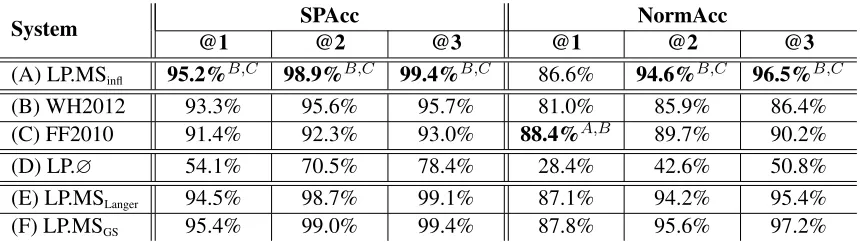
Table 5 shows the German results for the binary compound splitting. We present the split point accu-racy (SPAcc) and the normalization accuaccu-racy (Nor-mAcc) for the splits ranked @1-3. We first compare LP.MSinfl against the previous work of FF2010 and
WH2012. Our system significantly12 outperforms both systems with respect to SPAcc and reaches
11We use an updated version of Weller and Heid (2012)
de-veloped and provided to us by Marion Di Marco.
99.4% for SPAcc@3. While for NormAcc@1 our splitter’s performance is less than 2 percentage point lower than the system of FF2010, which heavily lies on language-dependent and knowledge-rich re-sources, we significantly outperform both systems in comparison for NormAcc@2 and NormAcc@3. This proves that one can attain state-of-the-art per-formance on compound splitting by using language-independent and unsupervised methods, and in par-ticular by means of inflectional information.
In an error analysis, it turned out that FF2010 (i.e.,SMOR) cannot process 2% of the gold samples.
However on a common processable test set, we still find our system to outperform FF2010 significantly, which indicates that the difference in performance is not just a matter of coverage. WH2012 leaves several compounds unsplit, for which our splitter provides the correct analysis. This is partly due to the hand-crafted transition rules of WH2012, which cannot capture all morphological operations, such as inHilfs|bereitschaft‘cooperativeness’, for which the MOP e$/s$(i.e., the combination ofe-truncation and s-suffixation) is not even covered by Langer’s (1998) published collection.
To evaluate whether our assumption about the us-ability of inflectional MOPs holds, we run some con-trolled experiments with two variants of our system, shown in the last two lines of Table 5. The exhaus-tive set of inflectional MOPs (LP.MSinfl) shows
com-petitive performance in SPAcc with the hand-crafted set of Langer (1998) (LP.MSLanger) and with the upper
bound (LP.MSGS). The latter outperforms LP.MSinfl
by only 1 percentage point in NormAcc.
Our separate evaluation of SPAcc and NormAcc reveals a lower performance for the normalization across all systems, as this is a much harder disci-pline. In addition, we can conclude that normal-ization requires more linguistic knowledge: while the LP-baseline (LP.∅) underperforms heavily, both FF2010 and LP.MSLanger, systems with a lot of lex-ical and morphologlex-ical information, outperform all systems in comparison at NormAcc@1.
For illustrating the multilingual applicability of our splitter, we perform an experiment on Dutch and Afrikaans. Table 6 shows the SPAcc13 results for
13The Dutch and Afrikaans gold standard only provides split
points and no reliable normalized constituents.
N-ary splits. While Verhoeven et al., (2014) use a supervised approach for predicting the correct split points, our unsupervised splitter outperforms their
Dutchresults significantly14. Although Dutch and Afrikaans are similar languages, the SPAcc achieved by our system forAfrikaansis 3.6% worse than the method presented by Verhoeven et al., (2014). This result is partly due to the crucial corpus size differ-ences presented in Table 4.
System Dutch Afrikaans
LP.MSinfl 93.4% 84.7%
[image:9.612.326.526.193.239.2]Verh.et.al.2014 91.5% 88.3%
Table 6:SPAcc results forN-ary splits in Dutch and Afrikaans
7 Conclusion
We presented a language-independent, unsupervised compound splitter based on inflectional morphology that significantly outperforms state-of-the-art meth-ods in finding the correct split points, relying only on monolingual PoS-tagged and lemmatized corpora. We provided a comprehensive, intrinsic evaluation of several systems in comparison for several lan-guages on two separate disciplines: split point deter-mination and constituent normalization. As a result, we draw the conclusions that inflectional morphol-ogy is a practical approximation for compounding in Germanic languages and overcomes the neces-sity of manual input, because both hand-crafted sets of compounding operations and operations derived from the gold standard lead to small differences in performance only. In future work, we plan to adapt our methods for learning compounding morphology for languages such as Greek, that have a special compound marker.
Acknowledgments
We thank the anonymous reviewers for their help-ful feedback. We also thank our colleague Stefan M¨uller for the discussions and feedback, and Marion Di Marco and Fabienne Cap for providing their split-ting methods. This research was funded by the Ger-man Research Foundation (Collaborative Research Centre 732, Project D11).
References
Liesbeth Augustinus and Peter Dirix. 2013. The IPP ef-fect in Afrikaans: A Corpus Analysis. InProceedings of the 19th Nordic Conference of Computational Lin-guistics (NODALIDA 2013), pages 213–225.
Marco Baroni, Johannes Matiasek, and Harald Trost. 2002. Predicting the Components of German Nomi-nal Compounds. InECAI, pages 470–474. IOS Press. Claudia Bretschneider and Sonja Zillner. 2015.
Seman-tic Splitting of German Medical Compounds. InText, Speech, and Dialogue. Springer International Publish-ing.
Roald Eiselen and Martin J. Puttkammer. 2014. De-veloping Text Resources for Ten South African Lan-guages. In Proceedings of the 9th International Conference on Language Resources and Evaluation (LREC 2014), pages 3698–3703.
Carla Parra Escart´ın. 2014. Chasing the Perfect Splitter: A Comparison of Different Compound Splitting Tools. InLREC 2014.
Fabienne Fritzinger and Alexander Fraser. 2010. How to Avoid Burning Ducks: Combining Linguistic Analysis and Corpus Statistics for German Compound Process-ing. InProceedings of the ACL 2010 Joint 5th Work-shop on Statistical Machine Translation and Metrics MATR, pages 224–234.
Verena Henrich and Erhard W. Hinrichs. 2011. Deter-mining Immediate Constituents of Compounds in Ger-maNet. InRANLP 2011, pages 420–426.
Philipp Koehn and Kevin Knight. 2003. Empirical meth-ods for compound splitting. InEACL.
Stefan Langer. 1998. Zur Morphologie und Semantik von Nominalkomposita. InKONVENS.
Klaus Macherey, Andrew M. Dai, David Talbot, Ashok C. Popat, and Franz Och. 2011. Language-independent Compound Splitting with Morphological Operations. InACL HLT 2011.
Christopher D. Manning, Prabhakar Raghavan, and Hin-rich Sch¨utze. 2008. Introduction to Information Re-trieval. Cambridge University Press, New York, NY, USA.
Mariikka Haapalainen and Ari Majorin. 1995. GERT-WOL und Morphologische Disambiguierung f¨ur das Deutsche. Technical report.
Sonja Nießen and Hermann Ney. 2000. Improving SMT quality with morpho-syntactic analysis. InCOLING 2000, pages 1081–1085.
Helmut Schmid, Arne Fitschen, and Ulrich Heid. 2004. SMOR: A German Computational Morphology Cov-ering Derivation, Composition, and Inflection. In
LREC 2004, pages 1263–1266.
Helmut Schmid. 1995. Improvements in Part-of-Speech Tagging with an Application to German. In ACL SIGDAT-Workshop.
Sara Stymne. 2008. German Compounds in Factored Statistical Machine Translation. InGoTAL.
Taalkommissie van die Suid-Afrikaanse Akademie vir Wetenskap en Kuns. 2011. Taalkommissiekorpus 1.1. Technical report, CTexT, North West University, Potchefstroom.
Ben Verhoeven, Menno van Zaanen, Walter Daelemans, and Gerhard B van Huyssteen. 2014. Automatic Com-pound Processing: ComCom-pound Splitting and Seman-tic Analysis for Afrikaans and Dutch. InComAComA 2014, pages 20–30.
Marion Weller and Ulrich Heid. 2012. Analyzing and Aligning German compound nouns. InLREC 2012. Alexander Yeh. 2000. More Accurate Tests for the