Redefining Context Windows for Word Embedding Models:
An Experimental Study
Pierre Lison
Norwegian Computing Center Oslo, Norway
Andrei Kutuzov Language Technology Group
University of Oslo
Abstract
Distributional semantic models learn vec-tor representations of words through the contexts they occur in. Although the choice of context (which often takes the form of a sliding window) has a direct in-fluence on the resulting embeddings, the exact role of this model component is still not fully understood. This paper presents a systematic analysis of context windows based on a set of four distinct hyper-parameters. We train continuous Skip-Gram models on two English-language corpora for various combinations of these hyper-parameters, and evaluate them on both lexical similarity and analogy tasks. Notable experimental results are the pos-itive impact of cross-sentential contexts and the surprisingly good performance of right-context windows.
1 Introduction
Distributional semantic models represent words through real-valued vectors of fixed dimen-sions, based on the distributional properties of these words observed in large corpora. Re-cent approaches such as prediction-based models (Mikolov et al., 2013b) andGloVe(Pennington et al., 2014) have shown that it is possible to esti-mate dense, low-dimensional vectors (often called embeddings) able to capture various functional or topical relations between words. These embed-dings are used in a wide range of NLP tasks, including part-of-speech tagging, syntactic pars-ing, named entity recognition and semantic role labelling; see (Collobert et al., 2011; Lin et al., 2015; Zhou and Xu, 2015; Lample et al., 2016), among others.
As recently shown by (Levy et al., 2015), the empirical variations between embedding models
are largely due to differences in hyper-parameters (many of which are tied to the underlying defini-tion of context) rather than differences in the em-bedding algorithms themselves. In this paper, we further develop their findings with a comprehen-sive analysis of the role played by context window parameters when learning word embeddings. Four specific aspects are investigated:
1. Themaximum sizeof the context window; 2. The weighting scheme of context words
ac-cording to their distance to the focus word; 3. The relative positionof the context window
(symmetric, left or right side);
4. The treatment of linguistic boundaries such as end-of-sentence markers.
The next section 2 provides a brief overview on word embeddings and context windows. Section 3 describes the experimental setup used to evaluate the influence of these four aspects. Finally, Sec-tion 4 presents and discusses the results.
2 Background
The works of (Bengio et al., 2003) and (Mikolov et al., 2013b) introduced a paradigm-shift for dis-tributional semantic models with new prediction-based algorithms outperforming the existing count-based approaches (Baroni et al., 2014). The word2vec models from (Mikolov et al., 2013b), comprising the Continuous Skip-gram and the Continuous Bag-of-Words algorithms, are now a standard part of many NLP pipelines.
Despite their differences, all types of distribu-tional semantic models require the definition of a context for each word observed in a given cor-pus. Given a set of (word, context) pairs extracted from the corpus, vector representations of words can be derived through various estimation meth-ods, such as predicting words given their contexts
(CBOW), predicting the contexts from the words (Skip-Gram), or factorizing the log of their co-occurrence matrix (GloVe). In all of these ap-proaches, the choice of context is a crucial factor that directly affects the resulting vector representa-tions. The most common method for defining this context is to rely on awindowcentered around the word to estimate (often called the focus word)1.
The context window thus determines which con-textual neighbours are taken into account when es-timating the vector representations.
The most prominent hyper-parameter associ-ated to the context window is the maximum win-dow size (i.e. the maximum distance between the focus word and its contextual neighbours). This parameter is the easiest one to adjust using exist-ing software, which is why it is comparatively well studied. Larger windows are known to induce em-beddings that are more ‘topical’ or ‘associative’, improving their performance on analogy test sets, while smaller windows induce more ‘functional’ and ‘synonymic’ models, leading to better perfor-mance on similarity test sets (Goldberg, 2016).
However, the context window is also affected by other, less obvious hyper-parameters. Inside a given window, words that are closer to the fo-cus word should be given more weights than more distant ones. To this end, CBOW and Continu-ous Skip-gram rely on a dynamic window mech-anism where the actual size of the context win-dow is sampled uniformly from 1 to L, where L is the maximum window size. This mechanism is equivalent to sampling each context wordwjwith
a probability that decreases linearly with the dis-tance|j−i|to the focus wordwi:
P(wj|wi) = L
∑
window=1P(wj|wi,window)P(window)
=1
L(L− |j−i|+1)
wherewindowis the actual window size (from 1 toL) sampled by the algorithm. Similarly, the co-occurrence statistics used by GloVe rely on har-monic series where words at distance d from the focus word are assigned a weight 1
d. For example,
with the window size 3, the context word at the position 2 will be sampled with the probability of
2/3inword2vecand the probability of1/2inGloVe.
1Other types of context have been proposed, such as dependency-based contexts (Levy and Goldberg, 2014) or multilingual contexts (Upadhyay et al., 2016), but these are outside the scope of the present paper.
Another implicit hyper-parameter is the sym-metric nature of the context window. The word2vecandGloVemodels pay equivalent atten-tion to the words to the left and to the right of the focus word. However, the relative importance of left or right contexts may in principle depend on the linguistic properties of the corpus language, in particular its word ordering constraints.
Finally, although distributional semantic mod-els do not themselves enforce any theoretical limit on the boundaries of context windows, word em-beddings are in practice often estimated on a sen-tence by sensen-tence basis, thus constraining the con-text windows to stop at sentence boundaries. How-ever, to the best of our knowledge, there is no sys-tematic evaluation of how this sentence-boundary constraint affects the resulting embeddings.
3 Experimental setup
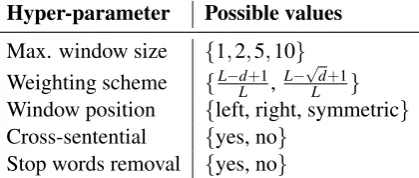
To evaluate how context windows affect the em-beddings, we trained Continuous Skip-gram with Negative Sampling (SGNS) embeddings for var-ious configurations of hyper-parameters, whose values are detailed in Table 1. In particu-lar, the “weighting scheme” encodes how the context words should be weighted according to their distance with the focus word. This hyper-parameter is given two possible values: a lin-ear weighting scheme corresponding to the default word2vecweights, or an alternative scheme using the squared root of the distance.
Hyper-parameter Possible values Max. window size {1,2,5,10}
Weighting scheme {L−d+1
L , L−
√ d+1
L }
Window position {left, right, symmetric} Cross-sentential {yes, no}
[image:2.595.310.520.506.595.2]Stop words removal {yes, no}
Table 1: Range of possible hyper-parameter values evaluated in the experiment.
21.7 tokens) while OpenSubtitles is a conversa-tional corpus (average sentence length 7.3 tokens). OpenSubtitles notably contains a large number of non-sentential utterances, which are utterances lacking an overt predicate and depend on the sur-rounding dialogue context for their interpretation (Fern´andez, 2006). The corpora were lemma-tized and POS-tagged with the Stanford CoreNLP (Manning et al., 2014) and each token was re-placed with its lemma and POS tag. Two versions of the corpora were used for the evaluation: one raw version with all tokens, and one filtered ver-sion after removal of stop words and punctuation. The word embeddings were trained with 300-dimensional vectors, 10 negative samples per word and 5 iterations. Very rare words (less than 100 occurrences in Gigaword, less than 10 in OpenSubtitles) were filtered out. The models were then evaluated using two standard test work-flows: Spearman correlation against SimLex-999 semantic similarity dataset (Hill et al., 2015) and accuracy on the semantic sections of the Google Analogies Dataset (Mikolov et al., 2013a).
4 Results
All in all, we trained 96 models on Gigaword (GW) and 96 models on OpenSubtitles (OS)2.
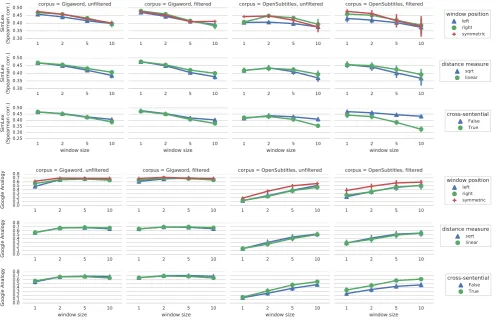
Fig-ure 1 illustrates the results for the SGNS embed-dings on lexical similarity and analogy tasks using various types of context windows. The main find-ings from the experiments are as follows.
Window size
As expected for a lexical similarity task (Sch¨utze and Pedersen, 1993), narrow context windows per-form best with the SimLex999 dataset, which con-tains pairs of semantically similar words (not just related). For the analogy task, larger context win-dows are usually beneficial, but not always: the word embeddings trained on OpenSubtitles per-form best with the window size of 10, while the best results on the analogy task for Gigaword are obtained with the window size of 2.
Window position
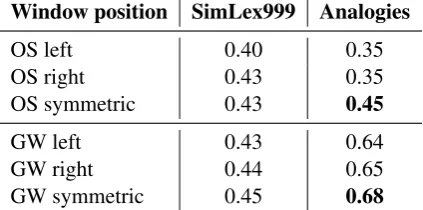
Table 2 shows how the position of the context win-dow influences the average model performance. Note that symmetric windows of, for instance, 10 are in fact 2 times larger than the ‘left’ or ‘right’ 2Encompassing different values of window size, weight-ing scheme, window position, cross-sentential boundaries and stop-words removal (4×2×3×2×2=96).
Window position SimLex999 Analogies
OS left 0.40 0.35
OS right 0.43 0.35
OS symmetric 0.43 0.45
GW left 0.43 0.64
GW right 0.44 0.65
[image:3.595.308.520.63.168.2]GW symmetric 0.45 0.68
Table 2: Average performance across all models depending on the window position.
windows of the same size, as they consider 10 words both to the left and to the right of the focus word. This is most likely why symmetric windows consistently outperform ‘single-sided’ ones on the analogy task, as they are able to include twice as much contextual input.
However, the average performance on the se-mantic similarity task (as indicated by the Spear-man correlation with the SimLex999 test set) does not exhibit the same trend. ‘Left’ windows are in-deed worse than symmetric ones, but ‘right’ win-dows are on par with the symmetric winwin-dows for OpenSubtitles and only one percent point behind them for Gigaword. It means that in many cases (at least with English texts) taking into account onlyncontext words to the right of the focus word is sufficient to achieve the same performance with SimLex999 as by using a model which addition-ally considersnwords to the left, and thus requires significantly more training time.
Cross-sentential contexts
The utility of cross-sentential contexts depends on several covariates, most importantly the type of corpus and the nature of the evaluation task. For similarity tasks, cross-sentential contexts do not seem useful, and can even be detrimental for large window sizes. However, for analogy tasks, cross-sentential contexts lead to improved results thanks to the increased window it provides. This is espe-cially pronounced for corpora with short sentences such as OpenSubtitles (see Table 3).
Weighting scheme
1 2 5 10 0.30
0.35 0.40 0.45 0.50
SimLex
(Spearman corr.)
corpus = Gigaword, unfiltered
1 2 5 10
corpus = Gigaword, filtered
1 2 5 10
corpus = OpenSubtitles, unfiltered
1 2 5 10
corpus = OpenSubtitles, filtered
window position left right symmetric
1 2 5 10
0.30 0.35 0.40 0.45 0.50
SimLex
(Spearman corr.) 1 2 5 10 1 2 5 10 1 2 5 10
distance measure sqrt linear
1 2 5 10
window size 0.25
0.30 0.35 0.40 0.45 0.50
SimLex
(Spearman corr.) 1 2 5 10
window size 1 window size2 5 10 1 window size2 5 10
cross-sentential False True
1 2 5 10
0.0 0.1 0.2 0.3 0.4 0.5 0.6 0.7 0.8
Google Analogy
corpus = Gigaword, unfiltered
1 2 5 10
corpus = Gigaword, filtered
1 2 5 10
corpus = OpenSubtitles, unfiltered
1 2 5 10
corpus = OpenSubtitles, filtered
window position left right symmetric
1 2 5 10
0.0 0.1 0.2 0.3 0.4 0.5 0.6 0.7 0.8
Google Analogy 1 2 5 10 1 2 5 10 1 2 5 10
distance measure sqrt linear
1 2 5 10
window size 0.0
0.1 0.2 0.3 0.4 0.5 0.6 0.7 0.8
Google Analogy 1 2 5 10
window size 1 window size2 5 10 1 window size2 5 10
[image:4.595.55.552.64.385.2]cross-sentential False True
Figure 1: Results for the SGNS word embeddings trained with various types of context windows.
Cross-sentential SimLex999 Analogies
OS False 0.44 0.34
OS True 0.40 0.43
GW False 0.44 0.66
GW True 0.44 0.65
Table 3: Average performance across all models with and without cross-sentential contexts.
increases the number of context words to con-sider for each focus word), decreasing the train-ing speed about 25% with window size 5. Thus, the original linear weighting scheme proposed in (Mikolov et al., 2013b) should be preferred. Stop words removal
As shown in Table 4, the removal of stop words does not really influence the average model perfor-mance for the semantic similarity task. The anal-ogy task, however, benefits substantially from this filtering, for both corpora. Although not shown in the table, filtering stop words also significantly de-creases the size of the corpus, thereby reducing the total time needed to train the word embeddings.
Stop words removal SimLex999 Analogies
OS no removal 0.41 0.34
OS with removal 0.42 0.43
GW no removal 0.44 0.64
[image:4.595.306.533.431.512.2]GW with removal 0.44 0.68 Table 4: Average performance across all models depending on the removal of stop words.
5 Conclusion
Our experiments demonstrate the importance of choosing the right type of context window when learning word embedding models. The two most prominent findings are (1) the positive role of cross-sentential contexts and (2) the fact that, at least for English corpora, right-side contexts seem to be more important than left-side contexts for similarity tasks, and achieve a performance com-parable to that of symmetric windows.
[image:4.595.73.282.432.513.2]References
Marco Baroni, Georgiana Dinu, and Germ´an Kruszewski. 2014. Don’t count, predict! a systematic comparison of context-counting vs. context-predicting semantic vectors. InProceedings of the 52nd Annual Meeting of the Association for Computational Linguistics (Volume 1: Long Papers), pages 238–247. Association for Computa-tional Linguistics.
Yoshua Bengio, Rejean Ducharme, and Pascal Vincent. 2003. A neural probabilistic language model. Jour-nal of Machine Learning Research, 3:1137–1155. Ronan Collobert, Jason Weston, L´eon Bottou, Michael
Karlen, Koray Kavukcuoglu, and Pavel Kuksa. 2011. Natural language processing (almost) from scratch. Journal of Machine Learning Research, 12(Aug):2493–2537.
Raquel Fern´andez. 2006. Non-Sentential Utterances in Dialogue: Classification, Resolution and Use. Ph.D. thesis, King’s College London.
Yoav Goldberg. 2016. A primer on neural network models for natural language processing. Journal of Artificial Intelligence Research, 57:345–420. Felix Hill, Roi Reichart, and Anna Korhonen. 2015.
Simlex-999: Evaluating semantic models with (gen-uine) similarity estimation. Computational Linguis-tics, 41(4):665–695.
Guillaume Lample, Miguel Ballesteros, Sandeep Sub-ramanian, Kazuya Kawakami, and Chris Dyer. 2016. Neural architectures for named entity recog-nition. In Proceedings of the 2016 Conference of the North American Chapter of the Association for Computational Linguistics: Human Language Tech-nologies, pages 260–270, San Diego, California, June. Association for Computational Linguistics. Omer Levy and Yoav Goldberg. 2014.
Dependency-based word embeddings. InProceedings of the 52nd Annual Meeting of the Association for Computa-tional Linguistics, ACL 2014, pages 302–308. Omer Levy, Yoav Goldberg, and Ido Dagan. 2015.
Im-proving distributional similarity with lessons learned from word embeddings. Transactions of the Associ-ation for ComputAssoci-ational Linguistics, 3:211–225. Chu-Cheng Lin, Waleed Ammar, Chris Dyer, and Lori
Levin. 2015. Unsupervised pos induction with word embeddings. InProceedings of the 2015 Conference of the North American Chapter of the Association for Computational Linguistics: Human Language Technologies, pages 1311–1316, Denver, Colorado, May–June. Association for Computational Linguis-tics.
P. Lison and J. Tiedemann. 2016. Opensubtitles2016: Extracting large parallel corpora from movie and TV subtitles. InProceedings of the 10th International Conference on Language Resources and Evaluation (LREC 2016), pages 923–929.
Christopher D. Manning, Mihai Surdeanu, John Bauer, Jenny Finkel, Steven J. Bethard, and David Mc-Closky. 2014. The Stanford CoreNLP natural lan-guage processing toolkit. InAssociation for Compu-tational Linguistics (ACL) System Demonstrations, pages 55–60.
Tomas Mikolov, Kai Chen, Greg Corrado, and Jef-frey Dean. 2013a. Efficient estimation of word representations in vector space. arXiv preprint arXiv:1301.3781.
Tomas Mikolov, Ilya Sutskever, Kai Chen, Greg S Cor-rado, and Jeff Dean. 2013b. Distributed represen-tations of words and phrases and their composition-ality. In C. J. C. Burges, L. Bottou, M. Welling, Z. Ghahramani, and K. Q. Weinberger, editors, Ad-vances in Neural Information Processing Systems 26, pages 3111–3119. Curran Associates, Inc.
Robert Parker, David Graff, Junbo Kong, Ke Chen, and Kazuaki Maeda. 2011. English gigaword fifth edi-tion, June. LDC2011T07.
Jeffrey Pennington, Richard Socher, and Christo-pher D. Manning. 2014. GloVe: Global vectors for word representation. InEmpirical Methods in Nat-ural Language Processing (EMNLP), pages 1532– 1543.
Hinrich Sch¨utze and Jan Pedersen. 1993. A vector model for syntagmatic and paradigmatic relatedness. InProceedings of the 9th Annual Conference of the UW Centre for the New OED and Text Research, pages 104–113.
Shyam Upadhyay, Manaal Faruqui, Chris Dyer, and Dan Roth. 2016. Cross-lingual models of word embeddings: An empirical comparison. InProc. of ACL.