German Dialect Identification in Interview Transcriptions
Shervin Malmasi Harvard Medical School, USA Macquarie University, Australia
Marcos Zampieri University of Cologne
Germany
Abstract
This paper presents three systems submit-ted to the German Dialect Identification (GDI) task at the VarDial Evaluation Cam-paign 2017. The task consists of training models to identify the dialect of Swiss-German speech transcripts. The dialects included in the GDI dataset are Basel, Bern, Lucerne, and Zurich. The three sys-tems we submitted are based on: a plu-rality ensemble, a mean probability en-semble, and a meta-classifier trained on character and wordn-grams. The best re-sults were obtained by the meta-classifier achieving68.1%accuracy and66.2% F1-score, ranking first among the 10 teams which participated in the GDI shared task.
1 Introduction
German is well-known for its intrinsic dialectal variation. Standard national varieties spoken in Germany, Austria, and Switzerland co-exist with a number of dialects spoken in everyday communi-cation. The case of Switzerland is particular repre-sentative of this situation because of the multitude and importance of dialects which are widely spo-ken throughout the country.
The German Dialect Identification (GDI) task, part of the VarDial Evaluation Campaign 2017 (Zampieri et al., 2017), addressed the problem of German dialectal variation by providing a dataset of transcripts from interviews with speakers of Swiss German dialects from Basel, Bern, Lucern, and Zurich recorded within the scope of the Archi-Mob1 project (Samardˇzi´c et al., 2016). The goal
of the GDI task is to evaluate how well compu-tational methods can discriminate between these four Swiss German dialects.
1http://archimob.ch/
In this paper we present the entries submitted by the team MAZA to the GDI task 2017. We investigate different combinations of classifiers for the task, namely: a plurality ensemble method, a mean probability ensemble method, and a meta-classifier trained on character and wordn-grams.
2 Related Work
Processing dialectal data is a challenge for NLP applications. When dealing with non-standard language, systems are trained to recog-nize spelling and syntactic variation for further processing in applications such as Machine Trans-lation. In the case of German, a number of studies have been published on developing NLP tools and resources for processing non-standard language (Dipper et al., 2013), dealing with spelling varia-tion on dialectal data and carrying out spelling nor-malization (Samardˇzi´c et al., 2015), and improv-ing the performance of POS taggers for dialectal data (Hollenstein and Aepli, 2014).
The identification of Swiss German dialects, the topic of the GDI shared task, has been the focus of a few recent studies. Methods for German di-alect identification have proved to be particularly important for the validation of methods applied to the compilation of German dialect corpora (Scher-rer and Rambow, 2010a; Scher(Scher-rer and Rambow, 2010b; Hollenstein and Aepli, 2015).
The work presented here also relates to studies on the discrimination between groups of similar languages, language varieties, and dialects such as South Slavic languages (Ljubeˇsi´c et al., 2007), Portuguese varieties (Zampieri and Gebre, 2012), English varieties (Lui and Cook, 2013), Romanian dialects (Ciobanu and Dinu, 2016), Chinese vari-eties (Xu et al., 2016), and past editions of the DSL shared task (Zampieri et al., 2014; Zampieri et al., 2015; Malmasi et al., 2016c).
3 Methods and Data 3.1 Data
The GDI training/test data was extracted from the aforementioned ArchiMob corpus (Samardˇzi´c et al., 2016) which contains transcriptions of 34 in-terviews with native speakers of various German dialects spoken in Switzerland. The subset used for GDI contains 18 interviews (14 for training and 4 for testing) from four Swiss German dialects: Basel, Bern, Lucerne, and Zurich. No acoustic data was released with the transcriptions.
According to the information provided by the task organizers, each interview was transcribed us-ing the ‘Schwyzert¨utschi Dial¨aktschrift’ writus-ing system (Dieth, 1986). The interviews were di-vided into utterances and each utterance was con-sidered to be an instance to be classified by the systems. The training set contains a total of around 14,000 instances (114,000 tokens) and the test set contains a total of 3,638 instances (29,500 tokens). We approach the text using ensemble classi-fiers and a meta-classifier. In the next sections we describe the features and algorithms used in the MAZA submissions in detail.
3.2 Features
We employ two lexical surface feature types for this task, as described below.
• Charactern-grams:This is a sub-word fea-ture that uses the constituent characters that make up the whole text. When used as n -grams, the features aren-character slices of the text. From a linguistic point of view, the substrings captured by this feature, de-pending on the length, can implicitly capture various sub-lexical features including single letters, phonemes, syllables, morphemes and suffixes. In this study we examinen-grams of order1–6.
• Wordn-grams:The surface forms of words can be used as a feature for classification. Each unique word may be used as a feature (i.e. unigrams), but the use of bigram distri-butions is also common. In this scenario, the
n-grams are extracted along with their fre-quency distributions. For this study we eval-uate unigram features.
We did not pre-process2 the data prior to feature 2For example, case folding or tokenization.
extraction. This was not needed as the data are human-generated transcripts.
3.3 Classifier
For our base classifier we use a linear Support Vector Machine (SVM). SVMs have proven to de-liver very good performance in discriminating be-tween language varieties and in other text clas-sification problems,3 SVMs achieved first place
in both the 2015 (Malmasi and Dras, 2015a) and 2014 (Goutte et al., 2014) editions of the DSL shared task.4
3.4 Ensemble Classifiers
The best performing system in the 2015 edition of the DSL challenge (Malmasi and Dras, 2015a) used SVM ensembles evidencing the adequacy of this approach for the task of discriminating be-tween similar languages and language varieties. In light of this, we decided to test two ensemble methods. Classifier ensembles have also proven to be an efficient and robust alternative in other text classification tasks such as grammatical error detection (Xiang et al., 2015), and complex word identification (Malmasi et al., 2016a).
We follow the methodology described by Mal-masi and Dras (2015a): we extract a number of different feature types and train a single linear model using each feature type. Our ensemble was created using linear Support Vector Machine clas-sifiers. We used the seven feature types listed in Section 3.2 to create our ensemble of classifiers.
Each classifier predicts every input and also as-signs a continuous output to each of the possible labels. Using this information, we created the fol-lowing two ensembles.
• System 1 - Plurality Ensemble
In this system each classifier votes for a sin-gle class label. The votes are tallied and the label with the highest number5 of votes
wins. Ties are broken arbitrarily. This voting method is very simple and does not have any parameters to tune. An extensive analysis of this method and its theoretical underpinnings can be found in the work of (Kuncheva, 2004, p. 112). We submitted this system as run 1.
3For example, Native Language Identification is often
performed using SVMs (Malmasi and Dras, 2015b)
4See Goutte et al. (2016) for a comprehensive evaluation. 5This differs with amajorityvoting combiner where a
Input x
Classifier 1 with Parameters
θ1
Final Decision C1
h1(x, θ1)
Ck−1
hk(x, θk)
Ck
Ck−1
CT
First Level Base Classifiers
SecondLevel Meta Classifier
Classifier
T
+
1
with
Parameters
θT+
1
[image:3.595.164.434.63.268.2]hT(x, θT)
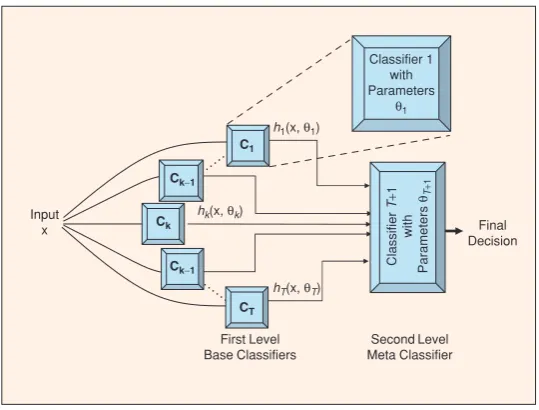
Figure 1: An illustration of a meta-classifier architecture. Image reproduced from Polikar (2006).
• System 2 - Mean Probability Ensemble
The probability estimates for each class are added together and the class label with the highest average probability is the winner. An important aspect of using probability outputs in this way is that a classifier’s support for the true class label is taken in to account, even when it is not the predicted label (e.g.
it could have the second highest probability). This method has been shown to work well on a wide range of problems and, in general, it is considered to be simple, intuitive, stable (Kuncheva, 2014, p. 155) and resilient to es-timation errors (Kittler et al., 1998) making it one of the most robust combiners discussed in the literature. We submitted this system as run 2.
3.5 Meta-classifier System
In addition to classifier ensembles, meta-classifier systems have proven to be very competitive for text classification tasks (Malmasi and Zampieri, 2016) and we decided to include a meta-classifier in our entry. Also referred to as classifier stacking. A meta-classifier architecture is generally com-posed of an ensemble of base classifiers that each make predictions for all of the input data. Their individual predictions, along with the gold labels are used to train a second-level meta-classifier that learns to predict the label for an input, given the decisions of the individual classifiers. This setup is illustrated in Figure 1. This meta-classifier at-tempts to learn from the collective knowledge
rep-resented by the ensemble of local classifiers. The first step in such an architecture is to create the set of base classifiers that form the first layer. For this we used the same seven base classifiers as our ensemble.
• System 3 - Meta-classifier
In this system we combined the probability outputs of our seven individual classifiers and used them to train a meta-classifier using 10-fold cross-validation. Following Malmasi et al. (2016b), we used a Random Forest as our meta-classification algorithm. We submitted this system as run 3.
4 Results
In this section we present results in two steps. First we comment on the performance obtained us-ing each feature type and the results obtained by cross-validation on the training set. Secondly, we present the official results obtained by our system on the test set and we discuss the performance of our best method in identifying each dialect.
4.1 Cross-validation Results
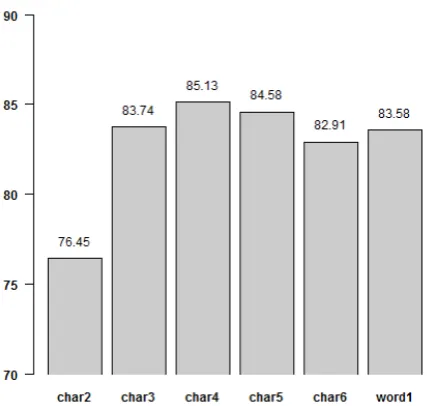
We first report our cross-validation results on the training data. We began by testing individual fea-ture types, charactersn-grams (2-6) and word un-igrams. Results are presented in Figure 2.
Figure 2: Cross-validation performance for each individual feature type (Y axis - Accuracy (%), X axis - Feature Type).
those obtained using word unigrams. The best re-sults were obtained with character 4-grams achiev-ing85.13%accuracy. As transcriptions have been carried out using the same transcription method, character unigrams were not very informative fea-tures for the classifier achieving much lower per-formance than the other feature types, 52.02% ac-curacy. For this reason, character unigrams were not included in Figure 2
We next tested our ensemble and meta-classifier configurations on the training data. Accuracy re-sults are shown in Table 1.
System Accuracy
Majority Class Baseline 0.2738 Voting Ensemble (System 1) 0.8621 Probability Ensemble (System 2) 0.8674 Meta-Classifier (System 3) 0.8725
Table 1: Cross-validation results for the German training data.
We note that all of these methods outperform any individual feature type, with the meta-classifier achieving the best result of 87.2% accuracy and the two ensemble methods achieving comparable performance of86.2%and86.7%accuracy. With this information in hand we proceed to the test set evaluation.
4.2 Test Set Results
In this section we report the results of our three submissions generated from the unlabelled test data. The samples in the test set were slightly un-balanced with a majority class baseline of25.8%.
The performance of all participants was evalu-ated by the shared task organizers and a more de-tailed description of the results is presented in the VarDial Evaluation Campaign report (Zampieri et al., 2017). Teams were ranked according to the weighted F1-score which provides a balance be-tween precision and recall. We present the ranks with the best results for each team in Table 2.
MAZA achieved the best performance overall with66.2%weighted F1-score. It is important to note that this rank is based on absolute scores. In the shared task report (Zampieri et al., 2017), orga-nizers are likely to calculate ranks with statistical significance tests, which is a common practice in other shared tasks such as the DSL 2016 (Malmasi et al., 2016c) and the shared tasks from WMT (Bo-jar et al., 2016).
Rank Team F1 (weighted)
1 MAZA 0.662
2 CECL 0.661
3 CLUZH 0.653
4 qcri mit 0.639
5 unibuckernel 0.637
6 tubasfs 0.626
7 ahaqst 0.614
8 Citius Ixa Imaxin 0.612
9 XAC Bayesline 0.605
10 deepCybErNet 0.263
Table 2: GDI Closed Submission Results
Accuracy, along with macro- and micro-averaged F1-scores obtained by the three runs submitted by MAZA are presented in Table 3. We observe that the results follow the same relative pattern as the cross-validation results, with the meta-classifier achieving the best result and ranking first among the 10 teams that participated in the GDI task.
[image:4.595.310.521.394.548.2]System Accuracy F1 (micro) F1 (macro) F1 (weighted)
Majority Class Baseline 0.258 — — —
Voting Ensemble (run1) 0.649 0.649 0.628 0.627
Probability Ensemble (run2) 0.669 0.669 0.648 0.647
[image:5.595.103.494.62.133.2]Meta-classifier (run3) 0.681 0.681 0.663 0.662
Table 3: MAZA official results for the GDI task.
4.2.1 Accuracy per Dialect
Finally, we discuss the results obtained by our best method, the meta-classifier, in identifying each di-alect in the test set. We present a confusion matrix with a column containing the total number of doc-uments in each class and the performance for each dialect in Table 4.
The column ‘Total’ provides us an indication of the aforementioned imbalance between each di-alect in the test set. The number of test instances varied from 939 instances from Basel to 877 from Zurich.
be bs lu zh Total Acc.
be 659 67 33 147 906 72.8%
bs 47 697 67 128 939 74.2%
lu 157 269 315 175 916 34.4%
zh 23 38 11 805 877 91.8%
Table 4: Confusion Matrix: Per Dialect Results
As expected, the four dialects are not equally dif-ficult to be identified. The dialect from Lucern was the most difficult to be identified and the per-formance of the classifier was only slightly better than the25.8%baseline.
An interesting outcome is that the dialect from Zurich, which was by far the easiest do be identi-fied obtaining 91.8% accuracy, was also the one which generated most confusion with the other three dialects. This seems counter-intuitive on a first glance, but it might indicate that the algo-rithm achieves great performance for this dialect because it tries to label most of its predictions to Zurich to maximize performance. An error anal-ysis of the misclassified instances can help under-stand this outcome.
5 Conclusion
In this paper we presented three systems submit-ted by the MAZA team to the GDI shared 2017. A meta-classifier system trained on word and charac-tern-grams achieved66.2%F1-score ranking first among the 10 teams that participated in the shared
task. We showed that the meta-classifier outper-forms two ensemble-based methods, namely plu-rality and mean probability, on both the training and test sets.
More than the NLP task itself, the GDI task pro-vided participants with an interesting opportunity to study the differences between Swiss German di-alects using computational methods. We observed that the dialect from Zurich is at the same time the easiest to be identified and also the one which causes the most confusion for the classifier. A lin-guistic analysis along with an error analysis of the misclassified instances is necessary to determine the reasons for this outcome.
Acknowledgement
We would like to thank the GDI task organizers, No¨emi Aepli and Yves Scherrer, for proposing and organizing this shared task.
References
Ondrej Bojar, Rajen Chatterjee, Christian Federmann, Yvette Graham, Barry Haddow, Matthias Huck, An-tonio Jimeno Yepes, Philipp Koehn, Varvara Lo-gacheva, Christof Monz, et al. 2016. Findings of the 2016 Conference on Machine Translation. In
Proceedings of WMT.
Alina Maria Ciobanu and Liviu P. Dinu. 2016. A Computational Perspective on Romanian Dialects. InProceedings of LREC.
Eugen Dieth. 1986. Schwyzert¨utschi Dial¨aktschrift.
Sauerl¨ander, Aarau, 2 edition.
Stefanie Dipper, Anke L¨udeling, and Marc Reznicek. 2013. NoSta-D: A corpus of German Non-standard
Varieties. Non-standard Data Sources in
Corpus-based Research.
Cyril Goutte, Serge L´eger, and Marine Carpuat. 2014. The NRC System for Discriminating Similar
Lan-guages. InProceedings of the VarDial Workshop.
Cyril Goutte, Serge L´eger, Shervin Malmasi, and Mar-cos Zampieri. 2016. Discriminating Similar
Lan-guages: Evaluations and Explorations. In
[image:5.595.75.287.349.419.2]Nora Hollenstein and No¨emi Aepli. 2014. Compila-tion of a Swiss German Dialect Corpus and its
Ap-plication to POS Tagging. InProceedings of the
Var-Dial Workshop.
Nora Hollenstein and No¨emi Aepli. 2015. A Resource for Natural Language Processing of Swiss German
Dialects. InProceedings of GSCL.
Josef Kittler, Mohamad Hatef, Robert PW Duin, and
Jiri Matas. 1998. On combining classifiers. IEEE
Transactions on Pattern Analysis and Machine In-telligence, 20(3):226–239.
Ludmila I. Kuncheva. 2004. Combining Pattern
Clas-sifiers: Methods and Algorithms. John Wiley & Sons.
Ludmila I. Kuncheva. 2014. Combining Pattern
Clas-sifiers: Methods and Algorithms. Wiley, second edi-tion.
Nikola Ljubeˇsi´c, Nives Mikelic, and Damir Boras. 2007. Language Identification: How to Distinguish
Similar Languages? InProceedings of ITI.
Marco Lui and Paul Cook. 2013. Classifying English
Documents by National Dialect. InProceedings of
ALTW.
Shervin Malmasi and Mark Dras. 2015a. Language
Identification using Classifier Ensembles. In
Pro-ceedings of the LT4VarDial Workshop.
Shervin Malmasi and Mark Dras. 2015b. Multilingual
Native Language Identification. In Natural
Lan-guage Engineering.
Shervin Malmasi and Marcos Zampieri. 2016. Ara-bic Dialect Identification in Speech Transcripts. In
Proceedings of the VarDial Workshop.
Shervin Malmasi, Mark Dras, and Marcos Zampieri. 2016a. LTG at SemEval-2016 Task 11: Complex Word Identification with Classifier Ensembles. In
Proceedings of SemEval.
Shervin Malmasi, Marcos Zampieri, and Mark Dras. 2016b. Predicting Post Severity in Mental Health
Forums. InProceedings of the CLPsych Workshop.
Shervin Malmasi, Marcos Zampieri, Nikola Ljubeˇsi´c, Preslav Nakov, Ahmed Ali, and J¨org Tiedemann. 2016c. Discriminating between Similar Languages and Arabic Dialect Identification: A Report on the
Third DSL Shared Task. InProceedings of the
Var-Dial Workshop.
Robi Polikar. 2006. Ensemble based systems in
deci-sion making. Circuits and Systems Magazine, IEEE,
6(3):21–45.
Tanja Samardˇzi´c, Yves Scherrer, and Elvira Glaser. 2015. Normalising Orthographic and Dialectal Vari-ants for the Automatic Processing of Swiss German. InProceedings of LTC.
Tanja Samardˇzi´c, Yves Scherrer, and Elvira Glaser. 2016. ArchiMob–A corpus of spoken Swiss
Ger-man. InProceedings of LREC.
Yves Scherrer and Owen Rambow. 2010a. Natural Language Processing for the Swiss German Dialect
Area. InProceedings of KONVENS.
Yves Scherrer and Owen Rambow. 2010b. Word-based Dialect Identification with Georeferenced
Rules. InProceedings of EMNLP.
Yang Xiang, Xiaolong Wang, Wenying Han, and Qinghua Hong. 2015. Chinese Grammatical Error
Diagnosis Using Ensemble Learning. In
Proceed-ings of the NLP-TEA Workshop.
Fan Xu, Mingwen Wang, and Maoxi Li. 2016.
Sentence-level Dialects Identification in the Greater
China Region. International Journal on Natural
Language Computing (IJNLC), 5(6).
Marcos Zampieri and Binyam Gebrekidan Gebre. 2012. Automatic Identification of Language
Vari-eties: The Case of Portuguese. In Proceedings of
KONVENS.
Marcos Zampieri, Liling Tan, Nikola Ljubeˇsi´c, and J¨org Tiedemann. 2014. A Report on the DSL
Shared Task 2014. InProceedings of the VarDial
Workshop.
Marcos Zampieri, Liling Tan, Nikola Ljubeˇsi´c, J¨org Tiedemann, and Preslav Nakov. 2015. Overview
of the DSL Shared Task 2015. InProceedings of the
LT4VarDial Workshop.
Marcos Zampieri, Shervin Malmasi, Nikola Ljubeˇsi´c, Preslav Nakov, Ahmed Ali, J¨org Tiedemann, Yves Scherrer, and No¨emi Aepli. 2017. Findings of the
VarDial Evaluation Campaign 2017. InProceedings