Empirically sampling Universal Dependencies
Natalie Schluter IT University of Copenhagen
ˇZeljko Agi´c
IT University of Copenhagen
Abstract
Universal Dependencies incur a high cost in computation for unbiased system de-velopment. We propose a 100% empiri-cally chosen small subset of UD languages for efficient parsing system development. The technique used is based on measure-ments of model capacity globally. We show that the diversity of the resulting rep-resentative language set is superior to the requirements-based procedure.
1 Introduction
The development of natural language parsing sys-tems has historically relied mainly on the central benchmarking dataset the Penn Treebank, as well as, to a lesser extent, a restrictive selection of very well-resourced languages like German and Chi-nese. This is problematic in that (1) the devel-opment of the technology risks being highly bi-ased towards English and other resource-rich lan-guages and their particular annotations for syntax, (2) the technology is inadequately benchmarked against a central group of languages that do not re-flect the linguistic diversity required to adequately evaluate parsing systems with respect to language in general, and (3) the development of linguistic resources for unrepresented or poorly represented languages continues to be erroneously regarded as independent of the development of parsing sys-tems, rather than integral to it.
The Universal Dependencies (UD) project (Nivre et al., 2016), has made great strides towards remedying this situation, by providing a single unified syntactic framework and related support for treebank development. The Universal Depen-dencies 1.4 resource now comprises 64 different treebanks covering 47 different languages (Nivre et al., 2017), and these numbers continue rising (v2.0 is set to add three languages and six tree-banks). Parsing scores are now expected to be
re-ported over all (modern) languages if not all tree-banks as macroaverages of scores.
With this added diversity in treebanks and lan-guages, and with a growing trend towards more computationally intensive learning algorithms that promise greater accuracy (such as neural net-works), feasible parser development should be a rising concern. The availability of compu-tational resources to develop–that is, to train across all interesting parameter/hyper-parameter settings–neural network models for 64 treebanks within a reasonable amount of time will counter-act progress and shut out researchers without ad-equate computational resources. Moreover, there are environmental concerns for the inefficient use of power in the language-exhaustive development of these resources.
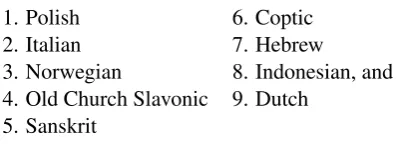
In this paper, we provide an entirely empirically motivated sub-sample of nine languages that can can be used to develop monolingual parsing re-sources. The method uses delexicalised parser per-formance as a measure of similarity to construct a language similarity network. The network is natu-rally partitioned into language groups using a stan-dard network clustering algorithm, which does not take the number of clusters as a parameter. The clusters are assumed to be diverse between them but coherent within them, with respect to their in-dividual parser models. Using this technique, the mean and standard deviation of monolingual un-labeled accuracy scores for cluster representatives are found to be close to the true average and stan-dard deviation. Future monolingual parsing sys-tems can extrapolate parser performance over the entire set of languages, using only the set of nine representative languages listed in Table 1, which interestingly excludes English, Chinese, German, and Czech.
Efficient parser development for UD languages.
As an efficient alternative to exhaustive parameter search across 47 languages (or 64 treebanks), the
1. Polish 6. Coptic 2. Italian 7. Hebrew
3. Norwegian 8. Indonesian, and 4. Old Church Slavonic 9. Dutch
[image:2.595.82.285.64.136.2]5. Sanskrit
Table 1: Representative languages for UD parsing resource development.
method we propose for the development of parsing resources is the following:
1. Development: develop parsing resources over only the nine languages in Table 1, opti-mising for average and standard deviation of unlabeled attachment across all languages.
2. Full testing: using the parameters discov-ered in step (1), report final average parsing scores and standard deviation over all UD languages.
In Section 3 we will outline the network analytic method for determining these nine representative languages empirically. First we discuss the only preceding approach to sampling UD languages for parser development; the approach is essentially non-empirical.
2 Related work
De Lhoneux and Nivre (2016) presented the first approach to language sampling from UD. They hand-picked a set of representative languages based on the following requirements:
1. Language family: include exactly one guage from each of 8 coarse-grained lan-guage families, and no more than one from each of 15 fine-grained language families,
2. Morphological diversity: include at least one isolating, one morphologically rich and one inflecting language,
3. Treebank size and domain: ensure varied treebank size and domain,
4. Non-projectivity: include one language with a large amount of non-projective trees.
De Lhoneux and Nivre (2016) also considered the quality of treebanks and selected those lan-guages that had as few annotation inconsistencies as possible. To ensure comparability, they also
only consider treebanks with morphological fea-tures. They selected eight languages: Czech, Chi-nese, Finnish, English, Ancient Greek-PROIEL, Kazakh, Tamil, and Hebrew (cf. Table 2).
Our method differs in that it is entirely empiri-cal, based on delexicalised parsing model similar-ity. Note that we also control for treebank size and exclude all morphological information.
3 Methodology
Delexicalised and projection-based parser ap-proaches form the state-of-the-art for cross-lingual dependency parsing systems (Rasooli and Collins, 2015). Moreover, as shown by Agi´c et al. (2016) in upper-bound experiments, languages that are well-known to hold similar syntactic behaviours to one another, given that they come from the same language family, often generate better cross-lingual parsers for one another.
In our approach, we use delexicalised cross-lingual parsing scores to the indicate parser gen-eralisation capacity from one language to another. As such, these parsing scores can be seen as a sort of similarity score between languages. The more similar the POS sequences and associated syn-tactic structures are between languages, the more similar the optimal parsing model to parse them and the better the resultant delexicalised parsing scores between them. We call this similarity score, (optimal)model similarity.
We need a global account of model similarity between UD languages in order to select a natu-rally small representative subset of UD languages based on maximal coverage of model capacities.
Building the network. We first create a com-plete weighted directed networkG= (V,E,w) to reflect model similarity. Each node inVrepresents a language from the UD dataset. We make arcs be-tween all ordered pairs of nodes and decorate each arc with a weight as follows.
language flow rank Cluster 1
pl Polish 0.134645 2
sl Slovenian 0.120378 3 bg Bulgarian 0.0772124 5 uk Ukrainian 0.0324838 8
cs Czech 0.0226545 11
sk Slovak 0.0105861 17 hr Croatian 0.00662242 19 de German 0.00651388 20 ru Russian 0.00620382 21
el Greek 0.0039794 23
et Estonian 0.00267263 24 fi Finnish 0.000232028 38 lv Latvian 3.36723e-05 43
Cluster 2
it Italian 0.180703 1 ca Catalan 0.0894462 4 es Spanish 0.0753139 6
fr French 0.0598804 7
pt Portuguese 0.0133104 16 ro Romanian 0.00190421 26 vi Vietnamese 0.000169612 39
Cluster 3
no Norwegian 0.020558 13 sv Swedish 0.019848 14 da Danish 0.00897288 18 en English 0.00116163 29
language flow rank Cluster 4
cu Old Church Slavonic 0.0242178 10
got Gothic 0.0212005 12
la Latin 0.00163673 28
grc Ancient Greek 0.000146437 40
Cluster 5
sa Sanskrit 0.0171218 15
tr Turkish 0.00405451 22
ta Tamil 0.00218517 25
hi Hindi 0.00175879 27
ug Uyghur 0.00105993 30
eu Basque 0.000897161 31
kk Kazakh 0.00084926 32
hu Hungarian 0.000793513 33
ja Japanese 0.000640374 35
gl Galician 6.85458e-05 42
zh Chinese 4.28534e-06 46
swl Swedish Sing 5.57449e-07 47
Cluster 6
cop Coptic 0.0260177 9
Cluster 7
he Hebrew 0.000642038 34
ga Irish 0.000452355 37
fa Persian 3.26755e-05 44
ar Arabic 1.8784e-05 45
Cluster 8
id Indonesian 0.000609376 36
Cluster 9
[image:3.595.116.483.63.406.2]nl Dutch 0.000105621 41
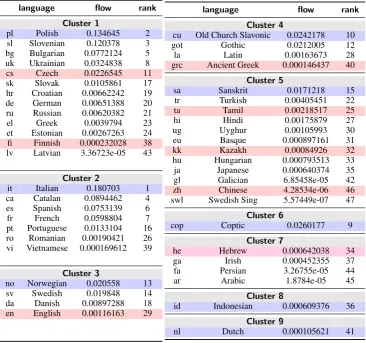
Table 2: Language clusters, flow (centrality) and rankings, given temperature τ =0.025. The most central languages for clusters are highlighted in blue. Red rows are the languages chosen by de Lhoneux and Nivre (2016). And the one purple language, Hebrew, was chosen by both methods.
τ, to be determined with respect to true parsing score aggregates later.
Our goal is to use the network to determine the language representatives of the UD dataset. To do this, we run the Infomap network clustering al-gorithm and then extract the most important lan-guages from each cluster.
Clustering the network naturally. We need to now cluster the nodes of the network, given its structure, but without supplying the number of languages as a parameter, in order for the output modular structure the be completely data-driven.
Infomap1 poses the problem of the clustering of nodes in a weighted directed network as the dual of the problem of minimising the descrip-tion length of a random walker’s movements on a network. Intuitively, the description parts corre-sponding to various regions of the network may be compressed if the random walker spends longer of
1http://www.mapequation.org/code.html
periods of time there.
The description of the network (the map equa-tion) to be minimised is
L(M):=qxH(Q) + m
∑
i=1piH (Pi)
whereqxis the total given probability that the ran-dom walker enters some new cluster;H(Q)is en-tropy of the modular structure of the network; pi
is the probability that some node in clusteriis vis-ited together with the probability of exiting cluster
i; and H(Pi) the entropy of the internal network structure in clusteri.
Extracting representative languages. For each cluster, the most representative (central) language of the cluster is considered to be the node with the highest flow. In terms of the random walker in the network structure, these are the nodes that are tra-versed the most within their own clusters, meaning that correspond to languages with highest cluster-wide model similarity. In this sense, they can act ascluster representatives.
Calculating parsing score aggregates. In order to fit the modular structure of the network to the true parsing score aggregates we carry out an ex-haustive search for optimal temperature within the interval τ ∈(0,1] at increments of 0.005. The
valueτ is optimal when
|µ−µτ|+|σ−στ| (1)
is minimised, where µ andσ are the true macro-average of unlabeled parsing accuracy score mean and standard deviation, andµτ andστare found in
the same way except that parsing scores for non-cluster representatives are replaced by that of their unique cluster representatives. This corresponds to a weighted average and standard deviation of scores of cluster representatives based on cluster size.
4 Data preparation
We used UD v1.4 in our experiment. Out of the 64 treebanks it offers, we select the 47 canonical ones for the 47 languages represented in the release.
We filter out all but the following CoNLL-U features from the dataset:2 ID, UPOSTAG, HEAD, and DEPREL. Note that all our parsers are delexicalised following McDonald et al. (2013), that is, we exclude all lexical information and learn parses over POS sequences. We also filter out all multi-word tokens.
All training data is sub-sampled up to 10k sen-tences so as to avoid the bias towards the largest training sets.3 Then, we train our delexicalized models using the graph-based parser MATEwith
default settings (Bohnet, 2010).
All our parsers assign labels, but here we evalu-ate for UAS only. While LAS and UAS are the two
2http://universaldependencies.org/format. html
3Czech, the largest training set in our UD subset, is 4.5x larger than each of the 12 languages that follow it.
most highly correlated dependency parsing met-rics as per Plank et al. (2015), we find that the lat-ter offers a bit more stability in constructing our similarity network. The aggregates over the 47 UD languages are: average UAS 74.45, and standard deviation UAS 9.4. An optimal language sampling method extrapolates to these aggregates as closely as possible.
5 Method visualisation and discussion
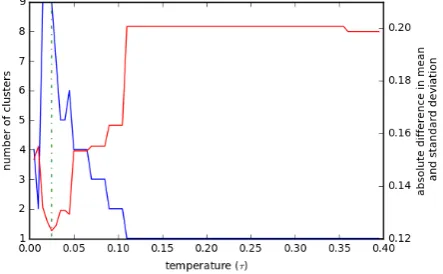
In Figure 1, on the left y-axis, we see the num-ber of clusters generated in the network for vary-ing temperature levels. On the right y-axis, we see the parsing score estimate over cluster rep-resentatives for varying temperatures. Equation (1) is minimised when τ =0.025 and this yields
nine separate clusters for our model similarity net-work. The error for this temperature is 5.05 (with
|µ−µτ|=3.5 and|σ−στ|=1.55) as reported in
[image:4.595.310.532.356.493.2]Table 3.
Figure 1: Number of clusters over varying tem-peratures, with respect to soft-max temperature. Optimal temperature at τ =0.025 (dotted green
line). The number of clusters and error remain un-changed forτ>0.4.
Visualising the model similarity network. A visualisation of the network forτ=0.025 is given
in Figure 2. We notice that, as expected, many of the clusters follow language family closely, but there are a number of outliers. For instance, Dutch is entirely alone in its cluster and Vietnamese is grouped together with the Romance languages.
ques-Figure 2: Visualisation of the model similarity net-work. Node centrality corresponds to node size.
tion and those of all other languages in the net-work. Surprisingly, English is ranked in 29th po-sition, which provides simple empirical evidence that parsing resources developed mainly on and optimised for English risk suboptimal overall per-formance. Interestingly, other well-studied lan-guages like Chinese and Arabic have considerably low rank both in the entire networks well as in their respective clusters.
In Table 2 we have also highlighted the rep-resentative languages chosen by de Lhoneux and Nivre (2016). We see that according to our empiri-cal model, the languages they chose reflect neither the centrality nor the diversity intended.
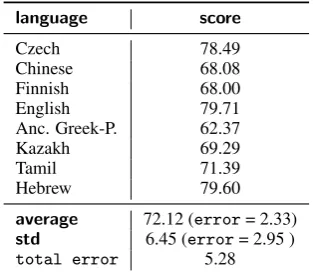
Comparing extrapolations. The error for de Lhoneux and Nivre’s (2016) representative set is given in Table 4. We see that total error is lower in the parsing model similarity method we de-scribe here. However, because of the combined optimisation of mean and standard deviation, our sample over-estimates general performance, while de Lhoneux and Nivre (2016)’s sample underes-timates the reliability of the parser to achieve the mean performance.
6 Concluding remarks
We have shown the first 100% empirical method for determining a small representative sample of UD languages for parser development, and have proposed an associated methodology. In particu-lar, for the Universal Dependencies v1.4, we given a specific subset of nine languages on which
pars-language cluster size score
Polish 13 84.91
Italian 7 85.11
Norwegian 4 79.99
Old Church Slav. 4 73.72
Sanskrit 12 66.10
Coptic 1 85.01
Hebrew 4 79.60
Indonesian 1 77.73
Dutch 1 75.05
average 77.96 (error= 3.5) std 7.85 (error= 1.55) total error 5.05
Table 3: UAS contributions and aggregates of our representative UD languages. The contri-butions(cluster size) * scoreare collected
over the 9 sampled languages and normalised over the 47 languages.
language score
Czech 78.49
Chinese 68.08
Finnish 68.00
English 79.71
Anc. Greek-P. 62.37
Kazakh 69.29
Tamil 71.39
Hebrew 79.60
[image:5.595.332.502.62.208.2]average 72.12 (error= 2.33) std 6.45 (error= 2.95 ) total error 5.28
Table 4: UAS and aggregates of de Lhoneux and Nivre’s (2016) representative UD languages. The score aggregates are calculated over the 8 sampled languages.
ing systems can be developed efficiently.
The language clusters presented here have many similarities with well-studied language family dis-tinctions, but also many differences. These clusters could provide an interesting technology-motivated study of syntactic similarity between languages.
References
ˇZeljko Agi´c, Anders Johannsen, Barbara Plank, H´ector Mart´ınez Alonso, Natalie Schluter, and Anders Søgaard. 2016. Multilingual projection for parsing truly low-resource languages. Transactions of the Association for Computational Linguistics, 4:303– 312.
[image:5.595.101.262.69.256.2] [image:5.595.338.495.296.433.2]Computa-tional Linguistics (Coling 2010), pages 89–97, Bei-jing, China, August. Coling 2010 Organizing Com-mittee.
Miryam de Lhoneux and Joakim Nivre. 2016. Ud tree-bank sampling for comparative parser evaluation. In
Proceedings of SLT 2016.
Ryan McDonald, Joakim Nivre, Yvonne Quirmbach-Brundage, Yoav Goldberg, Dipanjan Das, Kuz-man Ganchev, Keith Hall, Slav Petrov, Hao Zhang, Oscar T¨ackstr¨om, Claudia Bedini, N´uria Bertomeu Castell´o, and Jungmee Lee. 2013. Uni-versal dependency annotation for multilingual pars-ing. In Proceedings of the 51st Annual Meeting of the Association for Computational Linguistics (Vol-ume 2: Short Papers), pages 92–97, Sofia, Bulgaria, August. Association for Computational Linguistics.
Joakim Nivre, Marie-Catherine de Marneffe, Filip Gin-ter, Yoav Goldberg, Jan Hajic, Christopher D. Man-ning, Ryan McDonald, Slav Petrov, Sampo Pyysalo, Natalia Silveira, and et al. 2016. Universal depen-dencies v1: A multilingual treebank collection. In
Proceedings of the 10th International Conference on Language Resources and Evaluation (LREC 2016).
Joakim Nivre, ˇZeljko Agi´c, Lars Ahrenberg, Maria Je-sus Aranzabe, Masayuki Asahara, Aitziber Atutxa, Miguel Ballesteros, John Bauer, Kepa Ben-goetxea, Riyaz Ahmad Bhat, Eckhard Bick, Cristina Bosco, Gosse Bouma, Sam Bowman, Marie Candito, G¨uls¸en Cebirolu Eryiit, Giuseppe G. A. Celano, Fabricio Chalub, Jinho Choi, C¸ar C¸¨oltekin, Miriam Connor, Elizabeth Davidson, Marie-Catherine de Marneffe, Valeria de Paiva, Arantza Diaz de Ilarraza, Kaja Dobrovoljc, Tim-othy Dozat, Kira Droganova, Puneet Dwivedi, Marhaba Eli, Tomaˇz Erjavec, Rich´ard Farkas, Jen-nifer Foster, Cl´audia Freitas, Katar´ına Gajdoˇsov´a, Daniel Galbraith, Marcos Garcia, Filip Ginter, Iakes Goenaga, Koldo Gojenola, Memduh G¨okr-mak, Yoav Goldberg, Xavier G´omez Guinovart, Berta Gonz´ales Saavedra, Matias Grioni, Normunds Gr¯uz¯itis, Bruno Guillaume, Nizar Habash, Jan Hajiˇc, Linh H`a M, Dag Haug, Barbora Hladk´a, Petter Hohle, Radu Ion, Elena Irimia, Anders Jo-hannsen, Fredrik Jørgensen, H¨uner Kas¸kara, Hiroshi Kanayama, Jenna Kanerva, Natalia Kotsyba, Simon Krek, Veronika Laippala, Phng Lˆe Hng, Alessan-dro Lenci, Nikola Ljubeˇsi´c, Olga Lyashevskaya, Teresa Lynn, Aibek Makazhanov, Christopher Man-ning, C˘at˘alina M˘ar˘anduc, David Mareˇcek, H´ector Mart´ınez Alonso, Andr´e Martins, Jan Maˇsek, Yuji Matsumoto, Ryan McDonald, Anna Mis-sil¨a, Verginica Mititelu, Yusuke Miyao, Simon-etta Montemagni, Amir More, Shunsuke Mori, Bo-hdan Moskalevskyi, Kadri Muischnek, Nina Musta-fina, Kaili M¨u¨urisep, Lng Nguyn Th, Huyn Nguyn Th Minh, Vitaly Nikolaev, Hanna Nurmi, Stina Ojala, Petya Osenova, Lilja Øvrelid, Elena Pascual, Marco Passarotti, Cenel-Augusto Perez, Guy Per-rier, Slav Petrov, Jussi Piitulainen, Barbara Plank, Martin Popel, Lauma Pretkalnia, Prokopis
Proko-pidis, Tiina Puolakainen, Sampo Pyysalo, Alexan-dre Rademaker, Loganathan Ramasamy, Livy Real, Laura Rituma, Rudolf Rosa, Shadi Saleh, Manuela Sanguinetti, Baiba Saul¯ite, Sebastian Schuster, Djam´e Seddah, Wolfgang Seeker, Mojgan Ser-aji, Lena Shakurova, Mo Shen, Dmitry Sichinava, Natalia Silveira, Maria Simi, Radu Simionescu, Katalin Simk´o, M´aria ˇSimkov´a, Kiril Simov, Aaron Smith, Alane Suhr, Umut Sulubacak, Zsolt Sz´ant´o, Dima Taji, Takaaki Tanaka, Reut Tsarfaty, Fran-cis Tyers, Sumire Uematsu, Larraitz Uria, Gert-jan van Noord, Viktor Varga, Veronika Vincze, Jonathan North Washington, Zdenˇek ˇZabokrtsk´y, Amir Zeldes, Daniel Zeman, and Hanzhi Zhu. 2017. Universal dependencies 2.0. LINDAT/CLARIN digital library at the Institute of Formal and Applied Linguistics, Charles University in Prague.
Barbara Plank, H´ector Mart´ınez Alonso, ˇZeljko Agi´c, Danijela Merkler, and Anders Søgaard. 2015. Do dependency parsing metrics correlate with human judgments? InProceedings of the Nineteenth Con-ference on Computational Natural Language Learn-ing, pages 315–320, Beijing, China, July. Associa-tion for ComputaAssocia-tional Linguistics.
Mohammad Sadegh Rasooli and Michael Collins. 2015. Density-driven cross-lingual transfer of de-pendency parsers. In Proceedings of the 2015 Conference on Empirical Methods in Natural Lan-guage Processing, pages 328–338, Lisbon, Portugal, September. Association for Computational Linguis-tics.