S Bandyopadhyay, D S Sharma and R Sangal. Proc. of the 14th Intl. Conference on Natural Language Processing, pages 283–289, Kolkata, India. December 2017. c2016 NLP Association of India (NLPAI)
Correcting General Purpose ASR Errors using Posteriors
Sunil Kumar Kopparapu
TCS Research and Innovation - Mumbai
C Anantaram
TCS Research and Innovation - Delhi
Abstract
Speech based interfaces have gained pop-ularity because of the advances in auto-matic speech recognition (ASR) technol-ogy, more recently, triggered by the use of deep neural networks for acoustic and language modeling. However, the per-formance of any general purpose ASR (gpASR) is poor especially for low re-source languages and the performance de-teriorate further for natural conversational speech. In this paper, we propose a statisti-cal approach to learn the corrections to en-able the use of a general purpose ASR for domain specific use. The proposed idea is based on the observation that there are three types of errors that occur in an ASR output, namely, insertion, deletion or sub-stitution of a word or a phoneme. We pro-pose to model these errors statistically and use these posteriors to develop a scheme that is able to repair the ASR output. The proposed system is able to handle ASR er-rors spread across lexical words also.
1 Introduction
Speech is the most natural mode of communica-tion to query for answers (Kopparapu, 2014). Use of natural language speech to query for informa-tion is gaining practical applicability in our day to day activities. It is also believed that in the next ten years there will be a ten times increase in the number of speech interface we will be facing in our day to day life (Fuhrmann et al., 2017). How-ever recognition of natural language speech is not always100%accurate even when a state of the art ASR engine is employed for a resource rich lan-guage. There are several reasons, the significant among them are the mismatch in the train and the
test conditions in terms of the acoustic modeling, the accent, the language, the environment etc.
There have been several attempts to improve the speech recognition accuracies (a) by fine tuning, adapting or learning the acoustic models (AM) to handle the train-test mismatch condition (Mo-hamed et al., 2012); and (b) by configuring the statistical language models (SLM) so that the per-plexity of the search space can be reduced (Kom-brink et al., 2012). However, these attempts are either far from producing accurate speech to text conversion especially for natural language speech or make the speech recognition engine constrained to perform for a very specific task or domain. Sub-sequently, there have been several attempts to post process (Ainsworth and Pratt, 1992; Nishizaki and Sekiguchi, 2006; Bassil and Alwani, 2012) the output of the speech recognition engine to identify and correct the erroneous output.
there have been attempts to use a general purpose speech recognition engine and then correct the ASR output using bio-inspired evo-devo (Anan-taram et al., 2015b; Anan(Anan-taram et al., 2015a) and statistical techniques (Anantaram and Kopparapu, 2017) based on features extracted from the refer-ence and the ASR output text. The machine learn-ing based system described in (Anantaram and Kopparapu, 2017) is along the lines of (Jeong et al., 2004) but differs in the sense that they use of multiple features for training the Naive Bayes clas-sifier instead of a single feature (syllable count) for training used in (Jeong et al., 2004) in addition to not using manual alignment between the ASR and reference text. In (Twiefel et al., 2014) the au-thors address the post correction of a general pur-pose ASR by using (a) the closeness of phoneme depending on the place and manner of articula-tion to identify the confusability between the ac-tual and the recognized phoneme and (b) using the front-end and the linguist module of Sphinx. How-ever their experiments seem to suggest that their task is that of aligning the gpASR output text with another sentence from a known finite set of sen-tences.
In this paper, we use a novel approach to repair the errors produced by a gpASR engine. We do not assume, unlike (Twiefel et al., 2014) the availabil-ity of reference pre defined sentences. In a very broad sense we try to model the performance of the gpASR engine for a certain environment and domain which is then used to repair the ASR out-put for all speech utterances coming from the same environment and domain. The rest of the paper is organized as follows. In Section 2 we formulate the problem and describe an approach to model the ASR for a specific domain and environment and in Section 3 we describe the dataset used to evaluate the proposed approach and give some preliminary results. We conclude in Section 4.
2 Problem Formulation
Let
~
R =/r1r2r3· · ·rm/
be a spoken sentence consisting ofMwords that is input to a speech recognition engine. For example,
~ R=
(/who is the accountable
person for manufacturing solutions/
Let the general purpose automatic speech
recognition (gpASR) output, ~
O = ”o1o2o3· · ·on”
consisting of sayN words such thatO~ 6=R~. For example,
~ O =
("who is accountable boston for the men affecting solutions"
which was obtained using Kaldi (Povey et al., 2011) with Fisher acoustic models (gpAM) and language models (gpLM) (Kaldi, 2015). Namely,
~
R−→ gpASR
| {z }x
gpLM, gpAM
−→O~
Observe that M can be≶ N. However, there are only three type of operations that are possible to transformO~ toR, namely, a word in~ O~ is either deleted or is inserted or is substituted so thatO~ can become identical toR. Clearly, one insertion, two~ deletions and two substitutions toO~ could make it identical toR~, namely,
"who is (φ ins→the) accountable (bostonsub→person) for
(the del→ φ) (men del→ φ)
(affectingsub→manufacturing) solutions"
~
Op ←− word2phoneme
| {zx }
gpLexicon
←−O~
Let each word inR~ andO~ be represented by its phonetic equivalent so that
~
Rp =r1r2· · ·rM
and
~
Op =o1o2o3· · ·oN
such that {ri, oi} ∈ IP where IP is the set of phonemes. Note thatr1inRp~ is a phoneme while r1 inR~ is a lexical word. In general there are39 phones inIP, namely,
IP =
a, ae, ah, ao, aw, ay, b, ch, d, dh, eh, er, ey, f, g, hh, ih, iy, jh, k, l, m, n, ng, ow, oy, p, r, s, sh, t, th, uh, uw, v, w, y, z, zh
Subsequently, we can write
~ Op =
hh uw ih z dh iy ah k aw n t ah b ah l p er s ah n f r er m ae n y ah f ae k ch er ih ng s ah l uw sh ah n z
(1) and
~ Rp =
(hh uw ih z ah k aw n t ah b ah l b ao s t ah n f r er dh iy m eh n ah f eh k t ih ng s ah l uw sh ah n z.
(2) Notice that even as a phonemic string,Op~ can be transformed intoR~pthrough one of the three oper-ations, namely, deletion, insertion or substitution. 2.1 Computing Posteriors
We define an extensionIP0 = {IP, φ}, where the elementφrepresents a null-phoneme. Given a cor-pus of{O~i
p, ~Rip}Ki=1 pairs (K is large). Note that the elements ofO~p and elements ofR~p ∈ IP and can take one of the39unique phones. Represento andrasp∈IP. Now we compute for allpi ∈IP
Psub=P(pisub→ pj) =
#((pi∈Op~ )&(pj ∈Rp))~ #(pi∈O~p)
(3) where (a) #(pi ∈Op)~ is the count of the phone pi occurring in {O~ip}K
i=1 and (b) #((pi ∈O~p)&(pj ∈R~p)) is the count of the phone pi which occurs in {O~ip}K
i=1 when pj occurs in{R~i
p}Ki=1. Similarly, we find
Pins =P(φsub→ pj) (4) wherepj occurs in Rp~ but does not occur inOp~ and
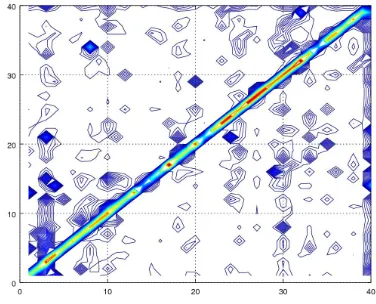
Pdel =P(pi sub→ φ) (5) wherepi occurs inO~p but does not occur in R~p. Note that we can compute P∗(pi sub→ pj) for all pi, pj ∈ IP0, clearlyP∗ is a40×40matrix. The last column corresponds toPdelwhile the last row corresponds toPins. We conjecture that these pos-terior probabilities P∗(pi sub→ pj) can be used to model the ASR engine (see Figure 1) which in turn can be used to repair the ASR output, namely,
~
Op−→ repair
| {z }x
P∗
[image:3.612.331.519.48.200.2]−→Rp~
Figure 1: P∗ for Kaldi (Povey et al., 2011) with Fischer acoustic and language models. Note that there are higherPins.
2.2 Repair Approach
Now given an general purpose ASR output, say, O1O2O3O4O5· · ·ON identify the wordsOi which are not part of the domain along the lines of (Anantaram et al., 2015a), using a domain on-tology. The domain ontology (dLexicon) helps in identifying all theOi’s such thatOi∈/ dLexicon.
Then using the domain lexicon we con-struct for each Oi the phoneme sequence oi1, oi2, oi3, oi4, oi5,· · ·, oimwhere eachoij ∈IP. We then expand the phonemes that require correc-tion as
expand(oi, φ) = φ, oi1, φ, oi2φ, oi3, φ, oi4, φ, oi5, φ,· · ·, φ, oim, φ (6) by inserting φbetween the phonemic representa-tion of Oi. This extended phoneme string is cor-rected using the posterior (P∗). Now for all iden-tifiedoij andφ∈, find allpk∈IP0such that the posterior
P∗(oj sub→ pk)> τ and P∗(φsub→ pk)> τ. (7) We form a lattice (L) using pk obtained in (7) , namely,
−→ P∗ −→ L
We search through this lattice, L, to identify the best set ofpkthat results in the highest probability score such that the resulting phoneme string rep-resents a word in the domain, namely,
L −→ search, phoneme2word
| {zx }
dLexicon
−→O0
whereO0 is the corrected word corresponding to Oi. Algorithm 1 captures this approach in greater details.
Algorithm 1RepairO.~
GivenO~ =O1O2O3O4O5· · ·ON Givenτ,P∗/* Posterior */
Givencnt= 0, dLexicon /* Domain Ontology */
fork= 1,2· · ·N do ifOk∈/ dLexiconthen
α[cnt+ +]←−Ok
/*αcontains all words∈/ dLexicon */ end if
end for
forl= 1,2,· · · , cntdo
~o←Ol/* Using gpLexicon */
~ol←expand(~o, φ)/* Expand using (6)*/ forpj ∈~oldo
knt= 0
for(pk∈IP0)do
if(P(pj sub→ pk)> τ)then Lj,knt++=
n
pk, P(pj sub→ pk)
o
end if end for
/*Lis the lattice */ end for
Search throughLto find the repaired~o0l end for
Ol0 ←~o0l/* Using Lexicon */ /*Ol0is the corrected word */
3 Experimental Results
3.1 Data setup
Experiments were carried out on a database of700 spoken utterances by 7 different people, each of them speaking100sentences. Each of the7 speak-ers were given a set of100different queries which they were required to speak into a data collection application built in-house. Each of them spoke 10 queries in a session and the10 sessions were recorded over a period of one or two days. The spoken utterance was recorded in the wave for-mat with16bits resolution and a sampling rate of 16 kHz. These 700spoken utterances were first
converted to text using a general purpose speech recognition engine, in our case Kaldi (Povey et al., 2011) using the Fischer acoustic (Kaldi, 2015) and Fischer language models. We built the gpLexicon using the700decoded text outputs using an online tool (CMU, 2017). Note that the general purpose ASR (Kaldi) can output words which need not al-ways be part of the domain Ontology (in our case the domain was related to software industry). In all there were1426unique words in the700ASR text output (gpLexicon) and there were372unique words in the domain lexicon (dLexicon). We di-vided the 700into 5 sets of 140 utterances each and carried out a5fold validation, namely we used 4sets, consisting of560sentences to compute the posterior and1set consisting of140sentences to test. In this paper, we present a sample example to demonstrate the effectiveness of our approach. 3.2 Construction ofP∗
We constructed the posteriors using the decoded text (example, (1)) and the actual spoken text (ex-ample, (2)) after converting both the text strings into phonemes using a phonetic lexicon (we used gpLexicon for ASR output text and dLexicon for the actual spoken text). We aligned the two pho-netic strings using edit distance algorithm which came with (Povey et al., 2011). For (1) and (2) we get
”hh,uw,ih, z,dh, (aesub→ah), (tdel→ φ),ah, k, aw, n,t, ah, b, ah, l, (bsub→p), (aasub→er),s, (tdel→ φ), ah,n,f,ao,r, (dh→delφ), (ahdel→φ),m, (ehsub→ae), n, (φins→y),ah,f, (ehsub→ae),k, (tsub→ch), (ihsub→er),
(φins→ih),ng,s,ah,l,uw,sh,ah,n,z”
which are used to compute the posterior as men-tioned earlier. As seen there are 7 substitutions, 3 deletions and 2insertions. A sample posterior P∗ is shown in Figure 1 as a contour plot. The x-axis represents the phonemes (from the actual text) while they-axis is the phonemes (in the words rec-ognized by gpASR).
3.3 Sample Repair
As an example the general purpose ASR returned
"who is that accountable boston for the men affecting solutions"
when
/who is the accountable person for manufacturing solutions/
”boston"
b ao s t ah n
1 φ b φ ao φ s φ t φ ah φ n φ
2 ah p ah ah ah sh ah φ ah φ ah φ ah
3 ih φ ih φ ih φ ih r ih er ih l ih
4 k r k er k z k ah k r k ah k
5 t w t aa t ah t er t aa t k t
6 l l l ow l er l l l ae l r l
7 r ah r iy r ey r d r ih r ae r
8 s dh s sh s r s th s eh s ih s
9 d d d p d ih d dh d ey d m d
10 w t w v w ch w eh w uw w ng w
p er s ah n
[image:5.612.148.468.44.233.2]”person"
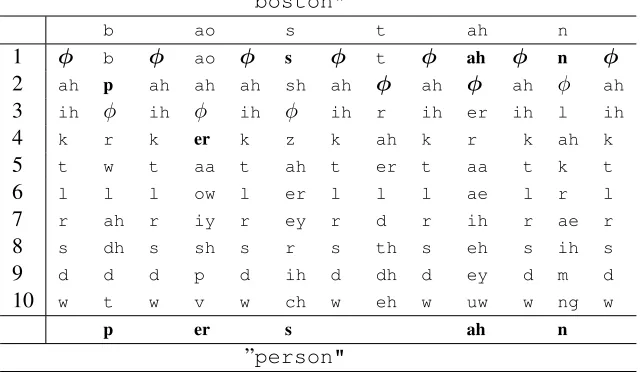
Table 1: LatticeLconstructed using the posteriorP∗, used to correct ’b ao s t ah n’ to ’p er s ah n’. The phones marked in bold are the ones that are picked during the lattice search.
was given as the audio input to the gpASR. The output text ”boston"and ”men affecting"
are not part of the domain ontology (dLexicon). We first converted the word ”boston" into its phoneme equivalent using the general pur-pose phonetic lexicon (gpLexicon), namely ’b ao s t ah n’, then using the posteriorP∗ we constructed the lattice L (see Table 1) which shows the top10phonemes that could replace the phoneme output by the ASR based on the poste-riorP∗. For example, the column associated withb
shows thatP(bsub→ p)≥P(bdel→ φ) ≥P(bsub→ r) etc. Note that we have captured the possible inser-tion by appendingφbetween the phones, namely, φbφaoφsφtφahφn(6). Now traversing the
latticeLin Table 1 from left to right we can getφ
pφerφsφ φ φahφnφwhich is nothing but ’p er s ah n’ which is part of our domain.
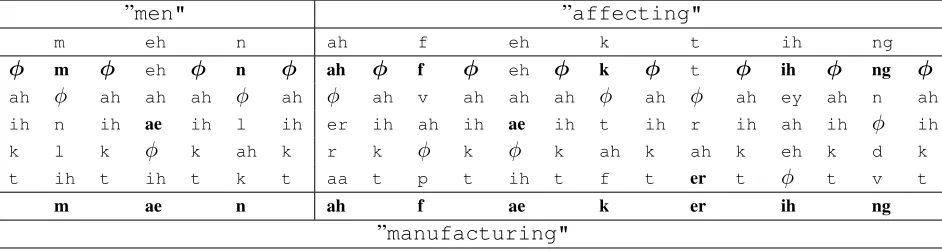
A similar repair mechanism described in Algo-rithm 1 helps in correcting ”men affecting"
to the domain word ”manufacturing" as shown in Figure 2. As a result the general purpose ASR output
"who is that accountable boston for the men affecting solutions"
is corrected to
"who is that accountable person for the manufacturing solutions"
Note that this is not exactly what was spoken,
namely,
/who is the accountable person for manufacturing solutions/
Notice that the repair mechanism is unable to cor-rect ”that"to ”the"and delete ”the"however the repair mechanism is able to correct the non-domain words by identifying phonetically equiva-lent words in the domain. In this example and all our experiments we chooseτ in a manner that we had the top10phonemes to form the latticeL.
Also notice that because the repair mech-anism operates in the phoneme space it is able to operate even if the error is spread across words (example, ”men affecting" −→ ”manufacturing"). This example sen-tence clearly demonstrates the ability of the pro-posed repair approach to correct the output of a general purpose automatic speech recognition en-gine based on the computed posteriors.
We measured the accuracy of improvement in the ASR output, by looking at the edit distance between (O,~ R) and the edit distance between (~ O~0,
~
R). HereR~ is the reference out (perfect ASR out-put), whileO~ is the output of the general purpose ASR (in our case Kaldi ASR output) andO~0is the
repaired output based on Algorithm 1. It is ob-served that the dis(O~0, R)~ ≤dis(O,~ R). Namely,~ the repaired output was always closer to the refer-ence that the output of the general purpose ASR engine (O).~
”men" ”affecting"
m eh n ah f eh k t ih ng
φ m φ eh φ n φ ah φ f φ eh φ k φ t φ ih φ ng φ
ah φ ah ah ah φ ah φ ah v ah ah ah φ ah φ ah ey ah n ah
ih n ih ae ih l ih er ih ah ih ae ih t ih r ih ah ih φ ih
k l k φ k ah k r k φ k φ k ah k ah k eh k d k
t ih t ih t k t aa t p t ih t f t er t φ t v t
m ae n ah f ae k er ih ng
[image:6.612.82.553.39.165.2]”manufacturing"
Table 2: LatticeLconstructed using the posteriorP∗, used to correct ”men affecting".
4 Conclusions
Speech based applications are being increasingly deployed for self help in enterprises. However for resource deficient languages (including Indian English) the performance of ASR engine is poor especially for natural spoken utterances. While there are two ways of getting over the poor per-formance of ASR engine, namely (a) fine tuning the AR engine in terms of acoustic and language models; thereby making the ASR engine domain specific or (b) using a general purpose ASR engine and then correcting the ASR output using domain ontology and in some way modeling the ASR be-havior. The advantage of the second approach is that of being able to use a readily available state of the art ASR engine without having to build a unique speech recognition engine for every appli-cation. In this paper, we approach the problem of correcting the general purpose ASR output using posteriors. The main contribution of this paper is the formulation of a posterior approach to repair the output of a general purpose ASR engine as de-picted in detail in Algorithm 1. We also showed that the approach is able to repair the errors that might be spread across lexical words.
5 Acknowledgements
The authors would like to thank Chirag Patel who assisted in performing some experiments in the earlier stages of this work.
References
W.A. Ainsworth and S.R. Pratt. 1992. Feedback strate-gies for error correction in speech recognition sys-tems. International Journal of Man-Machine Stud-ies, 36(6):833 – 842.
C. Anantaram and Sunil Kumar Kopparapu. 2017. Adapting general-purpose speech recognition
en-gine output for domain-specific natural language question answering.CoRR, abs/1710.06923.
C. Anantaram, Rishabh Gupta, Nikhil Kini, and Sunil Kumar Kopparapu. 2015a. Adapting general-purpose speech recognition engine output for domain-specific natural language question an-swering. InWorkshop on Replicability and Repro-ducibility in Natural Language Processing: adap-tive methods, resources and software at IJCAI 2015, Buenous Aires.
C Anantaram, Nikhil Kini, Chirag Patel, and Sunil Kopparapu. 2015b. Improving ASR recognized speech output for effective NLP. InThe Ninth Inter-national Conference on Digital Society ICDS 2015, pages 17–21, Lisbon, Portugal.
Youssef Bassil and Mohammad Alwani. 2012. Post-editing error correction algorithm for speech recog-nition using bing spelling suggestion. CoRR, abs/1203.5255.
CMU. 2017. The CMU pronouncing dictio-nary. http://www.speech.cs.cmu.edu/
cgi-bin/cmudict.
Ferdinand Fuhrmann, Anna Maly, Christina Leitner, and Franz Graf. 2017. Three experiments on the application of automatic speech recognition in in-dustrial environments. In Nathalie Camelin, Yan-nick Est`eve, and Carlos Mart´ın-Vide, editors, Statis-tical Language and Speech Processing - 5th Inter-national Conference, SLSP 2017, Le Mans, France, October 23-25, 2017, Proceedings, volume 10583 of
Lecture Notes in Computer Science, pages 109–118. Springer.
Minwoo Jeong, Byeongchang Kim, and G Lee. 2004. Using higher-level linguistic knowledge for speech recognition error correction in a spoken q/a dialog. In HLT-NAACL special workshop on Higher-Level Linguistic Information for Speech Processing, pages 48–55.
Kaldi. 2015. Kaldi fisher english. http: //kaldi-asr.org/downloads/build/2/
sandbox/online/egs/fisher_english/.
Stefan Kombrink, Tomas Mikolov, Martin Karafi´at, and Luk´as Burget. 2012. Improving language mod-els for ASR using translated in-domain data. In
2012 IEEE International Conference on Acoustics, Speech and Signal Processing, ICASSP 2012, Ky-oto, Japan, March 25-30, 2012, pages 4405–4408. IEEE.
S.K. Kopparapu. 2014. Non-Linguistic Analysis of Call Center Conversations. SpringerBriefs in Elec-trical and Computer Engineering. Springer Interna-tional Publishing.
A. Mohamed, G.E. Dahl, and G. Hinton. 2012. Acous-tic modeling using deep belief networks. Audio, Speech, and Language Processing, IEEE Transac-tions on, 20(1):14 –22, jan.
Hiromitsu Nishizaki and Yoshihiro Sekiguchi. 2006. Word error correction of continuous speech recog-nition using web documents for spoken document indexing. In Yuji Matsumoto, RichardW. Sproat, Kam-Fai Wong, and Min Zhang, editors,Computer Processing of Oriental Languages. Beyond the Ori-ent: The Research Challenges Ahead, volume 4285 ofLecture Notes in Computer Science, pages 213– 221. Springer Berlin Heidelberg.
Daniel Povey, Arnab Ghoshal, Gilles Boulianne, Lukas Burget, Ondrej Glembek, Nagendra Goel, Mirko Hannemann, Petr Motlicek, Yanmin Qian, Petr Schwarz, Jan Silovsky, Georg Stemmer, and Karel Vesely. 2011. The kaldi speech recognition toolkit. In IEEE 2011 Workshop on Automatic Speech Recognition and Understanding, number Idiap-RR-04-2012, Rue Marconi 19, Martigny, De-cember. IEEE Signal Processing Society. IEEE Cat-alog No.: CFP11SRW-USB.
E.K. Ringger and J.F. Allen. 1996. Error correction via a post-processor for continuous speech recogni-tion. InAcoustics, Speech, and Signal Processing, 1996. ICASSP-96. Conference Proceedings., 1996 IEEE International Conference on, volume 1, pages 427–430 vol. 1, May.
Yongmei Shi. 2008. An Investigation of Linguistic Information for Speech Recognition Error Detec-tion. Ph.D. thesis, University of Maryland, Balti-more County, October.
Johannes Twiefel, Timo Baumann, Stefan Heinrich, and Stefan Wermter. 2014. Improving domain-independent cloud-based speech recognition with domain-dependent phonetic post-processing. In
Proceedings of the Twenty-Eighth AAAI Conference on Artificial Intelligence, AAAI’14, pages 1529– 1535. AAAI Press.
Lina Zhou, Jinjuan Feng, A. Sears, and Yongmei Shi. 2005. Applying the naive bayes classifier to assist users in detecting speech recognition errors. In Sys-tem Sciences, 2005. HICSS ’05. Proceedings of the 38th Annual Hawaii International Conference on, pages 183b–183b, Jan.