Analysing Data-To-Text Generation Benchmarks
Laura Perez-Beltrachini
School of Informatics, University of Edinburgh 10 Crichton Street, Edinburgh EH8 9AB
Scotland
Claire Gardent
CNRS, LORIA, UMR 7503 Vanoeuvre-l`es-Nancy, F-54506
France
Abstract
A generation system can only be as good as the data it is trained on. In this short pa-per, we propose a methodology for analysing data-to-text corpora used for training micro-planner i.e., systems which given some input must produce a text verbalising exactly this in-put. We apply this methodology to three exist-ing benchmarks and we elicite a set of criteria for the creation of a data-to-text benchmark which could help better support the develop-ment, evaluation and comparison of linguisti-cally sophisticated data-to-text generators.
1 Introduction
In some scenarios, generation datasets provide lin-guistic descriptions of a specific domain and appli-cation (e.g. (Reiter et al., 2005)). However, in other scenarios generation datasets aim at broader syntac-tic (e.g. the surface realisation shared-task (Belz et al., 2011)) or domain (Wen et al., 2015a) coverage. Recently, several datasets have been created to train data-to-text generators (Wen et al., 2015a; Liang et al., 2009; Lebret et al., 2016; Novikova et al., 2016; Chen and Mooney, 2008). It is unclear how-ever to what extent the generation task exercised by these datasets is linguistically challenging. Do these datasets provide enough variety to support the de-velopment of high-quality data-to-text generators ? In this paper, we propose a methodology for charac-terising the variety and complexity of these datasets. We exemplify its use by applying it to three existing training corpora for NLG and we conclude by elic-iting a set of criteria for the creation of data-to-text
benchmarks which could better support the devel-opment, evaluation and comparison of linguistically sophisticated data-to-text generators.
2 Approach
Our classification aims to assess to what extent a data-to-text corpus will allow for the learning of a linguistically sophisticated microplanner i.e., a mi-croplanner which can handle a wide range of lin-guistic constructions and their interaction. We focus on the following four criteria: linguistic and com-putational diversity(How complex or varied are the data and the texts?),lexical richness(Is the dataset lexically varied ?), syntactic variety (Is the dataset syntactically varied and in particular, does it include text of varied syntacticcomplexity?) and informa-tional adequacy (Does the text match the informa-tion contained in the data ?).
Linguistic and Computational Diversity. Lin-guistic and computational diversity can be assessed using the following metrics1:
Size: the number of training instances in the dataset
Nb. of Rel: the number of distinct relations
Sub.Ent: the number of distinct subject entities
Rel.Obj.Ent: the number of relation-object pairs
Da Len: the average length of the input data computed as the number of subject-relation-object triples
Da Ptns: the number of distinct relation combinations
Da Inst: the number of distinct data inputs
1We assume that a data-to-text corpus for NLG includes
en-tities, concepts and binary relations. Following RDF terminol-ogy, we refer to the first argument of a binary relation as a sub-ject entity and to the second as an obsub-ject entity.
PPxDa Inst: the average (min/max) number of para-phrases per data input.
Lexical Richness. (Lu, 2012)’s system automat-ically measure various dimensions of lexical rich-ness. Two measures are particularly relevant here.
Type-token ratio (TTR) is a measure of diversity defined as the ratio of the number of word types to the number of words in a text. To address the fact that this ratio tends to decrease with the size of the corpus, Mean segmental TTR (MSTTR) is com-puted by dividing the corpus into successive seg-ments of a given length and then calculating the av-erage TTR of all segments.
Lexical sophistication (LS) measures the propor-tion of relatively unusual or advanced word types in the text. In practice, LS is the proportion of lexical word types which are not in the list of 2,000 most frequent words from the British National Corpus.
Syntactic Variation To support the training of generators with wide syntactic coverage, a bench-mark needs to show a balanced distribution of the various syntactic phenomena present in the target language. To characterise the syntactic coverage of a dataset, we use a complexity classification pro-posed in the domain of language learning develop-ment assessdevelop-ment which consists of eight levels: (0) simple sentences, including questions (1) infinitive or -ing complement with subject control; (2) con-joined noun phrases in subject position; conjunc-tions of sentences, of verbal, adjectival, or adver-bial construction; (3) relative or appositional clause modifying the object of the main verb; nominaliza-tion in object posinominaliza-tion; finite clause as object of main verb; subject extraposition; (4) subordinate clauses; comparatives; (5) nonfinite clauses in adjunct posi-tions; (6) relative or appositional clause modifying subject of main verb; embedded clause serving as subject of main verb; nominalization serving as sub-ject of main verb; (7) more than one level of embed-ding in a single sentence.
We use (Lu, 2010)’s system for the automatic measurement of syntactic variability. Briefly, this system decomposes parse trees2 into component sub-trees and scores each of these sub-trees based
2Parses are obtained using Collins’ constituent parser
(Collins, 1999).
M A MA E
RNNLGLaptop 16% 2% 0 82%
RNNLGT V 12% 4% 0 84%
RNNLGHotel 0 6% 0 94%
RNNLGRestaurant 0 6% 0 94%
IMAGEDESC 50% 6% 0 44%
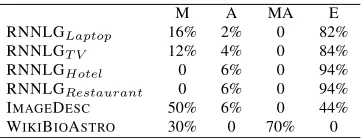
[image:2.612.337.519.53.122.2]WIKIBIOASTRO 30% 0 70% 0
Table 1: Match between Text and Data. M: Missing content in the text, A: Additional content in the text, MA: both additional and missing, E:Exact.
on the type of the syntactic constructions detected in it using a set of heuristics. Sentences are then assigned to a syntactic level based on the scores as-signed to the sub-trees it contains as follows. If all sub-trees found in that sentence are assigned to level zero, the sentence is assigned to level 0; if one and only one non-zero level is assigned to one or more sub-trees, the sentence is assigned to that non-zero level; if two or more different non-zero scores are assigned to two or more of the sub-trees, the sen-tence is assigned to level 7. When evaluated against a gold standard of 500 sentences independently rated by two annotators with a very high inter-annotator agreement (kappa = 0.91), the system achieves an F-Score of 93.2% (Lu, 2010).
Informational Adequacy A microplanner should express all or part of the content expressed in the in-put data. It is therefore important to verify that this is the case through manual examination of a random subset of the dataset. A data/text pair will be con-sidered an “Exact” match if all data is verbalised by the text. It will be labelled as “Missing” if part of the data is not present in the text (content selection) and as “Additional” if the text contains information not present in the input data.
3 Case Study
To illustrate the usage of the evaluation grid pro-posed in the preceding section, we apply it to three datasets recently proposed for data-to-text genera-tion by (Lebret et al., 2016), (Wen et al., 2015b; Wen et al., 2016) and (Novikova and Rieser, 2016).
two subsets of it for better comparison: one whose size is similar to the other datasets (WIKIBIO16317) and one which is domain specific in that all biographies are about astronauts (WIKIBIOASTRO).
The other two datasets were created manually with humans providing text for dialogue acts in the case of (Wen et al., 2015b; Wen et al., 2016)’s RNNLG datasets (laptop, TV, hotel, restaurant) and image descriptions in the case of (Novikova and Rieser, 2016)’s dataset (IMAGEDESC).
We also include a text-only corpus for compari-son with the texts contained in our three datasets. This corpus (GMB) consists of the texts from the Groningen Meaning Bank (Version 1.0.0, (Basile et al., 2012)) and covers different genres (e.g., news, jokes, fables).
Linguistic and Computational Diversity. Ta-ble 2 gives the descriptive statistics for each of these three datasets. It shows marked differences in terms of size (WIKIBIO16317being the largest andIMAGEDESC the smallest), number of distinct relations (from 16 forIMAGEDESCto 2367 forWIKIBIO16317) and average number of paraphrases (15.11 forIMAGEDESCagainst 1 to 3.72 for the other two datasets). The num-ber of distinct data inputs (semantic variability) also varies widely (from 77 distinct data inputs for theIM -AGEDESCcorpus to 12527 forRNNLGLaptop). Overall the number of distinct relations is relatively small.
Lexical Richness. TheWIKIBIOdataset, even when restricted to a single type of entity (namely, astro-nauts) has a higher MSTTR. This higher lexical vari-ation is probably due to the fact that this dataset also has the highest number of relations (cf. Table 2): more relations brings more diversity and thus better lexical range. Indeed, there is a positive correlation between the number of relations in the dataset and MSTTR (Spearman’s rho +0.385).
Again the WIKIBIO dataset has a markedly higher level of lexical sophistication than the other datasets. The higher LS might be because theWIKIBIOtext are edited independently of input data thereby leaving more freedom to the authors to include additional information. It may also result from the fact that theWIKIBIOdataset, even though it is restricted to bi-ographies, covers a much more varied set of domains than the other datasets as people’s lives may be very diverse and consequently, a more varied range of
topics may be mentioned than in a domain restricted dataset.
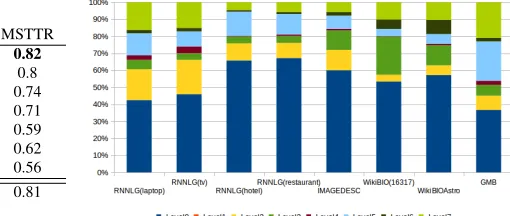
Syntactic variation. Figure 1 summarises the re-sults for the various datasets. A first observation is that the proportion of simple texts (Level 0) is very high across the board (42% to 68%). In fact, in all data sets but two,more than half of the sentences are of level 0 (simple sentences). In comparison, only 35% of the GMB corpus sentences are of level 0.
Second, levels 1, 4 and to a lesser extent level 3, are absent or almost absent from the data sets. We conjecture that this is due to the shape and type of the input data. Infinitival clauses with sub-ject control (level 1) and comparatives (level 4) in-volve coreferential links and relations between en-tities which are absent from the simple binary rela-tions comprising the input data. Similarly, non finite complements with their own subject (e.g., “John saw Mary leaving the room”, Level 3) and relative clauses modifying the object of the main verb (e.g.,
“The man scolded the boy who stole the bicycle”, Level 3) require data where the object of a literal is the subject of some other literal. In most cases how-ever, the input data consists of sets of literals predi-cating facts about a single entity.
Third, datasets may be more or less varied in terms of syntactic complexity. It is in particular no-ticeable that, for theWIKIBIOdataset, three levels (1, 3 and 7) covers 84% of the cases. This restricted va-riety points to stereotyped text with repetitive syn-tactic structure. Indeed, in WIKIBIO, the texts con-sist of the first sentence of biographic Wikipedia ar-ticles which typically are of the form “W (date of birth - date of death) was P”.whereP usually is an arbitrarily complex predicate potentially involving relative clauses modifying the object of main verb (Level 3) and coordination (Level 7).
Dataset Size Nb. of Rel Sub.Ent‡ Rel.Obj.Ent Da Len. Da Ptns Da Inst PPxDa Inst.
WIKIBIO16317 16317 2367 16317 149484 19.65 9990 16317 1
WIKIBIOASTRO 615 68 615 5290 15.46 293 615 1
RNNLGLaptop 13242 34 123 451 5.86 2068 12527 1.03(1/3)
RNNLGT V 7035 30 92 300 5.79 1024 6808 1.01(1/6)
RNNLGHotel 5373 22 138 535 2.66 112 940 3.72(1/149)
RNNLGRestaurant 5192 22 223 869 2.86 182 1950 1.82(1/101)
[image:4.612.98.515.55.131.2]IMAGEDESC 1242 16 33 117 5.33 21 77 15.11(8/22)
Table 2: Datasets descriptive statistics. ‡Note that we consider as distinct entities those given by thename relations and that in theRNNLGdatasets not all dialogue acts describe entities (e.g. inform count or ?select).
Dataset Tokens Types LS MSTTR
WIKIBIO16317 377048 36712 0.92 0.82 WIKIBIOASTRO 14720 2335 0.81 0.8 RNNLGLaptop 295492 1757 0.46 0.74
RNNLGT V 141606 1171 0.48 0.71
RNNLGHotel 48982 967 0.43 0.59
RNNLGRestaurant 45791 1187 0.43 0.62
IMAGEDESC 20924 598 0.47 0.56
GMB 75927 7791 0.75 0.81
Table 3: Lexical Sophistication (LS) and Mean
Segmental Type-Token Ratio (MSTTR). Figure 1: Syntactic complexity. D-Level sentencedistribution.
traced back to the way in which each resource was created. TheWIKIBIOdataset is created automatically from Wikipedia infoboxes and articles while infor-mation adequacy is not checked for. In theIMAGEDESC dataset, the texts are created from images using crowdsourcing. It seems that this method, while en-hancing variety, makes it easier for the crowdwork-ers to omit some information.
4 Conclusion
The proposed measures suggest several key aspects to take into account when constructing a data-to-text dataset for the development and evaluation of NLG systems. Lexical richness can be enhanced by including data from different domains, using a large number of distinct relations and ensuring that the total number of distinct inputs is high. Wide and balanced syntactic coverage is difficult to en-sure and probably requires input data of various size and shape, stemming from different domains. Infor-mational adequacy is easiest to achieve using crowd-sourcing which also facilitates the inclusion of para-phrases. In future work, it would be interesting to further exploit such analyses of data-to-text corpora (i) to better characterise the generators that can be
learnt from a given corpus, (ii) to perform a graded analysis of generation systems on data of various syntactic complexity or (iii) to support error min-ing (which type of data is most often associated with generation failure ?).
More specifically, our classification could be use-ful to identify sources of under-performance and thus directions for improvements. For instance, BLEU results reported by (Wen et al., 2015a) on three different datasets indicate that the same sys-tems are facing different difficulties on each of these. Indeed, lexical richness is higher (Table 3) for the RNNLGLaptop dataset for which (Wen et al., 2015a) reports the lowest BLEU score. But also the pro-portion of simple sentences is lower (Figure 1) in this dataset. A focused evaluation could report on BLEU scores aggregated on the syntactic classifica-tion of sentences into levels.
Acknowledgments
[image:4.612.264.519.178.286.2] [image:4.612.82.300.190.278.2]References
Valerio Basile, Johan Bos, Kilian Evang, and Noortje Venhuizen. 2012. Developing a large semantically annotated corpus. InLREC, volume 12, pages 3196– 3200.
Anja Belz, Mike White, Dominic Espinosa, Eric Kow, Deirdre Hogan, and Amanda Stent. 2011. The first surface realisation shared task: Overview and evaluation results. In Proceedings of the Genera-tion Challenges Session at the 13th European Work-shop on Natural Language Generation, pages 217– 226, Nancy, France, September. Association for Com-putational Linguistics.
David L Chen and Raymond J Mooney. 2008. Learning to sportscast: a test of grounded language acquisition. InProceedings of the 25th international conference on Machine learning, pages 128–135. ACM.
M. Collins. 1999. Head-Driven Statistical Models for Natural Language Parsing. Ph.D. thesis, University of Pennsylvania, Philadelphia, PA.
R´emi Lebret, David Grangier, and Michael Auli. 2016. Neural text generation from structured data with ap-plication to the biography domain. InProceedings of the 2016 Conference on Empirical Methods in Natu-ral Language Processing, pages 1203–1213, Austin, Texas, November. Association for Computational Lin-guistics.
P. Liang, M. I. Jordan, and D. Klein. 2009. Learning semantic correspondences with less supervision. In
Association for Computational Linguistics and Inter-national Joint Conference on Natural Language Pro-cessing (ACL-IJCNLP), pages 91–99.
Xiaofei Lu. 2010. Automatic analysis of syntactic complexity in second language writing. International Journal of Corpus Linguistics, 15(4):474–496. Xiaofei Lu. 2012. The relationship of lexical richness to
the quality of esl learners oral narratives. The Modern Language Journal, 96(2):190–208.
Jekaterina Novikova and Verena Rieser. 2016. The ana-logue challenge: Non aligned language generation. In
The 9th International Natural Language Generation conference, page 168.
Jekaterina Novikova, Oliver Lemon, and Verena Rieser. 2016. Crowd-sourcing nlg data: Pictures elicit better data. In Proceedings of the 9th International Natu-ral Language Generation conference, pages 265–273, Edinburgh, UK, September 5-8. Association for Com-putational Linguistics.
Ehud Reiter, Somayajulu Sripada, Jim Hunter, Jin Yu, and Ian Davy. 2005. Choosing words in computer-generated weather forecasts. Artificial Intelligence, 167(1-2):137–169.
Tsung-Hsien Wen, Milica Gaˇsic, Nikola Mrkˇsic, Lina M Rojas-Barahona, Pei-Hao Su, David Vandyke, and Steve Young. 2015a. Toward multi-domain language generation using recurrent neural networks. In The Proceedings of the 29th Annual Conference on Neural Information Processing Systems (NIPS), Workshop on Machine Learning for Spoken Language Understand-ing and Interaction.
Tsung-Hsien Wen, Milica Gasic, Nikola Mrksic, Pei-Hao Su, David Vandyke, and Steve Young. 2015b. Seman-tically conditioned lstm-based natural language gen-eration for spoken dialogue systems. arXiv preprint arXiv:1508.01745.
Tsung-Hsien Wen, Milica Gasic, Nikola Mrksic, Lina M Rojas-Barahona, Pei-Hao Su, David Vandyke, and Steve Young. 2016. Multi-domain neural network language generation for spoken dialogue systems.