Proceedings of NAACL-HLT 2018, pages 1575–1584
Learning to Rank Question-Answer Pairs using
Hierarchical Recurrent Encoder with Latent Topic Clustering
Seunghyun Yoon, Joongbo Shin and Kyomin Jung Dept. of Electrical and Computer Engineering
Seoul National University, Seoul, Korea
{mysmilesh,jbshin,kjung}@snu.ac.kr
Abstract
In this paper, we propose a novel end-to-end neural architecture for ranking candidate an-swers, that adapts a hierarchical recurrent neu-ral network and a latent topic clustering mod-ule. With our proposed model, a text is en-coded to a vector representation from an word-level to achunk-levelto effectively capture the entire meaning. In particular, by adapting the hierarchical structure, our model shows very small performance degradations in longer text comprehension while other state-of-the-art re-current neural network models suffer from it. Additionally, the latent topic clustering mod-ule extracts semantic information from tar-get samples. This clustering module is use-ful for any text related tasks by allowing each data sample to find its nearest topic cluster, thus helping the neural network model ana-lyze the entire data. We evaluate our mod-els on the Ubuntu Dialogue Corpus and con-sumer electronic domain question answering dataset, which is related to Samsung products. The proposed model shows state-of-the-art re-sults for ranking question-answer pairs.
1 Introduction
Recently neural network architectures have shown great success in many machine learning fields such as image classification, speech recognition, ma-chine translation, chat-bot, question answering, and other task-oriented areas. Among these, the automatic question answering (QA) task has long been considered a primary objective of artificial intelligence.
In the commercial sphere, the QA task is usually tackled by using pre-organized knowledge bases and/or by using information retrieval (IR) based methods, which are applied in popular intelligent voice agents such asSiri,Alexa, andGoogle Assis-tant (from Apple, Amazon, and Google, respec-tively). Another type of advanced QA systems is
IBM’s Watson who builds knowledge bases from unstructured data. These raw data are also indexed in search clusters to support user queries (Fan et al.,2012;Chu-Carroll et al.,2012).
In academic literature, researchers have in-tensely studied sentence pair ranking task which is core technique in QA system. The ranking task selects the best answer among candidates re-trieved from knowledge bases or IR based mod-ules. Many neural network architectures with end-to-end learning methods are proposed to address this task (Yin et al.,2016;Wang and Jiang,2016;
Wang et al.,2017). These works focus on match-ing sentence-level text pair (Wang et al., 2007;
Yang et al., 2015; Bowman et al., 2015). There-fore, they have limitations in understanding longer text such as multi-turn dialogue and explanatory document, resulting in performance degradation on ranking as the length of the text become longer. With the advent of the huge multi-turn dialogue corpus (Lowe et al.,2015), researchers have pro-posed neural network models to rank longer text pair (Kadlec et al., 2015; Baudiˇs et al., 2016). These techniques are essential for capturing con-text information in multi-turn conversation or un-derstanding multiple sentences in explanatory text. In this paper, we focus on investigating a novel neural network architecture with additional data clustering module to improve the performance in ranking answer candidates which are longer than a single sentence. This work can be used not only for the QA ranking task, but also to evaluate the rel-evance of next utterance with given dialogue gen-erated from the dialogue model. The key contribu-tions of our work are as follows:
First, we introduce a Hierarchical Recurrent Dual Encoder (HRDE) model to effectively cal-culate the affinity among question-answer pairs to determine the ranking. By encoding texts from an word-level to a chunk-level with
cal architecture, the HRDE prevents performance degradations in understanding longer texts while other state-of-the-art neural network models suf-fer.
Second, we propose a Latent Topic Clustering (LTC) module to extract latent information from the target dataset, and apply these additional infor-mation in end-to-end training. This module allows each data sample to find its nearest topic cluster, thus helping the neural network model analyze the entire data. The LTC module can be combined to any neural network as a source of additional infor-mation. This is a novel approach using latent topic cluster information for the QA task, especially by applying the combined model of HRDE and LTC to the QA pair ranking task.
Extensive experiments are conducted to inves-tigate efficacy and properties of the proposed model. Our proposed model outperforms previ-ous state-of-the-art methods in the Ubuntu Dia-logue Corpus, which is one of the largest text pair scoring datasets. We also evaluate the model on real world QA data crawled from crowd-QA web pages and from Samsung’s official web pages. Our model also shows the best results for the QA data when compared to previous neural network based models.
2 Related Work
Researchers have released question and answer datasets for research purposes and have proposed various models to solve these datasets. (Wang et al.,2007;Yang et al.,2015;Tan et al.,2015) in-troduced small dataset to rank sentences that have higher probabilities of answering questions such as WikiQA and insuranceQA. To alleviate the dif-ficulty in aggregating datasets, that are large and have no license restrictions, some researchers in-troduced new datasets for sentence similarity rank-ings (Baudiˇs et al., 2016; Lowe et al.,2015). As of now, the Ubuntu Dialogue dataset is one of the largest corpus openly available for text ranking.
To tackle the Ubuntu dataset, (Lowe et al.,
2015) adopted the “term frequency-inverse doc-ument frequency” approach to capture important words among context and next utterances (Ramos et al., 2003). (Bordes et al., 2014; Yu et al.,
2014) proposed deep neural network architecture for embedding sentences and measuring similar-ities to select answer sentence for a given ques-tion. (Kadlec et al., 2015) used convolution
neu-ral network (CNN) architecture to embed the sen-tence while a final output vector was compared to the target text to calculate the matching score. They also tried using long short-term memory (LSTM) (Hochreiter and Schmidhuber,1997), bi-directional LSTM and ensemble method with all of those neural network architectures and achieved the best results on the Ubuntu Dialogues Cor-pus dataset. Another type of neural architecture is the RNN-CNN model, which encodes each token with a recurrent neural network (RNN) and then feeds them to the CNN (Baudiˇs et al., 2016). Re-searchers also introduced an attention based model to improve the performance (Tan et al., 2015;
Wang and Jiang,2016;Wang et al.,2017). Recently, the hierarchical recurrent encoder-decoder model was proposed to embed contex-tual information in user query prediction and di-alogue generation tasks (Sordoni et al.,2015; Ser-ban et al., 2016). This shows improvement in the dialogue generation model where the context for the utterance is important. As another type of neu-ral network architecture, memory network was proposed by (Sukhbaatar et al.,2015). Several re-searchers adopted this architecture for the reading comprehension (RC) style QA tasks, because it can extract contextual information from each sen-tence and use it in finding the answer (Xiong et al.,
2016;Kumar et al.,2016). However, none of this research is applied to the QA pair ranking task di-rectly.
3 Model
In this section, we depict a previously released neural text ranking model, and then introduce our proposed neural network model.
3.1 Recurrent Dual Encoder (RDE)
A subset of sequential data is fed into the recurrent neural network (RNN) which leads to the forma-tion of the network’s internal hidden state ht to
model the time series patterns. This internal hid-den state is updated at each time step with the in-put data wt and the hidden state of the previous
time stepht−1 as follows:
ht=fθ(ht−1, wt), (1)
wherefθis the RNN function with weight
param-eterθ,ht is hidden state att-th word input,wtis
t-th word in a target questionwQ={w1:Qtq}or an answer textwA={wA
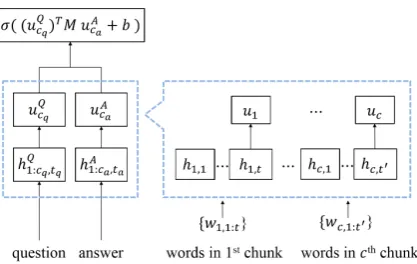
Figure 1: Diagram of the HRDE model. The word-lever RNN encodes words sequences of each chunk. The the final hidden status of the word-level RNN is fed into chunk-level RNN.
The previous RDE model uses two RNNs for encoding question text and answer text to calcu-late affinity among texts (Lowe et al.,2015). After encoding each part of the data, the affinity among the text pairs is calculated by using the final hidden state value of each question and answer RNNs. The matching probability between question text wQ and answer text wAwith the training
objec-tive are as follows:
p(label) =σ((hQtq)TM hAta +b),
L=−log
N
Y
n=1
p(labeln|hQn,tq, h
A n,ta),
(2)
where hQtq and hAta are last hidden state of each
question and answer RNN with the dimensionality
ht ∈ Rd. TheM ∈ Rd×dand bias bare learned
model parameters. TheN is total number of
sam-ples used in training andσis the sigmoid function.
3.2 Hierarchical Recurrent Dual Encoder (HRDE)
From now we explain our proposed model. The previous RDE model tries to encode the text in question or in answer with RNN architecture. It would be less effective as the length of the word sequences in the text increases because RNN’s natural characteristic of forgetting information from long ranging data. To address this RNN’s forgetting phenomenon, (Bahdanau et al., 2014) proposed an attention mechanism, however, we found that it still showed a limitation when we consider very large sequential length data such as 162 steps average in the Ubuntu Dialogue Corpus dataset (see Table1). To overcome this limitation, we designed the HRDE architecture. The HRDE
model divides long sequential text data into small chunk such as sentences, and encodes the whole text from word-level to chunk-level by using two hierarchical level of RNN architecture.
Figure1shows a diagram of the HRDE model. The word-level RNN part is responsible for en-coding the words sequencewc={wc,1:t}in each
chunk. The chunk can be sentences in paragraph, paragraphs in essay, turns in dialogue or any kinds of smaller meaningful sub-set from the text. Then the final hidden states of each chunk will be fed into chunk-level RNN with its original sequence order kept. Therefore the chunk-level RNN can deal with pre-encoded chunk data with less se-quential steps. The hidden states of the hierarchi-cal RNNs are as follows:
hc,t=fθ(hc,t−1, wc,t),
uc=gθ(uc−1, hc),
(3)
wherefθ andgθ are the RNN function in
hierar-chical architecture with weight parametersθ, hc,t
is word-level RNN’s hidden status att-th word in
c-th chunk. Thewc,tist-th word inc-th chunk of
target question or answer text. The uc is
chunk-level RNN’s hidden state atc-th chunk sequence, and hc is word-level RNN’s last hidden state of
each chunkhc∈ {h1:c,t}.
We use the same training objective as the RDE model, and the final matching probability be-tween question and answer text is calculated using chunk-level RNN as follows:
p(label) =σ((uQcq)TM uAca+b), (4)
whereuQcq anduAcaare chunk-level RNN’s last
hid-den state of each question and answer text with the dimensionality uc ∈ Rd
u
, which involves the
M ∈Rdu×du
.
3.3 Latent Topic Clustering (LTC)
To learn how to rank QA pairs, a neural net-work should be trained to find the proper feature that represents the information within the data and fits the model parameter that can approximate the true-hypothesis. For this type of problem, we pro-pose the LTC module for grouping the target data to help the neural network find the true-hypothesis with more information from the topic cluster in end-to-end training.
The blue-dotted box on the right-side of Figure
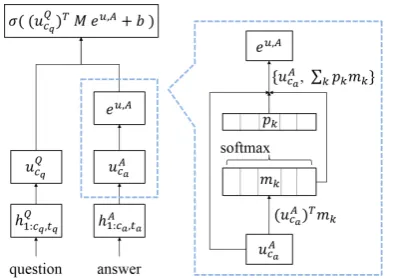
[image:3.595.74.283.59.191.2]Figure 2: Diagram of the HRDE-LTC. Input vector is compared to each latent topic memorymk to calculate
cluster-info contained vector. This vector will be con-catenated to original input vector.
m ∈ Rdm×K, which is only model parameter to
be learned, wheredmis vector dimension of each
latent topic andKis number of latent topic cluster.
For a given input sequencex = {x1:t}with these
K vectors, we construct LTC process as follows:
pk=softmax((x)Tmk),
xK = K
X
k=1
pkmk,
e=concat{x,xK}.
(5)
First, the similarity between thexand each la-tent topic vector is calculated by dot-product. Then the resultingKvalues are normalized by the
soft-max function softsoft-max(zk) = ezk/Piezi to
pro-duce a similarity probability pk. After
calculat-ing the latent topic probabilitypk,xK is retrieved
from summing overmkweighted by thepk. Then
we concatenate this result with the original encod-ing vector to generate the final encodencod-ing vectore with the LTC information added.
Note that the input sequence of the LTC could be any type of neural network based encoding function x = fθenc(w) such as RNN, CNN and
multilayer perceptron model (MLP). In addition, if the dimension size of x is different from that of memory vector, additional output projection layer should be placed afterxbefore applying dot-product to the memory.
3.4 Combined Model of (H)RDE and LTC As the LTC module extracts additional topic clus-ter information from the input data, we can com-bine this module with any neural network in their end-to-end training flow. In our experiments,
we combine the LTC module with the RDE and HRDE models.
3.4.1 RDE with LTC
The RDE model encodes question and answer texts tohQtq andhA
ta, respectively. Hence, the LTC
module could take these vectors as the input to generate latent topic cluster information added vectore. With this vector, we calculate the affinity among question and answer texts as well as addi-tional cluster information. The following equation shows our RDE-LTC process:
p(label) =σ((hQtq)TM eA+b). (6)
In this case, we applied the LTC module only for the answer side, assuming that the answer text is longer than the question. Thus, it needs to be clus-tered. To train the network, we use the same train-ing objective, to minimize cross-entropy loss, as in equation (2).
3.4.2 HRDE with LTC
The LTC can be combined with the HRDE model, in the same way it is applied to the RDE-LTC model by modifying equation (6as follows:
p(label) =σ((uQcq)TM eu,A+b), (7)
where uQcq is the final network hidden state
vec-tor of the chunk-level RNN for a question input sequence. Theeu,A is the LTC information added
vector from equation (5), where the LTC module takes the input x = uA from the HRDE model equation (3). The HRDE-LTC model also use the same training objective, minimizing cross-entropy loss, as in equation (2). Figure2shows a diagram of the combined model with the HRDE and the LTC.
4 Experimental Setup and Dataset 4.1 The Ubuntu Dialogue Corpus
The Ubuntu Dialogue Corpus has been developed by expanding and preprocessing the Ubuntu Chat Logs1, which refer to a collection of logs from the
Ubuntu-related chat room for solving problem in using the Ubuntu system by (Lowe et al.,2015).
Among the utterances in the dialogues, they consider each utterance, starting from the third one, as a potential{response}while the previous utterance is considered as a {context}. The data
Dataset # Samples Message (Avg.) Response (Avg.)
Train Val. Test # tokens # groups # tokens/group # tokens # groups # tokens/group Ubuntu-v1 1M 35,609 35,517 162.47
±132.47 8±.436.32 20±18.14.41 14±13.44.93 1 -Ubuntu-v2 1M 19,560 18,920 85.92
±74.71 4±.952.98 20±20.73.19 17±16.01.41 1 -Samsung QA 163,616 10,000 10,000 12.84
[image:5.595.79.520.62.145.2]±6.42 1 - 173±192.48.12 6±.509.58 29±31.28.91 Table 1: Properties of the Ubuntu and Samsung QA dataset. The message and response are{context},{response} in Ubuntu and{question},{answer}in the Samsung QA dataset.
was processed extracting ({context}, {response}, flag) tuples from the dialogues.
We called this original Ubuntu dataset as v1 dataset. After releasing the Ubuntu-v1 dataset, researchers published v2 version of this dataset. Main updates are separating train/valid/test dataset by time so that mimics real life implementation, where we are training a model on past data to predict future data, chang-ing samplchang-ing procedure to increase average turns in the{context}. We consider this Ubuntu dataset is one of the best dataset in terms of its quality, quantity and availability for evaluating the perfor-mance of the text ranking model.
To encode the text with the HRDE and HRDE-LTC model, a text needs to be divided into several chunk sequences with predefined criteria. For the Ubuntu-v1 dataset case, we divide the {context} part by splitting with end-of-sentence delimiter “ eos ”, and we do not split the {response} part since it is normally short and does not contain “ eos ” information. For the Ubuntu-v2 dataset case, we split the{context} part in the same way as we do in the Ubuntu-v1 dataset while only us-ing end-of-turn delimiter “ eot ”. Table 1 shows properties of the Ubuntu dataset.
Question
how do i set a timer of clock in applications and development for samsung galaxy s4 mini? Answer
1 from within the clock application, tap timer tab. 2 tap the hours, minutes, or seconds field and use the on-screen keypad to enter the hour, minute, or seconds. the timer plays an alarm at the end of the countdown. 3 tap start to start the timer. 4 tap stop to stop the timer or reset to reset the timer and start over. 5 tap restart to resume the timer counter.
Table 2: Example of the Samsung QA dataset.
4.2 Consumer Product QA Corpus
To test the robustness of the proposed model, we introduce an additional question and answer pair dataset related to an actual user’s interaction with the consumer electronic product domain. We crawled data from various sources like the Sam-sung Electronics’ official web site2 and crowd
QA web sites34 in a similar way that (Yoon
et al., 2016) did in building QA system for con-sumer products. On the official web page, we can retrieve data consisting of user questions and matched answers like frequently asked questions and troubleshooting. From the crowd QA sites, there are many answers from various users for each question. Among these answers, we choose answers from company certificated users to keep the reliability of the answers high. If there are no such answers, we skip that question answer pair. Table2shows an example of question-answer pair crawled from the web page. In addition, we crawl hierarchical product category information related to QA pairs. In particular, mobile, office,
photo, tv/video, accessories, and home appliance
as top-level categories, and specific categories like
galaxy s7, tablet, led tv, and others are used. We collected these meta-information for further use. The total size of the Samsung QA data is over 100,000 pairs and we split the data into ap-proximately 80,000/10,000/10,000 samples to cre-ate train/valid/test sets, respectively. To crecre-ate the train set, we use a QA pair sample as a ground-truth and perform negative sampling for answers among training sets to createfalse-label datasets. In this way, we generated ({question},{answer}, flag) triples (see Table 1). We do the same pro-cedure to create valid and test sets by only dif-ferentiating more negative sampling within each dataset to generate 9false-label samples with one
ground-truth sample. We apply the same method in such a way that the Ubuntu dataset is gener-ated from the Ubuntu Dialogue Corpus to main-tain the consistency. The Samsung QA dataset is available via web repository. We refer the readers to AppendixAfor more examples of each dataset.
4.3 Implementation Details 4.3.1 Ubuntu dataset case
To implement the RDE model, we use two single layer Gated Recurrent Unit (GRU) (Chung et al.,
2014) with 300 hidden units . Each GRU is used to encode{context}and{response}, respectively. The weight for the two GRU are shared. The hid-den units weight matrix of the GRU are initialized using orthogonal weights (Saxe et al.,2013), while input embedding weight matrix is initialized using a pre-trained embedding vector, the Glove ( Pen-nington et al., 2014), with 300 dimension. The vocabulary size is 144,953 and 183,045 for the Ubuntu-v1/v2 case, respectively. We use the Adam optimizer (Kingma and Ba,2014), with gradients clipped with norm value 1. The maximum time step for calculating gradient of the RNN is deter-mined according to the input data statistics in Ta-ble1.
For the HRDE model, we use two single layer GRU with 300 hidden units for word-level RNN part, and another two single layer GRU with 300 hidden units for chunk-level RNN part. The weight of the GRU is shared within the same hi-erarchical part, word-level and chunk-level. The other settings are the same with the RDE model case. As for the combined model with the (H)RDE and the LTC, we choose the latent topic memory dimensions as 256 in both v1 and ubuntu-v2. The number of the cluster in LTC module is de-cided to 3 for both the RDE-LTC and the HRDE-LTC cases. In HRDE-HRDE-LTC case, we applied HRDE-LTC module to the{context}part because we think it is longer having enough information to be clustered with. All of these hyper-parameters are selected from additional parameter searching experiments. The dropout (Srivastava et al.,2014) is applied for the purpose of regularization with the ratio of: 0.2 for the RNN in the RDE and the RDE-LTC, 0.3 for the word-level RNN part in the HRDE and the HRDE-LTC, 0.8 for the latent topic memory in the RDE-LTC and the HRDE-LTC.
We need to mention that our implementation of the RDE module has the same architecture as
the LSTM model (Kadlec et al.,2015) in ubuntu-v1/v2 experiments case. It is also the same archi-tecture with the RNN model (Baudiˇs et al.,2016) in ubuntu-v2 experiment case. We implement the same model ourselves, because we need a base-line model to compare with other proposed models such as the RDE-LTC, HRDE and HRDE-LTC. 4.3.2 Samsung QA dataset case
To test the Samsung QA dataset, we use the same implementation of the model (RDE, RDE-LTC, HRDE and HRDE-LTC) used in testing the Ubuntu dataset. Only the differences are, we use 100 hidden units for the RDE and the RDE-LTC, 300 hidden units for the HRDE and 200 hid-den units for the HRDE-LTC, and the vocabulary size of 28,848. As for the combined model with the (H)RDE and LTC, the dimensions of the tent topic memory is 64 and the number of la-tent cluster is 4. We chose best performing hyper-parameter of each model by additional extensive hyper-parameter search experiments.
All of the code developed for the empirical re-sults are available via web repository5.
5 Empirical Results 5.1 Evaluation Metrics
We regards all the tasks as selecting the best an-swer among text candidates for the given ques-tion. Following the previous work (Lowe et al.,
2015), we report model performance as recall at
k(R@k) relevant texts among given 2 or 10
can-didates (e.g., 1 in 2 R@1). Though this metric is useful for ranking task, R@1 metric is also mean-ingful for classifying the best relevant text.
Each model we implement is trained multiple times (10 and 15 times for Ubuntu and the Sam-sung QA datasets in our experiments, respectively) with random weight initialization, which largely influences performance of neural network model. Hence we report model performance as mean and standard derivation values (Mean±Std).
5.2 Performance Evaluation
5.2.1 Comparison with other methods
As Table 3 shows, our proposed HRDE and HRDE-LTC models achieve the best performance for the Ubuntu-v1 dataset. We also find that the RDE-LTC model shows improvements from the baseline model, RDE.
Model 1 in 2 Ubuntu-v1
R@1 1 in 10R@1 1 in 10R@2 1 in 10R@5
TF-IDF[1] 0.659 0.410 0.545 0.708
CNN[2] 0.848 0.549 0.684 0.896
LSTM[2] 0.901 0.638 0.784 0.949 CompAgg[3] 0.884 0.631 0.753 0.927 BiMPM[4] 0.897 0.665 0.786 0.938
RDE 0.898
±0.002 0±.6430.009 0±.7840.007 0±.9450.002 RDE-LTC 0.903
±0.001 0±.6560.003 0±.7940.003 0±.9480.001
HRDE 0.915
[image:7.595.306.526.61.158.2]±0.001 0±.6810.001 0±.8200.001 0±.9590.001 HRDE-LTC 0.916±0.001 0.684±0.001 0.822±0.001 0.960±0.001 Table 3: Model performance results for the Ubuntu-v1 dataset. Models [1-4] are from (Lowe et al.,2015;
Kadlec et al.,2015;Wang and Jiang,2016;Wang et al.,
2017), respectively.
Model 1 in 2 Ubuntu-v2
R@1 1 in 10R@1 1 in 10R@2 1 in 10R@5
LSTM[1] 0.869 0.552 0.721 0.924 RNN[5] 0±.9070.002 0±.6640.004 0±.7990.004 0±.9510.001 CNN[5] 0±.8630.003 0±.5870.004 0±.7210.005 0±.9070.003 RNN-CNN[5] 0±.9110.001 0.672±0.002 0±.8090.002 0±.9560.001 Attention[6]
(RNN-CNN) 0±.9030.002 0±.6530.005 0±.7880.005 0±.9450.002 CompAgg[3] 0.895 0.641 0.776 0.937 BiMPM[4] 0.877 0.611 0.747 0.921
RDE 0.894
±0.002 0±.6100.008 0±.7760.006 0±.9470.002 RDE-LTC 0.899
±0.002 0±.6250.004 0±.7880.004 0±.9510.001
HRDE 0.914
±0.001 0±.6490.001 0±.8130.001 0±.9640.001 HRDE-LTC 0.915±0.002 0.652
[image:7.595.72.303.62.199.2]±0.003 0.815±0.001 0.966±0.001
Table 4: Model performance results for the Ubuntu-v2 dataset. Models [1,3-6] are from (Lowe et al.,2015;
Wang and Jiang,2016;Wang et al.,2017;Baudiˇs et al.,
2016;Tan et al.,2015), respectively.
For the ubuntu-v2 dataset case, Table 4reveals that the HRDE-LTC model is best for three cases (1 in 2 R@1, 1 in 10 R@2 and 1 in 10 R@5). Com-paring the same model with our implementation (RDE) and (Baudiˇs et al.,2016)’s implementation (RNN), there is a large gap in the accuracy (0.610 and 0.664 of 1 in 10 R@1 for RDE and RNN, re-ceptively). We think this is largely influenced by the data preprocessing method, because the only differences between these models is the data pre-processing, which is (Baudiˇs et al., 2016)’s con-tribution to the research. We are certain that our model performs better with the exquisite datasets which adapts extensive preprocessing method, be-cause we see improvements from the RDE model to the HRDE model and additional improvements with the LTC module in all test cases (the Ubuntu-v1/v2 and the Samsung QA).
Model 1 in 2 Samsung QA
R@1 1 in 10R@1 1 in 10R@2 1 in 10R@5
TF-IDF 0.939 0.834 0.897 0.953
RDE 0.978
±0.002 0±.8690.009 0±.9660.003 0±.9970.001 RDE-LTC 0.981
±0.002 0±.8800.009 0±.9700.003 0±.9970.001
HRDE 0.981
[image:7.595.308.525.206.288.2]±0.002 0±.8850.011 0±.9710.004 0±.9970.001 HRDE-LTC 0.983±0.002 0.890±0.010 0.972±0.003 0.998±0.001 Table 5: Model performance results for the Samsung QA dataset.
# clusters Ubuntu-v1Accuracy (1 in 10 R@1)Ubuntu-v2 Samsung QA
1 0.643
±0.009 0±.6100.008 0±.8690.009
2 0.655
±0.005 0±.6160.006 0±.8760.011 3 0.656±0.003 0.625±0.004 0.877
±0.010
4 0.651
±0.005 0±.6220.005 0.880±0.009
Table 6: The RDE-LTC model results with different numbers of latent clusters. “Cluster 1” is the baseline model, RDE.
In the Samsung QA case, Table 5 indicates that the proposed RDE-LTC, HRDE, and the HRDE-LTC model show performance improve-ments when compared to the baseline model, TF-IDF and RDE. The average accuracy statistics are higher in the Samsung QA case when compared to the Ubuntu case. We think this is due to in the smaller vocabulary size and context variety. The Samsung QA dataset deals with narrower topics than in the Ubuntu dataset case. We are certain that our proposed model shows robustness in sev-eral datasets and different vocabulary size environ-ments.
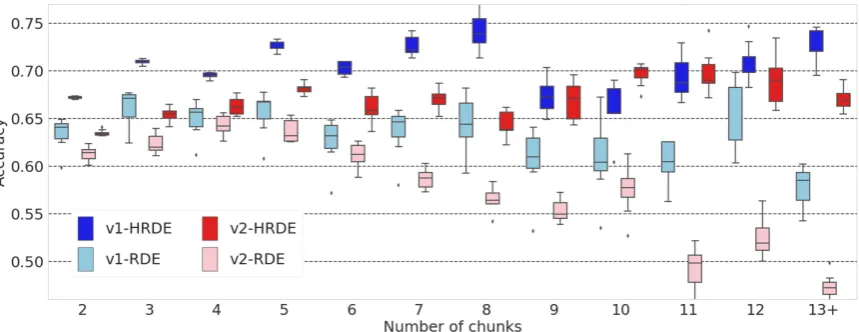
5.2.2 Degradation Comparison for Longer Texts
[image:7.595.72.295.269.444.2]Figure 3: The HRDE and RDE model performance comparisons for the number-of-chunk in the Ubuntu dataset. Each boxplot shows average accuracy with standard deviation. The HRDE models, in darker blue and red colors, show consistent performances as the number-of-chunks increased. Meanwhile, the RDE models in lighter colors show performance degradation as the number-of-chunks increased. Furthermore, 13+ indicates all data over 13-chunks.
Figure 4: Examples of the cluster proportions for four realcategoriesfrom20kevaluated samples. Each color corresponds to each cluster.
5.2.3 Effects of the LTC Numbers
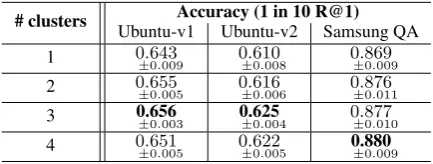
We analyze the RDE-LTC model for different numbers of latent clusters. Table 6 indicates that the model performances increase as the number of latent clusters increase (until 3 for the Ubuntu and 4 for the Samsung QA case). This is probably a major reason for the different number of subjects in each dataset. The Samsung QA dataset has an internalcategoryrelated to the type of consumer electronic products (6 top-level categories; mo-bile,office,photo,tv/video,accessories, andhome appliance), so that the LTC module makes clus-ters these categories. The Ubuntu dataset, how-ever, has diverse contents related to issues in us-ing the Ubuntu system. Thus, the LTC module has fewer clusters with the sparse topic compared to the Samsung QA dataset.
5.2.4 Comprehensive Analysis of LTC
We conduct quantitative and qualitative analysis on the HRDE-LTC model for four latent topic clusters. The Samsung QA dataset has category
Cluster Example
1 How to adjust the brightness on thes**d300 series monitors 2 How do I reject an incoming call on mySamsung Galaxy Note 3? 3 How should I clean and maintain themicrowave? 4 How do I connnect my surround sound tothis TV and what type of cables do I need
Table 7: Example sentences for each cluster.
information; hence, latent topic clustering results can be compared with real categories. We ran-domly choose 20k samples containing real
cate-gory information and evaluate each sample with the HRDE-LTC model. The cluster with the high-est similarity among the latent topic clusters is considered a representative cluster of each sample. Figure 4 shows proportion of four latent clus-ters among these samples according to real cat-egory information. Even though the HRDE-LTC model is trained without any ground-truth cate-gory labels, we observed that the latent cluster is formed accordingly. For instance, cluster 2 is shown mostly in “Mobile”categorysamples while “clusters 2 and 4” are rarely shown in “Home Ap-pliance”categorysamples.
[image:8.595.311.527.322.418.2]re-lated to the “Mobile”category(e.g., call rejection, voice level). This qualitative analysis explains why “cluster 2” is shown mostly in the “Mobile” cate-gory in Figure 4. We also discover that “cluster 3” has the largest portion of samples. As “cluster 3” contains “security” and “maintenance” related sentences (e.g., password, security, log-on, main-tain), we assume that this is one of the frequently asked issues across allcategoriesin the Samsung QA dataset. Table7shows example sentences with high scores from each cluster.
6 Conclusion
In this paper, we proposed the HRDE model and LTC module. HRDE showed higher perfor-mances in ranking answer candidates and less per-formance degradations when dealing with longer texts compared to conventional models. The LTC module provided additional performance improve-ments when combined with both RDE and HRDE models, as it added latent topic cluster information according to dataset properties. With this proposed model, we achieved state-of-the-art performances in Ubuntu datasets. We also evaluated our model in real world question answering dataset, Samsung QA. This demonstrated the robustness of the pro-posed model with the best results.
Acknowledgments
K. Jung is with the Department of Electrical and Computer Engineering, ASRI, Seoul National University, Seoul, Korea. This work was supported by Basic Science Research Program through the National Research Foundation of Korea (NRF) funded by the Ministry of Education (NRF-2016M3C4A7952587), the Ministry of Trade, In-dustry & Energy (MOTIE, Korea) under Industrial Technology Innovation Program (No.10073144).
References
Dzmitry Bahdanau, Kyunghyun Cho, and Yoshua Ben-gio. 2014. Neural machine translation by jointly learning to align and translate. arXiv preprint arXiv:1409.0473.
Petr Baudiˇs, Jan Pichl, Tom´aˇs Vyskoˇcil, and Jan ˇSediv`y. 2016. Sentence pair scoring: Towards uni-fied framework for text comprehension. arXiv preprint arXiv:1603.06127.
Antoine Bordes, Jason Weston, and Nicolas Usunier. 2014. Open question answering with weakly super-vised embedding models. InJoint European
Con-ference on Machine Learning and Knowledge Dis-covery in Databases. Springer, pages 165–180.
Samuel R Bowman, Gabor Angeli, Christopher Potts, and Christopher D Manning. 2015. A large anno-tated corpus for learning natural language inference. arXiv preprint arXiv:1508.05326.
Jennifer Chu-Carroll, James Fan, BK Boguraev, David Carmel, Dafna Sheinwald, and Chris Welty. 2012. Finding needles in the haystack: Search and candi-date generation. IBM Journal of Research and De-velopment56(3.4):6–1.
Junyoung Chung, Caglar Gulcehre, KyungHyun Cho, and Yoshua Bengio. 2014. Empirical evaluation of gated recurrent neural networks on sequence model-ing.arXiv preprint arXiv:1412.3555.
James Fan, Aditya Kalyanpur, David C Gondek, and David A Ferrucci. 2012. Automatic knowledge ex-traction from documents. IBM Journal of Research and Development56(3.4):5–1.
Sepp Hochreiter and J¨urgen Schmidhuber. 1997. Long short-term memory. Neural computation 9(8):1735–1780.
Rudolf Kadlec, Martin Schmid, and Jan Kleindienst. 2015. Improved deep learning baselines for ubuntu corpus dialogs. arXiv preprint arXiv:1510.03753.
Diederik Kingma and Jimmy Ba. 2014. Adam: A method for stochastic optimization. arXiv preprint arXiv:1412.6980.
Ankit Kumar, Ozan Irsoy, Peter Ondruska, Mohit Iyyer, James Bradbury, Ishaan Gulrajani, Victor Zhong, Romain Paulus, and Richard Socher. 2016. Ask me anything: Dynamic memory networks for natu-ral language processing. In International Confer-ence on Machine Learning. pages 1378–1387.
Ryan Lowe, Nissan Pow, Iulian V Serban, and Joelle Pineau. 2015. The ubuntu dialogue corpus: A large dataset for research in unstructured multi-turn dia-logue systems. In16th Annual Meeting of the Spe-cial Interest Group on Discourse and Dialogue. page 285.
Jeffrey Pennington, Richard Socher, and Christopher Manning. 2014. Glove: Global vectors for word rep-resentation. InProceedings of the 2014 conference on empirical methods in natural language process-ing (EMNLP). pages 1532–1543.
Juan Ramos et al. 2003. Using tf-idf to determine word relevance in document queries. In Proceedings of the first instructional conference on machine learn-ing. volume 242, pages 133–142.
Iulian Vlad Serban, Alessandro Sordoni, Yoshua Ben-gio, Aaron C Courville, and Joelle Pineau. 2016. Building end-to-end dialogue systems using gener-ative hierarchical neural network models. InAAAI. pages 3776–3784.
Alessandro Sordoni, Yoshua Bengio, Hossein Vahabi, Christina Lioma, Jakob Grue Simonsen, and Jian-Yun Nie. 2015. A hierarchical recurrent encoder-decoder for generative context-aware query sugges-tion. InProceedings of the 24th ACM International on Conference on Information and Knowledge Man-agement. ACM, pages 553–562.
Nitish Srivastava, Geoffrey E Hinton, Alex Krizhevsky, Ilya Sutskever, and Ruslan Salakhutdinov. 2014. Dropout: a simple way to prevent neural networks from overfitting. Journal of machine learning re-search15(1):1929–1958.
Sainbayar Sukhbaatar, Jason Weston, Rob Fergus, et al. 2015. End-to-end memory networks. InAdvances in neural information processing systems. pages 2440–2448.
Ming Tan, Cicero dos Santos, Bing Xiang, and Bowen Zhou. 2015. Lstm-based deep learning models for non-factoid answer selection. arXiv preprint arXiv:1511.04108.
Mengqiu Wang, Noah A Smith, and Teruko Mita-mura. 2007. What is the jeopardy model? a quasi-synchronous grammar for qa. In Proceedings of the 2007 Joint Conference on Empirical Methods in Natural Language Processing and Computational Natural Language Learning (EMNLP-CoNLL).
Shuohang Wang and Jing Jiang. 2016. A compare-aggregate model for matching text sequences. arXiv preprint arXiv:1611.01747.
Zhiguo Wang, Wael Hamza, and Radu Florian. 2017. Bilateral multi-perspective matching for natural lan-guage sentences. InProceedings of the 26th Inter-national Joint Conference on Artificial Intelligence. AAAI Press, pages 4144–4150.
Caiming Xiong, Stephen Merity, and Richard Socher. 2016. Dynamic memory networks for visual and textual question answering. In International Con-ference on Machine Learning. pages 2397–2406.
Yi Yang, Wen-tau Yih, and Christopher Meek. 2015. Wikiqa: A challenge dataset for open-domain ques-tion answering. In Proceedings of the 2015 Con-ference on Empirical Methods in Natural Language Processing. pages 2013–2018.
Wenpeng Yin, Hinrich Sch¨utze, Bing Xiang, and Bowen Zhou. 2016. Abcnn: Attention-based convo-lutional neural network for modeling sentence pairs. Transactions of the Association of Computational Linguistics4(1):259–272.
Seunghyun Yoon, Mohan Sundar, Abhishek Gupta, and Kyomin Jung. 2016. Automatic question answering system for consumer products. In Proceedings of SAI Intelligent Systems Conference. Springer, pages 1012–1016.
Lei Yu, Karl Moritz Hermann, Phil Blunsom, and Stephen Pulman. 2014. Deep learning for answer sentence selection. arXiv preprint arXiv:1412.1632 .
A More examples of the dataset A.1 Ubuntu dataset
Question
“what will happend if i unmounted the ubuntu partition”, “it will unmount , unless it is in use”, “srr i did n’t got it”
Answer flag
“you cannot unmount a partition if it is
currently in use” 1
[image:10.595.307.528.99.366.2]“why do you not have a backup if the data is important ?” 0
Table 8: Example of the Ubuntu-v2 dataset.
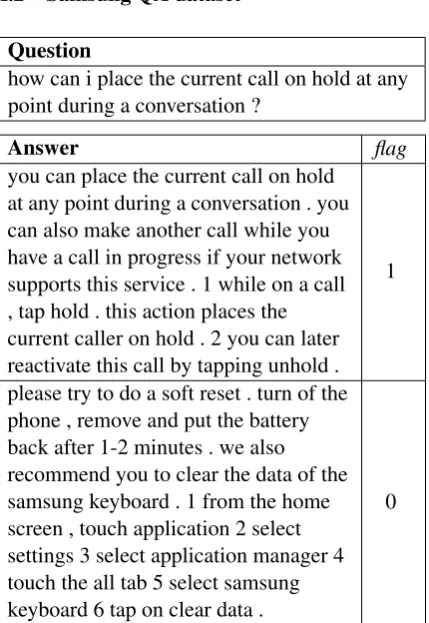
A.2 Samsung QA dataset
Question
how can i place the current call on hold at any point during a conversation ?
Answer flag
you can place the current call on hold at any point during a conversation . you can also make another call while you have a call in progress if your network supports this service . 1 while on a call , tap hold . this action places the current caller on hold . 2 you can later reactivate this call by tapping unhold .
1
please try to do a soft reset . turn of the phone , remove and put the battery back after 1-2 minutes . we also recommend you to clear the data of the samsung keyboard . 1 from the home screen , touch application 2 select settings 3 select application manager 4 touch the all tab 5 select samsung keyboard 6 tap on clear data .
0
[image:10.595.311.526.417.729.2]