188
Dictionaries and Decision Trees for the 2019 CLPsych Shared Task
Micah Iserman, Taleen Nalabandian, and Molly E. Ireland
Department of Psychological Sciences, Texas Tech University, Lubbock, Texas [email protected]
Abstract
In this summary, we discuss our approach to the CLPsych Shared Task and its initial re-sults. For our predictions in each task, we used a recursive partitioning algorithm (de-cision trees) to select from our set of fea-tures, which were primarily dictionary scores and counts of individual words. We focused primarily on Task A, which aimed to pre-dict suicide risk, as rated by a team of expert clinicians (Shing et al.,2018), based on lan-guage used in SuicideWatch posts on Reddit. Category-level findings highlight the potential importance of social and moral language cat-egories. Word-level correlates of risk levels underline the value of fine-grained data-driven approaches, revealing both theory-consistent and potentially novel correlates of suicide risk that may motivate future research.
1 Introduction
The shared task for this year’s CLPsych workshop focused on predicting Reddit users’ risk for sui-cide (none, low, moderate, and severe, as coded by clinical psychologists with suicide expertise) based on language used in their posts (Shing et al. 2018; for a review, seeZirikly et al. 2019). Reddit is a social media website that hosts over 138,000 active forums (or subreddits; as of 20171) in which users can post on any topics of interest.
Social media sites like Reddit, Facebook, and Twitter have increasingly become an important source of data for researchers. Studies have demonstrated how language use in social me-dia posts reflects various psychological processes, ranging from personality (Youyou et al., 2017) to mental health (e.g., postpartum depression; De Choudhury et al., 2014). For instance, Eich-staedt et al.(2018) were able to accurately distin-guish depressed patients from non-depressed
con-1https://www.redditinc.com/
trols based on Facebook statuses posted before the date of their diagnosis.
Certain language categories have been impli-cated as markers of mental health conditions (such as anxiety; Dirkse et al., 2015). Relevant to this shared task, suicidal ideation tends to be posi-tively correlated with rates of first-person singular pronoun use (Stirman and Pennebaker,2001) and negative emotion word use (e.g., anger, sadness; Coppersmith et al.,2016). Self-focused and nega-tive language appear to be associated with psycho-logical distress in general, relating to a variety of mental health issues, such as psychosis (Fineberg et al.,2016), neuroticism (Tackman et al.,2018), and depression (Rude et al., 2004). Notably, self-focused language correlates with psycholog-ical distress across a variety of contexts (such as across public Facebook posts; De Choudhury et al., 2014), whereas the use of negative emo-tional language tends to be limited to more private or intimate contexts (such as in conversations with romantic partners;Baddeley et al.,2012).
Based on previous research, we went into this year’s shared task with a particular interest in first-person singular pronouns and overtly nega-tive content words. Although our models cast a wide net, making use of all available lexicons, we expected categories relating to negative affect, self-focus, and social distance to be most predic-tive of suicide risk, as rated by expert coders.
2 Method
remove some formatting that could make identi-fying word or sentence boundaries more difficult, such as periods within word; (d) standardize some common typing-related practices, such as repeat-ing characters within some words for emphasis (e.g., “reeeeeaallllly”); and (e) replace some stan-dard formatted elements with tags, such as URLs, references to subreddits, and simple emojis.
After cleaning and tokenizing texts, we applied a spelling correction processes in two phases: First, we applied a more generic version of the process (to be described), and checked its output for (a) miscorrections (such as specialized termi-nology like “reddit”, “macbook”, and “moba”), which we added to the list defining correctly spelled words, and (b) frequent misspellings not caught by the process, which we added to a map between correctly spelled words and their mis-spelled instances. This caught some of the most frequent miscorrections and missed misspellings, but was limited by available time. We applied the process again with these refinements and allowed it to correct the misspellings it identified.
The spelling correction process used the hun-spell package (Ooms, 2018) and its US English dictionary to mark words as misspelled (on its own at first, then manually supplemented; only con-sidering words over 3 characters long). The pro-cess then measured edit distance (optimal string alignment, calculated with the stringdist package; van der Loo, 2014) between each marked and unmarked (correctly spelled) word found in the text. If a misspelled word was within 2 edit dis-tance of one and only one correctly spelled word, it was considered a matched to that word. If a word was within 1 edit distance of multiple words, these were considered potential matches, and the qgram and soundex distance were calculated be-tween them and the original misspelling—a com-bination of these new distances and the frequency of the potential matches determined which of these would claim the misspelling (as shown in equa-tion 1, where ais the misspelling, and b is each word in the set of words within 1 edit distance; document frequency is the number of posts in which the word appears).
arg min b∈matches
qgram(a, b) +soundex(a, b)
documentf requency(b) (1)
If a misspelled word did not meet the edit dis-tance criteria, corrections suggested by hunspell
AFINN Nielsen(2011)
Hu & Liu Hu and Liu(2004)
General Inquirer Stone and Hunt(1963)
labMT Dodds et al.(2011)
LIWC Pennebaker et al.(2015)
Lusi Ireland and Iserman(2018) Moral Foundations Frimer et al.(2018)
Netspeak Ireland and Iserman(2019)
NRC Mohammad(2017)
Senticnet Cambria et al.(2010)
SentimentDictionaries Pr¨ollochs et al.(2018) SentiWordNet Baccianella et al.(2010)
Slangsd Wu et al.(2016)
Vader Hutto and Gilbert(2014)
Whissell Whissell(1989)
Age and Gender Sap et al.(2014)
[image:2.595.307.525.59.295.2]PERMA Schwartz et al.(2016)
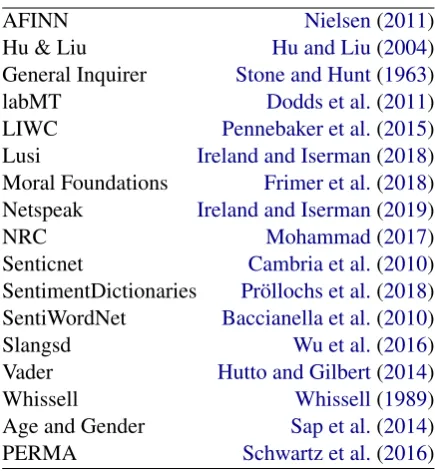
Table 1: Dictionaries/Lexicons.
were considered: If any of these were more fre-quent than the misspelling, the most frefre-quent of them was considered its correction. Otherwise, if any suggested corrections contained spaces (i.e., the misspelling was suggested to be a combination of words), and if the individual suggested words were all found in the texts, the most frequent com-bination was taken to be its correction.
Most of the genuine spelling errors appeared to be typing related (e.g.,ddin’t,favirite), with other common errors seeming to be formatting related (such as words being combined, or parts of words being appended to others). Other corrections ef-fectively standardized across certain word variants (e.g., forms ofhighschool to high-school, words with commonly omitted apostrophes to have apos-trophes, or British to English spellings) or casual language (e.g.,wana,coulda).
con-taining code examples) caused entries to overflow.
Many individual categories were nearly identi-cal, so we removed those correlating over .9 with any other category (done iteratively, such that only one of each similar category was retained, pre-ferring to retain LIWC categories). In addition to these pre-built dictionaries, we considered each manually replaced tag (such as those for proper names, subreddits, and emojis) to be its own cat-egory, counting their instances up and including them as features. The final set of features included dictionary categories and counts of each token, as well as Language Style Matching (Ireland and Pennebaker,2010) between (a) each post and the posting user’s average language style across all of their posts, and (b) each post and the average lan-guage style of the subreddit in which it was posted.
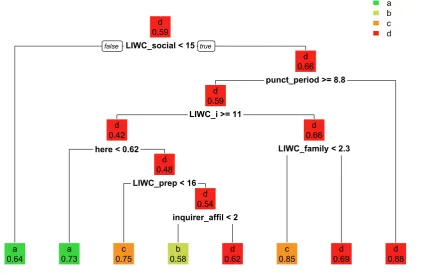
Model. We ended up using a simple recur-sive partitioning model (as calculated by the rpart package; Therneau and Atkinson, 2018), with all features predicting the ratings for each task (with tasks simply defining the particular posts to be included). For final predictions, we trained each model on the full task specific training data (though the submitted task C model was acciden-tally trained on the task B data), then aggregated within user, assigning each user the rating that had the largest average probability across their posts (as depicted in Figure2).
We also briefly considered other models (with a small set of features, selected by their corre-lations with any rating or the continuous rating scale), such as linear regressions predicting a nu-meric version of the ratings (with their predictions being binned), separate logistic regressions pdicting each category, and multinomial logistic re-gressions (both with the subset of features, and an elastic net regularized version with all features), as well as a random forest model, but these all either performed worse than our final model in our own testing splits, or seemed to overly capitalize on pri-ors (tending to predict only the most common rat-ings, even more than our final models). Of course, there are many strategies that might be explored to address the uneven distribution of ratings, but our first step in this brief analysis was to compare the performance of a few different models. We also considered mixed-effects models estimating a per-user intercept adjustment, but these did not work well, at least for task A, since most users had only 1 r/SuicideWatch post.
Task a b c d mean rank
A .667 .200 .140 .600 .402 6th
B .000 .000 .000 .591 .148 11th
[image:3.595.309.524.63.118.2]C .000 .000 .353 .118 8th
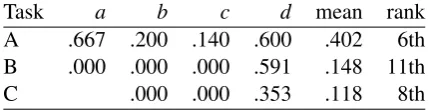
Table 2: F1 scores for each rating level in each task. Rankings out of 12, 11, and 8 for each task respectively.
3 Results and Discussion
As the results on the official test sample depict (Ta-ble2), our models tended to only predict extreme ratings, capitalizing on the prior ratings distribu-tions. Because the model could perform well in each task by identifying features that marked a -ord-rated users (withd being the most common rating; as ratings applied per user, across posts), trees in tasks B and C in particular tended to be very simple. This tendency was exacerbated by the fact that some users had multiple posts, which meant any idiosyncrasies in word use or topics of discussion among prolific posters could be used as a cue for their entire rating level.
In terms of differences in higher-level language dimensions, posts in r/SuicideWatch were more likely to be coded as high risk (category d) if they had higher Clout scores (used I more, and we andyou less), talked about family (e.g., dad, grandma) at relatively low rates, and used less positive affective language (as indexed by senti-mentr). With respect to moral language, higher-risk posts referred more often to care (e.g., help, pity; Moral Foundations Dictionary, Frimer et al. 2018) as well as both vice and virtue, as mea-sured by the General Inquirer lexicons (e.g., abil-ity, burn). In terms of sentence structure and punctuation, higher risk posts used more periods, fewer parentheses, and more hyperbolic or ex-treme statements (e.g., quite, extreme; overstate-ment, General Inquirer), and fewer third-person singular pronouns (e.g., him, she; LIWC shehe), relative to lower-risk posts.
die). Higher risk posts also included a num-ber of negations (don’t, can’t, no; see Weintraub 1989). Swearing (e.g.,fucking) was indicative of the highest risk level as well, perhaps reflecting in-tense negative affect or disregard for social norms. Perhaps the most notable and theory-consistent word-level correlates of the highest risk level were self-focused pronouns, including I, me, and my-self. Self-focused pronouns are commonly asso-ciated with depression (Rude et al., 2004), suici-dality (Stirman and Pennebaker, 2001), or, more broadly, vulnerability to stress (Tackman et al., 2018). See Figure1for additional word-level cor-relates of risk-level ratings.
Some of the linguistic correlates of risk cate-gorization are consistent with our prediction that posts would be viewed as indicating higher sui-cide risk to the degree that they used more nega-tive and socially distant language. The interper-sonal theory of suicide (Van Orden et al., 2010) is a leading psychological model of suicide risk. The theory proposes that people are more likely to attempt or die by suicide to the degree that they feel a thwarted desire to belong, believe they are a burden on their loved ones, and have acquired the capability to die (or no longer fear death). Talking infrequently about family and using fewer third-person singular references that might refer to other people in their lives could reflect social isolation.
Although not predicted a priori, the moral language correlates seem to be relatively face valid. People using carelated words from the re-vised Moral Foundations Dictionary (Frimer et al., 2018) may have simply been requesting help more explicitly than people who did not use words such ashelp, mercy, orcomfort (Graham et al., 2009; Sagi and Dehghani,2014). The General Inquirer viceandvirtuecategories (Stone and Hunt,1963) are less intuitive, but discussing basic moral ques-tions of good and evil may reflect the thwarted be-longing dimension of the interpersonal theory of suicide (e.g., discussing wanting to be good but disappointing loved ones;Van Orden et al. 2010).
The punctuation categories are less straightfor-ward to interpret. Using more periods and fewer parentheses seems to indicate simpler writing. Others have observed that writing about serious trauma is often better quality than writing about more mundane or lighter-hearted topics, partly due to its less convoluted sentence structures and more straightforward style (Pennebaker,1997). Perhaps
that is some of what experts were decoding in the severe-risk posts: Posts using simpler punctuation may have indicated a more urgent or certain desire to die, and thus were coded as high risk.
4 Conclusion
It is important to remember that the expert coders in Shing et al. (2018) had no more informa-tion than we do about these users. We do not know whether the people whose r/SuicideWatch posts comprised this sample have died by suicide since posting, either immediately following an ex-pressed intention to die or later on, related to long-term complications of problems mentioned in their posts. Thus, there are bound to be some false pos-itives in every risk category.
anymore
i'm
myself
later
too
every
anything
out
i
can't
want
noticed
last
did
called
end
only
fucking
first
knife
so
woke
said
alive
piece
[image:5.595.93.523.405.679.2]day
up
world
me
everybody
my
disgusting
gonna
don't
now
hurts
die
it's
URL
it
taking
nothing
no
exactly
we
rent
you'll
relief
room
brother
hated
silly
black
herself
sadness
told
cause
was
bottle
comfortable
clear
drinks
passionate
police
young
advice
male
fast
laugh
treated
friday
mom
college
escape
she
while
hello
text
parents
subreddit
somewhere
cousin
experiences main typing she'll terms message however building hobbies site background worried near treatment action live especially image pm high continue awkward lucky memory onto places yelled less son says meant regardless teenager attempt options lose contact also barely financially female his year r/subreddit hour post mine himself friend early we've birth suicidewatch we're account open tldr possibleFigure 1: Word cloud based on posts in r/SuicideWatch, aggregated within user. Words are colored by the rating they most correlate with (a = green,b = yellow, c= orange,d = red), sized by correlation size, and shaded by document frequency (lighter words being used by more users).
LIWC_social < 15
punct_period >= 8.8
LIWC_i >= 11
here < 0.62
LIWC_prep < 16
inquirer_affil < 2
LIWC_family < 2.3
d 0.59 a 0.64 d 0.66 d 0.59 d 0.42 a 0.73 d 0.48 c 0.75 d 0.54 b 0.58 d 0.62 d 0.66 c 0.85 d 0.69 d 0.88 false true a b c d
References
Stefano Baccianella, Andrea Esuli, and Fabrizio Sebas-tiani. 2010. Sentiwordnet 3.0: An enhanced lexi-cal resource for sentiment analysis and opinion
min-ing. In Proceedings of the Seventh conference on
International Language Resources and Evaluation
(LREC’10), Valletta, Malta. European Languages
Resources Association (ELRA).
Jenna L Baddeley, James W Pennebaker, and Christo-pher G Beevers. 2012. Everyday social behavior during a major depressive episode. Social Psycho-logical and Personality Science, 4(4):445–452.
Erik Cambria, Robert Speer, Catherine Havasi, and Amir Hussain. 2010. Senticnet: A publicly available semantic resource for opinion mining. InAAAI Fall
Symposium: Commonsense Knowledge, volume
FS-10-02 ofAAAI Technical Report. AAAI.
Glen Coppersmith, Kim Ngo, Ryan Leary, and An-thony Wood. 2016. Exploratory analysis of social media prior to a suicide attempt. In Proceedings of the Third Workshop on Computational Lingusitics
and Clinical Psychology, pages 106–117.
Munmun De Choudhury, Scott Counts, Eric J Horvitz, and Aaron Hoff. 2014. Characterizing and pre-dicting postpartum depression from shared facebook
data. In Proceedings of the 17th ACM conference
on Computer supported cooperative work & social
computing, pages 626–638. ACM.
Dale Dirkse, Heather D Hadjistavropoulos, Hugo Hesser, and Azy Barak. 2015. Linguistic analy-sis of communication in therapist-asanaly-sisted internet-delivered cognitive behavior therapy for general-ized anxiety disorder. Cognitive behaviour therapy, 44(1):21–32.
Peter Sheridan Dodds, Kameron Decker Harris, Is-abel M. Kloumann, Catherine A. Bliss, and Christo-pher M. Danforth. 2011. Temporal patterns of hap-piness and information in a global social network: Hedonometrics and twitter.PLOS ONE, 6(12):1–1.
Johannes C Eichstaedt, Robert J Smith, Raina M Mer-chant, Lyle H Ungar, Patrick Crutchley, Daniel Preot¸iuc-Pietro, David A Asch, and H Andrew Schwartz. 2018. Facebook language predicts de-pression in medical records. Proceedings of the
Na-tional Academy of Sciences, 115(44):11203–11208.
SK Fineberg, J Leavitt, S Deutsch-Link, S Dealy, CD Landry, K Pirruccio, S Shea, S Trent, G Cecchi, and PR Corlett. 2016. Self-reference in psychosis and depression: a language marker of illness. Psy-chological medicine, 46(12):2605–2615.
Jeremy Frimer, Jonathan Haidt, Jesse Graham, Morteza Dehgani, and Reihane Boghrati. 2018. Moral Foun-dations Dictionary 2.0.
Jesse Graham, Jonathan Haidt, and Brian A Nosek. 2009. Liberals and conservatives rely on different
sets of moral foundations. Journal of personality and social psychology, 96(5):1029.
Robert M Hamm. 1988. Clinical intuition and clini-cal analysis: expertise and the cognitive continuum.
Professional judgment: A reader in clinical decision
making, pages 78–105.
Minqing Hu and Bing Liu. 2004. Mining and summa-rizing customer reviews. InProceedings of the Tenth ACM SIGKDD International Conference on
Knowl-edge Discovery and Data Mining, KDD ’04, pages
168–177, New York, NY, USA. ACM.
C.J. Hutto and Eric Gilbert. 2014. Vader: A parsimo-nious rule-based model for sentiment analysis of so-cial media text. InEighth International Conference
on Weblogs and Social Media (ICWSM-14).
Molly E. Ireland and Micah Iserman. 2018. LUSI Lab Development Dictionaries.
Molly E. Ireland and Micah Iserman. 2019. LUSI Lab Revised Netspeak Dictionary.
Molly E Ireland and James W Pennebaker. 2010. Lan-guage style matching in writing: synchrony in es-says, correspondence, and poetry. Social Psycho-logical and Personality Science, 99(3):549–571.
Saif M. Mohammad. 2017. Word affect intensities.
CoRR, abs/1704.08798.
Finn ˚Arup Nielsen. 2011. A new ANEW: evaluation of a word list for sentiment analysis in microblogs.
CoRR, abs/1103.2903.
Jeroen Ooms. 2018. hunspell: High-Performance Stemmer, Tokenizer, and Spell Checker. R package version 3.0.
James W Pennebaker. 1997. Opening up: The healing power of expressing emotions. Guilford Press.
James W. Pennebaker, Ryan L. Boyd, Kayla Jordan, and Kate Blackburn. 2015. The development and psychometric properties of liwc2015. UT Fac-ulty/Researcher Works.
Nicolas Pr¨ollochs, Stefan Feuerriegel, and Dirk Neu-mann. 2018. Statistical inferences for polarity identification in natural language. PLOS ONE, 13(12):1–21.
Stephanie Rude, Eva-Maria Gortner, and James Pen-nebaker. 2004. Language use of depressed and depression-vulnerable college students. Cognition & Emotion, 18(8):1121–1133.
Eyal Sagi and Morteza Dehghani. 2014. Measuring moral rhetoric in text. Social science computer re-view, 32(2):132–144.
media. InProceedings of the 2014 Conference on Empirical Methods in Natural Language Processing
(EMNLP).
Wolfgang Schneider, Joachim K¨orkel, and Franz E. Weinert. 1990. Expert knowledge, general abilities, and text processing. In Wolfgang Schneider and Franz E. Weinert, editors, Interactions Among Ap-titudes, Strategies, and Knowledge in Cognitive
Per-formance, pages 235–251. Springer New York, New
York, NY.
H Andrew Schwartz, Maarten Sap, Margaret L Kern, Johannes C Eichstaedt, Adam Kapelner, Megha Agrawal, Eduardo Blanco, Lukasz Dziurzynski, Gregory Park, David Stillwell, Michal Kosinski, Martin E P Seligman, and Lyle H Ungar. 2016.
Predicting individual well-being through the lan-guage of social media. Pacific Symposium on
Bio-computing. Pacific Symposium on Biocomputing,
21:516—527.
Han-Chin Shing, Suraj Nair, Ayah Zirikly, Meir Friedenberg, Hal Daum´e III, and Philip Resnik. 2018. Expert, crowdsourced, and machine assess-ment of suicide risk via online postings. In Proceed-ings of the Fifth Workshop on Computational Lin-guistics and Clinical Psychology: From Keyboard to Clinic, pages 25–36.
Shannon Wiltsey Stirman and James W Pennebaker. 2001. Word use in the poetry of suicidal and non-suicidal poets.Psychosomatic medicine, 63(4):517– 522.
Philip J. Stone and Earl B. Hunt. 1963. A computer ap-proach to content analysis: Studies using the general inquirer system. InProceedings of the May 21-23,
1963, Spring Joint Computer Conference, AFIPS
’63 (Spring), pages 241–256, New York, NY, USA. ACM.
Allison M Tackman, David A Sbarra, Angela L Carey, M Brent Donnellan, Andrea B Horn, Nicholas S Holtzman, To’Meisha S Edwards, James W Pen-nebaker, and Matthias R Mehl. 2018. Depression, negative emotionality, and self-referential language: A multi-lab, multi-measure, and multi-language-task research synthesis. Journal of personality and social psychology.
Terry Therneau and Beth Atkinson. 2018. rpart: Re-cursive Partitioning and Regression Trees. R pack-age version 4.1-13.
Mark P.J. van der Loo. 2014. The stringdist package for approximate string matching. The R Journal, 6:111–122. Version 0.9.4.7.
Kimberly A Van Orden, Tracy K Witte, Kelly C Cukrowicz, Scott R Braithwaite, Edward A Selby, and Thomas E Joiner Jr. 2010. The interpersonal theory of suicide.Psychological review, 117(2):575.
Walter Weintraub. 1989. Verbal behavior in everyday life.Springer Publishing Co.
Cynthia M. Whissell. 1989. Chapter 5 - the dictionary of affect in language. In Robert Plutchik and Henry Kellerman, editors, The Measurement of Emotions, pages 113 – 131. Academic Press.
Liang Wu, Fred Morstatter, and Huan Liu. 2016.
Slangsd: Building and using a sentiment dictionary of slang words for short-text sentiment classifica-tion.CoRR, abs/1608.05129.
Wu Youyou, David Stillwell, H Andrew Schwartz, and Michal Kosinski. 2017. Birds of a feather do flock together: Behavior-based personality-assessment method reveals personality similarity among couples and friends.Psychological science, 28(3):276–284.
Ayah Zirikly, Philip Resnik, ¨Ozlem Uzuner, and Kristy Hollingshead. 2019. CLPsych 2019 shared task: Predicting the degree of suicide risk in Reddit posts.
In Proceedings of the Sixth Workshop on