Proceedings of NAACL-HLT 2018, pages 1823–1832
Variational Knowledge Graph Reasoning
Wenhu Chen, Wenhan Xiong, Xifeng Yan, William Yang Wang Department of Computer Science
University of California, Santa Barbara Santa Barbara, CA 93106
{wenhuchen,xwhan,xyan,william}@cs.ucsb.edu
Abstract
Inferring missing links in knowledge graphs (KG) has attracted a lot of attention from the research community. In this paper, we tackle a practical query answering task involving pre-dicting the relation of a given entity pair. We frame this prediction problem as an inference problem in a probabilistic graphical model and aim at resolving it from a variational infer-ence perspective. In order to model the rela-tion between the query entity pair, we assume that there exists an underlying latent variable (paths connecting two nodes) in the KG, which carries the equivalent semantics of their rela-tions. However, due to the intractability of connections in large KGs, we propose to use variation inference to maximize the evidence lower bound. More specifically, our frame-work (DIVA) is composed of three modules,
i.e. a posterior approximator, a prior (path finder), and a likelihood (path reasoner). By using variational inference, we are able to in-corporate them closely into a unified archi-tecture and jointly optimize them to perform KG reasoning. With active interactions among these sub-modules, DIVAis better at handling noise and coping with more complex reason-ing scenarios. In order to evaluate our method, we conduct the experiment of the link pre-diction task on multiple datasets and achieve state-of-the-art performances on both datasets. 1 Introduction
Large-scaled knowledge graph supports a lot of downstream natural language processing tasks like question answering, response generation, etc. However, there are large amount of important facts missing in existing KG, which has significantly limited the capability of KG’s application. There-fore, automated reasoning, or the ability for com-puting systems to make new inferences from the observed evidence, has attracted lots of attention from the research community. In recent years,
there are surging interests in designing machine learning algorithms for complex reasoning tasks, especially in large knowledge graphs (KGs) where the countless entities and links have posed great challenges to traditional logic-based algorithms. Specifically, we situate our study in this large KG multi-hop reasoning scenario, where the goal is to design an automated inference model to com-plete the missing links between existing entities in large KGs. For examples, if the KG contains a fact like president(BarackObama, USA) and
spouse(Michelle, BarackObama), then we would
like the machines to complete the missing link
livesIn(Michelle,USA) automatically. Systems for
this task are essential to complex question answer-ing applications.
To tackle the multi-hop link prediction problem, various approaches have been proposed. Some earlier works like PRA (Lao et al., 2011; Gard-ner et al., 2014, 2013) use bounded-depth ran-dom walk with restarts to obtain paths. More re-cently, DeepPath (Xiong et al., 2017) and MIN-ERVA (Das et al., 2018), frame the path-finding problem as a Markov Decision Process (MDP) and utilize reinforcement learning (RL) to maximize the expected return. Another line of work along with ours are Chain-of-Reasoning (Das et al.,
2016) and Compositional Reasoning (Neelakantan et al.,2015), which take multi-hop chains learned by PRA as input and aim to infer its relation.
Here we frame the KG reasoning task as a two sub-steps, i.e. Finding” and “Path-Reasoning”. We found that most of the re-lated research is only focused on one step, which leads to major drawbacks—lack of interactions between these two steps. More specifically, Deep-Path (Xiong et al., 2017) and MINERVA (Das et al., 2018) can be interpreted as enhancing the “Path-Finding” step while compositional reason-ing (Neelakantan et al.,2015) and chains of
soning (Das et al.,2016) can be interpreted as en-hancing the “Path-Reasoning” step. DeepPath is trained to find paths more efficiently between two given entities while being agnostic to whether the entity pairs are positive or negative, whereas MIN-ERVA learns to reach target nodes given an entity-query pair while being agnostic to the quality of the searched path1. In contrast, chains of
reason-ing and compositional reasonreason-ing only learn to pre-dict relation given paths while being agnostic to the path-finding procedure. The lack of interac-tion prevents the model from understanding more diverse inputs and make the model very sensitive to noise and adversarial samples.
In order to increase the robustness of existing KG reasoning model and handle noisier environ-ments, we propose to combine these two steps to-gether as a whole from the perspective of the la-tent variable graphic model. This graphic model views the paths as discrete latent variables and re-lation as the observed variables with a given entity pair as the condition, thus the path-finding module can be viewed as a prior distribution to infer the underlying links in the KG. In contrast, the path-reasoning module can be viewed as the likelihood distribution, which classifies underlying links into multiple classes. With this assumption, we intro-duce an approximate posterior and design a vari-ational auto-encoder (Kingma and Welling,2013) algorithm to maximize the evidence lower-bound. This variational framework closely incorporates two modules into a unified framework and jointly train them together. By active cooperations and interactions, the path finder can take into account the value of searched path and resort to the more meaningful paths. Meanwhile, the path reasoner can receive more diverse paths from the path finder and generalizes better to unseen scenarios. Our contributions are three-fold:
• We introduce a variational inference
frame-work for KG reasoning, which tightly in-tegrates the path-finding and path-reasoning processes to perform joint reasoning.
• We have successfully leveraged negative samples into training and increase the robust-ness of existing KG reasoning model.
• We show that our method can scale up to
large KG and achieve state-of-the-art results 1MINERVA assigns constant rewards to all paths reaching
the destination while ignoring their qualities.
on two popular datasets.
The rest of the paper is organized as follow. In Section2 we will outline related work on KG embedding, multi-hop reasoning, and variational auto-encoder. We describe our variational knowl-edge reasoner DIVAin Section3. Experimental
re-sults are presented in Section4, and we conclude in Section5.
2 Related Work
2.1 Knowledge Graph Embeddings
Embedding methods to model multi-relation data from KGs have been extensively studied in recent years (Nickel et al., 2011; Bordes et al., 2013;
Socher et al., 2013; Lin et al., 2015; Trouillon et al.,2017). From a representation learning per-spective, all these methods are trying to learn a projection from symbolic space to vector space. For each triple(es, r, ed)in the KG, various score
functions can be defined using either vector or ma-trix operations. Although these embedding ap-proaches have been successful capturing the se-mantics of KG symbols (entities and relations) and achieving impressive results on knowledge base completion tasks, most of them fail to model multi-hop relation paths, which are indispensable for more complex reasoning tasks. Besides, since all these models operate solely on latent space, their predictions are barely interpretable.
2.2 Multi-Hop Reasoning
search, which could make their models sensitive to noises and adversarial examples.
2.3 Variational Auto-encoder
Variational Auto-Encoder (Kingma and Welling,
2013) is a very popular algorithm to perform ap-proximate posterior inference in large-scale sce-narios, especially in neural networks. Recently, VAE has been successfully applied to various complex machine learning tasks like image gen-eration (Mansimov et al., 2015), machine trans-lation (Zhang et al., 2016), sentence genera-tion (Guu et al., 2017a) and question answer-ing (Zhang et al., 2017). Zhang et al.(2017) is closest to ours, this paper proposes a variational framework to understand the variability of human language about entity referencing. In contrast, our model uses a variational framework to cope with the complex link connections in large KG. Un-like the previous research in VAE, both Zhang et al. (2017) and our model uses discrete vari-ables as the latent representation to infer the se-mantics of given entity pairs. More specifically, we view the generation of relation as a stochastic process controlled by a latent representation, i.e. the connected multi-hop link existed in the KG. Though the potential link paths are discrete and countable, its amount is still very large and poses challenges to direct optimization. Therefore, we resort to variational auto-encoder as our approxi-mation strategy.
3 Our Approach
3.1 Background
Here we formally define the background of our task. Let E be the set of entities and R be the
set of relations. Then a KG is defined as a col-lection of triple facts(es, r, ed), wherees, ed ∈ E
andr ∈ R. We are particularly interested in the
problem of relation inference, which seeks to an-swer the question in the format of (es,?, ed), the
problem setting is slightly different from standard link prediction to answer the question of(es, r,?).
Next, in order to tackle this classification problem, we assume that there is a latent representation for given entity pair in the KG, i.e. the collection of linked paths, these hidden variables can reveal the underlying semantics between these two entities. Therefore, the link classification problem can be decomposed into two modules – acquire underly-ing paths (Path Finder) and infer relation from
la-tent representation (Path Reasoner).
Path Finder The state-of-the-art
ap-proach (Xiong et al., 2017; Das et al., 2018) is to view this process as a Markov Decision Process (MDP). A tuple< S, A, P >is defined to
represent the MDP, where S denotes the current
state, e.g. the current node in the knowledge graph, A is the set of available actions, e.g. all
the outgoing edges from the state, while P is
the transition probability describing the state transition mechanism. In the knowledge graph, the transition of the state is deterministic, so we do not need to model the state transitionP.
Path Reasoner The common approach (Lao et al., 2011;Neelakantan et al., 2015;Das et al.,
2016) is to encode the path as a feature vector and use a multi-class discriminator to predict the un-known relation. PRA (Lao et al.,2011) proposes to encode paths as binary features to learn a log-linear classifier, while (Das et al.,2016) applies recurrent neural network to recursively encode the paths into hidden features and uses vector similar-ity for classification.
3.2 Variational KG Reasoner (DIVA)
Here we draw a schematic diagram of our model in Figure 1. Formally, we define the objec-tive function for the general relation classification problem as follows:
Obj= X
(es,r,ed)∈D
logp(r|(es, ed))
= X
(es,r,ed)∈D
logX
L
pθ(L|(es, ed))p(r|L)
(1)
whereDis the dataset,(es, r, ed)is the triple
con-tained in the dataset, andLis the latent connecting
paths. The evidence probabilityp(r|(es, ed))can
be written as the marginalization of the product of two terms over the latent space. However, this ev-idence probability is intractable since it requires summing over the whole latent link space. There-fore, we propose to maximize its variational lower bound as follows:
ELBO= E
L∼qϕ(L|r,(es,ed))
[logpθ(r|L)]−
KL(qϕ(L|r,(es, ed))||pβ(L|(es, ed)))
𝑒"
𝑒##
𝑒$
𝑒#%
𝑒%%
𝑒 𝑒
Path connecting entity pair
Query: (𝑒", ? , 𝑒$) Relation: 𝑟
Triple: (𝑒", 𝑟, 𝑒$) Posterior
[image:4.595.303.526.61.154.2]𝑞(𝐿|𝑒", 𝑒$, 𝑟)
Figure 1: The probabilistic graphical model of our pro-posed approach. Arrows with dotted border represent the approximate posterior, which is modeled as a multi-nomial distribution over the whole link space. Arrows with solid border represent the prior and likelihood dis-tributions.
Specifically, the ELBO (Kingma and Welling,
2013) is composed of three different terms – like-lihoodpθ r|L), priorpβ L|(es, et)), and posterior
qϕ L|(es, ed), r). In this paper, we use three
neu-ral network models to parameterize these terms and then follow (Kingma and Welling, 2013) to apply variational auto-encoder to maximize the approximate lower bound. We describe these three models in details below:
Path Reasoner (Likelihood). Here we propose a path reasoner using Convolutional Neural Net-works (CNN) (LeCun et al., 1995) and a feed-forward neural network. This model takes path se-quenceL={a1, e1,· · ·, ai, ei,· · ·an, en}to
out-put a softmax probability over the relations setR,
whereaidenotes thei-th intermediate relation and
eidenotes thei-th intermediate entity between the
given entity pair. Here we first project them into embedding space and concatenate i-th relation em-bedding withi-th entity embedding as a combined
vector, which we denote as {f1, f2,· · ·, fn} and
fi ∈ R2E. As shown inFigure 2, we pad the
em-bedding sequence to a length ofN. Then we
de-sign three convolution layers with window size of
(1×2E),(2×2E),(3×2E), input channel size 1 and filter size D. After the convolution layer,
we use (N ×1),(N −1 ×1),(N −2 ×1) to max pool the convolution feature map. Finally, we concatenate the three vectors as a combined vector
F ∈ R3D. Finally, we use two-layered MLP with
intermediate hidden size ofM to output a softmax
distribution over all the relations setR.
F =f(f1, f2,· · ·, fN)
p(r|L;θ) =sof tmax(WrF +br)
(3)
𝑎" 𝑒"
𝑎" 𝑒"
𝑎$ 𝑒$
𝑎" 𝑒"
𝑎$ 𝑒$
𝑎% 𝑒%
Window=1
Window=2
Window=3
𝑝"
𝑝$
𝑝%
Feature Map
Relation Flattened Vector
[image:4.595.71.295.61.151.2]ReLU, Max Pooling Softmax
Figure 2: Overview of the CNN Path Reasoner.
ℎ"#$
𝑎"#$, 𝑒"#$ 𝑎", 𝑒" 𝑎"($, 𝑒"($
ℎ"($
𝐚′𝟏, 𝐞′𝟏
𝐚′𝟐, 𝐞′𝟐
𝐚′𝟑, 𝐞′𝟑
𝑒/
dot
ℎ"
MLP 𝑒0
𝑒′$
𝑒′0
𝑒′1
𝒂′𝟏
𝒂′0
𝒂′1
𝐴/
RNN 𝐜𝝉
𝑝$ 𝑝0 𝑝1
𝑟8
KG Normalize
ℎ"
Figure 3: An overview of the path finder model. Note thatrq (query relation) exists in the approximate
pos-terior while disappearing in the path finder model and
etrepresents the target entity embedding,cτis the
out-put of MLP layer at time stepτ,a0, e0denotes the con-nected edges and ends in the knowledge graphs.
wherefdenotes the convolution and max-pooling
function applied to extract reasoning path feature
F, andWr, brdenote the weights and bias for the
output feed-forward neural network.
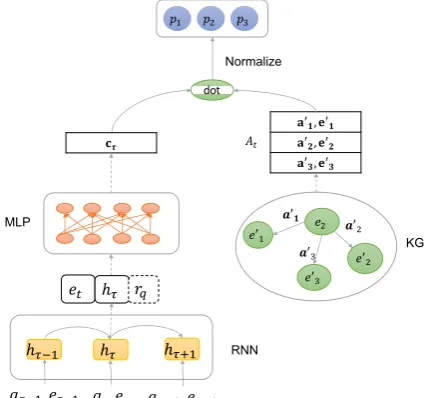
Path Finder (Prior). Here we formulate the path finderp(L|(es, ed))as an MDP problem, and
recursively predict actions (an outgoing relation-entity edge(a, e)) in every time step based on the
previous historyht−1 as follows:
ct=ReLU(Wh[ht;ed] +bh)
p((at+1, et+1)|ht, β) =sof tmax(Atct)
(4)
where the ht ∈ RH denotes the history
embed-ding, ed ∈ RE denotes the entity embedding,
At∈ R|A|×2Eis outgoing matrix which stacks the
[image:4.595.309.523.207.406.2]and|A|denotes the number of outgoing edge, we use Wh and bh to represent the weight and bias
of the feed-forward neural network outputting fea-ture vectorct∈ R2E. The history embeddinghtis
obtained using an LSTM network (Hochreiter and Schmidhuber,1997) to encode all the previous de-cisions as follows:
ht=LST M(ht−1,(at, et)) (5)
As shown inFigure 3, the LSTM-based path finder interacts with the KG in every time step and de-cides which outgoing edge(at+1, et+1)to follow, search procedure will terminate either the target node is reached or the maximum step is reached.
Approximate Posterior. We formulate the pos-terior distribution q(L|(es, ed), r) following the
similar architecture as the prior. The main differ-ence lies in the fact that posterior approximator is aware of the relationr, therefore making more
rel-evant decisions. The posterior borrows the history vector from finder as ht, while the feed-forward
neural network is distinctive in that it takes the re-lation embedding also into account. Formally, we write its outgoing distribution as follows:
ut=ReLU(Whp[ht;ed;r] +bhp)
q((at+1, et+1)|ht;ϕ) =sof tmax(Atut)
(6)
whereWhpandbhpdenote the weight and bias for
the feed-forward neural network.
3.3 Optimization
In order to maximize the ELBO with respect to the neural network models described above, we follow VAE (Kingma and Welling,2013) to interpret the negative ELBO as two separate losses and mini-mize these them jointly using a gradient descent:
Reconstruction Loss. Here we name the first term of negative ELBO as reconstruction loss:
JR= E
L∼qϕ(L|r,(es,ed))
[−logpθ(r|L)] (7)
this loss function is motivated to reconstruct the relationRfrom the latent variableLsampled from
approximate posterior, optimizing this loss func-tion jointly can not only help the approximate pos-terior to obtain paths unique to particular relation
r, but also teaches the path reasoner to reason over
multiple hops and predict the correct relation.
KL-divergence Loss. We name the second term as KL-divergence loss:
JKL=KL(qϕ(L|r,(es, ed))|pβ(L|(es, ed)))
(8)
this loss function is motivated to push the prior dis-tribution towards the posterior disdis-tribution. The intuition of this loss lies in the fact that an entity pair already implies their relation, therefore, we can teach the path finder to approach the approx-imate posterior as much as possible. During test-time when we have no knowledge about relation, we use path finder to replace posterior approxima-tor to search for high-quality paths.
Derivatives. We show the derivatives of the loss function with respect to three different models. For the approximate posterior, we re-weight the KL-diverge loss and design a joint loss function as follows:
J =JR+wKLJKL (9)
where wKL is the re-weight factor to combine
these two losses functions together. Formally, we write the derivative of posterior as follows:
∂J
∂ϕ =L∼qEϕ(L))
[−fre(L)
∂logqϕ(L|(es, ed), r)
∂ϕ
(10)
wherefre(L) = logpθ+wKLlogpqβϕ denotes the
probability assigned by path reasoner. In prac-tice, we found that the KL-reward term logpβ
qϕ
causes severe instability during training, so we fi-nally leave this term out by settingwKL as 0. For
the path reasoner, we also optimize its parameters with regard to the reconstruction as follows:
∂JR
∂θ =L∼qEϕ(L)−
∂logpθ(r|L)
∂θ (11)
For the path finder, we optimize its parameters with regard to the KL-divergence to teach it to in-fuse the relation information into the found links.
∂JKL
∂β =L∼Eqϕ(L)−
∂logpβ(L|(es, ed))
∂β (12)
Train & Test During training time, in contrast to the preceding methods like Das et al. (2018);
Algorithm 1The DIVAAlgorithm. 1: procedureTRAINING& TESTING
2: Train:
3: forepisode←1 to Ndo
4: Rollout K paths from posteriorpϕ
5: ifTrain-Posteriorthen
6: ϕ←ϕ−η×∂Lr
∂ϕ
7: else ifTrain-Likelihoodthen
8: θ←θ−η×∂Lr
∂θ
9: else ifTrain-Priorthen
10: β ←β−η× ∂LKL
∂β
11: end if
12: end for
13: Test MAP:
14: Restore initial parametersθ, β
15: Given sample(es, rq,(e1, e2,· · · , en))
16: Li←BeamSearch(pβ(L|es, ei))
17: Si ← |L1i|Pl∈Lipθ(rq|l)
18: SortSiand find positive rankra+
19: M AP ← 1+1ra+
20: end procedure
which indicates “no-relation” between two enti-ties. Therefore, we manage to decompose the data sample (eq, rq,[e1−, e−2,· · ·, e+n]) into a series of
tuples(eq, rq0, ei), wherer0q=rqfor positive
sam-ples and rq0 = n/a for negative samples.
Dur-ing trainDur-ing, we alternatively update three sub-modules with SGD. During test, we apply the path-finder to beam-search the top paths for all tu-ples and rank them based on the scores assign by path-reasoner. More specifically, we demonstrate the pseudo code inAlgorithm 1.
3.4 Discussion
We here interpret the update of the posterior ap-proximator in equation Equation 10 as a special case of REINFORCE (Williams, 1992), where we use Monte-Carlo sampling to estimate the ex-pected returnlogpθ(r|L)for current posterior
pol-icy. This formula is very similar to DeepPath and MINERVA (Xiong et al., 2017;Das et al.,2018) in the sense that path-finding process is described as an exploration process to maximize the pol-icy’s long-term reward. Unlike these two mod-els assigning heuristic rewards to the policy, our model assigns model-based reward logpθ(r|L),
which is known to be more sophisticated and con-siders more implicit factors to distinguish between good and bad paths. Besides, our update formula for path reasoner Equation 11 is also similar to
chain-of-reasoning (Das et al.,2016), both models are aimed at maximizing the likelihood of relation given the multi-hop chain. However, our model is distinctive from theirs in a sense that the ob-tained paths are sampled from a dynamic policy, by exposing more diverse paths to the path rea-soner, it can generalize to more conditions. By the active interactions and collaborations of two mod-els, DIVAis able to comprehend more complex
in-ference scenarios and handle more noisy environ-ments.
4 Experiments
To evaluate the performance of DIVA, we explore
the standard link prediction task on two different-sized KG datasets and compare with the state-of-the-art algorithms. Link prediction is to rank a list of target entities (e−1, e−2,· · ·, e+n) given a query
entityeqand query relationrq. The dataset is
ar-ranged in the format of(eq, rq,[e1−, e−2,· · · , e+n]),
and the evaluation score (Mean Averaged Preci-sion, MAP) is based on the ranked position of the positive sample.
4.1 Dataset and Setting
We perform experiments on two datasets, and the details of the statistics are described in Ta-ble 1. The samples of FB15k-237 (Toutanova et al., 2015) are sampled from FB15k (Bordes et al., 2013), here we follow DeepPath (Xiong et al.,2017) to select 20 relations including Sports, Locations, Film, etc. Our NELL dataset is down-loaded from the released dataset2, which contains
12 relations for evaluation. Besides, both datasets contain negative samples obtained by using the PRA code released byLao et al.(2011). For each queryrq, we remove all the triples withrqandr−q1
during reasoning. During training, we set number of rollouts to 20 for each training sample and up-date the posterior distribution using Monte-Carlo REINFORCE (Williams, 1992) algorithm. Dur-ing testDur-ing, we use a beam of 5 to approximate the whole search space for path finder. We follow MINERVA (Das et al.,2018) to set the maximum reasoning length to 3, which lowers the burden for the path-reasoner model. For both datasets, we set the embedding sizeE to 200, the history
embed-ding sizeHto 200, the convolution kernel feature
sizeDto 128, we set the hidden size of MLP for
Dataset #Ent #R #Triples #Tasks FB15k-237 14,505 237 310,116 20 NELL-995 75,492 200 154,213 12
Table 1: Dataset statistics.
Model 12-rel MAP 9-rel MAP
RPA (Lao et al.,2011) 67.5
-TransE (Bordes et al.,2013) 75.0 -TransR (Lin et al.,2015) 74.0 -TransD (Ji et al.,2015) 77.3 -TransH (Wang et al.,2014) 75.1 -MINERVA (Das et al.,2018) - 88.2 DeepPath (Xiong et al.,2017) 79.6 80.2 RNN-Chain (Das et al.,2016) 79.0 80.2
CNN Path-Reasoner 82.0 82.2
DIVA 88.6 87.9
Table 2: MAP results on the NELL dataset. Since MINERVA (Das et al.,2018) only takes 9 relations out of the original 12 relations, we report the known results for both version of NELL-995 dataset.
4.2 Quantitative Results
We mainly compare with the embedding-based al-gorithms (Bordes et al., 2013; Lin et al., 2015;
Ji et al., 2015; Wang et al., 2014), PRA (Lao et al., 2011), MINERVA (Das et al., 2018), DeepPath (Xiong et al., 2017) and Chain-of-Reasoning (Das et al., 2016), besides, we also take our standalone CNN path-reasoner from DIVA. Besides, we also try to directly
max-imize the marginal likelihood p(r|es, ed) = P
Lp(L|es, ed)p(r|L) using only the prior and
likelihood model following MML (Guu et al.,
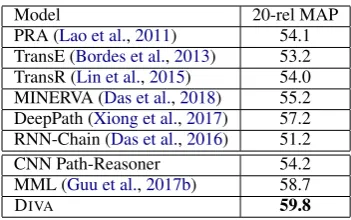
2017b), which enables us to understand the su-periority of introducing an approximate posterior. Here we first report our results for NELL-995 inTable 2, which is known to be a simple dataset and many existing algorithms already approach very significant accuracy. Then we test our meth-ods in FB15k (Toutanova et al.,2015) and report our results inTable 3, which is much harder than NELL and arguably more relevant for real-world scenarios.
Besides, we also evaluate our model on FB-15k 20-relation subset with HITS@N score. Since our model only deals with the relation classification problem(es,?, ed)withedas input, so it’s hard for
us to directly compare with MINERVA (Das et al.,
2018). However, here we compare with chain-RNN (Das et al.,2016) and CNN Path-Reasoner model, the results are demonstrated as Table 4. Please note that the HITS@N score is computed against relation rather than entity.
Model 20-rel MAP
PRA (Lao et al.,2011) 54.1 TransE (Bordes et al.,2013) 53.2 TransR (Lin et al.,2015) 54.0 MINERVA (Das et al.,2018) 55.2 DeepPath (Xiong et al.,2017) 57.2 RNN-Chain (Das et al.,2016) 51.2
CNN Path-Reasoner 54.2
MML (Guu et al.,2017b) 58.7
[image:7.595.48.519.57.259.2]DIVA 59.8
Table 3: Results on the FB15k dataset, please note that MINERVA’s result is obtained based on our own imple-mentation.
Model HITS@3 HITS@5
RNN-Chain (Das et al.,2016) 0.80 0.82
CNN Path-Reasoner 0.82 0.83
[image:7.595.327.503.60.170.2]DIVA 0.84 0.86
Table 4: HITS@N results on the FB15k dataset
Result Analysis We can observe from the above tablesTable 3andTable 2that our algorithm has significantly outperformed most of the existing algorithms and achieves a very similar result as MINERVA (Das et al., 2018) on NELL dataset and achieves state-of-the-art results on FB15k. We conclude that our method is able to deal with more complex reasoning scenarios and is more robust to the adversarial examples. Besides, we also ob-serve that our CNN Path-Reasoner can outperform the RNN-Chain (Das et al.,2016) on both datasets, we speculate that it is due to the short lengths of reasoning chains, which can extract more useful information from the reasoning chain.
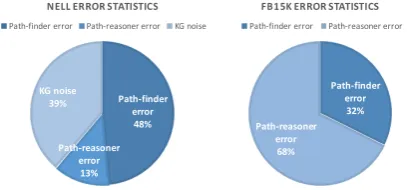
From these two pie charts in Figure 5, we can observe that in NELL-995, very few errors are coming from the path reasoner since the path length is very small. A large proportion only con-tains a single hop. In contrast, most of the failures in the FB15k dataset are coming from the path rea-soner, which fails to classify the multi-hop chain into correct relation. This analysis demonstrates that FB15k is much harder dataset and may be closer to real-life scenarios.
4.3 Beam Size Trade-offs
0 20 40 60 80 100
1 5 1 0 2 0 3 0 4 0 5 0
MA
P
BEAM SIZE MAP VS. BEAM SIZE
NELL-MAP FB15k-MAP
0 0.01 0.02 0.03 0.04 0.05 0.06 0.07
1 5 1 0 2 0 3 0 4 0 5 0
PE
RC
EN
T
BEAM SIZE
ERROR TYPE RATIO VS. BEAM SIZE (NELL)
Neg>Pos=0 (Type 1) Neg>Pos>0 (Type 2) Neg=Pos=0 (Type 3)
0 0.1 0.2 0.3 0.4 0.5
1 5 1 0 2 0 3 0 4 0
PE
RC
EN
T
BEAM SIZE
ERROR TYPE RATIO VS. BEAM SIZE (FB15K)
[image:8.595.79.520.66.164.2]Neg>Pos=0 (Type 1) Neg>Pos>0 (Type 2) Neg=Pos=0 (Type 3)
Figure 4: MAP results varying beam size and the error type’s occurrence w.r.t to beam size. A beam size that is too large or too small would cause performance to drop.
Type Reasoning Path Score
Negative athleteDirkNowitzki→(athleteLedSportsteam)→sportsteamMavericks 0.98 Positive athleteDirkNowitzki→(athleteLedSportsteam)→sportsteamDallasMavericks 0.96 Explanation “maverick” is equivalent to “dallas-maverick”, but treated as negative sample -Negative athleteRichHill→(personBelongsToOrganization)→sportsteamChicagoCubs 0.88 Positive athleteRichHill→(personBelongsToOrganization)→sportsteamBlackhawks 0.74 Explanation Rich Hill plays in both sportsteam but the knowledge graph only include one -Negative coachNikolaiZherdev→(athleteHomeStadium)→stadiumOreventvenueGiantsStadium
→(teamHomestadium−1)
→sportsteamNewyorkGiants 0.98
Positive coachNikolaiZherdev→(athleteHomeStadium)→stadiumOreventvenueGiantsStadium →(teamHomestadium−1)
→sportsteam-rangers 0.72
Explanation The home stadium accommodates multiple teams, therefore the logic chain is not valid
-Table 5: The three samples separately indicates three frequent error types, the first one belongs to “duplicate entity”, the second one belongs to “missing entity”, while the last one is due to “wrong reasoning”. Please note that the parenthesis terms denote relations while the non-parenthesis terms denote entities.
Path-finder error 48%
Path-reasoner error
13% KG noise
39%
NELL ERROR STATISTICS
Path-finder error Path-reasoner error KG noise
Path-finder error 32% Path-reasoner
error 68%
FB15K ERROR STATISTICS
Path-finder error Path-reasoner error
Figure 5: Error analysis for the NELL and FB15k link prediction task. Since FB15k dataset uses placeholders for entities, we are not able to analyze whether the error comes from KG noise.
pairs, meanwhile eliminating many noisy links. Therefore, we first mainly summarize three dif-ferent types and investigate their changing curve under different beam size conditions:
1. No paths are found for positive samples, while paths are found for negative samples, which we denote as Neg>Pos=0.
2. Both positive samples and negative samples found paths, but the reasoner assigns higher
scores to negative samples, which we denote as Neg>Pos>0.
3. Both negative and positive samples are not able to find paths in the knowledge graph, which we denote as Neg=Pos=0.
We draw the curves for MAP and error ratios inFigure 4 and we can easily observe the trade-offs, we found that using beam size of 5 can bal-ance the burden of path-finder and path-reasoner optimally, therefore we keep to this beam size for the all the experiments.
4.4 Error Analysis
In order to investigate the bottleneck of DIVA, we
[image:8.595.88.517.227.370.2] [image:8.595.81.285.437.532.2]is caused by the path reasoner to assign a higher score to negative paths. Here we draw two pie charts to demonstrate the sources of reasoning er-rors in two reasoning tasks.
4.5 Failure Examples
We also show some failure samples inTable 5 to help understand where the errors are coming from. We can conclude that the “duplicate entity” and “missing entity” problems are mainly caused by the knowledge graph or the dataset, and the link prediction model has limited capability to resolve that. In contrast, the “wrong reasoning” problem is mainly caused by the reasoning model itself and can be improved with better algorithms.
5 Conclusion
In this paper, we propose a novel variational in-ference framework for knowledge graph reason-ing. In contrast to prior studies that use a ran-dom walk with restarts (Lao et al.,2011) and ex-plicit reinforcement learning path finding (Xiong et al.,2017), we situate our study in the context of variational inference in latent variable probabilis-tic graphical models. Our framework seamlessly integrates the path-finding and path-reasoning pro-cesses in a unified probabilistic framework, lever-aging the strength of neural network based repre-sentation learning methods. Empirically, we show that our method has achieved the state-of-the-art performances on two popular datasets.
6 Acknowledgement
The authors would like to thank the anonymous reviewers for their thoughtful comments. This re-search was sponsored in part by the Army Re-search Laboratory under cooperative agreements W911NF09-2-0053 and NSF IIS 1528175. The views and conclusions contained herein are those of the authors and should not be interpreted as rep-resenting the official policies, either expressed or implied, of the Army Research Laboratory or the U.S. Government. The U.S. Government is autho-rized to reproduce and distribute reprints for Gov-ernment purposes notwithstanding any copyright notice herein.
References
Antoine Bordes, Nicolas Usunier, Alberto Garcia-Duran, Jason Weston, and Oksana Yakhnenko.
2013. Translating embeddings for modeling multi-relational data. In Advances in neural information
processing systems. pages 2787–2795.
Rajarshi Das, Shehzaad Dhuliawala, Manzil Zaheer, Luke Vilnis, Ishan Durugkar, Akshay Krishna-murthy, Alex Smola, and Andrew McCallum. 2018. Go for a walk and arrive at the answer: Reason-ing over paths in knowledge bases usReason-ing reinforce-ment learning. International Conference on
Learn-ing Representations (ICLR).
Rajarshi Das, Arvind Neelakantan, David Belanger, and Andrew McCallum. 2016. Chains of reasoning over entities, relations, and text using recurrent neu-ral networks. arXiv preprint arXiv:1607.01426.
Matt Gardner, Partha Pratim Talukdar, Bryan Kisiel, and Tom Mitchell. 2013. Improving learning and in-ference in a large knowledge-base using latent syn-tactic cues .
Matt Gardner, Partha Pratim Talukdar, Jayant Krishna-murthy, and Tom Mitchell. 2014. Incorporating vec-tor space similarity in random walk inference over knowledge bases .
Kelvin Guu, Tatsunori B Hashimoto, Yonatan Oren, and Percy Liang. 2017a. Generating sen-tences by editing prototypes. arXiv preprint
arXiv:1709.08878.
Kelvin Guu, Panupong Pasupat, Evan Zheran Liu, and Percy Liang. 2017b. From language to programs: Bridging reinforcement learning and maximum marginal likelihood. arXiv preprint
arXiv:1704.07926.
Sepp Hochreiter and J¨urgen Schmidhuber. 1997. Long short-term memory. Neural computation
9(8):1735–1780.
Guoliang Ji, Shizhu He, Liheng Xu, Kang Liu, and Jun Zhao. 2015. Knowledge graph embedding via dy-namic mapping matrix. InACL (1). pages 687–696.
Diederik P Kingma and Max Welling. 2013. Auto-encoding variational bayes. arXiv preprint
arXiv:1312.6114.
Ni Lao, Tom Mitchell, and William W Cohen. 2011. Random walk inference and learning in a large scale knowledge base. InProceedings of the Conference on Empirical Methods in Natural Language
Pro-cessing. Association for Computational Linguistics,
pages 529–539.
Yann LeCun, Yoshua Bengio, et al. 1995. Convolu-tional networks for images, speech, and time series.
The handbook of brain theory and neural networks
3361(10):1995.
Elman Mansimov, Emilio Parisotto, Jimmy Lei Ba, and Ruslan Salakhutdinov. 2015. Generating im-ages from captions with attention. arXiv preprint
arXiv:1511.02793.
Arvind Neelakantan, Benjamin Roth, and Andrew Mc-Callum. 2015. Compositional vector space models for knowledge base inference. In2015 aaai spring
symposium series.
Maximilian Nickel, Volker Tresp, and Hans-Peter Kriegel. 2011. A three-way model for collective learning on multi-relational data. In ICML. vol-ume 11, pages 809–816.
Richard Socher, Danqi Chen, Christopher D Manning, and Andrew Ng. 2013. Reasoning with neural ten-sor networks for knowledge base completion. In
Advances in neural information processing systems.
pages 926–934.
Kristina Toutanova, Danqi Chen, Patrick Pantel, Hoi-fung Poon, Pallavi Choudhury, and Michael Gamon. 2015. Representing text for joint embedding of text and knowledge bases. InEMNLP. volume 15, pages 1499–1509.
Th´eo Trouillon, Christopher R Dance, Johannes Welbl, Sebastian Riedel, ´Eric Gaussier, and Guillaume Bouchard. 2017. Knowledge graph completion via complex tensor factorization. arXiv preprint
arXiv:1702.06879.
Zhen Wang, Jianwen Zhang, Jianlin Feng, and Zheng Chen. 2014. Knowledge graph embedding by trans-lating on hyperplanes. InAAAI. pages 1112–1119.
Ronald J Williams. 1992. Simple statistical gradient-following algorithms for connectionist reinforce-ment learning. Machine learning8(3-4):229–256.
Wenhan Xiong, Thien Hoang, and William Yang Wang. 2017. Deeppath: A reinforcement learn-ing method for knowledge graph reasonlearn-ing. arXiv
preprint arXiv:1707.06690.
Biao Zhang, Deyi Xiong, Jinsong Su, Hong Duan, and Min Zhang. 2016. Variational neural machine trans-lation. arXiv preprint arXiv:1605.07869.
Yuyu Zhang, Hanjun Dai, Zornitsa Kozareva, Alexan-der J Smola, and Le Song. 2017. Variational reason-ing for question answerreason-ing with knowledge graph.