Proceedings of the 12th International Workshop on Semantic Evaluation (SemEval-2018), pages 1048–1052
ECNU at SemEval-2018 Task 11: Using Deep Learning Method to
Address Machine Comprehension Task
Yixuan Sheng1, Man Lan1,2∗, Yuanbin Wu1,2 1Department of Computer Science and Technology, East China Normal University, Shanghai, P.R.China
2Shanghai Key Laboratory of Multidimensional Information Processing
[email protected], {mlan, ybwu}@cs.ecnu.edu.cn
Abstract
This paper describes the system we submitted to the Task11in SemEval 2018, i.e., Machine
Comprehension using Commonsense Knowl-edge. Given a passage and some questions that each have two candidate answers, this task re-quires the participate system to select out one answer meet the meaning of original text or commonsense knowledge from the candidate answers. For this task, we use a deep learning method to obtain final predict answer by calcu-lating relevance of choices representations and question-aware document representation.
1 Introduction
In recent years, the presentation of challenge and large-scale reading comprehension corpora has driven the development of technology for machine reading comprehension, and most of these ma-chine comprehension datasets do not need com-monsense knowledge to answer questions. The purpose of Machine Comprehension using Com-monsense Knowledge task in Semeval 2018 is to provide a platform for finding a way for the machine to better understand the text and enable the machine answer questions based on the text, and encourage participants to make use any ex-ternal resources (e.g., DeScript, narrative chains, Wikipedia, etc) to improve the system perfor-mance (Ostermann et al.,2018b). The task 11is a multiple-choice machine comprehension, which requires a system read a narrative text about every-day activities (Ostermann et al., 2018a) and then answer multiple-choice questions based on this text. Some questions need to be answered accord-ing to the original text, and others can be answered by commonsense knowledge. Each question is as-sociated with a set of two answers. Table1 gives an example of the dataset.
To address this machine comprehension task, we utilized rule-based methods and a deep
learn-document: Early this morning I woke up to the sound of my newspaper landing on my driveway. I sat up and wrapped my pink robe around me. I slipped my feet into my slippers and looked at the clock. It was only 7:00 but it was time for me to get my newspaper and drink some coffee. I looked out the window and noticed it was raining quite a bit. I saw the newspaper at the end of my driveway, as far away as it could be. I grabbed my umbrella out of my coat closet and opened my front door enough to stick the umbrella through and open it outside. I stepped out the door and quickly covered my head with the umbrella. Then I ran to the end of my driveway, scooped up the newspaper in its plastic wrapping, and ran back to my front door. I closed my umbrella, took off my slippers, and dried off. Then, I unwrapped my newspaper and sat down to read it.
question: Do they read the paper daily?
candidate answers:
0. No they usually watch TV in the mornings. 1. Yes
answer:1
Table 1: An example from the SemEval2018 task11
dataset.
ing method. Our final submission use Gated-Attention Reader (Dhingra et al., 2016) to fuse question information into document and acquire a question-awared document representation, the degree of interaction between choices and docu-ment are regard as the probabilities of choices be-ing returned as an answer. The above two meth-ods do not use additional commonsense knowl-edge, which may lead to the poor preformance of our system. In future work, we may explore more methods to integrate common knowledge into models.
The rest of this paper is organized as follows. Section 2 describes our systems. Section 3 de-scribes datasets, experimental setting and analyse results on datasets. Finally, Section 4 concludes this work.
2 System Description 2.1 Task Description
Formally, this multiple-choice machine compre-hension task can be expressed as a quadruple:<D,
Q, A, a>. Where D represents a narrative text
about everyday activities,Qrepresents a question for the content of the narrative text, Ais the can-didate answer choice set to the question(this task contains two candidate answers choicea0anda1) andarepresents the correct answer. The system is expected to select an answer fromAthat best an-swers Qaccording to the evidences in document D or commonsense knowledge.
2.2 Two Rule-based Baselines
First of all, we implemented a rule-based system proposed in (Richardson et al.,2013), which used the sliding-window (SW) and word distance-based (WD) algorithms to calculate the answer scores according to the rules and return the highest-score answer. We also tried the improved SW and WD algorithms proposed in (Smith et al., 2015), and the system performance has improvement. Sliding-window and Word Distance-based algo-rithms are are described as follows:
Sliding-Window: Given a data sample<D,Q,
a0(or a1), a>, firstly, we calculate the inverse word counts of each word in the document D. Then we set a window that slides word by word from the beginning of the document to the end. When the window slides to a position, the sum of inverse word counts of all the words that appears in the questionQor the candidate choicea0(ora1) is the score of the window at this moment. Until the window slides to the end of the passage, we choose the highest window score as the final score of the candidate choicea0 (ora1). Window size is size of union of the questionQand the choicea0 (or a1), and the window slides over full passage only once. In the improved SW algorithm, the window size is 2-30, and window passes full pas-sage window several times, and increasing the size of the window by one after each sliding over the full passage. The summing up values of all passes is served as improved sliding window score.
Word Distance-based: Given a data sample
<D,Q, a0(or a1),a>, firstly, we define two col-lections,setdq andsetdc, setdq represents the
in-tersection of the question words and the document words, andsetdcrepresents the intersection of the
words in the choice and the words of the
docu-ment. If neithersetdq norsetdc is empty set, we
calculate the shortest distance between words of
setdpand words ofsetdc in the document, denote
the shortest distance as dmin, and the word
dis-tance score of the choice is dmin+1
|D|−1 , otherwise, the word distance score of the choice is zero.
The sliding-window score minus the word distance-based score is the final score of the choice. We separately calculated the scores of the two choices for the question and then selected the choice with higher score as the answer to the ques-tion.
2.3 Deep Learning model
Both of the above unsupervised methods score the overlap that between each answer and the doc-ument by making a sliding-window passes over the document. Therefore, we roughly count the proportion of words in correct answers appear in the document1, and we find that the proportion of correct answers whose words appear entirely in the article is not high in all correct answers. The proportion show that there is a limit to us-ing the above method to improve system perfor-mance. Hence we used a deep learning approach to passage representations modeling. Inspired by (Lai et al., 2017), we use the state-of-art Gated-Attention Reader which performs well on several datasets. When a sample data <D, Q, A, a>is
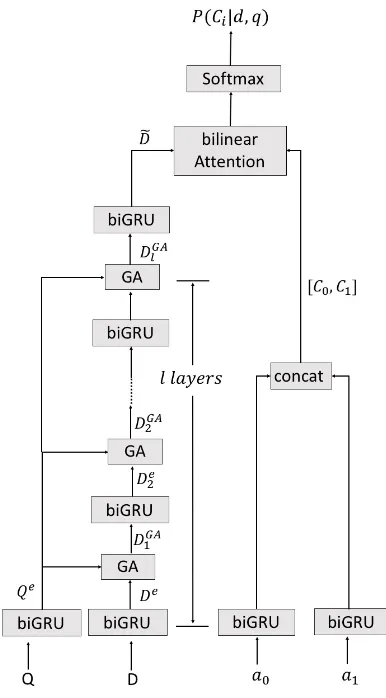
given, the steps of the model processing this data sample are described below, Figure 1 shows the system.
2.3.1 Passage, Question and Choice Encoder
First, each word in D, Q, and choices (two choices in candidate answer setA) is mapped to d-dimendional vector. The 300-dim GloVe em-bedding (Pennington et al., 2014) is used. For the input word vectors of D, we also include a 5-dim binary feature to indicates the overlap be-tween the ducument and the question(or choices) which inspired by (Chen et al., 2017). Each di-mension of the 5-dim binary match feature repre-sent whether the word prerepre-sent in the query, in the choicea0, in the choicea1, in both question and
1We use the following equations to estimate how many answers appear entirely in the document: if|answer word∩ document word|/|answer word|= 1, it means the answer appears entirely in the document, where|A|means size of set A. Then we calculate|ansce|/|ansc|, whereansce means
correct answers which entirely appeared in document, and anscmeans correct answers. The percentage of the correct
choicea0, in both question and choicea1, respec-tively. Take passage as an example, we have doc-umentD:xD1, xD2, ..., xDm ∈R|D|∗dim, and next we
use bi-directional GRU to encode each document word embeddingxDi,
−→
hDi =biGRU(−−→hDi−1, xD1), i= 1,2, ..., m
←−
hDi =biGRU(←−−hDi+1, xD1), i=m, m−1, ...,1
we define hDi ∈ R2d is concatenation of the
−→
hDi
and←h−Di , where d is hidden size. At this time, we
get the encoded document representation De = {
hD
1,hD2, ... ,hDm}. Meanwhile, we use separate
bi-directional GRU to form representation for ques-tion, we denote these representations asQe={hQ
1, hQ2, ... ,hQ
n }. As for choices, we concat
−→
hCn and
←−
hC1 to make up a vector represent a choice, so we
getC0 ∈R2dandC1∈R2d.
2.3.2 Summarize Question-aware Passage Representation
The interaction layer of Gated-Attention Reader is a l-layers multi-hop architecture with gated-attention units. Each multi-hop layer contain a bi-GRU and a gated-attention unit. As shown in Fig-ure 1, we sent Qe ∈ R|Q|∗2d andDe ∈ R|D|∗2d
into a gated-attention unit. Gated-attention unit fuses information from question to each docu-ment tokens and generates a set of vectorsDGA
l =
{d(1l),d (l) 2 , ...,d
(l)
m }, where superscript(l)denote l-th multi-hop layer. To generates DGA
l , firstly, the question soft attention to each document word to obtain attention weight αi, and then we use αi to calculate a weighted question representation qi fori-th word in D, finally, the weighted
ques-tion qi representation is element-wise multiplied
byhimakesdi. The specific calculation steps of a
gated-attention unit are as follows.
αi=sof tmax(Qehi) (1)
qi=QeTαi (2) di =hi·qi (3) After obtaining the current layer question-aware document representation, we put this representa-tion into next hop layer, until afterllayers multi-hops, we generate the a set of question-aware vec-torsDGA
l for document. Finally, we sentDGAl into a layer biGRU and concat the last outputs of each di-rection (−−→hGAl+1and←−−hGAl+1) to get a ultimate
[image:3.595.319.512.62.411.2]question-aware document representation vectorDe ∈R2d
Figure 1: Architecture of our system.
2.3.3 Answer Selection
Now, we have a question-aware representationDe, two choice representations C0 and C1. We es-timate the probability that the choice selected as the correct answer by equation(4), and the choice with a higher-probability is returned as the predict answer.
[p0, p1] =sof tmax([C0,C1]WDe) (4) 3 Experiments
3.1 Datasets and Evaluation Metric
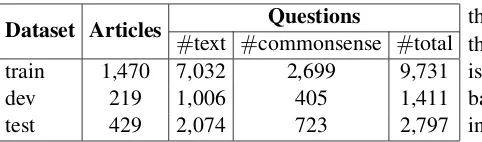
Dataset Articles Questions
#text #commonsense #total
train 1,470 7,032 2,699 9,731
dev 219 1,006 405 1,411
[image:4.595.73.314.62.133.2]test 429 2,074 723 2,797
Table 2: The statistics of data sets in training, develop-ment and test data.
To evaluate the system performance, the official evaluation criterion isaccuracy.
3.2 Preprocessing and Experimental Setting
For rule-based baselines, we first converted words into their lowercase and then performed tokeniza-tion and stemming using Stanford CoreNLP2. For deep learning system, we use 300-D pretrained word vectors provided by GloVe3 as initial word embedding, which are fine-tuned during training. The encoding layer use one layer biGRU with 128-dims hidden size to encoder texts. Learning rate is 0.3, droprate is 0.5, epoch is 100, and num of multi-hops is 2. We use cross entropy and vanilla stochastic gradient descent (SGD) to train our models.
3.3 Experiments on Training Data
Table3shows the results of Task11with different methods on dev dataset, where “GA(biGRU)” de-notes the final system we submit, “GA(biLSTM)” represents the experiment that we replace all bi-GRU units in the system with biLSTM units, “GA
−fmatch” represents the system without 5-dim
match feature, “#text” and “#commonsens” rep-resent the accuracy under different question types, respectively.
Methods Accuracy
#text #commonsense#total
SW + WD 62.62% 45.92% 57.83%
improved SW+WD65.01% 47.65% 60.02%
GA(biGRU) 77.33% 78.51% 77.63%
GA(biLSTM) 76.41% 77.53% 76.76%
GA−fmatch 76.34% 78.02% 76.82%
Table 3: The results on dev.
Based on above experimental results, we find that the performance of GA system is much bet-ter than rule-based approaches, this is because
2https://stanfordnlp.github.io/CoreNLP/
3http://nlp.stanford.edu/data/wordvecs/glove.6B.zip
the multi-hop structure merges the information of the question and the document repeatedly which is helpful to select final answer, unlike the rule-based approach that considers only word match-ing within a window-size distance. Furthermore, we find that the improved SW + WD algorithm is better than SW + WD algorithm, because the improved SW + WD algorithm considers the de-gree of word matching at different distances. From the GA system results, we find the performance of using biGRU units is better than that of biLSTM units and matching features also improves the sys-tem performance. Compare the accuracy of dif-ferent types of questions under difdif-ferent methods, we find that the rule-based approaches considers only the word-matched features lead to lower ac-curacy on the commonsense type questions. GA systems perform better than rule-based systems on both types of questions, because the GA sys-tem takes into account the semantic similarity of the question-aware document and choices. Fur-ther, there are some commonsense types questions which the document content does not clearly indi-cate the correct answer but clearly does not meet the meaning of wrong answer. This may be the reason why we did not use external resources but the accuracy of the commonsense type question predicted by GA system is improved.
3.4 Results on Test Data
Table4shows the our result and official results of top-ranked teams on SemEval2018 Task11 test set.
Teamname Rank Accuracy(total)
ECNU 10 0.7311
iFLYTEK & HIT (HFL) 1 0.8413
Yuanfudao 2 0.8395
MITRE 3 0.8227
Table 4: Our result and the top three results on test sets.
[image:4.595.307.525.520.604.2]system lacks.
4 Conclusion
In this paper, we implement rule-based and deep learning approaches to address Machine Compre-hension Using Commonsense Knowledge task in SemEval 2018. We explored two rule-based al-gorithm i.e., sliding window and word distance-based algorithm. We also utilized a deep learn-ing method which use a multi-hop architecture (Gated-attention Reader). The above two methods do not use additional commonsense knowledge, this is a point that we need to improve.
Acknowledgements
This work is is supported by the Science and Technology Commission of Shanghai Municipal-ity Grant (No.15ZR1410700) and the open project of Shanghai Key Laboratory of Trustworthy Com-puting (No.07dz22304201604).
References
Danqi Chen, Adam Fisch, Jason Weston, and An-toine Bordes. 2017. Reading wikipedia to an-swer open-domain questions. arXiv preprint
arXiv:1704.00051.
Bhuwan Dhingra, Hanxiao Liu, Zhilin Yang, William W Cohen, and Ruslan Salakhutdinov. 2016. Gated-attention readers for text comprehen-sion.
Guokun Lai, Qizhe Xie, Hanxiao Liu, Yiming Yang, and Eduard Hovy. 2017. Race: Large-scale read-ing comprehension dataset from examinations. In
EMNLP.
Simon Ostermann, Ashutosh Modi, Michael Roth, Ste-fan Thater, and Manfred Pinkal. 2018a. MCScript: A Novel Dataset for Assessing Machine Compre-hension Using Script Knowledge. In Proceedings of the 11th International Conference on Language
Resources and Evaluation (LREC 2018), Miyazaki,
Japan.
Simon Ostermann, Michael Roth, Ashutosh Modi, Ste-fan Thater, and Manfred Pinkal. 2018b. SemEval-2018 Task 11: Machine Comprehension using Com-monsense Knowledge. In Proceedings of Interna-tional Workshop on Semantic Evaluation
(SemEval-2018), New Orleans, LA, USA.
Jeffrey Pennington, Richard Socher, and Christopher Manning. 2014. Glove: Global vectors for word representation. InProceedings of the 2014 confer-ence on empirical methods in natural language
pro-cessing (EMNLP), pages 1532–1543.
Matthew Richardson, Christopher J. C. Burges, and Erin Renshaw. 2013. Mctest: A challenge dataset for the open-domain machine comprehension of text. InEMNLP, pages 193–203. ACL.
Ellery Smith, Nicola Greco, Matko Bosnjak, and An-dreas Vlachos. 2015. A strong lexical matching method for the machine comprehension test. In Pro-ceedings of the 2015 Conference on Empirical
Meth-ods in Natural Language Processing, pages 1693–