Multi-Metric Optimization Using Ensemble Tuning
Baskaran Sankaran, Anoop Sarkar
Simon Fraser University Burnaby BC. CANADA
{baskaran,anoop}@cs.sfu.ca
Kevin Duh
Nara Institute of Science & Technology Ikoma, Nara. JAPAN
Abstract
This paper examines tuning for statistical ma-chine translation (SMT) with respect to mul-tiple evaluation metrics. We propose several novel methods for tuning towards multiple
ob-jectives, including some based on ensemble
decodingmethods. Pareto-optimality is a
nat-ural way to think about multi-metric optimiza-tion (MMO) and our methods can effectively combine several Pareto-optimal solutions,
ob-viating the need to choose one. Our best
performingensemble tuningmethod is a new
algorithm for multi-metric optimization that searches for Pareto-optimal ensemble models. We study the effectiveness of our methods through experiments on multiple as well as single reference(s) datasets. Our experiments show simultaneous gains across several met-rics (BLEU, RIBES), without any significant reduction in other metrics. This contrasts the traditional tuning where gains are usually lim-ited to a single metric. Our human evaluation results confirm that in order to produce better MT output, optimizing multiple metrics is bet-ter than optimizing only one.
1 Introduction
Tuning algorithms are used to find the weights for a statistical machine translation (MT) model by min-imizing error with respect to a single MT evalua-tion metric. The tuning process improves the per-formance of an SMT system as measured by this metric; with BLEU (Papineni et al., 2002) being the most popular choice. Minimum error-rate train-ing (MERT) (Och, 2003) was the first approach in MT to directly optimize an evaluation metric. Sev-eral alternatives now exist: MIRA (Watanabe et al., 2007; Chiang et al., 2008), PRO (Hopkins and May, 2011), linear regression (Bazrafshan et al., 2012) and ORO (Watanabe, 2012) among others.
However these approaches optimize towards the best score as reported by a single evaluation met-ric. MT system developers typically use BLEU and
ignore all the other metrics. This is done despite the fact that other metrics model wide-ranging as-pects of translation: from measuring the translation edit rate (TER) in matching a translation output to a human reference (Snover et al., 2006), to capturing lexical choices in translation as in METEOR (Lavie and Denkowski, 2009) to modelling semantic simi-larity through textual entailment (Pad´o et al., 2009) to RIBES, an evaluation metric that pays attention to long-distance reordering (Isozaki et al., 2010). While some of these metrics such as TER, ME-TEOR are gaining prominence, BLEU enjoys the status of being the de facto standard tuning metric as it is often claimed and sometimes observed that optimizing with BLEU produces better translations than other metrics (Callison-Burch et al., 2011).
The gains obtained by the MT system tuned on a particular metric do not improve performance as measured under other metrics (Cer et al., 2010), sug-gesting that over-fitting to a specific metric might happen without improvements in translation quality. In this paper we propose a new tuning framework for jointly optimizing multiple evaluation metrics.
Pareto-optimality is a natural way to think about multi-metric optimization and multi-metric opti-mization (MMO) was recently explored using the notion of Pareto optimality in the Pareto-based Multi-objective Optimization (PMO) approach (Duh et al., 2012). PMO provides several equivalent solu-tions (parameter weights) having different trade-offs between the different MT metrics. In (Duh et al., 2012) the choice of which option to use rests with the MT system developer and in that sense their ap-proach is ana posteriorimethod to specify the pref-erence (Marler and Arora, 2004).
In contrast to this, our tuning framework pro-vides a principled way of using the Pareto optimal options using ensemble decoding (Razmara et al., 2012). We also introduce a novel method of ensem-ble tuningfor jointly tuning multiple MT evaluation metrics and further combine this with the PMO
proach (Duh et al., 2012). We also introduce three other approaches for multi-metric tuning and com-pare their performance to the ensemble tuning. Our experiments yield the highest metric scores across many different metrics (that are being optimized), something that has not been possible until now.
Our ensemble tuning method over multiple rics produced superior translations than single met-ric tuning as measured by a post-editing task. HTER (Snover et al., 2006) scores in our human evaluation confirm that multi-metric optimization can lead to better MT output.
2 Related Work
In grammar induction and parsing (Spitkovsky et al., 2011; Hall et al., 2011; Auli and Lopez, 2011) have proposed multi-objective methods based on round-robin iteration of single objective optimizations.
Research in SMT parameter tuning has seen a surge of interest recently, including online/batch learning (Watanabe, 2012; Cherry and Foster, 2012), large-scale training (Simianer et al., 2012; He and Deng, 2012), and new discriminative objec-tives (Gimpel and Smith, 2012; Zheng et al., 2012; Bazrafshan et al., 2012). However, few works have investigated the multi-metric tuning problem in depth. Linear combination of BLEU and TER is re-ported in (Zaidan, 2009; Dyer et al., 2009; Servan and Schwenk, 2011); an alternative is to optimize on BLEU with MERT while enforcing that TER does not degrade per iteration (He and Way, 2009). Stud-ies on metric tunability (Liu et al., 2011; Callison-Burch et al., 2011; Chen et al., 2012) have found that the metric used for evaluation may not be the best metric used for tuning. For instance, (Mauser et al., 2008; Cer et al., 2010) report that tuning on lin-ear combinations of BLEU-TER is more robust than a single metric like WER.
The approach in (Devlin and Matsoukas, 2012) modifies the optimization function to include traits such as output length so that the hypotheses pro-duced by the decoder have maximal score according to one metric (BLEU) but are subject to an output length constraint, e.g. that the output is 5% shorter. This is done by rescoring an N-best list (forest) for the metric combined with each trait condition and then the different trait hypothesis are combined us-ing a system combination step. The traits are
in-dependent of the reference (while tuning). In con-trast, our method is able to combine multiple metrics (each of which compares to the reference) during the tuning step and we do not depend on N-best list (or forest) rescoring or system combination.
Duh et. al. (2012) proposed a Pareto-based ap-proach to SMT multi-metric tuning, where the lin-ear combination weights do not need to be known in advance. This is advantageous because the optimal weighting may not be known in advance. However, the notion of Pareto optimality implies that multiple ”best” solutions may exist, so the MT system devel-oper may be forced to make a choice after tuning.
These approaches require the MT system devel-oper to make a choice either before tuning (e.g. in terms of linear combination weights) or afterwards (e.g. the Pareto approach). Our method here is dif-ferent in that we do not require any choice. We useensemble decoding(Razmara et al., 2012) (see sec 3) to combine the different solutions resulting from the multi-metric optimization, providing an el-egant solution for deployment. We extend this idea further and introduce ensemble tuning, where the metrics have separate set of weights. The tuning process alternates between ensemble decoding and the update step where the weights for each metric are optimized separately followed by joint update of metric (meta) weights.
3 Ensemble Decoding
We now briefly review ensemble decoding (Razmara et al., 2012) which is used as a component in the al-gorithms we present. The prevalent model of statis-tical MT is a log-linear framework using a vector of feature functionsφ:
p(e|f)∝expw·φ (1)
The idea of ensemble decoding is to combine sev-eral models dynamically at decode time. Given mul-tiple models, the scores are combined for each par-tial hypothesis across the different models during decoding using a user-defined mixture operation⊗.
p(e|f)∝expw1·φ1⊗w2·φ2⊗. . .
(2)
lo-cally best model) among others. The different mix-ture operations allows the user to encode the be-liefs about the relative strengths of the models. It has been applied successfully for domain adaptation setting and shown to perform better approaches that pre-compute linear mixtures of different models.
4 Multi-Metric Optimization
In statistical MT, the multi-metric optimization problem can be expressed as:
w∗= arg max
w
g
[M1(H), . . . , Mk(H)]
(3)
whereH =N(f;w)
whereN(f;w) is the decoding function generating a set of candidate hypothesesHbased on the model parametersw, for the source sentencesf. For each source sentence fi ∈ f there is a set of candidate
hypotheses {hi} ∈ H. The goal of the
optimiza-tion is to find the weights that maximize the func-tiong(.)parameterized by different evaluation met-ricsM1, . . . , Mk.
For the Pareto-optimal based approach such as PMO (Duh et al., 2012), we can replaceg(·) above withgPMO(·) which returns the points in the Pareto
frontier. Alternately a weighted averaging function
gwavg(·)would result in a linear combination of the
metrics being considered, where the tuning method would maximize the joint metric. This is similar to the (TER-BLEU)/2 optimization (Cer et al., 2010; Servan and Schwenk, 2011).
We introduce four methods based on the above formulation and each method uses a different type ofg(·)function for combining different metrics and we compare experimentally with existing methods.
4.1 PMO Ensemble
PMO (Duh et al., 2012) seeks to maximize the num-ber of points in the Pareto frontier of the metrics con-sidered. The inner routine of the PMO-PRO tuning is described in Algorithm 1. This routine is con-tained within an outer loop that iterates for a fixed number iterations of decoding the tuning set and op-timizing the weights.
The tuning process with PMO-PRO is inde-pendently repeated with different set of weights for metrics1 yielding a set of equivalent solutions
1
For example Duh et al. (2012) use five different weight
Algorithm 1PMO-PRO (Inner routine for tuning)
1: Input:Hypotheses H =N(f;w); Weightsw
2: InitializeT ={}
3: foreach f in tuning setfdo
4: {h}=H(f)
5: {M({h})}= ComputeMetricScore({h},e)ˆ
6: {F }= FindParetoFrontier({M({h})})
7: foreach h in{h}do
8: ifh∈ F thenadd(1, h)toT
9: elseadd(`, h)toT (see footnote 1)
10: wp←PRO(T) (optimize using PRO)
11: Output:Pareto-optimal weightswp
{ps1, . . . , psn}which are points on the Pareto
fron-tier. The user then chooses one solution by making a trade-off between the performance gains across dif-ferent metrics. However, as noted earlier thisa pos-teriorichoice ignores other solutions that are indis-tinguishable from the chosen one.
We alleviate this by complementing PMO with ensemble decoding, which we callPMO ensemble, in which each point in the Pareto solution is a dis-tinct component in the ensemble decoder. This idea can also be used in other MMO approaches such as linear combination of metrics(gwavg(.))mentioned
above. In this view, PMO ensemble is a special case ofensemble combination, where the decoding is per-formed by an ensemble of optimal solutions.
The ensemble combination model introduces new hyperparameters β that are the weights of the en-semble components (meta weights). These ensem-ble weights could set to be uniform in a na¨ıve implementation. Or the user can encode her be-liefs or expectations about the individual solutions
{ps1, . . . , psn} to set the ensemble weights (based
on the relative importance of the components). Fi-nally, one could also include a meta-level tuning step to set the weightsβ.
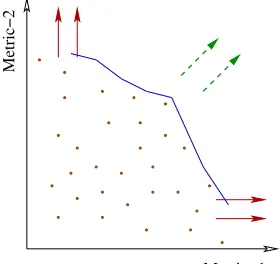
The PMO ensemble approach is graphically il-lustrated in Figure 1; we will also refer to this fig-ure while discussing other methods.2 The
orig-settings for metrics (M1, M2), viz. (0.0,1.0), (0.3,0.7), (0.5,0.5), (0.7,0.3) and (1.0,0.0). They combine the met-ric weights qi with the sentence-level metric scores Mi as
` = P kqkMk
/k where`is the target value for negative examples (theelseline in Alg 1) in the optimization step.
2
Metric−2
[image:4.612.115.255.63.195.2]Metric−1
Figure 1: Illustration of different MMO approaches involving two metrics. Solid (red) arrows indicate optimizing two met-rics independently and the dashed (green) arrow optimize them jointly. The Pareto frontier is indicated by the curve.
inal PMO-PRO seeks to maximize the points on the Pareto frontier (blue curve in the figure) lead-ing to Pareto-optimal solutions. On the other hand, the PMO ensemble combines the different Pareto-optimal solutions and potentially moving in the di-rection of dashed (green) arrows to some point that has higher score in either or both dimensions.
4.2 Lateen MMO
Lateen EM has been proposed as a way of jointly optimizing multiple objectives in the context of de-pendency parsing (Spitkovsky et al., 2011). It uses a secondary hard EM objective to move away, when the primary soft EM objective gets stuck in a local optima. The course correction could be performed under different conditions leading to variations that are based on when and how often to shift from one objective function to another during optimization.
The lateen technique can be applied to the multi-metric optimization in SMT by treating the differ-ent metrics as differdiffer-ent objective functions. While the several lateen variants are also applicable for our task, our objective here is to improve performance across the different metrics (being optimized). Thus, we restrict ourselves to the style where the search alternates between the metrics (in round-robin fash-ion) at each iteration. Since the notion of conver-gence is unclear in lateen setting, we stop after a fixed number of iterations optimizing the tuning set. In terms of Figure 1, lateen MMO corresponds to al-ternately maximizing the metrics along two dimen-sions as depicted by the solid arrows.
By the very nature of lateen-alternation, the
metric score is better.
weights obtained at each iteration are likely to be best for the metric that was optimized in that itera-tion. Thus, one could use weights from the last k
iterations (for lateen-tuning with as many metrics) and then decode the test set with an ensemble of these weights as in PMO ensemble. However in practice we find the weights to converge and we sim-ply use the weights from the final iteration to decode the test set in our lateen experiments.
4.3 Union of Metrics
At each iteration lateen MMO excludes all but one metric for optimization. An alternative would be to consider all the metrics at each iteration so that the optimizer could try to optimize them jointly. This has been the general motivation for considering the linear combination of metrics (Cer et al., 2010; Ser-van and Schwenk, 2011) resulting in a joint metric, which is then optimized.
However due to the scaling differences between the scores of different metrics, the linear combi-nation might completely suppress the metric hav-ing scores in the lower-range. As an example, the RIBES scores that are typically in the high 0.7-0.8 range, dominate the BLEU scores that is typically around 0.3. While the weighted linear combination tries to address this imbalance, they introduce ad-ditional parameters that are manually fixed and not separately tuned.
We avoid this linear combination pitfall by taking the union of the metrics under which we consider the union of training examples from all metrics and optimize them jointly. Mathematically,
w∗= arg max
w
g(M1(H))∪. . .∪g(Mk(H)) (4)
Most of the optimization approaches involve two phases: i) select positive and negative examples and ii) optimize parameters to favour positive examples while penalizing negative ones. In the union ap-proach, we independently generate positive and neg-ative sets of examples for all the metrics and take their union. The optimizer now seeks to move to-wards positive examples from all metrics, while pe-nalizing others.
metrics. Thus, instead of the entire Pareto frontier curve in Figure 1, the union approach optimizes the two dimensions simultaneously in each iteration.
5 Ensemble Tuning
These methods, even though novel, under utilize the power of ensembles as they combine the solution only at the end of the tuning process. We would prefer to tightly integrate the idea of ensembles into the tuning. We thus extend the ensemble decoding toensemble tuning. The feature weights are repli-cated separately for each evaluation metric, which are treated as components in the ensemble decoding and tuned independently in the optimization step. Initially the ensemble decoder decodes a devset us-ing a weighted ensemble to produce a sus-ingle N-best list. For the optimization, we employ a two-step ap-proach of optimizing the feature weights (of each ensemble component) followed by a step for tun-ing the meta (component) weights. The optimized weights are then used for decoding the devset in the next iteration and the process is repeated for a fixed number of iterations.
Modifying the MMO representation in Equa-tion 3, we formulateensemble tuningas:
Hens=Nens
f;{wM};⊗;λ
(5)
w∗=
n
arg max
wMi
Hens |1≤i≤k
o
(6)
λ= arg max
λ
g({Mi(Hens)|1≤i≤k};w∗) (7)
Here the ensemble decoder function Nens(.)
is parameterized by an ensemble of weights
wM1, . . . , wMk (denoted as{wM}in Eq 5) for each
metric and a mixture operation (⊗).λrepresents the weights of the ensemble components.
Pseudo-code for ensemble tuning is shown in Al-gorithm 2. In the beginning of each iteration (line 2), the tuning process ensemble decodes (line 4) the tuning set using the weights obtained from the pre-vious iteration. Equation 5 gives the detailed expres-sion for the ensemble decoding, whereHensdenotes
the N-best list generated by the ensemble decoder. The method now uses a dual tuning strategy in-volving two phases to optimize the weights. In the first step it optimizes each of thekmetrics indepen-dently (lines 6-7) along its respective dimension in
Algorithm 2Ensemble Tuning Algorithm
1: Input:Tuning setf,
MetricsM1, . . . , Mk(ensemble components)
Initial weights{wM} ←wM1, . . . wMk and
Component (meta) weightsλ
2: forj= 1, . . .do
3: {w(Mj)} ← {wM}
4: Ensembledecode the tuning set
Hens =Nens(f;{wM(j)};⊗;λ)
5: {wM}={}
6: foreach metricMi ∈ {M}do
7: wMi∗ ←PRO(Hens, wMi) (use PRO)
8: AddwMi∗ to{wM}
9: λ←PMO-PRO(Hens,{wM}) (Alg 1)
10: Output:Optimal weights{wM}andλ
the multi-metric space (as shown by the solid arrows along the two axes in Figure 1). This yields a new set of weightsw∗for the features in each metric.
The second tuning step (line 9) then optimizes the meta weights (λ) so as to maximize the multi-metric objective along the jointk-dimensional space as shown in Equation 7. This is illustrated by the dashed arrows in the Figure 1. Whileg(.)could be any function that combines multiple metrics, we use the PMO-PRO algorithm (Alg. 1) for this step.
The main difference betweenensemble tuningand PMO ensemble is that the former is an ensemble model over metrics and the latter is an ensemble model over Pareto solutions. Additionally, PMO en-semble uses the notion of enen-sembles only for the fi-nal decoding after tuning has completed.
5.1 Implementation Notes
All the proposed methods fit naturally within the usual SMT tuning framework. However, some changes are required in the decoder to support en-semble decoding and in the tuning scripts for op-timizing with multiple metrics. For ensemble de-coding, the decoder should be able to use multiple weight vectors and dynamically combine them ac-cording to some desired mixture operation. Note that, unlike Razmara et al. (2012), our approach uses just one model but has different weight vectors for each metric and the required decoder modifications are simpler than full ensemble decoding.
pa-per we uselog-wsum– the linear combination of the ensemble components andlog-wmax– the combina-tion that prefers the locally best component. These are simpler to implement and also performed com-petitively in their domain adaptation experiments. Unless explicitly noted otherwise, the results pre-sented in Section 6 are based on linear mixture oper-ation log-wsum, which empirically performed better than the log-wmax for ensemble tuning.
6 Experiments
We evaluate the different methods on Arabic-English translation in single as well as multiple ref-erences scenario. Corpus statistics are shown in Table 1. For all the experiments in this paper, we use Kriya, our in-house Hierarchical phrase-based (Chiang, 2007) (Hiero) system, and inte-grated the required changes for ensemble decoding. Kriya performs comparably to the state of the art in phrase-based and hierarchical phrase-based transla-tion over a wide variety of language pairs and data sets (Sankaran et al., 2012).
We use PRO (Hopkins and May, 2011) for op-timizing the feature weights and PMO-PRO (Duh et al., 2012) for optimizing meta weights, wher-ever applicable. In both cases, we use SVM-Rank (Joachims, 2006) as the optimizer.
We used the default parameter settings for dif-ferent MT tuning metrics. For METEOR, we tried both METEOR-tune and METEOR-hter settings and found the latter to perform better in BLEU and TER scores, even though the former was marginally better in METEOR3 and RIBES scores. We ob-served the margin of loss in BLEU and TER to out-weigh the gains in METEOR and RIBES and we chose METEOR-hter setting for both optimization and evaluation of all our experiments.
6.1 Evaluation on Tuning Set
Unlike conventional tuning methods, PMO (Duh et al., 2012) was originally evaluated on the tuning set to avoid potential mismatch with the test set. In order to ensure robustness of evaluation, they re-decode the devset using the optimal weights from the last tuning iteration and report the scores on
1-3
This behaviour was also noted by Denkowski and Lavie (2011) in their analysis of Urdu-English system fortunable met-ricstask in WMT11.
best candidates.
Corpus Training size Tuning/ test set
ISI corpus 1.1 M 1664/ 1313 (MTA) 1982/ 987 (ISI)
Table 1: Corpus Statistics (# of sentences) for Arabic-English. MTA (4-refs) and ISI (1-ref).
We follow the same strategy and compare our PMO-ensemble approach with PMO-PRO (denoted P) and a linear combination4 (denoted L) base-line. Similar to Duh et al. (2012), we use five different BLEU:RIBES weight settings, viz.
(0.0,1.0), (0.3,0.7), (0.5,0.5), (0.7,0.3) and
(1.0,0.0), marked L1 through L5 or P1 through P5.
The Pareto frontier is then computed from 80 points (5 runs and 15 iterations per run) on the devset.
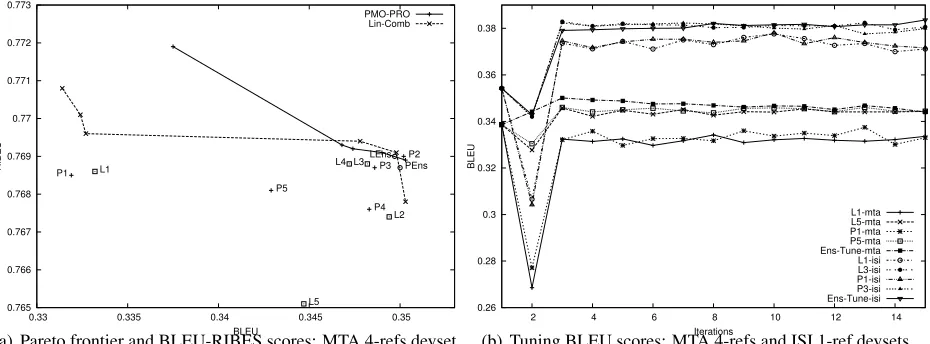
Figure 2(a) shows the Pareto frontier of L and P baselines using BLEU and RIBES as two metrics. The frontier of the P dominates that of L for most part showing that the PMO approach benefits from picking Pareto points during the optimization.
We use the PMO-ensemble approach to combine the optimized weights from the 5 tuning runs and re-decode the devset employing ensemble decoding. This yields the points LEns and PEns in the plot, which obtain better scores than most of the indi-vidual runs of L and P. This ensemble approach of combining the final weights also generalizes to the unseen test set as we show later.
Figure 2(b) plots the change in BLEU during tun-ing in the multiple references and the stun-ingle refer-ence scenarios. We show for each baseline method L and P, plots for two different weight settings that ob-tain high BLEU and RIBES scores. In both datasets, our ensemble tuning approach dominates the curves of the (L and P) baselines. In summary, these results confirm that the ensemble approach achieves results that are competitive with previous MMO methods on the devset Pareto curve. We now provide a more comprehensive evaluation on the test set.
6.2 Evaluation on Test Set
This section contains multi-metric optimization re-sults on the unseen test sets, one test set has multi-ple references and the other has a single-reference.
0.765 0.766 0.767 0.768 0.769 0.77 0.771 0.772 0.773
0.33 0.335 0.34 0.345 0.35
RIBES
BLEU L1
L2 L3 L4
L5 P1
P2 P3
P4 P5
LEns PEns PMO-PRO
Lin-Comb
(a) Pareto frontier and BLEU-RIBES scores: MTA 4-refs devset
0.26 0.28 0.3 0.32 0.34 0.36 0.38
2 4 6 8 10 12 14
BLEU
Iterations
L1-mta L5-mta P1-mta P5-mta Ens-Tune-mta L1-isi L3-isi P1-isi P3-isi Ens-Tune-isi
[image:7.612.76.541.60.232.2](b) Tuning BLEU scores: MTA 4-refs and ISI 1-ref devsets Figure 2: Devset (redecode): Comparison of Lin-comb (L) and PMO-PRO (P) with Ensemble decoding (Lens and PEns) and Ensemble tuning (Ens-Tune)
We plot BLEU scores against other metrics (RIBES, METEOR and TER) and this allows us to compare the performance of each metric relative to the de-facto standard BLEU metric.
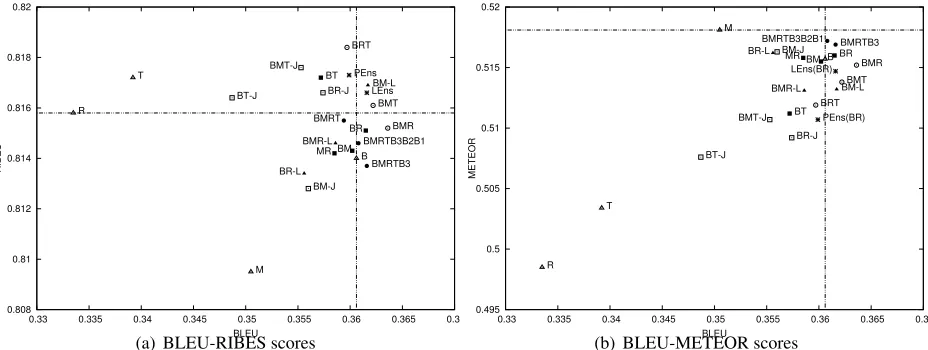
Baseline points are identified by single letters B for BLEU, T for TER, etc. and the baseline (single-metric optimized) score for each (single-metric is indicated by a dashed line on the corresponding axis. MMO points use a series of single letters referring to the metrics used, e.g. BT for BLEU-TER. The union of metrics method is identified with the suffix ’J’ and lateen method with suffix ’L’ (thus BT-L refers to the lateentuning with BLEU-TER). MMO points with-out any suffix use the ensemble tuning approach.
Figures 3 and 4(a) plot the scores for the MTA test set with 4-references. We see noticeable and some statistically significant improvements in BLEU and RIBES (see Table 2 for BLEU improvements). All our MMO approaches, except for the union method, show gains on both BLEU and RIBES axes. Figures 3(b) and 4(a) show that none of the proposed methods managed to improve the baseline scores for METEOR and TER. However, several of our en-semble tuning combinations work well for both ME-TEOR (BR, BMRTB3, etc.) and TER (BMRT and BRT) in that they improved or were close to the baseline scores in either dimension. We again see in these figures that the MMO approaches can improve the BLEU-only tuning by0.3BLEU points, without much drop in other metrics. This is in tune with the finding that BLEU could be tuned easily (Callison-Burch et al., 2011) and also explains why it remains
Approach and Tuning Metric(s) BLEU
MTA ISI
Single Objective Baselines
BLEU 36.06 37.20
METEOR 35.05 36.91
RIBES 33.35 36.60
TER 33.92 35.85
Ensemble Tuning: 2 Metrics
B-M 36.02 37.26
B-R 36.15 37.37
B-T 35.72 36.31
Ensemble Tuning: 3 Metrics
B-M-R 36.36 37.37
B-M-T 36.22 36.89
B-R-T 35.97 36.72
Ensemble Tuning:>3 Metrics
B-M-R-T 35.94 36.84
B-M-R-T-B3 36.16 37.12
B-M-R-T-B3-B2-B1 36.08 37.24
Table 2: BLEU Scores on MTA (4 refs) and ISI (1 ref) test sets using the standardmtevalscript. Boldface scores indicate scores that are comparable to or better than the baseline BLEU-only tuning.Italicizedscores indicate statistically significant differ-ences atp-value0.05computed with bootstrap significance test.
a popular choice for optimizing SMT systems. Among the different MMO methods the ensem-ble tuning performs better than lateen or union ap-proaches. In terms of the number of metrics being optimized jointly, we see substantial gains when us-ing a small number (typically 2 or 3) of metrics. Re-sults seem to suffer beyond this number; probably because there might not be a space that contain so-lution(s) optimal forall the metrics that are jointly optimized.
0.808 0.81 0.812 0.814 0.816 0.818 0.82
0.33 0.335 0.34 0.345 0.35 0.355 0.36 0.365 0.37
RIBES
BLEU
B
M R
T PEns
LEns BM BR BT MR BMR BMT BRT BMRT BMRTB3 BMRTB3B2B1 BM-J BR-J BT-J BMT-J BM-L BR-L BMR-L
(a) BLEU-RIBES scores
0.495 0.5 0.505 0.51 0.515 0.52
0.33 0.335 0.34 0.345 0.35 0.355 0.36 0.365 0.37
METEOR BLEU B M R T PEns(BR) LEns(BR) BM
BR BT MR BMR BMT BRT BMRTB3 BMRTB3B2B1 BM-J BR-J BT-J BMT-J BM-L BR-L BMR-L
[image:8.612.76.540.59.234.2](b) BLEU-METEOR scores
Figure 3: MTA 4-refs testset: Comparison of different MMO approaches. The dashed lines correspond to baseline scores tuned on the respective metrics in the axes. The union of metrics method is identified with the suffix J and lateen with suffix L.
0.4 0.405 0.41 0.415 0.42 0.425 0.43 0.435
0.33 0.335 0.34 0.345 0.35 0.355 0.36 0.365 0.37
nTER BLEU B M R T PEns(BR) LEns(BR) BM BR BT MR BMR BMT BRT BMRT BMRTB3 BM-J BR-J BT-J BMT-J BM-L BR-L BMR-L
(a) MTA (4-refs)
0.44 0.445 0.45 0.455 0.46 0.465
0.355 0.36 0.365 0.37 0.375
nTER BLEU B M R T
PEns(BR) LEns(BR)
BM BR BMR B3MT BRT BMRT BMRTB3 BMRTB3B2B1 BR-J BR-L
[image:8.612.75.540.263.441.2](b) ISI (1-ref)
Figure 4: BLEU-TER scores: Comparison of different MMO approaches. We plot nTER (1-TER) scores for easy reading of the plots. The dashed lines correspond to baseline scores tuned on the respective metrics in the axes.
(in a looser sense) with few others, but not all. For example, union optimizations BR-J and BMT-J per-form close to or better than RIBES and TER base-lines, but get very poor score in METEOR. On the other hand BM-J is close to the METEOR baseline, while doing poorly on the RIBES and TER. This be-haviour is also evident from the single-metric base-lines, where R and T-only settings are clearly distin-guished from the M-only system. It is not clear if such distinct classes of metrics could be bridged by some optimal solution and themetric dichotomy re-quires further study as this is key to practical multi-metric tuning in SMT.
The lateen and union approaches appear to be very sensitive to the number of metrics and they generally perform well for two metrics case and show degradation for more metrics. Unlike other
approaches, the union approach failed to improve over the baseline BLEU and this could be attributed to the conflict of interest among the metrics, while choosing example points for the optimization step. The positive example preferred by a particular met-ric could be a negative example for the other metmet-ric. This would only confuse the optimizer resulting in poor solutions. Our future line of work would be to study the effect of avoiding such of conflicting ex-amples in the union approach.
For the single-reference (ISI) dataset, we only plot the BLEU-TER case in Figure 4(b) due to lack of space. The results are similar to the multiple references set indicating that MMO approaches are equally effective for single references5. Table 2
ref-Metric Single-metric Tuning Ensemble Tuning
B-only M-only B-M-R
BLEU 37.89 37.18 39.01
HBLEU 51.93 53.59 53.14
METEOR 61.31 61.56 61.68
HMETEOR 72.35 72.39 72.74
TER 0.520 0.532 0.516
[image:9.612.72.301.60.155.2]HTER 0.361 0.370 0.346
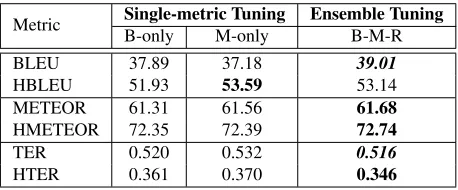
Table 3: Post-editing Human Evaluation: Regular (untargeted) and human-targeted scores. Human targeted scores are com-puted against the post-edited reference and regular scores are computed with the original references.Bestscores are in bold-face andstatistically significantones (atp= 0.05) are italicized.
shows the BLEU scores for our ensemble tuning method (for various combinations) and we again see improvements over the baseline BLEU-only tuning.
6.3 Human Evaluation
So far we have shown that multi-metric optimiza-tion can improve over single-metric tuning on a sin-gle metric like BLEU and we have shown that our methods find a tuned model that performs well with respect to multiple metrics. Is the output that scores higher on multiple metrics actually a better trans-lation? To verify this, we conducted a post-editing human evaluation experiment. We compared our en-semble tuning approach involving BLEU, METEOR and RIBES (B-M-R) with systems optimized for BLEU (B-only) and METEOR (M-only).
We selected 100 random sentences (that are at least 15 words long) from the Arabic-English MTA (4 references) test set and translated them using the three systems (two single metric systems and BMR ensemble tuning). We shuffled the resulting trans-lations and split them into 3 sets such that each set has equal number of the translations from three sys-tems. The translations were edited by three human annotators in a post-editing setup, where the goal was to edit the translations to make them as close to the references as possible, using the Post-Editing Tool: PET (Aziz et al., 2012). The annotators were not Arabic-literate and relied only on the reference translations during post-editing. The identifiers that link each translation to the system that generated it are removed to avoid annotator bias.
In the end we collated post-edited translations for each system and then computed the system-level
erence sentence. Our experiment shows that even with a single reference MMO methods can work.
human-targeted (HBLEU, HMETEOR, HTER) scores, by using respective post-edited translations as the reference. First comparing the HTER (Snover et al., 2006) scores shown in Table 3, we see that the single-metric system optimized for ME-TEOR performs slightly worse than the one op-timized for BLEU, despite using METEOR-hter version (Denkowski and Lavie, 2011). Ensemble tuning-based system optimized for three metrics (B-M-R) improves HTER by 4% and 6.3% over BLEU and METEOR optimized systems respectively.
The single-metric system tuned with M-only set-ting scores high on HBLEU, closely followed by the ensemble system. We believe this to be caused by chance rather than any systematic gains by the M-only tuning; the ensemble system scores high on HMETEOR compared to the M-only system. While HTER captures the edit distance to the targeted ref-erence, HMETEOR and HBLEU metrics capture missing content words or synonyms by exploiting
n-grams and paraphrase matching.
We also computed the regular variants (BLEU, METEOR and TER), which are scored against orig-inal references. The ensemble system outperformed the single-metric systems in all the three metrics. The improvements were also statistically significant atp-value of0.05for BLEU and TER.
7 Conclusion
We propose and present a comprehensive study of several multi-metric optimization (MMO) methods in SMT. First, by exploiting the idea of ensemble de-coding (Razmara et al., 2012), we propose an effec-tive way to combine multiple Pareto-optimal model weights from previous MMO methods (e.g. Duh et al. (2012)), obviating the need for manually trading off among metrics. We also proposed two new vari-ants: lateen-style MMO and union of metrics.
References
Michael Auli and Adam Lopez. 2011. Training a log-linear parser with loss functions via softmax-margin.
In Proceedings of the 2011 Conference on Empirical
Methods in Natural Language Processing, pages 333– 343, Edinburgh, Scotland, UK., July. Association for Computational Linguistics.
Wilker Aziz, Sheila Castilho Monteiro de Sousa, and
Lucia Specia. 2012. PET: a tool for post-editing
and assessing machine translation. In
Proceed-ings of the Eight International Conference on Lan-guage Resources and Evaluation (LREC’12), Istanbul, Turkey, may. European Language Resources Associa-tion (ELRA).
Marzieh Bazrafshan, Tagyoung Chung, and Daniel
Gildea. 2012. Tuning as linear regression. In
Pro-ceedings of the 2012 Conference of the North Ameri-can Chapter of the ACL: Human Language Technolo-gies, pages 543–547, Montr´eal, Canada. ACL.
Chris Callison-Burch, Philipp Koehn, Christof Monz, and Omar Zaidan. 2011. Findings of the 2011
work-shop on statistical machine translation. InProceedings
of the Sixth Workshop on Statistical Machine Transla-tion, pages 22–64, Edinburgh, Scotland, July. ACL.
Daniel Cer, Christopher D. Manning, and Daniel Juraf-sky. 2010. The best lexical metric for phrase-based
statistical mt system optimization. In Human
Lan-guage Technologies: The 2010 Annual Conference of the North American Chapter of the ACL, pages 555– 563. ACL.
Boxing Chen, Roland Kuhn, and Samuel Larkin. 2012. Port: a precision-order-recall mt evaluation metric for
tuning. In Proceedings of the 50th Annual Meeting
of the ACL (Volume 1: Long Papers), pages 930–939, Jeju Island, Korea. ACL.
Colin Cherry and George Foster. 2012. Batch tuning
strategies for statistical machine translation. In
Pro-ceedings of the 2012 Conference of the North Ameri-can Chapter of the ACL: Human Language Technolo-gies, pages 427–436, Montr´eal, Canada. ACL. David Chiang, Yuval Marton, and Philip Resnik. 2008.
Online large-margin training of syntactic and
struc-tural translation features. InProceedings of the
Con-ference on Empirical Methods in Natural Language Processing, pages 224–233. ACL.
David Chiang. 2007. Hierarchical phrase-based
transla-tion. Computational Linguistics, 33.
Michael Denkowski and Alon Lavie. 2011. Meteor
1.3: Automatic Metric for Reliable Optimization and
Evaluation of Machine Translation Systems. In
Pro-ceedings of the Sixth Workshop on Statistical Machine Translation, Edinburgh, Scotland, July. ACL.
Jacob Devlin and Spyros Matsoukas. 2012. Trait-based
hypothesis selection for machine translation. In
Pro-ceedings of the 2012 Conference of the North Ameri-can Chapter of the ACL: Human Language Technolo-gies, pages 528–532. ACL.
Kevin Duh, Katsuhito Sudoh, Xianchao Wu, Hajime Tsukada, and Masaaki Nagata. 2012. Learning to
translate with multiple objectives. InProceedings of
the 50th Annual Meeting of the ACL, Jeju Island, Ko-rea. ACL.
Chris Dyer, Hendra Setiawan, Yuval Marton, and Philip Resnik. 2009. The university of maryland statistical machine translation system for the fourth workshop on
machine translation. InProc. of the Fourth Workshop
on Machine Translation.
Kevin Gimpel and Noah A. Smith. 2012.
Struc-tured ramp loss minimization for machine
transla-tion. In Proceedings of the 2012 Conference of
the North American Chapter of the ACL: Human Language Technologies, pages 221–231, Montr´eal, Canada. ACL.
Keith Hall, Ryan T. McDonald, Jason Katz-Brown, and
Michael Ringgaard. 2011. Training dependency
parsers by jointly optimizing multiple objectives. In Proceedings of the Empirical Methods in Natural Lan-guage Processing, pages 1489–1499.
Xiaodong He and Li Deng. 2012. Maximum expected bleu training of phrase and lexicon translation
mod-els. In Proceedings of the 50th Annual Meeting of
the Association for Computational Linguistics (Vol-ume 1: Long Papers), pages 292–301, Jeju Island, Ko-rea. ACL.
Yifan He and Andy Way. 2009. Improving the
objec-tive function in minimum error rate training. InMT
Summit.
Mark Hopkins and Jonathan May. 2011. Tuning as
rank-ing. InProceedings of the 2011 Conference on
Empir-ical Methods in Natural Language Processing, Edin-burgh, Scotland. ACL.
Hideki Isozaki, Tsutomu Hirao, Kevin Duh, Katsuhito Sudoh, and Hajime Tsukada. 2010. Automatic evalu-ation of translevalu-ation quality for distant language pairs.
In Proceedings of the 2010 Conference on Empirical
Methods in Natural Language Processing, pages 944– 952, Cambridge, MA. ACL.
Thorsten Joachims. 2006. Training linear svms in linear
time. InProceedings of the 12th ACM SIGKDD
inter-national conference on Knowledge discovery and data mining, pages 217–226.
Alon Lavie and Michael J. Denkowski. 2009. The me-teor metric for automatic evaluation of machine
Chang Liu, Daniel Dahlmeier, and Hwee Tou Ng. 2011. Better evaluation metrics lead to better machine
trans-lation. InProceedings of the Conference on Empirical
Methods in Natural Language Processing.
R. T. Marler and J. S. Arora. 2004. Survey of
multi-objective optimization methods for
engineer-ing. Structural and Multidisciplinary Optimization,
26(6):369–395, April.
Arne Mauser, Saˇsa Hasan, and Hermann Ney. 2008.
Automatic evaluation measures for statistical machine
translation system optimization. InInternational
Con-ference on Language Resources and Evaluation, Mar-rakech, Morocco.
Franz Josef Och. 2003. Minimum error rate training in
statistical machine translation. InProceedings of the
41st Annual Meeting of the ACL, pages 160–167. ACL. Sebastian Pad´o, Daniel Cer, Michel Galley, Dan Jurafsky, and Christopher D. Manning. 2009. Measuring ma-chine translation quality as semantic equivalence: A
metric based on entailment features. Machine
Trans-lation, 23(2-3):181–193.
Kishore Papineni, Salim Roukos, Todd Ward, and Wie-Jing Zhu. 2002. BLEU: a method for automatic
eval-uation of machine translation. InProceedings of
Asso-ciation of Computational Linguistics, pages 311–318. ACL.
Majid Razmara, George Foster, Baskaran Sankaran, and
Anoop Sarkar. 2012. Mixing multiple translation
models in statistical machine translation. In
Proceed-ings of the 50th Annual Meeting of the ACL, Jeju, Re-public of Korea. ACL.
Baskaran Sankaran, Majid Razmara, and Anoop Sarkar.
2012. Kriya an end-to-end hierarchical phrase-based
mt system. The Prague Bulletin of Mathematical
Lin-guistics (PBML), 97(97):83–98.
Christophe Servan and Holger Schwenk. 2011.
Optimis-ing multiple metrics with mert. Prague Bull. Math.
Linguistics, 96:109–118.
Patrick Simianer, Stefan Riezler, and Chris Dyer. 2012. Joint feature selection in distributed stochastic learn-ing for large-scale discriminative trainlearn-ing in smt. In Proceedings of the 50th Annual Meeting of the Associ-ation for ComputAssoci-ational Linguistics (Volume 1: Long Papers), pages 11–21, Jeju Island, Korea. ACL. Matthew Snover, Bonnie Dorr, Richard Schwartz,
Lin-nea Micciulla, and John Makhoul. 2006. A study of translation edit rate with targeted human annotation.
InProceedings of Association for Machine Translation
in the Americas, pages 223–231.
Valentin I. Spitkovsky, Hiyan Alshawi, and Daniel Juraf-sky. 2011. Lateen EM: Unsupervised training with multiple objectives, applied to dependency grammar
induction. InProceedings of the Empirical Methods in
Natural Language Processing, pages 1269–1280. As-sociation of Computational Linguistics.
Taro Watanabe, Jun Suzuki, Hajime Tsukada, and Hideki Isozaki. 2007. Online large-margin training for
sta-tistical machine translation. In Proceedings of the
2007 Joint Conference on Empirical Methods in Nat-ural Language Processing and Computational Natu-ral Language Learning (EMNLP-CoNLL), pages 764– 773. ACL.
Taro Watanabe. 2012. Optimized online rank
learn-ing for machine translation. In Proceedings of the
2012 Conference of the North American Chapter of the ACL: Human Language Technologies, pages 253–262, Montr´eal, Canada, June. ACL.
Omar F. Zaidan. 2009. Z-MERT: A fully configurable open source tool for minimum error rate training of
machine translation systems. The Prague Bulletin of
Mathematical Linguistics, 91:79–88.
Daqi Zheng, Yifan He, Yang Liu, and Qun Liu. 2012. Maximum rank correlation training for statistical