Graph-Based Seed Set Expansion for Relation Extraction Using
Random Walk Hitting Times
Joel Lang
University of Geneva 7 Route de Drize 1227 Carouge, Switzerland
James Henderson
Xerox Research Centre Europe 6 Chemin de Maupertuis
38240 Meylan, France
Abstract
Iterative bootstrapping methods are widely employed for relation extraction, especially because they require only a small amount of human supervision. Unfortunately, a phenomenon known as semantic drift can affect the accuracy of iterative bootstrapping and lead to poor extractions. This paper proposes an alternative bootstrapping method, which ranks relation tuples by measuring their distance to the seed tuples in a bipartite tuple-pattern graph. In contrast to previous bootstrapping methods, our method is not susceptible to semantic drift, and it empirically results in better extractions than iterative methods.
1
Introduction
The goal of relation extraction is to extract tu-ples of a particular relation from a corpus of natural language text. A widely employed ap-proach to relation extraction is based on iter-ative bootstrapping (Brin, 1998; Agichtein and Gravano, 2000; Pasca et al., 2006; Pantel and Pennacchiotti, 2006), which can be applied with only small amounts of supervision and which scales well to very large datasets.
A well-known problem with iterative boot-strapping is a phenomenon known as seman-tic drift (Curran et al., 2007): as bootstrap-ping proceeds it is likely that unreliable pat-terns will lead to false extractions. These extrac-tion errors are amplified in the following itera-tions and the extracted relation will drift away
from the intended target. Semantic drift often results in low precision extractions and there-fore poses a major limitation of iterative boot-strapping algorithms. Previous work on itera-tive bootstrapping has addressed the issue of re-ducing semantic drift for example by bagging the results of various runs employing differing seed tuples, constructing filters which identify false tuples or patterns and adding further con-straints to the bootstrapping process (T. McIn-tosh, 2010; McIntosh and Curran, 2009; Curran et al., 2007).
However, the analysis of Komachi et al. (2008) has shown that semantic drift is an in-herent property of iterative bootstrapping algo-rithms and therefore poses a fundamental prob-lem. They have shown that iterative bootstrap-ping without pruning corresponds to an eigen-vector computation and thus as the number of iterations increases the resulting ranking will al-ways converge towards the same static ranking of tuples, regardless of the particular choice of seed instances.
In this paper, we describe an alternative method, that is not susceptible to semantic drift. We represent our data as a bipartite graph, whose vertices correspond to patterns and tu-ples respectively and whose edges capture cooc-currences and then measure the distance of a tuple to the seed set in terms of random walk hitting times. Experimental results confirm that semantic drift is avoided by our method and show that substantial improvements over iter-ative forms of bootstrapping are possible.
2
Scoring with Hitting Times
From a given corpus, we extract a dataset con-sisting of tuples and patterns. Tuples are pairs of co-occurring strings in the corpus, such as (Bill Gates, Microsoft), which potentially belong to a particular relation of interest. In our case, patterns are simply the sequence of tokens oc-curring between tuple elements, e.g. “is the founder of”. We represent all the tuple types1 X and all the extraction pattern types Y con-tained in a given corpus through an undirected, weighted, bipartite graph G = (V, E) with ver-ticesV =X∪Y and edgesE ⊂X×Y, where an edge (x, y) ∈ E indicates that tuple x oc-currs with pattern y somewhere in the corpus. Edge weights are defined through a weight ma-trixW which holds the weightWi,j = w(vi, vj) for edges (vi, vj) ∈ E. Specifically, we use the count of how many times a tuple occurs with a pattern in the corpus and weights for uncon-nected vertices are zero.
Our goal is to compute a score vectorσ hold-ing a score σi = σ(xi) for each tuple xi ∈ X, which quantifies how well the tuple matches the seed tuples. Higher scores indicate that the tu-ple is more likely to belong to the relation de-fined through the seeds and thus the score vec-tor effectively provides a ranking of the tuples.
We define scores of tuples based on their dis-tance2to the seed tuples in the graph. The dis-tance of some tuple x to the seed set S can be naturally formalized in terms of the aver-age time it takes until a random walk starting in S reaches x, the hitting time. The random walk is defined through the probability distri-bution over start vertices and through a ma-trix of transition probabilities. Edge weights are constrained to be non-negative, which al-lows us to define the transition matrix P with Pi,j = p(vj|vi) = d1
viw(vi, vj), where dv =
P
vk∈V w(v, vk)is the degree of a vertexv∈V.
The distance of two vertices is measured in terms of the average time of a random walk
be-1Note that we are using tuple and patterntypesrather
than particular mentions in the corpus.
2The term is used informally. In particular, hitting times
are not adistance metric, since they can be asymmetric.
tween the two. Specifically, we adopt the notion of T-truncated hitting time (Sarkar and Moore, 2007) defined as the expected number of steps it takes until a random walk of at mostT steps starting atvi reachesvj for the first time:
hT(vj|vi) = (
0 iff.vj =vior T=0 1 +P
vk∈V p(vk|vi)h
T−1(v j|vk)
The truncated hitting time hT(vj|vi) can be approximately computed by sampling M inde-pendent random walks starting atvi of lengthT and computing
ˆ
hT(vj|vi) = 1
M
m X
k=1
tk+ (1−
m
M)T (1)
where{t1. . . tm}are the sampled first-hit times of random walks which reachvj withinT steps (Sarkar et al., 2008).
The scoreσHT(v)of a vertexv /∈Sto the seed setS is then defined as the inverse of the aver-age T-truncated hitting time of random walks starting at a randomly chosen vertexs∈S:
1
σHT(v)
=hT(v|S) = 1
|S|
X
s∈S
hT(v|s) (2)
3
Experiments
We extracted tuples and patterns from the fifth edition of the Gigaword corpus (Parker et al., 2011), by running a named entity tagger and extracting all pairs of named entities and ex-tracting occurring within the same sentence which do not have another named entity stand-ing between them. Gold standard seed and test tuples for a set of relations were obtained from YAGO (Suchanek et al., 2007). Specifically, we took all relations for which there are at least 300 tuples, each of which occurs at least once in the corpus. This resulted in the set of rela-tions shown in Table 1, plus the development relationhasWonPrize.
full produced ranking, not just the top N ele-ments and is furthermore computable with only a small set of labeled test tuples3.
We compare our proposed method based on hitting times (HT) with two variants of iterative bootstrapping. The first one (IB1) does not em-ploy pruning and corresponds to the algorithm described in Komachi et al. (2008). The sec-ond one (IB2) correspsec-onds to a standard boot-strapping algorithm which employs pruning af-ter each step in order to reduce semantic drift. Specifically, scores are pruned after projecting from X onto Y and from Y onto X, retaining only the topN(t)=N0tscores at iterationtand setting all other scores to zero.
3.1 Parametrizations
The experiments in this section were conducted on the held out development relation hasWon-Prize. The ranking produced by both forms of iterative bootstrapping IB1 and IB2 depend on the number of iterations, as shown in Figure 1. IB1 achieves an optimal ranking after just one iteration and thereafter scores get worse due to semantic drift. In contrast, pruning helps avoid semantic drift for IB2, which attains an optimal score after 2 iterations and achieves relatively constant scores for several iterations. However, during iteration 9 an incorrect pattern is kept and this at once leads to a drastic loss in ac-curacy, showing that semantic drift is only de-ferred and not completely eliminated.
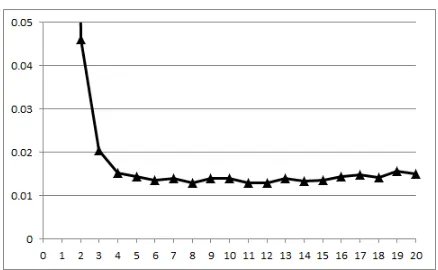
Our method HT has parameterT, correspond-ing to the truncation time, i.e., maximal number of steps of a random walk. Figure 2 shows the PRM of our method for different values of T. Performance gets better as T increases and is optimal for T = 12, whereas for larger values, the performance gets slightly worse again. The figure shows that, ifT is large enough (>5), the PRM is relatively constant and there is no phe-nomenon comparable to semantic drift, which causes instability in the produced rankings.
[image:3.612.318.535.53.214.2]3other common metrics do not satisfy these conditions.
[image:3.612.317.536.280.415.2]Figure 1: PRM for iterative bootstrapping with-out pruning (IB1) and with pruning (IB2). A lower PRM is better.
Figure 2: PRM for our method based on hitting times, for different values of the truncation time parameter T.
3.2 Method Comparison
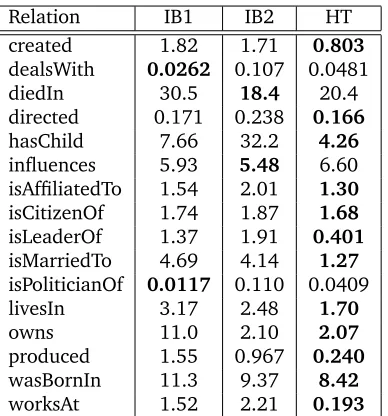
To evaluate the methods, firstly the parameters for each method were set to the optimal values as determined in the previous section. For the experiments here, we again use 200 randomly chosen tuples as the seeds for each relation. All the remaining gold standard tuples are used for testing.
Relation IB1 IB2 HT created 1.82 1.71 0.803
dealsWith 0.0262 0.107 0.0481 diedIn 30.5 18.4 20.4 directed 0.171 0.238 0.166
hasChild 7.66 32.2 4.26
influences 5.93 5.48 6.60 isAffiliatedTo 1.54 2.01 1.30
isCitizenOf 1.74 1.87 1.68
isLeaderOf 1.37 1.91 0.401
isMarriedTo 4.69 4.14 1.27
isPoliticianOf 0.0117 0.110 0.0409 livesIn 3.17 2.48 1.70
owns 11.0 2.10 2.07
produced 1.55 0.967 0.240
wasBornIn 11.3 9.37 8.42
[image:4.612.91.285.55.263.2]worksAt 1.52 2.21 0.193
Table 1: PRM in percent for all relations, for all three models. A lower PRM corresponds to a better model, with the best score indicated in bold.
Figure 3: PRM for the three methods, as a func-tion of the size of the seed set for the relafunc-tion created.
HT is better than both IB1 and IB2 at signifi-cance levelα <0.01.
Moreover, the ranking produced by HT is sta-ble and not affected by semantic drift, given that even where results are worse than for IB1 or IB2, they are still close to the best performing method. In contrast, when semantic drift oc-curs, the performance of IB1 and IB2 can dete-riorate drastically, e.g. for theworksAtrelation, where both IB1 and IB2 produce rankings that are a lot worse than the one produced by HT.
3.3 Sensitivity to Seed Set Size
Figure 3 shows the PRM for each of the three methods as a function of the size of the seed set for the relationcreated. For small seed sets, the performance of the iterative methods can be in-creased by adding more seeds. However, from a seed set size of 50 onwards, performance re-mains relatively constant. In other words, iter-ative bootstrapping is not benefitting from the information provided by the additional labeled data, and thus has a poor learning performance. In contrast, for our method based on hitting times, the performance continually improves as the seed set size is increased. Thus, also in terms of learning performance, our method is more sound than iterative bootstrapping.
4
Conclusions
[image:4.612.77.296.345.476.2]References
Agichtein, E. and Gravano, L. (2000). Snow-ball: Extracting Relations from Large Plain-text Collections. In Proceedings of the Fifth ACM Conference on Digital Libraries.
Brin, S. (1998). Extracting Patterns and Rela-tions from the World-Wide Web. In Proceed-ings of the 1998 International Workshop on the Web and Databases.
Curran, J., Murphy, T., and Scholz, B. (2007). Minimising Semantic Drift with Mutual Exclu-sion Bootstrapping. InProceedings of the 10th Conference of the Pacific Association for Com-putational Linguistics.
Francois, F., Pirotte, A., Renders, J., and Saerens, M. (2007). Random-Walk Computa-tion of Similarities between Nodes of a Graph with Application to Collaborative Recommen-dation. IEEE Transactions on Knowledge and Data Engineering, 19(3):355 –369.
Kok, S. and Brockett, C. (2010). Hitting the Right Paraphrases in Good Time. In Proceed-ings of the Annual Conference of the North American Chapter of the Association for Com-putational Linguistics.
Komachi, M., Kudo, T., Shimbo, M., and Mat-sumoto, Y. (2008). Graph-based Analysis of Semantic Drift in Espresso-like Bootstrap-ping Algorithms. In Proceedings of the Con-ference on Empirical Methods in Natural Lan-guage Processing.
McIntosh, T. and Curran, J. (2009). Reduc-ing Semantic Drift with BaggReduc-ing and Distri-butional Similarity. InProceedings of the Joint Conference of the 47th Annual Meeting of the ACL.
Mei, Q., Zhou, D., and Church, K. (2008). Query Suggestion Using Hitting Time. In Proceed-ings of the 17th ACM Conference on Informa-tion and Knowledge Management.
Pantel, P. and Pennacchiotti, M. (2006). Espresso: Leveraging Generic Patterns for Au-tomatically Harvesting Semantic Relations. In Proceedings of the 21st International Confer-ence on Computational Linguistics and the 44th
Annual Meeting of the Association for Compu-tational Linguistics.
Parker, R., Graff, D., Kong, J., Chen, K., and Maeda, K. (2011). English Gigaword Fifth Edition. Technical report, Linguistic Data Consortium.
Pasca, M., Lin, D., Bigham, J., Lifchits, A., and Jain, A. (2006). Organizing and Searching the World Wide Web of Facts – Step One: the One-million Fact Extraction Challenge. In Pro-ceedings of the 21st National Conference on Ar-tificial Intelligence (AAAI).
Sarkar, P. and Moore, A. (2007). A Tractable Approach to Finding Closest Truncated-commute-time Neighbors in Large Graphs. In Proceedings of the 23rd Conference on Uncer-tainty in Artificial Intelligence.
Sarkar, P., Moore, A., and Prakash, A. (2008). Fast Incremental Proximity Search in Large Graphs. In Proceedings of the 25th Interna-tional Conference on Machine Learning.
Suchanek, F., Kasneci, G., and Weikum, G. (2007). Yago: A Core of Semantic Knowl-edge. InProceedings of the International World Wide Web Conference (WWW).