INSIGHT-1 at SemEval-2016 Task 5: Deep Learning for Multilingual
Aspect-based Sentiment Analysis
Sebastian Ruder12 Parsa Ghaffari2 John G. Breslin1
1Insight Centre for Data Analytics
National University of Ireland, Galway
2Aylien Ltd.
Dublin, Ireland
Abstract
This paper describes our deep learning-based approach to multilingual aspect-based sentiment analysis as part of Se-mEval 2016 Task 5. We use a convo-lutional neural network (CNN) for both aspect extraction and aspect-based sen-timent analysis. We cast aspect extrac-tion as a multi-label classificaextrac-tion prob-lem, outputting probabilities over aspects parameterized by a threshold. To deter-mine the sentiment towards an aspect, we concatenate an aspect vector with ev-ery word embedding and apply a con-volution over it. Our constrained sys-tem (unconstrained for English) achieves competitive results across all languages and domains, placing first or second in 5 and 7 out of 11 language-domain pairs for aspect category detection (slot 1) and sentiment polarity (slot 3) respectively, thereby demonstrating the viability of a deep learning-based approach for multi-lingual aspect-based sentiment analysis.
1 Introduction
With access to the Internet becoming more prevalent, an inreasing number of people ex-press their opinions online in a plethora of
lan-guages. Sentiment analysis (Liu, 2012) enables us to derive shallow insights from these opin-ions related to their overall polarity. Often, however, e.g. in reviews, people do not express their opinion towards the entity as a whole, but refer to specific aspects such as the service in a restaurant.
Aspect-based sentiment analysis allows us to go deeper and determine sentiment towards such aspects of an entity. Past research in aspect-based sentiment analysis has largely fo-cused on the English language, while SemEval 2016 Task 5 (Pontiki et al., 2016) for the first time provides a forum for multilingual aspect-based sentiment analysis.
Recently, deep learning-based approaches have demonstrated remarkable results for text classification and sentiment analysis (Kim, 2014). A cascade of non-linearities allows them to model complex functions such as sentiment compositionality, while their ability to process raw signals renders them language and domain independent. In spite of these factors, they have largely gone untested for aspect-based senti-ment analysis, particularly in the multilingual setting.
based approach to aspect-based sentiment anal-ysis as part of our participation in SemEval-2016 Task 5 Aspect-based Sentiment Analysis Slot 1 (Aspect Category Detection) and Slot 3 (Sentiment Polarity) .
2 Related work
Aspect-based sentiment analysis is traditionally split into an aspect extraction and a sentiment analysis subtask.
Previous approaches to aspect extraction framed the task as a multiclass classification problem and relied mostly on CRS that lever-aged a plethora of common features, e.g. NER, POS tagging, parsing, semantic analysis, bag-of-words, as well as domain-dependent ones, such as word clusters learnt from Amazon and Yelp data, while previous sentiment analysis ap-proaches have used different classifiers with a wide range of features based on n-grams, POS, negation words, and a large array of sentiment lexica (Pontiki et al., 2014; Pontiki et al., 2015). Past deep learning-based approaches have fo-cused mostly on the sentiment analysis subtask: Tang et al. (2015) use a target-dependent LSTM to determine sentiment towards a target word, while Nguyen and Shirai (2015) use a recursive neural network that leverages both constituency as well as dependency trees.
In contrast to previous approaches, our model neither relies on expensive feature engineering, availability of a parser, nor positional informa-tion, but solely on a language’s input signals.
3 Model
The model architecture we use is an extension of the CNN structure used by Collobert et al. (2011), which has been successfully used by many others (Kim, 2014).
The model takes as input a text, which is
padded to length n. We represent the text as
a concatentation of its word embeddings x1:n
wherexi ∈ Rk is thek-dimensional vector of
thei-th word in the text.
The convolutional layer slides filters of dif-ferent window sizes over the input embeddings. Each filter with weights w ∈ Rhk generates a
new featurecifor a window ofhwords
accord-ing to the followaccord-ing operation:
ci=f(w·xi:i+h−1+b) (1)
Note thatb ∈Ris a bias term andf is a
non-linear function, ReLU (Nair and Hinton, 2010) in our case. The application of the filter over each possible window ofhwords or characters
in the sentence produces the following feature map:
c= [c1, c2, ..., cn−h+1] (2)
Max-over-time pooling in turn condenses this feature vector to its most important feature by taking its maximum value and naturally deals with variable input lengths.
A final softmax layer takes the concatenation of the maximum values of the feature maps pro-duced by all filters and outputs a probability dis-tribution over all output classes.
4 Methodology
4.1 Preprocessing
We lower-case and tokenize the corpus, where applicable, keeping the 10,000 most frequent words as the vocabulary for each language and domain. For Chinese, in preparation for the pre-vious step, we additionally segment the corpus using themmsegPython library.
4.2 Hyperparameters
Listing 1:Example sentence with aspect and sentiment annotations for the English laptops domain.
1 < s e n t e n c e i d =" 347 : 0 ">
2 < t e x t > I bought i t f o r r e a l l y cheap a l s o and i t s AMAZING. < / t e x t > 3 < O p i n i o n s >
4 < Opinion c a t e g o r y ="LAPTOP#PRICE " p o l a r i t y =" p o s i t i v e "/ > 5 < Opinion c a t e g o r y ="LAPTOP#GENERAL" p o l a r i t y =" p o s i t i v e "/ > 6 < / O p i n i o n s >
7 < / s e n t e n c e >
hyperparameters via random search over a wide range of values.
For both tasks and all languages and do-mains, we use the following hyperparameters, which are similar to those reported by Kim (2014): mini-batch size of 10, maximum sen-tence length of 100 tokens, word embedding size of 300, dropout rate of 0.5, and 100 fil-ter maps. We use filfil-ter lengths of 3, 4, and 5, and of 4, 5, and 6 for aspect extraction and aspect-based sentiment analysis respec-tively since these produced good results for the respective task.
English word embeddings are initialized with 300-dimensional GloVe vectors (Pennington et al., 2014) trained on 840B tokens of the Com-mon Crawl corpus for the unconstrained sub-mission. Word embeddings for the constrained submission, for all other languages, as well as for words not present in the pre-trained set of words are initialized randomly.
We train for 15 epochs using mini-batch stochastic gradient descent, the Adadelta update rule (Zeiler, 2012), and early stopping.
4.3 Aspect Category Detection
To extract aspects, e.g. LAPTOP#PRICEand
LAPTOP#GENERALfrom sentences as in List-ing 1, we cast aspect extraction as a multi-label classification problem and train a convolutional
neural network (CNN) to output probability dis-tributions over aspects, minimizing the cross-entropy loss. To model multi-label output as a probability distribution, we define an aspect
a’s probabilitypgiven a sentencesasp(a|s) = 1/nif aappears insandscontains naspects,
otherwisep(a|s) = 0. We define a thresholdf
and discard all aspects withp(a|s) < f. After
training, we select f maximizing the F1 score
on the validation set.
We observe that aspect distributions vary sig-nificantly depending on the domain and lan-guage. For instance, the English laptops do-main contains 82 aspects, while the restaurants domain only contains 13 aspects.
In every domain, we thus replace all as-pects that occur less than 5 times with an
OTHER aspect.1 E.g. this produces 51
aspects covering 98% of occurrences and all 13 aspects for the English laptops and restaurants domain respectively. For in-stance, in the English laptops domain, as-pects such as HARDWARE#MISCELLANEOUS
andBATTERY#USABILITY, which occur less than 5 times are replaced with OTHER during training. We add a NONE aspect to each sen-tence containing no aspect to enable the CNN
1We found that replacing all aspects with fewer than
to make no aspect prediction. During inference, every time the model predictsOTHER, the most frequent aspect replaced byOTHERfor each do-main is output instead. For the English laptops domain, this can be one of several aspects, e.g.
SOFTWARE#QUALITY occurring four times. Finally, we discard all predictedNONEaspects. We experimented with producing repretations for the preceding and subsequent sen-tence to take context information into account, but this did not improve results.
4.4 Sentiment Polarity
For aspect-based sentiment analysis, we feed the aspect vector together with the word em-beddings of the input sentence into a CNN. To obtain the aspect vector, we follow an ap-proach similar to the one used by Socher et al. (2013) to represent named entities: We split each aspect into its constituent tokens, e.g.
RESTAURANT#GENERAL → restaurant, gen-eral. We embed the tokens of all aspects in an embedding space. We then look up the embedding of each of the tokens and average them to retrieve the aspect vector. This way, the model should learn that aspects sharing the same entity, e.g.restaurantare correlated with-out the need to train several tiered models to classify between entities (restaurant) and at-tributes (general).
For aspect-based sentiment analysis in the English language, we embed aspect tokens in the same embedding space as word tokens to exploit the semantics of pre-trained embed-dings. For all other languages, we keep the em-bedding spaces separate, as aspect tokens are in English and word tokens are in the respec-tive languages. Translating aspect tokens into the source language did not provide any ben-efits, but the use of pre-trained embeddings in the source language could ameliorate this.
We have experimented with different variants of adding aspect embeddings to our model: We evaluated summation, concatenation, and mul-tiplication of word vectors and aspect vectors before the convolution, and multiplication and concatenation of the max-pooled sentence vec-tor and the aspect vecvec-tor after the convolution. We find that concatenating each word vector with the aspect vector before the convolution yields the best results.
To summarize, for the sentence in List-ing 1 and the aspect LAPTOP#PRICE, our model first pads the input sentence, then looks up the embeddings of each of the input words. It creates the aspect vector by splitting
LAPTOP#PRICEinto the aspect tokenslaptop
andprice. For these, it looks up the embeddings in the aspect embedding space (which is the same as for word embeddings for English) and averages both embeddings. The resulting aspect vector is then concatenated with each word vec-tor, which are then concatenated to produce a 100x600 sentence matrix. Convolutions, max-pooling and softmax are applied to this matrix as described in section 3.
We observe for some languages an incremen-tal performance improvement when using addi-tional average-pooling as reported by Tang et al. (2014). We further note that simply using a low-dimensional embedding space to embed aspects leads to superior results on a few occa-sions when no pre-trained word embeddings are used.
5 Evaluation
Lg. Dom. F1 Top F1 R.
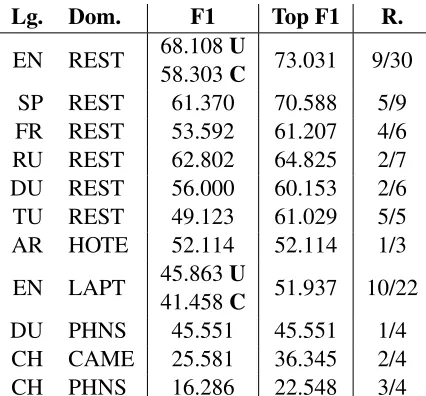
[image:5.612.77.290.78.276.2]EN REST 68.10858.303UC 73.031 9/30 SP REST 61.370 70.588 5/9 FR REST 53.592 61.207 4/6 RU REST 62.802 64.825 2/7 DU REST 56.000 60.153 2/6 TU REST 49.123 61.029 5/5 AR HOTE 52.114 52.114 1/3 EN LAPT 45.86341.458UC 51.937 10/22 DU PHNS 45.551 45.551 1/4 CH CAME 25.581 36.345 2/4 CH PHNS 16.286 22.548 3/4
Table 1: F1 and rank of our system for aspect extraction for each language and domain in comparison to the best system. Lg.: Language. Dom.: Domain. R.: Rank. EN: English. SP: Spanish. FR: French. RU: Russian. TU: Turkish. AR: Arabic. DU: Dutch. CH: Chinese. REST: Restaurants. HOTE: Hotels. LAPT: Laptops. PHNS: Phones. CAME: Cameras. U: Unconstrained submission. C: Constrained submission.
5.1 Aspect Category Detection
Despite using only the input sentence as data, our system is able to achieve competitive per-formance for multilingual aspect extraction, placing first or second in 5 out of 11 language-domain pairs. However, for English, Spanish, French, and Turkish, the differential with re-gard to the best performing system still remains large. We observe that initializing the system with general-purpose pre-trained embeddings provides a significant performance boost, which is most pronounced in the English restaurants domain.
Consequently, we hypothesize that the most straightforward way to overcome this perfor-mance differential is to initialize the system with embeddings trained on a large
mono-lingual corpus in the target language. In-corporating domain information used by best-performing systems (Pontiki et al., 2015) by pre-training on a large in-domain corpus such as the dataset released as part of the Yelp Dataset Challenge2should further improve results.
The multi-label condition is currently en-forced only after prediction through the applica-tion of a threshold, which may potentially dis-card promising aspects or retain erroneous ones, while the current normalization of aspect prob-abilities might lead to the loss of signals. To make the model more robust, the multi-label condition can be integrated more naturally into the architecture, e.g. by adapting the error func-tion and using a trainable thresholding funcfunc-tion as in (Zhang et al., 2006).
5.2 Sentiment Polarity
We report convincing results for multilingual aspect-based sentiment analysis, placing first or second for 7 out of 11 language-domain pairs. Again, the difference in performance compared to the best-performing system is largest for En-glish, Spanish, French, and Turkish. To miti-gate this, pre-trained word embeddings as de-scribed in 5.1 can be used.
However, without relying on dependency and constituency trees (Nguyen and Shirai, 2015) or positional information (Tang et al., 2015), the model falls short of being able to reliably tri-angulate aspects, particularly in sentences with opposing sentiments toward different aspects. Simply concatenating each word vector with the aspect vector does not seem to provide the model with enough expressiveness to model truly aspect-dependent sentiment. Training the model to associate different surface forms with their aspect instantiations should help to
Lg. Dom. Acc. Top Acc. R.
[image:6.612.78.293.78.277.2]EN REST 82.07280.210UC 88.126 7/28 SP REST 79.571 83.582 4/5 FR REST 73.166 78.826 4/6 RU REST 75.077 77.923 2/6 DU REST 75.041 77.814 3/4 TU REST 74.214 84.277 2/3 AR HOTE 82.719 82.719 1/3 EN LAPT 78.40274.282UC 82.772 2/21 DU PHNS 83.333 83.333 1/3 CH CAME 78.170 80.457 2/5 CH PHNS 72.401 73.346 2/5
Table 2: Accuracy and rank of our system for aspect-based for each language and domain in comparison to the best system. For legend, refer to Table 1.
liorate this.
6 Conclusion
In this paper, we have presented a deep learning-based approach to aspect-based senti-ment analysis, which employs a convolutional neural network for aspect extraction and sen-timent analysis as part of our submission to SemEval-2016 Task 5. We have demonstrated convincing results in the multilingual setting, which is particularly appropriate for neural net-works due to their language and domain inde-pendence. We have evaluated our model, out-lining weaknesses and potential future improve-ments.
Acknowledgments
This project has emanated from research con-ducted with the financial support of the Irish Research Council (IRC) under Grant Number EBPPG/2014/30 and with Aylien Ltd. as En-terprise Partner. This publication has emanated
from research supported in part by a research grant from Science Foundation Ireland (SFI) under Grant Number SFI/12/RC/2289.
References
Ronan Collobert, Jason Weston, Leon Bottou, Michael Karlen, Koray Kavukcuoglu, and Pavel Kuksa. 2011. Natural Language Processing (al-most) from Scratch. Journal of Machine Learn-ing Research, 12(Aug):2493–2537.
Yoon Kim. 2014. Convolutional Neural Net-works for Sentence Classification. Proceedings of the Conference on Empirical Methods in Natu-ral Language Processing, pages 1746–1751. Bing Liu. 2012. Sentiment Analysis and Opinion
Mining. Synthesis Lectures on Human Language Technologies, 5(1):1–167.
Vinod Nair and Geoffrey E Hinton. 2010. Recti-fied Linear Units Improve Restricted Boltzmann Machines. Proceedings of the 27th International Conference on Machine Learning, (3):807–814. Thien Hai Nguyen and Kiyoaki Shirai. 2015.
PhraseRNN : Phrase Recursive Neural Net-work for Aspect-based Sentiment Analysis. (September):2509–2514.
Jeffrey Pennington, Richard Socher, and Christo-pher D Manning. 2014. Glove: Global Vec-tors for Word Representation. Proceedings of the 2014 Conference on Empirical Methods in Natu-ral Language Processing, pages 1532–1543. Maria Pontiki, Dimitrios Galanis, John Pavlopoulos,
Haris Papageorgiou, Ion Androutsopoulos, and Suresh Manandhar. 2014. SemEval-2014 Task 4: Aspect Based Sentiment Analysis. Proceed-ings of the 8th International Workshop on Seman-tic Evaluation (SemEval 2014), pages 27–35. Maria Pontiki, Dimitris Galanis, Haris
Papageor-giou, Suresh Manandhar, and Ion Androutsopou-los. 2015. SemEval-2015 Task 12: Aspect Based Sentiment Analysis.Proceedings of the 9th Inter-national Workshop on Semantic Evaluation (Se-mEval 2015), pages 486–495.
Mohammad AL-Smadi, Mahmoud Al-Ayyoub, Yanyan Zhao, Bing Qin, Orphée De Clercq, Véronique Hoste, Marianna Apidianaki, Xavier Tannier, Natalia Loukachevitch, Evgeny Kotel-nikov, Nuria Bel, Salud María Jiménez-Zafra, and Gül¸sen Eryi˘git. 2016. SemEval-2016 Task 5: Aspect-Based Sentiment Analysis. In Proceed-ings of the 10th International Workshop on Se-mantic Evaluation, San Diego, California. Asso-ciation for Computational Linguistics.
Richard Socher, Danqi Chen, Christopher D. Man-ning, and Andrew Y. Ng. 2013. Reasoning With Neural Tensor Networks for Knowledge Base Completion. Proceedings of the Advances in Neural Information Processing Systems 26 (NIPS 2013), pages 1–10.
Duyu Tang, Furu Wei, Nan Yang, Ming Zhou, Ting Liu, and Bing Qin. 2014. Learning Sentiment-Specific Word Embedding. Proceedings of the 52nd Annual Meeting of the Association for Com-putational Linguistics, 1:1555–1565.
Duyu Tang, Bing Qin, Xiaocheng Feng, and Ting Liu. 2015. Target-Dependent Sentiment Classi-fication with Long Short Term Memory. arXiv preprint arXiv:1512.01100.
Matthew D. Zeiler. 2012. ADADELTA: An Adaptive Learning Rate Method. arXiv preprint arXiv:1212.5701.