Tohoku at SemEval-2016 Task 6: Feature-based Model versus
Convolutional Neural Network for Stance Detection
Yuki Igarashi
Tohoku University [email protected]
Hiroya Komatsu
Tohoku University [email protected]
Sosuke Kobayashi
Tohoku University [email protected]
Naoaki Okazaki
Tohoku University [email protected]
Kentaro Inui
Tohoku University [email protected]
Abstract
In this paper, we compare feature-based and Neural Network-based approaches on the su-pervised stance classification task for tweets in SemEval-2016 Task 6 Subtask A (Moham-mad et al., 2016). In the feature-based ap-proach, we use external resources such as lex-icons and crawled texts. The Neural Network based approach employs Convolutional Neu-ral Network (CNN). Our results show that the feature-based model outperformed the CNN model on the test data although the CNN model was better than the feature-based model in the cross validation on the training data.
1 Introduction
To solve supervised short text classification tasks, there are two major approaches; feature-based and Neural Network based approaches. In traditional feature-based approaches, we extract various fea-tures from a text. The feafea-tures are usually con-structed from n-grams (e.g., bigrams) of the texts and external resources such as lexicons and unla-beled corpora.
In Neural Network based approaches, a number of models for text classifications exist; for exam-ple, Feed-Forward Neural Network model using an average of embeddings of target word sequences as the input layer (Iyyer et al., 2015), Recursive Neural Network (Socher et al., 2011; Socher et al., 2013), and Convolutional Neural Network (CNN) (Johnson
and Zhang, 2015; dos Santos and Gatti, 2014; Kim, 2014).
In this paper, we compare feature-based and Neural Network based approaches on the super-vised stance classification task for tweets, SemEval-2016 Task 6 Subtask A (Mohammad et al., SemEval-2016). The feature-based approach classifies tweets using logistic regression model. The features are ex-tracted using external knowledge such as Senti-WordNet (Esuli and Sebastiani, 2006) and a collec-tion of crawled tweets, in addicollec-tion to unigrams or bigrams in the target tweet. For the Neural Net-work approach, we implement CNN based on Kim (2014). As the input embeddings, we use word embeddings trained by Continuous Bag-Of-Words (CBOW) model (Mikolov et al., 2013) on Wikipedia articles.
The experimental results show that the CNN based approach performed the best in the cross val-idation on the training data. However the tendency was opposite on the test data probably because the CNN model overfitted to the training data. In con-trast, the feature-based approach was more robust, leveraging the external knowledge.
2 Datasets
We use the dataset of the SemEval-2016 Task 6 Sub-task A, which is a supervised tweet classification task for five topics. There are three stances to clas-sify;NONE,FAVOR,AGAINST. Table 1 shows the topics and distributions of the training data.
Topic FAVOR AGAINST NONE
Atheism 92 304 117
Climate Change is a
Real Concern 212 15 168
Feminist Movement 210 328 126
Hillary Clinton 112 361 166
[image:2.612.88.292.61.135.2]Legalization of Abortion 105 334 164
Table 1:Distributions of the labels for each topics in the train-ing data.
To classify tweets into their stances, we consider two configurations: Three-way Polarity Classifier
which detects three stance labels at once, and a com-bination of Topic Classifier and Two-way Polarity
Classifier. Topic Classifier judges the relevance of
a tweet to the topic, in other words, whether a stance label isNONEor not (FAVOR/AGAINST). Two-way Polarity Classifier then labelsFAVORorAGAINST
for tweets that were not judged asNONEby the Topic Classifier.
3 Feature-Based Approach
3.1 Preprocessing Tweets
We remove reply and mention expressions (@UserName) in tweets to prevent overfitting, and keep flags indicating whether tweets contain them or not. We also remove hashtags based on the following rules to prevent overfitting.
Rule 1. Hashtags embedded in the sentence with capitals or digits at non-inital letters
e.g.,#WeLoveJapan, #Pray4all Rule 2. Hashtags at the end of a tweet
e.g.,#SemST, #2014, #LylicTweet Rule 1removes hashtags that are too long or unpop-ular. Rule 2removes hashtags that do not contain a stance. Remaining hashtags such as#hillary
and#godmay provide important features to detect the stances.
We also expand shortened forms such as “I’m” and “can’t” based on simple rules. Finally, we obtain part-of-speech (POS) tags and dependency trees of tweets by using Stanford CoreNLP1.
3.2 Features
Reply (R): If a tweet has a flag that indi-cates a reply or mention expression, we
gener-1http://stanfordnlp.github.io/CoreNLP/
Topic Query # tweets
Atheism ”atheism” 24124
Climate Change is a
Real Concern ”climate”, ”climate change” 22703
Feminist Movement
”feminist”, ”feaminism”, ”feminist movement”,
”gender equality”
131677
Hillary Clinton ”hillary”, ”clinton”,
”hillary clinton” 980080 Legalization of Abortion ”abortion” 54846
Table 2:Crawled tweets used for HighPMI Features. This table shows search queries and the number of tweets we collected for each topic.
Topic Keywords
Atheism ”atheism”
Climate Change is a
Real Concern ”climate”, ”change” Feminist Movement ”feminist”, ”feminism”
[image:2.612.312.539.63.164.2]Hillary Clinton ”hillary”, ”clinton” Legalization of Abortion ”abortion”
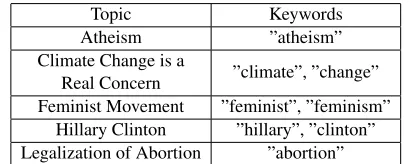
Table 3:Seed keywords for each topic for TargetSentiment and HighPMI features.
ateR=is replyorR=is mentionas a feature. This feature may be effective because a reply or mention may provides a clue for detecting a stance.
BagOfWords (BoW): For detecting stances, words in a tweet are very informative. We include all unigrams of lemmas in a tweet as features. (e.g.
BoW=think, BoW=not)
BagOfDependencies (BoD): Dependency rela-tions such as adjectival modifier and negation are important for detecting stances. We include all de-pendency relations in a tweet as features. (e.g.
BoD=hate=>i, BoD=like=>not)
BagOfPOSTag (BoP): We also extract features from POS tags. For example, if a tweet contains several interjections, the user probably has a nega-tive opinion to the topic. We include all unigrams of POS tags in a tweet as features. (e.g. BoP=NOUN, BoP=UH)
[image:2.612.321.526.213.295.2]Classifier Atheism ClimateChangeis a Real concern
Feminist
Movement ClintonHillary
Legalization Of Abortion
ALL topics
3-way Polarity 0.5314 0.5144 0.5735 0.5273 0.5277 0.6083
[image:3.612.96.519.61.124.2]Topic + 2-way Polarity 0.5327 0.5248 0.5860 0.5502 0.5290 0.6188
Table 4: Comparison of 3-way Polarity Classifier with Topic + 2-way Polarity Classifier on 10-fold cross validation using the feature-based approach. The scores were measured in a macro average of micro-F1 scores ofFAVORandAGAINSTfor each topic and all topics.
Feature sets Atheism
ClimateChange is a Real concern
Feminist Movement
Hillary Clinton
Legalization Of Abortion
ALL topics
ALL 0.5327 0.5248 0.5860 0.5502 0.5290 0.6188
- R 0.5373 0.5248 0.5776 0.5539 0.5349 0.6180
- BoW 0.5440 0.5248 0.5936 0.4927 0.5341 0.6185
- BoD 0.5672 0.5097 0.5895 0.5561 0.5746 0.6276
- BoP 0.5525 0.5248 0.5785 0.5527 0.5034 0.6169
- SWN 0.5357 0.5168 0.5760 0.5475 0.5308 0.6162
- SWS 0.5316 0.5248 0.5783 0.5520 0.5342 0.6174
- TS 0.5327 0.5248 0.5882 0.5502 0.5349 0.6200
- P 0.5360 0.5248 0.5834 0.5520 0.5406 0.6204
Best 0.5672 0.5642 0.5208 0.5883 0.5208 0.6297
Table 5: Ablation Test of Topic + 2-way Polarity Classifier on 10-fold cross validation using the feature-based approach. The scores were measured in a macro average of micro-F1 scores ofFAVORandAGAINSTfor each topic and all topics.
adjectives and adverbs in the tweet based on the fol-lowing rules.
1. For a given word, look up the top item in Sen-tiWordNet and obtain a negative and positive score of the word.
2. If the negative score is equal to the positive score, no features are generated.
3. If the negative score is larger than the positive score, generate a negative polarity feature, oth-erwise generate a positive polarity feature. (e.g.
SWN=love=>p, SWN=hate=>n)
SentiWordSubject (SWS): This feature focuses on sentiment expressed by subjective pronouns such as “I” or “we”, which may indicate emotions or stances of the user of a tweet. We obtain a sen-timent polarity from the word modifying a subjec-tive pronoun in a tweet, and include it as a fea-ture. A sentiment polarity is obtained by SentiWord-Net using the same rules for SWN features. (e.g.
SWS=I=love=>p, SWS=We=hate=>n)
TargetSentiment (TS): We also consider senti-ment or emotion for the topics. Jiang et al. (2011)
add words modifying target words as features. Sim-ilarly, we extract words modifying target words in a tweet, and include sentiment polarity features using the same rules in SWN features.
We calculate similarities between words and seed keywords using word embeddings. If the similarity is higher than 0.7, we use it as the target word. Table 3 shows the seed keywords for each topic.
For example, given a tweet “We hate feminist”, we extract “hate” that modifies the target word “fem-inist”. Then we get a featureTS=n using the same rules in SWN features. (e.g.TS=p, TS=n)
HighPMI (P): We crawled tweets containing tar-get words, and collected words cooccuring with seed keywords (Table 3) in all crawled tweets for each topic. Table 2 shows query words and the number of crawled tweets for each topic. Then we calculate Point-wise Mutual Information (PMI) for all words. If the word in a tweet is in top 300 of the PMI, we generate a feature. This feature detects a tweet con-taining words related to the topic. This feature may be effective to classify whether NONEor not. (e.g.
𝒗𝒘𝟏 0.5 0.7 … 0.1
𝒗𝒘𝟐 0.9 -0.4 … 0.2
… 𝒗𝒘𝟒 -0.9 0.5 … -0.1
𝒗𝒛 0.0 0.0 … 0.0
… 𝒗𝒛 0.0 0.0 … 0.0 Embedding vector𝒗𝒘𝒌
1×𝑑
Zero padding 𝒗𝒛
1×𝑑 Input matrix𝑁×𝑑
𝒗𝒘𝟏
𝒗𝒘𝟐
𝒗𝒘𝟑
𝑾
1.5 -0.2 … 0.1
0.3 0.7 … 0.8
0.4 -0.5 … 0.0
f
f
f …
…
…
…
Convolution layer Max-pooling layer
1.5
0.7
…
0.8
1.5
0.7
…
0.8
0.2
0.6
0.2
Fully connected layers
Favor Against None
200
𝑁 − 𝑘 + 1
Output vector
Region
𝑘 ×𝑑 Activation
Function
𝒗𝒘𝟒
𝒗𝒛
𝒗𝒛
𝒗𝒘𝟐
𝒗𝒘𝟑
𝒗𝒘𝟒
… …
(𝑑×𝑘)×200
𝑁 − 𝑘 + 1 𝑾𝑾
e.g. Feminists are a minority
𝑤Q 𝑤R 𝑤S 𝑤T
Feminist are
minority
NULL
[image:4.612.78.531.64.203.2]NULL
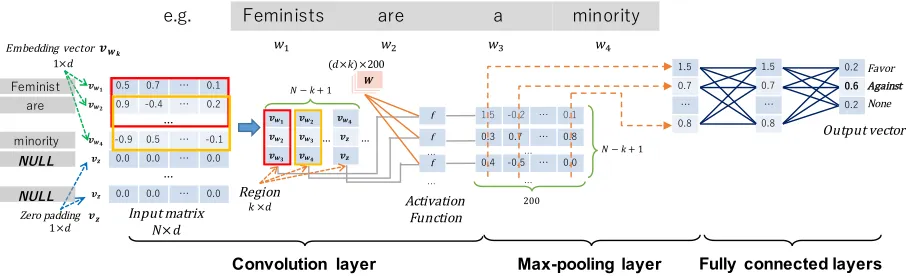
Figure 1:Overview of our CNN model.
3.3 Evaluation
3.3.1 Experimental Setups
We used L2 logistic regression as the classifica-tion algorithm, and measured the classificaclassifica-tion per-formance on 10-fold cross validation using the Clas-sias package (Okazaki, 2009). We evaluated each model by a macro average of micro-F1 scores of
FAVORandAGAINSTfor each topic and all topics.
3.3.2 Comparison of Classifier Combinations
We compared Three-way Polarity Classifier with the combination of Topic Classifier and Two-way Polarity Classifier. Table 3.1 shows the perfor-mances of these two classifier configurations. We confirmed that the combination of Topic Classi-fier and Two-way Polarity ClassiClassi-fier outperformed Three-way Polarity Classifier. Therefore, we used the combination of Topic Classifier and Two-way Polarity Classifier hereafter.
3.3.3 Ablation Test
Through this experiment, we explore the contri-bution of individual features explained in Section 3.2. Table 5 shows the results of ablation tests. These results show that SWN features were the most effective to classify the stances. Sentiment of the tweet is one of the keys for stance classification. In contrast, BoD features degraded the classifier. We experimented further ablation tests with the fea-ture set except for degraded feafea-tures in the ablation test. These experiments revealed the best feature sets
{BoW, BoP, R, SWN, P}(denoted ‘Best’ in Table 5).
4 CNN Based Approach
4.1 Method Overview
In recent years, Convolutional Neural Network (CNN) models have achieved remarkable results in various fields of research, such as computer vision and speech recognition. In the field of natural lan-guage processing, CNN models are also used for text classification tasks (Johnson and Zhang, 2015; dos Santos and Gatti, 2014), sentiment analysis (Kim, 2014), etc.
Following Kim (2014), we constructed CNN models to detect stances, as shown in Figure 1. They consist of one convolution layer with one max-pooling layer, and a three-layered feedforward net-work with softmax at the end to predict a distribution over classes. The convolution layer has 200 kernel windows whose sizes arek×d, wherekis the
num-ber of words in a window anddis the dimension size
of the word embeddings. We denote an input tweet
sas a sequence of wordsw1,w2, ...,wn, and their
embeddings vw1,vw2, ...,vwn. We use Chainer2
for creating neural networks. To create a fixed-size input matrix for the implementation on Chainer, we added zero-padding vectors into the end of a sen-tence so that each input matrix will beN×dmatrix, whereN is the upper bound of the length of a sen-tence.
As we mentioned in Section 2, we consider both
Three-way Polarity Classifier and a combination of Topic Classifierand Two-way Polarity Classi-fier. We also try to find out the best hyper parameter
kand activation functions.
Classifier ActivationFunctions Atheism
Climate Change is a Real Concern
Feminist
Movement ClintonHillary
Legalization of
Abortion Total
3-way relusig 0.67700.6039 0.41180.5186 0.59580.6015 0.56810.6098 0.48140.5421 0.66640.6647
Topic + 2-way
sig sig 0.6751 0.4080 0.5969 0.6061 0.5528 0.6381
relu relu 0.5736 0.5710 0.5990 0.6391 0.5455 0.6365
sig relu 0.5826 0.5774 0.5974 0.6402 0.5425 0.6713
[image:5.612.126.488.61.158.2]relu sig 0.6688 0.4017 0.6005 0.6090 0.5612 0.6398
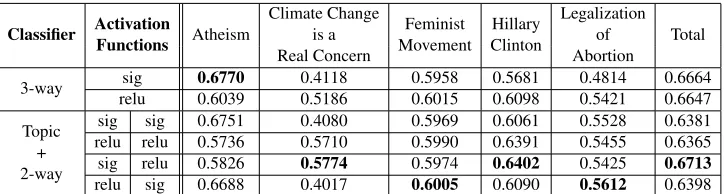
Table 6:Comparison of 3-way Polarity Classifier with Topic + 2-way Polarity Classifier on 10-fold cross validation using CNN based approach. The scores were measured in a macro average of micro-F1 scores ofFAVORandAGAINSTfor each topic and all topics.
Kernel Size
(k) Atheism
Climate Change is a Real Concern
Feminist Movement
Hillary Clinton
Legalization of Abortion
ALL topics
2 0.6390 0.5743 0.6189 0.6490 0.5611 0.6831
3 0.5826 0.5774 0.5974 0.6402 0.5425 0.6713
[image:5.612.144.471.210.275.2]4 0.5746 0.5746 0.6276 0.6354 0.5398 0.6755
Table 7:Tuning of window size per wordkon 10-fold cross validation using CNN based approach. The scores were measured in a macro average of micro-F1 scores ofFAVORandAGAINSTfor each topic and all topics.
4.2 Experimental Setups
We trained 300 dimensional word embeddings us-ing Word2Vec3 with Wikipedia articles4 (3950598 articles in total)5. We set N to 100, which ex-ceeds the maximum length of all tweets. We use
(300×k)×200matrix asW and three fully
con-nected layers that consist of 200-50-3 units (Three-way Polarity Classifier) or 200-50-2 units (Topic Classifier or Two-way Polarity Classifier).
We measured the performance on 10-fold cross validation. We evaluated each model by a macro av-erage of micro-F1 scores ofFAVORandAGAINST
for each topic and all topics.
4.3 Evaluation
4.3.1 Comparison of Classifier Combinations
We compared Three-way Polarity Classifier with the combination of Topic Classifier and Two-way Polarity Classifier withk = 3. We tried using all
possible combinations of sigmoid and relu
func-tions in the CNN models.
Table 6 shows the performances of the classifiers.
3https://code.google.com/archive/p/word2vec/
4
https://dumps.wikimedia.org/enwiki/20151201/enwiki-20151201-pages-articles.xml.bz2
5We used the following options: -size 300 -window 5 -sample 1e-4 -negative 5 -hs 0 -cbow 1 -iter 3
The table indicates that the combination of Topic Classifier and Two-way Polarity Classifier outper-formed Three-way Polarity Classifier. We confirmed that the combination of these classifier has been found effective for not only the feature-based ap-proach, but also for the CNN-based approach.
We also achieved the best score when we use
sigmoid function for Topic Classifier and relu for
Two-way Polarity Classifier.
4.3.2 Tuning of Window Sizek
We searched for the best value of the hyperparam-eterkwith the highest model in Section 4.3.1. Table
7 shows that the model obtained the highest score with window sizek = 2. The results show that bi-gram is appropriate for stance detection on the train-ing data.
4.3.3 Visualization of the CNN Model
In this section, we visualize the CNN model that achieved the highest score in Section 4.3.2. To vi-sualize the CNN model, we define aregion scoreas the number of dimensions that are selected by the max-pooling layer per region. Figure 2 shows a heat map reflecting the region score.
The figure provides several observations.
no , men need a movement that will help them not hurt them NULL
22 16 23 16 20 14 10
10 10 21 10 11 17
no , men need a movement that will help them not hurt them NULL
7 20 20 9 12 16 4
12 11 21 19 16 30
e.g. 10407 no , men need a movement that will help them not hurt them.
Topic Classifier
Gold Label: AGAINST, Predicted Label: (Feature based) FAVOR, (CNN based) AGAINST
[image:6.612.129.494.74.156.2]Two-way Polarity Classifier
Figure 2: Visualization of the CNN model. A bigram region in deep color receives highregion score, which indicates that the convolution layer highly focuses on the region.
Method Train Test
Total Atheism Climate Changeis a Real Concern
Feminist
Movement ClintonHillary
Legalization of
Abortion ALL topic Feature-Best 0.6297 0.5973 0.3891 0.5487 0.5360 0.5796 0.6426
[image:6.612.126.491.204.274.2]CNN-Best (Submission) 0.6831 0.5890 0.3951 0.5241 0.3981 0.3775 0.6221 Majority Baseline 0.5411 0.4210 0.4212 0.3910 0.3683 0.4030 0.6522
Table 8: Comparison of Feature-based Model and CNN Model on test data. The scores were measured in a macro average of micro-F1 scores ofFAVORandAGAINSTfor each topic and all topics.
CNN model automatically detects the topic words.
• Nouns, verbs and adjectives that appear in Sen-tiWordNet received a higher score in both clas-sifiers. In addition, their scores have some associations with cooccurrence with the topic word.
• Negation words such asnotandcan’treceived
high scores in Polarity Classifier, but they re-ceived less scores in Topic Classifier.
5 Overall Results
We compared feature-based models with CNN mod-els and the majority baseline in the test data. The feature-based models used Topic + Two-way Polar-ity Classifiers and the best feature sets mentioned in Section 3.3.3. The CNN models used Topic + Two-way Polarity Classifiers and the best hyperparame-ters mentioned in Section 4.3. The majority base-line labeled the test data as the stance that was most prevalent in the training data.
Table 8 shows a macro average of micro-F1 scores ofFAVORandAGAINSTfor two models in the test data and the cross validation results. As a compari-son, we also show the majority baseline in Table 8.
We found that the feature-based model outper-formed the CNN model in the test data, although the
CNN model was better in the cross validation on the training data. We think that the feature-based model was more robust, including broad external knowl-edge such as SentiWordNet and crawled tweets. In contrast, the CNN model obtained a lower score on the test data than on the cross validation.
6 Conclusion
We compared the feature-based and the CNN based approaches on SemEval-2016 Task 6 Subtask A. The CNN based approach performed the best in the cross validation on the training data although the feature-based approach outperformed the CNN model on the test data. We also visualized the CNN model to reveal what was focused on. We found that the CNN model automatically detected the topic words and effective words to detect the stances.
Acknowledgments
We acknowledge the support of the Step-QI School program, Department of Information and Intelligent Systems, Tohoku University.
References
In-ternational Conference on Computational Linguistics: Technical Papers, pages 69–78.
Andrea Esuli and Fabrizio Sebastiani. 2006. Sentiword-net: A publicly available lexical resource for opinion mining. InProceedings of the 5th Conference on Lan-guage Resources and Evaluation, pages 417–422. Mohit Iyyer, Varun Manjunatha, Jordan Boyd-Graber,
and Hal Daum´e III. 2015. Deep unordered composi-tion rivals syntactic methods for text classificacomposi-tion. In Proceedings of the 53rd Annual Meeting of the Associ-ation for ComputAssoci-ational Linguistics and the 7th Inter-national Joint Conference on Natural Language Pro-cessing (Volume 1: Long Papers), pages 1681–1691. Long Jiang, Mo Yu, Ming Zhou, Xiaohua Liu, and Tiejun
Zhao. 2011. Target-dependent twitter sentiment clas-sification. InProceedings of the 49th Annual Meet-ing of the Association for Computational LMeet-inguistics: Human Language Technologies - Volume 1, HLT ’11, pages 151–160.
Rie Johnson and Tong Zhang. 2015. Effective use of word order for text categorization with convolutional neural networks. InNAACL HLT 2015, The 2015 Con-ference of the North American Chapter of the Associa-tion for ComputaAssocia-tional Linguistics: Human Language Technologies, pages 103–112.
Yoon Kim. 2014. Convolutional neural networks for sen-tence classification. InProceedings of the 2014 Con-ference on Empirical Methods in Natural Language Processing (EMNLP), pages 1746–1751.
Tomas Mikolov, Kai Chen, Greg Corrado, and Jeffrey Dean. 2013. Efficient estimation of word represen-tations in vector space.CoRR, abs/1301.3781. Saif M. Mohammad, Svetlana Kiritchenko, Parinaz
Sobhani, Xiaodan Zhu, and Colin Cherry. 2016. SemEval-2016 Task 6: Detecting stance in tweets. In Proceedings of the International Workshop on Seman-tic Evaluation, SemEval ’16.
Naoaki Okazaki. 2009. Classias: a collection of machine-learning algorithms for classification. Bo Pang, Lillian Lee, and Shivakumar Vaithyanathan.
2002. Thumbs up?: Sentiment classification using machine learning techniques. InProceedings of the ACL-02 Conference on Empirical Methods in Natural Language Processing - Volume 10, EMNLP ’02, pages 79–86.
Richard Socher, Jeffrey Pennington, Eric H. Huang, An-drew Y. Ng, and Christopher D. Manning. 2011. Semi-Supervised Recursive Autoencoders for Predict-ing Sentiment Distributions. InProceedings of the 2011 Conference on Empirical Methods in Natural Language Processing (EMNLP).
Richard Socher, Alex Perelygin, Jean Wu, Jason Chuang, Christopher D. Manning, Andrew Ng, and Christopher