Ensemble-based Active Learning for Parse Selection
Miles Osborne and Jason Baldridge
School of Informatics
University of Edinburgh
Edinburgh EH8 9LW, UK
miles,jbaldrid
@inf.ed.ac.uk
Abstract
Supervised estimation methods are widely seen as being superior to semi and fully unsuper-vised methods. However, superunsuper-vised methods crucially rely upon training sets that need to be manually annotated. This can be very ex-pensive, especially when skilled annotators are required. Active learning (AL) promises to help reduce this annotation cost. Within the complex domain of HPSG parse selection, we show that ideas from ensemble learning can help further reduce the cost of annotation. Our main results show that at times, an ensemble model trained with randomly sampled exam-ples can outperform a single model trained
us-ing AL. However, convertus-ing the sus-ingle-model
AL method into an ensemble-based AL method shows that even this much stronger baseline model can be improved upon. Our best results show a reduction in annotation cost
com-pared with single-model random sampling.
1
Introduction
Active learning (AL) methods, such as uncertainty sam-pling (Cohn et al., 1995) or query by committee (Seung et al., 1992), can dramatically reduce the cost of creat-ing an annotated dataset. In particular, they enable rapid creation of labeled datasets which can then be used for trainable speech and language technologies. Progress in AL will therefore translate into even greater savings in annotation costs and hence faster creation of speech and language systems.
In this paper, we:
Present a novel way of improving uncertainty sam-pling by generalizing it from using a single model to using an ensemble model. This generalization easily outperforms single-model uncertainty sampling.
Introduce a new, extremely simple AL method (called lowest best probability selection) which is competitive with uncertainty sampling and can also be improved using ensemble techniques.
Show that an ensemble of models trained using ran-domly sampled examples can outperform a single model trained using (single model) AL methods.
Demonstrate further reductions in annotation cost when we train the ensemble parse selection model using examples selected by an ensemble-based ac-tive learner. This result shows that ensemble learn-ing can improve both the underlylearn-ing model and also the way we select examples for it.
Our domain is parse selection for Head-Driven Phrase Structure Grammar (HPSG). Although annotated corpora exist for HPSG, such corpora do not exist in significant volumes and are limited to a few small domains (Oepen et al., 2002). Even if it were possible to bootstrap from the Penn Treebank, it is still unlikely that there would be sufficient quantities of high quality material necessary to improve parse selection for detailed linguistic formalisms such as HPSG. There is thus a pressing need to efficiently create significant volumes of annotated material.
AL applied to parse selection is much more challeng-ing than applychalleng-ing it to simpler tasks such as text classifi-cation or part-of-speech tagging. Our labels are complex objects rather than discrete values drawn from a small, fixed set. Furthermore, the fact that sentences are of vari-able length and have varivari-able numbers of parses poten-tially adds to the complexity of the task.
Our results specific to parse selection show that:
An ensemble of three parse selection models is able to achieve a 10.8% reduction in error rate over the best single model.
met-ric based upon efficiently selecting the correct parse from a set of possible parses, we are able to show that some AL methods are more effective than oth-ers, even though they perform similarly when mak-ing the unit cost per example assumption.
Ad-hoc selection methods based upon superficial characteristics of the data, such as sentence length or ambiguity rate, are typically worse than random sampling. This motivates using AL methods.
Labeling sentences in the order they appear in the corpus – as is typically done in annotation – per-forms much worse than using random selection.
Throughout this paper, we shall treat the terms
sen-tences and examples as interchangeable; we shall also
consider parses and labels as equivalent. Also, we shall use the term method whenever we are talking about AL, and model whenever we are talking about parse selection.
2
Parse selection
2.1 The Redwoods treebank
Many broad coverage grammars providing detailed syn-tactic and semantic analyses of sentences exist for a va-riety of computational grammar frameworks, but their purely symbolic nature means that when ordering li-censed analyses, parse selection models are necessary. To overcome this limitation for the HPSG English Resource Grammar (ERG, Flickinger (2000)), the Redwoods tree-bank has been created to provide annotated training ma-terial (Oepen et al., 2002).
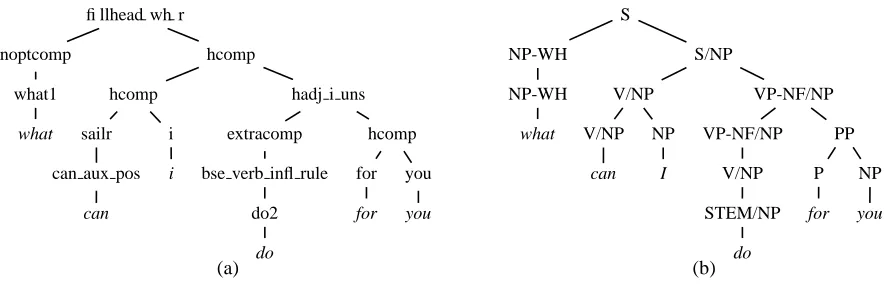
For each utterance in Redwoods, analyses licensed by the ERG are enumerated and the correct one, if present, is indicated. Each analysis is represented as a tree that records the grammar rules which were used to derive it. For example, Figure 1a shows the preferred derivation tree, out of three analyses, for what can I do for you?.
Using these trees and the ERG, several different views of analyses can be recovered: phrase structures, semantic interpretations, and elementary dependency graphs. The phrase structures contain detailed HPSG non-terminals but are otherwise of the variety familiar from context-free grammar, as can be seen in Figure 1b.
Unlike most treebanks, Redwoods also provides se-mantic information for utterances. The sese-mantic interpre-tations are expressed using Minimal Recursion Seman-tics (MRS) (Copestake et al., 2001), which provides the means to represent interpretations with a flat, underspec-ified semantics using terms of the predicate calculus and generalized quantifiers. An example MRS structure is given in Figure 2.
An elementary dependency graph is a simplified ab-straction on a full MRS structure which uses no
under-specification and retains only the major semantic predi-cates and their relations to one another.
In this paper, we report results using the third growth of Redwoods, which contains 5302 sentences for which there are at least two parses and for which a unique pre-ferred parse is identified. These sentences have 9.3 words and 58.0 parses on average. Due to the small size of Red-woods and the underlying complexity of the system, ex-ploring the effect of AL techniques for this domain is of practical, as well as theoretical, interest.
2.2 Modeling parse selection
As is now standard for feature-based grammars, we use log-linear models for parse selection (Johnson et al., 1999). Log-linear models are popular for their ability to incorporate a wide variety of features without making as-sumptions about their independence.1
For log-linear models, the conditional probability of an analysis given a sentence with a set of analyses
is given as:
!#"%$'&
!
(*)
!
+,
-(1)
where&
!
( returns the number of times feature. occurs
in analysis ,)
!
is a weight,+/
- is a normalization
fac-tor for the sentence, and is a model. The parse with
the highest probability is taken as the preferred parse for the model. We use the limited memory variable metric algorithm (Malouf, 2002) to determine the weights. Note that because the ERG usually only produces relatively few parses for in-coverage sentences, we can simply enu-merate all parses and rank them.
The previous parse selection model (equation 1) uses a single model. It is possible to improve performance using an ensemble parse selection model. We create our ensem-ble model (called a product model) using the
product-of-experts formulation (Hinton, 1999):
$
0123
4
15
"6$
0
5
+/
-(2)
Note that each individual model
5
is a well-defined dis-tribution and is usually taken from a fixed set of mod-els. +,
7 is a normalization factor to ensure the product
distribution sums to one over the set of possible parses. A product model effectively averages the contributions made by each of the individual models. Our product model, although simple, is sufficient to show enhanced performance when using multiple models. Of course, other ensemble techniques could be used instead.
1
fillhead wh r
noptcomp
what1
what
hcomp
hcomp
sailr
can aux pos
can
i
i
hadj i uns
extracomp
bse verb infl rule
do2
do
hcomp
for
for
you
you
S
NP-WH
NP-WH
what
S/NP
V/NP
V/NP
can
NP
I
VP-NF/NP
VP-NF/NP
V/NP
STEM/NP
do
PP
P
for
NP
you
[image:3.612.77.522.68.210.2](a) (b)
Figure 1: Example ERG derivation tree (a) and phrase structure tree (b).
:which rel(BV:,RESTR:
,SCOPE:
,DIM:),
:can rel(EVENT: ,ARG: ,ARG4:
,DIM:
),
:def rel(BV:
,RESTR:
,SCOPE:
,DIM:
), :def rel(BV: ,RESTR: ,SCOPE:
,DIM:
),
:do rel(EVENT:
,ARG:
,ARG1:
,ARG3: ,ARG4: ,DIM:
),
:int rel(SOA:
),
:thing rel(INST: )
:for rel(EVENT: ,ARG: ,ARG3: ,DIM: ), :pron rel(INST: ),
:pron rel(INST:
)! , "$#&%'(%$)$#&%'%$)$#&%'(%$*) #&%'(%
" #&%'(%$
!+
Figure 2: MRS structure for the sentence what can I do for you? The label of the entire structure is,
$
and the main event index is
-. These are followed by a list of elementary predications, each of which is preceded by a label that allows it to be related to other predications. The final list is a set of constraints on how labels may be equated.
2.3 Three feature sets
Utilizing the various structures made available by Red-woods – derivation trees, phrase structures, MRS struc-tures, and elementary dependency graphs – we create three distinct feature sets – configurational, ngram, and
conglomerate. These three feature sets are used to train
log-linear models. They incorporate different aspects of the parse selection task and so have different properties. This is crucial for creating diverse models for use in prod-uct ensembles as well as for the ensemble-based AL al-gorithms discussed in 4.
The configurational feature set is based on the deriva-tion tree features described by Toutanova etal. (2003) and takes into account parent, grandparent, and sibling relationships among the nodes of the trees (such as that given in Figure 1(a)). The ngram set, described by Baldridge and Osborne (2003), also uses derivation trees; however, it uses a linearized representation of trees to create ngrams over the tree nodes. This feature creation strategy encodes many (but not all) of the relationships in the configurational set, and also captures some additional long-distance relationships.
The conglomerate feature set uses a mixture of fea-tures gleaned from phrase strucfea-tures, MRS strucfea-tures, and elementary dependency graphs. Each of these rep-resentations contains less information than that provided by derivation trees, but together they provide a different and comprehensive view on the ERG semantic analyses. The features contributed by phrase structures are simply
ngrams of the kind described above for derivation trees. The features drawn from the MRS structures and elemen-tary dependency graphs capture various dominance and co-occurrence relationships between nodes in the struc-tures, as well as some global characteristics such as how many predications and nodes they contain.
2.4 Parse selection performance
Parse selection accuracy is measured using exact match, so a model is awarded a point if it picks some parse for a sentence and that parse is the correct analysis indicated in Redwoods. To deal with ties, the accuracy is given as
./10
when a model ranks0
parses highest and the best parse is one of them.
Using the configurational, ngram, and conglomerate feature sets described in section 2.3, we create three log-linear models, which we will refer to asLL-CONFIG,LL
-NGRAM, andLL-CONGLOM, respectively. We also create
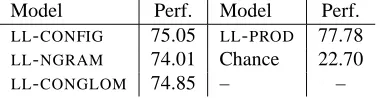
an ensemble model (called LL-PROD) with them using equation 2. The results for a chance baseline (selecting a parse at random), each of the three base models, and
LL-PRODare given in Table 1. These are 10-fold cross-validation results, using all the training data when esti-mating models and the test split when evaluating them.
Model Perf. Model Perf.
LL-CONFIG 75.05 LL-PROD 77.78
LL-NGRAM 74.01 Chance 22.70
[image:4.612.92.284.72.121.2]LL-CONGLOM 74.85 – –
Table 1: Parse selection accuracy.
of the best single model by.
.
2
Redwoods is different from other treebanks in that the treebank itself changes as the ERG is improved. LL
-PROD’s accuracy of 77.78% is the highest reported per-formance on version 3 of Redwoods. Results have also been presented for versions 1 (Baldridge and Osborne, 2003) and 1.5 (Oepen et al., 2002; Toutanova et al., 2003), both of which have considerably less ambiguity than version 3. Accordingly, LL-PROD’s accuracy in-creases to 84.23% when tested on version 1.5, which has 3834 ambiguous sentences with an average length of 7.98 and average ambiguity of 11.05.
3
Measuring annotation cost
When evaluating AL methods, we compare methods based on two metrics: the absolute number of sentences they select (unit cost) and the summed number of deci-sions needed to select an individual preferred parse from a set of possible parses (discriminant cost). Unit cost is commonly used in AL research (Tang et al., 2002), but discriminant cost is more fine-grained.3
Discriminant cost works as follows. Annotation for Redwoods does not consist of actually drawing parse trees, and instead involves picking the correct parse out those produced by the ERG. To facilitate this task, Red-woods presents local discriminants which disambiguate large portions of the parse forest. This means that the annotator does not need to inspect all parses when spec-ifying the intended analysis and so possible parses are narrowed down quickly even for sentences with a large number of parses. More interestingly, it means that the la-beling burden is relative to the number of possible parses rather than the number of constituents in a parse. The dis-criminant cost of the examples we use averages 3.34 per sentence and ranges from 1 to 14.
We measure the discriminant cost of annotating a sen-tence as the number of discriminants whose values were
set by the human annotators in labeling that sentence in
2
The product model is also better than a single model which uses all of the features of LL-CONFIG, LL-NGRAM, and LL-CONGLOM. The accuracy of the latter is 76.75%, so we achieve a 4.3% error reduction over this by using the product model.
3
Hwa (2000) measured the number of constituents in a parse tree as another annotation cost. Our approach measures the cost of a more efficient labelling strategy than Hwa’s (tree drawing).
Redwoods plus one to reflect the final decision of select-ing the preferred parse from the reduced parse forest.
Although we have not measured the cognitive burden on humans, we strongly believe that simply selecting the best parse is far more efficient than drawing the best parse for some sentence (as exemplified by Hwa (2000)). How-ever, an interesting tension here is that we are committed to the ERG producing the intended parse within the set of analyses. When drawing a parse tree, by definition, the best parse is created. This may not be always true when using a manually written grammar such as the ERG.
4
Active learning methods
Suppose we have a set of examples and labels 1
$
$
which is to be extended with a
new labeled example
5
5
. The information gain for some model is maximized after selecting, labeling, and adding a new example
5
to 1 such that the noise
level of
5
is low and both the bias and variance of some model using1
5
5
is minimized (Cohn et al., 1995). If examples are selected for labeling using a strat-egy of minimizing either variance or bias, then typically, the error rate of a model decreases much faster than if examples are simply selected randomly for labeling.
In reality, selecting data points for labeling such that a model’s variance and/or bias is maximally minimized is computationally intractable, so approximations are typi-cally used instead. Ensemble methods can improve the performance of our active learners. An ensemble active learner uses more than one component model. For exam-ple, query-by-committee is an ensemble AL method, as is our generalization of uncertainty sampling.
In this section, we describe the AL methods that we tested on Redwoods, which include both single-model and ensemble-based AL techniques. Our single-method approaches are not meant to be exhaustive. In princi-ple, there is no reason why we could not have also tried (within a kernel-based environment) selecting examples by their distance to a separating hyperplane (Tong and Koller, 2000) or else using the computationally demand-ing approach of Roy and McCallum (2001).
AL for parse selection is potentially problematic as sentences vary both in length and the number of parses they have. After experimenting with, and without, a va-riety of normalization strategies, we found that generally, there were no major differences overall. All of our meth-ods therefore do not have any extra normalization.
In all our methods, denotes the set of analyses
pro-duced by the ERG for the sentence and is some
model. is the set of models
$
1 .
4.1 Uncertainty sampling
of parses of a given sentence, based on the conditional distribution it assigns to them. Following Hwa, we use the following measure to quantify uncertainty:
&
# 0
0
(3)
Higher values of &
( 0 indicate examples on
which the learner is most uncertain and thus presumably are more informative. Calculating& is trivial with the
conditional log-linear models described in section 2.2. Uncertainty sampling as defined above is a single-model approach. It can be generalized to an ensemble by simply replacing the probability of a single log-linear model with a product probability:
&
(
(4)
4.2 Fixed Query-by-Committee
Another AL method is inspired by the
query-by-committee (QBC) algorithm (Freund et al., 1997;
Argamon-Engelson and Dagan, 1999). According to QBC, one should select data points when a group of mod-els cannot agree as to the predicted labeling.
Using a fixed committee consisting of distinct
mod-els, the examples we select for annotation are those for which the models most disagree on the preferred parse. One way of measuring this is with vote entropy (Argamon-Engelson and Dagan, 1999):4
&
#
.
log min
7'
log
7
(5)
where
0- is the number of committee members that
preferred parse . QBC is inherently an ensemble-based method. We use a fixed set of models in our committee and refer to the resulting sample selection method as fixed
QBC. Clearly there are many other possibilities for
cre-ating our ensemble, such as sampling from the set of all possible models.
4.3 Lowest best probability selection
Uncertainty sampling considers the overall shape of a distribution to determine how confident a model is for a given example. A radically simpler way of determin-ing the potential informativity of an example is simply to consider the absolute probability of the most highly
4
We experimented with Kullback-Leibler divergence to the
mean (Pereira et al., 1993; McCallum and Nigam, 1998), but it
performed no better than the simpler vote entropy metric.
ranked parse. The smaller this probability, the less confi-dent the model is for that example and the more useful it will be to know its true label.
We call this new method lowest best probability (LBP) selection, and calculate it as follows:
&
( max
(6)
LBP can be extended for use with an ensemble model in the same manner as uncertainty sampling (that is, re-place the single model probability with a product).
5
Experiments
To test the effectiveness of the various AL strategies dis-cussed in the previous section, we perform simulation studies of annotating version 3 of Redwoods.
For all experiments, we used a tenfold cross-validation strategy by randomly selecting .
(roughly 500
sen-tences) from Redwoods for the test set and selecting sam-ples from the remaining of the corpus (roughly!#"
sentences) as training material. Each run of AL begins with a single randomly chosen annotated seed sentence. At each round, new examples are selected for annotation from a randomly chosen, fixed sized" sentence subset
according to the method until the annotated training ma-terial made available to the learners contains at least$
examples and discriminants.
5 We select
$
exam-ples for manual annotation at each round, and exclude all examples that have more than 500 parses. Other parame-ter settings did not produce substantially different results to those reported here.
AL results are usually presented in terms of the amount of labeling necessary to achieve given performance lev-els. We say that one method is better than another method if, for a given performance level, less annotation is re-quired. The performance metric used here is parse selec-tion accuracy as described in secselec-tion 2.4.
5.1 Baseline results
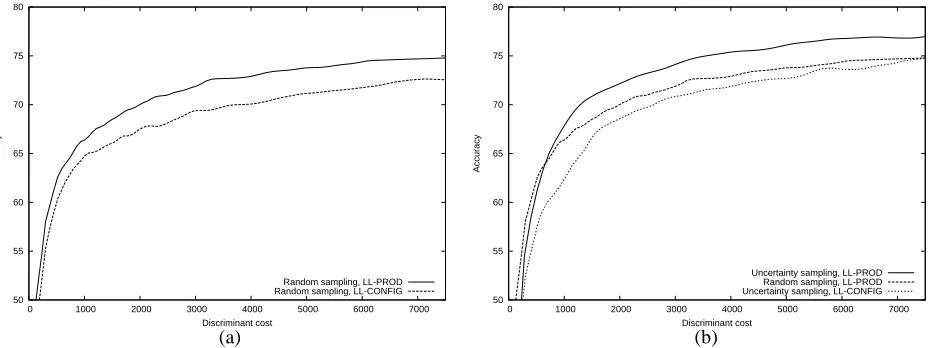
Frequently, baseline results are those produced by ran-dom sampling for a single model. Figure 3a shows a set of baseline results: LL-CONFIG (the best single model) using random sampling and the stronger baseline result ofLL-PROD, also using random sampling. Quite clearly, we see thatLL-PROD(which uses all three feature sets) outperformsLL-CONFIG. Although not shown,LL-PROD
also outperformsLL-NGRAMandLL-CONGLOMtrained using random sampling. These results show that the com-mon practice in AL of only reporting the convergence re-sults of a single model, trained using random sampling, can be misleading: we can improve upon the performance
5
50 55 60 65 70 75 80
0 1000 2000 3000 4000 5000 6000 7000
Accuracy
Discriminant cost
Random sampling, LL-PROD Random sampling, LL-CONFIG
50 55 60 65 70 75 80
0 1000 2000 3000 4000 5000 6000 7000
Accuracy
Discriminant cost
Uncertainty sampling, LL-PROD Random sampling, LL-PROD Uncertainty sampling, LL-CONFIG
[image:6.612.76.540.74.248.2](a) (b)
Figure 3: Accuracy as more annotation decisions are requested according to (a) random sampling withLL-CONFIG
andLL-PROD, and (b) uncertainty sampling withLL-CONFIGandLL-PRODand random sampling withLL-PROD.
of a single model without using AL by using an ensemble model. Our main baseline system is thereforeLL-PROD, trained progressively with randomly sampled examples.
5.2 Ensemble active learning results
Figure 3b compares uncertainty sampling using LL
-CONFIG (the lower curve), random sampling usingLL
-PROD, and uncertainty sampling usingLL-PROD. The first thing to note is that random sampling for the ensemble outperforms uncertainty sampling for the sin-gle model. This shows that sinsin-gle model AL results can themselves be beaten by a model that does not use AL. Nonetheless, the graph also shows that an ensemble parse selection model using an ensemble AL method outper-forms an ensemble parse selection model not using AL.
Table 2 shows the amount of labeling (as measured us-ing our discriminant cost function) selected by some AL method necessary to achieve a given performance level. The top two methods are random baselines; the third method is uncertainty sampling using a single model, while the remaining three other methods are all ensemble active learners. There, and in the following text, labels of the form rand-config mean (in this case) using ran-dom sampling forLL-CONFIG; labels of the form rand-mean (again in this case) random sampling forLL-PROD; the legend QBC means using query-by-committee, with all three base models, when selecting examples forLL
-PROD.
All three ensemble AL methods – product uncertainty sampling, QBC, and product LBP – provide large gains over random sampling (of all kinds). There is very little to distinguish the three methods, though product uncer-tainty sampling proves the strongest overall, providing a 53.6% reduction over rand- to achieve 77% accuracy and a 73.5% reduction over rand-config to reach 75%
ac-curacy.
To understand whether product uncertainty is indeed choosing more wisely, it is important to consider the per-formance of an ensemble parse selection model when ex-amples are chosen by a single-model AL method. That is, using a single-model AL method, but labeling ex-amples using an ensemble model. If the ensemble AL method using the ensemble parse selection model per-forms equally to a single-model AL method also using an ensemble parse selection model, then the ensemble parse selection model would be responsible for improved per-formance. This contrasts with our ensemble AL method instead selecting more informative examples. We find that, as expected, selecting examples usingLL-CONFIG
forLL-PRODis worse thanLL-PRODselecting for itself.
5.3 Simple selection metrics
Since sentences have variable length and ambiguity, there are four obvious selection metrics that make no use of AL methods: select sentences that are longer, shorter, more ambiguous or less ambiguous. We tested all four with
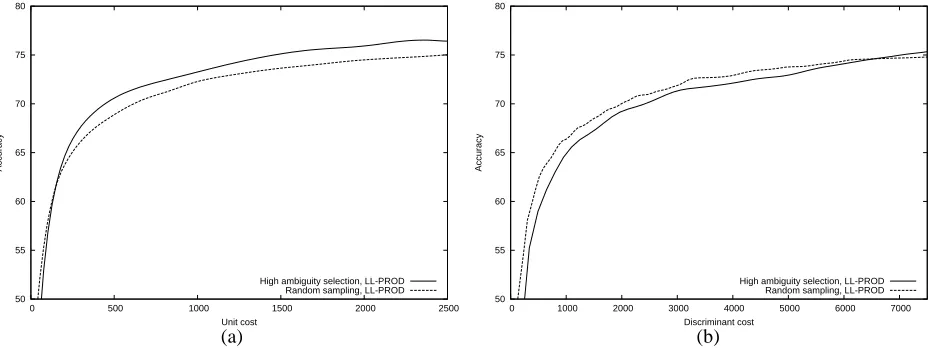
LL-PROD and found none which improved on random sampling with the same model. For example, selecting the least ambiguous sentences performs the worst of all experiments we ran, with selection by shortest sentences close behind, respectively requiring 61.9% and 55.4%
increases in discriminant cost over random sampling to
reach 70% accuracy.
70% 75% 77%
Reduction Reduction Reduction
Cost rand-config rand- Cost rand-config rand- Cost
rand-rand-config 3700 N/A (46.2%) 13000 N/A (36.2%) N/A N/A
rand- 1990 46.2% N/A 8300 36.2% N/A 13800 N/A
us-config 2600 29.7% (25.2%) 7700 40.8% 7.2% N/A N/A
qbc 1300 64.9% 34.7% 3820 70.6% 54.0% 6780 50.9%
lbp- 1280 65.4% 35.7% 3660 71.9% 55.9% 7320 47.0%
[image:7.612.95.518.70.181.2]us- 1300 64.9% 34.7% 3450 73.5% 58.4% 6410 53.6%
Table 2: Discriminant costs required for selection methods to reach 70%, 75%, and 77% accuracy. The reduction columns give the percentage reduction in cost compared toLL-CONFIGandLL-PRODusing random sampling.
50 55 60 65 70 75 80
0 500 1000 1500 2000 2500
Accuracy
Unit cost
High ambiguity selection, LL-PROD Random sampling, LL-PROD
50 55 60 65 70 75 80
0 1000 2000 3000 4000 5000 6000 7000
Accuracy
Discriminant cost
High ambiguity selection, LL-PROD Random sampling, LL-PROD
(a) (b)
Figure 4: Comparison of cost metrics for selection by ambiguity forLL-PROD: (a) unit cost and (b) discriminant cost.
It is also important to consider sequential selection, a default strategy typically adopted by annotators. This was the worst of all AL methods, requiring an increase of 45.5% in discriminant cost over random sampling. This is most likely because the four sections of Redwoods come from two slightly different domains: appointment scheduling and travel planning dialogs. Because of this, sequential selection does not choose examples from the latter domain until all those from the former have been selected, and it thus lacks examples that are similar to those in the test set from the latter domain.
6
Related work
There is a large body of AL work in the machine learn-ing literature, but less so within natural language pro-cessing. There is even less work on ensemble-based AL. Baram et al. (2003) consider selection of individual AL methods at run-time. However, their AL methods are only ever based on single model approaches.
Turning to parsing, most work has utilized uncertainty sampling (Thompson et al., 1999; Hwa, 2000; Tang et al., 2002). In all cases, relatively simple parsers were
boot-strapped, and also, comparison was with a single model, trained using random sampling. As we pointed out ear-lier, our product model, not using AL, can outperform single-model active learning.
Baldridge and Osborne (2003) also applied AL to Red-woods. They only used two feature sets, did not consider product models, nor our simple LBP method. Addition-ally, they used the unit cost assumption.
Hwa et al. (2003) showed that for parsers, AL outper-forms the closely related co-training, and that some of the labeling could be automated. However, their approach re-quires strict independence assumptions.
7
Discussion
We have shown that simple ensemble models can help both the underlying model and the AL method. Using a state-of-the-art parse selection model, we are able to achieve a decrease in annotation costs compared
[image:7.612.75.540.232.406.2]greater savings might follow when using more complex mode combination techniques such as boosting.
We expect our parse selection-specific results to im-prove if we present only the top most highly ranked
parses to the annotator, rather than the full set of parses. Provided the true best parse is within the top with
suf-ficient regularity, this would reduce the number of dis-criminants which the human annotator needs to consider when compared to unaided uncertainty sampling.
Another issue we will explore in future work is that for a scenario in which we label a data set from scratch, it is quite possible that we will not know how best to model the task we are labeling that data for. Thus, it is likely in such situations that we will be able to develop better evolved models only after the data is annotated and more has been learned about the task. It is then necessary to see whether improved models benefit from the examples selected using AL techniques with an earlier model more than they would have if random sampling had been used.
Acknowledgements
We would like to thank Markus Becker, Steve Clark, and the anonymous reviewers for their comments. Jeremiah Crim developed some of the feature extraction code and conglomerate features, and Alex Lascarides made suggestions for the semantic features. This work was supported by Edinburgh-Stanford Link R36763, ROSIE project.
References
Shlomo Argamon-Engelson and Ido Dagan. 1999. Committee-based sample selection for probabilistic classifiers. Journal
of Artificial Intelligence Research, 11:335–360.
Jason Baldridge and Miles Osborne. 2003. Active learning for HPSG parse selection. In Proc. of the 7th Conference on
Natural Language Learning, Edmonton, Canada.
Y. Baram, R. El-Yaniv, and K. Luz. 2003. Online choice of active learning algorithms. In Proc. of ICML-2003, pages 19–26, Washington.
David A. Cohn, Zoubin Ghahramani, and Michael I. Jordan. 1995. Active learning with statistical models. In G. Tesauro, D. Touretzky, and T. Leen, editors, Advances in Neural
Infor-mation Processing Systems, volume 7, pages 705–712. The
MIT Press.
Ann Copestake, Alex Lascarides, and Dan Flickinger. 2001. An algebra for semantic construction in constraint-based grammars. In Proc. of the 39th Annual Meeting of the ACL, pages 132–139, Toulouse, France.
Dan Flickinger. 2000. On building a more efficient grammar by exploiting types. Natural Language Engineering, 6(1):15– 28. Special Issue on Efficient Processing with HPSG.
Yoav Freund, H. Sebastian Seung, Eli Shamir, and Naftali Tishby. 1997. Selective sampling using the query by com-mittee algorithm. Machine Learning, 28(2-3):133–168.
G. E. Hinton. 1999. Products of experts. In Proc. of the 9th Int.
Conf. on Artificial Neural Networks, pages 1–6.
Rebecca Hwa, Miles Osborne, Anoop Sarkar, and Mark Steed-man. 2003. Corrected Co-training for Statistical Parsers. In
Proceedings of the ICML Workshop “The Continuum from Labeled to Unlabeled Data”, pages 95–102. ICML-03.
Rebecca Hwa. 2000. Sample selection for statistical grammar induction. In Proc. of the 2000 Joint SIGDAT Conference on
EMNLP and VLC, pages 45–52, Hong Kong, China, October.
Mark Johnson, Stuart Geman, Stephen Cannon, Zhiyi Chi, and Stephan Riezler. 1999. Estimators for Stochastic “Unification-Based” Grammars. In 37th Annual Meeting of
the ACL.
Robert Malouf. 2002. A comparison of algorithms for max-imum entropy parameter estimation. In Proc. of the Sixth
Workshop on Natural Language Learning, pages 49–55,
Taipei, Taiwan.
Andrew McCallum and Kamal Nigam. 1998. Employing EM and pool-based active learning for text classification. In
Proc. of the International Conference on Machine Learning.
Stephan Oepen, Kristina Toutanova, Stuart Shieber, Christopher Manning, Dan Flickinger, and Thorsten Brants. 2002. The LinGO Redwoods Treebank: Motivation and preliminary ap-plications. In Proc. of the 19th International Conference on
Computational Linguistics, Taipei, Taiwan.
Fernando Pereira, Naftali Tishby, and Lillian Lee. 1993. Distri-butional clustering of English words. In Proc. of the Annual
Meeting of the ACL.
Nicholas Roy and Andrew McCallum. 2001. Toward optimal active learning through sampling estimation of error reduc-tion. In Proc. 18th International Conf. on Machine Learning, pages 441–448. Morgan Kaufmann, San Francisco, CA.
H. S. Seung, Manfred Opper, and Haim Sompolinsky. 1992. Query by committee. In Computational Learning Theory, pages 287–294.
Min Tang, Xiaoqiang Luo, and Salim Roukos. 2002. Ac-tive Learning for Statistical Natural Language Parsing. In
Proc. of the
Annual Meeting of the ACL, pages 120–
127, Philadelphia, Pennsylvania, USA, July.
Cynthia A. Thompson, Mary Elaine Califf, and Raymond J. Mooney. 1999. Active learning for natural language pars-ing and information extraction. In Proc. 16th International
Conf. on Machine Learning, pages 406–414. Morgan
Kauf-mann, San Francisco, CA.
Simon Tong and Daphne Koller. 2000. Support vector machine active learning with applications to text classification. In Pat Langley, editor, Proc. of ICML-00, 17th International
Con-ference on Machine Learning, pages 999–1006, Stanford,
US. Morgan Kaufmann Publishers, San Francisco, US.
Kristina Toutanova, Mark Mitchell, and Christopher Manning. 2003. Optimizing local probability models for statistical parsing. In Proc. of 14th European Conf. on Machine