Original Article
Elevated serum levels of fibroblast growth factor 21
from patients with nephrolithiasis
Yong Guo1, Jianwei Qu2, Yongheng Bai3, Peng Xia1, Xianbin Sun1, Bicheng Chen3, Cunzao Wu1
1Transplantation Centre, 3Wenzhou Key Laboratory of Surgery, The First Affiliated Hospital, Wenzhou Medical University, Wenzhou, China; 2Wenzhou Medical University, Wenzhou, China
Received February 12, 2016; Accepted November 15, 2016; Epub October 15, 2017; Published October 30, 2017
Abstract: Objectives: It was aimed to detect serum fibroblast growth factor-21 (FGF-21) levels among patients with nephrolithiasis and healthy control, and to identify whether FGF-21 is disease-correlated. Methods: Serum
con-centrations of total FGF-21 were determined by enzyme-associated immunosorbent assay in 60 participants with nephrolithiasis from our unit and 50 non-nephrolithiasis normal control from the general health examination center. Renal failure, chronic urinary tract infection, renal tubular acidosis, cancer, chronic diarrhea, diabetes and gout were totally excluded. Results: It was shown that FGF-21 levels were obviously higher in the serum of the patients with nephrolithiasis, compared with that in the healthy individuals. Serum levels of FGF-21 were obviously inversely re
-lated to renal function parameter while it positively corre-lated with serum C-reactive protein (CRP) and interleukin-6.
By univariate analysis, it was shown that FGF-21 was obviously and proportionally related to serum creatinine, age, triglycerides, CRP; and negatively correlated with blood pressure, HDL cholesterol and LDL cholesterol. Conclusions:
Taken all factors into consideration, the consequence showed that circulating levels of FGF-21 elevated in patients with nephrolithiasis. The pathophysiological significance of the study required further investigation.
Keywords: Nephrolithiasis, fibroblast growth factor-21, ELISA, inflammation, renal function
Introduction
Nephrolithiasis is a condition which refers to the progress of stones in peoples’ kidney; it is believed to be a popular disease in the world that almost 8% population is afflicted with it [1]. The exact cause and etiology of nephrolithiasis remained unclear. The risk factors for develop -ing nephrolithiasis comprise of sex, genetics, geography, age, diet, seasonal factors and jobs [2]. There is no specific forecasted sign for the illness which come on the scene and many patients are diagnosed late after marked symp -toms such as renal colic and hematuria appear. A trustworthy sign showing nephrolithiasis which may predict previous diagnosing, cure or effective supervision is greatly demanded.
One of the underlying mechanisms of metabol-ic disorders in the etiology of nephrolithiasis have been recently proposed however not clari-fied [3]. Fibroblast growth factor-21 (FGF-21) is considered as a part of FGF big group, consi- sting of FGF-19, FGF-21, and FGF-23. FGF-21 is
a hormone mainly produced by white adipose tissue and the liver, where it is in part induced by peroxisome proliferator-activated receptor gamma (PPARg) and the peroxisome prolifera-tor-activated receptor alpha (PPARa) respec-tively [4, 5]. Recently, literature reported that inflammation, infection, malignancy and trau-ma could to some degree lead to acute phase response (APR), which is believed to be caused by alterations in hepatic protein synthesis. This would lead to changes to the specific serum proteins. The common APR included C-reactive protein, serum amyloid A as well as apolipopro-tein A1 [6].
coro-nary heart disease while comparing with the healthy people [8]. In the latest meta-study demonstrated that there is an increasing dan-ger of coronary heart disease in the sick that are diagnosed with kidney stones before [9]. In addition, Chavez AO revealed that there was ris-ing FGF-21 serum levels among the sick who suffer from type 2 diabetes mellitus while com-paring with healthy people [10]. Seen together, FGF-21 is likely to be a very important adipo-kine. Nevertheless, the precise mechanisms of FGF-21 upregulation among the human beings are still unsure. To date, there was no research which has specifically study the metabolite-related cytokines & adipokines among the sick of nephrolithiasis. So in terms of this research, it will compare the serum levels of FGF-21 among the sick with nephrolithiasis and con-trolled health people.
Methods
Patients
This study is carried out from July 2011 to September 2012 in the 1st affiliated hospital to Wenzhou Medical University. We selected the patients who were diagnosed with nephrolithia-sis in radiography and ultrasonography during the period. It was shown that so special case was discovered with radiolucent stones through the ways of X-ray or cystine, or uric acid stones by the means of medical examination. If through the approaches of surgery, the stone speci -mens could be moved or gained through shock-wave lithotripsy or medical treatment, and the stones components could be testified through the means of infrared spectroscopy [11]. All patients had been followed every two months for at least 12 months. And renal function was assessed at every visit. Clinical data included serum creatinine and urine routine were deter-mined by the responsible physicians and not affected by the study. All physicians were blind -ed from the results of measurements.
In the process, it randomly chose normal con-trols among the patients who had received health examination in this hospital almost in the same time. There was premise that the con-trolled patients were deprived of nephrolithia -sis before and had no history of stones which were detected by X-ray or other methods such as abdominal ultrasound. It made sure that all subjects would be excluded if they once were
diagnosed with renal failure, gout, chronic uri -nary tract infection, autoimmune diseases, renal tubular acidosis, chronic diarrhea, first and secondary hyperparathyroidism, diabetes as well cancer. And they were excluded the his-tory of inflammahis-tory disorders and recent inflammations. In addition, all participants lived in Zhejiang Province. The Institutional Review Board in the 1st affiliated hospital to Wenzhou Medicine University also authorized this research, and researchers collected the infor -mation with the permission of patients.
Samples collection and detection
The researched collected blood samples from the participants with their permission in advance. Through the means of venous punc -ture in healthy volunteers or arterial catheter, 20 milliliters of heparinized blood were ab-stracted from each participant. Serum FGF-21 concentrations could be gauged through a mer-chant ELISA Kit, under the guidance of instruc -tions. C-reactive protein (CRP), interleukin 6, as well as glucose had been gauged by using nor-mative approached by the central laboratory of Wenzhou medical university 1st affiliated hospital.
C-reactive protein (CRP), Serum standards from the fasting blood glucose, low-density lipopro -tein cholesterol (LDL-c), triglycerides (TG) as well as high-density lipoprotein cholesterol (HDL-c) were gauged through standard labora-tory approaches in a qualified laboralabora-tory. When the overnight fasting was done, researched col -lected blood samples from the participants. TC and TG proportions were confirmed by the means of CHOP-PAP and GPO-PAP approaches. The selective solubilization approach (LDL-c test kit, Kyowa Medex, Tokyo) was used to ana -lyze the concentration of LDL-c, and a similar approach was employed to determine the con-centration of HDL-c (Determiner L HDL, Kyowa Medex).
(mL/min/1.73 m2)=194 × Cr-1.094 × age-0.287 × 0.739 (2) in females.
Statistical analysis
Enumeration data were given as mean ± stan-dard deviation. Statistical Package for Social Science version 19.0 (SPSS, Inc., Chicago, IL, USA) was adopted to make analysis of all data. Intergroup comparisons for medical values had been evaluated by the means of unpaired Student’s t-test, while intergroup comparisons
This research included 60 nephrolithiasis patients and 50 normal healthy people in the control group. The demographic parameters were listed in Table 1. It showed no obvious dif -ference on mean age between patients in nephrolithiasis group or controlled group (P>0.05) (See Table 1). In order to exclude the possible consequence caused by diabetes, in both groups we have excluded diabetes patients. So there is no diabetes in nephrolithi-asis group or healthy control. Urine detection were performed in all patients, and pre-existed urinary infection candidates were excluded either.
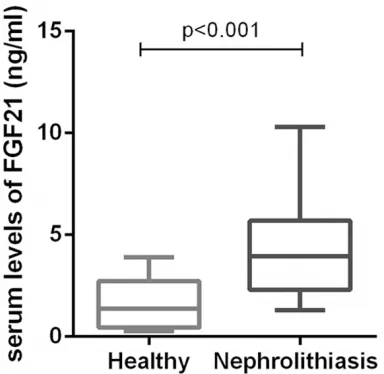
To date, no reliable study has validated the FGF-21 expression in the cohort of nephrolithi -asis patients, so we used median and inter-quartile range (IQR) for the others to quantify the expression profile of FGF-21. As compared to healthy control, the serum FGF-21 levels were significantly higher in nephrolithiasis patients (3.83, IQR 2.55 to 8.29) versus 1.67, IQR 0.43 to 3.24, P<0.01 (Figure 1).
Correlations between serum FGF21 levels and
some laboratory parameters
[image:3.612.88.383.97.279.2]50 healthy volunteers provided us the plasma samples for detection of FGF21; we analyzed the correlations between serum FGF21 levels and renal function parameter, estimated glo -merular filtration (eGFR) and inflammatory Table 1. Clinical characteristics of patients with nephrolithiasis and
healthy volunteers, Data are shown as means ± SD
Characteristics Nephrolithiasis group Control group P
Number of cases (n) 60 50
Male, n (%) 48 (80.0) 39 (78.0) >0.05 Mean age (years) (mean ± SD) 46.6±9.5 44.4±7.3 0.236 Fasting glucose (mmol/L) 6.0±1.3 5.8±1.4 0.229 Hypertension, n (%) 39 (65.0) 31 (62.0) 1.000 Hyperlipidemia, n (%) 38 (63.3) 31 (62.0) 0.838
Ca2+ 3.2±0.9 2.4±0.2 <0.001
TC (mmol/L) 4.3±1.4 4.1±1.2 0.201
LDL-c (mmol/L) 2.8±0.9 2.6±1.0 0.465
HDL-c (mmol/L) 1.0±0.2 1.0±0.2 0.486
TG (mmol/L) 1.7±1.0 1.5±0.9 0.222
FGF21 (ng/ml) 0.25 (0.16-0.34) 0.14 (0.11-0.20)* <0.001
TC: total cholesterol; TG: triglycerides; HDL-c: high-density lipoprotein cholesterol; LDL-c: low-density lipoprotein cholesterol. *P<0.05, Nephrolithiasis group vs. control group.
Standard BUN 1.8-7.1 mmol/L, standard SCr 59-104 mmol/L.
Figure 1. Serum levels of FGF21 in patients with
nephrolithiasis (n=60) and in normal controls (n=50).
in different categorical vari -ables had been calculated by Chi-square test. In addi -tion, it still adopted the mul-tivariate linear regression analysis which was intro-duced in advance. Among the analysis, parameters that were related obviously to FGF-21 during the analyz-ing process would be com-posed. For instance, gender and age were both con-tained in these multivariate analyses. P-value of <0.05 was regarded as signifi-cant.
Results
[image:3.612.95.287.335.522.2]parameter, Interleukin 6 (IL-6), as well as C-reactive protein (CRP). Serum levels of FGF21 significantly inverses correlates with the eGFR (r=--0.495, P<0.01), whilst serum levels of FGF21 positively correlates with serum CRP (r=0.323, P<0.01) and IL-6 (r=0.209, P<0.001), the details were shown in Figure 2.
Univariate correlations and multivariate re -gression analysis
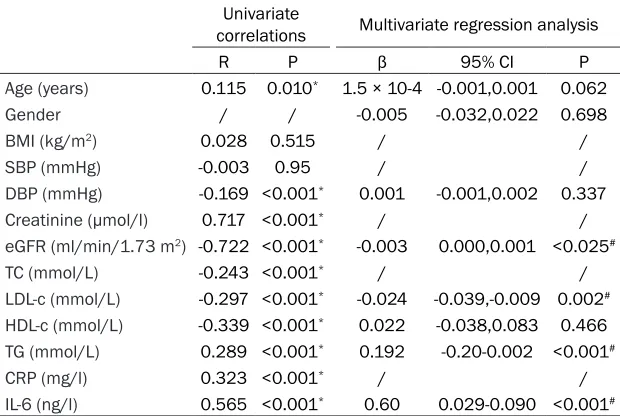
By univariate analysis, it showed that FGF-21 was obviously and actively correlated with serum creatinine, age, CRP, TG, and IL-6 (See Table 2). On the contrary, FGF-21 serum
con-Discussion
[image:4.612.93.524.73.174.2] [image:4.612.87.397.250.458.2]From the present research, it proved at the first time that FGF-21 levels increase among the nephrolithiasis participants while comparing with that of in non-nephrolithiasis control. In addition, it showed that renal responsibility is considered as the best reliable forecaster for FGF-21 among these diseases. Noteworthy, related alterations in FGF-21 are negatively and independently related to the lipid parameters (LDL cholesterol, HDL cholesterol) among the group. It was believed that these findings par -tially proved assumptions that renal excretion is a primary factor which could prevent FGF-21 Figure 2. Relation between serum levels of FGF21 and (A) estimated glomerular filtration (eGFR), (B) CRP and (C) IL-6. Data are compared by Spearman’s rank correlation coefficient.
Table 2. Univariate correlations and multivariate regression analysis with serum FGF-21 in patients with nephrolithiasis
Univariate
correlations Multivariate regression analysis
R P β 95% CI P
Age (years) 0.115 0.010* 1.5 × 10-4 -0.001,0.001 0.062
Gender / / -0.005 -0.032,0.022 0.698
BMI (kg/m2) 0.028 0.515 / /
SBP (mmHg) -0.003 0.95 / /
DBP (mmHg) -0.169 <0.001* 0.001 -0.001,0.002 0.337
Creatinine (μmol/l) 0.717 <0.001* / /
eGFR (ml/min/1.73 m2) -0.722 <0.001* -0.003 0.000,0.001 <0.025#
TC (mmol/L) -0.243 <0.001* / /
LDL-c (mmol/L) -0.297 <0.001* -0.024 -0.039,-0.009 0.002#
HDL-c (mmol/L) -0.339 <0.001* 0.022 -0.038,0.083 0.466
TG (mmol/L) 0.289 <0.001* 0.192 -0.20-0.002 <0.001#
CRP (mg/l) 0.323 <0.001* / /
IL-6 (ng/l) 0.565 <0.001* 0.60 0.029-0.090 <0.001#
Multivariate regression analysis of FGF-21 (dependent variable). adjusted for age and
gender, as well as DBP, eGFR, TG, HDL cholesterol, LDL cholesterol, and IL-6. Non-normally
distributed variables were logarithmically transformed prior to multivariate testing. r- and
P-values, as well as standardized ß-coefficients and P-values, are given. Abbreviations are indicated in Table 1. *indicates significant correlation as assessed by Spearman’s rank cor -relation method. #indicates significant correlation in multivariate analysis. P<0.05.
as obviously associating with eGFR, DBP, HDL cho-lesterol, cholesterol as well as LDL cholesterol (See Table 2).
from circulation, which is accordant with previ -ous literature [13].
It is noteworthy that the parameters of renal function, such as creatinine or eGFR, should be taken into account for all FGF21 related stud -ies. As we reported previously, the etiology of nephrolithiasis is usually accompanied with the deterioration of renal function, since calcium oxalate could induce renal tubular epithelial cells damage, oxidative stress injury, chronic inflammation and eventually, the progressing epithelial-mesenchymal transition, which will contribute to the loss of renal function [14-16]. Lin M demonstrated that significantly elevated FGF-21 levels were found among the sick with severe chronic kidney disease (CKD) when comparing with mild CKD and healthy groups [8]. However, there were no animal studies to elucidate the exact factors cause renal remov -ing of FGF-21 or to calculate the physiological pertinence about growing FGF-21 proportions in chronic or acute renal dysfunction. According to our study, this could be considered as the first report relating FGF21 levels among the nephrolithiasis sufferers.
FGF-21 is believed to be a kind of endocrine factor, hided primarily by the liver, and have positive influence on the lipid homeostasis and glucose [17]. It is indicated to be elevated among participations who suffer from adverse lipid profiles, damaged glucose tolerance, obe -sity, type 2 diabetes mellitus (DM), hyperten-sion, coronary disease and metabolic syn-drome [18, 19]. It was believed that increased serum FGF-21 proportions were related to carotid atherosclerosis among human beings, and independent from the previous danger ele -ments such as adverse lipid profiles and CRP. In our study, FGF-21 indicates a negative link with HDL cholesterol, cholesterol and LDL cho-lesterol, and sustain the assumption that upregulation of FGF-21 is correlated with lipid metabolism disorder in nephrolithiasis pati- ents. As literature reported, management of FGF-21 in diabetic primates gave rise to declin-ing LDL and TG cholesterol levels; and Emanuelli B found that FGF-21-cured fat mice exhibit growing spending on energy, fat use and lipid excretion [20, 21]. From the above, we may assume that the rising circulation FGF-21 in nephrolithiasis patients might function as a compensatory response to adverse metabolic status in the disease. Recently, it is
demon-strated that stimulation for FGF-21 signaling pathways and FGF-2 intercede previous gene record is damaged among the fat mice model [22]; and interestingly, the mean Body Mass Index (BMI) in nephrolithiasis patients is higher than healthy control, regardless of no stati-stical significance. However, latest literature reported by Sancak EB, diabetes mellitus, hypertension and increased BMI may add to the possibility of stone formation, which is in accordant with our data [23].
In nephrolithiasis patients, FGF-21 correlates actively and separately with TG and CRP; it is similar to some other reports [24]. A previous study showed that FGF-21 improves LDL-receptor performance among cultivated human beings hepatocytes, which may lead to the increasing of lipoprotein obtained during the process [25]. Nevertheless, we need to pay attention to that some statistics in other patient cohort show a positive association between LDL cholesterol and FGF-21 standards which is in the contrary with our findings in the study [26]. Differences in participant features such as renal obligation, age, ethnicity, gender, as well as phenotyping might give an explanation to these differences.
It has to admit that there exist restrictions of our study that required to be issued. First of all, the researched adopted a cross-sectional design to ensure the nephrolithiasis patients, so causality cannot be established. In fact, the nephrolithiasis patients include calcium oxa-late nephrolithiasis, phosphate nephrolithiasis, cysteine nephrolithiasis, and uric acid nephroli-thiasis, etc, so we should enroll as more pati- ents in the future study as possible. Secondly, more inflammatory elements were not detected and creatinine alteration before and after neph -rolithiasis clearing operation could be written down. Therefore, gaining these statistics might greatly contribute to identify the factors which are hidden among the rising FGF-21 in kidney stone disease.
-sis, however, novel potential therapeutic target and its potential role in modulating inflamma -tion and lipid metabolic dysfunc-tion warrants further investigation.
Acknowledgements
This study was supported by Zhejiang Pro- vincial Natural Science Foundation of Ch-ina (LY12H10004, LY13H030006), Wenzhou Municipal Science and Technology Bureau (Y20160032, Y20160127).
Disclosure of conflict of interest
None.
Address correspondence to: Cunzao Wu, Trans-
plantation Centre, The First Affiliated Hospital,
Wenzhou Medical University, Wenzhou 325014, China. Tel: 55579472; Fax: 0086-577-55579472; E-mail: [email protected]
References
[1] Keddis MT and Rule AD. Nephrolithiasis and
loss of kidney function. Curr Opin Nephrol
Hypertens 2013; 22: 390-396.
[2] Neisius A and Preminger GM. Stones in 2012:
epidemiology, prevention and redefining thera -peutic standards. Nat Rev Urol 2013; 10: 75-77.
[3] Kreydin EI and Eisner BH. Risk factors for sep
-sis after percutaneous renal stone surgery.
Nat Rev Urol 2013; 10: 598-605.
[4] Ye D, Wang Y, Li H, Jia W, Man K, Lo CM, Wang
Y, Lam KS and Xu A. Fibroblast growth factor
21 protects against acetaminophen-induced hepatotoxicity by potentiating peroxisome
pro-liferator-activated receptor coactivator
protein-1alpha-mediated antioxidant capacity in mice. Hepatology 2014; 60: 977-989.
[5] Kim H, Mendez R, Zheng Z, Chang L, Cai J, Zhang R and Zhang K. Liver-enriched
transcrip-tion factor CREBH interacts with peroxisome proliferator-activated receptor alpha to regu -late metabolic hormone FGF21. Endocrinology 2014; 155: 769-782.
[6] Heilbronn LK, Campbell LV, Xu A and
Samocha-Bonet D. Metabolically protective cytokines adiponectin and fibroblast growth factor-21 are increased by acute overfeeding in healthy
humans. PLoS One 2013; 8: e78864.
[7] Cantley J. The control of insulin secretion by adipokines: current evidence for adipocyte-be -ta cell endocrine signalling in me-tabolic ho-meostasis. Mamm Genome 2014; 25: 442-454.
[8] Lin Z, Wu Z, Yin X, Liu Y, Yan X, Lin S, Xiao J,
Wang X, Feng W and Li X. Serum levels of
FGF-21 are increased in coronary heart disease patients and are independently associated
with adverse lipid profile. PLoS One 2010; 5:
e15534.
[9] Liu Y, Li S, Zeng Z, Wang J, Xie L, Li T, He Y, Qin X and Zhao J. Kidney stones and
cardiovascu-lar risk: a meta-analysis of cohort studies. Am
J Kidney Dis 2014; 64: 402-410.
[10] Chavez AO, Molina-Carrion M, Abdul-Ghani MA,
Folli F, Defronzo RA and Tripathy D. Circulating fibroblast growth factor-21 is elevated in im -paired glucose tolerance and type 2 diabetes and correlates with muscle and hepatic insulin resistance. Diabetes Care 2009; 32: 1542-1546.
[11] Miernik A, Eilers Y, Bolwien C, Lambrecht A, Hauschke D, Rebentisch G, Lossin PS, Hesse
A, Rassweiler JJ, Wetterauer U and Schoen-
thaler M. Automated analysis of urinary stone
composition using Raman spectroscopy: pilot
study for the development of a compact por
-table system for immediate postoperative ex
vivo application. J Urol 2013; 190: 1895-1900.
[12] Terami T, Wada J, Inoue K, Nakatsuka A, Ogawa D, Teshigawara S, Murakami K, Katayama A, Eguchi J and Makino H. Urinary angiotensino
-gen is a marker for tubular injuries in patients
with type 2 diabetes. Int J Nephrol Renovasc Dis 2013; 6: 233-240.
[13] Stein S, Bachmann A, Lossner U, Kratzsch J, Bluher M, Stumvoll M and Fasshauer M. Serum
levels of the adipokine FGF21 depend on renal function. Diabetes Care 2009; 32: 126-128. [14] Liu M, Liu YZ, Feng Y, Xu YF, Che JP, Wang GC
and Zheng JH. Novel evidence demonstrates that epithelial-mesenchymal transition
contrib-utes to nephrolithiasis-induced renal fibrosis. J
Surg Res 2013; 182: 146-152.
[15] Sun W, Feng Y, Yao XD, Xu YF, Peng B, Liu M and Zheng JH. Urinary angiotensinogen is ele-vated in patients with nephrolithiasis. Biomed Res Int 2014; 2014: 349602.
[16] Richman K, O’Bell J and Pareek G. The growing prevalence of kidney stones and opportunities for prevention. R I Med J (2013) 2014; 97:
31-34.
[17] Zhang J and Li Y. Fibroblast growth factor 21,
the endocrine FGF pathway and novel
treat-ments for metabolic syndrome. Drug Discov
Today 2014; 19: 579-589.
[18] Domouzoglou EM, Naka KK, Vlahos AP, Papafaklis MI, Michalis LK, Tsatsoulis A and Maratos-Flier E. Fibroblast growth factors in cardiovascular disease: The emerging role of
[19] Andersen B, Omar BA, Rakipovski G, Raun K and Ahren B. Fibroblast growth factor 21 pre
-vents glycemic deterioration in insulin deficient mouse models of diabetes. Eur J Pharmacol
2015; 764: 189-194.
[20] Adams AC, Halstead CA, Hansen BC, Irizarry AR, Martin JA, Myers SR, Reynolds VL, Smith
HW, Wroblewski VJ and Kharitonenkov A.
LY2405319, an Engineered FGF21 Variant,
Improves the Metabolic Status of Diabetic Monkeys. PLoS One 2013; 8: e65763. [21] Emanuelli B, Vienberg SG, Smyth G, Cheng C,
Stanford KI, Arumugam M, Michael MD, Adams AC, Kharitonenkov A and Kahn CR. Interplay
between FGF21 and insulin action in the liver regulates metabolism. J Clin Invest 2014; 124: 515-527.
[22] Gao M, Ma Y, Cui R and Liu D. Hydrodynamic
delivery of FGF21 gene alleviates obesity and fatty liver in mice fed a high-fat diet. J Control
Release 2014; 185: 1-11.
[23] Sancak EB, Resorlu M, Akbas A, Gulpinar MT,
Arslan M and Resorlu B. Do hypertension,
dia-betes mellitus and obesity increase the risk of severity of nephrolithiasis? Pak J Med Sci
2015; 31: 566-571.
[24] Wang J, Liu JH, Zheng B, Zhang M, Wang SP
and Zheng Z. Impact of primary percutaneous coronary intervention on blood perfusion in
nonculprit artery in patients with anterior ST
elevation myocardial infarction. Chin Med J
(Engl) 2013; 126: 22-26.
[25] Do HT, Tselykh TV, Makela J, Ho TH, Olkkonen
VM, Bornhauser BC, Korhonen L, Zelcer N and
Lindholm D. Fibroblast growth factor-21
(FGF21) regulates low-density lipoprotein
re-ceptor (LDLR) levels in cells via the E3-ubiquitin
ligase Mylip/Idol and the Canopy2 (Cnpy2)/
Mylip-interacting saposin-like protein (Msap). J
Biol Chem 2012; 287: 12602-12611.
[26] Lee Y, Park YJ, Ahn HY, Lim JA, Park KU, Choi SH, Park DJ, Oh BC, Jang HC and Yi KH. Plasma
FGF21 levels are increased in patients with
hy-pothyroidism independently of lipid profile.