Towards Improving Abstractive Summarization
via Entailment Generation
Ramakanth Pasunuru Han Guo Mohit Bansal
UNC Chapel Hill
{[email protected], [email protected], [email protected]}
Abstract
Abstractive summarization, the task of rewriting and compressing a document into a short summary, has achieved con-siderable success with neural sequence-to-sequence models. However, these mod-els can still benefit from stronger natu-ral language inference skills, since a cor-rect summary is logically entailed by the input document, i.e., it should not con-tain any contradictory or unrelated infor-mation. We incorporate such knowledge into an abstractive summarization model via multi-task learning, where we share its decoder parameters with those of an en-tailment generation model. We achieve promising initial improvements based on multiple metrics and datasets (including a test-only setting). The domain mis-match between the entailment (captions) and summarization (news) datasets sug-gests that the model is learning some domain-agnostic inference skills.
1 Introduction
Abstractive summarization, the task of rewriting a document into a short summary is a significantly more challenging (and natural) task than extrac-tive summarization, which only involves choos-ing which sentence from the original document to keep or discard in the output summary. Neu-ral sequence-to-sequence models have led to sub-stantial improvements on this task of abstractive summarization, via machine translation inspired encoder-aligner-decoder approaches, further en-hanced via convolutional encoders, pointer-copy mechanisms, and hierarchical attention (Rush et al., 2015; Nallapati et al., 2016; See et al., 2017). Despite these promising recent improvements,
Input Document:may is a pivotal month for moving and storage companies .
Ground-truth Summary:moving companies hit bumps in economic road
Baseline Summary:a month to move storage companies
Multi-task Summary:pivotal month for storage firms Figure 1: Motivating output example from our summarization+entailment multi-task model.
there is still scope in better teaching summariza-tion models about the general natural language inference skill of logical entailment generation. This is because the task of abstractive summa-rization involves two subtasks: salient (important) event detection as well as logical compression, i.e., the summary should not contain any informa-tion that is contradictory or unrelated to the origi-nal document. Current methods have to learn both these skills from the same dataset and a single model. Therefore, there is benefit in learning the latter ability of logical compression via external knowledge from a separate entailment generation task, that will specifically teach the model how to rewrite and compress a sentence such that it logi-cally follows from the original input.
To achieve this, we employ the recent paradigm of sequence-to-sequence multi-task learning (Lu-ong et al., 2016). We share the decoder param-eters of the summarization model with those of the entailment-generation model, so as to generate summaries that are good at both extracting impor-tant facts from as well as being logically entailed by the input document. Fig. 1 shows such an (ac-tual) output example from our model, where it suc-cessfully learns both salient information extraction as well as entailment, unlike the strong baseline model.
Empirically, we report promising initial im-provements over some solid baselines based on several metrics, and on multiple datasets: Giga-word and also a test-only setting of DUC.
tantly, these improvements are achieved despite the fact that the domain of the entailment dataset (image captions) is substantially different from the domain of the summarization datasets (gen-eral news), which suggests that the model is learn-ing certain domain-independent inference skills. Our next steps to this workshop paper include incorporating stronger pointer-based models and employing the new multi-domain entailment cor-pus (Williams et al., 2017).
2 Related Work
Earlier summarization work focused more towards extractive (and compression) based summariza-tion, i.e., selecting which sentences to keep vs discard, and also compressing based on choos-ing grammatically correct sub-sentences havchoos-ing the most important pieces of information (Jing, 2000; Knight and Marcu, 2002; Clarke and Lap-ata, 2008; Filippova et al., 2015). Bigger datasets and neural models have allowed the addressing of the complex reasoning involved in abstractive summarization, i.e., rewriting and compressing the input document into a new summary. Several ad-vances have been made in this direction using ma-chine translation inspired encoder-aligner-decoder models, convolution-based encoders, switching pointer and copy mechanisms, and hierarchical at-tention models (Rush et al., 2015; Nallapati et al., 2016; See et al., 2017).
Recognizing textual entailment (RTE) is the classification task of predicting whether the rela-tionship between a premise and hypothesis sen-tence is that of entailment (i.e., logically follows), contradiction, or independence (Dagan et al., 2006). The SNLI corpus Bowman et al. (2015) al-lows training accurate end-to-end neural networks for this task. Some previous work (Mehdad et al., 2013; Gupta et al., 2014) has explored the use of textual entailment recognition for redundancy de-tection in summarization. They label relationships between sentences, so as to select the most in-formative and non-redundant sentences for sum-marization, via sentence connectivity and graph-based optimization and fusion. Our focus, on the other hand, is entailment generation and not recog-nition, i.e., to teach summarization models the general natural language inference skill of gener-ating a compressed sentence that logically entails the original longer sentence, so as to produce more effective short summaries. We achieve this via
multi-task learning with entailment generation. Multi-task learning involves sharing parameters between related tasks, whereby each task benefits from extra information in the training signals of the related tasks, and also improves its generaliza-tion performance. Luong et al. (2016) showed im-provements on translation, captioning, and parsing in a shared multi-task setting. Recently, Pasunuru and Bansal (2017) extend this idea to video cap-tioning with two related tasks: video completion and entailment generation. We demonstrate that abstractive text summarization models can also be improved by sharing parameters with an entail-ment generation task.
3 Models
First, we discuss our baseline model which is sim-ilar to the machine translation encoder-aligner-decoder model of Luong et al. (2015), and pre-sented by Chopra et al. (2016). Next, we intro-duce our multi-task learning approach of sharing the parameters between abstractive summarization and entailment generation models.
3.1 Baseline Model
Our baseline model is a strong, multi-layered encoder-attention-decoder model with bilinear at-tention, similar to Luong et al. (2015) and follow-ing the details in Chopra et al. (2016). Here, we encode the source document with a two-layered LSTM-RNN and generate the summary using an-other two-layered LSTM-RNN decoder. The word probability distribution at time step t of the de-coder is defined as follows:
p(wt|w<t, ct, st) =softmax(Wsg(ct, st)) (1)
wheregis a non-linear function andctandstare the context vector and LSTM-RNN decoder hid-den state at time stept, respectively. The context vectorct = Pαt,ihi is a weighted combination of encoder hidden states hi, where the attention weights are learned through the bilinear attention mechanism proposed in Luong et al. (2015). For the rest of the paper, we use same notations.
SUM MAR
Y GENERA
TION ENTAILMENT
GENERA TION
Document Encoder Premise Encoder
Summary/Entailment Decoder
LSTM LSTM LSTM LSTM
[image:3.595.93.503.59.209.2]LSTM LSTM LSTM LSTM LSTM LSTM LSTM LSTM
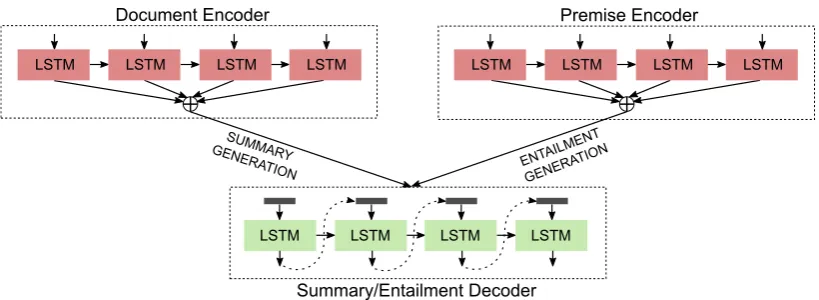
Figure 2: Multi-task learning of the summarization task (left) with the entailment generation task (right).
3.2 Multi-Task Learning
Multi-task learning helps in sharing knowledge between related tasks across domains (Luong et al., 2015). In this work, we show improvements on the task of abstractive summarization by shar-ing its parameters with the task of entailment gen-eration. Since a summary is entailed by the input document, sharing parameters with the entailment generation task improves the logically-directed as-pect of the summarization model, while maintain-ing the salient information extraction aspect.
In our multi-task setup, we share the decoder parameters of both the tasks (along with the word embeddings), as shown in Fig. 2, and we optimize the two loss functions (one for summarization and another for entailment generation) in alternate mini-batches of training. Letαsbe the number of mini-batches of training for summarization after which it is switched to trainαe number of mini-batches for entailment generation. Then, the mix-ing ratio is defined as αs
αs+αe :
αe
αs+αe.
4 Experimental Setup 4.1 Datasets
Gigaword Corpus We use the exact annotated Gigaword corpus provided by Rush et al. (2015). The dataset has approximately 3.8 million train-ing pairs. We use10,000pairs as validation set and the exact test sample provided by Rush et al. (2015) as our test set. We use the first sentence of the article as the source with vocabulary size of
119,505and article headline as target with vocab-ulary size of68,885.
DUC Test Corpus The DUC corpus1 comes in two variants: DUC-2003 corpus consists of
1http://duc.nist.gov/duc2004/tasks.html
624 documents and DUC-2004 corpus consists of 500 documents. Each document in these datasets has four human annotated summaries. For ex-periments on this corpus, we directly used the Gigaword-trained model and tested on the DUC-2004 corpus. This is similar to the setups of Nalla-pati et al. (2016) and Chopra et al. (2016) (whereas the Rush et al. (2015) setup tunes on the DUC-2003 corpus).
SNLI corpus For the task of entailment gen-eration, we use the Standford Natural Language Inference (SNLI) corpus (Bowman et al., 2015), where we only use the entailment-labeled pairs and regroup the splits to have a zero overlap train-test split and have a multi-reference train-test set, as suggested by Pasunuru and Bansal (2017). Out of 190,113 entailments pairs, we use 145,822
unique premise pairs for training, and the rest of them are equally divided into dev and test sets.
4.2 Evaluation
Following previous work (Nallapati et al., 2016; Chopra et al., 2016; Rush et al., 2015), we use the full-length F1 variant of Rouge (Lin, 2004) for the Gigaword results, and the75-bytes length lim-ited Recall variant of Rouge for DUC. Addition-ally, we also report other standard language gener-ation metrics (as motivated recently by See et al. (2017)): METEOR (Denkowski and Lavie, 2014), BLEU-4 (Papineni et al., 2002), and CIDEr-D (Vedantam et al., 2015), based on the MS-COCO evaluation script (Chen et al., 2015).
4.3 Training Details
Models ROUGE-1 ROUGE-2 ROUGE-L METEOR BLEU-4 CIDEr-D PREVIOUSWORK
ABS+ (Rush et al., 2015) 29.76 11.88 26.96 - -
-RAS-Elman (Chopra et al., 2016) 33.78 15.97 31.15 - -
-words-lvt2k-1sent (Nallapati et al., 2016) 32.67 15.59 30.64 - - -OURMODELS
Baseline 31.75 14.71 29.91 14.54 10.31 128.22
[image:4.595.74.528.63.145.2]Multi-Task with Entailment Generation 32.75 15.35 30.82 15.25 11.09 130.44 Table 1: Summarization results on Gigaword. Rouge scores are full length F-1, following previous work.
We use RNN hidden state dimension of 512and word embedding dimension of256. We do not ini-tialize our word embeddings with any pre-trained models, i.e., we learn them from scratch. We use the Adam (Kingma and Ba, 2015) optimizer with a learning rate of0.001. During training, to handle the large vocabulary, we use the sampled loss trick of Jean et al. (2014). We always tune hyperpa-rameters on the validation set of the corresponding dataset, where applicable. For multi-task learning, we tried a few mixing ratios and found1 : 0.05to work better, i.e.,100mini-batches of summariza-tion with5mini-batches of entailment generation task in alternate training rounds.
5 Results and Analysis
5.1 Summarization Results: Gigaword Baseline Results and Previous Work Our base-line is a strong encoder-attention-decoder model based on Luong et al. (2015) and presented by Chopra et al. (2016). As shown in Table 1, it is reasonably close to some of the state-of-the-art (comparable) results in previous work, though making this baseline further strong (e.g., based on pointer-copy mechanism) is our next step.
Multi-Task Results We show promising initial multi-task improvements on top of our baseline, based on several metrics. This suggests that the entailment generation model is teaching the sum-marization model some skills about how to choose a logical subset of the events in the full input doc-ument. This is especially promising given that the domain of the entailment dataset (image captions) is very different from the domain of the summa-rization datasets (news), suggesting that the model might be learning some domain-agnostic inference skills.
5.2 Summarization Results: DUC
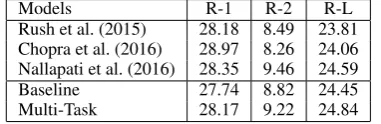
Here, we directly use the Gigaword-trained model to test on the DUC-2004 dataset (see tuning dis-cussion in Sec. 4.1). In Table 2, we again see that
Models R-1 R-2 R-L
Rush et al. (2015) 28.18 8.49 23.81 Chopra et al. (2016) 28.97 8.26 24.06 Nallapati et al. (2016) 28.35 9.46 24.59
Baseline 27.74 8.82 24.45
[image:4.595.322.513.178.240.2]Multi-Task 28.17 9.22 24.84 Table 2: Summarization test results on DUC-2004 corpus. Rouge scores are based on 75-byte Recall, following previous work.
Input Document:results from the second round of the french first-division soccer league -lrb- home teams listed first -rrb- : UNK
Ground-truth Summary:french soccer results
Baseline Summary:first round results of french league soccer league
Multi-task Summary:second round of french soccer league results
Input Document:austrian women in leading positions complained about lingering male domination in their society in a meeting tuesday with visiting u.s. first lady hillary rodham clinton .
Ground-truth Summary:austrian women complain to mrs. clinton about male domination by roland prinz
Baseline Summary:first lady meets with first lady
Multi-task Summary:austrian women complained about male domination
Figure 3: Output examples of our multi-task model in comparison with the baseline.
our Luong et al. (2015) baseline model achieves competitive performance with previous work, esp. on Rouge-2 and Rouge-L. Next, we show promis-ing multi-task improvements over this baseline of around 0.4% across all metrics, despite being a test-only setting and also with the mismatch be-tween the summarization and entailment domains.
5.3 Analysis Examples
6 Conclusion and Next Steps
We presented a multi-task learning approach to incorporate entailment generation knowledge into summarization models. We demonstrated promising initial improvements based on multi-ple datasets and metrics, even when the entailment knowledge was extracted from a domain different from the summarization domain.
Our next steps to this workshop paper include: (1) stronger summarization baselines, e.g., using pointer copy mechanism (See et al., 2017; Nal-lapati et al., 2016), and also adding this capa-bility to the entailment generation model; (2) re-sults on CNN/Daily Mail corpora (Nallapati et al., 2016); (3) incorporating entailment knowledge from other news-style domains such as the new Multi-NLI corpus (Williams et al., 2017), and (4) demonstrating mutual improvements on the entail-ment generation task.
Acknowledgments
We thank the anonymous reviewers for their help-ful comments. This work was supported by a Google Faculty Research Award, an IBM Fac-ulty Award, a Bloomberg Data Science Research Grant, and NVidia GPU awards.
References
Samuel R Bowman, Gabor Angeli, Christopher Potts, and Christopher D Manning. 2015. A large anno-tated corpus for learning natural language inference. InEMNLP.
Xinlei Chen, Hao Fang, Tsung-Yi Lin, Ramakr-ishna Vedantam, Saurabh Gupta, Piotr Doll´ar, and C Lawrence Zitnick. 2015. Microsoft coco captions: Data collection and evaluation server. arXiv preprint arXiv:1504.00325.
Sumit Chopra, Michael Auli, and Alexander M Rush. 2016. Abstractive sentence summarization with at-tentive recurrent neural networks. InHLT-NAACL.
James Clarke and Mirella Lapata. 2008. Global in-ference for sentence compression: An integer linear programming approach. Journal of Artificial Intelli-gence Research, 31:399–429.
Ido Dagan, Oren Glickman, and Bernardo Magnini. 2006. The pascal recognising textual entailment challenge. In Machine learning challenges. evalu-ating predictive uncertainty, visual object classifica-tion, and recognising tectual entailment, pages 177– 190. Springer.
Michael Denkowski and Alon Lavie. 2014. Meteor universal: Language specific translation evaluation for any target language. InEACL.
Katja Filippova, Enrique Alfonseca, Carlos A Col-menares, Lukasz Kaiser, and Oriol Vinyals. 2015. Sentence compression by deletion with lstms. In
EMNLP, pages 360–368.
Anand Gupta, Manpreet Kaur, Adarsh Singh, Aseem Goel, and Shachar Mirkin. 2014. Text summa-rization through entailment-based minimum vertex cover. Lexical and Computational Semantics (* SEM 2014), page 75.
S´ebastien Jean, Kyunghyun Cho, Roland Memisevic, and Yoshua Bengio. 2014. On using very large target vocabulary for neural machine translation.
CoRR.
Hongyan Jing. 2000. Sentence reduction for automatic text summarization. InANLP.
Diederik Kingma and Jimmy Ba. 2015. Adam: A method for stochastic optimization. InICLR.
Kevin Knight and Daniel Marcu. 2002. Summariza-tion beyond sentence extracSummariza-tion: A probabilistic ap-proach to sentence compression. Artificial Intelli-gence, 139(1):91–107.
Chin-Yew Lin. 2004. ROUGE: A package for auto-matic evaluation of summaries. In Text Summa-rization Branches Out: Proceedings of the ACL-04 workshop, volume 8.
Minh-Thang Luong, Quoc V. Le, Ilya Sutskever, Oriol Vinyals, and Lukasz Kaiser. 2016. Multi-task se-quence to sese-quence learning. InICLR.
Minh-Thang Luong, Hieu Pham, and Christopher D. Manning. 2015. Effective approaches to attention-based neural machine translation. InEMNLP, pages 1412–1421.
Yashar Mehdad, Giuseppe Carenini, Frank W Tompa, and Raymond T Ng. 2013. Abstractive meeting summarization with entailment and fusion. InProc. of the 14th European Workshop on Natural Lan-guage Generation, pages 136–146.
Ramesh Nallapati, Bowen Zhou, Caglar Gulcehre, Bing Xiang, et al. 2016. Abstractive text summa-rization using sequence-to-sequence rnns and be-yond. InCoNLL.
Kishore Papineni, Salim Roukos, Todd Ward, and Wei-Jing Zhu. 2002. BLEU: a method for automatic evaluation of machine translation. In ACL, pages 311–318.
Alexander M Rush, Sumit Chopra, and Jason Weston. 2015. A neural attention model for abstractive sen-tence summarization. InCoRR.
Abigail See, Peter J Liu, and Christopher D Manning. 2017. Get to the point: Summarization with pointer-generator networks. InACL.
Ramakrishna Vedantam, C Lawrence Zitnick, and Devi Parikh. 2015. CIDEr: Consensus-based image de-scription evaluation. InCVPR, pages 4566–4575. Adina Williams, Nikita Nangia, and Samuel R