Unbabel’s Participation
in the WMT17 Translation Quality Estimation Shared Task
Andr´e F. T. MartinsUnbabel & Instituto de Telecomunicac¸˜oes Lisbon, Portugal
Fabio N. Kepler
Unbabel
University of Pampa, Alegrete, Brazil
Jos´e L. Monteiro
Unbabel Lisbon, Portugal
Abstract
This paper presents the contribution of the Unbabel team to the WMT 2017 Shared Task on Translation Quality Estimation. We participated on the word-level and sentence-level tracks. We describe our two submitted systems: (i) STACKEDQE, a “pure” QE system, trained only on the provided training sets, which is a stacked combination of a feature-rich se-quential linear model with a neural net-work, and (ii) FULLSTACKEDQE, which also stacks the predictions of an automatic post-editing system, trained on additional data. When evaluated on the English-German and English-German-English datasets, FULLSTACKEDQE achieved word-level
FMULT
1 scores of 56.6% and 52.9%, and sentence-level correlation Pearson scores of 64.1% and 62.6%, respectively. Our system ranked second in both tracks, be-ing statistically indistbe-inguishable from the best system in the word-level track.
1 Introduction
Quality estimation is the task of evaluating a trans-lation system’s quality without access to reference translations (Blatz et al.,2004;Specia et al.,2013). This paper describes the contribution of the Unba-bel team to the Shared Task on Sentence-Level and Word-Level Quality Estimation (QE Tasks 1 and 2) at the 2017 Conference on Statistical Machine Translation (WMT 2017).
In the word-level task, the goal is to predict the word-level quality of machine translated text, by assigning a label of OK or BAD to each word in
the translation. The sentence-level task attempts to predict the HTER of each sentence, along with a ranking of the sentences. Two language pairs and domains are considered: English-German (IT domain) and German-English (medical domain).
Our submission is largely based on the approach that we have recently proposed in Martins et al. (2017), which ensembles a “pure” quality estima-tion system with predicestima-tions derived from an au-tomatic post-editing system. The focus was on developing a word-level system, and to use the word label predictions to predict the sentence-level HTER.
Our system architecture is described in full de-tail in the following sections. We first describe our “pure” QE system (§2), which consists of a neural model (NEURALQE) stacked into a lin-ear feature-rich classifier (LINEARQE). Then, we train an APE system (using a large amount of arti-ficial “roundtrip translations”) and adapt it to pre-dict word-level quality labels (yielding APEQE,
§3). We show that the pure and the APE-based QE
system are highly complementary (§4): our best system is a stacked combination of LINEARQE, NEURALQE, and APEQE. By employing a simple word-to-sentence conversion, we adapt our sys-tems to sentence-level QE. Overall, we achieve word-levelFMULT
1 scores of56.6%and52.9%and sentence-level Pearson scores of64.1%and62.6% for English-German and German-English, respec-tively.
The following external resources were used: part-of-speech tags and extra syntactic depen-dency information were obtained with Turbo-Tagger and TurboParser (Martins et al., 2013),1
1Publicly available on http://www.cs.cmu.edu/
˜ark/TurboParser/.
trained on the Penn Treebank (for English) and on the version of the German TIGER corpus used in the SPMRL shared task (Seddah et al.,2014). For the neural models, we used pre-trained word em-beddings from Polyglot (Al-Rfou et al.,2013).
For our FULLSTACKEDQE submission, we also use additional data to train the APE-based QE sys-tems: for English-German, the set of 500K arti-ficial roundtrip translations provided by Junczys-Dowmunt and Grundkiewicz (2016), and, for German-English, the UFAL Medical Corpus pro-vided in the WMT17 Biomedical Translation task.
2 Pure Quality Estimation
We use the pure quality estimation system devel-oped by the Unbabel team and described in Mar-tins et al.(2017), which consists of an ensemble of a linear feature-based classifier with a neural network. We briefly describe the linear (§2.1) and
neural (§2.2) components of our system, as well as their combination (§2.3). Further details are pre-sented inMartins et al.(2016,2017).
2.1 Linear Sequential Model
The linear component of our model is a discrimi-native feature-based sequential model (called LIN -EARQE). The system receives as input a tuple
hs, t,Ai, wheres = s1. . . sM is the source sen-tence,t=t1. . . tN is the translated sentence, and
A ⊆ {(m, n) |1 ≤ m ≤ M, 1 ≤ n ≤ N}is a set of word alignments. It predicts as output a se-quenceyb=y1. . . yN, with eachyi ∈ {BAD,OK}. This is done as follows:
b
y = argmaxy
N
X
i=1
w>φu(s, t,A, yi)
+ NX+1
i=1
w>φb(s, t,A, yi, yi−1). (1)
Above, w is a vector of weights, φu(s, t,A, yi) are unigram features (depending only on a sin-gle output label), φb(s, t,A, yi, yi−1) are bigram features (depending on consecutive output labels), andy0andyN+1are special start/stop symbols.
Table 1 shows the unigram and bigram fea-tures used in the LINEARQE system. We include features that depend on the target word and its aligned source word, as well as the context sur-rounding them.2 We include also syntactic
fea-2Features involving the aligned source word are replaced
2 x FF 2 x 400
2 x FF 2 x 200
2 x FF 100 + 50
... ...
BiGRU 100
... ...
BiGRU 200
softmax OK/BAD
source word
source POS target word
target POS
embeddings
3 x 64
3 x 50 3 x 64
[image:2.595.339.490.63.204.2]3 x 50
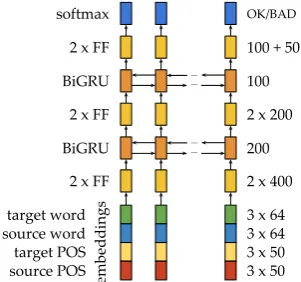
Figure 1: Architecture of our NEURALQE system.
tures to detect grammatically incorrect construc-tions. We use features that involve the depen-dency relation, the head word, and second-order sibling and grandparent structures. Features in-volving part-of-speech (POS) tags and syntactic information are obtained with TurboTagger and TurboParser (Martins et al., 2013). The feature weights are learned by running 50 epochs of the max-loss MIRA algorithm (Crammer et al.,2006), with regularization constantC ∈ {10−k}4
k=1 and a Hamming cost function placing a higher penalty on false positives than on false negatives (cFP ∈
{0.5,0.55, . . . ,0.95}, cFN = 1−cFP), to account for the existence of fewer BADlabels thanOK la-bels in the data. These values are tuned on the development set.
2.2 Neural System
Next, we describe the neural component of our pure QE system, which we call NEURALQE.
The architecture of NEURALQE is depicted in Figure 1. We used Keras (Chollet, 2015) to im-plement our model. The system receives as in-put the source and target sentencess andt, their
word-level alignmentsA, and their corresponding POS tags obtained from TurboTagger. The input layer follows a similar architecture as QUETCH (Kreutzer et al., 2015), with the addition of POS features. A vector representing each target word is obtained by concatenating the embedding of that word with those of the aligned word in the source.3
The immediate left and right contexts for source and target words are also concatenated. We use byNILif the target word is unaligned. If there are multiple aligned source words, they are concatenated into a single fea-ture.
3For the cases in which there are multiple source words
Features Label Input (referenced by theith target word) unigram yi∧. . . ∗BIAS
∗WORD, LEFTWORD, RIGHTWORD
∗SOURCEWORD, SOURCELEFTWORD, SOURCERIGHTWORD
∗LARGESTNGRAMLEFT/RIGHT, SOURCELARGESTNGRAMLEFT/RIGHT ∗POSTAG, SOURCEPOSTAG
†WORD+LEFTWORD, WORD+RIGHTWORD †WORD+SOURCEWORD, POSTAG+SOURCEPOSTAG
simple bigram yi∧yi−1∧. . . ∗BIAS
rich bigrams yi∧yi−1∧. . . all above
yi+1∧yi∧. . . WORD+SOURCEWORD, POSTAG+SOURCEPOSTAG
syntactic yi∧. . . DEPREL, WORD+DEPREL
HEADWORD/POSTAG+WORD/POSTAG
LEFTSIBWORD/POSTAG+WORD/POSTAG
RIGHTSIBWORD/POSTAG+WORD/POSTAG
GRANDWORD/POSTAG+HEADWORD/POSTAG+WORD/POSTAG
Table 1: Features used in the LINEARQE system (see Martins et al., 2016 for a detailed description). Features marked with∗are included in the WMT16 baseline system. Those marked with†were proposed
by Kreutzer et al. (2015).
the pre-trained64-dimensional Polyglot word em-beddings (Al-Rfou et al., 2013) for English and German, and refine them during training. In ad-dition to this, POS tags for each source and target word are also embedded and concatenated. POS embeddings have size50and are initialized as de-scribed byGlorot and Bengio(2010). A dropout probability of0.5is applied to the resulting vector representations.
The following layers are then applied in se-quence:
1. Two feed-forward layers of size400with rec-tified linear units (ReLU; Nair and Hinton (2010));
2. A layer with bidirectional gated recurrent units (BiGRU,Cho et al.(2014)) of size200, where forward and backward vectors are con-catenated, trained with layer normalization (Ba et al.,2016);
3. Two feed-forward ReLU layers of size200;
4. A BiGRU layer of size 100 with identical configuration to the previous BiGRU;
5. Two more feed-forward ReLU layers of sizes 100and50, respectively.
As the output layer, a softmax transformation over theOK/BADlabels is applied. We provide ablation experiments inMartins et al.(2017) to validate this architecture choice.
We train the model with the RMSProp algo-rithm (Tieleman and Hinton, 2012) by minimiz-ing the cross-entropy with a linear penalty forBAD word predictions, as inKreutzer et al.(2015). We set theBADweight factor to3.0. All hyperparam-eters are adjusted based on the development set. Target sentences are bucketed by length and then processed in batches (without any padding or trun-cation).
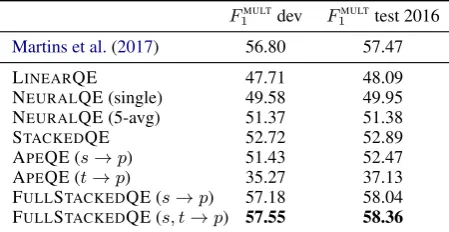
Finally, we also trained 5 independent instances of NEURALQE with different random initializa-tions and different data shuffles. We ensemble these systems by taking the averaged probability of each word beingBAD. Tables2–3show the re-sults. We observe that, for both language pairs, the neural model outperforms the linear model, and the ensemble of 5 neural systems achieves an ex-tra boost (most noticeable in the English-German dataset).
2.3 Stacking Neural and Linear Models
We now stack the NEURALQE system (§2.2) into the LINEARQE system (§2.1) as an en-semble strategy; we call the resulting system STACKEDQE.
LINEARQE model. As unigram features, we used one real-valued feature for every model prediction at each position, conjoined with the label. As bi-gram features, we used two real-valued features for every model prediction at the two positions, conjoined with the label pair.
For the remainder of this paper, we will take STACKEDQE as our pure QE system.
3 APE-Based Quality Estimation
To develop our APE-based QE system (APEQE), we followed a similar approach as the one de-scribed inMartins et al.(2017), with a few minor differences, explained below.
Junczys-Dowmunt and Grundkiewicz (2016) applied neural translation models to the APE prob-lem, treating different models as components in a log-linear model, allowing for multiple inputs (the sources and the translated sentencet) that were
decoded to the same target language (post-edited translationp). Two systems were considered, one
using sas the input (s → p) and another using tas the input (t → p). For English-German, we used the 500K artificial roundtrip translations pro-vided by the shared task organizers, along with the original data from the shared task (oversam-pled 20 times, as inJunczys-Dowmunt and Grund-kiewicz (2016)). For German-English, we only considered thes→pmachine translation system, trained from a subset of the UFAL Medical Cor-pus provided in the WMT17 Biomedical Transla-tion task. This subset was obtained through cross-entropy filtering. For this, we built an in-domain trigram language model from the English post-edited training data. We then calculated cross-entropy scores for the UFAL corpus according to the language model. We sorted the corpus by in-creasing cross-entropy and kept the first 500K sen-tences to be used as additional training data.
To convert the resulting APE systems into word-level quality estimators, we need to turn the automatic post-edited sentences into word quality labels. This is done in a straightforward way by using the TERCOM software tool (Snover et al., 2006)4 with the default settings (tokenized, case
insensitive, exact matching only, shifts disabled). This tool computes the HTER (the normalized edit distance) between the translated and post-edited sentence. As a by-product, it aligns the words in the two sentences, identifying substitution errors,
4
http://www.cs.umd.edu/˜snover/tercom.
word deletions (i.e. words omitted by the trans-lation system), and insertions (redundant words in the translation). This is mapped deterministically intoOKandBADlabels.
Our approach for the shared task differs from Martins et al. (2017) in which we skipped the QE-tuning step when training the log-linear APE model; instead, we kept the output of the s → p and the t → p systems, converted each to
word-level quality labels, and then include the two predictions as additional features in the FULL -STACKEDQE system, described below. We de-note the individual systems as APEQE s → p
and APEQEt → p, and the combined system as
FULLSTACKEDQEs, t→p.
4 Full Stacked System
Finally, we consider a larger stacked system where we stack both NEURALQE and APEQE into LIN -EARQE. This mixes pure QE with APE-based QE systems; we call the result FULLSTACKEDQE. The procedure is analogous to that described in
§2.3, with extra binary features for the APE-based word quality label predictions. For training, we used jackknifing to ensure the predictions on the training set are not biased.
4.1 Word-Level QE
The performance of the FULLSTACKEDQE sys-tem on the English-German and German-English development datasets are shown in Tables 2–3. For English-German, we compare with the system fromMartins et al.(2017).
For both language pairs, we can see that the APE-based and the pure QE systems are highly complementary. For English-German, the full combination of the linear, neural, and APE-based systems improves the scores with respect to the best individual system by about 5.5 points. There is a small improvement by including also a fea-ture from APEt → p, in addition tos→ p. For
German-English, we observe an improvement of 4.9 points.
4.2 Sentence-Level QE
We followed the same procedure ofMartins et al. (2017) to convert word-level quality predictions to a sentence-level HTER prediction. For the APE system, we simply measured the HTER between the translated sentence t and the predicted
ap-F1MULTdev F1MULTtest 2016
Martins et al.(2017) 56.80 57.47
LINEARQE 47.71 48.09
NEURALQE (single) 49.58 49.95
NEURALQE (5-avg) 51.37 51.38
STACKEDQE 52.72 52.89
APEQE (s→p) 51.43 52.47
APEQE (t→p) 35.27 37.13
FULLSTACKEDQE (s→p) 57.18 58.04
FULLSTACKEDQE (s, t→p) 57.55 58.36
Table 2: Performance of the several word-level QE systems on the development and WMT16 English-German test datasets.
FMULT
1 dev
LINEARQE 48.07
NEURALQE (single) 49.39
NEURALQE (avg-5) 49.58
STACKEDQE 53.22
APEQE (s→p) 45.09 FULLSTACKEDQE (s→p) 58.08
Table 3: Performance of the several word-level QE systems on the German-English development dataset.
plied the following word-to-sentence conversion technique: (i) run a QE system to obtain a se-quence of OK and BAD word quality labels; (ii) use the fraction of BAD labels as an estimate for HTER. Finally, to combine the APE and pure QE systems toward sentence-level QE, we simply take the average of the two HTER predictions above.
Table4shows the results obtained with our pure QE system (STACKEDQE), with our APE-based system (APEQE), and with the combination of the two (FULLSTACKEDQE). We report also the per-formance of the system ofMartins et al.(2017) for English-German, for comparison.
5 Final Results
Finally, we show in Tables 5–6 the results ob-tained in the test set for our two submitted systems, STACKEDQE and FULLSTACKEDQE, in word-level and sentence-word-level quality estimation. As expected, the inclusion of the predictions made by the APE system gave a significant boost for the word-level task (>5F1MULTpoints for
English-German, and>6 points for German-English) and
for the sentence-level task (>5 Pearson
correla-tion points for English-German, >4 points for
German-English).
6 Conclusions
We have presented the contribution of the Unba-bel team to the WMT 2017 Shared Task on Trans-lation Quality Estimation. Our word-level sys-tem combines a pure quality estimation syssys-tem, based on stacking a neural and feature-based lin-ear model, and an APE-based quality estimation system, which uses the predictions of an auto-matic post-editing system to generate additional features. We applied a simple conversion strategy to obtain a sentence-level quality estimator based on the word-level one. The system is evaluated on two language pairs, English-German and German-English.
Acknowledgments
This work was partially supported by the the EX-PERT project (EU Marie Curie ITN No. 317471), and by Fundac¸˜ao para a Ciˆencia e Tecnologia (FCT), through contracts UID/EEA/50008/2013 and UID/CEC/50021/2013, the LearnBig project (PTDC/EEI-SII/7092/2014), and the GoLocal project (grant CMUPERI/TIC/0046/2014).
References
Rami Al-Rfou, Bryan Perozzi, and Steven Skiena. 2013. Polyglot: Distributed word represen-tations for multilingual nlp. arXiv preprint
arXiv:1307.1662.
Jimmy Lei Ba, Jamie Ryan Kiros, and Geoffrey E Hin-ton. 2016. Layer normalization. arXiv preprint
arXiv:1607.06450.
John Blatz, Erin Fitzgerald, George Foster, Simona Gandrabur, Cyril Goutte, Alex Kulesza, Alberto Sanchis, and Nicola Ueffing. 2004. Confidence esti-mation for machine translation. InProc. of the
Inter-national Conference on Computational Linguistics.
page 315.
Kyunghyun Cho, Bart Van Merri¨enboer, Caglar Gul-cehre, Dzmitry Bahdanau, Fethi Bougares, Hol-ger Schwenk, and Yoshua Bengio. 2014. Learn-ing Phrase Representations UsLearn-ing RNN Encoder-Decoder for Statistical Machine Translation. In
Proc. of Empirical Methods in Natural Language Processing.
Franc¸ois Chollet. 2015. Keras. https://github. com/fchollet/keras.
Koby Crammer, Ofer Dekel, Joseph Keshet, Shai Shalev-Shwartz, and Yoram Singer. 2006. Online Passive-Aggressive Algorithms. Journal of
[image:5.595.72.297.63.179.2]Pearson dev Pearson test 2016 Spearman dev Spearman test 2016
En-De
Martins et al.(2017) 64.04 65.56 65.52 65.92
STACKEDQE 62.18 59.90 64.07 60.23
APEQE 58.79 56.69 59.41 59.43
FULLSTACKEDQE 64.33 65.25 65.65 66.10
De-En
STACKEDQE 60.47 – 59.74 –
APEQE 59.94 – 57.68 –
[image:6.595.101.497.71.160.2]FULLSTACKEDQE 67.97 – 62.45 –
Table 4: Performance of our sentence-level QE systems on the English-German and German-English datasets, as measured by the official evaluation script. We show the performance ofMartins et al.(2017) for comparison.
F1OK F1BAD F1MULT
EN-DESTACKEDQE 88.2 58.1 51.2
EN-DEFULLSTACKEDQE 90.6 62.5 56.6
DE-ENSTACKEDQE 93.6 49.7 46.6
DE-ENFULLSTACKEDQE 94.1 56.2 52.9
Table 5: Performance of the submitted word-level systems on the test set.
Pearson Spearman
EN-DESTACKEDQE 58.9 61.0
EN-DEFULLSTACKEDQE 64.1 65.2
DE-ENSTACKEDQE 58.0 57
DE-ENFULLSTACKEDQE 62.6 61
Table 6: Performance of the submitted sentence-level systems on the test set.
Xavier Glorot and Yoshua Bengio. 2010. Understand-ing the difficulty of trainUnderstand-ing deep feedforward neural networks. InInternational Conference on Artificial Intelligence and Statistics. pages 249–256.
Marcin Junczys-Dowmunt and Roman Grundkiewicz. 2016. Log-linear combinations of monolingual and bilingual neural machine translation models for au-tomatic post-editing. In Proceedings of the First
Conference on Machine Translation. pages 751–
758.
Julia Kreutzer, Shigehiko Schamoni, and Stefan Rie-zler. 2015. Quality estimation from scratch (quetch): Deep learning for word-level translation quality estimation. In Proceedings of the Tenth Workshop on Statistical Machine Translation. pages 316–322.
Andr´e F. T Martins, Miguel B. Almeida, and Noah A. Smith. 2013. Turning on the turbo: Fast third-order non-projective turbo parsers. InProc. of the Annual Meeting of the Association for Computational Lin-guistics.
Andr´e F. T. Martins, Ram´on Astudillo, Chris Hokamp, and F´abio Kepler. 2016. Unbabel’s participation in
the wmt16 word-level translation quality estimation shared task. InProceedings of the First Conference on Machine Translation.
Andr´e F. T. Martins, Marcin Junczys-Dowmunt, Fabio Kepler, Ramon Astudillo, Chris Hokamp, and Ro-man Grundkiewicz. 2017. Pushing the limits of translation quality estimation. Transactions of the Association for Computational Linguistics (to ap-pear).
Vinod Nair and Geoffrey E Hinton. 2010. Rectified linear units improve restricted boltzmann machines. InProc. of the International Conference on Machine
Learning. pages 807–814.
Djam´e Seddah, Sandra K¨ubler, and Reut Tsarfaty. 2014. Introducing the SPMRL 2014 shared task on parsing morphologically-rich languages. In Pro-ceedings of the First Joint Workshop on Statisti-cal Parsing of MorphologiStatisti-cally Rich Languages and
Syntactic Analysis of Non-Canonical Languages.
pages 103–109.
Matthew Snover, Bonnie Dorr, Richard Schwartz, Lin-nea Micciulla, and John Makhoul. 2006. A study of translation edit rate with targeted human annota-tion. InProc. of the 7th Conference of the Associa-tion for Machine TranslaAssocia-tion in the Americas. pages 223–231.
Lucia Specia, Kashif Shah, Jose G.C. de Souza, and Trevor Cohn. 2013. QuEst - a translation qual-ity estimation framework. In Proc. of the An-nual Meeting of the Association for Computational
Linguistics: System Demonstrations. pages 79–84.
http://www.aclweb.org/anthology/P13-4014.
Tijmen Tieleman and Geoffrey Hinton. 2012. Rm-sprop: Divide the gradient by a running average of its recent magnitude. COURSERA: Neural
[image:6.595.79.282.349.416.2]