Boundary-Based MWE Segmentation With Text Partitioning
Jake Ryland Williams Drexel University
30 N. 33rd Street Philadelphia, PA 19104 [email protected]
Abstract
This work presents a fine-grained, text-chunking algorithm designed for the task of multiword expressions (MWEs) segmentation. As a lexical class, MWEs include a wide vari-ety of idioms, whose automatic identification are a necessity for the handling of colloquial language. This algorithm’s core novelty is its use of non-word tokens, i.e., boundaries, in a bottom-up strategy. Leveraging boundaries refines token-level information, forging high-level performance from relatively basic data. The generality of this model’s feature space al-lows for its application across languages and domains. Experiments spanning 19 different languages exhibit a broadly-applicable, state-of-the-art model. Evaluation against recent shared-task data places text partitioning as the overall, best performing MWE segmen-tation algorithm, covering all MWE classes and multiple English domains (including user-generated text). This performance, coupled with a non-combinatorial, fast-running design, produces an ideal combination for implemen-tations at scale, which are facilitated through the release of open-source software.
1 Introduction
Multiword expressions (MWEs) constitute a mixed class of complex lexical objects that often behave in syntactically unruly ways. A unifying property that ties this class together is the lexical-ization of multiple words into a single unit. MWEs are generally difficult to understand through gram-matical decomposition, casting them as types of minimal semantic units. There is variation in this non-compositionality property (Bannard et al., 2003), which in part may be attributed to differ-ences in MWE types. These range from multi-word named entities, such asLong Beach, Califor-nia, to proverbs, such asit takes one to know one, to idiomatic verbal expressions, like cut it out
(which often contain flexible gaps). For all of their strangeness they appear across natural
languages (Jackendoff, 1997; Sag et al., 2002), though generally not for common meanings, and frequently with opaque etymologies that confound non-native speakers.
1.1 Motivation
There are numerous applications in NLP for which a preliminary identification of MWEs holds great promise. This notably includes idiom-level ma-chine translation (Carpuat and Diab, 2010); re-duced polysemy in sense disambiguation ( Fin-layson and Kulkarni,2011); keyphrase-refined in-formation retrieval (Newman et al., 2012); and the integration of idiomatic and formulaic lan-guage in learning environments (Ellis et al.,2008). Parallel to these linguistically-focused applica-tions is the possibility that MWE identification can positively affect machine learning applications in text analysis. Regardless of algorithm com-plexity, a common preliminary step in this area is tokenization. Having the “correct” segmenta-tion of a text into words and MWEs results in a meaning-appropriate tokenization of minimal se-mantic units. Partial steps in this direction have been taken through recent work focusing on mak-ing the bag of phrases framework available as a simple improvement to the bag of words. How-ever, that work (Handler et al.,2016) utilized only noun phrases, leaving the connection between MWEs and a comprehensive bag of phrases frame-work yet to be acknowledged. With the specific focus of MWEs on idiomaticity, a comprehensive bag of words and phrases framework would be possible, provided the MWE identification task is resolved.
1.2 Task description
Despite the variety that exist, studies often only focus on a few MWEs classes, or on only specific lengths (Tsvetkov and Wintner, 2011). In fact,
named entity extraction may be thought of as satis-fying the MWE identification task for just this one MWE class. The problem has a broader framing when all classes of MWEs are considered. Fur-thermore, since a mixed tokenization of words and phrases as minimal semantic units is a desired out-come, it is helpful to consider this task as a kind of fine-grained segmentation. Thus, this work refers to its task asMWE segmentation, and not iden-tification or extraction. In other words, the spe-cific goal here is to delimit texts into the smallest possible, independent units of meaning.Schneider et al.(2014b) were the first to treat this problem as such, when they created the first data set compre-hensively annotated for MWEs. From this data set, an exemplar annotated record is:1
My wife hadtaken1 her07’2Ford2Fusion2 in1 for a routineoil3change3.
whose segmentation is an example of the present focus of this work. Note that the present study focuses only on MWE tokens, does not aim to ap-proach the task of MWE class identification, and does not attempt to disambiguate MWE meanings. For detailed descriptions of these other MWE-related tasks,Baldwin and Kim(2010) provide an extensive discussion.
1.3 Existing work
The identification of MWEs and collocations is an area of study that has seen notable focus in recent years (Seretan, 2008;Pecina, 2010; New-man et al.,2012;Ramisch,2015;Schneider et al., 2014a), and has a strong history of attention (both directly and through related work) in the liter-ature (Becker, 1975; Church and Hanks, 1990; Sag et al., 2002). It has become commonplace for approaches to leverage well-studied machine learning algorithms such as structured percep-trons (Schneider et al.,2014a) and conditonal ran-dom fields (Constant and Sigogne, 2011; Hos-seini et al., 2016). The flexibility of these algo-rithms allow researchers to mix a variety of fea-ture types, ranging from tokens to parts of speech to syntax trees. Juxtaposed to these relatively-complex models exist the simpler and more-heuristic (Cordeiro et al., 2015). Some rely sin-gularly on MWE dictionaries, while others incor-porate multiple measures or are rule-based, like 1 Note that color/indices redundantly indicate separate MWEs, with the colored box highlighting an MWE’s gap, and black, unnumbered text tokenized simply as words.
those present in the suite available through mwe-toolkit (Ramisch, 2015) or jMWE (Kulkarni and Finlayson,2011).
MWEs have been the focus of considerable attention for languages other than English, too. Hungarian MWE corpora focusing on light verb constructions have been under development for some time (T. et al., 2011). In application to the French language, part-of-speech tagging has seen benefit (Constant and Sigogne,2011) through awareness and relativity to MWEs. Recently, Savary et al. (2017) conducted a shared task for the identification of verbal MWEs with a data set spanning 18 languages (excluding English). While extending this area of work to a large variety of languages, this task saw notable multilingual algo-rithmic developments (Saied and Candito,2017), but did not approach the identification of all MWE classes, comprehensively. On the other hand, a Se-mEval 2016 shared task (Schneider et al., 2016) covered English domains and all MWE classes, bearing the greatest similarity to the present work. In general, these shared tasks have all highlighted a need for the improvement of algorithms.
2 Algorithms 2.1 Text partitioning
Text partitioningis a physical model developed recently (Williams et al., 2015) for fine-grained text segmentation. It treats a text as a dichotomous squence, alternating between word (wi) and
non-word (bi) tokens:
(· · ·, bi−1, wi, bi, wi+1, bi+1· · ·)
The key feature of text partitioning is its treat-ment of non-word, i.e., “boundary”, tokens. Act-ing like glue, these may take one of two distinct states,s∈ {0,1}, identifying if a non-word token is bound (b1
i) or broken (b0i). A non-word token
in the bound state binds words together. Thus, a text partitioning algorithm is a function that de-termines the states of non-word tokens.
In its original development, text partitioning was studied simplistically, with space as the only non-word token. In that work, a threshold proba-bility,q, was set. For each space, bi, in a text, a
uniform random binding probability,qi, would be
drawn. Ifqi > q,bi would be bound, and
q ∈ (0,1), a randomly-determined collection of N-grams. While non-deterministic, this method was found to preserve word frequencies, (unlike the sliding-window method), and made possible the study of Zipf’s law for mixed distributions of words andN-grams.
The present work utilizes the parameterqto de-velop a supervised machine learning algorithm for MWE segmentation. A threshold probability,q, is still set, and the supervised component is the de-termination of the binding probabilities (qi) for a
text’s non-word tokens. Provided a gold-standard, MWE-segmented text:
(· · ·, bsi−1
i−1, wi, bsii , wi+1, bsii+1+1· · ·)
letf(wi, bsii , wi+1)denote the frequency at which a boundarybiis observed betweenwiandwi+1in the statesi. Provided this, a binding probability is
defined as:
qi= f(wi, b
1
i, wi+1)
f(wi, b1i, wi+1) +f(wi, b0i, wi+1). This basic,2-gram text partitioning model makes the binding probabilities a function of bound-aries and their immediately-surrounding words. In principle, this might be extended to a more-nuanced model, with binding probabilities refined by larger-gram information.
2.1.1 Extensions
Some MWEs consist of non-contiguous spans of words. These varieties are often referred to as “gappy” expressions, an example of which is shown in Sec.1.2. Text partitioning may easily be extended to handle gappy MWEs by instituting a unique boundary token,2e.g.,
b= GAP
that indicates the presence of a gap. For example, to handle the gappy MWE out of control in the statement:
The situation wasout1of1theircontrol1. a binding probability for b (as above) between wordsw5 =ofandw7 =controlwould be com-puted from the state frequenciesf(w5, b{0,1}, w7). Since gappy MWEs are relatively sparse as com-pared to other MWEs, a single gap-boundary to-ken is used for all gap sizes. This is designed 2 Note that the exact form forbthat is used to indicate a gap is not important, but that it just needs to be unique to compute state frequencies and binding probabilities.
for a flexible handling of variable gap sizes, given the relatively small amount of gold-standard data that is presently available. However, this may in principle be refined to particular gap-sized speci-fications, possibly ideal for higher precision in the presence of larger quantities of gold-standard data. A number of MWE types, such as named en-tities, are entirely open classes. Often occurring only once, or as entirely emergent objects, these pose a significant challenge for MWE segmenta-tion, along with the general sparsity and size of the current gold-standards. For their inclusion in the gold-standard datasets and the general quality of automated taggers, part-of-speech (POS) informa-tion may generally be leveraged to increase recall. These data are utilized in a parallel text partition-ing algorithm, swapppartition-ing tokens for tags,3 so that
binding probabilities, qi,tok andqi,POS, are com-puted for both data types. Two thresholds are then used to determine states via a logical disjunction, i.e.,bibinds ifqi,tok> qtok∨qi,POS> qPOS.
Algorithm 1Pseudocode for the longest first de-fined (LFD) algorithm. Here, a candidate MWE’s tokens are pruned from left to right for the longest referenced in a training lexicon, lex. When no form is found in lex, the first token is automati-cally pruned, (accepting it as an expression), leav-ing the algorithm to start from the next. Note that the “_” symbol indicates a concatenation opera-tion in line 10, where the currentformis placed onto the end of thelexemesarray.
1: procedureLFD(tokens) 2: lexemes←(·) 3: N ←length(tokens) 4: whileN do
5: indices←(N+ 1) : 1 6: foriinindicesdo
7: form←join(tokens[0 :i]) 8: remaining ←tokens[i:N] 9: ifform∈ lexor noti−1then 10: lexemes←lexemes_form 11: iflength(tokens) = 1then 12: tokens←(·)
13: else
14: tokens←remaining
15: break
16: N ←length(tokens) 17: returnlexemes
2.2 The longest first defined
In the presented form, text partitioning only fo-cuses on information immediately local to bound-aries (surrounding word pairs). This has positive effects for recall, but can result in lower preci-sion, since there is no guarantee that a sequence of bound tokens is an MWE. For example, if pre-sented with the text:
“I go for take out there, frequently.” the segmenttake out theremight be bound, since
take out and out there are both known MWE forms, potentially observed in training. To bal-ance this, a directional, lookup-based algorithm is proposed. Referred to as the longest first de-fined (LFD) algorithm (see Alg. 1), this algo-rithm prunes candidates by clipping off the longest known (MWE) references along the reading di-rection of a language. This requires knowledge of MWE lexica, which may be derived from both gold-standard data and external sources (see Sec. 3). Continuing with the example, if the text partitioning algorithm outputs the candidate,
take out there, it would next be passed to the LFD. The LFD would findtake out thereunreferenced, and check the next-shortest (2-word) segments, from left to right. The LFD would immediately findtake outreferenced, output it, and continue on the remainder,there. With only one term remain-ing, the wordtherewould then be trivially output and the algorithm terminated. While this algo-rithm will likely fail when confronted with patho-logical expressions, like those in “garden path” sentences, e.g., “The prime number few.”, direc-tionality is a powerful heuristic in many languages that may be leveraged for increased precision.
3 Materials
3.1 Gold standard data
Treating MWE segmentation as a supervised ma-chine learning task, this work relies on several recently-constructed MWE-annotated data sets. This includes the business reviews contained in the Supersense-Tagged Repository of English with a Unified Semantics for Lexical Expressions, anno-tated by Schneider et al. (2014b; 2015). These data were harmonized and merged with the Rit-ter and Lowlands data set of supersense-annotated tweets (Johannsen et al., 2014) for the SemEval 2016 shared task (#10) on Detecting Minimal Semantic Units and their Meanings (DIMSUM),
conducted bySchneider et al.(2016). The DIM-SUM data set additionally possesses token lem-mas and gold-standard part of speech (POS) tags for the 17 universal POS categories. In addition to the shared task training data of business reviews and tweets, the DIMSUM shared task resulted in the creation of three domains of testing data, which spanned business reviews, tweets, and TED talk transcripts. All DIMSUM data are compre-hensive in being annotated for all MWE classes.
To evaluate against a diversity of languages this work also utilizes data produced by the multi-national, European Cooperation in Science and Technology’s action group: PARSing and Multi-word Expressions within a European multilingual network (PARSEME) (Savary et al., 2015). In 2017, the PARSEME group conducted a shared task with data spanning 18 languages4 (Savary
et al., 2017), focusing on several classes of ver-bal MWEs. So, while the PARSEME data are not annotated for all MWEs classes, they do provide an assessment against multiple languages. How-ever, the resources gathered for the 18 languages exhibit a large degree of variation in overall size and numbers of MWEs annotated, leading to ob-servable differences in identifiability.
The gold standard data sets were produced with variations in annotation formats. The DIMSUM data set utilizes a variant of the beginning in-side outin-side (BIO) scheme (Ramshaw and Mar-cus,1995) used for named entity extraction. Ad-ditionally, their annotations indicate which tokens are linked to which, as opposed to the PARSEME data set, which simply identifies tokens to indexed MWEs. Note that this has implications to task evaluation: the PARSEME evaluations can only assess tokens’ presence inside of specific MWEs, while the DIMSUM evaluations can focus on spe-cific token-token attachments/separations. Eval-uations against the DIMSUM datasets are there-fore more informative of segmentation, than iden-tification. Additionally, the DIMSUM data sets use lowercase BIO tags to indicate the presence
of tokens inside of the gaps of others. How-ever, the DIMSUM data sets provide no informa-tion on the locainforma-tions of spaces in sentences, un-like the PARSEME data sets, which do. Since the present work relies on knowledge of spaces to identify token-token boundaries for segmenta-tion, the DIMSUM data sets had to first be pre-processed to infer the locations of spaces. This is done in such a way as to preserve comparability with the work others, (discussed in Sec.4.1).
3.2 Support data
The gold-standard data sets (DIMSUM, and PARSEME) exhibit variations in size, domain, language, and in the classes of annotated MWEs. Ideally, each of these data sets would cover all MWE classes. Since the English data sets do, and many are open classes (e.g., the named en-tity class readily accepts new members), gold stan-dards cannot be expected to cover all MWE forms. So, to produce segmentations that identify rare MWEs, like those that occur once in the gold stan-dard data, this work relies on support data. Note that because the PARSEME data set covers a re-stricted set of MWE types (verbal MWEs, only), type-unrestricted lexical resources, such as Wik-tionary and Wikipedia, can be expected to substan-tially hurt precision while helping recall. Thus, the support data described below are only used for the English language experiments, i.e., the DIM-SUM data sets. Enhancement by support data for the PARSEME task and extension to the identifi-cation of MWE types are thus left for future devel-opment, together.
Since this work approaches the problem as a segmentation task, information is needed on MWE edge-boundaries. Thus, support data must present MWEs in their written contexts, and not just as entries in a lexicon. Example usages of dictionary entries provide this detail, and are leveraged from Wiktionary (data accessed 1/11/16) and Word-net (Miller, 1995). These exemplified dictionary entries help to fill gold standard data gaps, but still lack many noun compounds and named entities. Outside of dictionaries, MWEs such as these may be found in encyclopedias. Thus, the Wikipedia hyperlinks present in all Wikipedia (data accessed 5/1/16) articles are utilized. Specifically, the exact hyperlink targets are used (not the displayed text), and without using any term extraction measures for filtering, as opposed to the data produced by
Hartmann et al.(2012). This results in data that are noisy, with many entities that may not actually be classifiable as MWEs. However, their availability and broad coverage offset these negative proper-ties, which is exhibited by this work’s evaluation.
4 Methods 4.1 Pre-processing
None of the gold standard data sets explicitly iden-tify the locations of spaces in their annotations. This is a challenge for the present work, since it focuses on word-word boundaries (of which space is the most common) to identify the separations between segments. This turns out to not be an is-sue with the PARSEME data sets, which indicate when a given token is not followed by a space. However for the DIMSUM data sets, the locations of spaces had to be inferred. To resolve this is-sue, a set of heuristic rules are adopted with a de-fault assumption of space on both sides of a to-kens. Exceptions to this default include, group openings (e.g., brackets and parentheses) and odd-indexed quotes (double, single, etc.), for which space is only assumed at left; and punctuation to-kens (e.g., commas and periods), group closures (e.g., brackets and parentheses), and even-indexed quotes (double, single, etc.), for which space is only assumed at right. While these heuristics will certainly not correctly identify all instances of space, they make the data sets more faithful to their original texts. Furthermore, since the anno-tations and evaluation procedures only focus on links between non-space tokens, the data may be re-indexed during pre-processing so as to allow for any resulting evaluation to be comparable to those of the data set authors’ and shared task par-ticipants’. Thus, the omission of space characters and their inference in this work only negatively impacts text partitioning’s evaluation. In other words, if this work were applied to annotated data that properly represents space, higher performance might be exhibited.
4.2 Evaluation
more flexible. Utilizing these partial credit MWE evaluation metrics provides refined detail into the performance of algorithms. However, these are not the same across the gold standard data sets. So, to maintain comparability of the present results, this work uses the specific strategies associated to each shared task.
In application to the PARSEME data sets, pre-cision, recall, and F1 describe tokens’ presence in MWEs. Alternatively, DIMSUM-style metrics measure link/boundary-based evaluations. Specif-ically, this strategy checks if the links between tokens are correct. Note that this latter (DIM-SUM) evaluation is better aligned to the formu-lation of text partitioning, but leaves the number evaluation points at one fewer per MWE than the PARSEME scheme. Thus, PARSEME evaluations favor longer MWEs more heavily.
4.3 Experimental design
The basic text partitioning model relies on the single threshold parameter, q, and integration of POS tags relies on a second. So, optimization ul-timately entails the determination of parameters for both tokens, qtok, and POS tags qPOS. To balance both precision and recall, these parame-ters are determined through optimization of theF1 measure. In the absence of the LFD,F1-optimal pairs, (qtok, qPOS), are first determined via a full parameter scan over
(qtok, qPOS)∈ {0,0.01,· · ·,0.99,1}2.
For a given threshold pair, LFD-enhancement can then only increase precision, while decreasing re-call. So, subsequent optimization with the LFD is accomplished through scanning values ofqtokand qPOSin the parameter space no less than those pre-viously determined for basic, non-LFD model.
The different experiments were conducted in accordance with the protocols established by the designers of data sets and shared tasks, and in all cases, an eight-fold cross-validation was con-ducted for optimization. Exact comparability was achieved for the DIMSUM and PARSEME ex-periments as a result of the precise configura-tions of training and testing data from the shared tasks. Moreover, since an evaluation script was provided for each, metrics reported for DIMSUM and PARSEME experiments are in complete ac-cord with the results of the shared tasks. For the DIMSUM experiments, results should be
com-pared to the open track (external data was uti-lized), and for the PARSEME experiments, results should be compared to the closed track (no exter-nal data was utilized).
5 Results
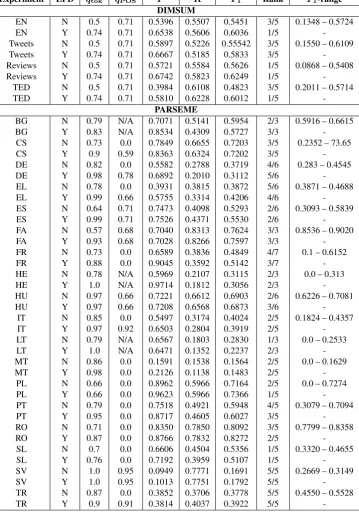
Evaluations spanning the variety of languages (19, in total) showed high levels of performance, espe-cially in application to English, where there was a diversity of domains (business reviews, Tweets, and TED talk transcripts), along with comprehen-sive MWE annotations. Moreover, these results were generally observed for text partitioning both with, and without the LFD. As expected, applica-tion of the LFD generally led to increased preci-sion. While integration of POS tags was found to generally improve MWE segmentation in all En-glish experiments, this was frequently not the case in applications to other languages. However, this observation should be taken with consideration for the restriction to the fewer MWE classes (verbal MWEs, only) annotated in the PARSEME (non-English) shared task languages, and additionally the fact that no external data were used. Detailed results for all DIMSUM and PARSEME experi-ments are recorded in Tab.1.
partition-Experiment LFD qtok qPOS P R F1 Rank F1-range
DIMSUM
EN N 0.5 0.71 0.5396 0.5507 0.5451 3/5 0.1348 – 0.5724
EN Y 0.74 0.71 0.6538 0.5606 0.6036 1/5
-Tweets N 0.5 0.71 0.5897 0.5226 0.55542 3/5 0.1550 – 0.6109
Tweets Y 0.74 0.71 0.6667 0.5185 0.5833 3/5
-Reviews N 0.5 0.71 0.5721 0.5584 0.5626 1/5 0.0868 – 0.5408
Reviews Y 0.74 0.71 0.6742 0.5823 0.6249 1/5
-TED N 0.5 0.71 0.3984 0.6108 0.4823 3/5 0.2011 – 0.5714
TED Y 0.74 0.71 0.5810 0.6228 0.6012 1/5
-PARSEME
BG N 0.79 N/A 0.7071 0.5141 0.5954 2/3 0.5916 – 0.6615
BG Y 0.83 N/A 0.8534 0.4309 0.5727 3/3
-CS N 0.73 0.0 0.7849 0.6655 0.7203 3/5 0.2352 – 73.65
CS Y 0.9 0.59 0.8363 0.6324 0.7202 3/5
-DE N 0.82 0.0 0.5582 0.2788 0.3719 4/6 0.283 – 0.4545
DE Y 0.98 0.78 0.6892 0.2010 0.3112 5/6
-EL N 0.78 0.0 0.3931 0.3815 0.3872 5/6 0.3871 – 0.4688
EL Y 0.99 0.66 0.5755 0.3314 0.4206 4/6
-ES N 0.64 0.71 0.7473 0.4098 0.5293 2/6 0.3093 – 0.5839
ES Y 0.99 0.71 0.7526 0.4371 0.5530 2/6
-FA N 0.57 0.68 0.7040 0.8313 0.7624 3/3 0.8536 – 0.9020
FA Y 0.93 0.68 0.7028 0.8266 0.7597 3/3
-FR N 0.73 0.0 0.6589 0.3836 0.4849 4/7 0.1 – 0.6152
FR Y 0.88 0.0 0.9045 0.3592 0.5142 3/7
-HE N 0.78 N/A 0.5969 0.2107 0.3115 2/3 0.0 – 0.313
HE Y 1.0 N/A 0.9714 0.1812 0.3056 2/3
-HU N 0.97 0.66 0.7221 0.6612 0.6903 2/6 0.6226 – 0.7081
HU Y 0.97 0.66 0.7208 0.6568 0.6873 3/6
-IT N 0.85 0.0 0.5497 0.3174 0.4024 2/5 0.1824 – 0.4357
IT Y 0.97 0.92 0.6503 0.2804 0.3919 2/5
-LT N 0.79 N/A 0.6567 0.1803 0.2830 1/3 0.0 – 0.2533
LT Y 1.0 N/A 0.6471 0.1352 0.2237 2/3
-MT N 0.86 0.0 0.1591 0.1538 0.1564 2/5 0.0 – 0.1629
MT Y 0.98 0.0 0.2126 0.1138 0.1483 2/5
-PL N 0.66 0.0 0.8962 0.5966 0.7164 2/5 0.0 – 0.7274
PL Y 0.66 0.0 0.9623 0.5966 0.7366 1/5
-PT N 0.79 0.0 0.7518 0.4921 0.5948 4/5 0.3079 – 0.7094
PT Y 0.95 0.0 0.8717 0.4605 0.6027 3/5
-RO N 0.71 0.0 0.8350 0.7850 0.8092 3/5 0.7799 – 0.8358
RO Y 0.87 0.0 0.8766 0.7832 0.8272 2/5
-SL N 0.7 0.0 0.6606 0.4504 0.5356 1/5 0.3320 – 0.4655
SL Y 0.76 0.0 0.7192 0.3959 0.5107 1/5
-SV N 1.0 0.95 0.0949 0.7771 0.1691 5/5 0.2669 – 0.3149
SV Y 1.0 0.95 0.1013 0.7751 0.1792 5/5
-TR N 0.87 0.0 0.3852 0.3706 0.3778 5/5 0.4550 – 0.5528
TR Y 0.9 0.91 0.3814 0.4037 0.3922 5/5
-Table 1: Evaluation results, including data sets (Experiment); the LFD’s application (LFD); token (qtok) and POS (qPOS)
thresholds; precision (P), recall (R), and F-measure (F1); shared-task rank (Rank); and shared taskF1 ranges (F1-Range).
DIMSUM experiments spanned three domains: Twitter (Tweets), business reviews (Reviews), and TED talk transcripts (TED), with combined evaluation under EN. PARSEME language experiments are identified by ISO 639-1 two-letter codes.
ing algorithm, particularly when the LFD was not applied. Indeed, cross-validation of the base model resulted inqPOS = 0as optimal for 11 out of the 15 languages where POS tags were made available. However, cross-validation of the LFD-enhanced algorithm resulted in only 6 parameteri-zations havingqPOS = 0as optimal. First place status was achieved for three out of the 18
lan-guages (LT, PL, and SL), and for all lanlan-guages aside from SV and TR, mid-to-high ranking F1 values were achieved.5 In contrast to the
[image:7.595.121.481.69.585.2]SUM data sets, application of the LFD improved F1scores in only roughly half of the experiments.
6 Discussion
Evaluation against the comprehensively-annotated English data sets has shown text partitioning to be the current highest overall ranking MWE segmen-tation algorithm. This result is upheld for two out of the three available test domains (business re-views and TED talk transcripts), with a close third place achieved against data from Twitter. This ex-hibits the algorithms general applicability across domains, and especially in the context of noisy text. Combined with the algorithm’s fast-running and non-combinatorial nature, this makes text par-titioning ideal for large-scale applications to the identification of colloquial language, often found on social media. For these purposes, the presented algorithms have been made available as open-source tools as the Python “Partitioner” module, which may be accessed through Github6 and the
Python Package Index7for general use.
Unfortunately, the PARSEME experiments did not provide an evaluation against all types of MWEs. However, they did exhibit the general applicability of text partitioning across languages. So, while the PARSEME data are not sufficient for comprehensive MWE segmentation, trained mod-els have also been made available for the 18 non-English languages through the Python Partitioner module. Across the 18 PARSEME shared-task languages text partitioning’sF1values were found to rank as mid to high, with the notable exception of SV. While the SV data is peculiar in being quite small (with its training set smaller than its testing set), models entered into the PARSEME shared task achieved roughly twice theF1 score for SV, indicating the possibility that text partitioning re-quires some critical mass of training data in order to achieve high levels of performance. Thus, for general increases in performance and for extension to comprehensive MWE segmentations, future di-rections of this work will likely do well to seek the format. This included27.2%of all MWEs annotated in the DE test records and64.8%of all in the HU test records. Since text partitioning identifies segment boundaries, it cannot han-dle these anomalous MWEs, unlike the models entered into the PARSEME shared task. So to accommodate these and maintain comparability, a separate algorithm was employed. This simply placed lone MWE tags on tokens that were ob-served as anomalous50%or more of the time in training.
6https://github.com/jakerylandwilliams/partitioner 7https://pypi.python.org/pypi/partitioner
collection of larger and more-comprehensive data sets.
As defined, text partitioning is subtly different from a 2-gram model: it focuses on non-word boundary tokens, as opposed to just word-word pairs. Because this algorithm relies on knowledge of boundary token states, it cannot be trained well on MWE lexica, alone. Fort this model to achieve high precision, boundaries commonly occurring as broken must be observed as such, even if they are necessary components of known MWEs. Thus, the use of boundary-adjacent words for prediction is a limitation of the present model. This may possibly be overcome through use of more dis-tant words and boundaries. However, since gold-standard data are still relatively small, they will likely require significant expansion before such models may be effectively implemented. Thus, fu-ture directions with more nuanced text partition-ing models highlight the importance of generatpartition-ing more gold standard data, too.
Acknowledgments
The author thanks Sharon Williams for her ongoing support and thoughtful conversations, Chaomei Chen for his early inspiration of the project, Andy Reagan for his collaboration on the Python Partitioner module, Giovanni Santia for his thoughtful conversations, and the anonymous re-viewers for their thoughtful comments. The author gratefully acknowledges research support from the University of California, Berkeley’s School of In-formation, along with Drexel University’s Depart-ment of Information Science and College of Com-puting and Informatics.
References
Timothy Baldwin and Su Nam Kim. 2010. Muilti-word expressions. In Handbook of Natural Lan-guage Processing. CRC Press, Boca Raton, USA, pages 267–292.
Colin Bannard, Timothy Baldwin, and Alex Las-carides. 2003. A statistical approach to the seman-tics of verb-particles. In Proceedings of the ACL 2003 Workshop on Multiword Expressions: Analy-sis, Acquisition and Treatment - Volume 18. pages 65–72.
Marine Carpuat and Mona Diab. 2010. Task-based evaluation of multiword expressions: A pilot study in statistical machine translation. In Human Lan-guage Technologies: The 2010 Annual Conference of the North American Chapter of the Association for Computational Linguistics. HLT ’10, pages 242– 245.
Kenneth W. Church and Patrick Hanks. 1990. Word association norms, mutual information, and lexi-cography. Computational Linguistics 16(1):22–29. Http://dl.acm.org/citation.cfm?id=89086.89095.
Matthieu Constant and Anthony Sigogne. 2011. Mwu-aware part-of-speech tagging with a crf model and lexical resources. In Proceedings of the Workshop on Multiword Expressions: From Parsing and Gen-eration to the Real World. MWE ’11, pages 49–56.
Silvio Ricardo Cordeiro, Carlos Ramisch, and Aline Villavicencio. 2015. Token-based mwe identifica-tion strategies in the mwetoolkit. InProceedings of the PARSEME 4th general meeting.
Nick C. Ellis, Rita Simpson-Vlach, and Carson May-nard. 2008. Formulaic Language in Native and Sec-ond Language Speakers: Psycholinguistics, Corpus Linguistics, and TESOL. TESOL Quarterly: A Journal for Teachers of English to Speakers of Other Languages and of Standard English as a Second Di-alect42(3):375–396.
Mark Alan Finlayson and Nidhi Kulkarni. 2011. De-tecting multi-word expressions improves word sense disambiguation. InProceedings of the Workshop on Multiword Expressions: From Parsing and Genera-tion to the Real World. MWE ’11, pages 20–24.
Abram Handler, Matthew J. Denny, Hanna Wallach, and Brendan OConnor. 2016. Bag of what? simple noun phrase extraction for text analysis. In Proceed-ings of the Workshop on Natural Language Process-ing and Computational Social Science. pages 114– 124.
Silvana Hartmann, Gy¨orgy Szarvas, and Iryna Gurevych. 2012. Mining multiword terms from wikipedia pages 226–258.
Mohammad Javad Hosseini, Noah A. Smith, and Su-In Lee. 2016. UW-CSE at SemEval-2016 Task 10: De-tecting multiword expressions and supersenses using double-chained conditional random fields. In Pro-ceedings of SemEval.
Ray S. Jackendoff. 1997. The Architecture of the Lan-guage Faculty. MIT Press.
Anders Johannsen, Dirk Hovy, Hctor Martinez, Bar-bara Plank, and Anders Sgaard. 2014. More or less supervised super-sense tagging of twitter. InThe 3rd Joint Conference on Lexical and Computational Se-mantics.
Nidhi Kulkarni and Mark Alan Finlayson. 2011. jmwe: A java toolkit for detecting multi-word expressions. In Proceedings of the Workshop on Multiword Ex-pressions: From Parsing and Generation to the Real World. MWE ’11, pages 122–124.
George A. Miller. 1995. Wordnet: A lexical database for english. Commun. ACM38(11):39–41.
David Newman, Nagendra Koilada, Jey Han Lau, and Timothy Baldwin. 2012. Bayesian text segmenta-tion for index term identificasegmenta-tion and keyphrase ex-traction. In Proceedings of the 9th Workshop on Multiword Expressions. pages 139–144.
Pavel Pecina. 2010. Lexical association mea-sures and collocation extraction. Language Resources and Evaluation 44(1-2):137–158. Http://dx.doi.org/10.1007/s10579-009-9101-4. https://doi.org/10.1007/s10579-009-9101-4.
Carlos Ramisch. 2015. Multiword Expressions Acquisition: A Generic and Open Framework. Springer Publishing Company, Incorporated. https://doi.org/10.1007/978-3-319-09207-2.
Lance A. Ramshaw and Mitchell P. Marcus. 1995. Text chunking using transformation-based learning. In
Proceedings of the Third ACL Workshop on Very Large Corpora. pages 82–94.
Ivan A. Sag, Timothy Baldwin, Francis Bond, Ann Copestake, and Dan Flickinger. 2002. Multiword Expressions: A Pain in the Neck for NLP. Springer, Berlin, Heidelberg. https://doi.org/10.1007/3-540-45715-1 1.
Hazem Al Saied and Marie Candito. 2017. The atilf-llf system for parseme shared task: a transition-based verbal multiword expression tagger. InProceedings of the 13th Workshop on Multiword Expressions. pages 127–132.
Agata Savary, Carlos Ramisch, Silvio Cordeiro, Fed-erico Sangati, Veronika Vincze, Behrang Qasem-iZadeh, Marie Candito, Fabienne Cap, Voula Giouli, Ivelina Stoyanova, and Antoine Doucet. 2017. The parseme shared task on automatic identification of verbal multiword expression. In Proceedings of the 13th Workshop on Multiword Expressions. pages 31–47.
Nathan Schneider, Emily Danchik, Chris Dyer, and Noah A. Smith. 2014a. Discriminative lexical se-mantic segmentation with gaps: Running the mwe gamut. Transactions of the Association for Compu-tational Linguistics2:193–206.
Nathan Schneider, Dirk Hovy, Anders Johannsen, and Marine Carpuat. 2016. SemEval-2016 Task 10: De-tecting Minimal Semantic Units and their Meanings (DiMSUM). InProceedings of SemEval.
Nathan Schneider, Spencer Onuffer, Nora Kazour, Emily Danchik, Michael T. Mordowanec, Henrietta Conrad, and Noah A. Smith. 2014b. Comprehensive annotation of multiword expressions in a social web corpus. In Proceedings of the Ninth International Conference on Language Resources and Evaluation (LREC’14). pages 455–461.
Nathan Schneider and Noah A. Smith. 2015. A cor-pus and model integrating multiword expressions and supersenses. InProceedings of the 2015 Con-ference of the North American Chapter of the Asso-ciation for Computational Linguistics: Human Lan-guage Technologies. The Association for Computa-tional Linguistics, pages 1537–1547.
V. Seretan. 2008. Collocation Extraction Based on Syntactic Parsing. Ph.D. thesis, University of Geneva.
Istv´an Nagy T., G´abor Berend, Gy¨orgy M´ora, and Veronika Vincze. 2011. Domain-dependent detec-tion of light verb construcdetec-tions. InRANLP Student Research Workshop. pages 1–8.