Unsupervised corpus-wide claim detection
Ran Levy Shai Gretz∗ Benjamin Sznajder
Shay Hummel Ranit Aharonov
Noam Slonim
IBM Research - Haifa, Israel
{ranl, avishaig, benjams, shayh, ranita, noams}@il.ibm.com
Abstract
Automatic claim detection is a fundamen-tal argument mining task that aims to au-tomatically mine claims regarding a topic of consideration. Previous works on min-ing argumentative content have assumed that a set of relevant documents is given in advance. Here, we present a first corpus– wide claim detection framework, that can be directly applied to massive corpora. Using simple and intuitive empirical ob-servations, we derive a claim sentence queryby which we are able to directly re-trieve sentences in which the prior prob-ability to include topic-relevant claims is greatly enhanced. Next, we employ simple heuristics to rank the sentences, leading to an unsupervised corpus–wide claim de-tection system, with precision that outper-forms previously reported results on the task of claim detection given relevant doc-uments and labeled data.
1 Introduction
Decision making typically relies on the quality of the arguments being presented and the process by which they are resolved. A common component in all argument models (e.g., (Toulmin,1958)) is the
claim, namely the assertion the argument aims to prove. Given a topic of interest, suggesting a di-verse set of persuasive claims is a demanding cog-nitive goal. The corresponding task ofautomatic
claim detection was first introduced in (Levy et al.,
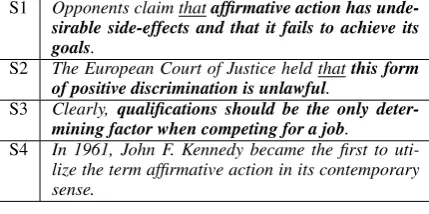
2014), and is considered a fundamental task in the emerging field of argument mining (Lippi and Tor-roni,2016). To illustrate some of the subtleties in-volved, Table1lists examples of sentences related
∗First two authors contributed equally.
to the topic of whether we should end affirmative action.
S1 Opponents claim thataffirmative action has unde-sirable side-effects and that it fails to achieve its goals.
S2 The European Court of Justice held thatthis form of positive discrimination is unlawful.
S3 Clearly, qualifications should be the only deter-mining factor when competing for a job.
[image:1.595.309.524.262.369.2]S4 In 1961, John F. Kennedy became the first to uti-lize the term affirmative action in its contemporary sense.
Table 1: Example sentences for the topic ’End affirmative action’: 3 sentences containing claims (in bold), and a non– argumentative sentence which is still relevant to the topic.
Previous works on claim detection have as-sumed the availability of a relatively small set of articles enriched with relevant claims (Levy et al.,
2014). Similarly, other argument–mining works have focused on the analysis of a small set of argu-mentative essays (Stab and Gurevych,2014). This paradigm has two limitations. First, it relies on a manual, or automatic (Roitman et al.,2016), pro-cess to retrieve the relevant set of articles, which is non-trivial and prone to errors. In addition, when considering large corpora, relevant claims may spread across a much wider and diverse set of articles compared to those considered by earlier works. Here, we present a first corpus–wide claim detection framework, that can be directly applied to massive corpora, with no need to specify a small set of documents in advance.
We exploit the empirical observation that rele-vant claims are typically (i) semantically related to the topic; and (ii) reside within sentences with identifiable structural properties. Thus, we aim to pinpoint single sentences within the corpus that satisfy both criteria.
Semantic relatedness can be manifested via a rich set of linguistic mechanisms. E.g., in Table1,
S1mentions the main concept (MC) of the topic (i.e., affirmative action) explicitly; S2 mentions the MC using a different surface form – ’positive discrimination’; while S3 contains a valid claim without explicitly mentioning the MC. Here, we suggest to use a mention detection tool ( Ferrag-ina and Scaiella,2010), which maps surface forms to Wikipedia titles (a.k.a Wikification), to focus the mining process on sentences in which the MC is detected. Thus, we keep the potential to de-tect sentences in which different surface forms are used to express the MC. Moreover, using a Wik-ification tool can help prevent drift in the mean-ing of the topic. For example, consider the topic
Marriage is outdated for which the MC is Mar-riage. Had we searched the corpus for all sen-tences with the word Marriage, we would have found many sentences that mention the termSame sex marriage which tends to appear more often in argumentative content within the corpus. The risk in this case, is to have the claim detection system drift towards this related but quite differ-ent topic. By using a Wikification tool, and as-suming it works reasonably well, we avoid this problem. Searching for sentences with the con-cept Marriagewill not return sentences in which the Wikification tool found the conceptSame sex marriage.
However, as mentioned, semantic relatedness is not enough; e.g., S4mentions the MC explicitly, but does not include a claim. To further distinguish such sentences from those containing claims, we observe that the token ’that’ is often used as a pre-cursor to a claim; as inS1,S2and in the sentence “we observethatthe token ’that’ is often used as a precursor to a claim.” The usage of ’that’ as a feature was first suggested in (Levy et al.,2014). Thus, we use the presence of ’that’ as an initial weak label, and further identify unigrams enriched in the suffixes of sentences containing ’that’ fol-lowed by the MC, compared to sentences contain-ing the MCwithouta preceding ’that’. This yields a Claim Lexicon (CL), from which we derive a
Claim Sentence Query(CSQ) composed of the fol-lowing ordered triplet:that→MC→CL, i.e., the token ’that’, the MC as identified by a Wikification tool, and a unigram from the CL, in that order.
We demonstrate empirically over Wikipedia, that for sentences satisfying this query, the prior probability to include a relevant claim is enhanced compared to the background distribution.
Further-more, by applying simple unsupervised heuristics to sort the retrieved sentences, we obtain precision results outperforming (Levy et al., 2014), while using no labeled data, and tackling the presum-ably more challenging goal of corpus–wide claim detection. Our results demonstrate the practical value of the proposed approach, in particular for topics that are well covered in the examined cor-pus.
2 Related Work
Context dependent claim detection (i.e. the detec-tion of claims that support/contest a given topic) was first suggested by (Levy et al.,2014). Next, (Lippi and Torroni,2015) proposed the context in-dependent claim detection task, in which one at-tempts to detect claims without having the topic as input. Thus, if the texts contain claims for mul-tiple topics, all should be detected. Both works used the data in (Aharoni et al.,2014) for training and testing their models.
(Levy et al., 2014) have first described ’that’ as an indicator for sentences containing claims. Other works have identified additional indicators of claims, such as discourse markers, and have used them within a rule-based, rather than a su-pervised, framework (Eckle-Kohler et al., 2015;
Ong et al.,2014;Somasundaran and Wiebe,2009;
Schneider and Wyner,2012).
The usage we make in this work of the word ’that’ as an initial weak label is closely related to the idea of distant supervision (Mintz et al.,
3 System Description
3.1 Sentence Level Index
Corpus-wide claim detection requires a run-time efficient approach. Thus, although the context sur-rounding a sentence may hint whether it contains a claim, we focus solely on single sentences and the information they contain. Correspondingly, we built an inverted index1 of sentences for the Wikipedia May 2015 dump, covering∼4.9M ar-ticles. After text cleaning and sentence splitting using OpenNlp2 we obtained a sentence–level in-dex that contains∼83M sentences. We then used TagMe (Ferragina and Scaiella, 2010) to Wikify each sentence, limiting the context used by TagMe for disambiguation, to the examined sentence. 3.2 Topics
We started with a manually curated list of431 de-bate topics that are often used in dede-bate-related sites like idebate.org. We limit our attention to debate topics that focus on a single concept, de-noted here as the MC, which is further identified by a corresponding Wikipedia page, e.g., Affirma-tive Action, Doping in Sport, Boxing, etc. In ad-dition, we focus on topics that are well covered in Wikipedia, which we formally define as topics for which the queryq1 = MC has at least1,000
matches. This criterion is satisfied in212/431 top-ics, of which we randomly selected100as a de-velopment set (termed dev-set henceforth) and50
topics as a test set, used solely for evaluation. The complete list of topics is given in the Supplemen-tary Material (SM).
3.3 Claim Sentence Query (CSQ)
For the 100 dev-set topics we obtained a total of ∼ 1.86M sentences that match the query q1, hence are assumed to be semantically related to their respective topic. We refer to this set of sen-tences as theq1-set. Using ’that’ as a weak label, we divide the q1-set into two classes – the sen-tences that contain the token ’that’ before the MC, and the sentences that do not – denotedc1andc2, respectively. The classc1consists of∼183K sen-tences, hence we define the estimated prior prob-ability of a sentence from q1-set to be included in
c1asP(c1) = 0.0986.
Based on these classes, we are interested in constructing a lexicon of claim-related words that
1See Supplementary Material (SM) for details. 2https://opennlp.apache.org/
will enable designing a query with a relatively high prior for detecting claim–containing sen-tences. We start with standard pre-processing in-cluding tokenization, stop-word removal, lower-casing, pos-tagging using OpenNlp, and removal of tokens mentioned in < 10 sentences in q1-set. Preliminary analysis – described in detail in the SM – suggested that we should focus on thesuffixesof the sentences inc1, where the suf-fix is defined as the part of the sentence that fol-lows the MC. Note, that in our setting the claim is expected to occur after the token ’that’ with the MC usually being the subject, hence the suf-fix as defined above seems like a natural candidate to search for words characteristic of claims. For-mally, we define n1 as the number of sentences inc1 that containw in the sentence suffix;n2 as the number of sentences inc2that containw; and
Psuff(c1|w) =n1/(n1 +n2). Finally, we define the Claim Lexicon (CL) as the set of words which satisfyPsuff(c1|w) > P(c1), namely the set of words that are characteristic of the suffixes of sen-tences in the classc1. To put it differently, the set of words that, when they appear in the sentence suffix, make the sentence more likely to be inc1 than expected by the prior.
A desirable feature of the CL is that it contains words which are indicative of claims in the general sense, i.e., in the context of many different topics. Since the resulting lexicon included some topic-specific words, mostly nouns, we applied straight-forward cleansing of removing all nouns, as well as numbers, single-character tokens, and country– specific terms from the CL, ending up with a lexi-con lexi-consisting of586words, listed in the SM.
We then use the CL to construct theclaim sen-tence query(CSQ):that→MC→CL, whereCL
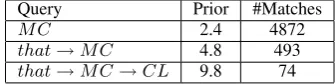
denotes any word from the CL. We assessed the prior probability to contain a claim for sentences matching different queries by randomly selecting at most3sentences that match the query per dev-set topic, and annotating the resulting sentences by5human annotators. We find that, as expected, the prior associated with the query that → MC is higher than the background prior of sentences matchingq1 =MC,4.8%vs.2.4%, respectively. Using the CSQ further enhances the prior to9.8%, a factor of4compared to the background. Table2
Query Prior #Matches
MC 2.4 4872
that→MC 4.8 493
that→MC→CL 9.8 74
Table 2: Summary of query evaluation. The ”Prior” col-umn shows the percentage of claim sentences estimated by the annotation experiment. The ”#Matches” column shows the median number of query matches across the dev-set top-ics.
3.4 From CSQ to Claim Detection
Based on the sentences that match the CSQ, we are now ready to define a system that performs corpus–wide claim detection by adding sentence re-ranking, boundary detection, and simple filters. Naturally, we are interested to present higher confidence predictions first. Remaining within the unsupervised framework, we rank the sentences by the average of two simple scores: (i)w2v: The CSQ only aims to ensure that the MC is present in the examined sentence. Hence, it seems rea-sonable to assume that considering the semantic similarity of theentirecandidate claim to the topic will improve the ranking. Thus, we compare the word2vec representation (Mikolov et al.,2013) of each word in the sentence part following the first ’that’ to each word in the MC to find the best cosine-similarity match, and average the obtained scores; (ii) slop: The number of tokens between ’that’ and the first match to the CL. This assumes that the closer the elements appear in the sentence, the higher the probability that it contains a claim.
To perform claim detection, the claim itself should be extracted from the surrounding sen-tence. From the way the CSQ is constructed, it follows that the claim is expected to start right af-ter the ’that’. The end of the claim is harder to pre-dict. An approach to boundary detection was de-scribed in (Levy et al.,2014), but here we employ a simple heuristic, which does not require labeled data, namely ending the claim at the sentence end. Finally, sentences containing location/person named–entities after the ’that’ are filtered out.
4 Results
To evaluate the performance of the proposed sys-tem we applied crowd labeling3 on the predicted claims for all 150topics in the dev- and test-set. For each topic we labeled the top50 predictions, or all predictions if there were less. A prediction
3via the CrowdFlower platform: www.crowdflower.com/, see details in supplementary material
was considered correct if the majority of the anno-tators marked it as a claim4. The average pairwise Kappa agreement on the dev-set was 0.38, which is similar to the Kappa of0.39reported in this con-text by (Aharoni et al.,2014).
Table3depicts the obtained results. Using our approach – that requires no labeling and is applied over the entire Wikipedia corpus – we obtain re-sults that outperform those reached using a super-vised approach over a manually pre-selected set of articles (Levy et al., 2014) (see ’Levy’ Row), though we note that we consider a different set of topics because of the restrictions we impose on the topic structure (section3.2). In addition, the test set results are better compared to the dev-set re-sults, suggesting that the system is able to gener-alize to entirely new topics.
When considering only topics for which > K
sentences match the CSQ, the precision increases considerably. For example, for topics that have at least50sentences matching the CSQ,P@50is
24%and34%in the dev- and test-set, respectively. Thus, for topics well covered in the corpus, the precision of the system is even more promising.
The precision results in table 3are not directly comparable to ”classical” argumentation mining tasks, e.g. (Stab and Gurevych,2014), since our task involves detecting claims over a full corpus in which the ratio of positive cases is much lower (2.4%of sentences containing the MC).
P@5 P@10 P@20 P@50
Dev 31 27 21 15
Test 32 32 28 22
Levy 23 20 16 12
P@50 P@100 P@200 P@500
[image:4.595.96.264.63.105.2]Dev 33 (94) 30 (86) 27 (70) 24 (47) Test 33 (96) 33 (96) 31 (86) 34 (56)
Table 3:System performance in percentages. Levy - Preci-sion as quoted in (Levy et al.,2014),P@K- Precision of the topKcandidates per topic, averaged over all topics (follow-ing (Levy et al.,2014)),P@K0- same asP@K, considering only topics for which there are at leastKcandidate claims; number in parenthesis denotes the percentage of such topics.
5 Limitations
In this work, we only considered topics that fo-cus on a single concept which has a corresponding
[image:4.595.309.524.478.582.2]Wikipedia page. Expanding the proposed frame-work to more complex queries, covering more than a single concept, merits further investigation. Yet, even without such an expansion, we note that controversial topics are often characterized by a corresponding Wikipedia page.
Our approach targets claims in which the MC is identified by a Wikification tool. While this allows mining claims in which the MC is expressed via different surface forms, Wikification errors also propagate to our performance. Thus, improve-ments in available Wikification tools are expected to improve the results of the approach. In addi-tion, claims that do not explicitly refer to the MC are out of the radar of the proposed system, lim-iting its recall. Expanding the CSQ with concepts related to the MC, may mitigate this issue.
Finally, we focused on sentences matching the pattern that →MC. Exploring the same method-ology for additional patterns characterizing claim– containing sentences is left for future work.
6 Discussion
We present an unsupervised simple framework for corpus-wide claim detection, which relies on fea-tures that are quick to compute. Exploiting the to-ken ’that’ as a weak signal, or as distant supervi-sion (Mintz et al.,2009) for claim–containing sen-tences, we obtain results that outperform a super-vised claim detection system applied to a limited set of documents (Levy et al., 2014). Extending this approach to other computational argumenta-tion tasks like evidence detecargumenta-tion (Rinott et al.,
2015) is a natural direction for future work. Notably, the system precision is clearly supe-rior to the precision of the initial ’that’ label, in-dicating the existence of characteristics of claim– containing sentences which may further enhance the signal embodied in this label. Thus, we hy-pothesize that supervised learning based on label-ing the predictions of the unsupervised system can further improve the system results, e.g., by obtain-ing better rankobtain-ing schemes and/or stronger meth-ods to determine claim boundaries.
Finally, we demonstrated our approach over the Wikipedia corpus. We speculate that the proposed approach holds even greater potential for mining larger and more argumentative corpora such as newspapers aggregates; in particular, when con-sidering controversial topics that are widely dis-cussed in the media, for which it is natural to
ex-pect that relevant claims are mentioned across a very large set of typically short articles.
References
Ehud Aharoni, Anatoly Polnarov, Tamar Lavee, Daniel Hershcovich, Ran Levy, Ruty Rinott, Dan Gutfre-und, and Noam Slonim. 2014. A benchmark dataset for automatic detection of claims and evidence in the context of controversial topics. In Proceedings of the First Workshop on Argumentation Mining, pages 64–68.
Khalid Al-Khatib, Henning Wachsmuth, Matthias Ha-gen, Jonas K¨ohler, and Benno Stein. 2016. Cross-domain mining of argumentative text through dis-tant supervision. InProceedings of the 2016 Con-ference of the North American Chapter of the Asso-ciation for Computational Linguistics: Human Lan-guage Technologies, pages 1395–1404, San Diego, California. Association for Computational Linguis-tics.
Judith Eckle-Kohler, Roland Kluge, and Iryna Gurevych. 2015. On the role of discourse markers for discriminating claims and premises in argumen-tative discourse. InProceedings of the 2015 Con-ference on Empirical Methods in Natural Language Processing, pages 2236–2242, Lisbon, Portugal. As-sociation for Computational Linguistics.
Paolo Ferragina and Ugo Scaiella. 2010. Tagme: on-the-fly annotation of short text fragments (by wikipedia entities). InProceedings of the 19th ACM international conference on Information and knowl-edge management, pages 1625–1628. ACM. Marti A Hearst. 1992. Automatic acquisition of
hy-ponyms from large text corpora. InProceedings of the 14th conference on Computational linguistics-Volume 2, pages 539–545. Association for Compu-tational Linguistics.
Ran Levy, Yonatan Bilu, Daniel Hershcovich, Ehud Aharoni, and Noam Slonim. 2014. Context depen-dent claim detection. InProceedings of COLING 2014, the 25th International Conference on Compu-tational Linguistics: Technical Papers, pages 1489– 1500, Dublin, Ireland. Dublin City University and Association for Computational Linguistics.
Marco Lippi and Paolo Torroni. 2015.
Context-independent claim detection for argument mining. InProceedings of the 24th International Conference on Artificial Intelligence, IJCAI’15, pages 185–191. AAAI Press.
Marco Lippi and Paolo Torroni. 2016. Argumenta-tion mining: State of the art and emerging trends.
ACM Transactions on Internet Technology (TOIT), 16(2):10.
representations in vector space. arXiv preprint arXiv:1301.3781.
Mike Mintz, Steven Bills, Rion Snow, and Dan Juraf-sky. 2009. Distant supervision for relation extrac-tion without labeled data. In Proceedings of the Joint Conference of the 47th Annual Meeting of the ACL and the 4th International Joint Conference on Natural Language Processing of the AFNLP: Vol-ume 2-VolVol-ume 2, pages 1003–1011. Association for Computational Linguistics.
Nathan Ong, Diane Litman, and Alexandra
Brusilovsky. 2014. Ontology-based argument
mining and automatic essay scoring. In Pro-ceedings of the First Workshop on Argumentation Mining, pages 24–28, Baltimore, Maryland. Association for Computational Linguistics.
Ruty Rinott, Lena Dankin, Carlos Alzate Perez, Mitesh M. Khapra, Ehud Aharoni, and Noam Slonim. 2015. Show me your evidence - an auto-matic method for context dependent evidence de-tection. InProceedings of the 2015 Conference on Empirical Methods in Natural Language Process-ing, pages 440–450, Lisbon, Portugal. Association for Computational Linguistics.
Haggai Roitman, Shay Hummel, Ella Rabinovich, Ben-jamin Sznajder, Noam Slonim, and Ehud Aharoni. 2016. On the retrieval of wikipedia articles con-taining claims on controversial topics. In Proceed-ings of the 25th International Conference Compan-ion on World Wide Web, WWW ’16 Companion, pages 991–996, Republic and Canton of Geneva, Switzerland. International World Wide Web Confer-ences Steering Committee.
Jodi Schneider and Adam Z Wyner. 2012. Identifying consumers’ arguments in text. InSWAIE, pages 31– 42.
Swapna Somasundaran and Janyce Wiebe. 2009. Rec-ognizing stances in online debates. In Proceed-ings of the Joint Conference of the 47th Annual Meeting of the ACL and the 4th International Joint Conference on Natural Language Processing of the AFNLP, pages 226–234, Suntec, Singapore. Associ-ation for ComputAssoci-ational Linguistics.
Christian Stab and Iryna Gurevych. 2014. Identifying argumentative discourse structures in persuasive es-says. InEMNLP, pages 46–56.