Proceedings of NAACL-HLT 2018: Student Research Workshop, pages 120–127
Training a Ranking Function for Open-Domain Question Answering
Phu Mon Htut1Samuel R. Bowman1,2,3
Kyunghyun Cho1,3
1Center for Data Science
New York University 60 Fifth Avenue New York, NY 10011
2Dept. of Linguistics
New York University 10 Washington Place New York, NY 10003
3Dept. of Computer Science
New York University 60 Fifth Avenue New York, NY 10011
Abstract
In recent years, there have been amazing ad-vances in deep learning methods for machine reading. In machine reading, the machine reader has to extract the answer from the given ground truth paragraph. Recently, the state-of-the-art machine reading models achieve hu-man level perforhu-mance in SQuAD which is a reading comprehension-style question an-swering (QA) task. The success of machine reading has inspired researchers to combine information retrieval with machine reading to tackle open-domain QA. However, these systems perform poorly compared to reading comprehension-style QA because it is difficult to retrieve the pieces of paragraphs that con-tain the answer to the question. In this study, we propose two neural network rankers that assign scores to different passages based on their likelihood of containing the answer to a given question. Additionally, we analyze the relative importance of semantic similarity and word level relevance matching in open-domain QA.
1 Introduction
The goal of a question answering (QA) system is to provide a relevant answer to a natural lan-guage question. In reading comprehension-style QA, the ground truth paragraph that contains the answer is given to the system whereas no such in-formation is available in open-domain QA setting. Open-domain QA systems have generally been built upon large-scale structured knowledge bases, such as Freebase or DBpedia. The drawback of this approach is that these knowledge bases are not complete (West et al.,2014), and are expensive to construct and maintain.
Another method for open-domain QA is a corpus-based approach where the QA system
looks for the answer in the unstructured text cor-pus (Brill et al.,2001). This approach eliminates the need to build and update knowledge bases by taking advantage of the large amount of text data available on the web. Complex parsing rules and information extraction methods are required to ex-tract answers from unstructured text. As machine readers are excellent at this task, there have been attempts to combine search engines with machine reading for corpus-based open-domain QA (Chen et al.,2017;Wang et al.,2017). To achieve high accuracy in this setting, the top documents re-trieved by the search engine must be relevant to the question. As the top ranked documents re-turned from search engine might not contain the answer that the machine reader is looking for, re-ranking the documents based on the likelihood of containing answer will improve the overall QA performance. Our focus is on building a neural network ranker to re-rank the documents retrieved by a search engine to improve overall QA perfor-mance.
Semantic similarity is crucial in QA as the pas-sage containing the answer may be semantically similar to the question but may not contain the ex-act same words in the question. For example, the answer to “What country did world cup 1998 take place in?” can be found in “World cup 1998 was held in France.” Therefore, we evaluate the perfor-mance of the fixed size distributed representations that encode the general meaning of the whole sen-tence on ranking. We use a simple feed-forward neural network with fixed size question and para-graph representations for this purpose.
In ad-hoc retrieval, the system aims to return a list of documents that satisfies the user’s in-formation need described in the query.1 Guo et al.(2017) show that, in ad-hoc retrieval, rele-1Information Retrieval Glossary:
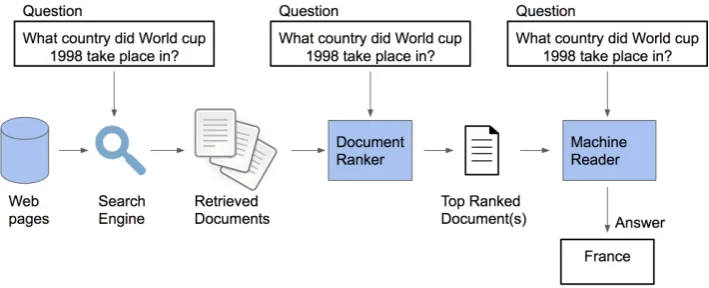
Figure 1: The overall pipeline of the open-domain QA model
vance matching—identifying whether a document is relevant to a given query—matters more than semantic similarity. Unlike semantic similarity, that measures the overall similarity in meaning between a question and a document, relevance matching measures the word or phrase level local interactions between pieces of texts in a question and a document. As fixed size representations en-code the general meaning of the whole sentence or document, they lose some distinctions about the keywords that are crucial for retrieval and ques-tion answering. To analyze the importance of rel-evance matching in QA, we build another ranker model that focuses on local interactions between words in the question and words in the docu-ment. We evaluate and analyze the performance of the two rankers on QUASAR-T dataset (Dhingra et al.,2017b). We observe that the ranker model that focuses on relevance matching (Relation-Networks ranker) achieves significantly higher re-trieval recall but the ranker model that focuses on semantic similarity (InferSent ranker) has better overall QA performance. We achieve 11.6 percent improvement in overall QA performance by inte-grating InferSent ranker (6.4 percent improvement by Relation-Networks ranker).
2 Related Work
With the introduction of large-scale datasets for machine reading such as CNN/DailyMail ( Her-mann et al.,2015) and The Stanford Question An-swering Dataset (SQuAD;Rajpurkar et al.,2016), the machine readers have become increasingly ac-curate at extracting the answer from a given para-graph. In machine reading-style question answer-ing datasets like SQuAD, the system has to locate
the answer to a question in the given ground truth paragraph. Neural network based models excel at this task and have recently achieved human level accuracy in SQuAD.2
Following the advances in machine reading, researchers have begun to apply Deep Learn-ing in corpus-based open-domain QA approach by incorporating information retrieval and ma-chine reading. Chen et al. (2017) propose a QA pipeline named DrQA that consists of a Docu-ment Retriever and a DocuDocu-ment Reader. The Document Retriever is a TF-IDF retrieval sys-tem built upon Wikipedia corpus. The Document Reader is a neural network machine reader trained on SQuAD. Although DrQA’s Document Reader achieves the exact match accuracy of 69.5 in read-ing comprehension-style QA settread-ing of SQuAD, their accuracy drops to 27.1 in the open-domain setting, when the paragraph containing the answer is not given to the reader. In order to extract the correct answer, the system should have an effec-tive retrieval system that can retrieve highly rele-vant paragraphs. Therefore, retrieval plays an im-portant role in open-domain QA and current sys-tems are not good at it.
To improve the performance of the overall pipeline, Wang et al. (2017) propose Reinforced Ranker-Reader (R3) model. The pipeline of R3
includes a Lucene-based search engine, and a neu-ral network ranker that ranks the documents re-trieved by the search engine, followed by a ma-chine reader. The ranker and reader are trained jointly using reinforcement learning. Qualitative analysis of top ranked documents by the ranker of R3shows that the neural network ranker can learn
2SQuAD leaderboard:
to rank the documents based on semantic similar-ity with the question as well as the likelihood of extracting the correct answer by the reader.
We follow a similar pipeline as Wang et al.
(2017). Our system consists of a neural network ranker and a machine reader as shown in Fig-ure 1. The focus of our work is to improve the ranker for QA performance. We use DrQA’s Doc-ument Reader as our reader. We train our ranker and reader models on QUASAR-T (Dhingra et al.,
2017b) dataset. QUASAR-T provides a collection top 100 short paragraphs returned by search en-gine for each question in the dataset. Our goal is to find the correct answer span for a given ques-tion.
3 Model Architecture
3.1 Overall Setup
The overall pipeline consists of a search engine, ranker and reader. We do not build our own search engine as QUASAR-T provides 100 short pas-sages already retrieved by the search engine for each question. We build two different rankers: In-ferSent rankerto evaluate the performance of se-mantic similarity in ranking for QA, and Relation-Networks rankerto evaluate the performance of relevance matching in ranking for QA. We use the Document Reader of DrQA (Chen et al.,2017) as our machine reader.
3.2 Ranker
Given a question and a paragraph, the ranker model acts as a scoring function that calculates the similarity between them. In our experi-ment, we explore two neural network models as the scoring functions of our rankers: a feed-forward neural network that uses InferSent sen-tence representations (Conneau et al., 2017), and Relation-Networks (Santoro et al., 2017). We train the rankers by minimizing the margin rank-ing loss (Bai et al.,2010):
k X
i=1
max(0,1−f(q, ppos) +f(q, pineg)) (1)
where f is the scoring function, ppos is a para-graph that contains the ground truth answer,pneg is a negative paragraph that does not contain the ground truth answer, andkis the number of neg-ative paragraphs. We declare paragraphs that con-tain the exact ground truth answer string provided
in the dataset as positive paragraphs. For every question, we sample one positive paragraph and five negative paragraphs. Given a question and a list of paragraphs, the ranker will return the simi-larity scores between the question and each of the paragraphs.
3.2.1 InferSent Ranker
InferSent (Conneau et al., 2017) provides dis-tributed representations for sentences.3 It is
trained on Stanford Natural Language Inference Dataset (SNLI; Bowman et al.,2015) and Multi-Genre NLI Corpus (MultiNLI; Williams et al.,
2017) using supervised learning. It generalizes well and outperforms unsupervised sentence rep-resentations such as Skip-Thought Vectors (Kiros et al.,2015) in a variety of tasks.
As InferSent representation captures the general semantics of a sentence, we use it to implement the ranker that ranks based on semantic similarity. To compose sentence representations into a paragraph representation, we simply sum the InferSent rep-resentations of all the sentences in the paragraph. This approach is inspired by the sum of word rep-resentations as composition function for forming sentence representations (Iyyer et al.,2015).
We implement a feed-forward neural network as our scoring function. The input feature vector is constructed by concatenating the question embed-ding, paragraph embedembed-ding, their difference, and their element-wise product (Mou et al.,2016):
xclassif ier =
q p q−p qJp
(2)
z =W(1)xclassif ier+b(1) (3) score=W(2)ReLU(z) +b(2) (4)
The neural network consists of a linear layer fol-lowed by a ReLU activation function, and another scalar-valued linear layer that provides the similar-ity score between a question and a paragraph.
3.2.2 Relation-Networks (RN) Ranker
We use Relation-Networks (Santoro et al.,2017) as the ranker model that focuses on measuring the relevance between words in the question and words in the paragraph. Relation-Networks are designed to infer the relation between object pairs.
In our model, the object pairs are the question word and context word pairs as we want to capture the local interactions between words in the ques-tion and words in the paragraph. The word pairs will be used as input to the Relation-Networks:
RN(q, p) =fφ X
i,j
gθ([E(qi);E(pj)])
(5)
whereq={q1, q2, ..., qn}is the question that con-tains n words andp={p1, p2, ..., pm}is the para-graph that contains m words; E(qi) is a 300 di-mensional GloVe embedding (Pennington et al.,
2014) of wordqi, and[·;·]is the concatenation op-erator. fφandgθ are 3 layer feed-forward neural networks with ReLU activation function.
The role of gθ is to infer the relation between two words whilefφserves as the scoring function. As we directly compare the word embeddings, this model will lose the contextual information and word order, which can provide us some semantic information. We do not fine-tune the word embed-dings during training as we want to preserve the generalized meaning of GloVe embeddings. We hypothesize that this ranker will achieve a high re-trieval recall as relevance matching is important for information retrieval (Guo et al.,2017).
3.3 Machine Reader
The Document Reader of DrQA (Chen et al.,
2017) is a multi-layer recurrent neural network model that is designed to extract an answer span to a question from a given document (or para-graphs). We refer readers to the original work for details. We apply the default configuration used in the original work, and train the DrQA on QUASAR-T dataset.4 As QUASAR-T does not
provide the ground truth paragraph for each ques-tion, we randomly select 10 paragraphs that con-tain the ground truth answer span for each ques-tion, and use them to train the DrQA reader.
3.4 Paragraph Selection
The ranker provides the similarity score between a question and each paragraph in the article. We se-lect the top 5 paragraphs based on the scores pro-vided by the ranker. We use soft-max over the top 5 scores to findP(pij), the model’s estimate of the probability that the passage is the most relevant one from among the top 5.
4DrQA code available at:
https://github.com/facebookresearch/DrQA .
Furthermore, the machine reader provides the probability of each answer span given a para-graphP(answerj|pij), whereanswerj stands for the answer span of jth question in dataset and pij indicates the corresponding top 5 paragraphs. We can thus calculate the overall confidence of each answer span and corresponding paragraph P(pij, answerj) by multiplying P(answerj|pij) withP(pi
j). We then choose the answer span with the highest P(answerj, pij) as the output of our model.
4 Experimental Setup
4.1 QUASAR Dataset
The QUestion Answering by Search And Read-ing (QUASAR) dataset (Dhingra et al., 2017b) includes QUASAR-S and QUASAR-T, each de-signed to address the combination of retrieval and machine reading. QUASAR-S consists of fill-in-the-gaps questions collected from Stackoverflow using software entity tags. As our model is not designed for fill-in-the-gaps questions, we do not use QUASAR-S. QUASAR-T, which we use, con-sists of 43,013 open-domain questions based on trivia, collected from various internet sources. The candidate passages in this dataset are collected from a Lucene based search engine built upon ClueWeb09.5,6
4.2 Baselines
We consider four models with publicly available results for QUASAR-T dataset. GA: Gated Atten-tion Reader (Dhingra et al.,2017a), BiDAF: Bidi-rectional Attention Flow (Seo et al., 2016), R3:
Reinforced Ranker-Reader (Wang et al.,2017) and SR2: Simple Ranker-Reader (Wang et al.,2017) which is a variant of R3 that jointly trains the
ranker and reader using supervised learning.
4.3 Implementation Details
Each InferSent embedding has 4096 dimensions. Therefore, the input feature vector to our InferSent ranker has 16384 dimensions. The dimensions of the two linear layers are 500 and 1.
As for Relation-Networks (RN), gθ andfφare three layer feed-forward neural networks with (300, 300, 5) and (5, 5, 1) units respectively.
5https://lucene.apache.org/
Question: Which country’s name means “equator”? Answer: Ecuador
InferSent ranker RN ranker
Ecuador: “Equator” in Spanish , as the country lies on the Equator.
Salinas, is considered the best tourist beach re-sort in Ecuador’s Pacific Coastline.. Quito,
EcuadorEcuador’s capital and the country’s sec-ond largest city.
The equator crosses just north ofEcuador’s cap-ital, Quito, and the country gets its name from this hemispheric crossroads.
Quito is the capital ofEcuadorand of Pichincha, the country’s most populous Andean province, is situated 116 miles from the Pacific coast at an altitude of 9,350 feet, just south of the equator. The country that comes closest to the equator
without actually touching it is Peru. The location of the Republic ofEcuador, known officially as the Republic ofEcuador Ecuador -LRB- which literally means “Republic of the equator” -RRB- , is a representative demo-cratic republic
The name of the country is derived from its posi-tion on the Equator.
The name of the country is derived from its posi-tion on the Equator.
Table 1: An example question from the QUASAR-T test set with the top passages returned by the two rankers.
We use NLTK to tokenize words for the RN ranker. 7 We lower-case the words, and remove
punctuations and infrequent words that occur less than 5 times in the corpus. We pass untokenized sentence string as input directly to InferSent en-coder as expected by it.
We train both the InferSent ranker and the RN ranker using Stochastic Gradient Descent with the Adam optimizer (Kingma and Ba, 2014).8 A
dropout (Srivastava et al., 2014) of p=0.5 is ap-plied to all hidden layers for training both In-ferSent and RN rankers.
5 Results and Analysis
First, we evaluate the two ranker models based on the recall@K, which measures whether the ground truth answer span is in the top K ranked docu-ments. We then evaluate the performance of ma-chine reader on the top K ranked documents of each ranker by feeding them to DrQA reader and measuring the exact match accuracy and F-1 score produced by the reader. Finally, we do qualita-tive analysis of top-5 documents produced by each ranker.
5.1 Recall of Rankers
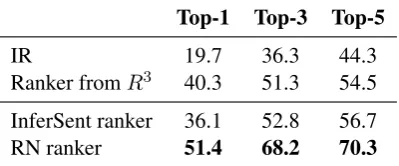
The performance of the rankers is shown in Table 2. Although the recall of the InferSent ranker is
7https://www.nltk.org/ 8Learning rate is set to 0.001.
somewhat lower than that of theR3 ranker at top-1, it still improves upon the recall of search engine provided by raw dataset. In addition, it performs slightly better than the ranker fromR3 for recall at top-3 and top-5. We can conclude that using In-ferSent as paragraph representation improves the recall in re-ranking the paragraphs for machine reading.
The RN ranker achieves significantly higher recall than R3 and InferSent rankers. This
proves our hypothesis that word by word rele-vance matching improves retrieval recall. Does high recall mean high question answering accu-racy? We further analyze the documents retrieved by the rankers to answer this.
5.2 Machine Reading Performance
Top-1 Top-3 Top-5
IR 19.7 36.3 44.3
[image:6.595.82.282.64.147.2]Ranker fromR3 40.3 51.3 54.5 InferSent ranker 36.1 52.8 56.7 RN ranker 51.4 68.2 70.3
Table 2: Recall of ranker on QUASAR-T test dataset. The recall is calculated by checking whether the ground truth answer appears in top-N paragraphs. IR is the search engine ranking given in QUASAR-T dataset.
EM F1
No ranker + DrQA 19.6 24.43 InferSent + DrQA 31.2 37.6
RN + DrQA 26.0 30.7
GA (Dhingra et al.,2017a) 26.4 26.4 BiDAF (Seo et al.,2016) 25.9 28.5 R3 (Wang et al.,2017) 35.3 41.7
SR2 (Wang et al.,2017) 31.9 38.7
Table 3: Exact Match(EM) and F-1 scores of different models on QUASAR-T test dataset. Our InferSent + DrQA model is as competitive asSR2 which is a
su-pervised variant of the state-of-the-art model,R3
5.3 Analysis of paragraphs retrieved by the rankers
The top paragraphs ranked by InferSent are gener-ally semanticgener-ally similar to the question (Table 1). However, we find that there is a significant number of cases where proper noun ground truth answer is missing in the paragraph. An example of such a sentence would be “The name of the country is de-rived from its position on the Equator”. Though this sentence is semantically similar to the ques-tion, it does not contain the proper noun answer. As InferSent encodes the general meaning of the whole sentence in a distributed representation, it is difficult for the ranker to decide whether the repre-sentation contains the important keywords for QA. Although the top paragraphs ranked by RN ranker contain the ground truth answer, they are not semantically similar to the question. This be-havior is expected as RN ranker only performs matching of words in question with words in the paragraph, and does not have information about the context and word order that is important for learning semantics. However, it is interesting to observe that RN ranker can retrieve the paragraph
that contains the ground truth answer span even when the paragraph has little similarity with the question.
In Table 1, the top paragraph retrieved by RN ranker is not semantically similar to the ques-tion. Moreover, the only word overlap between the question and paragraph is “country’s” which is not an important keyword. The fourth paragraph retrieved by RN ranker not only contains the word “country” but also has more word overlap with the question. Despite this, RN ranker gives a lower score to the fourth paragraph as it does not contain the ground truth answer span. As RN ranker is de-signed to give higher ranking score to sentences or paragraphs that has the highest word overlap with the question, this behavior is not intuitive. We no-tice many similar cases in test dataset which sug-gests that RN ranker might be learning to predict the possible answer span on its own. As RN ranker compares every word in question with every word in the paragraph, it might learn to give a high score to the word in the paragraph that often co-occurs with all the words in the question. For example, it might learn thatEquadoris the word that has high-est co-occurence withcountry, name, means and
equator, and gives very high scores to the para-graphs that containEquador.
Nevertheless, it is difficult for machine reader to find answer in such paragraphs that have little or no meaningful overlap with the question. This ex-plains the poor performance of machine reader on documents ranked by RN ranker despite its high recall.
6 Conclusion
[image:6.595.80.284.226.347.2]Relation-Networks. Acknowledgments
PMH is funded as an AdeptMind Scholar. This project has benefited from financial support to SB by Google, Tencent Holdings, and Samsung Research. KC thanks support by AdeptMind, eBay, TenCent, NVIDIA and CIFAR. This work is partly funded by the Defense Advanced Research Projects Agency (DARPA) D3M program. Any opinions, findings, and conclusions or recommen-dations expressed in this material are those of the authors and do not necessarily reflect the views of DARPA.
References
Bing Bai, Jason Weston, David Grangier, Ronan Col-lobert, Kunihiko Sadamasa, Yanjun Qi, Olivier Chapelle, and Kilian Q. Weinberger. 2010. Learn-ing to rank with (a lot of) word features. Inf. Retr., 13(3):291–314.
Samuel R. Bowman, Gabor Angeli, Christopher Potts, and Christopher D. Manning. 2015. A large an-notated corpus for learning natural language infer-ence. In Proceedings of the 2015 Conference on Empirical Methods in Natural Language Processing (EMNLP). Association for Computational Linguis-tics.
Eric Brill, Jimmy J. Lin, Michele Banko, Susan T. Dumais, and Andrew Y. Ng. 2001. Data-intensive question answering. In Proceedings of The Tenth Text REtrieval Conference, TREC 2001, Gaithers-burg, Maryland, USA, November 13-16, 2001. Danqi Chen, Adam Fisch, Jason Weston, and Antoine
Bordes. 2017. Reading wikipedia to answer open-domain questions. InProceedings of the 55th An-nual Meeting of the Association for Computational Linguistics, ACL 2017, Vancouver, Canada, July 30 - August 4, Volume 1: Long Papers, pages 1870– 1879.
Alexis Conneau, Douwe Kiela, Holger Schwenk, Lo¨ıc Barrault, and Antoine Bordes. 2017. Supervised learning of universal sentence representations from natural language inference data. InProceedings of the 2017 Conference on Empirical Methods in Nat-ural Language Processing, EMNLP 2017, Copen-hagen, Denmark, September 9-11, 2017, pages 670– 680.
Bhuwan Dhingra, Hanxiao Liu, Zhilin Yang, William W. Cohen, and Ruslan Salakhutdinov. 2017a. Gated-attention readers for text comprehen-sion. In Proceedings of the 55th Annual Meeting of the Association for Computational Linguistics, ACL 2017, Vancouver, Canada, July 30 - August 4, Volume 1: Long Papers, pages 1832–1846.
Bhuwan Dhingra, Kathryn Mazaitis, and William W Cohen. 2017b. Quasar: Datasets for question an-swering by search and reading. arXiv preprint arXiv:1707.03904.
Jiafeng Guo, Yixing Fan, Qingyao Ai, and W. Bruce Croft. 2017. A deep relevance matching model for ad-hoc retrieval.CoRR, abs/1711.08611.
Karl Moritz Hermann, Tom´as Kocisk´y, Edward Grefenstette, Lasse Espeholt, Will Kay, Mustafa Su-leyman, and Phil Blunsom. 2015. Teaching ma-chines to read and comprehend. In Advances in Neural Information Processing Systems 28: Annual Conference on Neural Information Processing Sys-tems 2015, December 7-12, 2015, Montreal, Que-bec, Canada, pages 1693–1701.
Mohit Iyyer, Varun Manjunatha, Jordan L. Boyd-Graber, and Hal Daum´e III. 2015. Deep unordered composition rivals syntactic methods for text clas-sification. InProceedings of the 53rd Annual Meet-ing of the Association for Computational LMeet-inguistics and the 7th International Joint Conference on Natu-ral Language Processing of the Asian Federation of Natural Language Processing, ACL 2015, July 26-31, 2015, Beijing, China, Volume 1: Long Papers, pages 1681–1691.
Diederik P. Kingma and Jimmy Ba. 2014. Adam: A method for stochastic optimization. CoRR, abs/1412.6980.
Ryan Kiros, Yukun Zhu, Ruslan Salakhutdinov, Richard S. Zemel, Raquel Urtasun, Antonio Tor-ralba, and Sanja Fidler. 2015. Skip-thought vec-tors. In Advances in Neural Information Process-ing Systems 28: Annual Conference on Neural In-formation Processing Systems 2015, December 7-12, 2015, Montreal, Quebec, Canada, pages 3294– 3302.
Lili Mou, Rui Men, Ge Li, Yan Xu, Lu Zhang, Rui Yan, and Zhi Jin. 2016. Natural language inference by tree-based convolution and heuristic matching.
ACLWeb, (P16-2022).
Jeffrey Pennington, Richard Socher, and Christo-pher D. Manning. 2014. Glove: Global vectors for word representation. In Proceedings of the 2014 Conference on Empirical Methods in Natural Lan-guage Processing, EMNLP 2014, October 25-29, 2014, Doha, Qatar, A meeting of SIGDAT, a Special Interest Group of the ACL, pages 1532–1543.
Pranav Rajpurkar, Jian Zhang, Konstantin Lopyrev, and Percy Liang. 2016. Squad: 100, 000+ questions for machine comprehension of text. InProceedings of the 2016 Conference on Empirical Methods in Nat-ural Language Processing, EMNLP 2016, Austin, Texas, USA, November 1-4, 2016, pages 2383–2392.
Battaglia, and Tim Lillicrap. 2017. A simple neu-ral network module for relational reasoning. In Ad-vances in Neural Information Processing Systems 30: Annual Conference on Neural Information Pro-cessing Systems 2017, 4-9 December 2017, Long Beach, CA, USA, pages 4974–4983.
Min Joon Seo, Aniruddha Kembhavi, Ali Farhadi, and Hannaneh Hajishirzi. 2016. Bidirectional at-tention flow for machine comprehension. CoRR, abs/1611.01603.
Nitish Srivastava, Geoffrey E. Hinton, Alex Krizhevsky, Ilya Sutskever, and Ruslan Salakhutdi-nov. 2014. Dropout: a simple way to prevent neural networks from overfitting. Journal of Machine Learning Research, 15(1):1929–1958.
Shuohang Wang, Mo Yu, Xiaoxiao Guo, Zhiguo Wang, Tim Klinger, Wei Zhang, Shiyu Chang, Gerald Tesauro, Bowen Zhou, and Jing Jiang. 2017. R$ˆ3$: Reinforced reader-ranker for open-domain question answering.CoRR, abs/1709.00023.
Robert West, Evgeniy Gabrilovich, Kevin Murphy, Shaohua Sun, Rahul Gupta, and Dekang Lin. 2014.
Knowledge base completion via search-based ques-tion answering. In 23rd International World Wide Web Conference, WWW ’14, Seoul, Republic of Ko-rea, April 7-11, 2014, pages 515–526.