Contents
Foreword
2
Mission Statement and Organisational Structure
3
Articles
C4I - the Community Climate Change Consortium for Ireland
4
Met Éireann’s Voluntary Observers
8
New Meteorology Unit in University College Dublin 10
Programme News
Forecasting Programme 11
Observing and Technical Support Programme 15
Climate Programme 17
Strategic Management 19
Other Activities 22
Appendices
I. Forecast Accuracy 24
In reviewing our activities during 2003, I am struck by two developments which illustrate particularly well Met Éireann’s long-term commitment to meeting the national requirement for high-quality weather services.
The first of these concerns the important issue of climate change. Over the past several years evidence has been accumulating that man-made emissions of greenhouse gases are causing global temperatures to rise, with consequent changes to established weather patterns. There is a pressing need to assess how such changes may affect Ireland. To this end Met Éireann, in collaboration with other organisations, has established the Community Climate Change Consortium for Ireland (C4I). Over the coming years C4I will strive to achieve a better understanding of the local impacts of climate change, and foster a national capability for addressing climate change issues.
The second development is an agreement with University College Dublin to establish a Professorship of Meteorology in the Department of Mathematical Physics. For many years Ireland has been one of the very few European countries without a Chair of Meteorology in any of its universities. The new agreement will remedy this deficiency, in a manner that will stimulate research and offer 3rd-level courses at postgraduate and undergraduate level.
Side by side with these initiatives, Met Éireann continued its routine work of delivering a first-class weather service to the public and to an ever-growing range of specialised users. Significant progress was made in upgrading the basic observational network, enhancing the IT infrastructure, improving the computer-based atmospheric models and maintaining the databases of climatological weather measurements.
While I am pleased to record Met Éireann’s excellent performance in 2003, I am also aware of the many challenges which we will face in the coming years. Our new Strategy Statement will set out plans to meet the changing environment in which Met Éireann, like other National Meteorological Services, will carry on its activities. As ever, our staff will be the key element in managing a successful adaptation to changing conditions.
I would like to thank all staff for their commitment and professionalism during 2003.
Declan Murphy
Director
August 2004
Met Éireann • Annual Report 2003
Our Mission is to meet the national requirement for high-quality
weather forecasts and associated services, with optimum efficiency
and value for money.
Organisational Structure of Met Éireann
(December 2003)
Met Éireann • Annual Report 2003
Mission Statement
Director
Declan Murphy
Aviation Services
Dave Murphy
General Forecasting
Michael Walsh
Administration and Training
Eamon Murphy
Commercial
Liam Campbell
Climatology and Observations
Tom Sheridan
Information Technology
Paul Halton
Research and Applications
Denis Fitzgerald
Instrumentation and Environmental Monitoring
Liam Burke
Assistant Director - Operations and Administration
Séamus Ó Laoghóg
Assistant Director - Scientific and Technical Support
Introduction
The scientific evidence is growing that man-made greenhouse gas emissions are having a significant effect on the Earth’s climate. Globally, the ten warmest years on record were in the 1990s and 2000s. Temperatures in Ireland have mirrored this global trend.
Climate models predict that global temperatures could rise by a further 1˚C - 5˚C over the next 100 years, depending on the amounts of greenhouse gases emitted and the sensitivity of the climate system. There is evidence too that increasing temperatures will lead to changes in many other aspects of the weather – for example wind patterns, the amount and type of precipitation, and the frequency of severe weather events. The social, environmental and economic costs associated with this could be huge. What will be the implications for Ireland? The Community Climate Change Consortium for Ireland (C4I) Project was established to help answer this question.
The Greenhouse Effect
Certain gases in the atmosphere – notably carbon dioxide, methane, nitrous oxide and fluorocarbons – act as a blanket around the Earth and keep it about 33˚C warmer than it would otherwise be. These gases are referred to as ‘greenhouse gases’ (GHGs) because their effect on temperature is similar to that of the glass panes in a greenhouse. Shorter-wavelength solar radiation passes through the Earth’s atmosphere and is absorbed by the surface of the Earth, causing it to warm. Part of the absorbed energy is then re-radiated back to the atmosphere as longer-wavelength infrared radiation. Little of this longer-wave radiation escapes back into space, because most of it is absorbed by the GHGs and re-emitted downward, causing the lower atmosphere to warm.
According to the Intergovernmental Panel on Climate Change (IPCC), most of the observed global warming over the last 50 years is likely to have been due to
Met Éireann • Annual Report 2003
C4I – the Community Climate Change
Consortium for Ireland
Irish Temperatures (1900 - 2003)
-0.90 -0.60 -0.30 0.00
0.30 0.60 0.90 1.20
1900 1920 1940 1960 1980 2000
Year
Annual Smoothed
D
epartures i
n
T
emperature
fr
o
m 1961-1990
No
rma
ls (
˚C
increases in GHG concentrations. There are fears that if the levels of GHGs keep increasing, global temperatures will continue to rise.
Global Climate Modelling
The impact of GHGs on climate change can be simulated using sophisticated computer models. By running the models for years past, the sensitivity of the climate to GHGs can be estimated and the accuracy of the models assessed by comparing the output to recorded observations. Equally, the models can be run into the future and the response of the climate system to estimated future GHG concentrations evaluated.
The realism of the models is a crucial issue: ideally, they should correctly account for all processes associated with the atmosphere, ocean and terrestrial ecosystems. However the complexity of the systems imposes serious constraints in running the models. For realistic
simulations the resolution, or amount of detail supported by the model configuration, should be as fine as possible, but this must be offset against the computational cost which rises rapidly as the resolution increases. Even with powerful supercomputers, long climate simulations using coupled atmosphere-ocean general circulation models
are currently feasible only with horizontal resolutions of around 200-300km. Considering the size of Ireland, such resolutions are too coarse to allow detailed study of local climate changes.
Regional Climate Modelling
A Regional Climate Model (RCM) is a simplified version of its global counterpart and focuses on a limited area of the globe. Its fundamental role is to dynamically downscale the relatively coarse-grained information provided by the global models.
The computational cost of running a RCM is
considerably less than a global model for two reasons: the area it covers is smaller and many of the slowly evolving climate feedback mechanisms can be simplified or ignored as the relevant information will be
incorporated in the driving global data. In its simplest form the RCM can focus solely on the atmosphere and rely on the global model to provide updating changes in sea surface temperatures etc. This allows for a more refined computational grid to be used compared with the global models. Horizontal resolutions in the range 10-20km are typically used in RCM simulations.
The impact of the increased RCM resolution on forecast precipitation can be seen in the diagrams, which show a climate simulation of precipitation for January 1991 using both Global and Regional Climate Models. Comparing these with the observed precipitation amount, it is clear that the increased resolution of the RCM gives a much more realistic estimate of precipitation over Ireland.
C4I’s Regional Climate Model
C4I makes use of a Regional Climate Model developed at the Rossby Centre of the Swedish Meteorological and Hydrological Institute. This model is currently being validated by simulating the past climate for two 15-year periods (1960 – 1974 and 1986 – 2000). Simulations of the future climate, using the output from global climate models running at the Max Planck Institute for Meteorology (Hamburg) and the Hadley Centre for Climate Prediction and Research (UK Met Office), will begin in 2004.
Currently C4I uses the supercomputer facilities at the European Centre for Medium-Range Weather Forecasts in Reading, England, for climate simulations. Later it is planned to run the model on a Grid computer system (CosmoGrid) funded under the Programme for
Research in Third Level Institutions (PRTLI). Work on the development of a Grid-capable version of the RCM is well advanced and the model has been tested on Grid prototypes.
Climate Change – Uncertainty
In spite of the ever-increasing sophistication of global and regional climate models, there will always be a degree of uncertainty in climate forecasts. Quite apart from unavoidable model limitations and the inherently chaotic nature of weather and climate, it is impossible to accurately forecast future greenhouse gas concentrations as these will be determined by political and social factors. Climate model forecasts are based on different
projections or scenarios of future GHG concentrations and while these give a broad picture of the likely changes we can expect, more detail is required. The RCM approach will go some way to filling out the regional detail but we also need some measure of the uncertainty in the forecasts.
C4I plans to estimate this uncertainty by running ensembles of forecasts with the RCM. An ensemble is a collection of forecasts, each generated by using different configurations of the RCM, or by using driving data from
Met Éireann • Annual Report 2003
Global Model Precipitation Jan 1991 RCM Precipitation Jan 1991 Observed Precipitation Jan 1991
Met Éireann • Annual Report 2003
different global models. While the forecasts in the ensemble will of course differ from one another, their mean state may be interpreted as indicating the most probable future climate development.
Conclusion
C4I’s principal goal is to build a capability for addressing climate change issues specific to national needs, and to provide a support framework for wider climate-related research activities in Ireland. Such research is essential for gaining a better understanding of the potential impacts of climate change and the adaptation strategies which may be needed to cope with them.
Met Éireann maintains a network of synoptic weather stations throughout the country – some are manned 24 hours a day, some are automatic while others implement a combination of manned and automatic operations. Altogether there are 16 full-time stations in Met Éireann’s synoptic network, each recording hourly values of pressure, wind, temperature etc. These are sufficient for normal weather forecasting purposes. But a much higher density of observations is needed to define the long-term climatology of the country – the detailed, localised variation of parameters such as temperature and rainfall over periods of many years.
This need is met by the climatological network. The stations in the climatological network are divided into two categories – (a) rainfall stations, numbering about 500 at which daily falls of precipitation are measured, and (b) about 80 ‘full’ climatological stations, which in addition to daily precipitation also record maximum and minimum temperatures, sunshine duration, and perhaps wind speed and other parameters.
In operating the climatological network, Met Éireann depends on a team of voluntary observers who carry out the routine task of recording weather
measurements. The observers may be private individuals or people attached to the staff of state or semi-state bodies or other institutions – e.g. Bord na Móna, the Electricity Supply Board, and the Universities. Many have shown extraordinary dedication, in some cases
maintaining sequences of observations extending over several decades.
In the future, Met Éireann will increasingly deploy automatic weather stations (AWSs) to further enhance its observing capability. The development of Met Éireann’s own AWS called TUCSON, specifically designed to carry out both synoptic and climatological observations, represents a major step in this direction. Several TUCSON stations have already been installed in the observing network. But despite such technological advances, for the foreseeable future the voluntary observers will remain an indispensable element in monitoring Ireland’s weather and climate. Only through their efforts can Met Éireann continue to obtain the localised weather information which is essential both for scientific studies and for a broad range of industrial and commercial applications.
Met Éireann • Annual Report 2003
Voluntary observers in Co. Kerry - measuring temperatures at Dooks (left) and rainfall amounts at Muckross House, Killarney (right).
Met Éireann • Annual Report 2003 Dublin Apt. Moneynierin Ballina Newport Knock Straide Belderrig Ballyhaise Elphin Drumconnick Cavan Loreto Ballinamore Aughafin Riverstown Sligo Apt. Ardtarmon Claremorris Mullingar Shannon Kilmaley Castleconnell U.C.G. Ardfert Dooks Blennerville Mallow Peafield Tycor Kildalton Cashel Littleton Athy Boora Ballinla Cloyne Glengarriff Clonroche Roches Point Sherkin Island Clover Hill Dunsany Glenealy Derrygreenagh Synoptic Station Climatological Station
TUCSON AWS
(The Unified Climatological and Synoptic Observing Network)
Cork Apt. Kilkenny Mt. Juliet Birr Casement Nealstown Laragh Delphi Cloosh Maam Craggaunowen Mountrussell Springfield Muckross Oughterard Valentia Moorepark Tara Wexford Wildfowl Johnstown Castle Ballygar Carron Oak Park J.F.K. Rosslare Waterford Apt. Dungarvan Warrenstown Arklow Cahore Glenveagh Letterkenny Raphoe Glenties Ballyshannon Belmullet Carna Mace Hd Fethard Connemara Nat. Pk.
Clare Is. Kells Dundalk Ardee Kinsealy Glasnevin Phoenix Park Merrion Square Dun Laoghaire Ashford Clones Finner Dunoge Malin Head 1 2 3 4 5 6 5 6 4 3 2 1
Met Éireann • Annual Report 2003
On October 2nd 2003 Dr. Art Cosgrove, President of University College Dublin and Mr. Declan Murphy, Director of Met Éireann signed an Agreement
establishing a joint activity in meteorological teaching and research at the university. The event took place in Newman House, UCD, during a ceremony at which Mr. Pat the Cope Gallagher T.D., Minister of State at the Department of the Environment, Heritage and Local Government (DEHLG), warmly welcomed the new venture.
Until now Ireland has been one of the few European countries having no formal link between its
Meteorological Service and 3rd-level institutions. There can be little doubt that this lack of adequate stimulus from the academic sector has constrained national progress in meteorological science and its applications. The Meteorology Unit to be set up under the new Agreement will address this deficiency – Met Éireann will fund a new Professorship of Meteorology in the Department of Mathematical Physics at UCD, and a Research Centre in Meteorology and Climatology will be established within the Faculty of Science. The operation of the Unit will be monitored by a Board of
Management with members from both organisations. The Board will initially focus on developing joint research programmes and agreeing a curriculum for postgraduate Diploma and M.Sc. courses. Provision of undergraduate courses will be addressed later.
The potential benefits of this joint initiative are substantial. The Department of Mathematical Physics at UCD has a long tradition of excellence in the field of Applied Mathematics and Theoretical Physics, including many areas directly relevant to meteorology. Met Éireann has considerable expertise in the science of
meteorology and its applications. The new Agreement provides a framework for UCD and Met Éireann to work together to raise the level of research in
meteorology and climatology, and facilitate the training of students in these fields.
Meteorology has a crucial role to play in several of Ireland’s most important industrial and commercial sectors. Also, current trends in climate change are likely to have significant consequences for the future. The new Meteorology Unit is a timely development which will enhance the contribution meteorology can make to economic and social progress.
At the signing of the UCD-Met Éireann Agreement: Dr. Art Cosgrove (President UCD), Mr. Pat the Cope Gallagher T.D. (Minister of State, Department of the Environment, Heritage and Local Government ), and Mr. Declan Murphy (Director, Met Éireann).
Met Éireann • Annual Report 2003
Much of Met Éireann’s work is directed towards its core task of delivering high-quality weather forecasts and warnings to end-users. The two Divisions most directly concerned with forecast delivery are the General Forecasting Division and the Aviation Services Division. These Divisions rely in turn on support from many other sections of Met Éireann – for example, in the areas of observing systems, instrumentation and Information Technology. Especially important is the computer-based guidance provided to the operational offices by the Research and Applications Division.
General Forecasting
The General Forecasting Division (GFD) supplies a wide range of forecast services through the Central Analysis and Forecast Office (CAFO) and the RTÉ Weather Office. Its main focus is on the provision of public weather forecasts and warnings for Ireland and the surrounding sea areas. Around 1,500 forecasts per week were delivered routinely by the Division during 2003, the bulk of these being provided to TV and radio stations (national and local).
Throughout the year the Division supplied specialised forecasts for the marine and agriculture sectors, the Defence Forces and the emergency services. Regular updates were provided for Met Éireann’s web site (www.met.ie), and during the spring and summer months forecasts of pollen count and sunburn index were issued. Customised weather services were delivered to energy utilities, the building industry and several other business and commercial interests. In collaboration with the National Roads Authority, winter road maintenance forecasts for over 50 sites were provided to Local Authorities nationwide. The Telephone Consultancy Service (which provides direct customer access to the operational weather forecasters) continued to prove popular with many industrial and
commercial clients. There was continued strong demand for premium-rate telephone weather services.
In 2003, following consultations with the marine community, GFD introduced a new Small Craft Warning for the months April through September inclusive. This service provides warnings of winds reaching a minimum of Beaufort Force 6 (minimum of 22 knots mean speed) on Irish Coastal Waters up to 10 nautical miles offshore. It is aimed primarily at those whose operating thresholds at sea are below those catered for by Met Éireann’s Gale Warning service.
Aviation Forecasting
The Aviation Services Division (ASD) is responsible for supplying weather services to civil, military and private aviation. It comprises the Central Aviation Office (CAO) at Shannon Airport, at which the Head of the Division is normally based, together with the meteorological offices at Dublin, Cork and Knock Airports and at Casement Aerodrome.
During 2003 ASD produced Terminal Area Forecasts (TAFs) for Shannon, Dublin, Cork and Knock Airports, and for Casement Aerodrome. In addition, Local Area
Cork Airport
Met Éireann • Annual Report 2003
Forecasts (LAFs) were produced for the airports at Donegal, Sligo, Galway, Kerry and Waterford. Area warnings called SIGMETS were issued by ASD for the Shannon Flight Information Region (FIR). (SIGMETs provide warnings of conditions that are dangerous or potentially dangerous for aircraft in flight - for example severe icing, mountain waves, turbulence or
thunderstorms). The Division also provided telephone briefings for private pilots and support for Search and Rescue operations.
Staff of the Division participated actively in the deliberations of international organisations governing aviation weather services. Of particular interest were developments in the European Union’s Single European Sky (SES) initiative. The SES is designed to improve air traffic efficiency and capacity in Europe, and will have a significant impact on the way services to the aviation sector are organised and delivered. For example, under the new system Met Éireann will be required to apply to an independent Regulator for certification to supply weather services to international civil aviation in Ireland. One specific certification requirement is that the Aviation Services Division has in place a recognised quality management system (QMS). The Division began the task of implementing the ISO 9001:2000 QMS during 2003.
Research and Applications
Numerical Weather Prediction
Theoretical work in the Research and Applications Division focused mainly on lateral boundary conditions and model dynamics, along with some initial
investigations on improving the use of upper-air data in the HIRLAM analysis.
The HIRLAM suite of programs and applications, as well as the WAM wave model, were ported to a new backup computer.
Project work undertaken by 3rd-level students featured prominently in the Division’s work during 2003, resulting in improved web-based forecast guidance for surface and 2-metre temperatures, for precipitation / thunderstorms and for maximum winds and gusts.
Agricultural and Environmental Unit
On-going collaboration with a range of agricultural and environmental groups continued during 2003. Much effort was committed to the hydrological sector, particularly into examining how Met Éireann might best contribute to flood warning and flood mapping systems. Consultations were held with the Office of Public Works, Local Authorities and experts from Australia and the UK.
Summary of services provided by Aviation Services Division in 2003
Number of SIGMET Warnings for Shannon FIR 128
Number of Flight Folders provided 14446
Number of aerodrome and wind shear warnings 567
Number of telephone aviation briefings 8463
Number of Terminal Aerodrome Forecasts issued 14180
Number of Local Area Forecasts issued 5617
Met Éireann • Annual Report 2003
In the agricultural area, the potato blight warning system was extended with the development of forecasts of blight conditions for up to ten days ahead. Online services were improved by the addition of graphical displays of agro-meteorological data on Met Éireann’s website. Support for the AGMET Group continued mainly in the form of preparations for the second edition of ‘Climate, Weather and Irish Agriculture’ - this standard reference on the impact of climate and weather on Irish agriculture was first published in 1986.
The Agricultural and Environmental Unit supported Met Éireann’s very successful attendance at the
National Ploughing Championships at Ballinabrackey, near Kinnegad in Co. Meath. The National Ploughing Championships have become a major annual event in the Irish agricultural calendar, and provide an important venue for Met Éireann to promote its services and meet with one of its most important user groups.
Marine Unit
The Marine Unit played a lead role in Met Éireann’s participation at the Boat Show 2003. This event was staged at the RDS Convention and Exhibition Centre in Dublin, and as always it provided a valuable opportunity to meet with the marine community and gather their views on Met Éireann’s forecasting services.
Training of Irish navy crews in weather observing techniques was arranged by Met Éireann’s Port Meteorological Officers. The fourth (M4) in a planned network of five weather buoys was deployed off the Donegal coast at 54° 40’ North, 9° 04’ West.
The Marine Unit participated in the EU-funded PRISM project which aims to develop a model of currents and tides in the Irish Sea. Planned outputs from PRISM include the development of a flood warning system for coastal areas, and a range of environmental models dealing with nutrient and sediment transport.
At Met Éireann’s stand at the National Ploughing Championships: Mrs. Anna May McHugh (Managing Director, National Ploughing Association), Mr. Gerald Fleming (Met Éireann), Mr. Joe Walsh T.D. (Minister for Agriculture and Food) and Dr. Klara Finkele (Met Éireann).
Met Éireann • Annual Report 2003
Library & Information Services
Three issues of Met Éireann’s staff magazine Splancwere produced during the year, and work was completed on the implementation of the Library’s automated
Met Éireann • Annual Report 2003
Synoptic Network
Met Éireann’s network of synoptic weather stations, at which hourly observations of weather conditions are made, comprises a mix of manned and automatic sites. A full programme of 24-hour observations was maintained throughout the year at all stations.
Five additional Automatic Weather Stations (AWSs) were deployed in The Unified Climate and Synoptic
Observation Network (TUCSON) during 2003.
The AWSs currently used by Met Éireann do not provide adequate information on some weather parameters – e.g. visibility and cloud conditions. A set of intelligent sensors capable of monitoring these
parameters is deployed at the synoptic stations in Birr, Clones, Kilkenny and Mullingar, for real-time assessment by meteorologists in the Central Aviation Office.
Airports
The new WD50 anemometer system at Shannon Airport was integrated into the Irish Aviation Authority’s Air Traffic Control Centre at Ballycasey, Co. Clare. The installation of a new meteorological enclosure at the airport was underway at the end of the year, in co-operation with Aer Rianta.
Meteorological Radar and Satellite
Receiving Systems
Throughout 2003 Met Éireann operated two networked weather surveillance radars, located at Dublin and Shannon Airports, and also maintained ground station facilities for the reception of data from meteorological satellites.
Valentia Observatory
Valentia Observatory maintained its programme of routine upper-air soundings, entailing four radiosonde ascents daily. Measurements of ozone and ultra-violet levels continued, supplemented during the winter months with special balloon ascents to monitor vertical profiles of ozone concentration. The Observatory participated in international and national atmospheric chemistry and geomagnetic monitoring programmes and, in collaboration with the Dublin Institute of Advanced Studies, continued its monitoring of worldwide seismic activity.
Phase 1 of a major refurbishment of the main building and the extensive grounds at the Observatory was completed in 2003, and a new non-ferrous geomagnetic hut was constructed. Phase 2 of the refurbishment project was underway at year’s end.
Laboratory
The laboratory analysed the chemical composition of air and precipitation samples at selected synoptic stations, as part of on-going national and international monitoring programmes.
The Environmental Protection Agency (EPA) and Met Éireann agreed on the establishment of a three year project for the measurement and study of transboundary
Observing and Technical Support
Programme
Met Éireann • Annual Report 2003
air pollution and acidification. During the project Met Éireann’s laboratory will analyse samples from all the stations in the proposed National Deposition Monitoring Network. An EPA Fellow joined the laboratory team in November, and two additional Ion Chromatographs supplied by the EPA were integrated into routine operations.
Information Technology
The IT Division performs a key role in developing and maintaining the wide range of computer systems and applications on which Met Éireann’s operations increasingly depend.
Among the Division’s principal areas of work during 2003 were:
NWP Servers:System software on the main RS/6000
SP server was upgraded in April. A rack-mounted Linux cluster, intended primarily for NWP experiments, was installed early in December.
Telecommunications:In October the basic bandwidth
of the RMDCN circuit, which links Met Éireann with ECMWF and the GTS, was upgraded from 128kbps to 384kbps. A new link from Met Éireann HQ (Glasnevin, Dublin) to Shannon Airport, via the Government VPN,
was installed in December. In conjunction with the ICT Unit (Department of the Environment, Heritage and Local Government) a new 2mbps microwave link was installed between Met Éireann HQ and the
Department’s offices at the Custom House, Dublin.
Desktop Services: There were in excess of 300
PC-based systems in operational use throughout Met Éireann at the end of 2003, placing an ever-increasing workload on system deployment and HELPDESK staff. A significant effort was required throughout the year to update and monitor antivirus software.
Other developments:Considerable support was
provided by the IT Division for Met Éireann’s involvement in the Irish Aviation Authority’s CAIRDE project. The Division was centrally involved in arrangements for reception of satellite imagery from EUMETSAT’s MSG-1 satellite, and in preparations for the implementation of the new Departmental Management Information Framework. Good progress was made on a major project to replace the existing VAX Cluster. Firewall and FlexiTime systems were upgraded.
An external assessment of the IT Division’s internal audit procedures concluded that software asset management arrangements in Met Éireann were extremely efficient.
Met Éireann • Annual Report 2003
During 2003 the Climatology & Observations Division continued its main tasks of maintaining the National Climate Database, managing the observational station networks and operating the Climate Enquiries Office.
Work was completed on porting the Climate Database to a new database server (Sun Fire V880).
Approximately 570 climatological and rainfall stations were operational throughout 2003, and over 30% of these were visited during the year. 14 new rainfall stations were added to the network, while 6 were closed. Quality control of data from the synoptic stations operated in near real-time, while for the climatological and rainfall stations it was typically between 1 and 3 months in arrears.
The Climate Enquiries Office received a total of 2,606 customer queries during 2003, a significant increase on the previous year. There was a noticeable reduction in the number of telephone enquiries as customers switched to e-mail or consulted daily weather summaries made available on Met Éireann’s web site.
The number of subscribers to the Monthly Weather Bulletin during 2003 was 460 (of which 276 were paid subscriptions). The end-of-month Weather Summary was distributed almost exclusively by e-mail, mainly to media interests (newspapers, TV and radio).
A project to produce comprehensive 5km baseline climatologies for the island of Ireland, conducted under the auspices of the British-Irish Council, was completed during the year.
The Weather of 2003
In contrast to 2002, which in many areas was one of the wettest years on record, 2003 proved to be generally
drier than normal. Only around 75% of normal rainfall was measured at some stations. It was the driest year at Birr since records began in the area in 1874.
While the period between May and July was relatively wet, rainfall was below normal at other times and especially so in the period August - October. But despite the low totals overall, there was some exceptionally heavy rain locally on individual days. A daily fall of 63.7mm at Valentia Observatory on June 9th was the highest daily amount recorded there during June since 1892. A thunderstorm near Pollathomas, Co. Mayo, on September 19th produced a 3-hour fall of over 80mm, resulting in locally devastating floods and landslides. More than 60mm fell over the Dublin area between October 21st and 23rd, accompanied by almost continuous hail and thunderstorms.
Annual mean temperatures were above the 1961-90 normals for the tenth successive year, ranging from 10°C - 11.5°C at most stations. With the exception of October, each month of 2003 was warmer than normal
A wintry scene north of Dublin on October 22nd
Met Éireann • Annual Report 2003
The Weather of 2003
County/
Station
Rainfall (mm)
Temperature (°C)
Sunshine
(hours)No. of days with:
Total Daily
mean Mean diff. from
average
Extremes Highest Lowest
CO. CLARE
SHANNON AIRPORT 773.3 83 29.8 9 Jun 11.5 +1.3 29.0 -4.5 4.04 111 14.0 14 Aug 187 3 15 9 1 30 42
CO. CORK
CORK AIRPORT 967.7 90 43.0 13 Apr 10.2 +0.7 25.2 -1.9 4.30 114 13.8 14 Aug 200 4 9 5 2 97 63
CO. DONEGAL
MALIN HEAD 842.3 79 26.7 27 Jun 10.5 +1.1 25.4 -2.9 3.93 111 16.0 29 Jun 226 5 3 36 7 9 170
CO. DUBLIN
DUBLIN AIRPORT 653.3 n/a 47.2 22 Oct 10.1 n/a 25.7 -5.2 4.42 113 13.6 14 Jun 173 6 35 8 8 40 66
CASEMENT AERODROME 634.8 89 51.6 22 Oct 10.4 +1.1 27.4 -4.9 4.31 117 14.4 14 Jun 163 8 42 10 9 26 59
CO. KERRY
VALENTIA OBSERVATORY 1508.0 105 63.7 9 Jun 11.4 +0.9 26.0 -3.5 3.94 117 14.8 25 Jun 241 0 9 14 3 5 71
CO. KILKENNY
KILKENNY 742.7 90 23.6 30 Jun 10.3 +0.9 29.0 -4.7 4.42 126 13.8 14 Jun 182 n/a 58 -- n/a -- 25
CO. MAYO
BELMULLET 1075.3 94 33.4 11 Nov 10.9 +1.2 27.7 -2.5 3.94 113 15.1 25 Jun 238 5 14 41 8 8 137
CONNAUGHT AIRPORT 1092.4 n/a 25.4 19 Jul 9.1 n/a 27.9 -3.3 4.93 n/a 14.2 7 Aug 248 13 29 8 2 133 64
CO. MONAGHAN
CLONES 841.5 91 42.3 17 Jul 9.9 +1.0 28.3 -6.0 3.90 123 12.2 17 Apr 201 n/a 43 -- n/a -- 33
CO. OFFALY
BIRR 595.9 74 22.5 30 Jun 10.3 +0.9 28.5 -5.3 3.90 118 14.1 14 Jun 190 n/a 41 -- n/a -- 26
CO. WESTMEATH
MULLINGAR II 737.7 79 21.7 30 Jun 9.8 +0.9 29.1 -5.7 4.35 125 13.4 8 Aug 198 n/a 47 -- n/a -- 14
CO. WEXFORD
ROSSLARE 889.6 101 41.5 2 May 11.3 +1.2 24.9 -0.5 5.18 120 15.5 24 Jun 162 1 3 9 6 33 104
% of average % of
average
Most in a day amount date(s)
Most in a day amount date(s)
R
ain
Snow Air frost Hail Thunder Fog Gale
everywhere. Almost every station recorded its highest temperature of the year during early August, when maxima touched 30°C in parts of the west. At most locations the year’s lowest temperatures were measured during mid-January, but Kilkenny’s lowest air temperature of -4.7°C occurred during a spell of exceptionally cold weather in late October.
Sunshine totals for 2003 were above normal everywhere.
May and July were dull but every other month was sunny relative to normal.
Met Éireann • Annual Report 2003
High-Level Objectives
Met Éireann’s High-Level Objectives are:
•
To provide a comprehensive range of high-quality meteorological services to the Irish people and to all sectors of the Irish economy.•
To ensure the long-term sustainability ofmeteorological services in Ireland through adequate infrastructural investment.
•
To help reduce public exchequer costs by engaging in profitable commercial activities, while maintaining a constructive relationship with the private sector and always conforming fully with competition law.•
To obtain optimum benefit from developments in meteorological science by prudent utilisation of modern technology, by a well-focused research programme and by collaboration with relevant bodies.•
To utilise fully the talents and potential of all staff by pursuing a humane and effective human resource policy, and by according high priority to training, communications and participation.•
To examine the current clerical, technical and professional grade structures with a view to matching individual skills to work requirements, and to promoting overall staffing flexibility.Significant progress was made in achieving these objectives during 2003.
Meteorological Services
Met Éireann continued to fulfil its primary role as Ireland’s National Meteorological Service, delivering a wide range of weather forecast products to its principal user groups – the general public, civil and private aviation, Government Departments and Agencies and many business and commercial interests.
Service quality was improved through Met Éireann’s on-going research and development programmes, and by greater exploitation of modern technology. The use of Met Éireann’s web site to disseminate weather information continued to increase.
Met Éireann’s Customer Action Plan 2003-2006 was produced in October.
Meteorological Infrastructure
A further five units of Met Éireann’s new TUCSON automatic weather station were deployed during 2003, and work continued on developing the related data handling systems. By the end of the year a total of seven TUCSONs had been installed - at Mullingar, Co. Westmeath; Phoenix Park, Dublin; Mace Head, Co. Galway; Johnstown Castle, Co. Wexford; Oak Park, Co. Carlow; Moorepark, Co. Cork and Ballyhaise, Co. Cavan.
New ground station facilities were installed at Met Éireann’s HQ offices in Glasnevin to receive data from
Installation of the 4-metre antenna
Met Éireann • Annual Report 2003
MSG-1, the first in a series of EUMETSAT second-generation weather satellites. MSG-1will supply images at an increased temporal frequency and spatial resolution, in addition to delivering new types of meteorological information. The installation work included locating a 4-metre diameter antenna on the roof of Met Éireann’s Headquarters building.
A new weather buoy (M4) was deployed off the coast of Donegal, approximately 20km west of Rossan Point, the fourth in a planned network of five fixed buoys around the Irish coast.
Commercial Activities
In 2003 Met Éireann’s principal revenue-earning activities included premium-rate weather forecasts, services to TV and other media, provision of climatological data and reports, and supply of severe weather forecasts (including winter road maintenance) to the National Roads Authority and to Local Authorities.
Overall revenues showed a small decline on 2002 levels. This may be attributed to a number of causes, not least the weather itself which was drier and warmer than normal. Another important factor was the increasingly competitive environment within which Met Éireann carries on its commercial activities.
Throughout 2003 the Commercial Division maintained on-going liaison with all major customer groups and
business partners. Marketing and promotional activities included attendance by Met Éireann at a number of shows and exhibitions, most notably the Boat Show in March and the National Ploughing Championships in September.
Science and Technology
The establishment of the C4I project was a major highlight in 2003. Significant progress was also made in several other areas – e.g. theoretical work in Numerical Weather Prediction (NWP), and the further
development of forecast verification procedures.
Following investigations into the effectiveness of PC clusters in providing backup for the main NWP computers, a 7-node cluster system was acquired in December.
Work continued on assessing the homogeneity of long–term rainfall data series from a number of synoptic, climatological and rainfall stations. The series have been investigated on a monthly, seasonal and yearly basis using Multiple Analysis of Series for Homogenisation
(MASH v 2.03) along with any available Station Metadata.
New technology and work practices in Met Éireann’s laboratory resulted in improved efficiency in the analysis of air and rainfall samples.
Staffing, Training and Partnership
Staff recruitment increased considerably from the low level in 2002. Eleven new Meteorological Officers were employed together with two Clerical Officers and two short-term contract Programmer Analysts. One person returned from a career break. During the year there was one resignation and five retirements. It is anticipated that there may be several voluntary retirements in 2004 in addition to a small number of mandatory retirements.
Re v enue EUR ,000 1,500
Annual Revenue 1994 - 2003
Year 1,200 900 600 300 0 1994 199 5
1996 1997 1998 1999 2000 2001 200 2
During 2003 Met Éireann staff attended general training courses totalling 185 training days. Initial training was provided at Casement Aerodrome for the newly-appointed Meteorological Officers. A total of nine staff availed of the Refund of 3rd Level Fees scheme.
At the end of the year there were the equivalent of 235 staff posts filled in Met Éireann (taking into account work sharing etc).
Met Éireann’s Partnership Council held nine meetings during 2003. Two of these were arranged at locations outside Dublin – at Malin Head in May and at Mullingar in October. The October meeting coincided with the 60th anniversary of meteorological observations at Mullingar.
The Partnership Council addressed a wide range of topics, covering issues as diverse as the implementation of teleworking, promotion of environment-friendly work practices and coordination of Met Éireann’s input to the parent Department’s Sustaining Progress Action Plan. Attendance by Met Éireann staff at meetings of the Department’s Partnership Committee ensured that good coordination with the wider partnership agenda was maintained.
The Partnership Council sub-groups were also active. The Merit Awards Group approved awards for three teams and nine individuals, benefiting a total of 19 staff members. Met Éireann’s Customer Action Plan 2003-2006 was prepared and published under the aegis of the Staff Customer Service Panel. The PMDS Project team
oversaw the progressive consolidation of Performance Management and Development procedures in Met Éireann. In March, the Communications Group presented its Report and Recommendations to both the Partnership Council and the Management Committee. The newly-formed Equality Group produced a draft Equality/Diversity Policy Document which was submitted to the Director in October.
North – South Co-operation
Established cooperative arrangements between Met Éireann and the Northern Ireland branch of the UK Met Office continued in 2003.
Met Éireann • Annual Report 2003
Trainers and trainees at a Meteorological Officer training course in Casement Aerodrome.
Met Éireann • Annual Report 2003
Administration
Following the Taoiseach’s speech to the Dáil on June 6th 2002, Met Éireann moved from the Department of Public Enterprise to the Department of the Environment and Local Government. A 3-year Administrative Budget agreement had been concluded between Met Éireann and the Department of Public Enterprise in 2002. In 2003 Met Éireann and its new parent Department agreed that the provisions of the Administrative Budget would remain valid for 2003 and 2004. It is intended that a new Administrative Budget, for the period 2005-2007, will be drawn up towards the end of 2004.
The title of the parent Department was changed from ‘Environment and Local Government’ to ‘Environment, Heritage and Local Government’ in mid-year, reflecting the Department’s important lead responsibilities for policy matters in relation to both the built and natural heritage.
During the year much effort was devoted to planning and training for the introduction of the new Management Information Framework (MIF) system which was scheduled to become operational in January 2004. At that stage, the Financial Management System currently in use would be discontinued.
Preparation of Met Éireann’s new Strategy Statement was well advanced at year’s end and publication was expected in the first quarter of 2004.
International Affairs
Met Éireann maintained its active involvement in the work of several international organisations, including the World Meteorological Organisation (WMO), the International Civil Aviation Organisation (ICAO), the European Centre for Medium-Range Weather Forecasts
(ECMWF), the European Organisation for the Exploitation of Meteorological Satellites (EUMETSAT), the European Co-operation in Meteorology grouping (ECOMET) and the European Meteorological Network (EUMETNET). Met Éireann also continued its participation in HIRLAM, a co-operative project in Numerical Weather Prediction between the Nordic countries, Spain, the Netherlands and Ireland.
Ireland became a Member State of the European Centre for Medium-Range Weather Forecasts at its foundation in 1973. In the intervening years the Centre has made an immense contribution to Met Éireann’s forecasting and research activities.
At the Centre each Member State is assigned a dedicated Contact Person to provide first-line support in the event of any problems or queries in relation to the Centre’s services.
For more than twenty years Ireland’s Contact Person has been Mr. Norbert Kreitz, of the User Support Section. In July Norbert paid his last official visit to Met Éireann prior to his planned retirement in 2004. The Director presented him with an inscribed crystal platter in recognition of his support and helpfulness to Met Éireann
Mr. Declan Murphy (Director, Met Éireann) making a presentation to Mr. Norbert Kreitz, User Support, ECMWF.
extending over almost a quarter of a century.
Met Éireann chaired meetings in Madrid and Paris of EGOS (European Group on Ocean Stations); this Group has responsibility for drifting and moored weather buoys in the North Atlantic. Work was mainly directed towards ensuring a smooth transition of EGOS functions to the EUCOS (European Composite Observing System) surface marine programme, the handover to be completed in 2005.
Special Olympics
Ireland hosted the Special Olympics in summer 2003. Met Éireann contributed to the success of this event in a number of ways. Detailed information on weather averages, normals and extremes in the Dublin area was provided to the organisers and made available on the Special Olympics website. Customised weather forecasts were provided for the various venues, including the sailing events in Dun Laoghaire harbour.
Young Scientist and Technology Exhibition
As in 2002, Met Éireann sponsored a Special Award at the Esat BT Young Scientist and Technology Exhibition for the best project with Irish weather or climate as its central theme. Mr. Gerry Murphy of Met Éireann made a presentation to the winners - Róisín Stronach and Harriet O’Rourke of Midleton College, Cork - for their project entitled ‘How can we balance our carbon emissions?’.
Met Éireann • Annual Report 2003
Met Éireann • Annual Report 2003
Verification of Public Weather Forecasts
During 2003 Met Éireann continued the routine verification of predicted daily maximum temperature, minimum temperature and rainfall at four sites (Dublin, Cork, Birr and Belmullet), based on the RTÉ Radio 1 forecasts at 07.55.
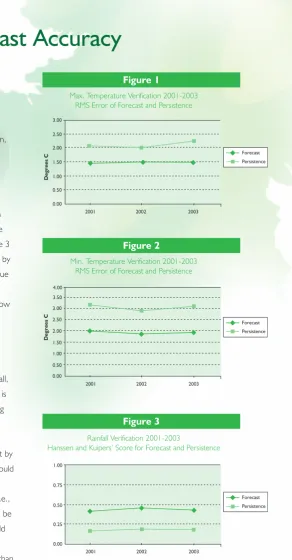
Figures 1 and 2 show the mean annual Root Mean Square (RMS) errors for the maximum and minimum temperature forecasts for the years 2001 – 2003 (the smaller the RMS error, the better the forecast). Figure 3 shows the mean annual verification of rainfall amount by means of Hanssen and Kuipers’ Score – this has a value of 1 for a perfect forecast, and zero for a random forecast, i.e. one lacking any skill. The Figures also show corresponding mean annual scores for persistence.
For 2003, the mean Root Mean Square error for the maximum temperature forecast is about 1.5°C, and about 1.9°C for the minimum temperature. For rainfall, the average value of the Hanssen and Kuipers’ Score is 0.42. All these scores are similar to the corresponding values for 2001 and 2002.
An indication of the quality of the forecasts can be got by comparing the forecast scores with the values that would be obtained for a ‘standard’ forecast. Persistence is a commonly-used standard for verification purposes - i.e., a forecast that assumes that tomorrow’s weather will be the same as today’s. Figures 1 - 3 show that, as would be expected, the annual forecast scores for the years 2001 - 2003 are in all cases very substantially better than the persistence scores.
Appendix I - Forecast Accuracy
0.00 1.00 1.50 2.00 2.50 3.00 3.50 4.00 Degrees C Degrees C 0.50 0.00 0.50 1.00 1.50 2.00 2.50 3.00 0.00 0.25 0.50 0.75 1.00
2001 2002 2003
2001 2002 2003
2001 2002 2003
Forecast Persistence Forecast Persistence Forecast Persistence 0.00 1.00 1.50 2.00 2.50 3.00 3.50 4.00 Degrees C Degrees C 0.50 0.00 0.50 1.00 1.50 2.00 2.50 3.00 0.00 0.25 0.50 0.75 1.00
2001 2002 2003
2001 2002 2003
2001 2002 2003
Forecast Persistence Forecast Persistence Forecast Persistence 0.00 1.00 1.50 2.00 2.50 3.00 3.50 4.00 Degrees C Degrees C 0.50 0.00 0.50 1.00 1.50 2.00 2.50 3.00 0.00 0.25 0.50 0.75 1.00
2001 2002 2003
2001 2002 2003
2001 2002 2003
[image:25.595.255.548.99.660.2]Forecast Persistence Forecast Persistence Forecast Persistence
Figure 1
Max. Temperature Verification 2001-2003 RMS Error of Forecast and Persistence
Figure 2
Min. Temperature Verification 2001-2003 RMS Error of Forecast and Persistence
Figure 3
Rainfall Verification 2001-2003
Numerical Weather Prediction
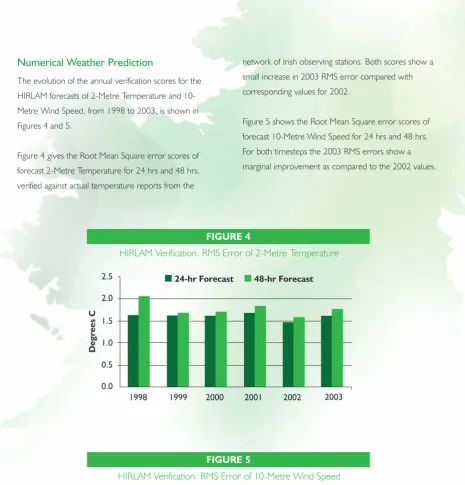
The evolution of the annual verification scores for the HIRLAM forecasts of 2-Metre Temperature and 10-Metre Wind Speed, from 1998 to 2003, is shown in Figures 4 and 5.
Figure 4 gives the Root Mean Square error scores of forecast 2-Metre Temperature for 24 hrs and 48 hrs, verified against actual temperature reports from the
[image:26.595.83.549.70.556.2]network of Irish observing stations. Both scores show a small increase in 2003 RMS error compared with corresponding values for 2002.
Figure 5 shows the Root Mean Square error scores of forecast 10-Metre Wind Speed for 24 hrs and 48 hrs. For both timesteps the 2003 RMS errors show a marginal improvement as compared to the 2002 values.
Met Éireann • Annual Report 2003
FIGURE 4
[image:26.595.171.440.572.708.2]HIRLAM Verification. RMS Error of 2-Metre Temperature
FIGURE 5
Met Éireann • Annual Report 2003
Road Surface Temperature
Forecasts of road conditions are provided under contract to the National Roads Authority. Verification of the Road Surface Temperature (RST) minimum forecasts was carried out during the winter 2002/2003 season for the so-called critical nights (nights on which RSTs less than 5°C were observed) for all available sites. Table 1 shows the Hanssen and Kuipers’ Score and the RMS error for the 2002/2003 forecasts, along with the corresponding values for the winter seasons 2001/2002 and 2000/2001.
The Hanssen and Kuipers’ score for 2002/2003 shows a small improvement compared to the 2001/2002 value. The RMS errors have remained almost unchanged over the three-year period.
Air Temperature Forecasts
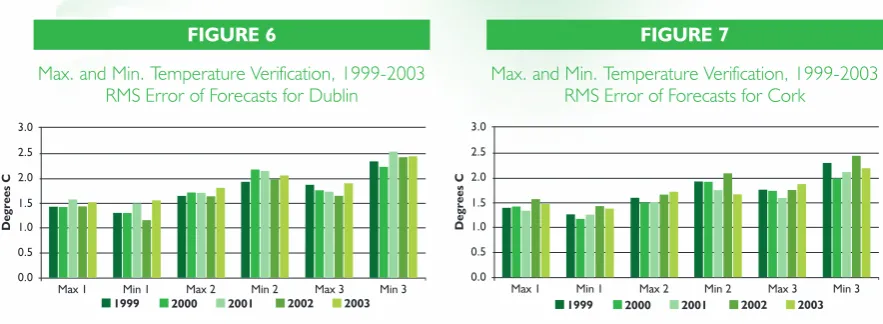
Early morning forecasts of maximum and minimum temperatures for Dublin and Cork, for the current day and the subsequent two days, are issued by General Forecasting Division. These forecasts are subsequently verified against observations at Dublin and Cork Airports. Figure 6 shows the annual RMS error scores for Dublin for the period 1999-2003 (Max1 = max. temperature on current day, Max2 = max. temperature on following day etc). Figure 7 shows the corresponding RMS error scores for Cork.
[image:27.595.78.486.272.400.2]Generally speaking the 2003 RMS scores are comparable with those of 2002. The errors for Dublin show a small increase, while for Cork there are small improvements in the RMS errors for minimum temperature, offset by marginal increases in the Max2 and Max3 errors.
Table 1 Hanssen and Kuipers’ RMS Error
Score
2002-2003 0.68 1.6°C
2001-2002 0.62 1.7°C
2000-2001 0.70 1.7°C
0.0 0.5 1.0 1.5 2.0 2.5 3.0
Max 1 Min 1 Max 2 Min 2 Max 3 Min 3
Deg
rees C
1999 2000 2001 2002 2003
Max. and Min. Temperature Verification, 1999-2003 RMS Error of Forecasts for Dublin
0.0 0.5 1.0 1.5 2.0 2.5 3.0
Max 1 Min 1 Max 2 Min 2 Max 3 Min 3
Deg
ree
s C
1999 2000 2001 2002 2003
Max. and Min. Temperature Verification, 1999-2003 RMS Error of Forecasts for Cork
[image:27.595.56.498.491.653.2]Met Éireann • Annual Report 2003
Finkele, K., Katzfey, J. J., Kowalczyk, E. A., McGregor,
J. L., Zhang, L. and Raupach, M.R. 2003: Modelling of
the oasis energy flux measurements using two canopy
concepts. Boundary-Layer Meteorology 107, 49-79.
Lopez, P., Finkele, K., Clark, P. and Mascart, P. 2003:
Validation and intercomparison of three mesoscale
models on three FASTEX cloud systems: Comparison
with coarse-resolution simulations. Q. J .R. Meteorol.
Soc. 129, 1841-1871.
Lynch, P. 2003: Resonant Rossby Wave Triads and the
Swinging Spring. Bull. Amer. Met. Soc. 84, 605-616.
Lynch, P. 2003: Richardson Extrapolation: The Power
of the 2-gon. Mathematics Today 39, 159-160.
Lynch, P. 2003: On the Significance of the Titius-Bode
Law for the Distribution of the Planets. Mon. Not. R.
Astron. Soc. 341, 1174-1178.
Lynch, P. 2003: Introduction to Initialization. Pp.
97-111 in Data Assimilation for the Earth System. Eds, R.
Swinbank, V. Shutyaev and W. Lahoz. 378pp.
Lynch, P. 2003: Digital Filter Initialization. Pp.
113-126 in Data Assimilation for the Earth System. Eds, R.
Swinbank, V. Shutyaev and W. Lahoz. 378pp.
Lynch, P. 2003: Margules’ Tendency Equation and
Richardson’s Forecast. Weather 58, 186-193.
McDonald, A. 2003: Transparent boundary
conditions for the shallow water equations: testing in
a nested environment. Monthly Weather Review
131, 698-705.
McDonald, A. 2003: Implication of steep orography
for time stepping schemes. HIRLAM Workshop
Report on Mesoscale Modelling, 14-16 October,
2002. Pp 6-9.
McDonald, A. 2003: Lateral boundary conditions for
nested systems. HIRLAM Workshop Report on
Mesoscale Modelling, 14-16 October, 2002. Pp 9-15.
McDonald, A. 2003: Sensitivity and robustness of
transparent boundary conditions. HIRLAM newsletter
43, 135-139.
McDonald, A. 2003: Re-arranging the HIRLAM
boundary relaxation treatment. HIRLAM newsletter
43, 140-142.
Met Éireann • Annual Report 2003
Appendix III - Met Éireann Finances
The figures presented below are approximate and for information only. They do not form part of the official annual accounts of Met Éireann.
Income and Expenditure 2003/2002
2003 2002 2003 2002 ,000 ,000 ,000 ,000
Salaries and Related Expenses (A1) 13,619 12,323
Other Operating Expenses 2,495 2,614
Capital Expenditure 558 930
Contributions to International Organisations 2,694 2,286
Total 19,366 18,153
Receipts from Eurocontrol (Route Charges) 6,735 6,984
Receipts from Commercial and Cost Recovery Activities 1,398 1,444
Total Receipts 8,133 8,428
Net Cost of Operations 11,233 9,725
Some details of above
A1
Salaries 12,696 11,660
Overtime 724 518
Payment to Observers 103 97
Other Allowances 96 48
A2 (Travel & Subsistence) 245 243
A3 (Training/Merit Awards/Cleaning etc) 248 404
A4 (Communications & Post) 261 241
A5 (Computing - Capital) 200 423
A5 (Computing - Non-Capital) 620 572
A6 (Maintenance/Energy) 572 553
A7 (Consultancy) 98 70
A8 (Instrumentation – Capital) 358 507
A8 (Instrumentation – Non-Capital) 451 531
16,672 15,867
Some details of commercial/cost recovery receipts
Aviation 20 27
Climatological Information 188 171
General Forecasting 1,161 1,219
Miscellaneous 29 27
Met Éireann • Annual Report 2003
Met Éireann Headquarters
Glasnevin Hill
Dublin 9, Ireland
Tel: +353-1-806 4200
Fax: +353-1-806 4247
e-mail: [email protected]
web: www.met.ie
General Forecasting
Tel: +353-1-806 4255
Fax: +353-1-806 4275
e-mail: [email protected]
Climatology and Observations
Tel: +353-1-806 4260
Fax: +353-1-806 4216
e-mail: [email protected]
Commercial Division
Tel: +353-1-806 4244
Fax: +353-1-806 4247
e-mail: [email protected]
Met Éireann
Valentia Observatory
Cahirciveen
Co. Kerry
Tel: +353-66-947 3460
Fax: +353-66-947 2442
Met Éireann
Dublin Airport
Co. Dublin
Tel: +353-1-812 0081
Fax: +353-1-844 4633
Met Éireann
Shannon Airport
Co Clare
Tel: +353-61-712 950
Fax: +353-61-712 962
Met Éireann
Cork Airport
Cork
Tel: +353-21-491 7750
Fax: +353-21-431 7405
Met Éireann
Connaught Airport
Knock
Co. Mayo
Tel: +353-94-936 7368
Fax: +353-94-936 7390
Met Éireann • Annual Report 2003
AGMET Joint Working Group on Applied Agricultural Meteorology
ASD Aviation Services Division
AWS Automatic Weather Station
C4I Community Climate Change Consortium for Ireland
CAFO Central Analysis and Forecast Office
CAIRDE Computerised Air Traffic Integrated Radar Display Equipment
CAO Central Aviation Office
DEHLG Department of the Environment, Heritage and Local Government
ECMWF European Centre for Medium-Range Weather Forecasts
ECOMET European Co-operation in Meteorology
EGOS European Group on Ocean Stations
EPA Environmental Protection Agency
EUCOS European Composite Observing System
EUMETNET Network of European Meteorological Services
EUMETSAT European Organisation for the Exploitation of Meteorological Satellites
FIR Flight Information Region
GHG Greenhouse Gas
GTS Global Telecommunication System
HIRLAM High-Resolution Limited Area Model
ICAO International Civil Aviation Organisation
IPCC Intergovernmental Panel on Climate Change
IT Information Technology
LAF Local Area Forecast
MIF Management Information Framework
MSG Meteosat Second Generation
NWP Numerical Weather Prediction
PMDS Performance Management and Development System
QMS Quality Management System
PRISM Programme for Integrated Earth System Modelling
RCM Regional Climate Model
RMDCN Regional Meteorological Data Communications Network
RMS Error Root Mean Square Error
RST Road Surface Temperature
SES Single European Sky
SIGMET Information on occurrence of specified aviation weather phenomena
TAF Terminal Aerodrome Forecast
TUCSON The Unified Climate and Synoptic Observation Network
VPN Virtual Private Network
WAM Wave Forecast Model
WMO World Meteorological Organisation
Acknowledgements and photo credits
Ian Dickson
University College Dublin Aer Rianta
Met Éireann staff