Fusing Document, Collection and Label Graph-based Representations
with Word Embeddings for Text Classification
Konstantinos Skianis ´Ecole Polytechnique
France
Fragkiskos D. Malliaros CentraleSup´elec and Inria Saclay
France
Michalis Vazirgiannis ´Ecole Polytechnique
France
Abstract
Contrary to the traditional Bag-of-Words approach, we consider the Graph-of-Words(GoW) model in which each doc-ument is represented by a graph that en-codes relationships between the different terms. Based on this formulation, the importance of a term is determined by weighting the corresponding node in the document, collection and label graphs, using node centrality criteria. We also introduce novel graph-based weighting schemes by enriching graphs with word-embedding similarities, in order to reward or penalize semantic relationships. Our methods produce more discriminative fea-ture weights for text categorization, out-performing existing frequency-based cri-teria. Code and data are available online1.
1 Introduction
With the rapid growth of the social media and net-working platforms, the available textual resources have been increased. Text categorizationor clas-sification (TC) refers to the supervised learning task of assigning a document to a set of two or more predefined categories (or classes) ( Sebas-tiani, 2002). Well-known applications of TC in-clude sentiment analysis, spam detection and news classification.
In the TC pipeline, each document is modeled using the so-called Vector Space Model ( Baeza-Yates and Ribeiro-Neto, 1999). The main issue here is how to find appropriate weights regard-ing the importance of each term in a document. Typically, the Bag-of-Words (BoW) model is ap-plied and a document is represented as a multiset of its terms, disregarding co-occurence between
1Code and data:github.com/y3nk0/Graph-Based-TC
Document GoWs
Collection GoW
Word Vectors
(w2v) Label GoWs
ICW (w2v) ICW-LW LW(w2v)
[image:1.595.319.485.228.363.2]ICW-LW (w2v)
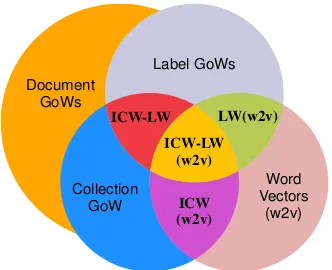
Figure 1: Blending different types of GoWs and word vector similarities in one framework.
the terms; using this model, the importance of a term in a document is mainly determined by the frequency of the term. Although several variants and extensions of this modeling approach have been proposed (e.g., the n-gram model ( Baeza-Yates and Ribeiro-Neto, 1999)), the main weak-ness comes from the underlying term indepen-dence assumption, where the order of the terms is also completely disregarded.
After the introduction of deep learning models for TC (Blunsom et al.,2014;Kim,2014), recent work by Johnson and Zhang (2015) shows how we could effectively use the order of words with CNNs (LeCun et al.,1995). In many cases though, space and time limitations may arise due to com-plex neural network architectures. As stated in work byJoulin et al.(2017), computation can still be expensive and prohibitive.
In this paper, we explore fast term weighting criteria for TC that go beyond the term indepen-dence assumption. The notion of dependencies between terms is introduced via aGraph-of-Words (GoW) representation model. Under this model, each term is represented as a node in the graph and the edges capture co-occurrence relationships
of terms with a specified distance in the document. We implicitly consider information aboutn-grams
in the document as well as the collection of doc-uments – expressed by paths in the graph – with-out increasing the dimensionality of the problem. Furthermore, we introduce word-embedding sim-ilarities as weights in the GoW approach, in order to further boost the performance of our methods. Finally, we successfully mix document, collection and label GoWs along with word vector similari-ties into a single powerful graph-based framework. An overview of our approach is shown in Fig.1.
2 Related Work
Term weighting schemes. A core aspect in the
Vector Space Modelfor document representation, is how to determine the importance of a term within a document. Many criteria have been introduced with the most prominent ones being TF, TF-IDF (Salton and Buckley, 1988; Sing-hal et al., 1996; Baeza-Yates and Ribeiro-Neto,
1999;Robertson,2004) and Okapi BM25 ( Robert-son et al., 1995), while some recent ones in-clude N-gram IDF (Shirakawa et al., 2015). Lan et al. (2005) conducted a comparative study of frequency-based term weighting criteria for text categorization; one of their outcomes was that, in many cases, the IDF factor is not significant for the categorization task, leading to no improvement of the performance. It is interesting to point out here that, more specialized approaches have been proposed for specific classification tasks, such as the Delta TF-IDF method that constitutes an ex-tension of TF-IDF for sentiment analysis ( Mar-tineau and Finin,2009). However, most of the pre-viously proposed frequency-based weights con-sider the document as a Bag-of-Words; that way, any structural information about the ordering or in general, syntactic relationship of the terms, is ig-nored by the weighting process.
Text categorization. A number of diverse
ap-proaches have been proposed for TC (Joachims,
1998;McCallum and Nigam,1998;Nigam et al.,
2000; Sebastiani, 2002; Kim et al., 2006). The first step of TC concerns the feature extraction task, i.e., which features will be used to repre-sent the textual content. Typically, the straight-forwardBag-of-Wordsapproach is adopted, where every document is represented by a feature vector that contains boolean or weighted representation of unigrams or n-grams in general. In the case
of weighted feature vectors, various term weight-ing schemes have been used, with the most well-known ones being TF (Term Frequency), TF-IDF (Term Frequency - Inverse Document Frequency). Although these weighting schemes were initially introduced in the NLP and IR fields, they have also been applied in the TC task. Paltoglou and Thelwall(2010) reported that, in the case of senti-ment analysis, extensions of the TF-IDF weighting schemes introduced in the IR field, can further im-prove the classification accuracy. A comprehen-sive review of this area is offered in the article by
Sebastiani(2002).
Deep Learning for TC. With the rise of deep
learning models, CNNs were applied for text clas-sification (Blunsom et al.,2014;Kim,2014; John-son and Zhang,2015). Next, Zhang et al.(2015) presented Character-level CNNs for the task of TC. Finally,Joulin et al.(2017) proposed a novel text classifier which achieves equivalent perfor-mance to state-of-the-art TC models, with faster learning times. Our work does not focus on the classifier part, as the aforementioned methods, but on the extraction of better features.
Graph-based text categorization. In the
re-lated literature, most of the graph-based method for TC, rely on graph mining algorithms that are applied to extract frequent subgraphs, which are then used to produce feature vectors for classifi-cation (Deshpande et al.,2005;Jiang et al.,2010;
Rousseau et al., 2015; Nikolentzos et al., 2017). The basic shortcoming of those methods stems from the computational complexity of the frequent subgraph mining algorithm. Furthermore, most of these methods require from the user to set the sup-port parameter, which concerns the frequency of appearance of a subgraph. Close to our work are the approaches followed by Hassan et al. (2007) andMalliaros and Skianis (2015); they explored how random walks and other graph centrality cri-teria can be applied to determine the importance of a term.
Graph-based text mining, NLP and IR.
sev-d1: A method for the solution
of systems of linear equations
Label: 0
Gd1 →
method solution
system linear
equation
w1,d1 w2,d1
w3,d1 w4,d1
w5,d1 w6,d1
d2: A solution to a
linear system
Label: 1
Gd2 → solution
system
linear
Document-level GoWs for d1, d2. w2,d2
w7,d2 w4,d2
method solution
system linear
equation
Collection-level GoWG. w1 w2
w3 w7
w4
w5 w6
method solution
system linear
equation
Label 0 GoW
solution
system
linear
Label 1 GoW
[image:3.595.89.519.61.256.2]Label GoWs for two classes.
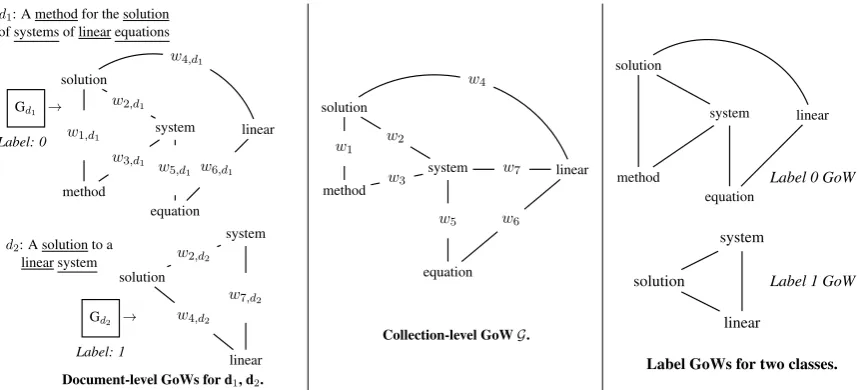
Figure 2: Example of document, collection-level and label GoWs for a collection composed by two documents and window sizew= 3. Weights on the edges ofGd1 andGd2 correspond to the similarity
of two terms in the vector space. Here, Label GoWs are the same with Document GoWs (one document per class-label).
eral methods for those tasks were followed (Erkan and Radev,2004;Litvak and Last,2008;Boudin,
2013;Lahiri et al.,2014;Rousseau and Vazirgian-nis, 2015). Another domain where graph-based term weighting schemes have been applied is the one of ad hoc Information Retrieval (Rousseau and Vazirgiannis,2013). An interesting survey can be found in the work ofBlanco and Lioma(2012) for a detailed description of graph-based methods in the text domain.
3 Preliminaries and Background
LetD ={d1, d2, . . . , dm}be a collection of
doc-uments and letC ={c1, c2, . . . , c|C|}be the set of
predefined categories. Text categorization is con-sidered the task of assigning a boolean value to each pair (di, ci) ∈ D × C, i.e., assigning each
document to one or more categories (Sebastiani,
2002). The main point here is how to find appro-priateweightsfor the terms within a document. As we will present below shortly, our approach uti-lizes network centrality criteria.
Node Centrality Criteria. Centrality2
repre-sents a central notion in graph theory and network analysis in general; it constitutes of measures that capture the relative importance of the node in the graph based on specific criteria (Newman,2010). One important characteristic of the centrality mea-sures is that they consider eitherlocalinformation
2en.wikipedia.org/wiki/Centrality.
of the graph (e.g., degree centrality, in-degree/out-degree centrality in directed networks, weighted degree in weighted graphs, clustering coefficient) (Newman,2010), or moreglobalinformation – in the sense that the importance of a node is deter-mined by the properties of the node globally in the graph (e.g., PageRank, closeness). Let G = (V, E)be a graph (directed or undirected), and let |V|,|E|be the number of nodes and edges
respec-tively. Next, we define basic centrality criteria that are used in the proposed methodology.
Degree centrality. The degree centrality is one of the simplest local node importance criteria, which captures the number of neighbors that each node has. Let N(i) be the set of nodes
con-nected to nodei. Then, the degree centrality can be derived based on the following formula: de-gree centrality(i) = |N|V|−(i)1|.
Closeness centrality. Letdist(i, j)be the shortest
path distance between nodesiandj. The
close-ness centrality of a nodeiis defined as the inverse
of the average shortest path distance from the node to any other node in the graph: closeness(i) =
|V|−1
P
j∈Vdist(i,j).
PageRank centrality. PageRank counts the num-ber and quality of edges to a node to determine a rough estimate of how important the node is: PR(i) = 1|−Vα| +αP∀(j,i)∈E out-deg(j)PR(j) , where α
4 Proposed Framework
In this section, we present the components of the proposed graph-based framework for TC.
4.1 Graph Construction
We model documents as graphs that capture de-pendencies between terms. More precisely, each document d ∈ D is represented by a graph
Gd = (Vd, Ed), where the nodes correspond to
the termstof the document and the edges capture
co-occurrence relationships between terms within a fixed-size sliding window of sizew. That is, for
all the terms that co-occur within the window, we add edges between the corresponding nodes of the graph. Note that, the windows are overlapping starting from the first term of the document; at each step, we simply remove the first term of the window and add the new one from the document. As graphs constitute rich modeling structures, sev-eral parameters about the construction phase need to be specified, including the directionality of the edges, the addition of edge weights, well as the size wof the sliding window. Fig. 2 gives a toy
example of the construction of GoW for a collec-tion composed by two documents.
To summarize, the key point of the graph-based representation for TC is the fact that it deals with the term independence assumption. Even if we consider then-gram model, still information about
the relationship between two differentn-grams is
not fully captured – as happens in the case of graphs. This has also been noted in other applica-tion domains (e.g., IR (Rousseau and Vazirgiannis,
2013)).
4.2 Term Weighting
Having the graph, the importance of a term in a document can be inferred by the importance of the corresponding node in the graph. In the previ-ous section, we presented local and global central-ity criteria that have been widely used for graph mining and network analysis purposes; here, we propose that those criteria can also be used for weighting terms in the TC task. That way, sim-ilar to TF, we can define the Term Weight (TW) weighting scheme as TW(t, d) = centrality(t, d),
where centrality(t, d) corresponds to the score of
term (node) t in the graph representation Gd of
documentd. The interesting point here is that TW
can be used along with any centrality criterion in the graph, local or global.
Furthermore, we can extend this weighting scheme by considering information about the in-verse document frequency (IDF factor) of the term
tin the collectionD. That way, we can derive the TW-IDF model as follows:
TW-IDF(t, d) =TW(t, d)×IDF(t,D). (1) In fact, TW and TW-IDF constitute suites for graph-based term-weighting schemes and thus, can be applied in any text analytics task. Some of them have already been explored in graph-based IR (Rousseau and Vazirgiannis, 2013) and keyword extraction (Mihalcea and Tarau, 2004;
Rousseau and Vazirgiannis,2015).
The proposed weights are inferred from the in-terconnection of features (i.e., terms) – as sug-gested by the graph – and therefore information about n-grams is implicitly captured. That way,
the feature space of the learning problem is kept to the one defined by the unique unigrams of our collection (instead of using simultaneously as fea-tures all the possible unigrams, bigrams,3-grams,
etc.), but the produced term weights incorporate
n-gram information through the graph-based
rep-resentation.
4.3 Inverse Collection Weight (ICW)
In this paragraph, we introduce the concept of In-verse Collection Weight (ICW) – a graph-based criterion to penalize the weight of terms that are “important” across the whole collection of docu-ments. The main concept behind ICW is the col-lection levelgraphG– an extension of the
Graph-of-Wordsin the collection of documentsD.
Definition 1 (Collection Level GraphG) Let
{G1, G2, . . . , Gd}|D| be the set of graphs that
correspond to all documents d ∈ D. The
col-lection level graph G is defined as the union of graphsG1∪G2∪. . .∪Gdover all documents in
the collection.
The union of two graphsG= (VG, EG)andH = (VH, EH)is defined as the union of their node and
edge sets, i.e.,G∪H = (VG∪VH, EG∪EH). The
number of nodes in graphGis equal to the number of unique terms in the collection, while the number of edges is equal to the number of unique edges over all document-level graphs (see also Fig.2).
be proportional to the importance of the corre-sponding node in G. Following similar method-ological arguments as used for IDF (Robertson,
2004), we define a probability distribution over the nodes of G (or equivalently, the unique terms of
D), with respect to a centrality (term-weighting in
our case) criterion; then, the probability of node (term)twill be:
Pr(t) = P TW(t,D)
v∈DTW(v,D)
. (2)
Note that, in Eq. (2), we useDinstead ofG; we consider that the space defined by the document collection D is equivalent to the one defined by
graph G with respect to the unique terms of the collection. This way, the notion of TW(t,D)used
here is consistent with what was described earlier. Based on this, we define the ICW measure as:
ICW(t,D) = maxv∈DTW(v,D)
TW(t,D) . (3)
Instead of selecting themaximumcentrality in the collection level (Eq. (3)), thesumof all centralities also yields good results.
ICW shares common intuition with the in-verse total term frequencydescribed inRobertson
(2004). In fact, it can be considered as an exten-sion of the total collection frequency of a term, to the graph-based document representation. Fur-thermore, similar to TW, it can be used along with any node centrality criterion.
Using ICW as a graph-based collection-level term penalization factor, we derive a new class of term-to-document weighting mechanism, namely TW-ICW. This weighting scheme is derived com-bining different local (i.e., document-level) and global (i.e., collection-level) criteria as follows:
TW-ICW(t, d) =TW(t, d)×log(ICW(t,D)).
In the case of TW and ICW, any centrality crite-rion can be applied. However, the computational complexity is a crucial factor that should be taken into account. Nevertheless, as we have noticed from the experimental evaluation, even using sim-ple and easy-to-compute local criteria (e.g., de-gree), we achieve good classification performance.
4.4 Label Graphs
Shanavas et al.(2016) introduced supervised term weighting (TW-CRC) as a method to integrate class information with graphs. Similarly, we cre-ate a graph for each class (label), where we add all
words of documents belonging to the respective class as nodes and their co-occurrence as edges. Our weighting scheme is a variant of TW-CRC; we define LW for a termtas:
LW(t) = max(deg(t, L))
max(avg(deg(t, L)),min(deg(L)),
where the maximum degree of termtin all label
graphs (L) is divided by the max of two values:
the average degree of the term in all label graphs (except the one having the max degree) and the min degree of all the terms in all the label graphs. Then, we obtain ICW-LW as follows:
ICW-LW(t, d) = log(ICW(t,D)×LW(t)),
and multiply it with TW(t, d)to get TW-ICW-LW.
Notice that, supervised frequency-based methods have also been proposed in previous work (Debole and Sebastiani,2004;Huynh et al.,2011).
4.5 Edge Weighting using Word Embeddings
With our proposed framework, we can now use word embeddings (Bengio et al.,2003) in order to extract similarities between terms. Our goal is to integrate these similarities in the graph represen-tation as weights on the edge between two words. The key idea behind our approach is that we want to reward semantically close words in the graph-document level (TW) and penalize them in the col-lection level (ICW).
The most commonly used similarity between two wordst1andt2in the word-embedding space
is cosine similarity, which ranges between -1 and 1. In order to have a valid distance metric, we need to bound this between 0 and 1. We use the angu-lar simiangu-larity to represent the weight of an edge between two words, and since the vector elements may be positive or negative, the formula becomes:
weight(t1, t2)= 1−arccos(sim(t1, t2))
π . (4)
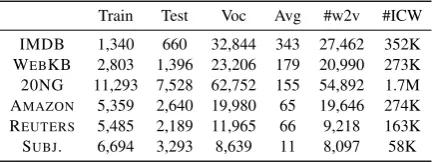
Table 1: Datasets’ statistics: #ICW shows the number of edges in the collection-level graph; #w2v: number of words that exist in pre-trained vectors.
Train Test Voc Avg #w2v #ICW
IMDB 1,340 660 32,844 343 27,462 352K
WEBKB 2,803 1,396 23,206 179 20,990 273K
20NG 11,293 7,528 62,752 155 54,892 1.7M
AMAZON 5,359 2,640 19,980 65 19,646 274K REUTERS 5,485 2,189 11,965 66 9,218 163K
SUBJ. 6,694 3,293 8,639 11 8,097 58K
A similar approach for generic keyphrase ex-traction can be tracked in work by Wang et al.
(2015). Providing more information in the weights, like number of co-occurrences between words, did not yield better results.
4.6 Classification Algorithms
Since the goal of this paper is to introduce new term weighting schemes, we rely on widely used classification algorithms. Specifically, we have used linear SVMs, due to their superior perfor-mance in TC (Joachims, 1998). Furthermore, as discussed inLeopold and Kindermann(2002), the choice of the kernel function of SVM is not very crucial, compared to the significance of the term weighting schemes.
5 Experiments
We have evaluated our method on six freely avail-able standard TC datasets, covering multi-class document categorization, sentiment analysis and subjectivity. Specifically: (1) 20NG3: news-group documents belonging to 20 categories, (2)
REUTERS3: 8 categories of Reuters-21578, (3)
WEBKB3: 4 most frequent categories of
web-pages from Computer Science departments, (4) IMDB (Pang and Lee, 2004): positive and nega-tive movie reviews; (5) AMAZON (Blitzer et al.,
2007): product reviews acquired from Amazon over four different sub-collections; (6) SUBJEC -TIVITY (Pang and Lee, 2004): contains subjec-tive sentences gathered from Rotten Tomatoes and objective sentences gathered from IMDB. A sum-mary of the datasets can be found in Table 1.
In the experiments, linear SVMs were used with grid search cross-validation for tuning the C
pa-rameter. We also examined logistic regression, and observed similar performance. In the text
3web.ist.utl.pt/acardoso/datasets/
preprocessing step, we have removed stopwords. No stemming or lowercase transformation was ap-plied in order to match the words inword2vec.
For evaluation we use macro-average F1 score and classification accuracy on the test sets; that way, we deal with the skewed class size dis-tribution of some datasets (Sebastiani, 2002). For the notation of the proposed schemes, we use TW (centrality measure) (e.g., TW (degree)) to indicate the centrality and TW-ICW (central-ity at G, centrality at G) (e.g., TW-ICW
(de-gree, degree)) for the local and collection-level graphs respectively. In TW-IDF (w2v), we com-pute the weighted degree centrality on the docu-ment level, with word-embedding similarities as weights. Similarly, in TW-ICW (w2v) we com-pute both weighted centralities for document and collection graphs. Finally, we denote as TW-ICW-LW the blending of TW, ICW and label graphs (LW). In label graphs we only make use of the de-gree centrality, since it is fast and performs best.
5.1 Results
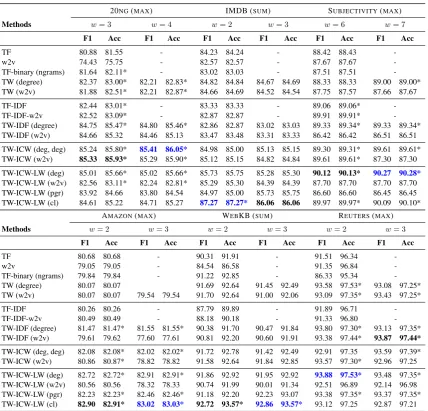
Table 2 presents the results concerning the cate-gorization performance of the proposed schemes for the six datasets. As discussed previously, the size of the window considered to create the graphs is one of the model’s parameters. From the ex-tensive experimental evaluation that we have per-formed, we have concluded that small window sizes give the most persistent results across var-ious datasets and weighting schemes. For com-pleteness in the presentation, we report results for two window sizes. In order to capture more in-formation, we need larger window sizes for small datasets (e.g. SUBJECTIVITY). Also, since for the baseline methods (TF, TF binary, TF-IDF, w2v, TF-IDF-w2v) there is no notion of window size, the results for w = {2,3} are the same. We have also examined several centrality criteria (us-ing both undirected and directed graphs); undi-rected giving better results.
Table 2: Macro-F1 and accuracy for window sizew. Bold shows the best performance on each window
size and blue the best overall on each dataset. * indicates statistical significance of improvement over TF atp <0.05using micro sign test. MAX and SUM state the best nominator for ICW in Eq. (3).
20NG(MAX) IMDB (SUM) SUBJECTIVITY(MAX)
Methods w= 3 w= 4 w= 2 w= 3 w= 6 w= 7
F1 Acc F1 Acc F1 Acc F1 Acc F1 Acc F1 Acc
TF 80.88 81.55 - 84.23 84.24 - 88.42 88.43
-w2v 74.43 75.75 - 82.57 82.57 - 87.67 87.67
-TF-binary (ngrams) 81.64 82.11* - 83.02 83.03 - 87.51 87.51
-TW (degree) 82.37 83.00* 82.21 82.83* 84.82 84.84 84.67 84.69 88.33 88.33 89.00 89.00* TW (w2v) 81.88 82.51* 82.21 82.87* 84.66 84.69 84.52 84.54 87.75 87.57 87.66 87.67
TF-IDF 82.44 83.01* - 83.33 83.33 - 89.06 89.06*
-TF-IDF-w2v 82.52 83.09* - 82.87 82.87 - 89.91 89.91*
-TW-IDF (degree) 84.75 85.47* 84.80 85.46* 82.86 82.87 83.02 83.03 89.33 89.34* 89.33 89.34* TW-IDF (w2v) 84.66 85.32 84.46 85.13 83.47 83.48 83.31 83.33 86.42 86.42 86.51 86.51 TW-ICW (deg, deg) 85.24 85.80* 85.41 86.05* 84.98 85.00 85.13 85.15 89.30 89.31* 89.61 89.61* TW-ICW (w2v) 85.33 85.93* 85.29 85.90* 85.12 85.15 84.82 84.84 89.61 89.61* 87.30 87.30 TW-ICW-LW (deg) 85.01 85.66* 85.02 85.66* 85.73 85.75 85.28 85.30 90.12 90.13* 90.27 90.28*
TW-ICW-LW (w2v) 82.56 83.11* 82.24 82.81* 85.29 85.30 84.39 84.39 87.70 87.70 87.70 87.70 TW-ICW-LW (pgr) 83.92 84.66 83.80 84.54 84.97 85.00 85.73 85.75 86.60 86.60 86.45 86.45 TW-ICW-LW (cl) 84.61 85.22 84.71 85.27 87.27 87.27* 86.06 86.06 89.97 89.97* 90.09 90.10*
AMAZON(MAX) WEBKB (SUM) REUTERS(MAX)
Methods w= 2 w= 3 w= 2 w= 3 w= 2 w= 3
F1 Acc F1 Acc F1 Acc F1 Acc F1 Acc F1 Acc
TF 80.68 80.68 - 90.31 91.91 - 91.51 96.34
-w2v 79.05 79.05 - 84.54 86.58 - 91.35 96.84
-TF-binary (ngrams) 79.84 79.84 - 91.22 92.85 - 86.33 95.34
-TW (degree) 80.07 80.07 91.69 92.64 91.45 92.49 93.58 97.53* 93.08 97.25* TW (w2v) 80.07 80.07 79.54 79.54 91.70 92.64 91.00 92.06 93.09 97.35* 93.43 97.25*
TF-IDF 80.26 80.26 - 87.79 89.89 - 91.89 96.71
-TF-IDF-w2v 80.49 80.49 - 88.18 90.18 - 91.33 96.80
-TW-IDF (degree) 81.47 81.47* 81.55 81.55* 90.38 91.70 90.47 91.84 93.80 97.30* 93.13 97.35* TW-IDF (w2v) 79.61 79.62 77.60 77.61 90.81 92.20 90.60 91.91 93.38 97.44* 93.87 97.44*
TW-ICW (deg, deg) 82.08 82.08* 82.02 82.02* 91.72 92.78 91.42 92.49 92.91 97.35 93.59 97.39* TW-ICW (w2v) 80.86 80.87* 78.82 78.82 91.58 92.64 91.84 92.85 93.57 97.30* 92.96 97.25 TW-ICW-LW (deg) 82.72 82.72* 82.91 82.91* 91.86 92.92 91.95 92.92 93.88 97.53* 93.48 97.35* TW-ICW-LW (w2v) 80.56 80.56 78.32 78.33 90.74 91.99 90.01 91.34 92.51 96.89 92.14 96.98 TW-ICW-LW (pgr) 82.23 82.23* 82.46 82.46* 91.18 92.20 92.23 93.07 93.38 97.35* 93.37 97.35* TW-ICW-LW (cl) 82.90 82.91* 83.02 83.03* 92.72 93.57* 92.86 93.57* 93.12 97.25 92.87 97.21
the IDF penalization factor is applied on the TW term-to-document weighting, a powerful mecha-nism is derived. In the case of purely graph-based schemes, we can observe that some of them pro-duce very good classification results. In almost all cases, TW-ICW-LW (degree or closeness) achieve the best performance.
Significant improvement is observed by adding the w2v similarities as weights in the document, collection level and label graphs in almost all datasets. In fact, we have obtained better results in 20NG (TW-ICW (w2v)), WebKB (TW-ICW (w2v)) and Reuters (TW-IDF(w2v)), by boosting semantically close words in the document level and penalizing them in the collection level.
TFn-gram binary scheme (TF binary) has also
been examined, i.e., all the possible n-grams of the collection with binary weights (up to6-grams
in our experiments). For comparison reasons, the size of the unigram feature space considered by our framework is equal to the unique terms in the collections and much smaller compared to the
n−grams ones. Moreover, graph-based weighting
20NG IMDB SUBJ. AMAZON WEBKB REUTERS
[image:8.595.76.289.212.346.2]CNN (no w2v, 20 ep.) (Kim,2014) 83.19 74.09 88.16 80.68 88.17 94.75 FastText (100 ep.) (Joulin et al.,2017) 79.70 84.70 88.60 79.50 92.60 97.00 TextRank (Mihalcea and Tarau,2004) 82.56 83.33 84.78 80.49 92.27 97.35 Word Attraction (Wang et al.,2015) 61.24 70.75 86.60 78.29 79.46 91.34 TW-CRC (Shanavas et al.,2016) 85.35 85.15 89.28 81.13 92.71 97.39 TW-ICW-LW (ours) 86.05 87.27 90.28 83.03 93.57 97.53
Table 3: Comparison in accuracy(%) to state-of-the-art deep learning and graph-based approaches.
1 2 3 4 5 6 7 8 9 10 11 Window Size w
0.87 0.88 0.89 0.90 0.91 0.92 0.93 0.94
F1 Score
1 2 3 4 5 6 7 8 9 10 11 Window Size w
0.88 0.90 0.92 0.94 0.96 0.98
Accuracy
Reuters: TW Reuters: TW-ICW Reuters: TW-ICW-LW
WebKB: TW WebKB: TW-ICW WebKB: TW-ICW-LW
Subj: TW Subj: TW-ICW Subj: TW-ICW-LW
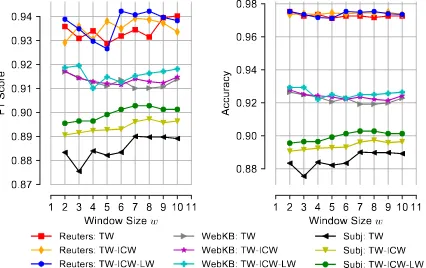
Figure 3: F1 score (left) and accuracy (right) of TW, TW-ICW and TW-ICW-LW (all degree) on REUTERS, WEBKB and SUBJECTIVITY, for win-dow sizew={2, . . . ,10}.
terms concerning different labels can be close in the word vector space. Choosing closeness in the document level GoW yields the best performance in 3 datasets. Closeness can only have an affect in larger document lengths and when used along with label graphs.
To further investigate the effectiveness of our approach, we have compared our results with cur-rent state-of-the-art based and non graph-based methods. In Table 3 we compare against CNN for text classification ,without pre-trained word vectors (Kim,2014), FastText (Joulin et al.,
2017), TextRank (Mihalcea and Tarau, 2004), Word Attraction weights based on word2vec sim-ilarities (Wang et al.,2015) and Supervised Term Weighting (TW-CRC) byShanavas et al. (2016). Our work produces comparable to state-of-the-art results. Since the implementation of most models is our own, their performance is not optimal.
Selecting the window size w is also
impor-tant. As we observed, the maximum accuracy is achieved while using small window sizes. In any case, even if larger values ofw were able to
get slightly better results, a smaller window size would be preferable, due to the overall overhead
that could be introduced (increase of the density of the graph). Figure3 depicts the F1 score and accuracy on the WEBKB, REUTERSand SUBJEC -TIVITYdatasets, using the TW, ICW and TW-ICW-LW(deg) schemes for various window sizes. We notice also that larger sliding windows are only improving accuracy in datasets with small docu-ment length (e.g. SUBJECTIVITY).
6 Conclusion & Future Work
In this paper, we proposed a graph-based frame-work for TC. By treating the term weighting task as a node ranking problem of interconnected fea-tures defined by a graph, we were able to deter-mine the importance of a term using node central-ity criteria. Building on this formulation, we intro-duced simple-yet-effective weighting schemes at the collection and label level, in order to penalize globally important terms (as analogous to “glob-ally frequent terms”) and reward loc“glob-ally impor-tant terms respectively. We also incorporate ad-ditional word-embedding information as weights in the graph-based representations.
References
Ricardo A. Baeza-Yates and Berthier Ribeiro-Neto. 1999. Modern Information Retrieval. Addison-Wesley Longman Publishing Co., Inc., Boston, MA, USA.
Yoshua Bengio, R´ejean Ducharme, Pascal Vincent, and Christian Janvin. 2003. A neural probabilistic lan-guage model.J. Mach. Learn. Res.3:1137–1155. Roi Blanco and Christina Lioma. 2012. Graph-based
term weighting for information retrieval. Inf. Retr. 15(1):54–92.
John Blitzer, Mark Dredze, and Fernando Pereira. 2007. Biographies, bollywood, boom-boxes and blenders: Domain adaptation for sentiment classi-fication. InAssociation for Computational Linguis-tics. Prague, Czech Republic.
Phil Blunsom, Edward Grefenstette, and Nal Kalch-brenner. 2014. A convolutional neural network for modelling sentences. In Proceedings of the 52nd Annual Meeting of the Association for Computa-tional Linguistics. Proceedings of the 52nd Annual Meeting of the Association for Computational Lin-guistics.
Florian Boudin. 2013. A comparison of centrality mea-sures for graph-based keyphrase extraction. In IJC-NLP. pages 834–838.
Franca Debole and Fabrizio Sebastiani. 2004. Super-vised term weighting for automated text categoriza-tion. InText mining and its applications, Springer, pages 81–97.
Mukund Deshpande, Michihiro Kuramochi, Nikil Wale, and George Karypis. 2005. Frequent substructure-based approaches for classifying chem-ical compounds. IEEE Trans. on Knowl. and Data Eng.17(8):1036–1050.
G¨unes Erkan and Dragomir R. Radev. 2004. Lexrank: Graph-based lexical centrality as salience in text summarization.J. Artif. Int. Res.22(1):457–479. Samer Hassan, Rada Mihalcea, and Carmen Banea.
2007. Random-walk term weighting for improved text classification. InICSC. pages 242–249. Dat Huynh, Dat Tran, Wanli Ma, and Dharmendra
Sharma. 2011. A new term ranking method based on relation extraction and graph model for text classification. InProceedings of the Thirty-Fourth Australasian Computer Science Conference-Volume 113. Australian Computer Society, Inc., pages 145– 152.
Chuntao Jiang, Frans Coenen, Robert Sanderson, and Michele Zito. 2010. Text classification using graph mining-based feature extraction. Knowl.-Based Syst.23(4):302–308.
Thorsten Joachims. 1998. Text categorization with su-port vector machines: Learning with many relevant features. InECML. pages 137–142.
Rie Johnson and Tong Zhang. 2015. Effective use of word order for text categorization with convolu-tional neural networks. InNAACL HLT 2015, The 2015 Conference of the North American Chapter of the Association for Computational Linguistics: Human Language Technologies, Denver, Colorado, USA, May 31 - June 5, 2015. pages 103–112.
Armand Joulin, Edouard Grave, Piotr Bojanowski, and Tomas Mikolov. 2017. Bag of tricks for efficient text classification. InProceedings of the 15th Con-ference of the European Chapter of the Association for Computational Linguistics. pages 427–431.
Sang-Bum Kim, Kyoung-Soo Han, Hae-Chang Rim, and Sung-Hyon Myaeng. 2006. Some effective techniques for naive bayes text classification. IEEE Trans. Knowl. Data Eng.18(11):1457–1466.
Yoon Kim. 2014. Convolutional neural networks for sentence classification. InProceedings of the 2014 Conference on Empirical Methods in Natural Lan-guage Processing.
Matt Kusner, Yu Sun, Nicholas Kolkin, and Kilian Weinberger. 2015. From word embeddings to docu-ment distances. InInternational Conference on Ma-chine Learning. pages 957–966.
Shibamouli Lahiri, Sagnik Ray Choudhury, and Cor-nelia Caragea. 2014. Keyword and keyphrase ex-traction using centrality measures on collocation networks. CoRR.
Man Lan, Chew-Lim Tan, Hwee-Boon Low, and Sam-Yuan Sung. 2005. A comprehensive comparative study on term weighting schemes for text categoriza-tion with support vector machines. InWWW. pages 1032–1033.
Yann LeCun, Yoshua Bengio, et al. 1995. Convolu-tional networks for images, speech, and time series. The handbook of brain theory and neural networks 3361(10):1995.
Tao Lei, Regina Barzilay, and Tommi Jaakkola. 2015. Molding cnns for text: non-linear, non-consecutive convolutions. Proceedings of the 2015 Conference on Empirical Methods in Natural Language Pro-cessing.
Edda Leopold and J¨org Kindermann. 2002. Text cat-egorization with support vector machines. How to represent texts in input space? Mach. Learn. 46(1-3).
Marina Litvak and Mark Last. 2008. Graph-based keyword extraction for single-document summariza-tion. InMMIES. pages 17–24.
Justin Martineau and Tim Finin. 2009. Delta tfidf: An improved feature space for sentiment analysis. In ICWSM.
Andrew McCallum and Kamal Nigam. 1998. A com-parison of event models for naive bayes text classi-fication. InAAAI: Proceedings of the Workshop on Learning for Text Categorization. pages 41–48.
Rada Mihalcea and Paul Tarau. 2004. Textrank: Bring-ing order into text. InEMNLP. pages 404–411.
Tomas Mikolov, Ilya Sutskever, Kai Chen, Greg S Cor-rado, and Jeff Dean. 2013. Distributed representa-tions of words and phrases and their compositional-ity. InAdvances in neural information processing systems. pages 3111–3119.
Mark Newman. 2010.Networks: An Introduction. Ox-ford University Press, Inc.
Kamal Nigam, Andrew Kachites McCallum, Sebastian Thrun, and Tom Mitchell. 2000. Text classification from labeled and unlabeled documents using EM. Mach. Learn.39(2-3):103–134.
Giannis Nikolentzos, Polykarpos Meladianos, Franc¸ois Rousseau, Yannis Stavrakas, and Michalis Vazir-giannis. 2017. Shortest-path graph kernels for doc-ument similarity. In Proceedings of the 2017 Con-ference on Empirical Methods in Natural Language Processing. pages 1890–1900.
Georgios Paltoglou and Mike Thelwall. 2010. A study of information retrieval weighting schemes for sen-timent analysis. InACL. pages 1386–1395.
Bo Pang and Lillian Lee. 2004. A sentimental educa-tion: Sentiment analysis using subjectivity summa-rization based on minimum cuts. InProceedings of the ACL.
Stephen Robertson. 2004. Understanding inverse doc-ument frequency: On theoretical argdoc-uments for idf. Journal of Documentation60:2004.
Stephen E Robertson, Steve Walker, Susan Jones, Micheline M Hancock-Beaulieu, Mike Gatford,
et al. 1995. Okapi at trec-3. Nist Special Publica-tion Sp109:109.
Franc¸ois Rousseau and Michalis Vazirgiannis. 2013. Graph-of-word and TW-IDF: new approach to ad hoc IR. InCIKM. pages 59–68.
Franc¸ois Rousseau and Michalis Vazirgiannis. 2015. Main core retention on graph-of-words for single-document keyword extraction. InECIR. pages 382– 393.
Franois Rousseau, Emmanouil Kiagias, and Michalis Vazirgiannis. 2015. Text categorization as a graph classification problem. InACL.
Gerard Salton and Christopher Buckley. 1988. Term-weighting approaches in automatic text retrieval. Inf. Process. Manage.24(5):513–523.
Fabrizio Sebastiani. 2002. Machine learning in au-tomated text categorization. ACM Comput. Surv. 34(1):1–47.
Niloofer Shanavas, Hui Wang, Zhiwei Lin, and Glenn Hawe. 2016. Centrality-based approach for super-vised term weighting. InData Mining Workshops (ICDMW), 2016 IEEE 16th International Confer-ence on. IEEE, pages 1261–1268.
Masumi Shirakawa, Takahiro Hara, and Shojiro Nishio. 2015. N-gram IDF: A global term weighting scheme based on information distance.
Amit Singhal, Chris Buckley, and Mandar Mitra. 1996. Pivoted document length normalization. InSIGIR. pages 21–29.
Rui Wang, Wei Liu, and Chris McDonald. 2015. Corpus-independent generic keyphrase extraction using word embedding vectors.