Effective Crowdsourcing for a New Type of Summarization Task
Youxuan Jiang, Catherine Finegan-Dollak, Jonathan K. Kummerfeld, Walter S. Lasecki Computer Science & Engineering
University of Michigan, Ann Arbor
{lyjiang,cfdollak,jkummerf,wlasecki}@umich.edu
Abstract
Most summarization research focuses on sum-marizing the entire given text, but in practice readers are often interested in only one aspect of the document or conversation. We propose “targeted summarization” as an umbrella cate-gory for summarization tasks that intentionally consider only parts of the input data. This cov-ers query-based summarization, update sum-marization, and a new task we propose where the goal is to summarize a particular aspect of a document. However, collecting data for this new task is hard because directly asking an-notators (e.g., crowd workers) to write sum-maries leads to data with low accuracy when there are a large number of facts to include. We introduce a novel crowdsourcing work-flow, Pin-Refine, that allows us to collect high-quality summaries for our task, a necessary step for the development of automatic systems.
1 Introduction
Our lives are increasingly dependent on informa-tion, but so much is generated every day that man-ually processing it is overwhelming (Jones et al.,
2004). For decades, research in NLP has focused on automatic summarization as a solution to this problem (Nenkova and McKeown, 2012). How-ever, most of that research has focused on generic summarization, where the summary aims to pro-duce a shorter form of a document. Variants of this task, query-based summarization and update summarization, consider summarization focusing on certain parts of the document, but neither cov-ers the situation when a user wants the summary to capture a particular aspect of a document. For ex-ample, a legal case document can contain multiple types of information, such as facts, procedural his-tory, and legal reasoning – but a lawyer may only
want a summary of the facts stated in the docu-ment, while leaving out procedural history and le-gal reasoning.
This paper makes two contributions: First, we propose a new hierarchy of summarization task types, which provides a framework for under-standing how tasks relate to one another and where gaps exist currently. We define a new concept, tar-geted summarization, that contrasts with generic summarization. We then define a new category of summarization task,aspect-based summarization, that covers cases like the law example above.
Second, we present and evaluate a new crowd-sourced data collection workflow pattern, Pin-Refine, that splits the summarization task into two stages: choosing what to summarize and writ-ing the summary. We apply this approach to a dialog dataset, where questions are expressed over multiple turns, to collect summaries that con-cisely express each question. Our results show that when more facts need to be summarized, the Pin-Refine workflow produces significantly more accurate summaries compared to a baseline ap-proach in which crowd workers read text and write summaries in a single step. Our method enables efficient creation of datasets for this new task and may be beneficial for other summarization tasks.
2 Related Work
Our work on targeted summarization is related to previous work in automatic summarization and crowdsourced corpus generation.
2.1 Automatic Summarization
In the most common form of summarization, generic summarization, summaries cover all the content in the given text (Gong and Liu, 2001). Specific variants of the task exist for certain do-mains, such as narrative (Mani,2004) and email-thread summarization (Rambow et al.,2004).
In contrast, summaries for query-based summa-rization only cover parts of the text that are about the topic specified by a query (Rahman and Borah,
2015). Another alternative is update summariza-tion, in which the summary should cover content in one set of documents, but not in another set that the user has already read (Dang and Owczarzak,
2008). The specific form of summarization we are interested in does not fit within either query-based or update summarization. To clarify the relation-ships between all of these different summarization tasks, we propose a new term, aspect-based sum-marization, and present a hierarchy of tasks.
In data mining, recent work has explored sum-marizing different aspects of graph data given do-main context (Jin and Koutra,2017). In NLP, pre-vious summarization tasks have explored summa-rization based on information types in individual domains, such as opinion summarization ( Con-dori and Pardo,2017) and task-focused email sum-marization (Corston-Oliver et al., 2004). Perfor-mance on these tasks is usually lower than tra-ditional summarization tasks due to the difficulty of identifying relevant information in noisy text. We introduce a new crowdsourcing workflow, Pin-Refine, that improves the quality of data collection for specialized summarization tasks.
2.2 Crowdsourced Corpus Generation Large corpora are critical for training robust natural language processing systems, but tradi-tional expert-driven data collection methods are both costly and time-consuming (Hovy et al.,
2006). During the last decade, crowdsourcing has been broadly applied to collect natural language data at large scale with reasonable costs (Snow et al., 2008), including for translation (Zaidan and Callison-Burch, 2011), paraphrasing ( Bur-rows et al., 2013; Jiang et al., 2017), dialog generation (Lasecki et al., 2013b,a), and annota-tion of corpora in tasks like sentiment classifica-tion (Hsueh et al.,2009).
[image:2.595.316.516.61.170.2]Since individual workers’ outputs are usually error-prone, aggregation mechanisms such as ma-jority voting (Raykar et al.,2010) and quality ver-ification tasks (Callison-Burch, 2009) have been developed to improve consistency. However, the results receiving the most votes may still miss in-formation that should be included. To address this issue, crowdsourced iterative methods have been developed to divide a complicated task into
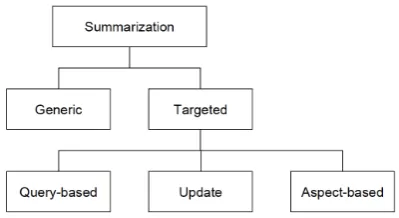
Figure 1: Proposed hierarchy of summarization tasks.
a series of micro-stages, each with a different fo-cus (Little et al.,2010;Merritt et al.,2017). For example,Ouyang et al.(2017) developed a dataset of aligned extractive and abstractive summaries by creating separate tasks for summarization, align-ment, and classification of changes. However, maintaining accuracy when the complexity of the given text increases has remained an open ques-tion. In our Pin-Refine workflow, workers first identified all text relevant to the given information type, which was aggregated across workers with a threshold, then wrote the summary using that information. This aggregation and priming helps maintain accuracy as text grows more complex.
3 Targeted and Aspect-Based Summarization
Traditionally, the NLP community has divided summarization tasks into generic summarization, which covers the entire text, query-based sum-marization, which covers only topics related to a query provided by the user (Nenkova and McK-eown, 2012), and update summarization, which covers only topics that were not addressed in doc-uments already presented to the user (Dang and Owczarzak, 2008). In query-based and update summarization, what should and should not be summarized depends on a topic (defined either by the query, or the already-read documents). This view omits cases where the user describes an in-formation need using something other than topics. We therefore re-categorize summarization tasks (Figure 1) as generic or targeted. We define the latter as the task of generating a summary that cap-tures the part of a document relevant to the user’s information request. It includes (1) query-based summarization, where the information request is a query indicating the desired topic, (2) update sum-marization, where the request is whether informa-tion is new, and (3) aspect-based summarization
Person A: I am aCS majorand need toschedule classes for next semester.
Person B: It looks like you have most of your pre-requisites out of the way and you can start taking some more EECS classes.
Person A: Cool, I’m veryinterested in Software Infras-tructure Applications and web app.
Figure 2: Example conversation for summarization. Targeted information units (TIUs) are in italics.
which can partially cover content of one or more topics. The information type targeted by aspect-based summarization varies aspect-based on users’ needs. For example, meeting attendees might want a sum-mary of a meeting transcript only including action items, while a supervisor evaluating an employee might need a summary of status updates the em-ployee provided at the meeting.
This hierarchy shows the relationship among existing summarization tasks and provides a framework to understand how the aspect-based task and potential future tasks relate to each other.
4 Experimental Design
When developing datasets for summarization, we are concerned with two key properties: accuracy and fluency. We conducted experiments to in-vestigate design options for crowdsourced aspect-based summarization, aiming to optimize both.
4.1 Conversation Generation
In this study, we focus on summarizing student questions regarding course selection from advis-ing conversations. For such a question to be cor-rectly expressed, the summary must include all relevant facts about the student’s background and preferences that appear in the conversation, as shown in Figure 2. We call these factstargeted in-formation units(TIU), because they are the pieces of information that must be part of the summary for the given information type.
In this paper, we tested our workflows on a course advising conversation dataset produced by undergraduates role-playing as students and advi-sors. The goal of the conversations was to deter-mine what courses the students should take based on their needs, as shown in the example conver-sation in Figure 2. Each “advisor” received a list of course profiles, and each “student” received a made-up student profile, including courses they had taken. Participants were instructed to use the profiles they received while letting the conversa-tion proceed as smoothly as possible.
Rewrite Questions
Please read each conversation below and rewrite ALL parts of Person A’s question, so that Person B can answer it without seeing the conversation. For example:
Example Conversation
Person A: I wanted to talk about my classes for next semester.
Person B: Okay, great. How many credits are you plan-ning to take?
Person A: I was hoping to have a relaxed semester, so I’m hoping to take 12 credits.
You may write: ‘What classes can I take next semester if I want 12 credits?’
If one sentence is not enough, use multiple sentences.
Figure 3: Baseline task instructions and examples.
4.2 Conversation Selection
We selected 30 conversations from the dataset mentioned above. Each conversation focuses on answering one question, and the number of TIUs per conversation varies evenly between 1 and 6 among the 30 conversations. Three of the authors—two native English speakers and one flu-ent speaker—read each conversation and summa-rized each user question. The lead author then compared these summaries and chose one per con-versation as the ground truth summary.
4.3 Conditions
Baseline We recruited crowd workers via Le-gionTools (Lasecki et al., 2014; Gordon et al.,
2015) from Amazon Mechanical Turk, presenting them with instructions and an example as shown in Figure 3. Workers were shown 5 conversations, one at a time, and asked to write the question be-ing asked, includbe-ing all the details that need to be known in order to correctly answer the question. Each worker was paid 10 cents per conversation.
Highlight In this condition, workers were first asked to highlight all details in each conversation that must be known to correctly answer the ques-tion, then write the question being asked, includ-ing the details they highlighted. We hypothesize that workers were primed by the process of high-lighting TIUs in conversations before writing the actual summaries. In this condition, workers were paid 15 cents per conversation1.
Correct Targeted Information Units Captured
Targeted Time (s) Intent (%) Recall Precision F1 Fluency (%)
Units b h p b h p b h p b h p b h p b h p
1 26.5 45 107† 100 94 96 100 96 92 94 96 88 96 96 89 84 90 86
2 35 46 131.5† 98 96 100 86 87 92 93 99 95 88 91 93 78 78 94 3 48 63 155.5† 94 84 96 73 78 86 89 93 91 79 83 87 66 72 78
4 60 82 161.5† 86 84 96 69 76 85 91 87 91 76 79 87 76 62 82
5 76.5 94.5 192† 78 88 94 68 71 88† 88 90 92 75 78 90† 80 80 76 6 92.5 116.5 230† 84 94 94 70 69 81† 87 88 90 77 76 85† 72 68 64
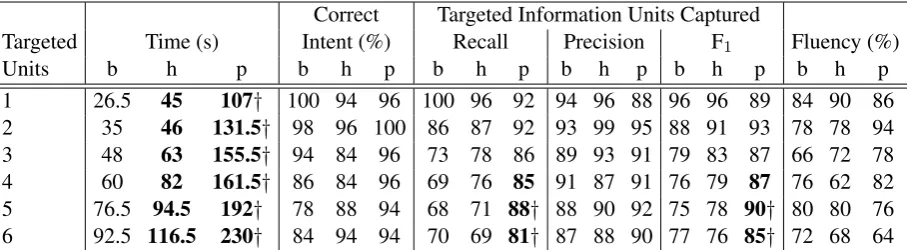
Table 1: Performance for a range of metrics (defined in§4.4) as the number of targeted information units and the condition vary (b: Baseline, h: Highlight, p: Pin-Refine). Bold indicates a statistically significant difference compared to the baseline at the0.05level, and a†indicates significance compared to the highlight condition at the 0.05level, both after applying the Holm-Bonferroni method across each row (Holm,1979).
Pin-Refine This condition had two separate steps: pin and refine. In the pin step, workers se-lected sections of the text as in the highlight case, and were paid 5 cents per conversation. High-lights from multiple workers for each conversation were automatically aggregated by keeping high-lights if the percentage of workers who assigned them was above a threshold. In the refine step, a different worker was shown the conversation with highlights and asked to write a justification of each highlight,thenwrite a summary. Each worker was paid 15 cents per conversation for the refine step.
To find and validate the correct threshold in the pin step, we repeated the data collection and ag-gregation of the pin step twice on the same set of conversations. In both attempts, all of the TIUs were covered by aggregated highlights at 40% agreement, and no completely irrelevant informa-tion was covered. While we used 40% agreement as our threshold, we also observed that coverage was robust to variation in this value. When very high agreement was required (70%) we still found on average 90% of correct phrases were covered (recall remains high), and when very low agree-ment was required (20%) only 7% of highlighted phrases were irrelevant (precision remains high).
4.4 Metrics
We evaluate question summaries on three met-rics: time was measured directly; accuracy and
fluency were independently rated by three of the authors. We used Fleiss’ Kappa to measure the inter-annotator agreement between the three anno-tators before discussing each case of disagreement for consensus judgment. The kappa scores were .95for intent accuracy,.86for TIU accuracy (both
near-perfect agreement), and.62for fluency
(sub-stantial agreement) (Altman,1990).
Accuracy An accurate question summary must ask for the information sought by the student (intent accuracy) and include all the information needed to define the question (TIU accuracy). Three authors rated the question intent in each summary and counted how many of the gold TIUs were present, as well as how many information units not in the gold appeared in the summary. To measure TIU accuracy, we calculated recall, pre-cision, and F1 score. We used Fisher’s exact tests and Mann Whitney U tests to measure significance of intent and TIU accuracy (respectively) between each pair of conditions in our study.
Fluency A fluent summary is grammatically correct or correct but for minor errors of punctua-tion. Run-on sentences, sentences with grammat-ical errors that obscure their meanings, sentences missing words, and so on, are not fluent. We used aχ2test to measure significance.
Time To estimate time-to-completion and en-sure fair payment, we meaen-sured and calculated the average time between when a worker submit-ted one summary and the next. Time spent on the first summary was excluded because it typi-cally includes time spent reading the instructions and understanding the task, which would skew the data. We report the median time to avoid skew-ing due to outliers, such as a value of five minutes when a worker took a break, and used a Moods Median test to measure significance.
5 Results
[image:4.595.75.529.62.187.2]Table 1shows the results accross all of our met-rics. We find there was relatively little variation in correctness and fluency of summaries across con-ditions. For the baseline, accuracy and fluency of summaries decreases as the number of TIUs per conversation increases.
Aggregation and priming had a major impact on recall and F1 when the number of TIUs was greater than three. After that point, the Pin-Refine condition achieved significant improvements in re-call and F1 compared to the baseline. There was no significant difference between accuracy of the baseline and highlight conditions, likely because workers were primed by their own mistakes and chose not to highlight information they believed was not important. Precision remains relatively high with no significant difference across all con-ditions, implying that workers’ ability to effec-tively exclude information is not related to the tar-geted information type.
The time workers spent summarizing one versation increases as the number of TIUs per con-versation increases. The significant time increase between the baseline and the other two conditions was caused by the additional work involved in highlighting and writing justifications.
On average, workers spent significantly longer on the justification task in the Pin-Refine con-dition (65.37s) than the highlighting task in the highlight condition (36.68s). Workers’ justifica-tions include single words like “timestamp,” short phrases like “why they want a specific course,” and long sentences like “This shows what grade they’re in, what related class they’ve taken, what their interest is, and what kind of help they need.” One possibility is that simply encouraging workers to spend more time writing their summaries im-proved performance, but fitting a linear model we find the correlation coefficient between time and F1 is −0.06, indicating no linear correlation
be-tween time and accuracy across conditions. There-fore, we believe that the significant accuracy im-provement observed in the Pin-Refine condition is the result of active priming with aggregated TIUs.
6 Conclusion
In this paper, we have identified a previously un-explored summarization problem that targets spe-cific information in a document instead of aiming to extract all key elements: aspect-based summa-rization. Then, to address the corresponding gap
in techniques for data collection for this new prob-lem, we proposed the Pin-Refine crowdsourcing workflow, which leverages input aggregation and worker priming effects. This approach leads to significantly higher summarization accuracy when the number of targeted information units (TIUs) is large. Our work provides methods and task design guidance for future data generation efforts, which are crucial for the development of robust summa-rization systems.
7 Acknowledgements
We would like to thank Sai Gouravajhala, Stephanie O’Keefe, and the anonymous reviewers for their helpful suggestions on this work, and all of our study participants for their work.
This material is based in part upon work sup-ported by IBM under contract 4915012629. Any opinions, findings, conclusions or recommenda-tions expressed above are those of the authors and do not necessarily reflect the views of IBM.
References
Douglas G Altman. 1990.Practical statistics for med-ical research. CRC press.
Steven Burrows, Martin Potthast, and Benno Stein. 2013. Paraphrase acquisition via crowdsourc-ing and machine learncrowdsourc-ing. ACM Transactions on Intelligent Systems and Technology (TIST)
4(3):43. https://dl.acm.org/citation.
cfm?id=2483676.
Chris Callison-Burch. 2009. Fast, cheap, and cre-ative: evaluating translation quality using amazon’s mechanical turk. In Empirical Methods in
Nat-ural Language Processing: Volume 1-Volume 1.
pages 286–295. https://www.aclweb.org/
anthology/D/D09/D09-1030.pdf.
Roque Enrique L´opez Condori and Thiago Alexan-dre Salgueiro Pardo. 2017. Opinion summarization methods: Comparing and extending extractive and abstractive approaches. Expert Systems with
Appli-cations78:124–134.
Simon Corston-Oliver, Eric Ringger, Michael Gamon, and Richard Campbell. 2004.Task-focused summa-rization of email. ACL Workshop on Text
Summa-rization Branches Out http://aclweb.org/
anthology/W/W04/W04-1008.pdf.
Hoa Trang Dang and Karolina Owczarzak. 2008. Overview of the tac 2008 update summarization task. InText Analysis Conference. pages 10–23.
analysis. InResearch and Development in
Informa-tion Retrieval. ACM, pages 19–25. https://dl.
acm.org/citation.cfm?id=383955.
Mitchell Gordon, Jeffrey P Bigham, and Walter S Lasecki. 2015. Legiontools: a toolkit+ ui for re-cruiting and routing crowds to synchronous real-time tasks. InUser Interface Software and
Tech-nology. ACM, pages 81–82. https://dl.acm.
org/citation.cfm?id=2815729.
Sture Holm. 1979. A simple sequentially rejec-tive multiple test procedure. Scandinavian Journal
of Statistics 6(2):65–70. http://www.jstor.
org/stable/4615733.
Eduard Hovy, Mitchell Marcus, Martha Palmer, Lance Ramshaw, and Ralph Weischedel. 2006. Ontonotes: the 90% solution. In Proceedings of the Human Language Technology Conference of the NAACL,
Companion Volume: Short Papers. pages 57–
60.https://dl.acm.org/citation.cfm?
id=1614064.
Pei-Yun Hsueh, Prem Melville, and Vikas Sindhwani. 2009. Data quality from crowdsourcing: a study of annotation selection criteria. In NAACL HLT 2009 workshop on active learning for natural
lan-guage processing. pages 27–35. https://dl.
acm.org/citation.cfm?id=1564137.
Youxuan Jiang, Jonathan K. Kummerfeld, and Wal-ter S. Lasecki. 2017. Understanding task design trade-offs in crowdsourced paraphrase collection.
In Association for Computational Linguistics
(Vol-ume 2: Short Papers). pages 103–109. http:
//aclweb.org/anthology/P17-2017.
Di Jin and Danai Koutra. 2017. Exploratory analysis of graph data by leveraging domain knowledge. In
2017 IEEE International Conference on Data
Min-ing (ICDM). IEEE, pages 187–196.
Quentin Jones, Gilad Ravid, and Sheizaf Rafaeli. 2004. Information overload and the message dynamics of online interaction spaces: A theoretical model and empirical exploration. Information systems research
15(2):194–210.
Walter S Lasecki, Mitchell Gordon, Danai Koutra, Malte F Jung, Steven P Dow, and Jeffrey P Bigham. 2014. Glance: Rapidly coding behavioral video with the crowd. In User Interface Software and
Technology. ACM, pages 551–562. https://
dl.acm.org/citation.cfm?id=2647367.
Walter S Lasecki, Ece Kamar, and Dan Bohus. 2013a. Conversations in the crowd: Collecting data for task-oriented dialog learning. InFirst AAAI Conference
on Human Computation and Crowdsourcing.
Walter S Lasecki, Rachel Wesley, Jeffrey Nichols, Anand Kulkarni, James F Allen, and Jeffrey P Bigham. 2013b. Chorus: a crowd-powered con-versational assistant. In User Interface Software
and Technology. ACM, pages 151–162. https://
dl.acm.org/citation.cfm?id=2502057.
Greg Little, Lydia B Chilton, Max Goldman, and Robert C Miller. 2010. Turkit: human computa-tion algorithms on mechanical turk. In User
In-terface Software and Technology. ACM, pages 57–
66.https://dl.acm.org/citation.cfm?
id=1866040.
Inderjeet Mani. 2004. Narrative summarization.
Traitement Automatique des Langues45(1).
David Merritt, Jasmine Jones, Mark S Ackerman, and Walter S Lasecki. 2017. Kurator: Using the crowd to help families with personal curation tasks. In Pro-ceedings of the 2017 ACM Conference on Computer Supported Cooperative Work and Social Comput-ing. pages 1835–1849. https://dl.acm.org/
citation.cfm?id=2998358.
Ani Nenkova and Kathleen McKeown. 2012. A survey of text summarization techniques. Mining text data
pages 43–76.
Jessica Ouyang, Serina Chang, and Kathy McKe-own. 2017. Crowd-sourced iterative annotation for narrative summarization corpora. In Euro-pean Chapter of the Association for Computational
Linguistics: Volume 2, Short Papers. pages 46–
51. http://aclweb.org/anthology/E/
E17/E17-2008.pdf.
Nazreena Rahman and Bhogeswar Borah. 2015. A survey on existing extractive techniques for query-based text summarization. InAdvanced Computing and Communication (ISACC), 2015 International
Symposium on. IEEE, pages 98–102.
Owen Rambow, Lokesh Shrestha, John Chen, and Chirsty Lauridsen. 2004. Summarizing email threads. InProceedings of HLT-NAACL 2004: Short
Papers. pages 105–108. http://aclweb.org/
anthology/N/N04/N04-4027.pdf.
Vikas C Raykar, Shipeng Yu, Linda H Zhao, Ger-ardo Hermosillo Valadez, Charles Florin, Luca Bogoni, and Linda Moy. 2010. Learning from crowds. Journal of Machine Learning Research
11(Apr):1297–1322.
Rion Snow, Brendan O’Connor, Daniel Jurafsky, and Andrew Y Ng. 2008. Cheap and fast— but is it good?: evaluating non-expert annotations for natural language tasks. In Empirical
Meth-ods in Natural Language Processing. pages 254–
263. http://aclweb.org/anthology/D/
D08/D08-1027.pdf.
Omar F. Zaidan and Chris Callison-Burch. 2011. Crowdsourcing translation: Professional quality from non-professionals. InProceedings of the 49th Annual Meeting of the Association for
Computa-tional Linguistics: Human Language Technologies.
pages 1220–1229. http://www.aclweb.org/