Finding Structure in Figurative Language: Metaphor Detection with
Topic-based Frames
Hyeju Jang, Keith Maki, Eduard Hovy, Carolyn Penstein Ros´e Language Technologies Institute
Carnegie Mellon University Pittsburgh, PA 15213, USA
{hyejuj, kmaki, hovy, cprose}@cs.cmu.edu
Abstract
In this paper, we present a novel and highly effective method for induction and application of metaphor frame templates as a step toward detecting metaphor in ex-tended discourse. We infer implicit facets of a given metaphor frame using a semi-supervised bootstrapping approach on an unlabeled corpus. Our model applies this frame facet information to metaphor de-tection, and achieves the state-of-the-art performance on a social media dataset when building upon other proven features in a nonlinear machine learning model. In addition, we illustrate the mechanism through which the frame and topic infor-mation enable the more accurate metaphor detection.
1 Introduction
Computational work on metaphor has largely fo-cused on metaphor detection within individual sentences, for the purpose of identification of literal meaning, with an eye towards improve-ment of downstream applications like Machine Translation. This limited conceptualization of metaphor within these restricted contexts has al-lowed prior work to leverage local indicators to identify metaphorical language, such as the vi-olation of selectional preferences (Martin, 1996;
Shutova et al., 2010; Huang, 2014) or the use of abstract vs concrete descriptors (Turney et al.,
2011; Brysbaert et al., 2014; Tsvetkov et al.,
2013). When detecting metaphor in an extended discourse, and especially for the purpose of mod-eling the use of metaphor in interaction, however, a broader conceptualization of metaphor is needed in order to accommodate the many places where these simplifying assumptions break down (Jang
et al.,2015,2016). Detection of metaphors in nat-uralistic discourse remains an open problem.
To begin to address this gap, this paper suggests adopting a concept offramingin discourse ( Tan-nen,1993;Tannen and Wallat, 1987;Gee, 2014;
Minsky, 1975; Schank and Abelson, 1975; Fill-more,1976;Fauconnier and Turner,1998). Fram-ing is a well-known approach for conceptualiz-ing discourse processes, with variants that have arisen in linguistics, cognitive psychology, and ar-tificial intelligence. This approach stands in con-trast to conceptualizations of metaphor as a vio-lation of narrowly defined linguistic rules such as selectional restrictions, instead adopting a softer, Gricean notion that an expectation of coherence broadly construed has been flouted. Specifically, a metaphor occurs when a speaker brings one frame into a context governed by another frame, and ex-plicitly relates parts of each, so that the original frame’s expectations are extended or enhanced ac-cording to the new frame.
We propose a novel and highly effective method for induction and application of metaphor frame templates as a step toward detecting metaphor in an extended discourse. Our contributions are three-fold. (1) We computationally induce frames, which can be either metaphorically or literally used, from unannotated text. Our approach infers the facets of a given frame through template in-duction using a semi-supervised bootstrapping ap-proach. Then, (2) we evaluate the obtained tem-plate in an established metaphor detection task which distinguishes whether a target word from the given frame is used metaphorically or literally in text. We demonstrate that this frame informa-tion is effective in metaphor detecinforma-tion in combi-nation with features from Jang et al. (2016) in a nonlinear machine learning model, which signif-icantly outperforms Jang et al. (2016), the state-of-the-art baseline on a social media dataset.
ditionally, (3) through error analysis, we illus-trate the mechanism through which the frame and topic information that are germane to our ap-proach enable the more accurate metaphor de-tection it achieves. Frame switching can occur not only for metaphor but also for other reasons e.g., topic switches. Our model provides more fine-grained information about what pieces of the frame make the frame metaphorical or literal. Specifically, in our model, semantically-related words from the same frame that co-exist around a target word aid metaphor detection whereas they confuse metaphor detection in other prior ap-proaches.
The remainder of the paper is organized as fol-lows. Section 2 relates our work to prior work. Section 3 shows how adopting the concept of a
framemay be useful for studying metaphor in dis-course from a social perspective. Section 4 ex-plains our semi-supervised approach of template induction to model a metaphor frame in detail. Section 5 presents the effectiveness of the frame information through metaphor detection experi-ments. Section 6analyzes the results and identi-fies when the frame information is beneficial. Sec-tion7concludes the paper.
2 Relation to Prior Work
In this section, we discuss previous computa-tional work on metaphor that is most relevant to our study. (For more thorough review, refer to (Shutova, 2015).) Next, Section 2.1 introduces approaches to metaphor detection by modeling metaphorical mapping patterns instead of relying on the idea of violation of linguistic expectations. Section 2.2 reviews work that specifically aims to address problems of metaphor detection in dis-course. As a direction related to metaphor detec-tion, Section 2.3 introduces computational work that extracts properties of similes, which provides inspiration for our template induction approach used to induce properties (facets) of a metaphor frame.
2.1 Modeling Metaphorical Mapping
There are many different types of metaphor in-cluding metaphors that do not violate any local linguistic expectations (Jang et al., 2015, 2016). In order to find other patterns not predicated on the assumption of constraint violation, one might investigate which domains are frequently mapped
metaphorically, or what target and source domains are frequently used together in metaphors.
Within these approaches that model frequent target and source domain mappings,Shutova et al.
(2010) identified new metaphors by expanding seed metaphors. The idea in this approach is that target concepts that are frequently used with the same source concept occur in similar lexico-syntactic settings. They cluster nouns (target do-main) and verbs (source dodo-main), and search the corpus for metaphors that use the verbs in the source domain lexicon to represent the target do-main concepts. ExtendingShutova et al. (2010), (Shutova and Sun, 2013) find metaphorical map-pings by building and traversing a graph of con-cepts. Then, they generate lists of salient fea-tures for the metaphorically connected clusters, and search the corpus for metaphors that use the verbs in the salient features to represent the target domain concepts.
Another approach, Hovy et al.(2013) detected metaphors using certain semantic patterns appear-ing in metaphor manifestations. For example, “sweet” with food is literal, but is metaphorical withpeople. By finding these patterns on different levels, they extended the application of this map-ping information from a narrow focus on verb re-lations to other syntactic rere-lations.
Along the same lines,Mohler et al.(2013) pre-sented a domain-aware semantic signature to cap-ture source and target domains for a text. A se-mantic signature represents the placement of a text on a semantic space by using a set of related Word-Net senses, and it includes source concept dimen-sions and target concept dimendimen-sions. The primary idea is that the signature of a known metaphor is used to detect the same conceptual metaphor.
These approaches are effective for captur-ing frequent domain specific metaphorical map-pings, and in appropriate contexts are helpful for metaphor detection. They also provided valuable insight to our approach. Nevertheless, they may overgeneralize in cases where frequent mappings are metaphorical when applied to an extended dis-course.
2.2 Metaphor Detection in Discourse
In these contexts, using only local indicators has less predictive power since metaphor is not always confined to a single clause in discourse.
In detection of metaphor in running discourse, coherence in context is an important ingredient. For example,Jang et al.(2015) detected metaphor in discourse focusing on modeling the context of a target word that may or may not have been used metaphorically. They modeled context as global and local, using lexical categories and topic dis-tributions to detect whether cohesion in context was disrupted. In addition, within a sentence, they used the idea that interplay between the tar-get words category and that of other words is in-dicative of the non-literalness of the target word.
Jang et al. (2016), building on the work ofJang et al. (2015), more aggressively tackle the prob-lem that distinguishes metaphorical/literal usage when there has been a recent topic transition. They do so by modeling topic transitions in conjunc-tion with situaconjunc-tional context. These approaches begin to grapple with the challenges of leverag-ing context, but encounter problems when related metaphors co-exist around a target word i.e., ex-tended metaphor. In contrast, in our approach, nearby related words are strategically used to as-sist rather than obfuscate metaphor detection.
Detecting extended metaphor is important for modeling the use of metaphor in communica-tion. Beigman Klebanov and Beigman(2010) of-fers an example of studying extended metaphor, showing that extended metaphors can reveal mo-tivations behind metaphor use and the effect of metaphor use on social dynamics in political com-munication. However, this study was conducted using manually-annotated extended metaphors on a small dataset, and to our knowledge there has been no computational work on detecting ex-tended metaphor. In this paper, we demonstrate promising improvement over prior approaches by leveraging frame facet information on an estab-lished metaphor detection task. There is no exist-ing corpus for extended metaphor detection; how-ever, our error analysis suggests that the broad conceptualization of metaphor we employ will be applicable to extended metaphor.
2.3 Extraction of Properties
So far very little computational work has focused on facets, or properties, of metaphor specifically. However, the Qadir et al. (2016) approach
auto-matically infers implicit properties evoked by sim-iles. They generate candidate properties from dif-ferent sources using a vehicle and an event. Then, properties are evaluated based on the influence of multiple simile components: using PMI or similar-ity between a candidate property and the second component of a simile, and aggregate ranking of the properties from different sources. This work is similar to our work in that it extracts properties re-lated to the source domain. However, this work only focuses on similes, which have more for-mulaic structural patterns compared to metaphors, e.g.He’s as cold as ice. In addition, the grammat-ical patterns used in their work are fixed manually by human intuition whereas we automatically in-fer the patterns in our work.
3 Metaphor Frames
A metaphor occurs when a speaker brings one frame into a context/situation governed by an-other. In this section, we offer a qualitative analy-sis of the data from this standpoint, and the techni-cal approach described in Section4will build on this understanding.
The same or related metaphors from the frame may be used repeatedly. For example, EX(1) pares people to a gun and bullets, and EX(2) com-pares the world and people to a stage and play-ers. Related metaphors can be used not only within a sentence, but also beyond a sentence. For instance, EX(3) compares the author’s imagina-tion to a circus and imaginaimagina-tion-related things to circus-related things throughout the paragraph.
EX(1) “He is the pointing gun, we are the bullets of his desire.”
EX(2) “All the world’s a stage and men and women merely players.” (Shakespeare, Twelfth Night) EX(3) “Bobby Holloway says my
In the breast cancer discussion forum we use in our work, community participants frequently bring in journey and battle frames when talking about their cancer experience. Depending on what aspects of the cancer experience they choose to fo-cus on, they invoke different frames accordingly even within the same text. For example, inEX(4), the journey and road metaphors are used to say that the speaker is having a similar experience with the hearer. Further on, weapons from the battle
frame are used to emphasize the power of faith and prayer in cancer treatment. In this way, metaphor introduces specific facets for specific communica-tive purposes.
EX(4) “I know, the age thing struck me too when I read about your bc journey — we have been going down the same road at the same time, only in another part of the country! It does help to know you are not alone! How amazing with the size of your tumor, that you did not have positive nodes. That is a miracle in itself. I do believe faith and prayer are our most powerful
weapons against this disease. It is what gets me thru each day.”
While metaphor provides resources for the speaker to use in communication, it also creates corresponding resources for the hearer. For ex-ample,EX(5)–EX(8)from the same thread in the breast cancer discussion forum shows how con-versational participants repeat and expand one an-other’s metaphors. The speaker in EX(5) starts using the falling off the wagon metaphorical id-iom to convey her opinion that failing to stay on a controlled diet is okay. EX(6)relays thefalling off part, and connects it to journey. EX(7) and
EX(8)carry thewagonpart of the initial post, and use on the wagon to describe her status (EX(7)) and her wish to the other person with the exten-sion ofget back on after you fall. Althoughfalling off the wagon and on the wagon are metaphori-cal idioms, get back on after you fall is a novel metaphor created by the following speaker. This novel metaphor is drawn from the wagon frame that has been brought into this conversation. In this way, a metaphor that is taken up by multi-ple speakers may increase empathetic understand-ing as well as add creative opportunities (e.g., for “fun”) to the conversation.
EX(5) “falling off the wagon is no big thing in my opinion, the psycho-logical good feelings of enjoyment weigh in big for feeling good.” EX(6) “Tina falling off is part of this
journey, it is stupid to deny your-self everything.”
EX(7) “I am on the wagon so far today . . . ongoing battle.”
EX(8) “Tina — hope you stay on the wagon, or at leastget back on af-ter you fall!”
As shown in the above examples, metaphor per-forms social functions through the switching of frames. In other words, observing frame switches offers insight into the ways in which people use metaphor to achieve social goals. The goal of our work is to lay a computational foundation for de-tection of such switches so that social strategies regarding metaphor use in interaction can be ac-complished as follow-up work. Thus, in this pa-per, we empirically construct a metaphor frame, and model the linguistic signals of frame switches.
4 Our Approach
To investigate how a metaphor frame appears in discourse, we computationally model frames that can be either metaphorically or literally used. A frame characterizes a conceptual domain, a “world” that is defined by a number of co-occurring facets. For example, the journey do-main in“life is a journey”or“he took a journey to Sweden”could have facets such asorigin, destina-tion, path,vehicle,companion, andguide. Using a journey-related metaphor activates this domain and its facets, which become available as conver-sational resources in communication. In our work, we identify facet “slots” of a frame such as the
origin anddestination of the journeyframe, and discover linguistic manifestations of the facets that fill the slots. We later use this frame information for metaphor detection, and observe how the same frame is used metaphorically or literally depend-ing on its facets. We will call the facet slotsfacets,
facet categories, orfacet slots, and the linguistic manifestationsfacet instances.
Figure 1: System flow diagram.
as (Riloff et al., 1999, 2003; Qadir and Riloff,
2013). In our model, we assume that a sentence tends to contain more than one important facet of a metaphor frame. In other words, if a sentence contains one facet of a metaphor frame, the sen-tence is likely to contain additional facets. Ad-ditionally, we assume that facets and dependency relations have some relationship. There are cer-tain grammatical patterns that represent semantic relations that connect facets in context. Note that we disregard frame facet instances that do not co-occur with a keyword (e.g., journey) within the same sentence. This can be considered as a lim-itation of this approach.
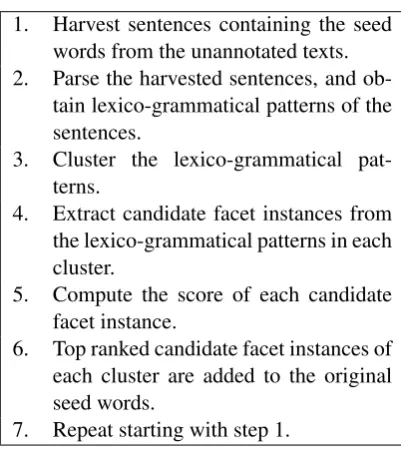
Our bootstrapping process begins with several seed words (Section 4.1) that specify the do-main and provide seed facet instances. Using the seed words, we collect lexico-grammatical pat-terns (Section4.2) in unannotated texts and cluster them to find facets (template slots) (Section4.3). Next, the induced patterns are used for identify-ing facet instances which comprise a facet clus-ter (Section 4.4). Then, the most representative facet instances for each cluster are identified and added to the seed word set. Repeating this pro-cess expands the seed facet instances and lexico-grammatical patterns into larger sets. The overall sequence is illustrated in Table1.
4.1 Seed Words
The mutual bootstrapping process begins with pre-defined seed words and a text corpus. The seed words are the frame related words including the domain (e.g. journey) and a few examples of rep-resentative facet instances (e.g. train, long) for one or more unspecified facets. The corpus is then filtered for sentences that contain the frame (e.g. journey) and at least one example seed facet instance. Note that the sentences in the corpus are not annotated metaphorical or literal. Since we are building a frame that can be used either metaphorically or literally, we do not require
sen-1. Harvest sentences containing the seed words from the unannotated texts. 2. Parse the harvested sentences, and
ob-tain lexico-grammatical patterns of the sentences.
3. Cluster the lexico-grammatical pat-terns.
4. Extract candidate facet instances from the lexico-grammatical patterns in each cluster.
5. Compute the score of each candidate facet instance.
6. Top ranked candidate facet instances of each cluster are added to the original seed words.
7. Repeat starting with step 1.
Table 1: The bootstrapping process.
tences where the seed words are used in a de-sired sense. For this reason, any general corpus that contains sufficient amount of sentences that include frame-related words can be used.
4.2 Collect Lexico-Grammar Patterns
[image:5.595.315.516.188.416.2]As a solution, we propose using lexico-grammatical patterns generated from dependency paths between a domain word and facet words via the ROOT. The lexico-grammatical patterns are defined as the shortest path that passes through the ROOT in dependencies between the domain name and seed facet instances. For example, Stan-fordCoreNLP (Manning et al.,2014) outputs the dependencies in Table 2for the sentence She re-sumed her journey through the city. The lexico-grammatical pattern that connects journey with other candidate property words such as she and
city is defined as the reverse path from journey
toROOT combined with the path from ROOT to
journey. The paths for the example are shown in Table3. Words are lemmatized to reduce sparsity. This lexico-grammatical pattern representation has advantages. First, it allows representing pat-terns connecting pairs of words in a position in-variant manner. For example, in our baseline boot-strapping model, it is difficult to represent the pat-ternreach of my journeybecausereachis not lo-cated between the slot for a property instance and
journey. However, using the lexico-grammatical pattern enables formalization of this pattern. Sec-ond, the lexico-grammar pattern is not affected by modifiers in the path. For example, the pat-terns representing the relationships between jour-neyandshe, and betweenjourneyandcitydo not change even for the sentence “She resumed her long journey through the city”, in whichlonghas been added.
4.3 Cluster Lexico-Grammar Patterns
Using the idea that lexico-grammar patterns can approximate semantic relations, we first cluster collected lexico-grammar patterns so that each cluster may represent a different relation (facet slot).
The feature representation of each pattern is based on all arguments (e.g., origin and desti-nation in Table 3) the pattern has in the cor-pus. For example, the pattern “dobj r(origin, re-sume), root r(resume, root), root(root, rere-sume), nmod:through(resume, destination)” in Table 3
may have otheroriginsanddestinationsin the cor-pus in addition to many occurrences of “city”. We use all arguments appearing with the pattern as features for the pattern, with the feature space size of the whole vocabulary. This is based on the idea that patterns with similar arguments would have
similar roles that can be facet slots, which is simi-lar to the distributional hypothesis (Harris,1954).
For the clustering algorithm, we use Nonnega-tive Matrix Factorization (NMF) (Lin,2007). We adopt this algorithm because our feature space is greatly sparse and NMF is effective for sparse data. We use the scikit-learn (Pedregosa et al.,
2011) implementation of NMF.
4.4 Identify Representative Facet Instances
After obtaining pattern clusters, we extract tokens that match patterns in each pattern cluster. Tokens extracted for each pattern cluster are facet instance candidates.
Although we have clusters of similar facet in-stance candidates, there are many noisy inin-stances in each cluster. To determine which instances are most reliable, we score each instance based on how far its generating patterns are from the center of the cluster. Specifically, an instance is scored high if it is found in more patterns in the cluster, and in patterns with higher within-cluster scores. We also take into account how semantically close each instance is to the other words in the same cluster. We use the GloVe vector representations (Pennington et al., 2014) to compute cosine sim-ilarity between two words. The scoring formula is shown below, where Ni is the number of
dif-ferent patterns that extracted wordi, Sim is the
average cosine similarity with all other words in the same cluster,score patternkis within-cluster
score computed by NMF.
score(wordi) =Sim∗ Ni
X
k=1
1+(.01∗score patternk)
(1) Once the best facet instances are identified in this ranking step, the new instances are added to the original seed words, and the process re-peats. The lexico-grammar patterns and property instances are clustered again and rescored after each iteration. The process stops after a speci-fied number of iterations. For our experiments, we found five iterations to be sufficient. We leave an exploration of more heuristic stopping criteria to future work.
5 Evaluation
Sentence She resumed her journey through the city.
Dependencies nsubj(resumed-2, She-1) root(ROOT-0, resumed-2) nmod:poss(journey-4, her-3) dobj(resumed-2, journey-4) case(city-7, through-5) det(city-7, the-6)
nmod:through(resumed-2, city-7)
Table 2: Dependencies from parsed result
origin destination pattern
journey she dobj r(origin, resume), root r(resume, root), root(root, resume), nsubj(resume,destination)
journey city dobj r(origin, resume), root r(resume, root), root(root, resume), nmod:through(resume,destination)
Table 3: Examples of lexico-grammar patterns. r represents a reverse dependency.
Model κ F1 P-L R-L P-M R-M A
Frame .204 .602 .381 .369 .826 .833 .732
Unigram .446 .720 .707 .434 .858 .950 .837
Unigram + Frame .485 .742 .665 .520 .874 .927 .838
Jang et al. (2016) .618 .808 .789 .615 .899 .954 .880
Jang et al. (2016) + Frame*** .655 .827 .814 .648 .907 .959 .891
Table 4: Performance on metaphor detection. (Metrics) κ: Cohen’s kappa, F1: average F1 score on M/L, P-L: precision on literals, R-L: recall on literals, P-M: precision on metaphors, R-M: recall on metaphors, A: accuracy, ***: highly statistically significant (p < 0.01) improvement over Jang et al.
(2016) by Student’s t-test.
respect to how well they perform for an applica-tion, metaphor detection. In so doing, we assess the performance of the represented frame informa-tion and compare to state-of-the-art models for the same task. The evaluation results are presented in Table4. The results show that our model per-forms significantly better than the state-of-the-art model, which indicates that modeling metaphor in terms of frames is promising for distinguishing metaphorical and literal usage of words.
Section 5.1 explains our evaluation task, and which datasets we have used for the evaluation. Section 5.2 describes baseline systems we com-pare our model with. Section 5.3illustrates how we model the frame information as features for classification, and explains the classification set-tings used in our experiments. Finally, Section5.4
provides the experiment results.
5.1 Evaluation Task
For our experiments, we use the metaphor detec-tion task as inJang et al. (2016). The task is to decide whether a given target word is metaphor-ically or literally used. Because there is a set of pre-determined target words, this task is beneficial
to see whether the applied model has disambiguat-ing power.
We conducted our metaphor detection experi-ments on a subset of the breast cancer metaphor dataset annotated byJang et al.(2015). We chose to work on this dataset because this dataset con-tains conversational texts so that we can observe how people use metaphor in discourse. In ad-dition, more importantly, this dataset has multi-ple target metaphors from a single frame, jour-ney. From the cross-validation and development datasets used in (Jang et al.,2016), we select the journey-related wordsroad,train, andrideto eval-uate the journey frame template we built. We ex-clude other target words, spice, boat, light, and
candlefor our experiments because they do not be-long to the journey frame. After filtering out these target words that are not relevant to the journey frame, the development dataset contains 488 in-stances, and the cross-validation dataset contains 1,119 instances.
ex-periments, we use 74,004,228 sentences from the books, which are provided together with the orig-inal book files in the corpus. We use this data in-stead of more conversational data in order to min-imize errors from detecting sentence boundaries and parsing, and to ensure broad topical coverage.
5.2 Baselines
First, we compare our model with a baseline Con-text Unigram Model that uses all the words in a post as features. Additionally, we compare our model with (Jang et al., 2016), a state-of-the-art model on this dataset. Their model uses sentence-level topic transition features and emo-tion and cogniemo-tion related features. We use their best configuration of features, which includes un-igram, lexical contrast between a target word and its global and local context (Jang et al.,2015), and topic transition surrounding the target word and emotion and cognition features (Jang et al.,2016). For comparison to approaches using only local in-dicators, see (Jang et al.,2015).
5.3 Features and Classification Settings
We extract a vector of binary features for each tar-get word to indicate which of the learned facets of the journey frame appear in its immediate context. The presence of each cluster in the same sentence, preceding sentence, and following sentence rela-tive to the target word; as well as the presence of each cluster in any of those three contexts, is indi-cated respectively by features in a vector of length four times the number of clusters.
We used the support vector machine (SVM) classifier provided in the LightSIDE toolkit (Mayfield and Ros´e, 2010) with sequential mini-mal optimization (SMO) and a polynomial kernel of exponent 2. This enables the model to make use of contingencies between features. We ex-pect that in order for a frame to be meaningfully identified, an appropriate topic shift coupled with identification of associated slot fillers in the nearby context is needed. The nonlinearity in this model enables this. For each experiment, we performed 10-fold cross-validation. We also trained the base-lines with the same SVM settings.
5.4 Results
The results of our classification experiment are shown in Table 4. We tested our frame features alone (Frame), with context unigram features
(Un-igram + Frame), and with features from the previ-ous state of the art ((Jang et al.,2016) + Frame).
Adding our frame features to the baselines im-proved performance in predicting metaphor de-tection. We see that our features combined with the unigram features slightly improved over the Unigram baseline. However, when our features are combined with the features from Jang et al.
(2016), we see large gains in performance, which suggests that there is an synergistic interaction be-tween our frame features and the features from
Jang et al.(2016).
6 Discussion
Our experiments show that frame facets that ap-pear in surrounding sentences can be strong indi-cators of metaphor detection. This is promising, and suggests that observing frame facets can be crucial key to understanding how metaphor is used in discourse. However, the frame facets them-selves are not as informative as when used with other features from the baseline. The improved performance when the frame facets are used with baseline features in the nonlinear model suggests that there are interactions among the features. In this section, we discuss the benefits of our model by examining prediction errors of our model and the (Jang et al.,2016) baseline.
The majority of the instances where the base-line model and our model do not agree is where our model improves on classifying literal instances as literal. In these cases, a topic shift is suffi-cient evidence of a metaphor, but the model with-out our template slots is not able to determine that.
EX(9)and EX(10)show some specific examples where the baseline failed by incorrectly predicting metaphor. In both of these examples, a target word
roadis used literally, but the baseline classified it as metaphorical. Although their own topic tran-sition features correctly captured that there is no topic transition in both cases, in combination with
Jang et al.(2015) features, the baseline model did not make a correct prediction.
EX(9) ... Planning on having my right re-moved then reconstruction on both sides . I am an avid runner , road biker and downhill skier . Was looking at the tram flap. ...
at our daughters to break up the time on theroad.
When our frame features are added, however, the model correctly predicted that they are literal. This is probably because our frame features that picked up frame facet words surrounding the target word in combination with topic transition features strongly signaled literal usage of the target word. InEX(10), for example, our model picked up the distance word,miles, in the sentence prior to the sentence where the target wordroadresides.
From this, we can see that adding the frame facet information allows having more complete frame information for distinguishing metaphorical and literal usage of the topic frame. Our model seems to provide more fine-grained information about what pieces of the frame make it metaphor-ical or literal.
Conducting an error analysis on the instances where both baseline and our model failed reveals the limitations of using a topic frame based ap-proach in general.EX(11)shows thattrainis used literally in the post. However, because there are different topical words around the target word and there is no other journey frame words, both (Jang et al.,2016) model and our model classify the tar-get word as metaphorical by picking up the topic transition.
EX(11) ... I woke at 2 a.m. because it was so quiet . I could n’t hear the frogs or crickets and then I heard atrain
getting louder and louder and then it threw us around . When we got out the giant trees looked like x-mas trees from all the clutter in the tops of them . ...
7 Conclusion
In this paper, we argued that a frame-based approach is useful for metaphor detection and may be useful in subsequent work for studying metaphor from a social perspective. In particu-lar, we described a semi-supervised computational approach for constructing a metaphor frame from unlabeled text. We demonstrated the effectiveness of this frame information in metaphor detection when used together with other proven features in a nonlinear machine learning model, which suggests interactions among the features. We discussed the ways in which the frame and topic information
anchor the classifier to allow for more accurate metaphor detection.
Although our approach showed promising re-sults which suggest that how the frame facet infor-mation is used in text helps determine the frame’s metaphorical usage, applying frame information to metaphor detection in this way has a limita-tion in scalability – we need to know which frame target words belong to in advance. Our contri-butions here demonstrated the potential of model-ing metaphor through the lens of frame theory; we hope to address scalable ways to leveraging frame information in future work, for example, by au-tomatically detecting primary frames that exist in text.
In addition, we hope to exploit this frame infor-mation for detecting extended metaphor, a series of related metaphors under the same frame. Ob-taining a metaphor corpus that contains a sufficient amount of extended metaphors is a big challenge. However, once such a dataset becomes available, we believe that the findings from this paper will be applicable in that context.
Acknowledgments
We thank the reviewers for their helpful and in-sightful comments. This research was supported in part by NSF grant IIS 1546393.
References
Beata Beigman Klebanov and Eyal Beigman. 2010. A game-theoretic model of metaphorical bargaining. InProceedings of the 48th annual meeting of the as-sociation for computational linguistics. Association for Computational Linguistics, pages 698–709. Marc Brysbaert, Amy Beth Warriner, and Victor
Ku-perman. 2014. Concreteness ratings for 40 thousand
generally known english word lemmas. Behavior
research methods46(3):904–911.
Nathanael Chambers and Dan Jurafsky. 2009. Unsu-pervised learning of narrative schemas and their par-ticipants. InProceedings of the Joint Conference of the 47th Annual Meeting of the ACL and the 4th In-ternational Joint Conference on Natural Language Processing of the AFNLP: Volume 2-Volume 2. As-sociation for Computational Linguistics, pages 602– 610.
Gilles Fauconnier and Mark Turner. 1998. Conceptual
integration networks. Cognitive science22(2):133–
187.
Charles J Fillmore. 1976. Frame semantics and the
Academy of Sciences: Conference on the origin and development of language and speech. volume 280, pages 20–32.
James Paul Gee. 2014. An introduction to discourse
analysis: Theory and method. Routledge, fourth edition.
Zellig S Harris. 1954. Distributional structure. Word
10(2-3):146–162.
Dirk Hovy, Shashank Srivastava, Sujay Kumar Jauhar, Mrinmaya Sachan, Kartik Goyal, Huiying Li, Whit-ney Sanders, and Eduard Hovy. 2013. Identifying
metaphorical word use with tree kernels. Meta4NLP
2013page 52.
Ting-Hao Kenneth Huang. 2014. Social metaphor de-tection via topical analysis. In Sixth International Joint Conference on Natural Language Processing. page 14.
Hyeju Jang, Yohan Jo, Qinlan Shen, Michael Miller, Seungwhan Moon, and Carolyn Rose. 2016.
Metaphor detection with topic transition, emotion and cognition in context. In Proceedings of the 54th Annual Meeting of the Association for Compu-tational Linguistics (Volume 1: Long Papers). As-sociation for Computational Linguistics, pages 216– 225. https://doi.org/10.18653/v1/P16-1021. Hyeju Jang, Seunghwan Moon, Yohan Jo, and
Car-olyn Penstein Ros´e. 2015. Metaphor detection in discourse. In16th Annual Meeting of the Special In-terest Group on Discourse and Dialogue. page 384. Chih-Jen Lin. 2007. Projected gradient methods for
nonnegative matrix factorization. Neural
computa-tion19(10):2756–2779.
Christopher D. Manning, Mihai Surdeanu, John
Bauer, Jenny Finkel, Steven J. Bethard,
and David McClosky. 2014. The Stanford
CoreNLP natural language processing toolkit. In Proceedings of 52nd Annual Meeting of the Association for Computational Linguis-tics: System Demonstrations. pages 55–60.
http://www.aclweb.org/anthology/P/P14/P14-5010. James H Martin. 1996. Computational approaches
to figurative language. Metaphor and Symbol
11(1):85–100.
Elijah Mayfield and Carolyn Ros´e. 2010. An inter-active tool for supporting error analysis for text
mining. In Proceedings of the NAACL HLT 2010
Demonstration Session. Association for Computa-tional Linguistics, pages 25–28.
Marvin Minsky. 1975. A framework for representing knowledge .
Michael Mohler, David Bracewell, David Hinote, and Marc Tomlinson. 2013. Semantic signatures for example-based linguistic metaphor detection. In
Proceedings of the First Workshop on Metaphor in
NLP. pages 27–35.
F. Pedregosa, G. Varoquaux, A. Gramfort, V. Michel, B. Thirion, O. Grisel, M. Blondel, P. Pretten-hofer, R. Weiss, V. Dubourg, J. Vanderplas, A. Pas-sos, D. Cournapeau, M. Brucher, M. Perrot, and E. Duchesnay. 2011. Scikit-learn: Machine learning
in Python. Journal of Machine Learning Research
12:2825–2830.
Jeffrey Pennington, Richard Socher, and
Christo-pher D. Manning. 2014. Glove: Global vectors for
word representation. InEmpirical Methods in Nat-ural Language Processing (EMNLP). pages 1532–
1543.http://www.aclweb.org/anthology/D14-1162.
Ashequl Qadir and Ellen Riloff. 2013. Bootstrapped learning of emotion hashtags# hashtags4you. In
Proceedings of the 4th workshop on computational approaches to subjectivity, sentiment and social me-dia analysis. pages 2–11.
Ashequl Qadir, Ellen Riloff, and Marilyn A Walker. 2016. Automatically inferring implicit properties
in similes. InProceedings of NAACL-HLT. pages
1223–1232.
Ellen Riloff, Rosie Jones, et al. 1999. Learning dic-tionaries for information extraction by multi-level
bootstrapping. InAAAI/IAAI. pages 474–479.
Ellen Riloff, Janyce Wiebe, and Theresa Wilson. 2003. Learning subjective nouns using extraction pattern bootstrapping. InProceedings of the seventh confer-ence on Natural language learning at HLT-NAACL 2003-Volume 4. Association for Computational Lin-guistics, pages 25–32.
Roger C Schank and Robert P Abelson. 1975. Scripts,
plans, and knowledge. Yale University.
Ekaterina Shutova. 2015. Design and evaluation of
metaphor processing systems. Computational
Lin-guistics41(4):579–623.
Ekaterina Shutova and Lin Sun. 2013. Unsupervised metaphor identification using hierarchical graph
fac-torization clustering. In HLT-NAACL. pages 978–
988.
Ekaterina Shutova, Lin Sun, and Anna Korhonen. 2010. Metaphor identification using verb and noun clustering. InProceedings of the 23rd International Conference on Computational Linguistics. Associ-ation for ComputAssoci-ational Linguistics, pages 1002– 1010.
Deborah Tannen. 1993. Framing in discourse. Oxford
University Press.
Deborah Tannen and Cynthia Wallat. 1987. Interactive frames and knowledge schemas in interaction:
Ex-amples from a medical examination/interview.
So-cial Psychology Quarterlypages 205–216.
Peter D Turney, Yair Neuman, Dan Assaf, and Yohai Cohen. 2011. Literal and metaphorical sense iden-tification through concrete and abstract context. In
Proceedings of the 2011 Conference on the Empiri-cal Methods in Natural Language Processing. pages 680–690.
Yukun Zhu, Ryan Kiros, Richard Zemel, Ruslan Salakhutdinov, Raquel Urtasun, Antonio Torralba, and Sanja Fidler. 2015. Aligning books and movies: Towards story-like visual explanations by
watch-ing movies and readwatch-ing books. In arXiv preprint