Complex Word Identification:
Challenges in Data Annotation and System Performance
Marcos Zampieri1, Shervin Malmasi2, Gustavo Paetzold3, Lucia Specia3
1University of Wolverhampton, United Kingdom 2Harvard Medical School, United States 3University of Sheffield, United Kingdom
[email protected], [email protected] [email protected], [email protected]
Abstract
This paper revisits the problem of com-plex word identification (CWI) follow-ing up the SemEval CWI shared task. We use ensemble classifiers to investi-gate how well computational methods can discriminate between complex and non-complex words. Furthermore, we ana-lyze the classification performance to un-derstand what makes lexical complexity challenging. Our findings show that most systems performed poorly on the SemEval CWI dataset, and one of the reasons for that is the way in which human annotation was performed.
1 Introduction
Lexical complexity plays a crucial role in read-ing comprehension. Several NLP systems have been developed to simplify texts to second lan-guage learners (Petersen and Ostendorf,2007) and to native speakers with low literacy levels ( Spe-cia, 2010) and reading disabilities (Rello et al.,
2013). Identifying which words are likely to be considered complex by a given target popula-tion is an important task in many text simplifica-tion pipelines called complex word identificasimplifica-tion (CWI). CWI has been addressed as a stand-alone task (Shardlow,2013) and as part of studies in lex-ical and text simplification (Paetzold,2016).
The recent SemEval 2016 Task 11 on Complex Word Identification – henceforth SemEval CWI – addressed this challenge by providing partici-pants with a manually annotated dataset for this purpose (Paetzold and Specia,2016a). In the Se-mEval CWI dataset, words in context were tagged as complex or non-complex, that is, difficult to be understood by non-native English speakers, or not. Participating teams used this dataset to train
classi-fiers to predict lexical complexity assigning a label 0 to non-complex words and 1 to complex ones. Below is an example instance from their dataset:
(1) Afrenulumis a small fold of tissue that se-cures orrestrictsthemotionof a mobile or-gan in the body.
The words in bold — frenulum, restricts, motion
— have been assigned by at least one of the an-notators as complex and thus they were labeled as such in the training set. All words that have not been assigned by at least one annotator as com-plex have been labeled as non-comcom-plex.
In this paper we evaluate the dataset annotation and the performance of systems participating in the SemEval CWI task. We first estimate the theo-retical upper bound performance of the task given the output of the SemEval systems. Secondly, we investigate whether human annotation correlates to the systems’ performance by carefully analyz-ing the samples of multiple annotators. Although in the shared task complexity was modeled as a bi-nary classification task, we pose that lexical com-plexity should actually be seen in a continuum spectrum. Intuitively, words that are labeled as complex more often should be easier to be pre-dicted by CWI systems. This hypothesis is investi-gated in Section3.3. To the best of our knowledge, no evaluation of this kind has been carried out for CWI. The most similar analyses to ours have been carried out byMalmasi et al.(2015) for native lan-guage identification and byGoutte et al.(2016) for language variety identification.
2 Methods and Experiments
In this section we present the data, the methods, and an overview of the experiments we propose in this paper. The goal of the experiments is to eval-uate CWI performance with respect to computa-tional methods and the manual annotation of the
Team Approach System Paper
SV000gg System voting with threshold and machine learning-based classifiers
trained on morphological, lexical, and semantic features (Paetzold and Specia,2016b) TALN Random forests of lexical, morphological, semantic & syntactic features (Ronzano et al.,2016) UWB Maximum Entropy classifiers trained over word occurrence counts on
Wikipedia documents (Konkol,2016)
PLUJAGH Threshold-based methods trained on Simple Wikipedia (Wr´obel,2016) JUNLP Random Forest and Naive Bayes classifiers trained over semantic,
lexicon-based, morphological and syntactic features (Mukherjee et al.,2016) HMC Decision trees trained over lexical, semantic, syntactic and
psycholin-guistic features (Quijada and Medero,2016)
MACSAAR Random Forest and SVM classifiers trained over Zipfian features (Zampieri et al.,2016) Pomona Threshold-based bagged classifiers with bootstrap re-sampling trained
over word frequencies (Kauchak,2016)
Melbourne Weighted Random Forests trained on lexical/semantic features (Brooke et al.,2016) IIIT Nearest Centroid classifiers trained over semantic and morphological
features (Palakurthi and Mamidi,2016)
Table 1: SemEval CWI - Systems and approaches
dataset. For this purpose we build a plurality en-semble and an oracle classifier and subsequently analyze systems output using the manual annota-tion provided by the SemEval CWI organizers.
2.1 Data
The dataset compiled for the shared task contains a training set composed of 2,237 instances and a test set of 88,221 instances. The data was col-lected through on-line questionnaires in which 400 non-native English speakers were presented with several sentences and asked to select which words they did not understand the meaning of. Annota-tors were students and staff of various universities. The training set is composed by the judgments of 20 distinct annotators over a set of 200 sentences, while the test set is composed by the judgments made over 9,000 sentences by only one annotator. The 9,200 sentences were evenly distributed across the 400 annotators. In the training set, a word is considered to be complex if at least one of the 20 annotators judged them so, thus repro-ducing a scenario that captures one of the biggest challenges in lexical simplification: predicting the vocabulary limitations of individuals based on the overall limitations of a group. This dataset is one of the few datasets available for CWI, another ex-ample is the one byYimam et al.(2017).
2.2 Systems
The SemEval CWI shared task provided an op-portunity to compare the performance of CWI ap-proaches using a common dataset. It was the first and only challenge organized on the topic thus far.
The task was very popular, having attracted 21 teams and 42 participating systems. In Table1we present the 10 highest performing approaches pro-posed by participants of the SemEval CWI task. 2.3 Approaches
We build ensemble classifiers taking the output of systems that participated in the SemEval CWI task as input. This approach is equivalent to train-ing multiple classifiers and combintrain-ing them us-ing ensembles. Our first goal is to build high-performance classifiers using plurality voting. Our second goal is to estimate the theoretical upper bound performance given the output of the sys-tems that participated in the SemEval CWI com-petition using the oracle classifier. Following Mal-masi et al.(2015) andGoutte et al.(2016) we use two approaches:
Plurality Voting: This approach selects the la-bel with the highest number of votes, regardless of the percentage of votes it received (Polikar,2006). Oracle: It assigns the correct label for an in-stance if at least one of the classifiers produces the correct label for the given data point. It serves to quantify the theoretical upper limit performance on a given dataset (Kuncheva et al.,2001).
3 Results
3.1 Plurality Voting
of the top 10 systems. Our assumption was that including systems that did not perform well in the task degrades the voting performance by introduc-ing too much noise in the predictions.
Plurality voting results for class 1 are pre-sented in Table 2 in terms of precision, recall, and F1 score. For comparison we also report a threshold-based baseline on word frequencies from Wikipedia (Paetzold and Specia,2016a) and the performance of the best system in terms of f-score for class 1. The number of instances in each class is presented in the column ‘Samples’.
System Class P R F1 Samples
All 0 0.98 0.83 0.90 84,090
All 1 0.17 0.71 0.27 4,131
Top 10 0 0.98 0.88 0.93 84,090
Top 10 1 0.21 0.66 0.32 4,131
Baseline 1 0.08 0.90 0.15 4,131
[image:3.595.309.516.161.365.2]Best 1 0.29 0.45 0.35 4,131
Table 2: Results for plurality voting
The results obtained show that the plurality vot-ing system performs significantly better on class 0 (non-complex words) achieving 0.90 F1 score than on class 1 (complex words) achieving 0.27 F1 score. The majority of instances in the dataset are non-complex words and this explains the bias. For class 1, the F1 score obtained by the ensemble featuring the top 10 systems outperforms the base-line but it is outperformed by the best system by 3 percentage points.
3.2 Optimal Ensemble and Oracle
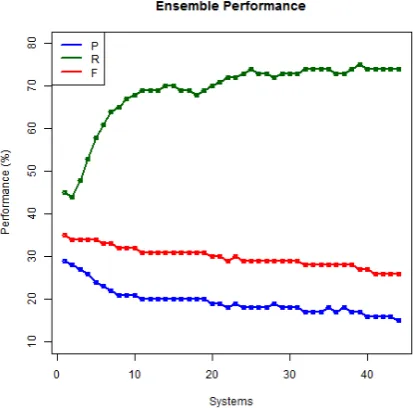
We showed the performance of plurality voting ensembles built with the output of all systems and with the output of the top-10 ranked systems. The setup using the output of the top-10 systems yielded very good performance, but still below the best system in the competition. In this section we investigate how many systems should be included in the ensemble to obtain the best possible perfor-mance. In Figure1we show the F1-score, preci-sion, and recall results for class 1 obtained by plu-rality voting using ensemble configurations rang-ing from 3 to 46 systems.
To investigate the optimal ensemble configura-tion we performed a greedy backward search over the systems, iteratively removing the worst sys-tems in a stepwise manner without a stopping cri-terion. The best performance for complex words was obtained using with the predictions of the
top-3 systems achieving 0.top-35 F1-score. This is the best performing and smallest ensemble configuration confirming that the SemEval CWI is a very chal-lenging task which led the vast majority of systems to perform so poorly that the plurality voting en-semble did not benefit from their predictions.
Figure 1: Plurality voting usingnbest systems Finally, in Table3we present the results obtained by the oracle classifier using the top-3 systems, which yielded the best results in the plurality vot-ing ensemble. The oracle performs very well when predicting non-complex words achieving 0.98 F1-score. The performance for complex words was substantially higher than the one obtained using the configurations of the plurality voting ensem-ble, reaching 0.60 F1-score and outperforming both the baseline and the best system. This is the theoretical upper bound of the task given the out-put of the systems that used this dataset.
System Class P R F1 Samples
Oracle 0 0.98 0.98 0.98 84,090
Oracle 1 0.59 0.61 0.60 4,131
Baseline 1 0.08 0.90 0.15 4,131
[image:3.595.311.520.577.642.2]Best 1 0.29 0.45 0.35 4,131
Table 3: Results for oracle classifier (top-3) 3.3 Lexical Complexity
Figure 2: Histogram of annotations.
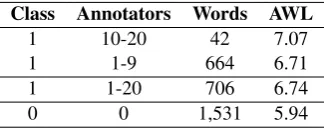
Among the 2,237 words in the training set, 706 were labeled as complex. The histogram shows the distribution of the annotation that ranged from 393 words labeled by 1 annotator as complex and only 5 words labeled by all 20 annotators as such. Inspired by readability metrics (Kincaid et al.,
1975), we looked at the average word length (AWL) of the words in the training set under the assumption that longer words tend to be more of-ten perceived as complex. We divide the dataset in intervals according to the number of annotators that assigned each word as complex: 10-20, 1-9, and none. Results are presented in Table4.
Class Annotators Words AWL
1 10-20 42 7.07
1 1-9 664 6.71
1 1-20 706 6.74
0 0 1,531 5.94
Table 4: Word length and complexity
We observed that words that were assigned as complex are on average longer than non-complex ones. Complex words in the dataset are on average 6.74 characters long whereas non-complex words are on average 5.94 characters long.
Finally, we investigate the interplay between an-notation and system performance by analyzing the 38 words in the training data which were labeled as complex by at least half of the annotators. We 1) check the overlap of these words in the train-ing and test sets; 2) verify how many
overlap-ping words received the same label in the training and test sets; 3) compute the number of times hu-mans annotated a given word as complex (0-20) and the number of top-10 systems that labeled the word as complex (0-10). We present the scores for the words that met these criteria in Table 5. For comparison we also present five randomly selected words labeled as complex by only one annotator which received the same label in the train and test sets.
Word Humans Systems
gharial 20 10
khachkar 17 10
anoxic 14 10
ubiquitous 12 8
rebuffed 11 10
took 1 0
better 1 0
however 1 0
designation 1 4
[image:4.595.342.491.204.342.2]islands 1 0
Table 5: Annotation vs. prediction. The CWI dataset replicates a scenario in which the vocabulary limitations of individuals is assessed based on the overall limitations of a group, as a result 50% of the most complex words did not re-ceive the same label in the training and test sets. Nevertheless, the results of this pilot analysis seem to confirm our hypothesis that words that were tagged more often as complex in the training set tend to be easier for CWI system to identify.
4 Conclusion and Future Work
This paper complements the findings from the Se-mEval CWI shared task report (Paetzold and Spe-cia, 2016a) by presenting an evaluation of CWI system outputs and of the dataset used in the shared task. We were able to: 1) estimate the po-tential upper limit of the task considering the out-put of the participating systems (0.60 F1 score for complex words); 2) provide empirical evidence of the relation between word length and lexical com-plexity for this dataset; and 3) confirm that the per-formance of CWI systems in this shared task is re-lated to non-native speakers’ annotation.
[image:4.595.100.264.519.585.2]Acknowledgements
This contribution was partially supported by the European Commission project SIMPATICO (H2020-EURO-6-2015, grant number 692819). We would like to thank the anonymous reviewers for their feedback.
References
Julian Brooke, Alexandra Uitdenbogerd, and Timothy Baldwin. 2016. Melbourne at semeval 2016 task 11: Classifying type-level word complexity using ran-dom forests with corpus and word list features. In Proceedings of the 10th International Workshop on Semantic Evaluation (SemEval-2016), pages 975– 981, San Diego, California. Association for Com-putational Linguistics.
Cyril Goutte, Serge L´eger, Shervin Malmasi, and Mar-cos Zampieri. 2016. Discriminating Similar Lan-guages: Evaluations and Explorations. In Proceed-ings of LREC.
David Kauchak. 2016. Pomona at semeval-2016 task 11: Predicting word complexity based on corpus fre-quency. InProceedings of the 10th SemEval, pages 1047–1051.
J Peter Kincaid, Robert P Fishburne Jr, Richard L Rogers, and Brad S Chissom. 1975. Derivation of New Readability Formulas (Automated Readability Index, Fog Count and Flesch Reading Ease For-mula) for Navy Enlisted Personnel. Technical re-port, Naval Technical Training Command Milling-ton TN Research Branch.
Michal Konkol. 2016. Uwb at semeval-2016 task 11: Exploring features for complex word identification. In Proceedings of the 10th SemEval, pages 1038– 1041.
Ludmila I Kuncheva, James C Bezdek, and Robert PW Duin. 2001. Decision Templates for Multiple Clas-sifier Fusion: An Experimental Comparison. Pat-tern Recognition, 34(2):299–314.
Shervin Malmasi, Joel Tetreault, and Mark Dras. 2015. Oracle and Human Baselines for Native Language Identification. InProceedings of the BEA workshop. Niloy Mukherjee, Braja Gopal Patra, Dipankar Das, and Sivaji Bandyopadhyay. 2016. Ju nlp at semeval-2016 task 11: Identifying complex words in a sen-tence. InProceedings of the 10th SemEval, pages 986–990.
Gustavo Henrique Paetzold. 2016. Lexical Simplifica-tion for Non-Native English Speakers. Ph.D. thesis, University of Sheffield.
Gustavo Henrique Paetzold and Lucia Specia. 2016a. SemEval 2016 Task 11: Complex Word Identifica-tion. InProceedings of SemEval.
Gustavo Henrique Paetzold and Lucia Specia. 2016b. SV000gg at SemEval-2016 Task 11: Heavy Gauge Complex Word Identification with System Voting. InProceedings of the 10th SemEval, pages 969–974. Ashish Palakurthi and Radhika Mamidi. 2016. Iiit at semeval-2016 task 11: Complex word identification using nearest centroid classification. InProceedings of the 10th SemEval, pages 1017–1021.
Sarah E Petersen and Mari Ostendorf. 2007. Text Sim-plification for Language Learners: A Corpus Analy-sis. InProceedings of SLaTE.
Robi Polikar. 2006. Ensemble Based Systems in Deci-sion Making.Circuits and systems magazine, IEEE, 6(3):21–45.
Maury Quijada and Julie Medero. 2016. Hmc at semeval-2016 task 11: Identifying complex words using depth-limited decision trees. InProceedings of the 10th SemEval, pages 1034–1037.
Luz Rello, Ricardo Baeza-Yates, Stefan Bott, and Ho-racio Saggion. 2013. Simplify or Help?: Text Sim-plification Strategies for People with Dyslexia. In Proceedings of W4A.
Francesco Ronzano, Ahmed Abura’ed, Luis Es-pinosa Anke, and Horacio Saggion. 2016. Taln at semeval-2016 task 11: Modelling complex words by contextual, lexical and semantic features. In Pro-ceedings of the 10th SemEval, pages 1011–1016. Matthew Shardlow. 2013. A Comparison of
Tech-niques to Automatically Identify Complex Words. InProceedings of the ACL Student Research Work-shop.
Lucia Specia. 2010. Translating from Complex to Sim-plified Sentences. Computational Processing of the Portuguese Language, pages 30–39.
Krzysztof Wr´obel. 2016. Plujagh at semeval-2016 task 11: Simple system for complex word identification. InProceedings of the 10th SemEval, pages 953–957.
Seid Muhie Yimam, Sanja ˇStajner, Martin Riedl, and Chris Biemann. 2017. Multilingual and Cross-Lingual Complex Word Identification. In Proceed-ings of RANLP.