STOCKHOLM SCHOOL OF ECONOMICS
619 Bachelor Thesis in Management, 15 ECTS May 2010
The Killing of Queues
A story of why some companies can create
competitive advantage from using
Technology-Based Self-Service
Authors: Annie Li (21061) and Sofie Winroth (21331) Tutor: Martin Sköld
Examiner: Dag Björkegren
Opponents: Andrea Holmström and Louise Lombach Dissertation: Friday the 11 June 2010 at 13.00-15.00
Abstract
Self scanning and Self checkouts are two popular in-store Technology-Based Self-Service (TBSS) systems used among food retailers in Sweden. These systems bring new opportunities and challenges for stores to consider. The result of implementing these in-store TBSS systems actually seems to differ quite a lot. Some are able to reduce the queues at the checkouts and save costs, while other stores have not been able to do this. The purpose of this thesis is therefore to explain why different results of using in-store TBSS systems occur between stores, based on how their internal resources, competencies and capabilities differ. It also aim at assessing if an in-store TBSS can be a source of creating sustained competitive advantage.
A multiple case study, including five food retail stores, was conducted using the classical Resource Based View (RBV) on strategy. The study shows that it is useful for managers to have a RBV on strategy before making investments. The following six resources, competencies and capabilities were found to serve as explanations for why the result of using in-store TBSS systems differ: (1) Type of location, (2) Physical store design, (3) Maintenance competence, (4) Customer service approach, (5) The store managers goals and commitment and (6) The marketing efforts. Although the study shows that the physical in-store TBSS system itself cannot be a source of sustained competitive advantage, having a high capability of deploying the system can be a source of sustained competitive advantage.
2
Acknowledgements
First we would like to thank the store managers of our case companies and the company representatives from Visma Retail AB, Information Factory and Sevenco for their time, helpfulness and cooperation. Without them we would not have been able to make this study. We would also like to thank Dag Björkegren for helping us with finding interviewees for our pre-study.
We would also like to thank our tutor Martin Sköld. He has been very supportive during the whole process, despite his very busy schedule. We especially appreciate his help with covering all the theories for our theoretical framework and finding interviewees for our pre-study. His help with structuring the methodology of this study was also of great importance. Last, but not least, we would like to thank each other; it has been a great pleasure for both of us working on this thesis.
Annie Li & Sofie Winroth
3
T
ABLE OF CONTENTS
Chapter 1. Introduction ... 5 1.1 Purpose ... 6 1.2 Delimitation ... 6 1.3 Definitions ... 6 1.4 Outline ... 6Chapter 2. Theoretical framework ... 7
2.1 Earlier research on the Resource Based View ... 7
2.1.1 Origin and Development of the Resource Based View ... 7
2.1.2 Defining resources ... 7
2.1.3 Resource Attributes ... 7
2.1.4 The difference between attaining and sustaining competitive advantage ... 9
2.1.5 Criticism of the RBV ... 9
2.2 Own implications and Research Model ... 10
2.2.1 Definitions ... 10
2.2.2 Research Model ... 10
Chapter 3. Research methodology ... 12
3.1 Research approach ... 12
3.1.1 A qualitative approach ... 12
3.1.2 A multiple case study ... 12
3.2 Selection of cases ... 13
3.2.1 Retrospective and real-time cases ... 13
3.3 The research process ... 14
3.4 Collection of data ... 15
3.4.1 Interview data ... 15
3.4.2 Direct observation and physical artifacts ... 15
3.4.3 Documentations ... 16 3.5 Analysis of data ... 16 3.6 Presentation of data ... 17 3.7 Quality of study ... 17 3.7.1 Construct Validity ... 17 3.7.2 Internal Validity ... 17 3.7.3 External Validity ... 18 3.7.4 Reliability ... 18
Chapter 4. Empirical Background of in-store TBSS systems in the food retail industry ... 19
4.1 Two in-store TBSS systems for the checkout process ... 19
4.2 History and development ... 19
4.3 Advantages ... 20
4
4.5 The investment ... 22
Chapter 5.Operationalization of research model ... 23
5.1 List of hypothetically important resources, competencies and capabilities ... 23
Chapter 6. Empirical findings and within-case analysis ... 25
6.1 Supermarket 1... 25
6.1.1 Within-case analysis Supermarket 1 ... 26
6.2 Supermarket 2... 26
6.2.1 Within-case analysis Supermarket 2 ... 28
6.3 Hypermarket 1 ... 28
6.3.1 Within-case analysis Hypermarket 1 ... 29
6.4 Hypermarket 2 ... 30
6.4.1 Within-case analysis Hypermarket 2 ... 31
6.5 Hypermarket 3 ... 31
6.5.1 Within-case analysis Hypermarket 3 ... 32
Chapter 7. Cross- Case Analysis... 34
7.1 Analyzing resource, competence and capability Heterogeneity ... 34
7.1.1 In-store TBSS system ... 34
7.1.2 Store Features... 34
7.1.3 Customer service approach ... 35
7.1.4 Organizational structure... 36
7.1.5 Corporate culture ... 36
7.1.6 Leadership ... 36
7.1.7 Human Resources ... 37
7.1.8 Innovation ... 37
7.1.9 Marketing of the in-store TBSS system ... 37
7.2 Assessing if in-store TBSS systems can be a source of creating competitive or even sustained competitive advantage ... 42
7.2.1 Competitive advantage ... 42
7.2.2 Sustained competitive advantage ... 44
Chapter 8. Synthesis ... 45
8.1 Creating sustained competitive advantage ... 45
8.1.1 Capability of deploying In-store TBSS system ... 46
Chapter 9. Thesis contribution ... 48
9.1 Conclusions ... 48
9.2 Managerial implications ... 49
Chapter 10. Discussion and future research ... 51
10.1 Discussion ... 51
10.2 Future research ... 51
5
C
HAPTER
1.
I
NTRODUCTION
A noticeable trend today is the increasing use of Technology-Based Self-Service systems (TBSS systems) in many different industries and businesses. TBSS are services with high customer involvement, where the customers to various extents through the use of technology perform some of the value adding activities themselves. In everyday life these kinds of systems can be found in multiple places. The bank industry, for example, was very early in adopting this kind of technology. In Sweden the first ATM was installed in Uppsala in 1967 (Thodenius, 2008). The spread of TBSS systems in Sweden during the last 20 years have been explosive and there is no sign of a slowdown. The railway and airline industries are other industries where the use of TBSS systems is widespread, in the form of ticket vending machines, online travel booking and self check in at airports. Another industry that has been in the front line of using TBSS systems is the retail industry. The majority of larger retailer chains today use TBSS systems, either through web shops, or in-store systems. In-store systems are for example multimedia kiosks, which is used to check the price of a good or to print a recipe. Other examples of in-store TBSS systems are self scanning and self checkout, which are alternatives to traditional checkouts. The usage of in-store TBSS systems in Sweden is, however, limited to the food retail industry and the famous furniture retailer IKEA.
The spread of self scanning and self checkouts in the Swedish food retail industry has gained much attention in media. Both the issue of customers complaining about having to do the cashiers work and the risk of lost control from the store perspective are common subjects in newspapers (“Självscanning väcker starka känslor”, 2009; “Självscanning är bra men kräver att butikerna byggs om”, 2006; “Åtalad för fusk med självscanning” 2010; “Oh no! Shoppers face yet more self-scan tills”, 2010; “Fem trender-så shoppar vi år 2020”, 2010). Despite the negative publicity, these in-store TBSS systems have become very popular among food retailers in Sweden. The advantages therefore seem to exceed the disadvantages. Still, the knowledge of what these advantages and disadvantages are and how they can be a source of creating possible competitive advantages for stores is quite limited. Nevertheless, it is a knowledge that would be valuable for many store managers to have when considering investing in self scanning or self checkouts or when an investment has already been made. The result of implementing these kinds of in-store TBSS systems in food retail stores actually seems to differ quite a lot. Some are able to reduce the queues at the checkouts and save costs, while other stores have not been able to do this (“Matbutikerna låter kunderna göra jobbet”, 2009). The question of why these results differ then becomes relevant.
The majority of earlier research on the subject of TBSS has been conducted from a marketing perspective and emphasis has been put on Internet-based self-service or customers’ attitudes, satisfaction and interaction with these self-service systems (Bobbit & Dabholkar, 2001; Curran et
al, 2003; Reinders et al, 2008; Bitner et al, 2002; van Beuningen et al 2009). Little research has, hence, been conducted from a strategic management perspective and this thesis therefore aims to fill this gap. The use of TBSS systems has a significant effect on the operations of a firm, since previously functions performed by the firm can now partially be handled by the customers themselves. These systems bring new opportunities and challenges for the store to consider and investing in this type of self-service technology can also affect a store's competitive advantage and strategy. The question of why some food retailers are able to benefit more from the technology than others then becomes relevant. To be able to answer this question we have chosen to use an inside-out perspective on strategy. The Resource Based View (RBV) offers this perspective, since this thesis focuses on in-store TBSS systems, which can be viewed as an internal resource.
6
1.1
P
URPOSEThe main purpose of this thesis is to explain why different results of using TBSS systems occur between stores, based on how their internal resources, competencies and capabilities differ. This thesis also aims at identifying if TBSS systems can be a source of creating competitive or even sustained competitive advantage.
1.2
D
ELIMITATIONOur research mainly focuses on the Swedish food retail industry and its use of TBSS systems in the checkout process. This means that we will focus on the in-store TBSS systems: self scanning and self checkouts. We have chosen this delimitation because it is relatively easy to compare the differences in results between stores with regard to this type of in-store TBSS systems. The results of other types of in-store TBSS systems such as multimedia kiosk are much more difficult to measure the results of. Sweden was chosen for practical reasons. The research will only focus on stores in the super- and hypermarket segments of the Swedish food retail industry, since the use of TBSS systems has been most prevalent in those segments.
1.3
D
EFINITIONS- Resources: Anything owned or controlled by a firm, which could be thought of as a strength or weakness.
- Competencies and Capabilities: The firm’s ability to deploy resources and the collective learning of how to coordinate diverse skills and integrate multiple streams of technologies.
- In-store Technology-Based Self-Service (in-store TBSS): High customer involvement services, where the customer to various extents performs some of the value adding activities herself through the use of technology when shopping in physical retail stores.
- Supermarket:
10 000 – 15 000 items
Located in the city centre or in residential areas
Concepts in Sweden: Hemköp, Vi-butiker, Coop Konsum, Coop Extra, Ica Supermarket and Ica Kvantum
- Hypermarket:
More than 12 000 items
Located in the outskirt of cities
Concepts in Sweden: Ica Maxi, Coop Forum, City Gross
1.4
O
UTLINEOur thesis will have the following outline; in Chapter 2 we will discuss the theoretical framework, which will be the base for our research model that will be presented at the end of that section. In Chapter 3 our chosen methodology will be presented. This will be followed by an empirical background of in-store TBSS systems in the Swedish food retail industry in Chapter 4. Chapter 5 presents an operationalization of our research model. In Chapter 6 we will present the empirical findings of our multiple cases along with within case analysis of each case. Chapter 7 will combine our research model and the empirical base to form our cross-case analysis. The analysis will then be developed in a synthesis in Chapter 8. In Chapter 9 we will present our conclusions and the managerial implications of this study. In the final chapter, Chapter 10, we will further discuss our findings and suggest interesting topics for future research.
7
C
HAPTER
2.
T
HEORETICAL FRAMEWORK
In this section we will clarify our chosen theoretical framework for this study. The first part will present the development of the Resource Based View (RBV) and thereafter discuss chosen parts of relevant earlier research on RBV. Finally, this discussion will lead to the development of our research model.
2.1
E
ARLIER RESEARCH ON THER
ESOURCEB
ASEDV
IEW2.1.1
O
RIGIN ANDD
EVELOPMENT OF THER
ESOURCEB
ASEDV
IEWIn contrast to the generic perspective on strategy, the Resource based view (RBV) on strategy recognizes “…that firms own or control sets of resources that support unique strengths, allowing the firm to perform activities better or at lower cost than rivals” (Fleisher & Benssoussan, 2003, p.207). This link between a firm’s resources and the creation of competitive advantage is a starting-point for all research on the RBV. The way a firm acquires, accumulates or develops its resources will have an impact on its strategic success (Slack & Lewis, 2008). The idea of looking at firms as broader set of resources goes back to the influential work of Penrose in 1959. However, this theory gained very little attention until the mid 80’s. In 1984, Birger Wernerfelt wrote the article “A Resource-based View of the firm”, arguing for the usefulness of analyzing firms from the resource side rather than the product side, which can be said to be one of the first articles describing the RBV in its modern form. However, it was not until the beginning of the 90’s that this perspective gained recognition in the academic world (Wernerfelt, 1995). The RBV has now gained wide popularity throughout the strategy literature (Priem & Butler, 2001).
2.1.2
D
EFINING RESOURCESThe inside-out perspective on strategy is common for all research on the RBV, but there are differences among researchers concerning the definition of resources. Two broad definitions of resources are for example, “…anything which could be thought of as a strength or weakness of a given firm” (Wernerfelt, 1984, p. 172) and“all assets, capabilities, organizational processes, firm attributes, information, knowledge, etc. controlled by a firm to conceive of and implement strategies that improves its efficiency and effectiveness”(Barney, 1991, p. 101). Amit and Schoemaker (1993) have a more specific definition and distinguish between resources and capabilities, where resources are defined as “stocks of available factors that are owned or controlled by the firm” (p. 35) and capabilities are defined as “the firm’s ability to deploy resources” (p. 35). The concept of resources is further developed to include a third aspect – competencies. Capabilities and competencies are formed when resources are combined (Lowson, 2003). Prahalad and Hamel (1990) define core competencies as ”…the collective learning in the organization, especially how to coordinate diverse production skills and integrate multiple streams of technologies” (p. 82). They argue that, unlike physical resources, competencies grow as they are applied and shared, instead of deteriorating.
2.1.3
R
ESOURCEA
TTRIBUTESRegardless of how you define what resources, competencies or capabilities are, and despite the fact that firms possess many resources, competencies and capabilities, only a few of these have the potential to be a source of creating sustained competitive advantage (Wade & Hulland, 2004). To handle the matter of finding these resources, competencies and capabilities, RBV theorists have different sets of attributes to determine whether or not a resource, competence or capability is strategic, i.e. a source of creating sustained competitive advantage.
Heterogeneity and immobility
Barney (1991) argues that in the search for sources of creating competitive advantage one must focus on resource heterogeneity and immobility. Resource heterogeneity means that firms have different amount and kinds of strategically relevant resources, competencies and capabilities
8 and this gives the firms different conditions for competing. Peteraf (1993) describes it in terms of productive factors, which have “intrinsically differential levels of ‘efficiency’“(p. 180). For example, some firms might have recruited more talented personnel than others, which give these firms advantages. If this difference is stable over time it can, in addition to being a source of creating competitive advantage, also be a source of creating sustained competitive advantage.
Immobility implies that resources, competencies and capabilities cannot be transferred between firms without cost, i.e. resources are sticky. An example of immobile resources could be something that is interconnected with other resources in the firm and therefore hard to trade. These two conditions are the truisms of the RBV according to Priem and Butler (2001).
The VRIN-attributes
One of the most common and influential frameworks, when it comes to finding sources of sustained competitive advantage, is Barney’s (1991) VRIN-attributes and therefore we will elaborate more thoroughly on this particular set of attributes. The VRIN-attributes states that a resource should be Valuable, Rare, Imperfectly imitable and Non-substitutable to be strategically important for a firm.
Valuable: A resource is said to be valuable when they can contribute to implementing a strategy that improves a firm’s efficiency and effectiveness. In other words it can exploit opportunities and/or neutralize threats (Barney, 1991).
Rare: A resource should be rare among its current and potential competitors in order for the firm to develop a competitive advantage. How rare a resource, competence or capability must be to generate a competitive advantage is however a difficult question. Barney (1991) argues that, as long as the number of firms that has a particular valuable resource, competence or capability is less than the majority of competing firms, that resource has the potential to generate a competitive advantage.
Imperfectly imitable: A resource can be imperfectly imitable for one or a combination of three reasons; (1) history dependence, (2) causal ambiguity, and (3) social complexity. What a firm has done previously will affect its ability to exploit and acquire resources in current and future periods of time, which builds a barrier of imitation. Causal ambiguity refers to when the link between a resource and the competitive advantage it confers is not understood or is only imperfectly understood by the firm. This ambiguity creates barriers to imitation and may lie in uncertainty about which resource or how a resource leads to sustained competitive advantage (Wade and Hulland, 2004). Resources that can be considered as socially complex are for example interpersonal relations among managers, organizational culture, reputation, etc. A socially complex phenomenon is very difficult to imitate, since it is inherently complicated to for a firm to manage and influence. Barney (1991) notes that although physical technology by itself is easy to imitate, some firms can through combining socially complex firm resources and physical technology create barriers to imitation, “Several firms may all possess the same physical technology, but only one of these firms may possess the social relations, culture, traditions, etc. to fully exploit this technology in implementing strategies” (p. 111).
Non-substitutability: The existence of a substitute itself does not mean that a firm resource, competence or capability cannot be a source of creating sustained competitive advantage. The substitute has to be either common or highly imitable or both for the last criterion of non-substitutability to be fulfilled (Barney, 1991).
Other sets of attributes
In addition to Barney’s (1991) set of attributes, Dierickx and Cool (1989), for example uses the following attributes to determine if a resource, competence or capability is a source of creating sustained competitive advantage; non-tradable, non-imitable and non-substitutable. Another example is Amit and Schoemaker’s (1993) set of attributes; non-tradable, complementary, scarce, appropriable and firm specific. Worth noticing is their complementarity attribute which
9 emphasize the dependence between resources to become strategically important for a firm. “The combined value of the firm´s resources and capabilities may be higher than the cost of developing or deploying each asset individually” (Amit & Schoemaker, 1993, p. 39). The idea of complementarities was originally introduced by Dierickx and Cool (1989), but Amit and Schoemaker (1993) further developed the notion. In other words, this attribute claims that an individual resource might not fill the criteria of being a source for creating competitive advantage. However, in combination with other resources, competencies and/or capabilities it might become strategically important. Eisehardt and Martin (2000) state that, when resources and their related processes have complementarities, their potential to create sustained competitive advantage, is improved.
2.1.4
T
HE DIFFERENCE BETWEEN ATTAINING AND SUSTAINING COMPETITIVE ADVANTAGE Barney (1991) distinguishes between competitive and sustained competitive advantage. He states that a competitive advantage can be attained if the current strategy is value creating, and not currently being implemented by present or possible future competitors. In other words, a resource only has to be valuable and rare to be a source of competitive advantage. Although a competitive advantage has the ability to become sustained, this is not necessarily the case. Sustained competitive advantage is not dependent on the time frame according to Barney (1991). Rather, a competitive advantage is sustained when competitors have ceased their efforts to duplicate that competitive advantage.Wade and Hulland (2004) also highlight the importance of distinguishing between resources, competencies and capabilities that help the firm to attain competitive advantage and those that help the firm to sustain the advantage. They think that it is central to separate these two phases and argues that many RBV theorists have mixed them. To be able to separate attributes connected to competitive advantage from attributes connected to sustained competitive advantage they add, in contradiction to Barney (1991) a time aspect to the RBV. They use the terminology of Peteraf (1993) and call the two types of resource attributes ex ante and ex post
limits to competition.
The ex ante limits to competition include attributes that indicate sources of competitive advantage. Peteraf (1993) uses the following terms to explain ex ante limits to competition: “prior to any firm’s establishing a superior resource position, there must be limited competition for that position.” If any firm can acquire and deploy resources for that position it cannot by definition be superior. Attributes in this category includes value, rarity and appropriability
(Wade and Hulland, 2004).
Peteraf’s (1993) explanation for ex post limits to competition is based on Barney’s (1991) reasoning regarding resource heterogeneity (see above). She argues that the condition of resource heterogeneity has to be relatively long lasting to add value. In accordance with Wade and Hulland’s (2004) reasoning the possibility of creating sustained competitive advantage will then only occur if there are ex post limits to competition. Attributes in this category include low imitability, non-substitutability and immobility.
The ex ante and ex post attributes are interrelated. For example, if a resource is imitated, more of that resource will be present in the market and hence it becomes less rare. The same reasoning also holds for substitutability and value. If there are multiple substitutes for a certain resource, then the value of the resource will deteriorate as substitute resources are developed (Wade and Hulland, 2004).
2.1.5
C
RITICISM OF THERBV
Although the RBV has gained large impact in the field of strategic management it has been subject to criticism. According to Priem and Butler (2001) the RBV have some weaknesses. They argue that it is difficult for practitioners to use, since virtually anything associated with the firm
10 can be seen as a resource. This makes some resources, e.g. tacit knowledge, very difficult for practitioners to measure and evaluate and therefore they are hard to exploit. Foss (1997) argues that the main problem with the RBV is the “terminological soup”, i.e. theorists use names such as “resources”, “capabilities” and “competencies” for what is virtually the same thing(s). Another highlighted issue is that the RBV is tautological, which is argued by both Priem and Butler (2001) and by Porter (1994). The latter states, the resource based view can be circular. Successful firms are doing well because they have unique resources, and they should nurture these resources to continue flourishing. But the question is then what is actually a unique resource? (Porter, 1994) Barney (2001) has responded to this criticism by arguing that all strategic management theories can be reduced to a tautology, since their primary assertions are by definition true and subject to empirical test. However, Barney (2001) argues that the propositions derived from a tautology can be parameterized in a way that makes empirical testing possible. The tautological argument of the critics is therefore not important, rather it is the possibility of empirical testing that is relevant (Barney, 2001).
2.2
O
WN IMPLICATIONS ANDR
ESEARCHM
ODELIn this section we will explain our chosen definitions and construct our research model based on the theory section presented above. The research model is a concretization of how the problem area of this thesis will be analyzed.
2.2.1
D
EFINITIONSSince the RBV suffers from terminological confusion it is important to clarify our chosen definitions. We have decided to use broad definitions.
We use two different sub groups as possible sources of competitive advantage and sustained competitive advantage; one group is resources and the other group is competencies and capabilities.
We base our definition of resources on Wernerfelt (1984) and define resources in the following terms:
A resource can be seen as anything owned or controlled by a firm, which could be thought of as a strength or weakness.
Our definition of competencies and capabilities originates from Amit and Schoemaker (1993) and Prahalad and Hamel (1990). Competencies and capabilities are therefore defined as:
The firm’s ability to deploy resources and the collective learning of how to coordinate diverse skills and integrate multiple streams of technologies.
2.2.2
R
ESEARCHM
ODELResearch model - Part 1
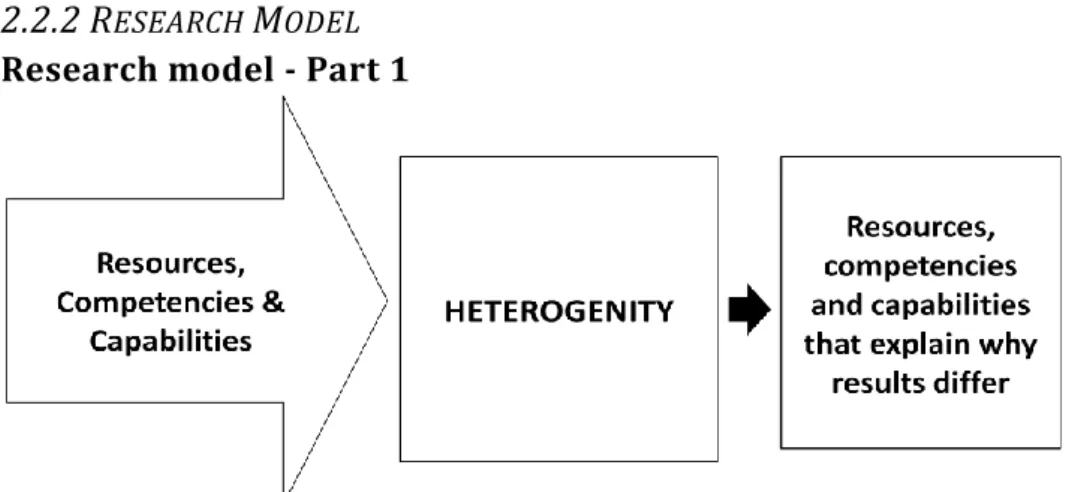
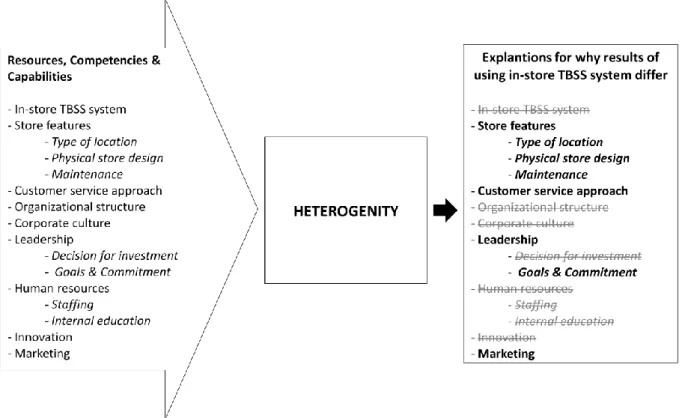
11 The first part of our research model is a tool for explaining why different results of using TBSS systems occur between stores, based on how their internal resources, competencies and capabilities differ. Barney (1991) argues that in the search for strategically important resources, one most focus on resource heterogeneity. That is, firms have different amount and kinds of strategically relevant resources, competencies and capabilities and this gives the firms different conditions for competing. Hence, when searching for possible explanations for why the results of using in-store TBSS systems differ, the heterogeneity aspect is a relevant starting point.
Research Model – Part 2
Figure 2. Research Model – Part 2
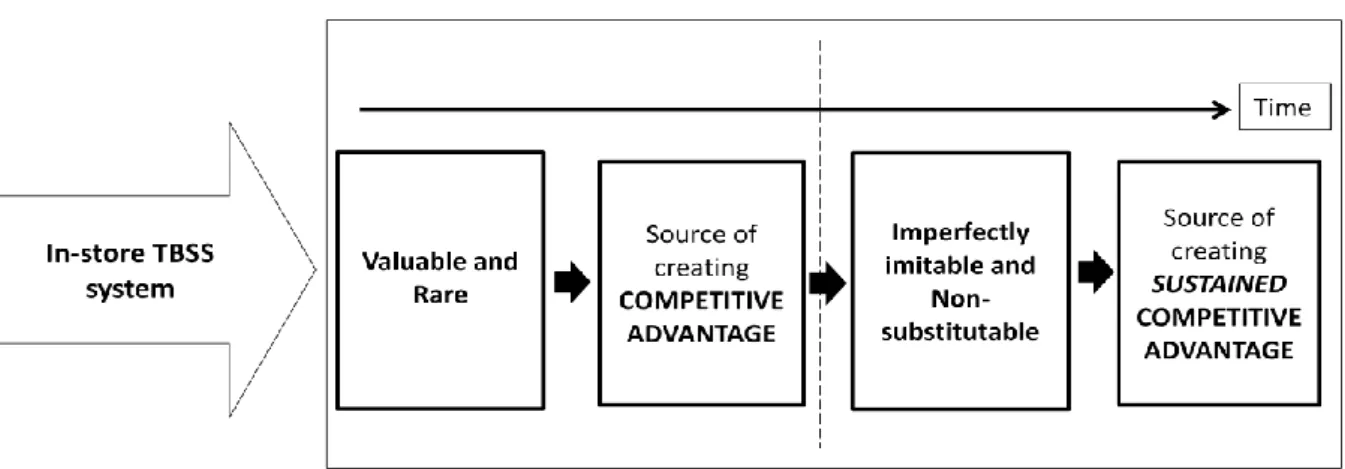
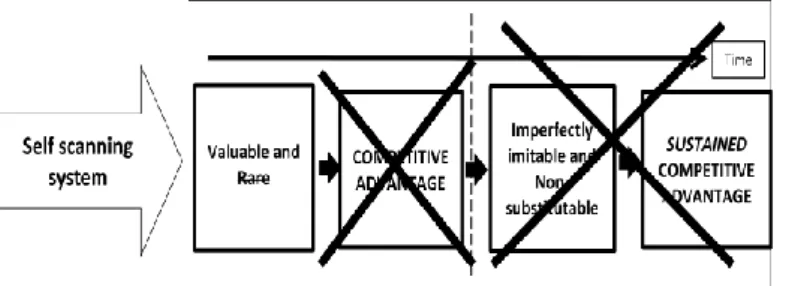
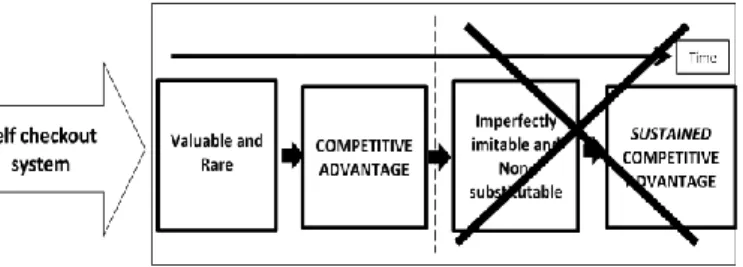
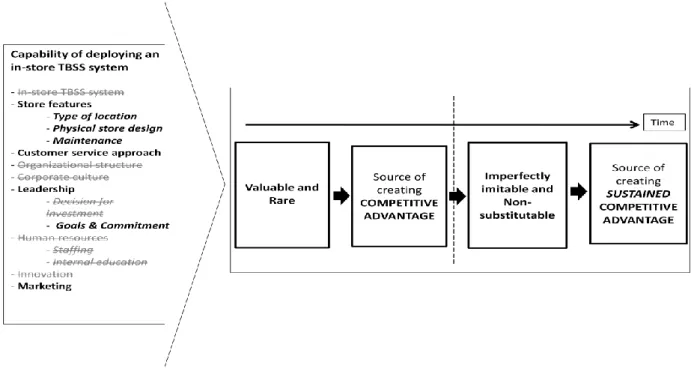
As mentioned above, the link between a firm’s resources, competencies and capabilities along with the creation of competitive advantage is a starting-point for all research on the RBV. However, this becomes relevant when assessing if TBSS systems can be a source of creating competitive advantage and possibly even sustained competitive advantage. We emanate our research model from Barney’s (1991) VRIN-framework, since this is the most widely accepted framework for assessing if a firm resource, competence or capability is strategically important, i.e. if it can be a source of creating sustained competitive advantage. We have also chosen to add the time aspect, that Wade and Hulland (2004) introduce, to our model. This is to be able to empirically separate between competitive advantage and sustained competitive advantage. Wade and Hulland’s (2004) grounds are used to divide the VRIN-attributes. For a resource, competence or capability to be a source of competitive advantage it has to be both valuable and rare. The appropriability attribute used by Wade and Hulland (2004) is left out, since our definition of resources already includes this aspect (see above). However, for this resource, competence or capability to be a source of sustained competitive advantage the fulfillment of the valuable and rare criteria is not sufficient. It also has to be imperfectly imitable and non-substitutable. According to Barney’s (1991) framework the immobility aspect serve as an underlying assumption when searching for sources of sustained competitive advantage. Therefore, we have also chosen to handle the immobility aspect as an underlying criterion for the imperfectly imitable and non-substitutability criteria to be fulfilled. The logic behind this is that if a resource, competence or capability is non-substitutable and imperfectly imitable, then there will always be some kind of transaction cost when transferring this to another firm. To conclude, the logic of our model is as follows: for a valuable and rare resource to create long-lasting competitive advantage they have to be imperfectly imitable and non-substitutable. Hence, for in-store TBSS systems to be a source of sustained competitive advantage it must fulfill the four criteria of being valuable, rare, imperfectly imitable and non-substitutable.
12
C
HAPTER
3.
R
ESEARCH METHODOLOGY
In this chapter we will describe the methodology used in this thesis as well as motivate why it was chosen to provide the readers with means to judge the reliability and validity of the study. We will start by covering the different elements of our research approach. This will be followed by a motivation of the selection of our cases. Our research process will be presented after the motivation of the selection our cases. Finally, the data collection process and the quality of research will be discussed.
3.1
R
ESEARCH APPROACH3.1.1
A
QUALITATIVE APPROACHA starting point when designing a study is to determine if the purpose can be fulfilled through a quantitative or a qualitative approach. In quantitative methods the researcher has to be able to identify specific research variables in advance, since the primary aim is to test the causality of these links in the study. This is often done through use of statistical modeling, mathematics or using arithmetical formulas (Meredith, 1998). Our chosen field of research is relatively unexplored and the aim of our study is to explain why the results of using in-store TBSS systems differ between stores and to assess if in-store TBSS systems can become a source of creating competitive advantage for firms. Andersen (1998) argues that when the aim is more of an explanatory character the qualitative approach is the most suitable approach. Furthermore, since the data in this study does not have the character of statistics, mathematics or results of formulas, there is even a stronger case for us to choose a qualitative research approach.
3.1.2
A
MULTIPLE CASE STUDYThis thesis aims to explain why some firms can take greater advantage of their in-store TBSS systems than others, based on how their internal resources, competencies and capabilities differ. When “how” or “why” questions are being asked Yin (2009) argues that the case study method is a suitable method. Furthermore, when the study focuses on contemporary events over which the investigator has little or no control, which is the case for this study, the suitability of the case study method is further promoted. The case study method offers an understanding of “…a contemporary phenomenon in depth within its real-life context, especially when the boundaries between phenomenon and context are not clearly evident” (Yin, 2009, p. 13). He further adds that case studies cope with situations where there are many variables of interest and it relies on multiple sources of evidence.
Since the purpose of our thesis aims at explaining differences between firms, it seems natural to use a multiple case study approach. Meredith (1998) argues that the multiple case study approach is appropriate when there is some knowledge about the phenomenon but much is still unknown, which is also the case for this study. There are many advantages with a multiple case study compared to a single case study. Yin (2009) argues that whenever there is a choice and enough resources available, a multiple case design is preferred over a single case study design. Some of the major benefits of a multiple case study are that it increases the external validity and helps to guard against observer biases. This approach also augments the generalizability of the study (Leonard-Barton, 1990). However, there are some limits to the multiple case study approach. Since the time and resources are constrained, choosing to use multiple case study approach means that we will obtain comparative insights from several different organizations, instead of a deep understanding of a single organization. In other words our focus is on breadth instead of depth. This is a limit of the multiple case study approach as described by Voss et al (2002).
13
3.2
S
ELECTION OF CASESEisenhardt (1989) argues that choosing a number between 4 and 10 cases usually works well when doing a multiple case study. She argues that with fewer than four cases the empirical grounding is likely to be weak and it is often difficult to generate theory with complexity. Having more than 10 cases on the other hand will be quite difficult to cope with the volume and complexity of data. We have used this as a guideline and chosen to include five cases in our study, which seemed to be reasonable number given the scope of this thesis.
The relevant population for our study is organizations within the retail industry that use in-store TBSS systems. In Sweden the use of in-store TBSS systems is only present at the furniture retail chain IKEA and in several food retail concepts. We have chosen to solely focus on the food retail industry in order to do a cross case analysis. The comparability of a furniture retailer and a food retailer is limited which is why we have chosen to exclude IKEA from our study.
The replication logic for a multiple case study is analogous to that used in multiple experiments. According to Yin (2009), each case must be selected so that it either (a) predicts similar results, a literal replication or (b) predicts contrasting results but for anticipative reason, a theoretical replication. Since the aim of this study is to explain differences in results of using in-store TBSS systems between stores, we chose to use these results as the selection criteria of our cases. Three cases were selected, which were renowned for having extraordinary positive results from using instore TBSS systems. These cases represents Group A. The other group Group B -consists of two cases which had a reputation of having an average result from using in-store TBSS systems. This approach of choosing extreme cases and polar types is often described as highly desirable (Meredith, 1998).
Furthermore, the majority of the cases selected are all located in a small geographic area, in a suburb of Stockholm. Selecting cases in a specific district make us avoid to some extent the differences between the stores that could be caused by geographic variations. These selected cases are immediate competitors to each other and in other words face the same competition. This aspect becomes important for the assessment of whether or not in-store TBSS systems can be a source of creating competitive advantage or even sustained competitive advantage, since the VRIN-attributes are put in relation to the competition. But since we wanted to capture the two different types of in-store TBSS systems, self scanning and self checkout, we included a store located in a metropolitan area as well. This store is the only store of our cases that uses self checkout system. Including this case means that we have two cases in the supermarket segment and three in the hypermarket segment. Three of the largest players in the Swedish food retail industry, ICA, Coop and Bergendahls, are represented in our selected cases.
3.2.1
R
ETROSPECTIVE AND REAL-
TIME CASESSince the purpose of our study is to explain the different results of using in-store TBSS systems, one criterion in the selection process of our cases was that the stores had used these kinds of systems over a period of time. Otherwise, they would not be able to evaluate their result of using in-store TBSS system. This brings a retrospective aspect to the study. At the time of the study, all of the stores still use these systems, implying that these are real-time cases as well. For retrospective cases, there is always the risk that participants may not recall important events, and even if they do, these recollections may be subject to bias (Voss et al, 2002). Since these are also real-time cases the respondents’ memory should not be a problem, however, the bias aspect cannot be ignored.
14
3.3
T
HE RESEARCH PROCESSThe following figure illustrates our research process:
Figur3. Our research process
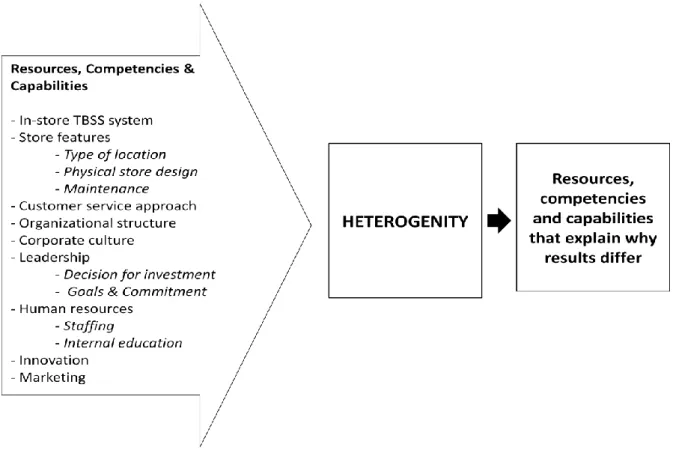
The first step of the pre-study phase was to observe an interesting phenomenon in today's society, namely the increasingly spread of TBSS systems in different industries, especially within the food retail industry, and to observe how these kinds of systems can be a source of creating competitive advantage for a firm (see Chapter 1 Introduction). The resource-based view on strategy was chosen as it provides an inside-out perspective. In the pre-study phase we aimed to gain a deeper understanding of the topic and identify interesting problem areas for us to further focus on. This was carried out through both secondary research about the Swedish food retail industry and open interviews. From the overview of the food retail industry’s use of in-store TBSS systems we were able to create a research purpose. We also generated a list of hypothetically important resources, competencies and capabilities, which might serve as possible explanations for why the results of using in-store TBSS systems differ. The purpose of this list is to serve as input variables for our Research Model – Part 1.
In the next phase, the theory study phase, we made an assessment of the RBV on strategy. Based on this assessment of the previous research on RBV in combination with the purpose of this thesis, we formed our research model, which is divided in two parts. Research model part 1 serve as a tool for collecting data of our cases and answer the first part of our purpose which is to explain why the result of using in-store TBSS systems differ based on how the internal resources, competencies and capabilities between stores differ. Research model part 2 serve as a tool to analyze the second part of our purpose, namely, to assess if in-store TBSS systems can be a source of creating competitive or even sustained competitive advantage. The case studies were conducted through direct observations in the stores and interviews with store managers and personnel. The guideline for collecting data during this phase was the list of hypothetically important resources, competencies and capabilities. The analysis was then derived from combining the data collected from our case studies with our research model. The synthesis was created by taking the analysis a step further, to a more holistic theoretical view. The contribution of this thesis stemmed from the analysis and synthesis phase and could be divided into two levels of abstraction ranging from the highest level of abstraction, discussing conclusions in relation to
15 the purpose of the thesis, to the lowest level of abstraction, discussing practical managerial implications.
3.4
C
OLLECTION OF DATAFour different methods for collecting data were used in this study. Interviews, direct observations and physical artifacts constitute the primary sources while documentations made out the secondary sources.
3.4.1
I
NTERVIEW DATAThe majority of our data was collected through interviews, which is one of the most important sources of case study information Yin (2009). For the pre-study phase, we conducted three open-ended interviews to gain a broad understanding of the food retail industry as well as its use of in-store TBSS systems. First we interviewed a Key Account Manager of Visma Retail AB, which is one of the largest suppliers of in-store TBSS systems to the food retail industry in Sweden. Then, we interviewed the CEO of Information Factory, which is another supplier of in-store TBSS systems to the Swedish food retail industry to gain an additional view. The final interview conducted in the pre-study phase was with a Management Consultant specialized in the food retail industry. He was chosen because of his long experience of being in the top management team of both Ica and Coop. Therefore, he could contribute with valuable inputs about the Swedish food retail industry in general and also its use of in-store TBSS systems. For the case study phase, we carried out five more focused interviews with the store managers of our selected cases. During these semi-structured interviews the questions evolved around the list of hypothetically important resources, competences and capabilities that can serve as explanations for gaining different results of using in-store TBSS systems, that was developed from our pre-study. The interviews still remained open ended and assumed a conversational manner. They lasted around 1.5 h each. During these interviews we continually posed prompt questions such as “Can you explain?” and “What do you mean?” In this way, we were able to notice particular groups of resources, competencies and capabilities that seemed to be important and related to the use of in-store TBSS systems. In addition to interviewing the store managers, we interviewed two to three cashiers in each store to gain an additional perspective. These interviews were much shorter and followed a more structured set of questions, along the lines of a formal survey. Examples of these types of questions were:
Example 1: Did your daily work change when the store installed the in-store TBSS systems? Example 2: Have you received any internal education about the use of in-store TBSS systems when the store installed these systems?
Notes were taken during all of the interviews, and they were recorded on an electric device as well. We listened to the contents of the recordings after each interview and complemented our notes.
3.4.2
D
IRECT OBSERVATION AND PHYSICAL ARTIFACTSTwo other sources of information were direct observations and physical artifacts. These were collected when we visited the selected stores. The methods were carried out in a casual manner where we before each interview spent 20 minutes of walking around in the store. During this time we looked at store features such as how the interior of the store was arranged, how the checkout area was arranged, how many customers used self-service system respectively traditional checkouts and the condition of the store in general. We also observed how many employees we met during the time we spent in the store and how they dealt with the customers at the checkouts. Additionally, we collected information brochures about how to use the in-store TBSS system and watched the instruction video on the television screens in the self-service area. Yin (2009) argues that casual observations of these kinds are useful in providing
16 additional information of the topic being studied. These methods are especially useful if the study regards new technology, since observing the technology at use provides invaluable aids for the understanding the actual use of the technology and potential problems being encountered according to Yin (2009). To increase the reliability of observational evidence, we took individual notes of our observations and compared these notes afterwards.
3.4.3
D
OCUMENTATIONSWe have used published news articles and academic articles about in-store TBSS as well as the Swedish food retail industry. The news articles were found online, in the daily press or in retail specific papers. Most of them concerned the controlling aspects or risks connected to the installation of in-store TBSS systems. The news articles and the academic articles were used in the pre-study phase to increase our understanding of the phenomenon in general. However, in this thesis, the previous academic research about TBSS systems was not used directly as this research is mostly conducted from a marketing perspective and focuses on internet or customer’s experience and attitudes towards TBSS systems.
There were plenty of different kinds of documentation about the Swedish food retail industry in general. These secondary data were very useful for gaining an understanding of the industry in general. Examples of sources of information we used were annual reports and screening of websites of the major actors in the food retail industry in Sweden.
3.5
A
NALYSIS OF DATAThe analysis approach in our thesis followed the one proposed by Eisenhardt (1989) and was done in two steps: (1) analysis of within case data and (2) searching for cross-case patterns. First, within case analyses were made where pattern of data were analyzed for each case. The overall idea of this process is for investigators to become familiar with each case as a stand-alone entity, and to allow the unique patters of each case to emerge before we seek to generalize across cases (Eisenhardt, 1989). In the within case analyses we analyzed possible reasons that could explain the particular store’s result from using an in-store TBSS system, based on the list of hypothetically important resources, competencies and capabilities. Different abbreviations for each group on the list were used to code the data.
In the second step of our analysis, a systematic search for cross-case patterns was carried out. We started this step with applying our Research Model – Part 1. To look for heterogeneity we grouped the cases into Group A and Group B, which differ in their result of using in-store TBSS systems. As a measure of the result from using in-store TBSS systems we have chosen to use the
utilization degree of the system. This is because it is the most common evaluation measure used in the food retail industry for evaluating the result of investing in an in-store TBSS system (Key Account Manager, Visma Retail AB). This measure indicates to what extent the traditional checkout process can become more efficient, and hence, how these systems can create opportunities to save cost or reallocate the personnel. Having a high utilization degree thus gives the opportunity to reduce a relatively larger share of the costs than a store having a lower utilization degree.
The utilization degree of an in-store TBSS system is either measured as the percentage of a store's turnover going through the in-store TBSS checkouts or the percentage of the total number of customers who use these checkout systems. The higher the percentage, the higher will the utilization degree of the system. Thus, the higher is the result of a store in using its in-store TBSS system. According to the interviewed Key Account Manager of Visma Retail, the break-even point of an investment in a self scanning system is reached when 30% of a store's turnover goes through the self scanning checkouts. Stores that have reached break-even of their investment are therefore classified in the first group of our cases, Group A. The other cases make up Group B.
17 A comparison between the two groups was made to find characteristic resources or competences and capabilities found in Group A. These could then be seen as possible explanations for why Group A has gained better results from using the in store TBSS system than Group B. The rationale for this screening is that if a certain resource, competence or capability does not differ between the groups, then it is impossible to say if they have an impact on the utilization degree of the TBSS system or not.
In the last step, we applied Research model – Part 2. This is to assess if in-store TBSS systems can be a source of creating competitive or even sustained competitive advantage, according to the VRIN-framework.
3.6
P
RESENTATION OF DATAWe have chosen to divide the data collected into two main sections. The first section presents the empirical background on in-store TBSS systems in the food retail industry. This is to give the reader an understanding of the context in which our specific research topic is embedded. This background also serves as a base for generating the list of hypothetically important resources, competencies and capabilities that can serve as possible explanations for why differences in result of using in-store TBSS systems occur. This list is hence presented in connection to the empirical background in tabular form.
The second empirical section presents our main study - the multiple case study. Each case is presented individually in the same manner. The presentation of each case follows the list mentioned above. Each empirical case description is followed by a within-case analysis. This is to make it easier for the reader to compare the cases and to follow the core analysis, which is the cross case analysis.
3.7
Q
UALITY OF STUDYTo assess the quality of our research we will use Yin's (2009) four tests of quality. These are construct validity, internal validity, external validity and reliability.
3.7.1
C
ONSTRUCTV
ALIDITYThe aim of construct validity is to identify correct measures for the studied concepts (Yin, 2009). To improve the construct validity of the research, Yin (2009) suggest three case study tactics. The first tactic suggested, is to use multiple sources of evidence. We have used multiple sources of data both from an internal perspective through direct observations, interviews with managers and interviews with personnel, and from an external perspective trough secondary research and interviews with external actors (see 3.4 Collection of Data). The second tactic suggested is to establish a chain of evidence. We have made sure that the research process is coherently structured to be able to establish a chain of evidence. The final tactic is to have key informants reviewing drafts from the case study report. This has been done continually throughout the whole research process by letting the interviewees give feedback on our composition of their empirical contribution. Through the feedback we have made sure that our interpretation of situations are similar to the informant’s.
3.7.2
I
NTERNALV
ALIDITYThe internal validity test tries to find causal relationships between certain conditions. When an event cannot be observed directly it is difficult to prove that some third, unknown, factor has caused the final event. However, Yin (2009) advocates that internal validity can be addressed through the analytical tactics of pattern matching, explanation building, addressing rival explanations and using logic models. We have used the majority of these tactics by some means to strengthen the internal validity of this study. Through the cross case analysis of the different stores we have been able to detect patterns of which internal resources, competencies and/or
18 capabilities that can serve as possible explanations for why the result of using in-store TBSS systems differ. Finally, our research model has been a useful tool for identifying patterns and explanations from our data. This is because it addresses clear valuation criteria for discovering if an in-store TBSS system can serve as a source of creating competitive or even sustained competitive advantage.
3.7.3
E
XTERNALV
ALIDITYTo define the field to which a study’s findings can be generalizable beyond the immediate cases studied the third test of external validity is conducted. It is important to obtain good external validity to reduce the risk of producing local theories which only can be used for the specific study objects (Eisenhardt, 1989). Case studies rely on analytical generalizations which mean that the investigator strives to generalize a particular set of results to some broader theory. However, the generalization is not automatic. The theory must be tested on several cases using a replication logic to obtain generalizable results (Yin, 2009). We have conducted five case studies using the same procedure of collecting data for each case. The replication logic has, in other words, been followed. The generalizability of our results is then relatively high, since our selection of cases has been focused on reflecting the whole Swedish food retail industry that uses in-store TBSS systems. The results can most certainly be applied to other organizations within the food retail industry and most likely also to other retail industries, but possibly not outside this scope of industries. Concluding, the external validity of this thesis is high and would be even higher if further research were conducted in other industries including different types of TBSS systems.
3.7.4
R
ELIABILITYThe final reliability test aims to demonstrate that the processes of a study can be repeated arriving at the same results. A prerequisite for allowing other investigators to repeat an earlier case study is the need for documentation of the procedures followed in the earlier case (Yin, 2009). To increase the reliability of this study we have used a systematic procedure for both documentation and our references. The interviews conducted with store-managers have all followed the same structure and we have used a tape-recorder. This was also the case for the interviews conducted with the store personnel. What must be remembered though is that when discussing reliability using interviews for collection of data, the interviewees’ response can change due to the time factor and because of a change of interviewer.
19
C
HAPTER
4.
E
MPIRICAL
B
ACKGROUND OF IN
-
STORE
TBSS
SYSTEMS IN THE FOOD RETAIL INDUSTRY
In this section we will present background information about in-store TBSS systems in the Swedish food retail industry. We will start by describing the two systems included in our study. Then, the history and development, the advantages and disadvantages with using the system, along with the investment in in-store TBSS systems, will be presented.
4.1
T
WO IN-
STORET
BSS SYSTEMS FOR THE CHECKOUT PROCESSSelf scanning: With the self scanning system the customer uses a portable scanner to scan and bag items while shopping. Items such as fruits and vegetables are manually weighed on special scales, which print out tags that the customer then can scan before bagging their groceries. When the customer has finished shopping the portable scanner is brought to a special checkout, where the information from the scanner is downloaded to the checkout. There are two types of self scanning checkouts; manned checkouts where the cashier is charging the customer and the unmanned checkouts where the customer is not served by a cashier. The self scanning system is tied to customer loyalty cards. When registering to use self scanning at a store, the customer approves of occasional audit of the customers’ shopping. In the case of a control, customers are chosen at random and taken to a specialized checkout. All their shopping is then scanned by the cashier in the traditional way. This is to prevent theft and make sure that the customer understands how to use the system.
Self checkout: When customers choose to use self checkouts, they do not have to use a loyalty card, scan their items with a portable scanner or bag their items while shopping. The self checkouts are similar to traditional checkouts with the difference that these self checkouts are reversed and there is no cashier scanning the items. The customers scan the barcodes on their own items, and manually identify items such as vegetables and fruits, which are weighed and placed into a bagging area. The weight observed in the bagging area is verified against previously stored information to ensure that the correct item is bagged, allowing the customer to proceed only if the observed and expected weights match. Various methods of payments are accepted in this kind of system including debit/credit cards, cash, in-store gift cards and coupons. Normally, there is an attendant watching over several self checkout machines.
4.2
H
ISTORY AND DEVELOPMENTThe Swedish food retail industry was pioneers using in-store TBSS systems, where self scanning systems was first introduced at Coop’s hypermarket B&W in the late 90’s. Five years later, Ica followed Coop’s lead (“Fyra av tio scannar själva”, 2009).
The original motives for implementing self scanning, according to the TBSS suppliers, was to give the customers a more VIP shopping experience, where the customer could control their own time and avoid queuing. It was an experimental “future store” in Holland in the early 90´s which was the role model (Key Account Manager, Visma Retail AB). During the following decade the two market leaders of the Swedish food retail industry, Coop and Ica, implemented and further developed the usage of in-store TBSS systems. The self scanning systems are now becoming more widespread in the Swedish food retail industry and are especially common in the super- and hypermarket stores.1 Still, Ica and Coop are leaders when it comes to using in-store TBSS systems (Key Account Manager, Visma Retail AB). However, actors such as Axfood and Bergendahls, which used to have a very negative attitude towards self scanning, now feel
1Supermarket: 10 000 – 15 000 items and Located in the city centre or in residential areas
(Concepts in Sweden: Hemköp, Vi-butiker, Coop Konsum, Coop Extra, Ica Supermarket and Ica Kvantum)
Hypermarket: More than 12 000 items and located in the outskirt of cities
20 like they have to offer this service to their customers. For example Bergendahls is implementing TBSS systems in all of its stores for the concept City Gross in the time of writing this thesis (CEO, Information Factory). Axfood has also started to implement self scanning in Willy’s concept stores (“Fyra av tio scanner själva”, 2009). This means that the four major actors, Ica, Coop, Axfood and Bergendahls all use in-store TBSS systems to some extent today. Together these actors have over 90 % of the total market share of the Swedish food retail industry (KF, Annual Report 2009).
Figure 4. Market shares of the largest actors in the Swedish food retail industry. Source: KF, Annual report 2009, p.11
The next step in the development of in-store TBSS systems was the implementation of self checkouts. These self checkouts has gained popularity relatively recently with the main focus on larger cities and smaller stores (Key Account Manager, Visma Retail AB).
4.3
A
DVANTAGESA general advantage with implementing in-store TBSS systems is that the need for having personnel staffed at the checkouts is lowered, since the customers will be responsible for doing much of the cashier's work. This advantage could either result in cutting personnel costs by employing fewer cashiers in general, or the store could choose to staff the personnel in other areas instead (“Matbutiker låter kunderna göra jobbet”, 2009). In addition, the working environment for cashiers is improved by having self scanning checkouts. This is because the variety of work tasks is increased and the work itself is less laborious at those checkouts compared to traditional checkouts (“Självscanning väcker starka känslor”, 2009).
Self scanning
The CEO of Information Factory explains that having self scanning offers the store several advantages. For example he mentions that an advantage of offering self scanning in food retail stores is that the technology ties customers to the store or the store chain, since a loyalty card must be used for this system and therefore customer loyalty could increase. Moreover, he says that self scanning customers tend to spend more time in the store and these customers in general make larger purchases than ordinary customers. Therefore the self scanning customers are often seen as the most profitable customers, thus the most important customers for a store. This reasoning was confirmed in our case studies as well.
Furthermore, since the self scanning customers are responsible for scanning and bagging their goods directly, the time consuming part in the traditional checkout process, where the customer puts their goods on the counter for the cashier to scan and then bag their purchases, could be eliminated. This means that the time for self scanning customers to checkout is significantly shorter than customers going through the traditional checkouts, in other words, a self scanning checkout has a larger capacity in handling flows of customers than traditional checkouts (Key Account Manager, Visma Retail AB). In an interview with the IT manager of Bergendahls, he further strengthens this view, “Every unmanned self scanning checkout replaces 20 traditional checkouts.” (“Modern självutcheckning ger klirr i kassan”, 2010, p. 9). Hence, queues can be reduced significantly by offering self scanning systems.
21 Figure 5. The more items the customers buy, the more time is saved from using self scanning instead of a
traditional checkout (Key Account Manager, Visma Retail AB).
The main benefits perceived by the customers are convenience and increased control over both time and their spending, as they could shop in their own pace, avoid queuing and see the sum of their purchases in real time (Key Account Manager, Visma Retail AB). The customers using self scanning are often very happy with the system and some would not do their grocery shopping without these systems. In general, the shopping behavior is mostly done on routine, and if customers get used to this system and like them, they will continue to use self scanning (Management Consultant, Sevenco). Self scanning customers also tend to have a quite rational shopping behavior. For example, they often have a shopping list when going to the hypermarket or supermarket, and they especially value the possibility to take control of the time it takes to shop (Key Account Manager, Visma Retail AB).
Self checkouts
The main advantages with offering self checkouts are that the store can manage those customers with few items and small purchases in a fast way. However, this type of checkouts demands more service-minded personnel to help the customers with potential problems (Management Consultant, Sevenco). The self checkouts could be especially advantageous for stores that have a high variety of number of customers over the day. Moreover, since no loyalty card is needed, all customers could use this system. According to the interviewed Management Consultant, convenience and avoidance of queuing are the main benefits for customers when using this system.
4.4
D
ISADVANTAGESNevertheless in-store TBSS systems have some disadvantages. Installing a self scanning system is a large investment and the need for maintenance is quite high. If the store does not get enough customers to use this system instead of the traditional checkouts it will be a costly investment (Key Account Manager, Visma Retail AB).
Self scanning
The self scanning system is sensitive to disruptions. If there are any disruptions in the system, for example scanners that do not work properly or coupons that cannot be scanned by customers themselves at the unmanned checkouts, the advantages of convenience and time control perceived by the customers will be lost completely. In that case, the risk of unsatisfied self scanning customers could increase, which in turn could affect the utilization degree of the system negatively (Management Consultant, Sevenco). Another disadvantage with self scanning is the control aspect and the fear of having customers stealing (CEO, Information Factory). However, in our study, no store manager thinks that the control aspect is a major issue.
22 Self checkouts
From the store’s point of view, there are not that many disadvantages with self checkouts except for the large investment cost and maintenance costs. But, a potential drawback from a customer’s point of view is the system itself, which is sometimes perceived as complicated (“Matbutiker låter kunderna göra jobbet”, 2009)
4.5
T
HE INVESTMENTOne important reason for installing an in-store TBSS system is the potential cost-saving aspect associated with it. However all stores that have installed these systems have not been able to make the investment profitable or reach breakeven (CEO, Information Factory). The Key Account Manager of Visma Retail, one of the largest suppliers of in-store TBSS systems, estimates that for a middle-sized food retail store with 10-12 ordinary checkouts, approximately three to four checkouts can be replaced with one self scanning or self checkout system. This would require an investment of approximately one million SEK. He further adds that the yearly maintenance cost is approximately 25% of the initial investment. The utilization degree of an in-store TBSS system is commonly used as a measure for the result of investing in these systems. This measure indicates to what extent the traditional checkout process can become more efficient, and hence, how these systems can create opportunities to save cost or reallocate the personnel. Having a high utilization degree thus gives the opportunity to reduce a relatively larger share of the costs than a store having a lower utilization degree. As a benchmark, for a self scanning system to be cost saving, more than 30 % of the store’s total revenue has to go through the self scanning system to reach breakeven.
When installing the in-store TBSS systems, there are some aspects that the stores need to consider. According to the interviewed suppliers of in-store TBSS systems, the store has to make sure that the customers can scan all of the items in the store. For those goods that are unpacked, the store needs to have scales where the customer’s can weigh the goods and obtain a tag with a barcode to scan. The store design and the maintenance hence become very important (CEO, Information Factory; Key Account Manager, Visma Retail AB). Furthermore, the in-store TBSS systems add new work tasks to cashiers, as they have to learn how to handle the new checkout systems in addition to the traditional ones. For this purpose, the suppliers offer half-day or a whole day courses to teach the personnel the functions of the in-store TBSS system. There are also informative films available for purchase that shows how to use the systems from a customer’s point of view. The interviewed management consultant further adds some aspects that he thinks are important to consider when implementing a new TBSS system. He emphasizes the importance of having a leader that shows great engagement and puts up clear goals. He also emphasizes the importance of having service-minded personnel. Finally, he mentions that marketing, innovation and the location are very important factors to succeed when investing in an in-store TBSS system.