DOCUMENT DE TREBALL
XREAP2009-9
Competition between TV Platforms
Competition between TV Platforms
Laia Domènech Campmajó ٭(Universitat de Barcelona & ppre-IREA) Abstract
The aim of this paper is to identify the factors that affect the market penetration of pay television by studying the competition that exists between three types of technology (satellite, cable and ADSL). We distinguish three groups of factors: the level of market competition, the level of competition in the industry and the quality of the product being offered. Our results seem to indicate that as market concentration increases, the television service can achieve greater penetration. This relationship is specifically captured by the level of intra- and inter-platform competition. We also examine the relationship between free television channels and pay television and find that as the amount of time dedicated to the broadcasting of advertising by the former increases, the number of subscribers to pay TV rises. Finally, we examine product quality by introducing the effect of holding the rights to broadcast Professional Football League matches and an HBO or Showtime produced series. Our results suggest that these variables are critical for the penetration of pay television.
Key Words: pay TV, competition between platforms, telecommunications. JEL CODES: L82, L96
٭ Dept. Política Económica – UB
Avd. Diagonal 690 08034 Barcelona
Tel: 934021946, Fax: 934024573
Competition between TV Platforms 1. Introduction
The pay TV market is changing as new technologies transform the pre-existing business model, while the convergence between telecommunication (fixed phones, mobile phones and broadband) and media services is revolutionizing competition in the market. This latter process, moreover, has served to remove the virtual frontier that had previously existed between telecommunication and media operators. Thus, today, the vast majority of pay TV platforms, thanks to the technological advances that they have incorporated, can offer duo or triple play bundling by combining broadband, telephone and television services1.
In addition to these bundled packages of media and telecom services, the introduction of new types of program and the development of new technologies have been key factors in instigating market change. At the same time, content innovations have given rise to new programs and increased viewer interaction. The development and rapid consolidation of new technologies has allowed pay TV platforms to broaden their offer. Traditionally, the most frequently exploited system for television platforms has been cable (optical fiber) and satellite; however, in recent years, the platforms have shifted over to the same infrastructure as that used by broadband services (TV-IP or TV-xDSL2). Further, telecom operators have begun mobile TV broadcasts, enabling users to watch TV on their cell phones.
A further change that has had a great impact on the market has been the introduction of digital terrestrial television (DTT) to replace analogue technology. DTT has led to a reorganization of TV along thematic lines so that we have seen the introduction of highly specific channels such as the Disney Channel and Canal Barça, Football Club Barcelona’s own television channel. Both channels broadcast on a pay TV platform, but currently viewers can tune in to these channels for free on DTT. This transfer of content over to pay TV platforms is indicative of the growing perception that these channels represent the future of the market.
In this context, the pay TV market has consolidated itself as a major business and one that has become the focus of the regulators, since telecom operators offer media products and exploit their infrastructure to broadcast TV channels. Thus, for example,
1 The telecom services can be provided by the same platform or by contract with a telecom operator.
2 The former (TV-IP) uses an internet protocol in its broadcasting; the latter (TV-xDSL) is a group of
TV-IP uses the same line as that used by broadband and telephone-IP. Given this situation, it is important to analyze the relationship between TV penetration and bundling, and how the outcomes of this relationship should be incorporated in the regulation of telecom infrastructure.
The aim of this paper is to analyze the factors that might influence the market penetration of pay TV platforms. In particular, we consider the role of competition in promoting the adoption of pay TV platforms and incorporate the effects of inter- and intra-industry competition (Distaso et al., 2006; Sohn, 2005), where inter-platform competition is that which exists between different technological platforms that are able to offer broadcast access, and intra-platform competition is that which exists between the same technological platform. Thus, our empirical model considers the relationship between the penetration of pay TV, the various forms of competition in the market as well as other market characteristics.
Our results are in line with those reported elsewhere in the literature, although our paper provides new evidence regarding the effect of competition in the penetration of pay television. The low level of inter-platform competition has a marked effect on the penetration of pay TV platforms and indeed the pay TV market presents many characteristics of monopolistic competition. Such markets have high sunk costs owing to their levels of investment in infrastructure and the purchase of TV channels and programs. Consequently, if a firm enjoys a relative monopolistic power in the market, it can buy better channels and programs and thus recover its initial investment in infrastructure.
Similarly, intra-platform competition also has a significant effect on the market penetration of pay television, with low levels of competition having a positive impact. If one platform can control the market, then it should be able to prevent its rivals from expanding. A good example of this is provided by Telefónica which offers IP-TV in the pay TV market. Telefónica enjoys a good company image and is the owner of the infrastructure for the diffusion of this pay TV format. If another firm wishes to offer IP-TV, then it must rent the infrastructure from Telefónica, but even so it remains dependent on Telefónica to facilitate the connections with the consumer. Thus, we have considered it necessary here to incorporate and evaluate these types of competition in our empirical analysis.
Other factors might also account for the penetration of pay television. Contracts providing exclusivity as regards content are a key variable in the introduction of a particular platform in the market. Subscribers will tend to contract a service with a platform that
offers high quality programs. Examples of premium programming are provided by a) National Football League, and b) Home Box Office (HBO) and Showtime series. Here, our results provide fresh evidence regarding the relationship between subscribers and quality programs. First, we observed a positive relationship between pay TV penetration and the broadcasting of National Football League matches on pay-per-view television. Platforms offering premium content show a higher degree of penetration than those that do not have this programming. Second, we found a positive relationship between the penetration of the service and the offer of HBO and Showtime premium shows. These particular companies have revolutionized the concept of TV through innovative program production and the enhanced quality of their TV series3. The origin of these changes can perhaps be traced back to the first series of the US drama “The Sopranos” (HBO).
Our study also considers the quantity of advertising on free-to-air television, a variable not previously considered in the literature. Recent studies claim that advertising is a negative externality on viewers (Anderson and Coate, 2005) and so viewers tend to connect to a platform with little advertising. Our results show that the amount of advertising broadcast on free-to-air channels is an important variable in explaining the penetration of a pay TV platform.
A further aspect we consider is the convergence between services4. Here our results seem to confirm the hypothesis that a platform that offers a bundle of television and telecom services will achieve greater market penetration. This can be explained by the fact that it is considerably easier and more attractive for a subscriber to contract all services based on the use of one technology.
Interestingly, however, the market leader in Spain, Digital Plus, does not offer any telecommunication services. The reason for this lies in the high costs involved in operating satellite technology, particularly in comparison with the costs incurred by operators of cable and DSL. As a market alternative, in 2008, Digital Plus signed distribution agreements with the commercial purpose of putting out to tender its pay TV services to the leading telecommunication operators. Thus, we take our analysis one step further by seeking to explain the factors that influence the penetration of such bundled services, including pay television. This is clearly necessary given the increase in this mode of distribution of audiovisual services. Our results show that as technology expands further in the telecommunications sector, the greater the penetration achieved by bundled services.
3 Forty-five minute episodes broadcast in seasons of 24 episodes. 4The offering of joint telecommunication and audiovisual services.
The rest of the article is organized as follows. In section 2 we analyze the market for pay TV in Spain. Section 3 undertakes a review of the literature. Section 4 presents our empirical strategy, while our data are explained in section 5. In section 6 we explain our results. Finally, section 7 concludes.
2. The Spanish Pay TV Market
The pay TV business is largely homogenous throughout the developed world, with the technologies used for its diffusion being satellite, cable and xDSL. However, the intensity of use of the various technologies depends on the country’s choice of telecommunication infrastructure. Thus, for example, Italy does not have cable television while Germany does not have TV-IP.
OFCOM (2007) undertook a comparative study of the evolution in the household penetration of pay TV platforms in several European countries. Graph 1 shows that Sweden has a high level of pay TV penetration, while in Italy and Spain this level is much lower. The latter finding is of interest as it highlights the significant presence of free TV (analogue terrestrial television) in these countries of southern Europe.
Graph 1. Pay TV Penetration in some European countries
0% 10% 20% 30% 40% 50% 60% 70% 80% 90% 100% 1997 1998 1999 2000 2001 2002 2003 2004 2005 2006 Suecia Alemania Francia Reino Unido España Italia Source: Ofcom (2007)
In recent years, technological developments in this sector have had two important consequences. First, there has been a marked increase in market competition and, second, there has been significant growth in the size of the pay TV market in Spain as well as elsewhere in the developed world. Our study specifically examines the Spanish pay TV market, but its characteristics might offer insights into the situation in other countries.
Graph 3 shows the evolution in the number of Spanish subscribers by the type of technology used.
Graph 3. Evolution in the number of pay TV subscribers in Spain
0 500000 1000000 1500000 2000000 2500000 2002 2003 2004 2005 2006 2007 tv satélite tv cable tv-IP
Source: Informe anual del Comisión del Mercado de las Telecomunicaciones (2006, 2007)
The market was initiated with just satellite and cable platforms, but the cable operators enjoyed an advantage over the satellite operators as they could offer additional services such as broadband. However, investors were slower to put their money in the more expensive cable infrastructure (Artero, Herrero and Sánchez-Tabernero, 2005). Consequently the two satellite operators, Canal Satélite Digital and Vía Digital, acquired a dominant position in the market, allowing them to purchase exclusive rights on sports events and films from the Hollywood Production Company. Yet, despite their market position, the satellite operators faced considerable financial problems.
In 2003, the two satellite operators merged creating Digital Plus (Sogecable), which now enjoyed a monopoly in the provision of satellite TV. Moreover, the new platform had exclusive rights to premium program content. However, the government, keen to maintain market competition, attached certain conditions to this merger including the fact that a number of channels were to be set aside so that they might be leased out to firms not owned by the platform. Bel, Calzada and Insa (2007) analyze the consequences of the merger for the access of independent productions in Digital Plus.
The cable industry has also been characterized by acquisitions and mergers, resulting in increased market concentration. Initially, the telecom services using cable infrastructure were organized into 43 demarcations. Today, only four firms operate in the market. The main acquisition process saw Auna Cable absorbed into Grupo ONO in 2005, making it the leading cable platform in Spain. The other three firms that remain in the market produce solely at the regional level.
The technological advances making it possible to use ADSL infrastructure to broadcast media content (TV channels and video on demand, for example) have been a key factor enabling telecom operators to enter the market. Initially, IP-TV was offered by Telefónica de España, the incumbent telecom operator in the Spanish market. Subsequently, two other telecom firms, Orange and Jazztel, have started broadcasting using internet protocol.
Thus, although the market provides a broad offer of TV platforms and considerable competition between them, the penetration of pay TV in Spain remains low in comparison with other European countries, as Spanish consumers do not show a clear preference for pay TV. In recent years, the platforms have striven to offer more attractive products so as to gain more subscribers. And one way in which they have tried this is by launching the bundling of telecom and media services, primarily for use with cable and ADSL operators5.
3. Literature review
This paper analyzes the factors that account for the penetration of pay TV and seeks to identify the effects of competition between technologies on the penetration of this service. In so doing, we wish to examine the assumptions made in the theoretical literature and compare our results with those reported in earlier empirical studies.
The multichannel distribution industry can be considered an example of a two-sided market6 (Seabright and Weeds, 2006). Cable, satellite and ADSL platforms link
subscribers, production companies and advertisers together. The relationship between advertisers and the platform generates a negative externality for subscribers. By contrast, the relationship between subscribers and the platform generates a positive externality for advertisers and production companies. Several studies have analyzed the pay TV industry in terms of this two-sided market, the best known being Reisinger (2004); Anderson and Coate (2005); Bel, Calzada and Insa (2007), and King, Nilssen and Søgard (2008).
Other studies have examined the factors influencing the penetration of pay television. The earliest studies, including Emmons and Prager (1997), Ford and Jackson (1997) and Mayo and Otsuka (1991), focused their attention on the relationship between
5 The satellite operator does not offer bundled services, although in 2007 and 2008 it has sought to
commercialize it products together with those of other telecom operators.
6 Recent studies have made an increasing use of the theoretical concept of the two-sided market, which
defines an industry in which a platform links two groups of agents. Among these agents externalities are generated linking them with the platform. The most recent work in this regard include Rochet and Tirole (2003), Evans (2003), Rysman, (2004), Anderson and Coates (2005) and Armstrong (2006).
price and the penetration of the service. They only considered cable platforms, as the sector was perhaps the most dynamic then, but in recent years alternative technologies, such as ADSL, have consolidated their position.
Subsequent studies began undertaking analyses of the competition between platforms using different technologies and its impact on market penetration. Karikari, Brown and Abramowitz (2003) analyze the factors that affect TV satellite penetration, while considering the level of penetration achieved by cable TV in the US market. They adopt an econometric model to account for the penetration of satellite TV, cable TV, the price of the service and the number of channels offered by TV platforms. Their results regarding penetration point to a different set of explanatory factors in the respective cases of cable and satellite television. They identify a price regulation variable in the case of the expanded basic service of cable television which increased the penetration of cable while reducing the penetration of satellite television. In areas in which there was competition, the competitive franchise tended to be deregulated, while the non-competitive franchises were regulated. Hence, the low price of cable regulation was, nevertheless, sufficiently high to attract potential entrants, including satellite operators.
Goolsbee and Petrin (2004) undertook an analysis of the impact of satellite TV on cable TV in the U.S., using subscriber data. They then estimated cross-elasticities for the different services, finding that satellite and the premium service offered by cable were more resilient than the basic cable service. They conclude that premium cable and satellite TV services act as close substitutes. Likewise, Kasuga, Shishikura and Kondo (2007) analyzed the competition between platforms in the Japanese television market in order to see how penetration affects market competition. They identified the advantages offered by cable platforms over their competitors, since the former are able to provide access to additional services such as the Internet. The number of channels offered by terrestrial broadcasters also has a significant effect on the number of subscribers to pay TV platforms.
Other studies have focused on analyzing the nature of competition between platforms. Cincera and Noury (2004) provide an empirical analysis of competition between the two satellite TV companies in France: the incumbent, CanalSatellite, and the entrant, TPS. Their purpose was to examine how the incumbent reacted to the entry of a new competitor. They report an increase in programming, while there was no fall in prices, which suggests competition in terms of quality with a fixed number of subscribers. Cincera and Noury find arguments, therefore, to reject collusive behavior between competitors and betting competition with a Stackelberg leader and a follower.
Sohn (2005) and Distaso et al. (2006) analyze intra- and inter-platform competition7. Sohn (2005) studies the role that these types of competition have played in the penetration of satellite pay television in the United State, Japan, England and France. Their paper shows that satellite TV operators behave more aggressively as they seek to minimize market competition. Distaso et al. (2006) analyze the impact of intra- and inter-platform competition on the penetration of broadband in Europe. They report a relationship between inter-platform competition and broadband penetration whereby broadband penetration increases if there is competition between xDSL and cable technology. However, they conclude that intra-platform competition does not affect the penetration of the service.
4. Empirical strategy
Our empirical approach involves estimating, on the one hand, the factors accounting for the penetration of pay TV and, on the other, the factors accounting for the penetration of the bundling of telecom and pay TV services. In carrying out this analysis we establish two models in order to determine these factors. First, we explain our strategy for determining the factors that affect the number of subscribers, and then we explain the methodology used to determine the penetration of bundled services.
The main objective of the paper is to analyze the factors accounting for the penetration of pay TV. To do this, we consider the relationship between the level of competition in the market and penetration. We include two types of competition: intra-platform and inter-intra-platform. Previous studies, Sohn (2005) and Distaso et al. (2006), conclude that, in different countries and similar markets, as is the case of the broadband market, inter-platform competition is a key variable in the level of competition in the market. By contrast, intra-platform competition does not play a significant role in the market.
Our hypothesis is therefore in keeping with these previously published findings. We expect to find a positive relationship between the number of subscribers to pay television services and the degree of market concentration. And, since we observed a strong natural monopoly characteristic, we also expect to find that as the concentration of the intra- and inter-platforms increases, the number of subscribers of TV service will also rise.
7 Weeds (2007) analyzed the effect of the exclusivity of content on the competition between platforms. The
study concluded that exclusivity is more likely when operators use the same technology, i.e., in instances of intra-platform competition.
We also wish to analyze how the penetration of pay TV is affected by the competition in TV content. Advertising is a negative externality for the viewers of free-to-air television, so it might also be responsible for a growing trend in pay TV subscriptions. Our empirical model therefore incorporates the level of program content quality. We consider the quality of program content to be of relevance for the potential subscriber. To capture this effect we introduce two variables: HBO and pay-per-view football matches. Many pay TV subscribes typically view Professional Football League matches on the pay-per-view service, while the HBO variable provides us with information on the quality of the series broadcast by the platform.
Our study introduces a new variable not previously considered in the literature. This variable is a dummy variable that captures the effect of the bundling of services on the penetration of pay TV. In recent years, telecom operators have offered a range of services that include fixed telephony, broadband and TV and this bundling might make it easier to attract new pay TV subscribers, since this service is not as common as broadband and fixed telephony. Taking all the previous hypotheses into consideration, we can estimate the following equation: ij ij paquetes 9 ij regional 8 ij 7 HBO 6 ij PPV 5 tj 4 tj 3 t 2 t ra int 1 it D D ) pusuario log( D D canales ) publicidad log( ) cuotaTEC log( ) HHI log( ) abonados log( (1)
The dependent variable is the number of subscribers to the platform i at time t (subscribers). We consider the following as explanatory variables of the number of subscribers to the platform:
1. The level of intra-platform competition at time t (HHIintra). A positive sign is
expected for the coefficient of this variable, since the greater the intra-platform concentration in the market, the greater the penetration of the service should be. 2. The technological quota at time t (quotaTec). A positive sign is expected for the
coefficient of this variable.
3. The number of minutes of advertising broadcast by free-to-air television at time t in region j (advertising). In this case, we expect a positive relationship between the number of minutes of advertising broadcast by free-to-air television and the number of subscribers to the platform. We consider advertising to generate a negative externality for viewers and, therefore, the viewers will contract a pay TV service to reduce this negative externality.
4. The number of channels broadcast on the free-to-air television at time t in region j (channels). We consider that an increased supply of free-to-air channels will reduce the number of subscribers to pay television.
5. The broadcasting of Professional Football League matches on pay-per-view by platform at time t (DPPV). A positive sign is expected because if the platform
broadcasts these matches, subscribers will contract the pay TV service with this platform.
6. The broadcasting of series produced by HBO (DHBO). Subscribers tend to contract
the services of those pay TV platforms that offer more quality content. Therefore, we consider this variable to be a good approximation of the quality of content delivered by the platform. Thus, we expect the sign of the coefficient of this dummy variable to be positive.
7. The price charged by platform user i at time t (p.user). If we control for variables of service quality, the variable cost per user may be charged as the costs of collecting the subscription service.
8. The scale at which the platform operates, i.e. regional or otherwise (regional). The sign of the coefficient of this dummy variable is expected to be negative. The pay TV platforms operating at the regional level will have fewer subscribers than the platforms that operate at the national level.
9. The effect of selling pay TV in bundles with other telecommunication services from the platform at time t (Dbundles). We believe that the inclusion of television as part of a package of telecommunication services can facilitate the recruitment of service subscribers.
Our study seeks to provide evidence concerning the penetration of bundled telecommunication services. We believe that such offers will become more common in forthcoming years as pay TV will be increasingly purchased in conjunction with other telecommunication services. We, therefore, believe that in order to understand the factors affecting the penetration of pay television, it is essential to analyze the factors affecting the penetration of bundled services. Here, our analysis focuses on the Spanish market at the provincial level in the year 2007.
In conducting our analysis of factors affecting the penetration of bundled services at the regional level, we establish two equations. First, we consider the penetration of the combined services offered by cable operators and then propose another equation for the services offered by operators of ADSL. Thus, we establish that:
) ADSL penetracio log( ) población log( mica vidadecono índeceacti canales ) e líneasCabl log( ) líneasADSL log( ) nCable penetracio log( 6 5 4 3 2 1 ij (2) ) nCable penetracio log( ) población log( indiceAE canales ) e líneasCabl log( ) líneasADSL log( ) nADSL penetracio log( 6 5 4 3 2 1 ij (3)
The dependent variable is the penetration of the bundled services in region i, offered using either cable or ADSL technology. Below, we describe the variables used as explanatory variables in the penetration of bundles of telecommunication services and pay TV.
1. The number of ADSL lines in region i (ADSLlines). We expect a positive relationship between the number of ADSL lines and the penetration of bundled services offered using ADSL technology, and a negative relationship with the penetration of bundled services offered using cable technology.
2. The number of cable lines in region i (Cablelines). We expect a positive relationship between the number of cable lines and the penetration of bundled services using cable technology, and a negative relationship with the penetration of bundled services using ADSL technology.
3. The number of free-to-view channels in region i (channels). The subscribers want to contract more bundled services in those regions where there is a smaller offer of free channels.
4. The economic activity index of region i (economicactivityindex). The richest regions prefer to contract bundled services more than do the poorest regions. Thus, a positive sign is expected.
5. The population of region i (population). A positive sign is expected. 5. Data
5.1 Penetration of Pay Television
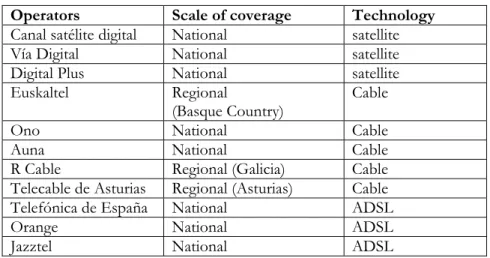
Our dependent variable in equation (1) is the number of pay television subscribers in Spain. These data are reported quarterly for 2002 to 2007 and are drawn from the quarterly and annual reports of the Commission for the Telecommunications Market and its Operators. Table 1 shows the pay TV operators in the sample, the scale of their coverage and the technology they use.
Table 1 Pay TV operators in Spain
Operators Scale of coverage Technology
Canal satélite digital National satellite
Vía Digital National satellite
Digital Plus National satellite
Euskaltel Regional
(Basque Country) Cable
Ono National Cable Auna National Cable
R Cable Regional (Galicia) Cable
Telecable de Asturias Regional (Asturias) Cable
Telefónica de España National ADSL
Orange National ADSL
Jazztel National ADSL
Source: authors’ own.
The following are the independent variables used in equation (1). To capture the degree of intra-platform competition we calculate the Herfindhal index (HHI). The variable HHI intra
measures the degree of concentration that exists between platforms using the same technology for broadcasting. In other words, it reflects the level of competition within each technology, be it cable, satellite or ADSL. We calculated the concentration index as follows:
n 1 i 2 2 i ra int Q q ) n ( HHI (2)
Furthermore, we measure the degree of inter-platform competition by the share each technology holds of the pay television market8. This allows us to show the degree of penetration made by each technology within the market. To calculate these two indices we used data obtained from the sources credited above.
The variables included advertising channels and features TV. More specifically the advertising variable measures the number of minutes of advertising on broadcast TV. It has been constructed from data reported by TNS-Sofres. For national platforms, we have taken into account the number of minutes of advertising broadcast on public access television. In the case of platforms that operate only within a specific region, we used the number of minutes of television advertising on the regional channels, if the region had a regional television. This variable contains the number of channels that are broadcast on public access channels. In this case, we corrected this number for the regional platforms. The information on this variable has been obtained from TNS-Sofres and pay TV platforms.
8 It would have been interesting to use the HHI to measure inter-platform concentration too, but as we are
Our model introduces a variable that approximates the quality of the product offered by the platform. The dummy variable PPV captures the effect of owning the rights to broadcast the matches of the League of Professional Football in the form of a pay-per- view service. According to Weeds and Seabright (2006) control over the live broadcast of football matches has played an important role in the development of pay television in many countries and here Spain is no exception. The PPV variable takes the value 1 if the platform delivers these programs in the form of pay-per-view.
Finally, we considered variables that reflect the characteristics of the platform. The variable cost per user (pmean) seeks to capture the quantity of revenue per subscriber. The input data have been collected from published reports by the Commission for the Telecommunications Market and the actual market participants.
The regional dummy variable takes the value 1 if the platform only broadcasts at the regional level and the value 0 if it does so nationally. This dummy variable package has been designed to include the fact that some of the pay TV platforms are also telecommunication operators, offering fixed telephony services and a broadband TV service in their charges. This variable takes the value 1 if the platform provides telecommunication services with a combined television service. All information about advertising has been obtained from the operators and the Quantum database.
Given the way in which the variables measuring competition in the market have been constructed, there exists a possible problem of endogeneity between these variables and the number of subscribers. This problem might also exist between the number of subscribers and the price per user. To control for this potential endogeneity problem, we estimate the subscriber equation by means of the two-stage least square estimator (IV/2SLS). As instruments, we use the number of years that the leading platform has been offering television (companyyears), the regulation dummy variable that takes the value 1 if the platform has a regulation governing access to its infrastructure, which includes a trend variable and the variable HHIintra, the quotaTec, and the price per user. We believe it to be important to use the variable companyyears as an instrument, since those companies that have been in the market for a period of years have a clearly defined brand image that has helped consolidate their position in the market, while at the same time they have generated a certain degree of market power. The regulation variable tells us if the company shares infrastructure with other companies in the market. ADSL companies are subject to regulation on their access to infrastructure, given that they all use and share Telefónica’s
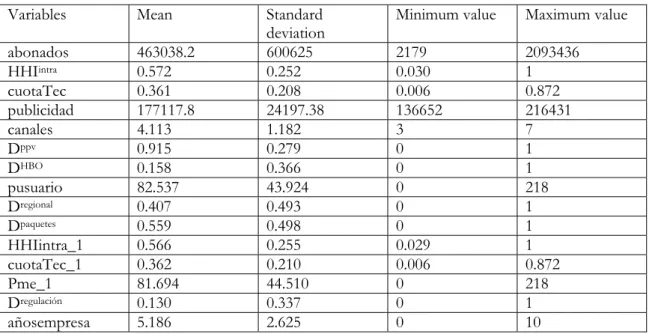
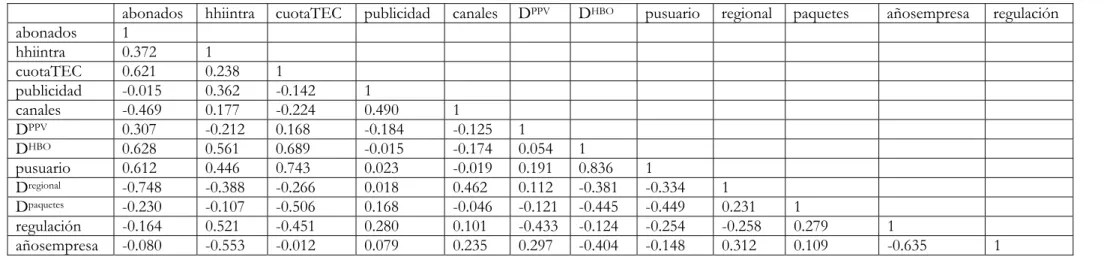
infrastructure. Table 2 presents our descriptive statistics while Table 1 in the annex shows the matrix correlation.
Table 2. Descriptive statistics
Variables Mean Standard
deviation Minimum value Maximum value
abonados 463038.2 600625 2179 2093436 HHIintra 0.572 0.252 0.030 1 cuotaTec 0.361 0.208 0.006 0.872 publicidad 177117.8 24197.38 136652 216431 canales 4.113 1.182 3 7 Dppv 0.915 0.279 0 1 DHBO 0.158 0.366 0 1 pusuario 82.537 43.924 0 218 Dregional 0.407 0.493 0 1 Dpaquetes 0.559 0.498 0 1 HHIintra_1 0.566 0.255 0.029 1 cuotaTec_1 0.362 0.210 0.006 0.872 Pme_1 81.694 44.510 0 218 Dregulación 0.130 0.337 0 1 añosempresa 5.186 2.625 0 10
5.2. Penetration of bundled services at regional level
In equations (2) and (3) the dependent variables are the penetration of bundled services offered by cable operators and by those who use ADSL technology. The data are for 2007 and are provided at the provincial level. In this case, satellite technology is also considered as it does not offer bundled services.
As explanatory variables we have introduced the number of cable lines (Cablelines) and ADSL (ADSLlines) in a province. The data were obtained from the Commission for the Telecommunications Market. The variable contains the number of channels that enjoy open public access in that province. We can approximate the offer of free television that competes with pay television. To capture the characteristics of demand in the province we introduced the index of industrial activity (AIindex), included in the annual La Caixa report, and its total population (population), obtained from at the National Institute of Statistics.
Table 3 presents our descriptive statistics while Table 2 in the annex shows the matrix correlations.
Table 3. Descriptive statistics
Variables Mean Standard
deviation Minimum value Maximum value
penetracionCable 2.382 1.964 0 10.26 penetracionadsl 0.862 0.513 0 2.24 lineasCable 32219.23 40606.97 0 199635 lineasADSL 121027.3 217484.9 1883 1193342 canales 7.058 0.849 6 8 indiceAE 1923.115 3039.56 94 16825 poblacion 1738490 2198436 138880 1.22e+07 6. Estimations and results
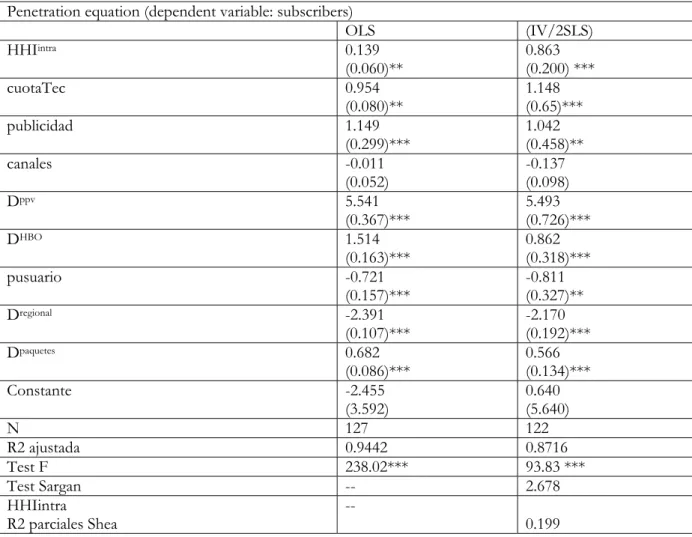
As discussed above, equation (1) including the factors that account for the penetration of pay television in Spain includes variables that might be endogenous. The variables that measure the degree of competition in the market and the price per user would appear to be endogenous, and so the estimation by ordinary least squares (OLS) would be biased. To solve this problem we conducted the estimate by two-stage least squares using instrumental variables (IV/2SLS). The results are presented in Table 4.
Table 4. Results Penetration equation (dependent variable: subscribers)
OLS (IV/2SLS) HHIintra 0.139 (0.060)** 0.863 (0.200) *** cuotaTec 0.954 (0.080)** 1.148 (0.65)*** publicidad 1.149 (0.299)*** 1.042 (0.458)** canales -0.011 (0.052) -0.137 (0.098) Dppv 5.541 (0.367)*** 5.493 (0.726)*** DHBO 1.514 (0.163)*** 0.862 (0.318)*** pusuario -0.721 (0.157)*** -0.811 (0.327)** Dregional -2.391 (0.107)*** -2.170 (0.192)*** Dpaquetes 0.682 (0.086)*** 0.566 (0.134)*** Constante -2.455 (3.592) 0.640 (5.640) N 127 122 R2 ajustada 0.9442 0.8716 Test F 238.02*** 93.83 *** Test Sargan -- 2.678 HHIintra R2 parciales Shea -- 0.199
Test F 4.53 *** Cuota TEC R2 parciales Shea Test F -- 0.665 85.83*** pusuari R2 parciales Shea Test F -- 0.517 33.06***
Note 1: Standard errors in parentheses: Robust to heterocedasticity. Note 2: *** significant at 1%; ** significant at 5%; * significant at 10%. Note 3: Instruments for HHIintra, Cuota TEC and pusuari are log (pusuarioT-1), log( HHIintra T-1), log( CuotaTEC T-1), regulación, añosempresa and tendencia.
As can be seen in our results, the OLS estimate shows a bias according to the estimate by IV/2SLS. Therefore, we only consider the results obtained by the IV/2SLS technique. Table 3 provides our results of the outcome of contract validity and the strength of the instruments. The Sargan test, whose null hypothesis is that the instruments are not correlated with the error term and that the excluded instruments are correctly excluded from the estimated equation, accepts the validity of the instruments. We also include the results of the Partial Shea R-square test which measures the correlation between the endogenous variable and the instruments excluded, and the contrast of the F-statistic.
The results for the two variables measuring the degree of market concentration are significant and show a positive relationship with the explanatory variables. Market concentration within the same technology (HHIintra) – i.e., a low level of intra-platform competition – is in our case significant and positive. We can interpret this result to indicate that the greater the concentration of a particular technology, the higher the level of its market penetration. Yet, the initial investment a company has to make in order to begin broadcasting using a particular technology is very high and the acquisition of content and this investment in infrastructure act as barriers to market entry. If there is only one company using a particular technology, it will be more likely to own the rights to the best content and to have a greater scale of coverage, since they will have acquired more resources to invest in infrastructure.
The QuotaTec variable measures the share each technology holds of the pay TV market, i.e., the weight of each technology in the market. This variable is positive and significant. It might be thought that growing competition would increase the penetration of the service, but our results indicate that the greater share enjoys a higher penetration of the market. In Spain, satellite technology has traditionally been preeminent and, indeed, it was the first technology to expand nationwide and enjoy the advantages of being the leader, ensuring itself the best content. ADSL and cable technology have developed more slowly. Moreover, substituting one technology for another involves high costs of change. The
consequence of this is that when the network industry presents certain strong characteristics, potential competitors, even though they might be more efficient than the incumbents, are unable to enter the market since increased efficiency does not offset the costs of change (Nicita et al., 2004).
One of the main contributions of this study is the incorporation of variables that reflect competition between free TV and pay television. The market that we analyze is characterized by the relatively low penetration of pay TV services and the stronger presence of free TV. Thus, first, we decided to consider the amount of advertising broadcast by free TV. This variable is positive and significant. The literature seems to have demonstrated that advertising creates a negative externality on viewers.
In recent years, the amount of advertising time has grown because of regulatory changes, innovation and the increased number of free channels operating in the market. For these reasons, viewers have preferred to contract a pay-TV service where the amount of advertising is significantly less than that on free channels. Accordingly, a reduction in product quality offered by free television leads to the increased penetration of pay television. We have also included here the number of free channels. The coefficient associated with this variable is negative and significant. By reducing the supply of free channels, the number of subscribers to pay-TV platforms increases.
The two variables that reflect the quality of the product are significant and positive. First, the variable DPPV, which captures the effect of broadcasting Spanish Professional
Football League matches in pay-per-view is significant and shows a high ratio. This means that a platform will have more subscribers if it can offer this type of content. Secondly, and in line with our initial hypothesis, the variable DHBO has a significant positive effect on the number of users who subscribe to a pay TV service.
Another variable included is the price per user (pusuario). This variable is not significant because the platforms are not competing in terms of price, although they do so in terms of quality. Subscribers now make their decision according to the characteristics of the product on offer. If a platform can differentiate their product, then it should be able to capture a higher number of subscribers. The regional dummy variable is significant and negative. As expected, if a platform’s broadcasts are restricted to just one region, it will have fewer subscribers.
The variable Dbundlescaptures the effect of bundles supplying pay television together
with other telecommunication services (telephone and/or broadband). Our results show that it is significant and positive. We are especially interested in this outcome, because
bundling is a relatively new practice in Spain. Such deals have become more widespread with the appearance in the pay TV market of telecom operators using ADSL technology. This result reinforces the hypothesis that the platforms are competing in terms of quality. In other words, they are introducing features that make their product more attractive. According to our results, if a company offers a pay television service together with other telecommunication services, then it can increase its market penetration.
Given the present importance of bundling, we need to analyze the factors that influence the penetration of these services. In order to guarantee the precision of this analysis, we discriminated this penetration by the technology used in each platform. Note that the satellite platform was excluded here as it does not offer these services.
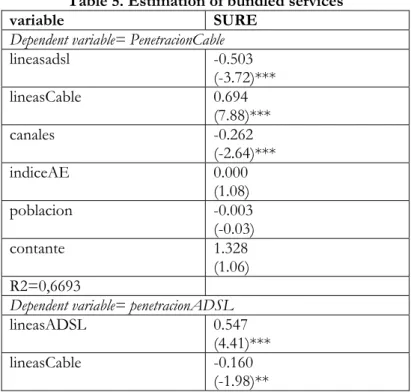
Table 5 shows the estimation results for equations (2) and (3) in which we calculate a SURE estimation. Our results show that the variable number of ADSL lines in the region is significant in both estimations. We obtain the same result for the variable number of cable lines. These variables capture the telecom infrastructure that is available in the different regions. As noted, the number of ADSL lines in a province will have a negative impact on the penetration of bundled services offered by cable operators. By contrast, the number of cable lines available in a province will have a negative impact on the penetration of services offered by ADSL operators.
The number of free channels (channels) has a negative impact on the penetration of the bundled service offered by cable operators. In other words, the variable has a positive effect on the penetration of the bundling offered by ADSL operators.
Table 5. Estimation of bundled services
variable SURE Dependent variable= PenetracionCable
lineasadsl -0.503 (-3.72)*** lineasCable 0.694 (7.88)*** canales -0.262 (-2.64)*** indiceAE 0.000 (1.08) poblacion -0.003 (-0.03) contante 1.328 (1.06) R2=0,6693 Dependent variable= penetracionADSL
lineasADSL 0.547 (4.41)***
lineasCable -0.160 (-1.98)**
canales 0.044 (0.48) IndiceAE 0.000 (3.13)*** Poblacion -0.286 (-3.04)*** R2=0,5559
Note: *** significant at 1% ** significant at 5% * significant at 10%
7. Conclusions
This study has sought to analyze the factors affecting the penetration of pay television in Spain. More specifically, we have attempted to shed some light on the relationship between the level of competition and the degree of penetration of the service. Understanding this relationship is important because the market is in a process of technological change, especially with the entry of the telecom operators. Thus, customers are being offered products that have a tendency to be similar, but which use different technologies. In order to make their products more attractive, companies are tending to bundle pay TV services together with telecommunication services.
Our results indicate that intra- and inter-platform competition have an effect on levels of penetration. If the market presents low inter-platform competition, then there tends to be a high penetration of the service. The reason for this is that we are dealing with a market that has invested heavily in infrastructure and content. Being a market with natural monopoly characteristics, the platform with greatest market power can develop and amortize the high initial investment. Because of this situation, entry and consolidation in the market for new platforms are difficult to achieve. In the case of the Spanish market, new platforms, especially for TV over ADSL, have been introduced thanks to the possibility of adapting telecommunications technology to the dissemination of the audiovisual signal.
The level of intra-platform competition plays an important role in the penetration of pay TV. Our results indicate that the greater the concentration achieved by a particular technology, the greater its penetration is likely to be. This result is due to the fact that being an industry with natural monopoly characteristics market concentration tends to increase production efficiency. Our study has also taken into account the relationship between free and pay TV. We have seen that as the amount of advertising on television has grown, pay TV has increased its penetration. According to the literature we know that advertising creates a negative externality, so viewers tend to choose those platforms that reduce this negative externality.
The price per user is not a significant variable in the penetration of pay television. This result may reflect the fact that platforms do not compete in terms of price but in terms of content only. This hypothesis is supported by our result for the variable that reflects the effect of owning the rights to broadcast Spanish Professional Football League matches in pay-per-view. This would seem to be a crucial variable in the penetration of pay television in Spain. The platforms that hold these rights enjoy greater market penetration than those that do not possess them.
As expected the package variable is significant and positive. We hypothesized that the platforms that offer a pay television service bundled with other telecommunication services would have a greater number of subscribers. Our results confirm this hypothesis. This result has considerable implications for regulation, as the offer of services can radically change the shape of market competition. If telecom operators are able to offer television with broadband and telephony, then they can introduce a much clearer product differentiation. It is therefore necessary to consider the whole issue of the exclusivity of audiovisual content, which may change with the whole nature of competition within the telecommunications market.
This study has allowed us to identify the factors that account for the penetration of bundled services at the provincial level. Our results show that if the operators in the province enjoy a high coverage, then penetration of their bid will be high. Again this has considerable regulatory implications, since the level achieved by infrastructure operators is conditioned by the regulation of telecommunications, not by the level of demand for pay television.
References
Anderson, S & Coate, S. (2005) Market Provision of Broadcasting: A Welfare Analysis. Review of Economic Studies, Vol. 72, No. 4, pp. 947-972.
Armstrong, M. (1999) Competition in the pay- TV market. Journal of the Japanese and International Economies, 13, pp. 257-280
Armstrong, M., (2006). Competition in two-sided market. The Rand Journal of Economics, 37, 668-691.
Artero, J.P., Herrero, M. & Sánchez- Tabernero,A. (2005). Monopolio, oligopolio y competencia en los últimos quince años de televisión en España. Sphera pública, 5, pp. 83-98.
Bel, G., Calzada, J., & Insa, R., (2007). Access pricing to a digital broadcasting platform. Journal of Media Economics, 20, 29-53.
Cincera, M. & Noury, A. (2004) Monopoly practises and competitive behavior in the French satellite pay-TV market. CEPR Discussion Paper nº 4174
Distaso, W., Lupi, P. & Manenti, F. (2006) Platform competition and broadband uptake: Theory and empirical evidence from the European Union. Information Economics and Policy, 18, pp. 87-106
Emmons, W. and Prager, R., 1997. The effect of market structure and ownership on prices and services offerings in the US cable television industry. RAND Journal of Economics 28 4, pp. 732–750.
Evans, D., (2003). The antitrust economics of multi-sided platform markets. Yale Journal on Regulation, 20, 352-382.
Ford, G. and Jackson, J., 1997. Horizontal concentration and vertical integration in the cable television industry. Review of Industrial Organization,12 (4), pp. 501–518
Goolsbee, A, & Petrin, A. (2004) The Consumer Gains from Direct Broadcast Satellites and the Competition with Cable Television. Econometrica 72(2), pp. 351-381.
Kasuga, N., Shishikura, M. & Kondo, M. (2007) Platform competition in Pay- TV market. MPRA Paper No. 5694.
Karikari, J., S. Brown and A. Abramowitz (2003) Subscriptions for direct broadcast satellite and cable television in the US: an empirical analysis, Information Economics and Policy, 15. pp. 1-15.
King, H., & Nilssen, T., & Sørgard, L., (2007). Competition for Viewers and Advertisers in a TV Oligopoly.Journal of Media Economics,20, 211-233.
Mayo, J. and Otsuka, Y., 1991. Demand, pricing, and regulation: evidence from the cable TV industry. RAND Journal of Economics22 3, pp. 396–410.
Nicita, A., Galbiati, R. & Nizi, G. (2004) Regulation and competition in media markets: the evolution of pay- TV in UK, Australia and Italy. American Law & Economics Association Annual Meetings, Working Paper 76
Ofcom (2007) Pay- TV market investigation. www.ofcom.org.uk/ consult/condocs/ market_invest_paytv/.
Reisinger, M., (2004). Two-sided markets with negative externalities. Munich Economics. Discussion paper 2004-27.
Rochet, J.-C., & Tirole, M. (2003). Platform competition in two-sided markets. Journal of the European Economic Association, 1, 990-1029.
Rysman, M. (2004). Competition between networks: A study of the market for yellow pages. Review of Economic Studies, 71,483–512.
Seabright, P. & Weeds, H. (2007). Competition and Market Power in Broadcasting: Where are the Rents?, en The Economic Regulation of Broadcasting Markets, edited by Paul Seabright and Jürgen von Hagen, Cambridge University Press.
Sohn, S. (2005) Interindustry and Intraindustry Competition in Satellite Broadcasting: A Comparative Case Study on the United States, Japan, England, and France. Journal of Media Economics, 18 (3) pp. 167 – 182.
Weeds, H. (2007) TV Wars: Exclusive Content and Platform Competition in Television Broadcasting. Working paper.
Annex
Table annex 1. Matrix correlation.
abonados hhiintra cuotaTEC publicidad canales DPPV DHBO pusuario regional paquetes añosempresa regulación
abonados 1 hhiintra 0.372 1 cuotaTEC 0.621 0.238 1 publicidad -0.015 0.362 -0.142 1 canales -0.469 0.177 -0.224 0.490 1 DPPV 0.307 -0.212 0.168 -0.184 -0.125 1 DHBO 0.628 0.561 0.689 -0.015 -0.174 0.054 1 pusuario 0.612 0.446 0.743 0.023 -0.019 0.191 0.836 1 Dregional -0.748 -0.388 -0.266 0.018 0.462 0.112 -0.381 -0.334 1 Dpaquetes -0.230 -0.107 -0.506 0.168 -0.046 -0.121 -0.445 -0.449 0.231 1 regulación -0.164 0.521 -0.451 0.280 0.101 -0.433 -0.124 -0.254 -0.258 0.279 1 añosempresa -0.080 -0.553 -0.012 0.079 0.235 0.297 -0.404 -0.148 0.312 0.109 -0.635 1
Table annex 2. Matrix correlation.
penetraciónCable penetraciónADSL lineasadsl lineascable canales indiceAE población penetraciónCable 1 penetraciónADSL 0.004 1 lineascable 0.452 0.371 1 lineascadsl -0.036 0.553 0.628 1 canales -0.299 0.483 0.353 0.344 1 indiceAE 0.032 0.341 0.079 0.044 0.066 1 población 0.016 0.331 0.062 0.026 0.063 0.083 1
SÈRIE DE DOCUMENTS DE TREBALL DE LA XREAP
2006
CREAP2006-01
Matas, A. (GEAP); Raymond, J.Ll. (GEAP)
"Economic development and changes in car ownership patterns" (Juny 2006)
CREAP2006-02
Trillas, F. (IEB); Montolio, D. (IEB); Duch, N. (IEB)
"Productive efficiency and regulatory reform: The case of Vehicle Inspection Services" (Setembre 2006)
CREAP2006-03
Bel, G. (PPRE-IREA); Fageda, X. (PPRE-IREA)
"Factors explaining local privatization: A meta-regression analysis" (Octubre 2006)
CREAP2006-04
Fernàndez-Villadangos, L. (PPRE-IREA)
"Are two-part tariffs efficient when consumers plan ahead?: An empirical study" (Octubre 2006)
CREAP2006-05
Artís, M. (AQR-IREA); Ramos, R. (AQR-IREA); Suriñach, J. (AQR-IREA) "Job losses, outsourcing and relocation: Empirical evidence using microdata" (Octubre 2006)
CREAP2006-06
Alcañiz, M. (RISC-IREA); Costa, A.; Guillén, M. (RISC-IREA);Luna, C.; Rovira, C.
"Calculation of the variance in surveys of the economic climate” (Novembre 2006)
CREAP2006-07
Albalate, D. (PPRE-IREA)
"Lowering blood alcohol content levels to save lives: The European Experience” (Desembre 2006)
CREAP2006-08
Garrido, A. (IEB); Arqué, P. (IEB)
“The choice of banking firm: Are the interest rate a significant criteria?” (Desembre 2006)
SÈRIE DE DOCUMENTS DE TREBALL DE LA XREAP
CREAP2006-09
Segarra, A. (GRIT); Teruel-Carrizosa, M. (GRIT)
"Productivity growth and competition in spanish manufacturing firms: What has happened in recent years?”
(Desembre 2006)
CREAP2006-10
Andonova, V.; Díaz-Serrano, Luis. (CREB)
"Political institutions and the development of telecommunications” (Desembre 2006)
CREAP2006-11
Raymond, J.L.(GEAP); Roig, J.L.. (GEAP)
"Capital humano: un análisis comparativo Catalunya-España” (Desembre 2006)
CREAP2006-12
Rodríguez, M.(CREB); Stoyanova, A. (CREB)
"Changes in the demand for private medical insurance following a shift in tax incentives” (Desembre 2006)
CREAP2006-13
Royuela, V. (AQR-IREA); Lambiri, D.;Biagi, B.
"Economía urbana y calidad de vida. Una revisión del estado del conocimiento en España” (Desembre 2006)
CREAP2006-14
Camarero, M.; Carrion-i-Silvestre, J.LL. (AQR-IREA).;Tamarit, C.
"New evidence of the real interest rate parity for OECD countries using panel unit root tests with breaks” (Desembre 2006)
CREAP2006-15
Karanassou, M.; Sala, H. (GEAP).;Snower , D. J.
"The macroeconomics of the labor market: Three fundamental views” (Desembre 2006)
SÈRIE DE DOCUMENTS DE TREBALL DE LA XREAP
2007
XREAP2007-01
Castany, L (AQR-IREA); López-Bazo, E. (AQR-IREA).;Moreno , R. (AQR-IREA) "Decomposing differences in total factor productivity across firm size”
(Març 2007)
XREAP2007-02
Raymond, J. Ll. (GEAP); Roig, J. Ll. (GEAP)
“Una propuesta de evaluación de las externalidades de capital humano en la empresa" (Abril 2007)
XREAP2007-03
Durán, J. M. (IEB); Esteller, A. (IEB)
“An empirical analysis of wealth taxation: Equity vs. Tax compliance” (Juny 2007)
XREAP2007-04
Matas, A. (GEAP); Raymond, J.Ll. (GEAP)
“Cross-section data, disequilibrium situations and estimated coefficients: evidence from car ownership demand”
(Juny 2007)
XREAP2007-05
Jofre-Montseny, J. (IEB); Solé-Ollé, A. (IEB)
“Tax differentials and agglomeration economies in intraregional firm location” (Juny 2007)
XREAP2007-06
Álvarez-Albelo, C. (CREB); Hernández-Martín, R.
“Explaining high economic growth in small tourism countries with a dynamic general equilibrium model” (Juliol 2007)
XREAP2007-07
Duch, N. (IEB); Montolio, D. (IEB); Mediavilla, M.
“Evaluating the impact of public subsidies on a firm’s performance: a quasi-experimental approach” (Juliol 2007)
XREAP2007-08
Segarra-Blasco, A. (GRIT)
“Innovation sources and productivity: a quantile regression analysis” (Octubre 2007)
SÈRIE DE DOCUMENTS DE TREBALL DE LA XREAP
XREAP2007-09
Albalate, D. (PPRE-IREA)
“Shifting death to their Alternatives: The case of Toll Motorways” (Octubre 2007)
XREAP2007-10
Segarra-Blasco, A. (GRIT); Garcia-Quevedo, J. (IEB); Teruel-Carrizosa, M. (GRIT) “Barriers to innovation and public policy in catalonia”
(Novembre 2007)
XREAP2007-11
Bel, G. (PPRE-IREA); Foote, J.
“Comparison of recent toll road concession transactions in the United States and France” (Novembre 2007)
XREAP2007-12
Segarra-Blasco, A. (GRIT);
“Innovation, R&D spillovers and productivity: the role of knowledge-intensive services” (Novembre 2007)
XREAP2007-13
Bermúdez Morata, Ll. (RFA-IREA); Guillén Estany, M. (RFA-IREA), Solé Auró, A. (RFA-IREA) “Impacto de la inmigración sobre la esperanza de vida en salud y en discapacidad de la población española”
(Novembre 2007)
XREAP2007-14
Calaeys, P. (AQR-IREA); Ramos, R. (AQR-IREA), Suriñach, J. (AQR-IREA) “Fiscal sustainability across government tiers”
(Desembre 2007)
XREAP2007-15
Sánchez Hugalbe, A. (IEB)
“Influencia de la inmigración en la elección escolar” (Desembre 2007)
SÈRIE DE DOCUMENTS DE TREBALL DE LA XREAP
2008
XREAP2008-01
Durán Weitkamp, C. (GRIT); Martín Bofarull, M. (GRIT) ; Pablo Martí, F.
“Economic effects of road accessibility in the Pyrenees: User perspective” (Gener 2008)
XREAP2008-02
Díaz-Serrano, L.; Stoyanova, A. P. (CREB)
“The Causal Relationship between Individual’s Choice Behavior and Self-Reported Satisfaction: the Case of Residential Mobility in the EU”
(Març 2008)
XREAP2008-03
Matas, A. (GEAP); Raymond, J. L. (GEAP); Roig, J. L. (GEAP) “Car ownership and access to jobs in Spain”
(Abril 2008)
XREAP2008-04
Bel, G. (PPRE-IREA) ; Fageda, X. (PPRE-IREA)
“Privatization and competition in the delivery of local services: An empirical examination of the dual market hypothesis”
(Abril 2008)
XREAP2008-05
Matas, A. (GEAP); Raymond, J. L. (GEAP); Roig, J. L. (GEAP) “Job accessibility and employment probability”
(Maig 2008)
XREAP2008-06
Basher, S. A.; Carrión, J. Ll. (AQR-IREA)
Deconstructing Shocks and Persistence in OECD Real Exchange Rates (Juny 2008)
XREAP2008-07
Sanromá, E. (IEB); Ramos, R. (AQR-IREA); Simón, H.
Portabilidad del capital humano y asimilación de los inmigrantes. Evidencia para España (Juliol 2008)
XREAP2008-08
Basher, S. A.; Carrión, J. Ll. (AQR-IREA)
Price level convergence, purchasing power parity and multiple structural breaks: An application to US cities
(Juliol 2008)
XREAP2008-09
Bermúdez, Ll. (RFA-IREA)
A priori ratemaking using bivariate poisson regression models (Juliol 2008)
SÈRIE DE DOCUMENTS DE TREBALL DE LA XREAP
XREAP2008-10
Solé-Ollé, A. (IEB), Hortas Rico, M. (IEB)
Does urban sprawl increase the costs of providing local public services? Evidence from Spanish municipalities
(Novembre 2008)
XREAP2008-11
Teruel-Carrizosa, M. (GRIT), Segarra-Blasco, A. (GRIT) Immigration and Firm Growth: Evidence from Spanish cities (Novembre 2008)
XREAP2008-12
Duch-Brown, N. (IEB), García-Quevedo, J. (IEB), Montolio, D. (IEB)
Assessing the assignation of public subsidies: Do the experts choose the most efficient R&D projects? (Novembre 2008)
XREAP2008-13
Bilotkach, V., Fageda, X. (PPRE-IREA), Flores-Fillol, R.
Scheduled service versus personal transportation: the role of distance (Desembre 2008)
XREAP2008-14
Albalate, D. (PPRE-IREA), Gel, G. (PPRE-IREA)
Tourism and urban transport: Holding demand pressure under supply constraints (Desembre 2008)
SÈRIE DE DOCUMENTS DE TREBALL DE LA XREAP
2009
XREAP2009-01
Calonge, S. (CREB); Tejada, O.
“A theoretical and practical study on linear reforms of dual taxes” (Febrer 2009)
XREAP2009-02
Albalate, D. (PPRE-IREA); Fernández-Villadangos, L. (PPRE-IREA)
“Exploring Determinants of Urban Motorcycle Accident Severity: The Case of Barcelona” (Març 2009)
XREAP2009-03
Borrell, J. R. (PPRE-IREA); Fernández-Villadangos, L. (PPRE-IREA) “Assessing excess profits from different entry regulations”
(Abril 2009)
XREAP2009-04
Sanromá, E. (IEB); Ramos, R. (AQR-IREA), Simon, H.
“Los salarios de los inmigrantes en el mercado de trabajo español. ¿Importa el origen del capital humano?”
(Abril 2009)
XREAP2009-05
Jiménez, J. L.; Perdiguero, J. (PPRE-IREA)
“(No)competition in the Spanish retailing gasoline market: a variance filter approach” (Maig 2009)
XREAP2009-06
Álvarez-Albelo,C. D. (CREB), Manresa, A. (CREB), Pigem-Vigo, M. (CREB) “International trade as the sole engine of growth for an economy”
(Juny 2009)
XREAP2009-07
Callejón, M. (PPRE-IREA), Ortún V, M.
“The Black Box of Business Dynamics” (Setembre 2009)
XREAP2009-08 Lucena, A. (CREB)
“The antecedents and innovation consequences of organizational search: empirical evidence for Spain” (Octubre 2009)
XREAP2009-09
Domènech Campmajó, L. (PPRE-IREA) “Competition between TV Platforms” (Octubre 2009)